

 Add SeoProfy as a preferred source on Google
More users now expect direct answers instead of scrolling through multiple search results. According to the 60 Perplexity AI Statistics 2026 report, Perplexity AI already processes more than 30 million searches per day while delivering AI-generated responses supported by cited sources.


A lot of SEO advice on how to rank in Perplexity still sounds like recycled Google SEO from 2019. In reality, Perplexity works very differently. It retrieves sources live for every query, evaluates them in real time, and decides which pages are trustworthy enough to cite.
At the same time, according to the AI SEO statistics, nearly half of marketers already report losing search traffic because users increasingly get answers directly inside AI-generated results instead of clicking through to websites. That means you are not competing for rankings once — you are competing for citations every single time the model retrieves information.
In this guide, we will break down how Perplexity actually selects sources, which ranking factors matter most, and what changes tend to move the needle fastest. We will also cover a practical 30/60/90-day optimization plan, the KPIs worth tracking, and the common mistakes we keep seeing across Perplexity, ChatGPT Search, and Google AI Overviews.
- Perplexity is not one of the traditional search engines. It generates answers and cites only a small set of sources for each query. Pages that researchers can easily extract, summarize, and trust have a much higher chance of being cited.
- The biggest ranking levers right now are simple: answer the query immediately, show strong authority signals, and keep content fresh. Pages updated within the last few months tend to perform noticeably better.
- Technical SEO for AI search is becoming its own layer. If PerplexityBot cannot access your content properly, or your structure is messy, your chances of appearing drop fast.
- Perplexity uses retrieval-augmented generation (RAG), meaning source selection happens live for every search. Visibility is not static — you compete for citations every time the model retrieves information.
- Citation-worthy formatting matters more than many teams expect. Pages with concise explanations, quotable insights, named entities, statistics, and clean formatting are easier for AI systems to reuse.
- Tracking AI visibility requires different KPIs than classic SEO. Citation frequency, cited URL diversity, AI referral traffic, and brand mentions are usually more useful than raw keyword rankings.
- Authority in Perplexity is heavily entity-driven. Brands consistently mentioned across trusted sources like Reddit, G2, Wikipedia, forums, podcasts, and industry media tend to appear more often in AI-generated answers.
| Right expectations about ranking in Perplexity AI | Wrong expectations about ranking in Perplexity AI |
| You compete for citations every time Perplexity retrieves sources. | Ranking once guarantees long-term visibility. |
| Clear answers and strong structure improve citation chances. | Visibility is mostly about keyword density. |
| Authority and trusted mentions strongly influence retrieval. | Only backlinks and Google rankings matter. |
| Fresh content has a major advantage in AI search. | You can publish once and never update pages. |
| Success is measured through citations and visibility. | Position #1 is still the main KPI. |
What Is Perplexity AI and Why It Matters in 2026
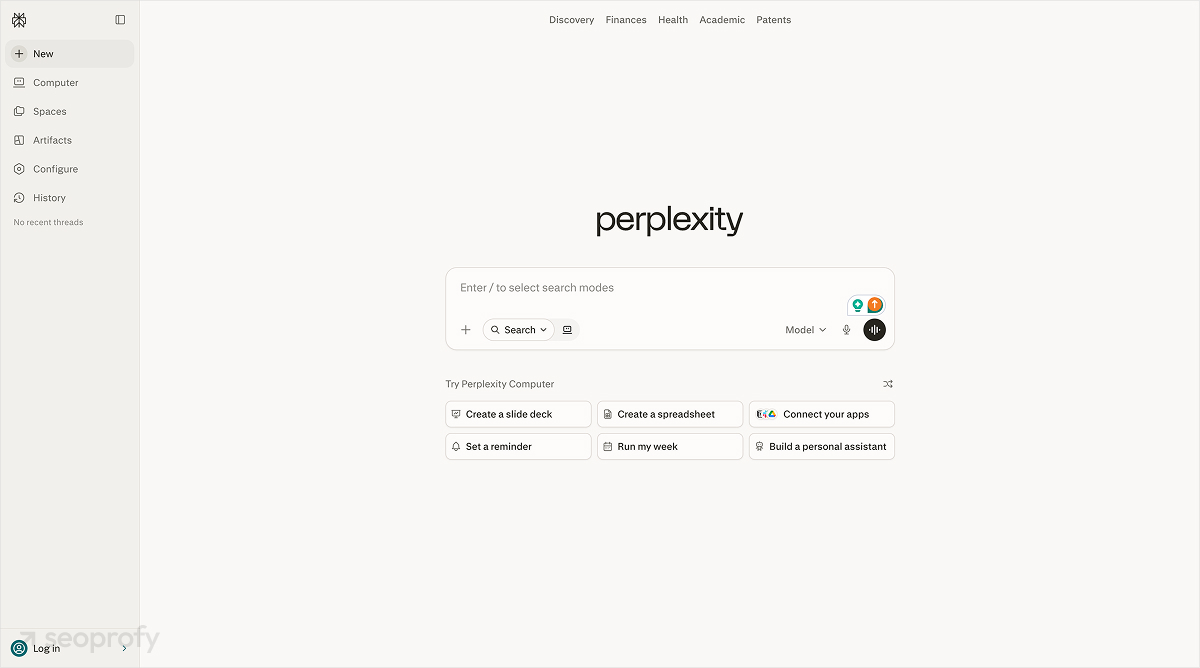
Perplexity AI is a citation-first AI answer engine that uses retrieval-augmented generation (RAG) to search the web, summarize information from multiple sources, and attach citations directly to its answers. Unlike traditional search engines that mainly return lists of links, Perplexity delivers synthesized responses backed by referenced sources.
That model is gaining traction fast. According to our Perplexity AI Statistics report, Perplexity now handles more than 30 million daily queries, attracts over 170 million monthly visits, and has surpassed 13.9 million app installs. Those numbers put it among the largest AI-native answer engines in 2026.
Perplexity’s audience looks different from traditional search. The platform is heavily used by developers, researchers, analysts, founders, marketers, and other knowledge workers who need quick answers with visible sourcing. Instead of opening five tabs to verify information manually, users can ask a question and continue refining the conversation through follow-up prompts.
That workflow helped Perplexity establish itself as a top-tier AI search platform alongside ChatGPT and Google AI Overviews. So, the system is gradually shifting user behavior away from traditional “10 blue links” toward direct answer interfaces.
Perplexity is also expanding beyond its core search product. In 2026, the company continues pushing into AI-assisted browsing and research through Perplexity Pages and the Perplexity Comet browser. That expansion increases the number of places where brands, publishers, and websites can surface inside AI-generated answers, creating new opportunities for generative engine optimization and showing businesses how to improve visibility across AI-driven discovery platforms.
How Perplexity AI Actually Works: The RAG Mechanism Explained
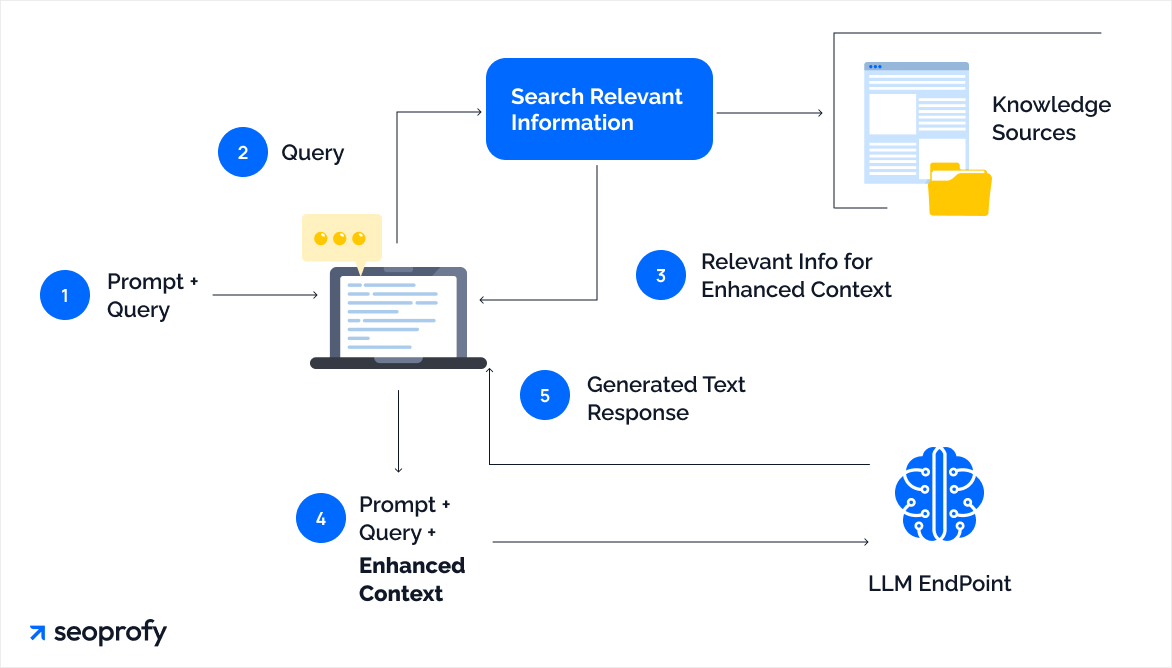
Perplexity AI runs on retrieval-augmented generation (RAG). For every query, the system interprets search intent, runs live retrieval across its own index and partner sources, collects roughly 10–30 candidate pages, reranks them using authority and entity signals, and summarizes the strongest sources into a cited answer.
Unlike traditional search engines that mainly rank links, Perplexity combines retrieval and generation into the same workflow. The result looks closer to a researched briefing than a classic SERP generated by modern AI search and answer engines.
The process starts with query understanding. Perplexity identifies entities, topical relationships, and intent patterns to decide which types of sources should enter the retrieval stage. A coding query, a news query, and a product-comparison query are processed differently.
Next comes retrieval. The platform runs live searches using its own crawling systems, indexed content, and external partnership data. Analyses from Perplexity research breakdown and XFunnel’s Perplexity analysis suggest the system pulls a broad candidate set before narrowing it down further.
The reranking layer is where many citation decisions happen. Perplexity evaluates:
- entity relevance;
- topical match;
- source authority;
- freshness;
- crawl accessibility;
- historical citation quality.
Research discussed by Search Engine Land indicates that entity-based reranking and selective domain weighting likely influence which publishers appear more frequently inside generated answers. Some domains appear to receive stronger visibility for certain query classes, especially when the platform has high confidence in topical authority.
After reranking, Perplexity’s Sonar models generate the final response using information pulled from roughly 5–10 selected sources. Citations are attached directly to the answer so users can verify claims or open the original pages. This retrieval-and-generation workflow is one of the core differences between classic search engines and emerging AI answer engines, and modern large language models.
Why This Matters for SEO
Perplexity retrieval happens live. Every query creates a new competition for citation placement.
That changes how content visibility works. Rankings still matter, but AI retrieval systems and modern answer engines also evaluate freshness, crawlability, structure, and entity clarity in real time. Pages that update regularly, expose clear topical signals, and provide concise quotable information tend to perform better inside AI-generated citation systems and answer-driven search experiences.
Perplexity vs Traditional Search
AI search tools are making people rethink what a search engine should feel like. Instead of digging through endless tabs and SEO-heavy pages, users now expect fast answers with real sources attached. That is one reason Perplexity AI quickly earned a place as one of the top AI search engines for 2026, moving far beyond its early reputation as a niche research tool.
| Feature | Traditional Search | Perplexity AI |
| Main output | Lists of blue links | Direct answers with citations |
| Research process | Manual browsing | AI-assisted summaries |
| Source visibility | User checks sources manually | Citations shown in answers |
| Search experience | Separate searches | Conversational follow-ups |
For users, the biggest difference is speed. Perplexity reduces the amount of manual research needed to compare sources, summarize information, or validate answers.
For publishers and SEO teams, the shift goes beyond interface design. Answer engines like Perplexity increasingly decide which sources get surfaced, cited, and trusted inside AI-generated responses. That is one of the main reasons AI visibility strategies are becoming part of modern SEO workflows alongside traditional rankings and organic traffic.
Perplexity vs Other AI Search Engines: Where Citations Come from
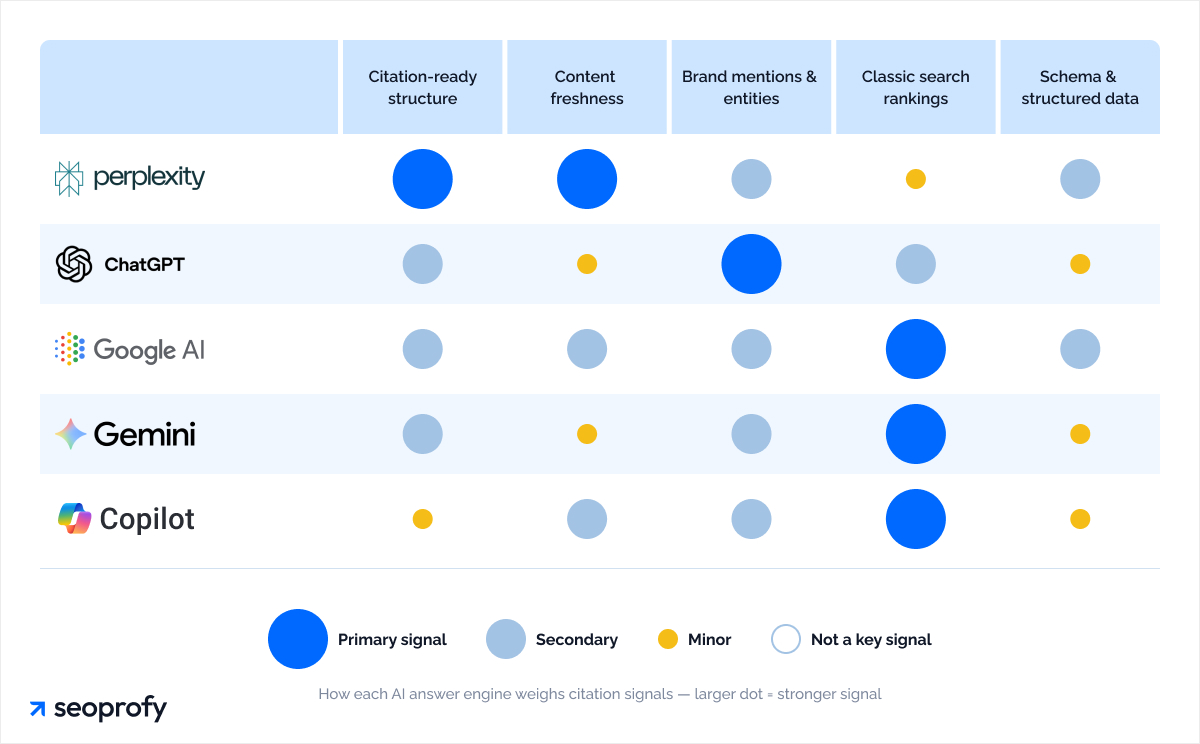
Search engines and modern answer engines do not rank and cite content the same way. Perplexity AI tends to favor citation-friendly formatting and recently updated pages, while ChatGPT Search appears to rely more heavily on entity recognition and brand mentions across the web. Google AI Overviews still inherit much of Google’s traditional ranking logic, especially around E-E-A-T and YMYL evaluation.
| Platform | Primary Signal | Secondary Signal | Quick-Win This Week | Best Monitoring Tool |
| Perplexity AI | Citation quality + freshness | Entity coverage + brand mentions | Add a large, highly visible “Key Takeaways” block near the top of the page to improve information extraction, scannability, and citation potential inside AI-generated answers.
Profound |
Profound |
| ChatGPT Search | Brand mentions across trusted sources | Structured answers + entity consistency | Increase branded mentions through digital PR and citations, since these are becoming important factors for brands researching how to rank on ChatGPT and improve visibility inside AI-generated responses. | Peec AI |
| Google AI Overviews | E-E-A-T + query relevance | Structured data + topical authority | Strengthen author signals, expand schema markup coverage, and build deeper topical authority across related pages to improve eligibility for AI-generated summaries and answer extraction. | Semrush + AWR |
| Gemini | Google ecosystem trust signals | Context alignment + search history | Improve structured content formatting with concise answers, clear heading hierarchy, visible bullet points, schema markup, and entity-rich sections that are easier for AI systems to interpret and reuse in generated responses. | Google Search Console |
| Microsoft Copilot | Bing rankings + source authority | Freshness + publisher trust | Refresh older high-performing pages by updating statistics, improving entity coverage, replacing outdated examples, strengthening internal links, and adding newer references that increase retrieval confidence and citation relevance for AI-powered search systems. | Bing Webmaster Tools |
One pattern appears across nearly all search systems and answer engines: pages with clear structure, strong entity associations, and recent updates have a better chance of being cited. Static evergreen content still works, but AI retrieval systems increasingly prefer pages that are actively maintained, easy to parse, and simple to extract information from.
The 7-Step Instruction on How to Rank in Perplexity AI
Getting cited inside Perplexity AI is not random. Pages that appear consistently tend to share the same patterns: accessible crawling, direct answers, strong entity signals, updated information, and recognizable brand authority. The playbook below focuses on the ranking factors that repeatedly appear across cited pages in Perplexity results.
Step 1: Make Sure PerplexityBot Can Crawl Your Site
If Perplexity cannot crawl your pages, nothing else matters. Start by checking whether your robots.txt, firewall, CDN, or JavaScript rendering setup blocks Perplexity’s crawlers.
Basic robots.txt configuration:
User-agent: PerplexityBot
Allow: /
User-agent: Perplexity-User
Allow: /
The two main crawlers are:
- PerplexityBot — indexing and retrieval
- Perplexity-User — user-triggered fetch requests
Common blockers include:
- aggressive Cloudflare bot management rules
- firewall rate limits
- JavaScript-heavy rendering
- client-side-only Next.js/Vercel setups
In one recent SaaS audit, the team of SeoProfy, one of the top Generative Engine Optimization agencies, found PerplexityBot blocked at the firewall layer. After removing the restriction and improving crawl accessibility, the client gained 12 new Perplexity citations within 30 days.
Step 2: Write Citation-Ready Content
Perplexity favors pages that answer questions quickly, clearly, and with strong factual structure. Long introductions, generic framing, and delayed answers reduce the likelihood of citation extraction. That is why many teams researching how to earn LLM citations and improve visibility in AI search and generative engine optimization prioritize concise answers, scannable formatting, visible bullet points, and key information placed near the top of the page.
Weak version:
“AI search is changing how people consume content online.”
Stronger version:
“Perplexity uses retrieval-augmented generation to summarize live web sources and attach citations directly to answers.”
A good structure is the inverted pyramid format for every section:
- direct answers;
- supporting explanation;
- examples or evidence;
Pages cited frequently inside search systems also tend to have higher factual density:
- named entities;
- dates;
- statistics;
- product names;
- research references.
Strong LLM SEO content also improves entity recognition and retrieval confidence by combining concise formatting with expert-driven insights, topical relevance, and clearly connected supporting information.
Step 3: Implement Schema Markup for AI Interpretation
Schema helps retrieval systems understand what your content contains and who published it.
Useful schema types include:
- Article
- FAQPage
- HowTo
- Organization
- Person
- BreadcrumbList
Properties that appear especially important for AI interpretation:
- author
- sameAs
- datePublished
- dateModified
- citation
Perplexity and other AI systems rely heavily on entity clarity. If authors, companies, and topics are disconnected or inconsistent across schema markup, citation confidence drops.
Always validate markup using:
- Schema.org Validator
- Google Rich Results Test
Structured data also helps large language models connect entities, authorship, publication dates, and topical relationships more accurately across the web. While schema alone will not guarantee citations, clear markup makes content easier for retrieval systems and large language models to interpret, classify, and trust during answer generation.
Step 4: Refresh Content Every 90 Days
Perplexity retrieval happens live. Older pages with outdated references lose visibility faster than many publishers expect, which makes content freshness a critical ranking factor for AI search visibility and generative engine optimization.
A simple refresh workflow:
- update statistics in the introduction;
- replace outdated screenshots;
- refresh examples and product references;
- remove broken competitor URLs;
- update dateModified in schema;
- add visible “Last updated” text;
- Add bullet points.
Pages that stay current tend to remain in retrieval pipelines longer, especially for software, SEO, SaaS, finance, and AI-related topics commonly surfaced by large language models and AI answer engines.
Step 5: Build Entity Coverage and Topical Authority
Perplexity evaluates topical relationships, not just isolated keywords.
Start by identifying missing entities around your primary topic using tools like:
- Surfer
- InLinks
- WordLift
Then build supporting content clusters around the main entity.
Example cluster:
- Perplexity AI
- AEO
- LLM SEO
- AI search engines
- AI Overviews
- retrieval-augmented generation
Internal linking matters here. AI systems use contextual relationships between pages to understand topical depth, entity relevance, answer engine optimization signals, and overall authority coverage. Strong internal linking also helps AI-driven retrieval systems connect related concepts across your site, improving the chances of your content appearing in AI-generated answers and citation-based search experiences.
Step 6: Earn Brand Mentions on Trusted Third-Party Sources
Perplexity frequently cites sources and brands that already appear across authoritative websites and communities.
That means SEO alone is not enough. You also need:
- digital PR
- community visibility
- third-party mentions
- review platform presence
High-leverage sources include:
- Reddit (r/SEO, r/marketing)
- G2
- Capterra
- industry podcasts
- niche newsletters
- high-authority blogs
- Wikipedia pages where eligibility exists
Consistent mentions across external sources strengthen entity trust and improve citation likelihood inside AI-generated answers.
Step 7: Measure and Iterate with AI Visibility Tools
Traditional rank trackers cannot fully monitor AI answer visibility. A page may lose citations while maintaining stable rankings in Google Search Console because search systems and answer engines evaluate visibility differently from classic SERPs.
That is why AI-specific monitoring tools matter.
Useful platforms include:
- HubSpot AEO;
- Profound;
- Peec AI;
- Otterly;
- AthenaHQ;
- Scrunch AI.
Track:
- citation frequency;
- brand mentions;
- answer inclusion;
- entity visibility;
- competitor citation overlap.
For a detailed breakdown of AI visibility platforms, see SeoProfy’s AI search monitoring tools guide. It compares tools used to track AI citations, monitor entity visibility, measure answer inclusion rates, and identify how brands appear across AI-driven search systems.
What Perplexity AI Says You Can Ignore: 5 Myths That Waste Budget
A lot of AI SEO advice circulating right now sounds convincing but falls apart in practice. Many teams spend time and budget chasing tactics that have little influence on whether their pages actually appear inside AI-generated answers. This is especially common in discussions around how to rank in AI overviews, where surface-level hacks often distract from the real drivers of AI visibility: strong entity signals, clear structure, trusted sources, and genuinely useful answers.
The problem is that most AI search systems still rely on core ranking factors such as crawlability, content freshness, entity clarity, topical authority, structured information, and source trust. Some of the most common misconceptions include:
- Claim: “You need a separate AI SEO website.”
What we actually see: Perplexity cites standard pages with strong structure and crawl access.
What to do instead: Improve existing pages with direct answers, updated references, and stronger entity clarity as part of a broader generative engine optimization strategy.
- Claim: “More keywords increase AI citations.”
What we actually see: Retrieval systems prefer concise factual sections over repetitive SEO copy.
What to do instead: Add statistics, named entities, dates, and quotable sentences instead of keyword repetition.
- Claim: “Schema markup alone fixes visibility.”
What we actually see: Structured data helps interpretation, but weak pages still get ignored.
What to do instead: Pair schema with updated content, visible authorship, and stronger internal linking.
- Claim: “AI search replaced traditional SEO.”
What we actually see: Perplexity still relies on crawlability, freshness, authority, and source trust.
What to do instead: Treat visibility as an additional search layer built on classic SEO fundamentals.
- Claim: “Publishing more articles solves citation problems.”
What we actually see: Thin pages rarely appear inside generated answers. Google explicitly warns against mass-producing low-value content.
What to do instead: Refresh existing pages before scaling production volume.
Most AI visibility wins come from improving execution, not chasing shortcuts. Sites that consistently appear inside AI-generated answers and modern answer engines usually focus on the basics: accessible crawling, trustworthy information, clear structure, and content that answers questions directly.
KPIs and 2026 Tooling Stack for Perplexity AI Optimization
Tracking AI visibility requires a different toolkit than traditional SEO. Standard rank trackers often miss citation placement, answer inclusion, and brand visibility inside AI-generated responses. As covered in the AI Search Monitoring Tools guide, teams increasingly rely on dedicated AI-monitoring platforms to measure citation share, entity visibility, and answer presence across AI search systems.
Key KPIs to monitor include:
- citation frequency;
- branded mentions inside AI answers;
- answer inclusion rate;
- AI referral traffic;
- entity visibility share;
- competitor citation overlap.
2026 AI Visibility Tooling Stack
Depending on company size and reporting needs, most teams combine several tools rather than relying on a single platform.
| Tier | Recommended Tools | Best For |
| Free | Perplexity Pages search, Google Analytics referrer reports, Reddit search, Bing Copilot testing | Manual citation discovery, Perplexity citations tracking, and basic visibility in AI checks |
| Mid ($50–$200/mo) | Peec AI, Brand Radar, Otterly, AlsoAsked | Tracking AI mentions, frequency of citation, prompt visibility, and entity coverage |
| Enterprise ($500+/mo) | Profound, AthenaHQ, Scrunch AI, Bluefish AI, Waikay | Enterprise AI-search monitoring, competitive intelligence, citation-share reporting, and LLM visibility analysis |
No single platform currently gives perfect AI search reporting. Most teams combine classic SEO data with AI-specific monitoring tools to understand how often their content appears inside generated answers, which competitors dominate citation visibility, and how their broader generative engine optimization strategy performs across evolving AI search ecosystems.
Getting cited inside AI-generated answers requires more than traditional rankings alone. SeoProfy helps brands improve crawl accessibility, entity visibility, citation readiness, and AI-search presence across platforms like Perplexity, ChatGPT Search, and AI Overviews.
Common Mistakes That Kill Perplexity AI Visibility
Many sites struggle with visibility not because the content is bad, but because retrieval systems cannot easily crawl, interpret, or trust the page. In practice, a few recurring mistakes account for most citation losses inside Perplexity answers.
- Blocking Perplexity crawlers
Symptom: Pages never appear inside AI answers.
Why it matters: Perplexity cannot retrieve or evaluate blocked pages.
Fix: Check robots.txt, Cloudflare, WAF rules, and JavaScript rendering issues affecting PerplexityBot.
- Writing long vague introductions
Symptom: Content ranks but rarely gets cited.
Why it matters: Retrieval systems extract concise answer fragments, not slow build-ups.
Fix: Start sections with direct answers, definitions, statistics, or clear claims.
- Publishing thin AI-generated content
Symptom: Pages get indexed but never surface in citations.
Why it matters: Low-depth content weakens retrieval confidence and entity trust.
Fix: Add original insights, examples, expert commentary, data, and named entities.
- Ignoring content freshness
Symptom: Older competitors keep replacing your citations.
Why it matters: Perplexity retrieval happens live and strongly favors updated information.
Fix: Refresh statistics, screenshots, examples, and visible update dates every few months.
- Weak entity associations
Symptom: Your site ranks for keywords but lacks visibility.
Why it matters: AI systems evaluate topical relationships, not just exact-match phrases.
Fix: Build supporting topic clusters and strengthen internal linking around core entities.
- No external brand mentions
Symptom: Strong content but limited frequency of citation.
Why it matters: AI systems use external references as trust and authority signals.
Fix: Invest in digital PR, reviews, expert mentions, podcasts, Reddit discussions, and industry citations.
You can fix most of these problems without rebuilding an entire SEO strategy. In many cases, learning how to optimize for Perplexity AI comes down to improving crawl accessibility, tightening answer formatting, strengthening entity signals, and understanding the growing role of AEO vs SEO in AI-driven discovery systems, while also refreshing existing pages.
These ranking factors play a major role in how AI systems retrieve, interpret, and cite content information. In practice, these generative engine optimization improvements often produce faster results than publishing large amounts of new content.
Your 30-60-90 Day Perplexity AI Optimization Plan
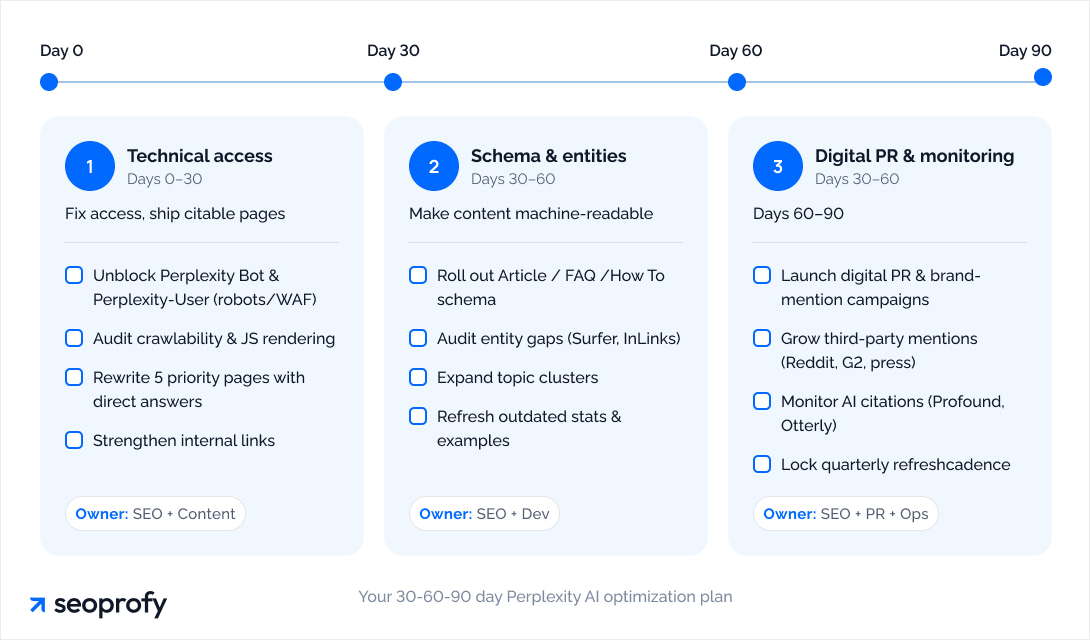
A typical AI SEO strategy for Perplexity AI starts with technical accessibility and citation-ready content updates, then expands into schema and entity optimization, and finally scales through digital PR, monitoring, and ongoing refresh workflows. Most sites see the fastest early gains from improving crawl access and rewriting a small group of high-value pages before expanding broader AI-visibility initiatives across the site.
| Days | Goal | Concrete Actions | Owner |
| 0–30 | Fix technical access and improve citation readiness | Unblock PerplexityBot, audit crawlability, rewrite 5 priority pages, improve direct-answer formatting, strengthen internal links | SEO + Content Team |
| 30–60 | Improve AI interpretation and topical coverage | Roll out schema markup, audit entity gaps, expand topic clusters, refresh outdated statistics and examples | SEO + Dev Team |
| 60–90 | Scale authority and monitoring workflows | Launch digital PR campaigns, grow third-party mentions, monitor AI citations, implement quarterly refresh cadence | SEO + PR + Content Ops |
Most companies see the first measurable AI-visibility gains during the initial 30–60 days, especially after improving crawl access and rewriting existing high-authority pages into citation-ready formats.
Treat Perplexity AI as a Citation Marketplace, Not a Search Engine
Perplexity optimization is fundamentally about earning citations inside generated answers. Every page competes for visibility based on crawl accessibility, factual clarity, entity trust, freshness, and how easily the system can extract useful information from the content.
The strongest-performing pages usually follow the same pattern: accessible crawling, direct-answer formatting, structured content, strong topical coverage, updated information, external brand mentions, and consistent AI-visibility monitoring. Together, these signals help retrieval systems identify pages that are reliable enough to cite.
Brands that adapt early tend to build stronger visibility across AI-answer ecosystems because citation frequency compounds over time through authority, mentions, and topical relevance.
If your team wants to improve visibility across Perplexity, ChatGPT Search, and AI Overviews, SeoProfy’s AI SEO services can help build a long-term AI-search strategy around measurable citation growth and brand presence.
FAQ
How do you optimize content for Perplexity AI?
Optimize content for Perplexity AI by answering the query directly in the first paragraph, using clear headings, fresh facts, credible sources, and structured sections that are easy to retrieve and cite. Focus on building topical authority with original insights, internal links, expert commentary, and concise formats like FAQs, tables, and step-by-step explanations.
How does Perplexity AI choose which sources to cite?
Perplexity AI chooses sources that provide clear answers, trustworthy information, strong topical relevance, and formatting that AI systems can easily extract and summarize.
Does traditional SEO still matter for Perplexity?
Yes, but ranking alone is no longer enough because pages also need to be citation-ready, factually dense, and optimized for AI retrieval systems.
What types of content perform best in AI-generated answers?
Content with concise definitions, visible bullet points, statistics, schema markup, expert insights, and strong internal linking usually performs best.
How important is structured data for AI visibility?
Structured data is important because it helps AI systems understand entities, relationships, authorship, and page purpose more accurately.
Can older pages rank in Perplexity AI?
Yes. Older pages can improve visibility after refreshing outdated information, updating statistics, improving formatting, and strengthening entity coverage.
What KPIs should teams track for AI SEO?
Teams should track citation frequency, AI referral traffic, branded mentions, entity visibility, answer inclusion rate, and competitor citation overlap.

Julia Lubianytska is a Copywriting Team Lead at SeoProfy with over 7 years of experience in copywriting and editing. She works closely with copywriting teams, helping writers craft clear and thoughtful content for SaaS products, IT services, and businesses in the legal and medical fields. Julia enjoys turning complex topics into easy-to-understand, trustworthy content, focusing on structure, clarity, and consistency to ensure the content is genuinely helpful for real people, not just search engines.