

To rank on ChatGPT, publish high-quality content that stays relevant and answers user questions directly. You should make your pages easy for AI crawlers to reach, and build your brand reputation through mentions on trusted sources and strong reviews.


This guide gives you seven data-backed strategies to do exactly that. You’ll get practical steps you can apply right away to grow your online visibility, lift brand mentions inside large language models, and pull more organic traffic from ChatGPT and similar AI tools in 2026.
- ChatGPT reaches nearly 900 million weekly active users, making visibility in its answers a real channel rather than a side experiment
- Schema markup is a strong citation signal: 61% of ChatGPT-cited pages carry rich schema, versus just 25% of Google’s top results
- Brand mentions, positive reviews, and an authentic Reddit presence carry the weight that backlinks do for Google
- Fresh content earns roughly 3.2× more AI citations than pages older than 90 days, so regularly updated sites tend to win.
Why Is Ranking on ChatGPT Important?
It matters because hundreds of millions of people now ask it for product picks, comparisons, and advice. And when your brand surfaces in those answers, you reach buyers at the exact moment they’re deciding. As AI search grows, that visibility increasingly happens inside the chat, not on a results page.
Google still holds around 90% of the search engine market share, but ChatGPT’s pull is too big to ignore. There are nearly 900 million weekly active users, and the site logged over 5.5 billion monthly visits this spring. That scale is the case for building an SEO campaign strategy around the platform: it can lift your brand prominence, send real referral traffic from ChatGPT, and shape decisions before a buyer ever opens traditional search engines.
A mention here also carries weight. When ChatGPT names your brand in a reply, users tend to read it as a vote of confidence, which puts you in front of people asking pointed questions about exactly what you sell.
How Do ChatGPT Algorithms Work?
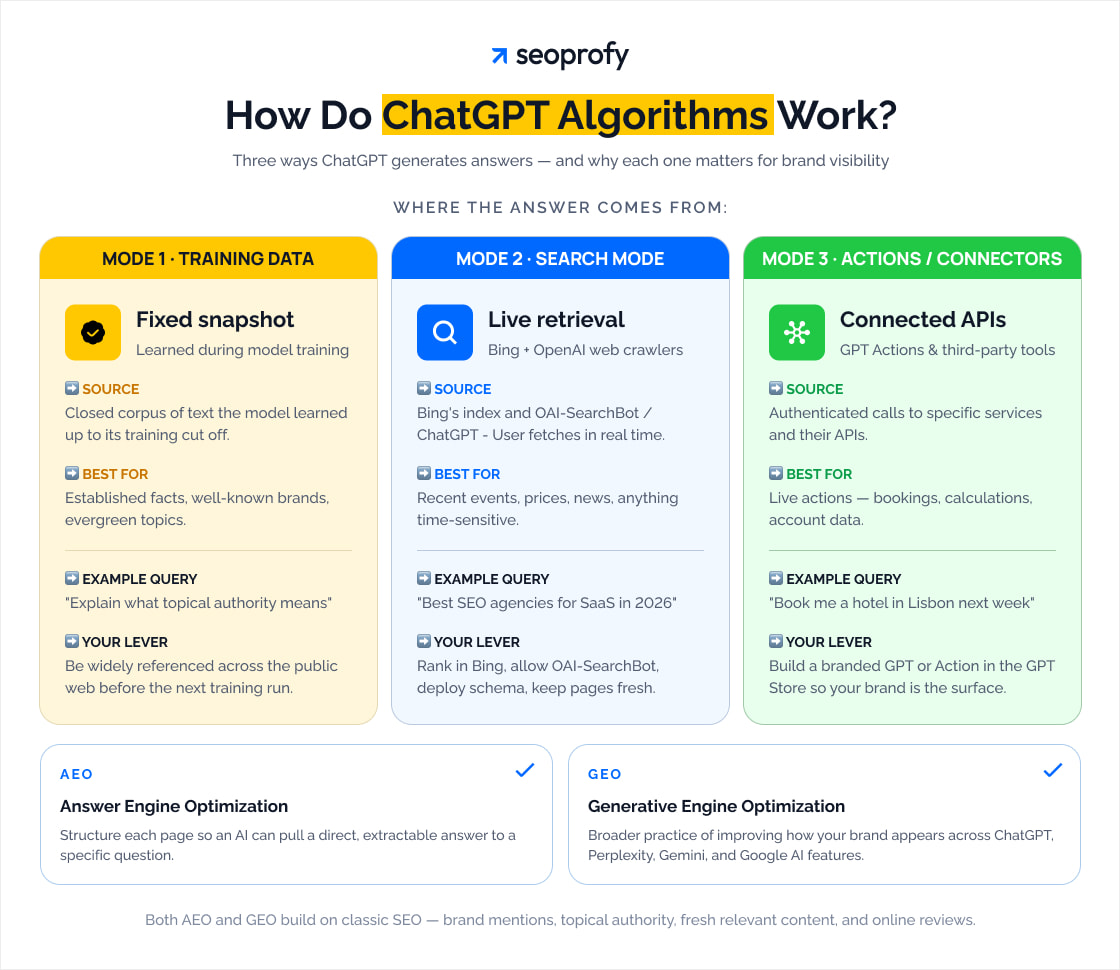
The model doesn’t pull from one place. Its default replies come from training data — a fixed snapshot of text it learned during training. When search is enabled, it retrieves current information using a blend of Bing’s index and OpenAI’s own web crawlers, which is how fresh pages and news make it into a response. The brand mentions and signals connected tools and GPT Actions find across public sources extend that further, letting it fetch real-time data from specific services.
|
Mode |
Where the answer comes from |
Best for |
| Training data | Fixed snapshot learned during model training | Established facts, well-known brands, and evergreen topics |
| Search mode | Blend of Bing’s index and OpenAI’s own web crawlers | Recent events, prices, anything time-sensitive |
| Actions/connectors | Connected third-party services and APIs | Live actions — bookings, calculations, account data |
For brands, visibility in ChatGPT is about making your brand easy to understand, verify, and recommend across the places AI-powered search tools may learn from or retrieve.
That is where AEO and GEO fit in. AEO, or answer engine optimization, focuses on making your content easy to use as a direct answer. GEO, or generative engine optimization, is the broader practice of improving how your brand appears across AI-generated answers in tools like ChatGPT, Perplexity, and Google’s AI features.
In practice, both rely on the same foundations:
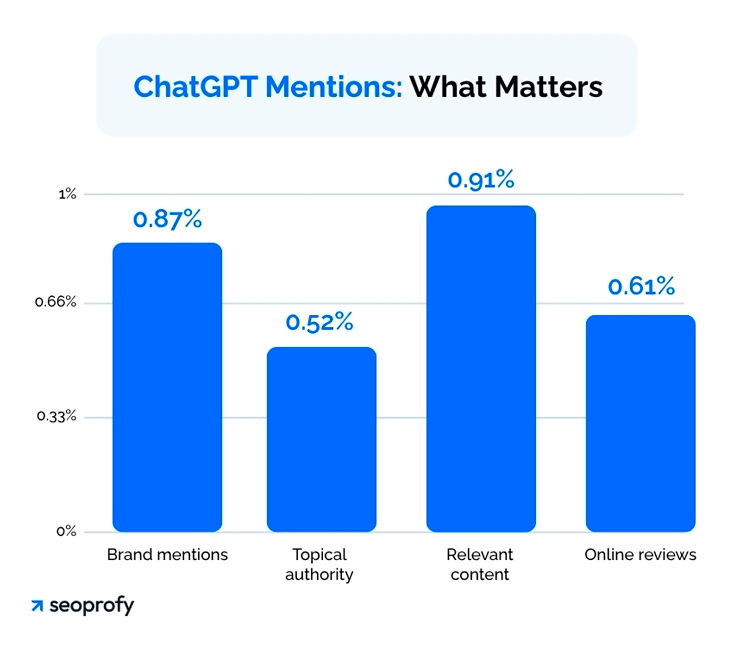
- Brand mentions: Steady references in articles, forums, product listings, and community threads teach the model that your brand is credible and relevant, raising the odds it appears in related answers.
- Topical authority: Publishing deeply around your subject and cross-linking related pages signals real expertise, so the model treats you as an authoritative source.
- Relevant content: The model matches answers to how people actually phrase questions. The closer your wording is to real user queries using natural language, the better your odds.
- Online reviews: Detailed, positive reviews across platforms get absorbed into what the model knows, linking your brand to the products people ask about and marking it as trustworthy.
ChatGPT vs. Google AI Overviews vs. Perplexity: How Citations Differ
The three platforms cite sources in fundamentally different ways: ChatGPT leans on consensus references like Wikipedia and third-party validation, Google AI Overviews track closely to traditional organic rankings with 2.5 billion monthly users, and Perplexity runs a live web query for every prompt and weights community sources heavily.
So, a page that one platform quotes constantly, another may never show. Research found that only about 11% of domains are cited by both ChatGPT and Perplexity for the same query.
That gap matters because optimizing for one isn’t optimizing for all. Each system pulls from a different index, scores authoritative sources on different signals, and rewards a different content shape. Your SEO strategies for ChatGPT should acknowledge that.
|
Parameter |
ChatGPT |
Google AI Overviews |
Perplexity |
| Primary sources | Wikipedia, third-party reviews, competitor pages | Sites already ranking in Google organic | Reddit, forums, live web pages |
| Citation style | Cites mainly in browsing mode; less prominent | Inline, tied to ranking pages | Citation-first — every claim linked |
| Freshness weight | Moderate; partly fixed training data | High; pulls live search results | Very high; real-time per query |
| Brand mention weight | High; values cross-source consensus | Moderate; follows organic authority | High; rewards community discussion |
The practical takeaway: ChatGPT favors brands that are widely and consistently referenced, Perplexity rewards fresh pages and active social platforms like Reddit, and appearing in Google’s AI features comes mostly from solid organic SEO. Our full breakdown of strategies to appear in Google AI Overviews covers the Google side in depth.
7 Strategies to Rank on ChatGPT
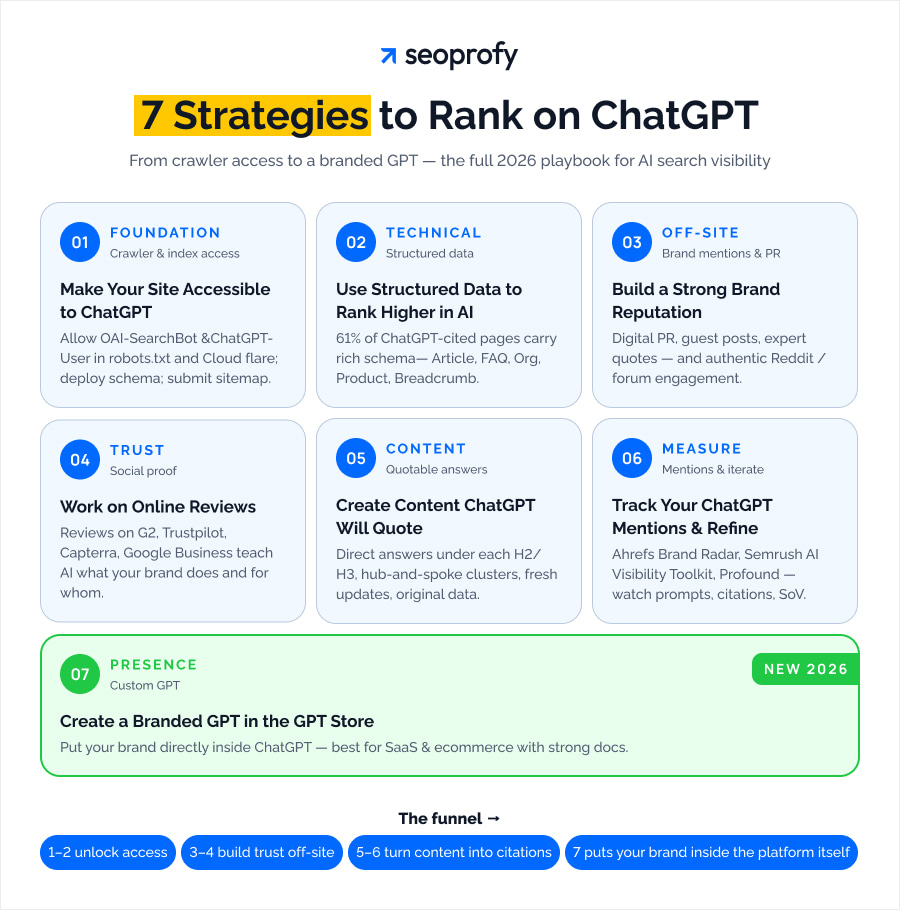
Here’s the short version: to rank in ChatGPT search results, you should:
- Make your site crawlable
- Add structured data
- Build a strong brand
- Work on online reviews
- Publish quotable content
- Track your mentions
- Launch a branded GPT
We break each one down below — what it is, why it matters, what to do, and how to measure it.
1. Make Sure Your Website Is Accessible to ChatGPT
If AI crawlers can’t reach your pages, you won’t appear in answers. The fastest way to appear in the ChatGPT results is to confirm the right bots are allowed before you optimize anything else.
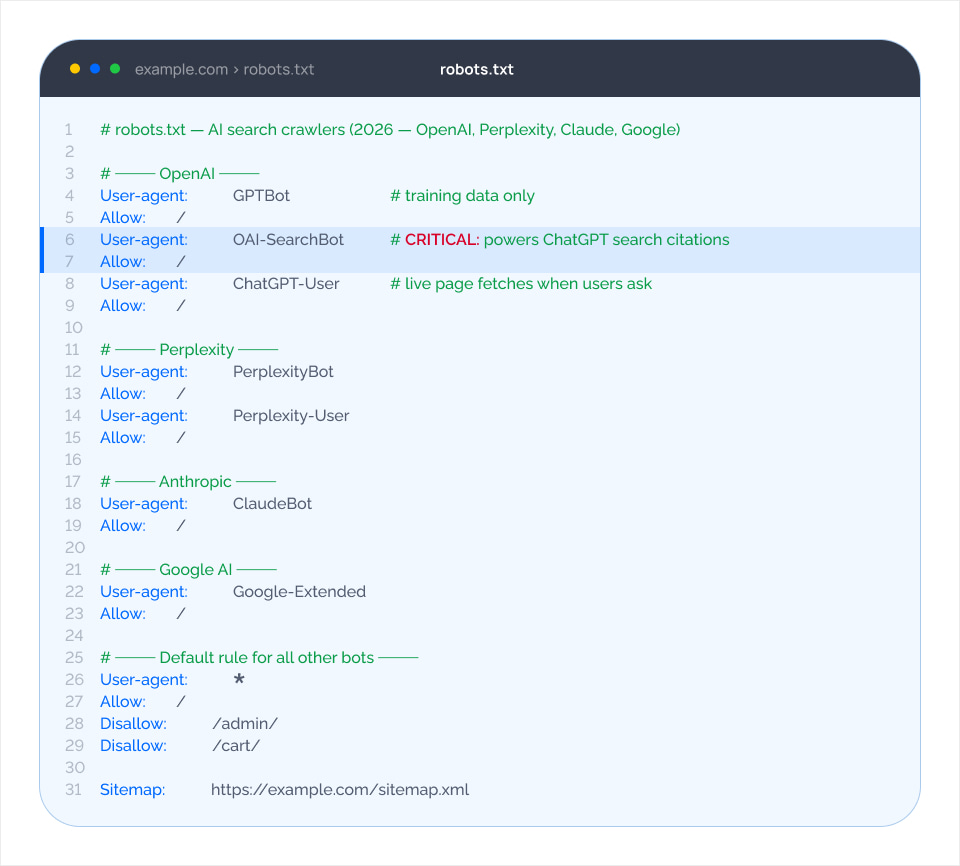
OpenAI now runs three separate crawlers, and the difference matters. GPTBot collects training data for the models. OAI-SearchBot powers ChatGPT’s live search citations. ChatGPT-User fetches a page live when the model needs it to answer a user’s request. Blocking GPTBot only keeps you out of training, but blocking OAI-SearchBot removes you from ChatGPT search answers.
This is where many sites quietly lose visibility in ChatGPT responses. Cloudflare changed its default to block AI crawlers for new domains, so a business can be invisible to AI search without ever choosing to be. And a robots.txt fix won’t help until the CDN setting is corrected first.
Here’s the check, which takes a few minutes:
- Open yourdomain.com/robots.txt and look for any Disallow rules hitting OAI-SearchBot and ChatGPT-User. If they’re there, you’re blocked from those citation systems.
- In Cloudflare (or your CDN), go to Security > Bots and confirm AI search crawlers aren’t blocked at the infrastructure level. Check Bot Fight Mode and any WAF custom rules, too.
- On WordPress, robots.txt is usually generated dynamically. You should manage it through Rank Math, Yoast, or server rules in Nginx or Apache.
- If you run client-side rendering, test what bots actually see. A large share of AI crawlers can’t execute JavaScript, so a JS-only page can read as blank, no matter what robots.txt says.
Quick checklist:
- robots.txt allows OAI-SearchBot and ChatGPT-User
- GPTBot decision made deliberately (block = no training use, still searchable)
- Cloudflare/CDN not blocking AI crawlers by default
- Sitemap path is reachable, not disallowed
- Key pages render server-side or are pre-rendered for bots
How to measure: Watch your server logs for OAI-SearchBot and ChatGPT-User hits (and any 403 responses to them). No crawler visits means no path into the index.
2. Use Structured Data to Rank Higher in AI Search
Schema markup labels your content so AI tools know exactly what each part means, which makes it far easier to pull into an answer. It’s one of the clearest technical signals you can send. AirOps found that 61% of pages ChatGPT cited carried rich schema, versus just 25% of Google’s top results.
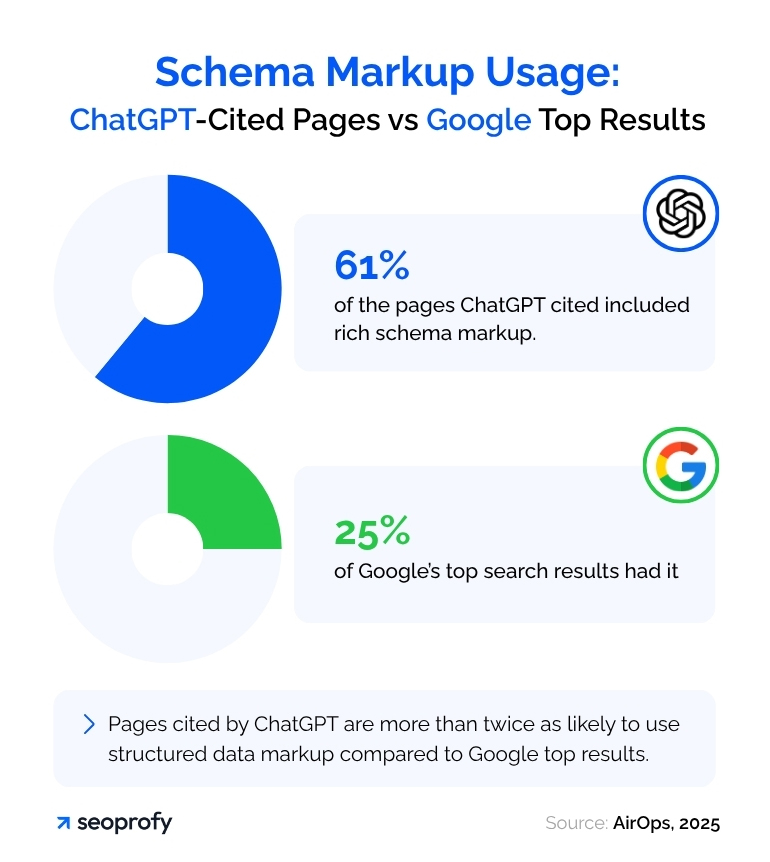
Most marketers know schema helps Google read a page. Fewer realize how much it shapes whether AI models trust and reuse your content. The reason is simple: structured data removes guesswork. Instead of making the model infer what a block of prose means, the schema states it plainly.
|
Schema type |
What it does for AI |
When to use |
| Article/BlogPosting | Attributes content and ties it to an author entity | Blog posts, guides, editorial |
| Organization | Confirms who you are and links your brand to known entities | Homepage, about page |
| Product/Service | Surfaces specs and offers for commercial answers | Product, pricing, service pages |
| BreadcrumbList | Signals site structure and topical authority | Category and nested pages |
| FAQPage | Maps clean question-answer pairs that the model can lift directly | Any page with recurring user questions |
To add these, insert JSON-LD into your HTML, then confirm it’s valid with the Schema Markup Validator. If you want to rank higher in ChatGPT search results, this is one of the easiest moves available that can help.
How to measure: Track which schema-marked pages start earning citations, and re-validate after any template change so markup doesn’t break silently.
3. Build a Strong Brand Reputation
For AI tools, brand mentions do roughly what backlinks do for Google: every credible reference teaches the model your brand is real, relevant, and worth surfacing. If the sources ChatGPT learned from rarely mention you, it has no reason to bring you up.
Unlike traditional search engines, ChatGPT draws on its pre-trained knowledge plus external sources, which means off-site reputation carries unusual weight here. The more your name appears across articles, reviews, and discussions the model trusts, the more confidently it can put you in an answer.
Work on Your Digital PR and Backlinks
Earned coverage is the most reliable way to manufacture those references. A few tactics worth building into creating an SEO strategy:
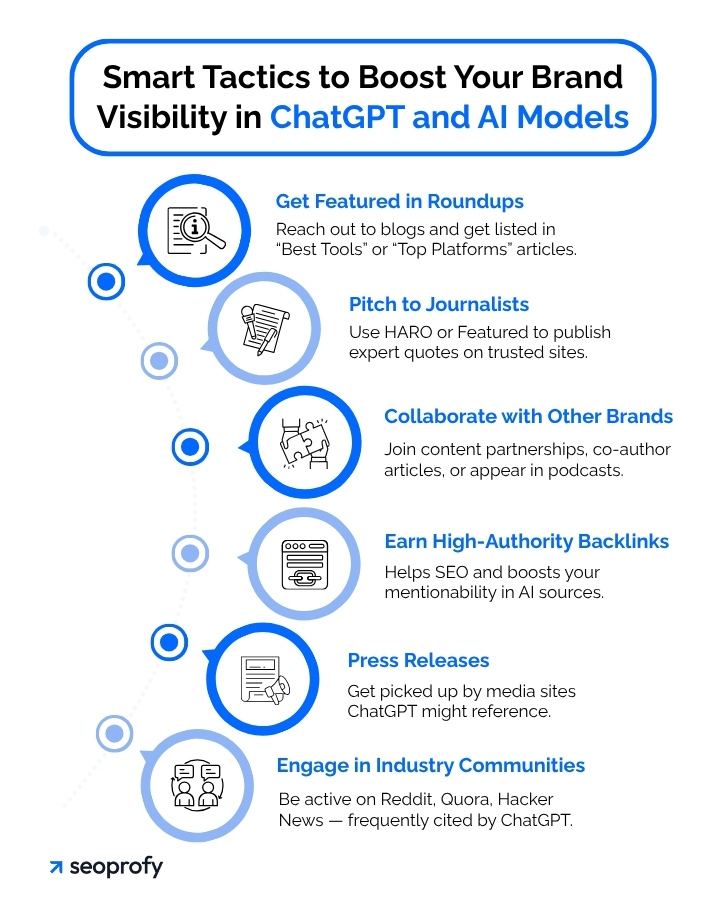
- Land in roundups and comparison posts: “Best tools for X” and “Top platforms for Y” lists get pulled into AI answers constantly. Pitch publishers in your space to be included.
- Feed expert quotes to journalists: Tools like Featured or Help a Reporter connect you to writers, and the resulting coverage on trusted sites often gets absorbed by AI models later.
- Co-create with peers: Partner content, podcasts, and webinars put your brand in more contexts, and each of them is another signal.
- Earn links from high authority sites: These double as both ranking signals and reference sources the model may draw on.
- Distribute genuine news: Real launches sent through PR services pick up media mentions worth referencing.
The best part of these digital PR and link building tactics is that they lift your standing in Google’s results and strengthen your brand prominence in AI replies.
Engage on Reddit and Industry Forums
Community platforms punch above their weight for AI visibility. Reddit is among the most-cited sources in ChatGPT, second only to Wikipedia in recent analyses. Showing up authentically in the right threads gives the model fresh, opinion-rich references tied to your name.
Where to focus, by niche:
- E-commerce: r/ecommerce, r/shopify, r/Entrepreneur
- Lawyers: r/legaladvice, r/Ask_Lawyers
- SaaS: r/SaaS, r/SaaSAI, r/SaaSSales
A few rules keep this from backfiring:
- Read each community’s rules first — many (r/legaladvice especially) ban self-promotion and solicitation outright
- Answer questions and add value before you ever mention your product; comment history matters
- Use one consistent account so your contributions promote building relationships and recognizable expertise over time.
How to measure: Monitor growth in branded searches, referring domains, third-party mentions, review volume, and Reddit/forum discussions. Then test the same commercial prompts monthly in ChatGPT Search to see whether your brand is mentioned, cited, or recommended more often over time.
Customers now turn to ChatGPT for product and service recommendations. As an AI SEO agency, we help your brand show up in those answers. With us, you get:
- Content built for both AI search and SEO
- Brand mentions across trusted third-party sites
- Visibility where buying decisions now happen.
4. Work on Online Reviews
Every time someone leaves feedback about your company, it adds to the larger conversation happening online. AI models learn from that pool of content during training. So the more people write about you on forums and review sites, the better the model recognizes your name and connects it to relevant topics, and the easier it becomes to rank your website on ChatGPT.
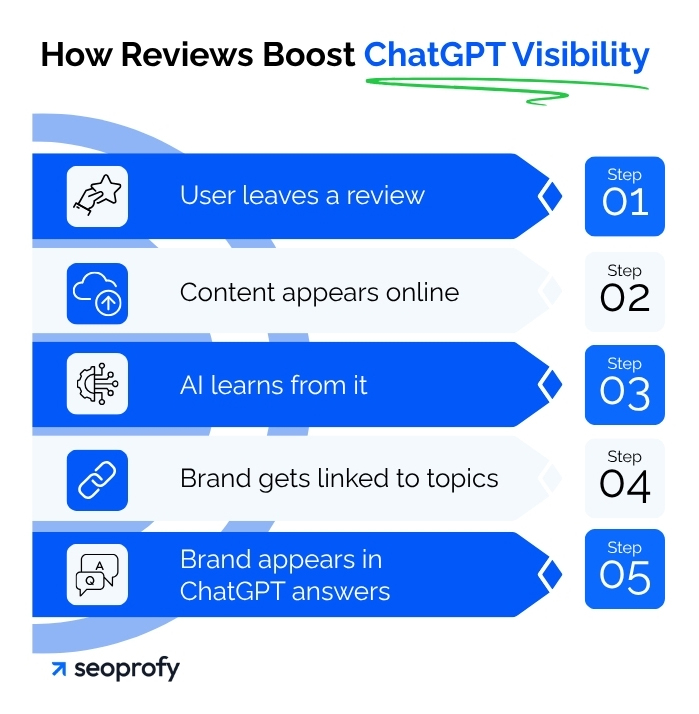
Reviews also teach AI systems what your product does and who it helps. For example, if your customers mention fast setup or how well your product integrates with other tools, those details get tied to your brand across AI responses.
The next time someone asks ChatGPT for “a CRM that works for small teams and connects easily with Slack,” those details nudge the model toward your name.
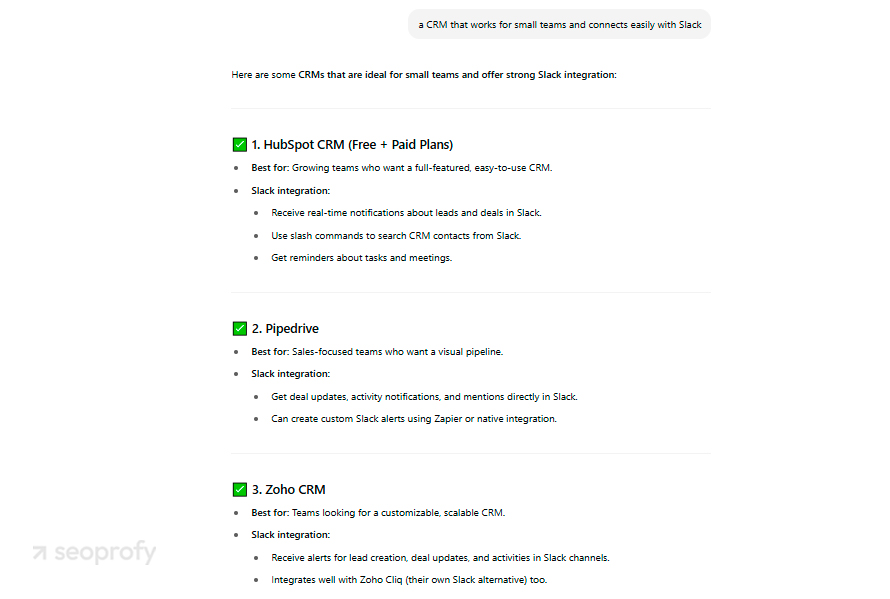
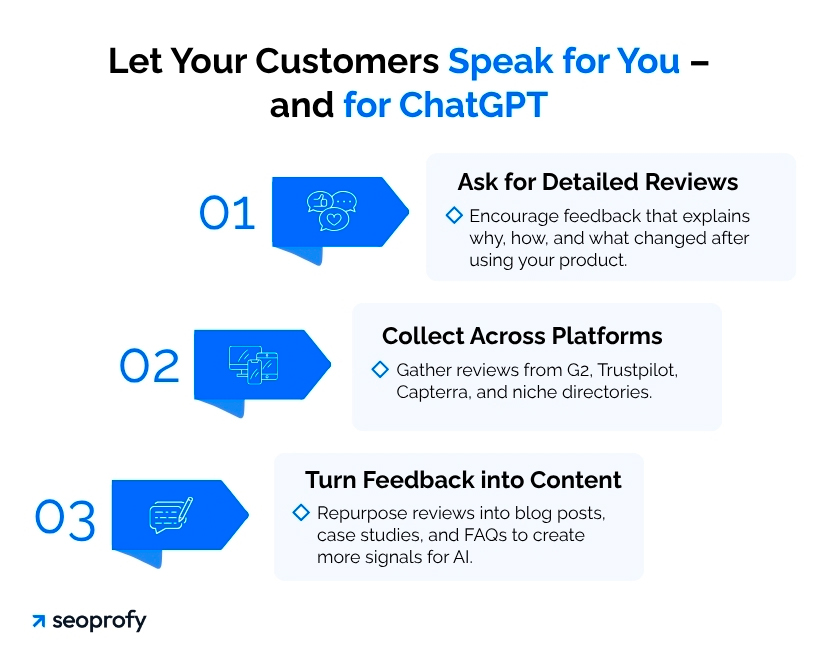
Another important thing to keep in mind is that ChatGPT pulls from patterns in the data it already has, including all the online conversations, lists, and reviews collected before the most recent update. That means the sooner you start building reviews, the more likely you’ll appear in answers over time. So, what should you do?
- Ask customers for reviews that include details like why they chose your product, how they’re using it, and what changed after they did
- Collect feedback on several platforms, for example, G2, Trustpilot, Capterra, and niche directories in your industry
- Use feedback as ideas for your content. It is a great idea to take the most common questions or customer wins from your reviews and turn them into case studies, blog posts, or FAQ sections. This creates even more signals for AI to reference.
For local queries, ChatGPT leans heavily on customer satisfaction reviews and local seo signals — Google Business Profile ratings, local directories, and city-specific mentions. This is decisive for service businesses like law firms: when someone asks for “a personal injury lawyer in Cheney,” for example, a firm with strong, recent Google Reviews and a complete local profile is far more likely to surface than one without.
In one SeoProfy engagement, a personal injury law firm grew organic clicks by 1,460% year over year and CTR by 852% across 200+ local service queries, with AI referrals emerging as a new brand-discovery channel.
The tactics behind it translate directly to AI search: hyper-local landing pages, Schema.org LegalService, Attorney, and LocalBusiness markup, and content built around “who should I call” intent rather than “what is X.” That same setup is often what helps rank your site in ChatGPT for the queries that actually convert.
How to measure: Keep an eye on review growth, average rating, review freshness, and recurring product/service phrases across platforms like Google Business Profile, G2, Trustpilot, Capterra, and niche directories. Then test the same local and category prompts in ChatGPT Search each month to see whether your brand appears, how it is described, and which review sources are cited.
5. Create Content that ChatGPT Will Quote
ChatGPT quotes web content that’s easy to extract: clear structure, concrete facts, and credible citations. Below are the practical moves that make your pages quotable, grouped into focus areas.
Publish Authoritative, Original Content
Quality still wins. ChatGPT weighs how expert and relevant your information is before referencing it, and the latest Google algorithm updates reward the same thing, which is why this holds for both human-written and AI content for SEO.
- Cover the full topic — answer the related questions a reader would ask next, not just the headline query
- Cite authoritative sources: original studies, government data, and recognized industry research
- Add what no one else has — your own expert insights, test results, or first-party data.
“The brands ChatGPT cites aren’t the ones publishing the most — they’re the ones publishing the clearest answer with a number attached. A specific stat the model can lift beats a thousand words of context.”
Andriy Shum, Head of SEO at SeoProfy
Write Clearly and Structure for Easy Extraction
Models in AI-driven search read in chunks, so format for machine parsing as much as for people. Short, single-idea paragraphs register as complete thoughts and are far more likely to get into the ChatGPT responses. People also ask in plain, conversational language, so writing the way they actually speak helps the model match you to real user needs.
- One idea per paragraph; keep them to three or four lines
- Break complex points into steps or bullet points
- Put a direct answer right under each H2 and H3 before you expand your insightful content
- Lead with the key info — AI tends to pull from the first clear answer it finds
- Mirror real phrasing; tools like AnswerThePublic show how people word questions.
Keep Your Content Fresh
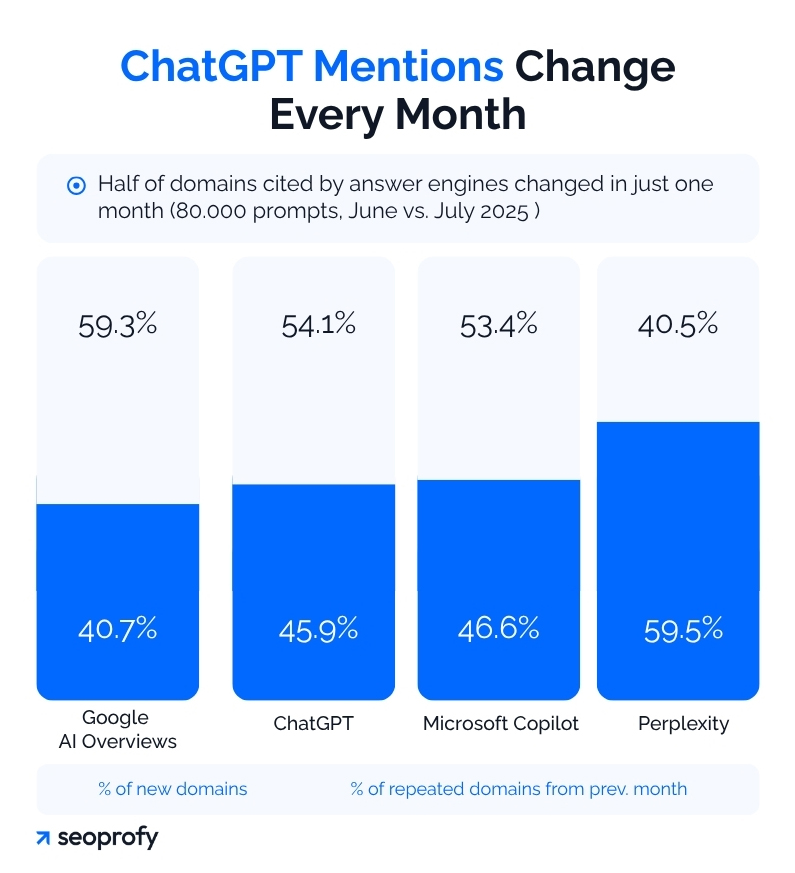
Freshness is now a top factor. Josh Blyskal’s recent study of 80,000+ prompts across ChatGPT, Google AI Overviews, Copilot, and Perplexity found nearly half the cited domains turned over within a single month. Relevance and recency are the priority when optimizing for ChatGPT — the model favors the newest material that reflects current questions.
- Refresh your priority pages on a schedule; lead with the ones you most want cited
- Update stats, screenshots, and product details as they change
- Track which sources AI tools currently recommend for your topics, and close the gap.
Build Topical Authority with Hub & Spoke
Depth signals expertise and reliable information. AI learns your topical authority from how thoroughly you cover a subject and how your pages connect. And because models train on sources well beyond your own site, your footprint across the web matters, too. A hub-and-spoke setup makes that depth legible.
- Build a central “hub” page on your core topic, then “spoke” articles on each subtopic, all interlinked
- Extend the ecosystem off-site: newsletters, Quora, LinkedIn, niche subreddits, and podcasts, each of which adds context that the model reads
- Reference your own material across social platforms so the connections are visible. (This is the heart of practical LLM optimization.)
Engage Users and Track Performance
Interactive content earns attention, and attention is a value signal — quizzes, tools, and videos keep people on the page, which helps you rank higher on ChatGPT. Pair that with data on what already works.
- Add interactive elements like quizzes, calculators, or polls; use visuals and short videos to simplify hard ideas
- In Google Analytics (GA4), find your top pages by traffic and engagement, then expand the topics that resonate. It is a direct route to more SEO value
- See which queries drive those visits, and build out from your winners.
Quotable content readiness checklist:
- Topic fully covered with deep research, original data, or insight
- One idea per short paragraph; direct answer under every clear heading
- Lists and clean structure throughout
- Priority pages refreshed and dated
- Hub-and-spoke internal links plus off-site presence
- Top performers identified in GA4 and expanded.
How to measure: Track which pages get cited or mentioned in ChatGPT Search for your target prompts. Also, you should compare that with GA4 engagement, organic traffic, informative content freshness dates, and growth in backlinks or third-party references to see which pages are becoming more quote-worthy.
6. Track Your ChatGPT Mentions and Refine Your Strategy
As of 2026, several AI SEO tools show exactly when and where ChatGPT names your brand. These include Ahrefs Brand Radar, Semrush AI Visibility Toolkit, Profound, and more. Start by tracking your brand prominence across AI answers, then feed what you learn back into the strategies above.
We’ll walk you through how to use Ahrefs Brand Radar. To try it out for yourself:
- Go to Ahrefs’ Brand Radar
- Select ChatGPT from the options
- Type in your brand name, a certain product, or a feature
- Press the Explore button to see the entire list.
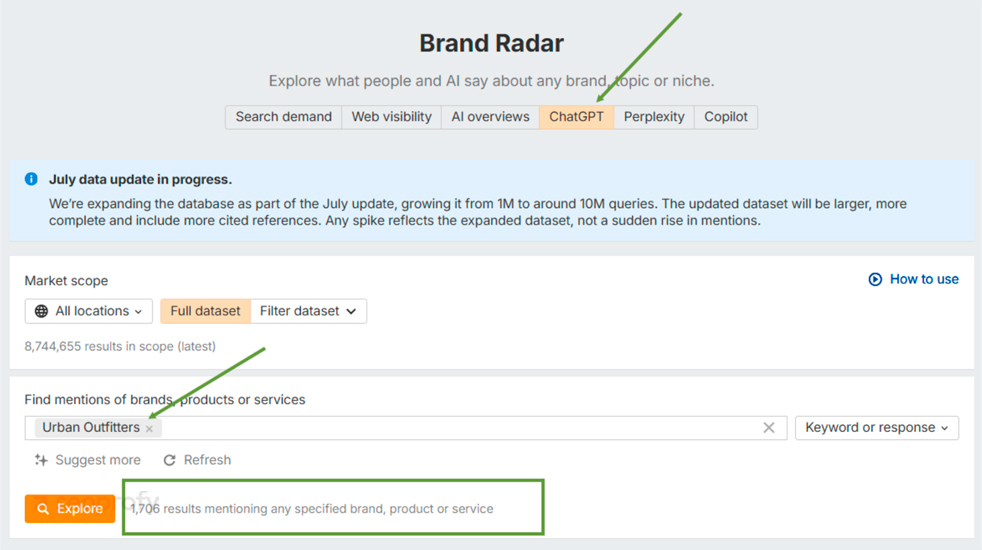
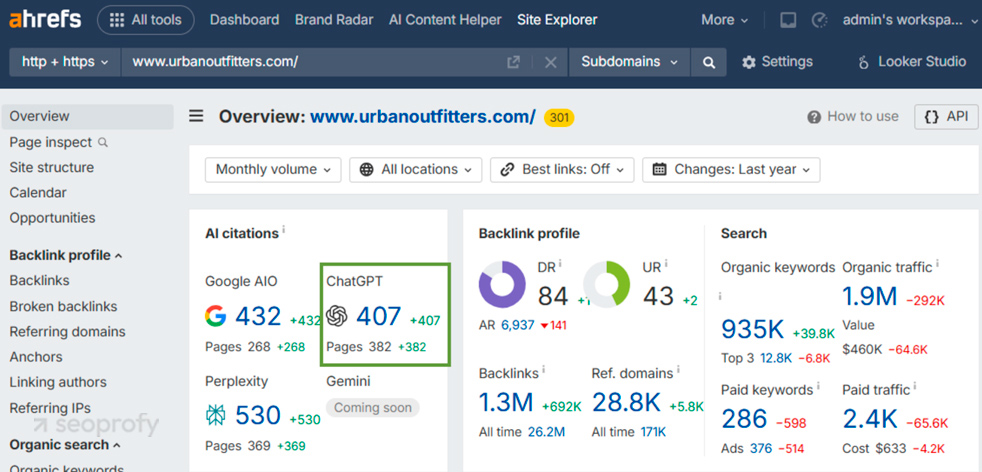
Similarly, in Ahrefs Site Explorer, you can see how many times your website is mentioned in ChatGPT right from the overview page.
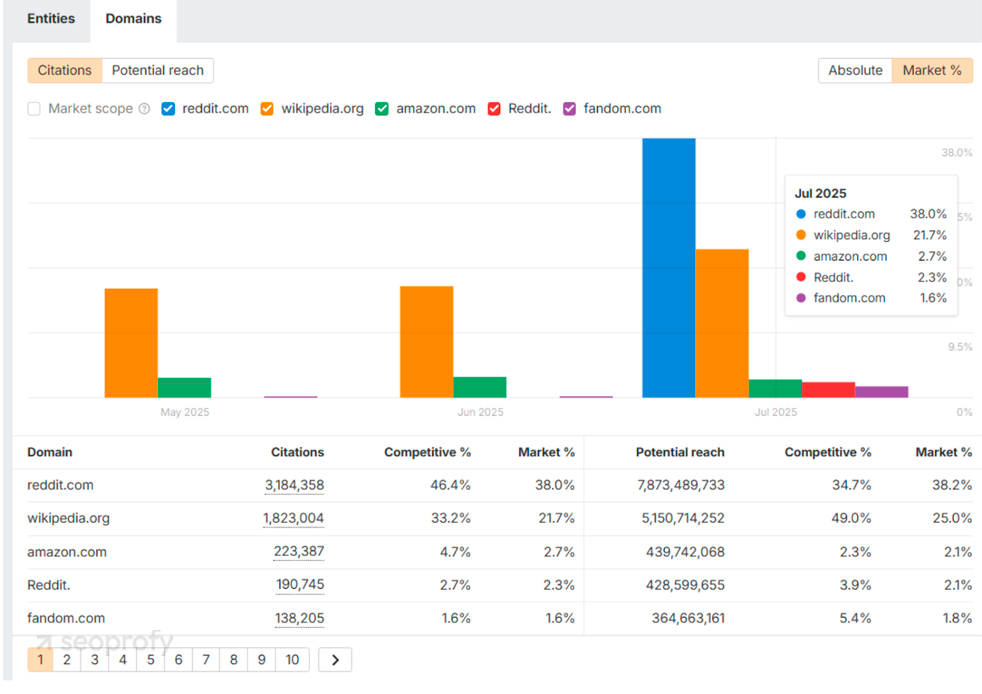
What’s great about this tool is that you don’t just get a count of mentions; you can also see which websites or domains are being cited the most, like reddit.com, wikipedia.org, and amazon.com.
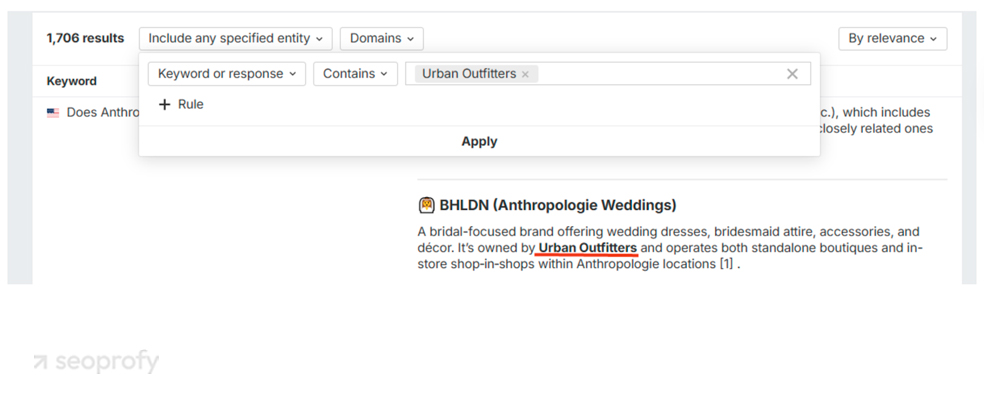
In addition to that, you can filter the results by specific keywords or phrases. In our case, we added “Urban Outfitters” to see exactly where the company name is being mentioned.
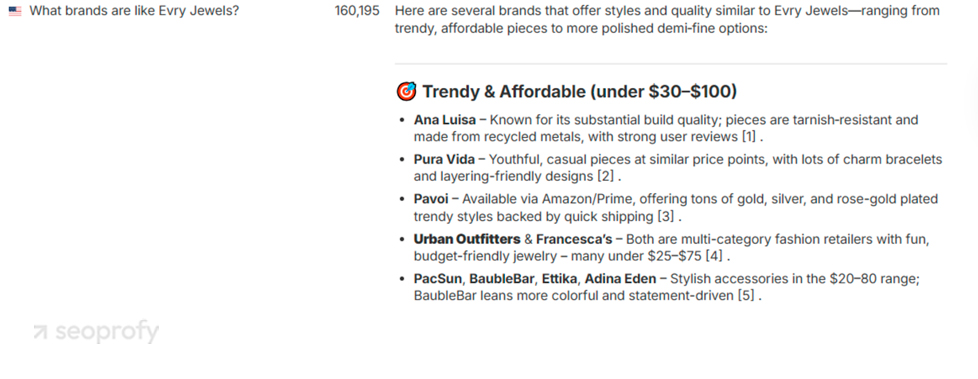
Once you filter, you get a list of user questions and responses where your brand appeared in a conversation. This gives you real-world examples of how ChatGPT talks about you and what your potential customers are asking.
Monitor weekly:
- Mention volume vs. last week, trending up or down?
- Which prompts trigger your brand (and which competitors own the ones you don’t)
- Top domains cited beside you, where to earn your next mention
- Sentiment, are you described the way you want to be?
- New questions appearing in your niche, content gaps to fill.
7. Create a Branded GPT in the GPT Store
A branded GPT is your own custom version of ChatGPT, trained on your docs and published in the GPT Store; this is a direct way to put your brand inside the platform itself. It works best for SaaS companies and ecommerce brands with real documentation to feed it: product guides, help-center articles, spec sheets, and FAQs. If you have content a buyer would ask about, you have enough to build one.
Why it helps online visibility: a public GPT carries your name, your tone, and your expertise into a space users already search, and every interaction reinforces the model’s association between your brand and your topic. It won’t single-handedly rank in ChatGPT for broad queries, but it gives you a permanent, branded surface inside the ecosystem.
How to build and publish one:
- Open the builder: In ChatGPT (Plus, Pro, Business, or Enterprise), go to Explore GPTs → Create. You configure everything in the browser.
- Define its job: Write clear instructions: role, scope, tone, and what it should refuse. Specific instructions mean fewer off-topic or hallucinated answers.
- Upload your knowledge: Add PDFs, help docs, and product pages under the Knowledge section. This is what makes the GPT genuinely yours rather than generic.
- Add conversation starters: Three or four example prompts show users the best way to interact — most people learn from these.
- Complete your Builder Profile: To publish publicly, verify your identity via billing details or a verified domain (a DNS TXT record). Only verified domains can appear as your public link.
- Set visibility to Public: Link-only GPTs won’t appear in the store. If it uses actions, each one needs a valid Privacy Policy URL.
- Publish and refine: Once live, watch which prompts users send and update your knowledge files as products change.
How to Rank Well on ChatGPT — Timeline
There’s no fixed timeline, but most brands see a realistic path over roughly three months: a setup phase in week one, first brand-query citations within four to eight weeks, and steady topical visibility by months two to three. How fast you move depends on how often your niche is discussed and how consistently you publish and refresh.
|
Week 1 |
Weeks 4–8 |
Weeks 9–12 |
|
| What you do | Allow OAI-SearchBot and ChatGPT-User in robots.txt and Cloudflare (these power ChatGPT search and citations); optionally allow GPTBot for training-data inclusion; submit your sitemap to Bing Webmaster Tools and Google Search Console, and configure IndexNow; deploy Schema.org markup (Article, FAQ, Organization); baseline existing brand mentions | Refresh long-form pillar content with substantive updates (not cosmetic date changes); start authentic Reddit / Quora engagement; update H1, intro, and Key Takeaways for AI extraction; run a first round of digital PR / guest posts | Build hub-and-spoke topical clusters; launch a branded GPT (SaaS/docs-heavy); publish original research; iterate on what ChatGPT already cites |
| What to expect | No citations yet — this is infrastructure, not visibility | First citations on direct brand queries (e.g., “what is [your brand]?”) if your brand entity is already indexed; expect a 6–12 week publish-to-citation lag for new pages | Citations for non-brand topical queries; share of voice vs. competitors starts to show |
| Metric to track | Bing & Google index status · OAI-SearchBot/ChatGPT-User crawl logs | Brand-query mentions and citations (Ahrefs Brand Radar, Semrush AI Visibility Toolkit, and more) | Topical citation share; AI Share of Voice vs. competitors |
| Benchmark | Bing processes sitemaps in 24–72 hrs; priority URLs are typically crawled within a week (IndexNow can prompt near-instant crawls), with broader indexing over 2–4 weeks | Content updated within 30 days earns ~3.2× more ChatGPT citations than content older than 90 days | Sustained AI-search presence typically takes 3–6 months of consistent work |
Stay Current with AI Trends
People no longer just type a few words into Google and click on links. They ask for advice directly inside AI tools and browse multiple channels to decide which products or services to buy. So learning how to rank in ChatGPT has become just as important as optimizing for traditional SEO.
For now, try testing a few ideas from this guide. Implement structured data (that’s where most wins seem to be coming from) and get your name mentioned on high-authority sites. Reddit and Quora are two of the best places to start because ChatGPT seems to reference them the most.
Here, at SeoProfy, we keep up with recent trends and experiment with new ways to show up in LLM tools through our AI SEO services. If you’re ready to update your SEO for the way people search now, book a free consultation. We’ll help you build a strategy that fits the new world of LLM search.
FAQs
How Do You Do SEO for ChatGPT?
How to rank on ChatGPT comes down to making your site crawlable, publishing clear and authoritative content, adding schema markup, and building brand mentions across trusted sources. ChatGPT pulls from training data and live Bing results, so off-site reputation matters as much as your own pages. Treat it as an extension of solid SEO, not a separate game.
How Long Does It Take to Rank in ChatGPT?
Most brands see first citations within a month and competitive visibility by months two to three. Week one is set up — crawler access, schema, sitemap. Brand-query citations usually follow within 30 days, and non-brand topical citations build over the next two months, given consistent publishing and fresh content.
What Is AEO?
AEO is the practice of structuring content so that an AI gives it directly as the answer to a question. It overlaps with GEO, which covers visibility across generative tools like ChatGPT, Perplexity, and Google’s AI features. Both build on traditional SEO rather than replacing it.
Does Schema Markup Help with ChatGPT Ranking?
Yes. Structured data clearly labels your content so AI models can interpret and reuse it. One analysis found rich schema on 61% of ChatGPT-cited pages versus just 25% of Google’s top results. FAQPage, Article, and Organization markup are especially useful for helping the model lift clean answers from your pages.
How Is ChatGPT Different from Google AI Overviews?
ChatGPT leans on consensus sources like Wikipedia and broad brand mentions, while Google AI Overviews track closely to pages already ranking in Google’s organic results. So a page cited often in one may rarely appear in the other. Optimizing for both means strong classic SEO plus wide, credible off-site references.
Can Small Websites Compete in ChatGPT Search?
Yes. Topical authority and clear, specific content often beat raw brand size. ChatGPT rewards pages that answer a question precisely, so a focused, small site covering one niche deeply can earn citations that broad, shallow sites miss. Depth, structure, and a real point of view matter more than domain age.
How Do You Track ChatGPT Citations?
Use AI visibility tools like Ahrefs Brand Radar, Semrush AI Visibility Toolkit, or Brand24 to see which prompts surface your brand and which domains get cited alongside you. Because these platforms sample prompts on a schedule, read the numbers as directional trends.

Bohdan has been an SEO analyst at SeoProfy for more than two years. He began his career in digital marketing in 2019 and has since gained experience helping scale some of the world’s leading brands in industries such as gambling and SaaS. Bohdan specializes in developing effective strategies tailored to specific regions.