
 Add SeoProfy as a preferred source on Google

Choosing a GEO agency requires looking beyond its service list. The right partner should understand how AI search platforms surface brands, have a clear approach to improving visibility, and provide measurable evidence of its work.


This guide compares 10 agencies offering GEO and related AI search services. It covers each agency’s core focus, methods, proof points, and best-fit clients, then explains how to choose the best generative engine optimization agency and measure its work. It is designed for teams researching providers and building a shortlist.
Disclosure: SeoProfy publishes this list and is featured first; the other agencies were selected using the criteria described below.
How We Selected the Best GEO Agencies
To help teams evaluate potential partners for their GEO efforts, we reviewed and compared the best agencies working in this space today. For a broader SEO-focused shortlist, see our guide to the best AI SEO agencies.
We compared the agencies using seven criteria:
- Hands-on GEO experience: Documented GEO campaigns, practical optimization work, and evidence of visibility in AI-generated answers.
- SEO and content foundations: Technical SEO expertise, content quality, entity coverage, structured data, and site accessibility.
- Client results and reviews: Published client outcomes and feedback on Clutch and G2.
- AI visibility evidence: We looked for published case studies showing visibility in AI-generated answers where agencies made that data available.
- Proprietary tools and methodology: Tools, frameworks, and processes used to plan, execute, and measure GEO work.
- Published research and thought leadership: Original research, analysis, or expert commentary on AI search.
- Contract flexibility and measurement transparency: Clear scope and contract terms, regular reporting, and defined visibility and business metrics.
The Best Generative Engine Optimization Agencies in 2026
The table compares 10 GEO agencies based on their published GEO approach and the types of companies that may benefit from their services.
| Company | Clutch Rating | Core GEO Focus | Potential Fit |
| SeoProfy | 4.9/5 (99 reviews) | AI search analysis, technical SEO, content, entity optimization, authority building | Mid-market and enterprise companies in competitive or international markets, including eCommerce, SaaS, and fintech, seeking one partner for SEO and AI search visibility. |
| WebFX | 4.9/5 (454 reviews) | OmniSEO®, GEO audits, AI visibility and competitor tracking | Businesses integrating GEO into broader digital marketing |
| Omniscient Digital | 4.8/5 (6 reviews) | B2B content, GEO, AEO, digital PR, authority building | B2B companies focused on content-led growth |
| Siege Media | 4.9/5 (48 reviews) | Original research, content optimization, digital PR, GEO | Brands needing ongoing content and citation work |
| Go Fish Digital | 5.0/5 (13 reviews) | Semantic audits, content optimization, technical SEO, digital PR | Businesses combining GEO with technical SEO |
| iPullRank | Not reviewed on Clutch | Relevance Engineering, semantic content, retrieval analysis | Enterprises with complex AI search requirements |
| Intero Digital | 4.8/5 (147 reviews) | Intero GRO™, entity optimization, AI visibility, technical SEO | Brands seeking integrated GEO execution |
| Victorious | 4.8/5 (119 reviews) | SEO, AEO, content optimization, AI search measurement | Teams extending SEO into AI search |
| First Page Sage | Not reviewed on Clutch | GEO content, list and database outreach, reputation management | Brands in high-consideration industries |
| RevenueZen by Eastern Standard | 4.9/5 (38 reviews) | SEO, content, GEO, pipeline measurement | B2B teams connecting GEO with pipeline |
1. SeoProfy
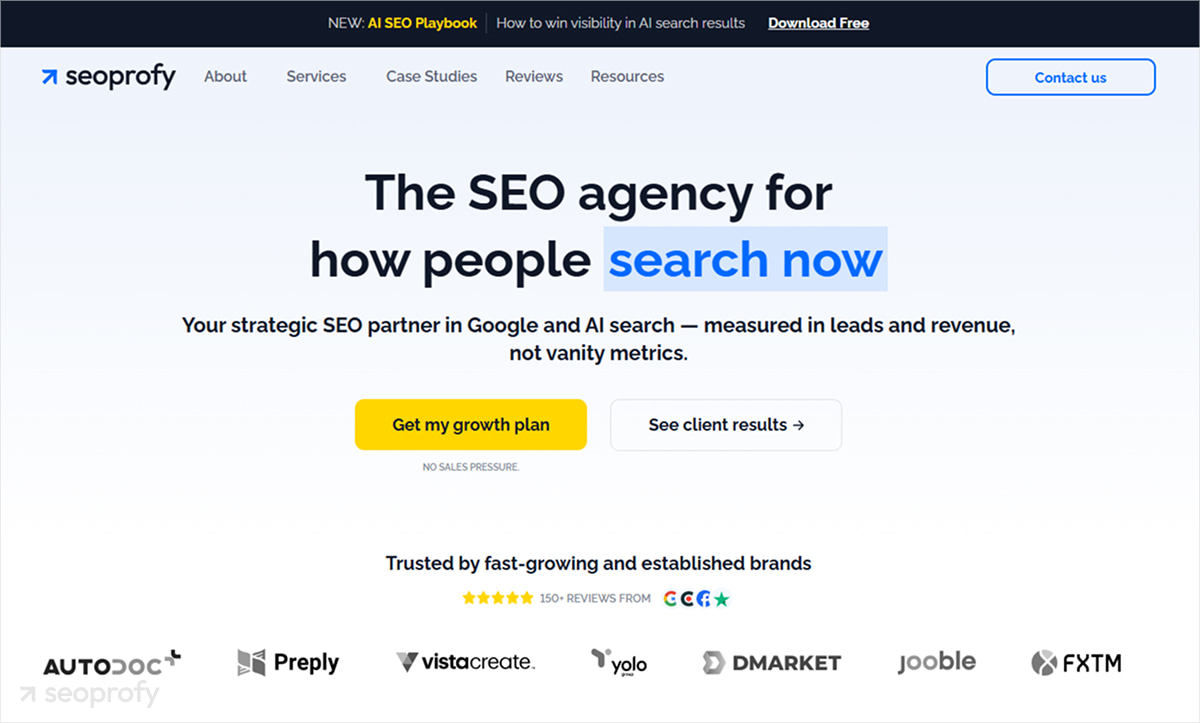
Best for: Mid-market and enterprise eCommerce, SaaS, and fintech brands seeking an integrated SEO and GEO partner for competitive international markets.
SeoProfy offers generative engine optimization services as part of its broader AI SEO work. The agency combines AI search analysis with technical SEO, content, entity optimization, and authority signals to improve visibility across traditional and AI-powered search.
SeoProfy says it began testing answer engine optimization in 2022 and later brought that work into client projects. One published case study reports 181% growth in AI citations for trading analytics software company ATAS.
SeoProfy’s approach starts with an assessment of a brand’s current search performance and AI visibility. The team identifies gaps in content coverage, technical SEO, and authority signals, then prioritizes improvements based on business goals. GEO activities are integrated into the broader SEO strategy, with performance monitored through search visibility, AI mentions, citations, and measurable business outcomes.
- Core services: GEO services, AI visibility audit, AEO, technical SEO, link building, professional SEO services, content marketing
- Years of experience: 14+
- Team size: 100+
- Reviews: 4.9/5 on Clutch out of 99 reviews
- Tooling and methodology: SearchAnalytics for AI search visibility analysis, competitor research, and performance tracking; other proprietary SEO tools for technical audits, content gap analysis, and identifying optimization opportunities.
- Clients: Preply, AutoDoc, VistaCreate, Jooble, DMarket
Why choose them:
- GEO is built into the full SEO system, so content, technical optimization, and authority work support the same goal
- Focus on ROI and KPIs from day one with regular reporting throughout the collaboration
- Experience across multiple markets and languages (useful for brands that aim for international visibility).
2. WebFX
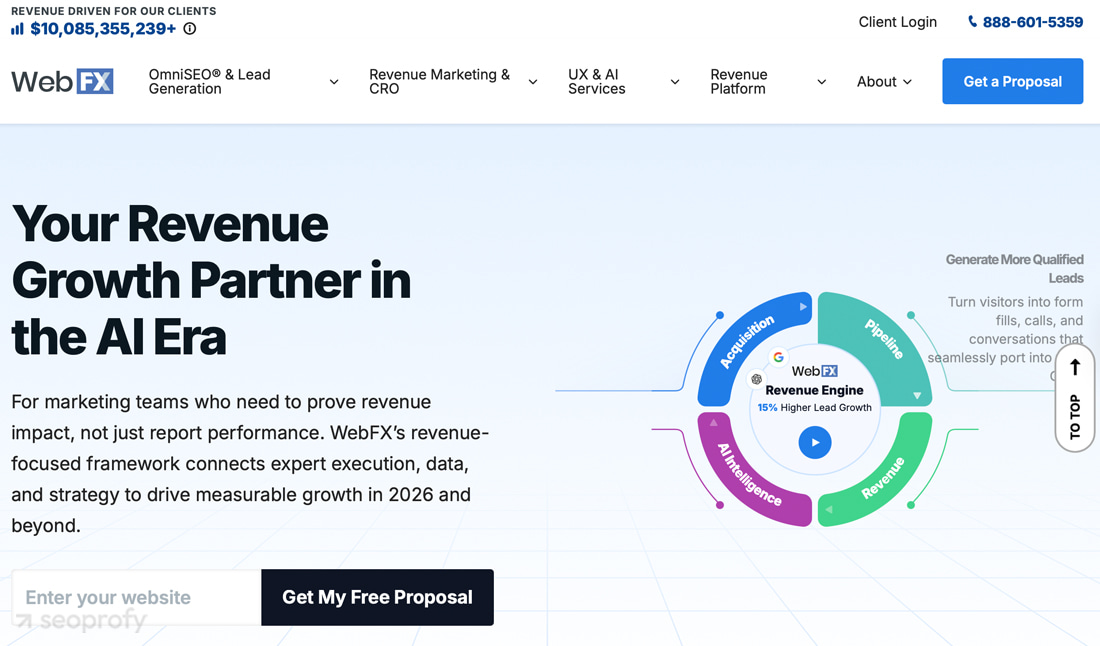
Best for: Mid-market and enterprise teams that want GEO handled as part of a wider digital marketing program
WebFX offers generative engine optimization through OmniSEO®, combining AI visibility tracking with technical SEO, content, and trust signals. It helps brands monitor mentions and citations across AI search experiences, including ChatGPT, Perplexity, Google AI Overviews, and Copilot.
WebFX combines GEO audits, content optimization, and technical SEO with AI visibility monitoring through its OmniSEO® offering. Its reporting tools help businesses assess their presence across supported AI search platforms alongside broader digital marketing performance.
- Core services: SEO services, OmniSEO®, AI brand visibility audit, GEO, AI consulting, PPC management, social media advertising, digital marketing, content marketing, and more
- Years of experience: 30+
- Team size: 750+
- Reviews: 4.9/5 on Clutch (454 reviews).
- Tooling and methodology: OmniSEO® system and RevenueCloudFX dashboard with real-time monitoring of brand mentions across AI sources
- Clients: O’Reilly Auto Parts, Truckstop, LiftMaster, Northrop Grumman, Thompson Tractor
Why choose them:
- 30+ years of experience with proprietary OmniSEO® and RevenueCloudFX for advanced SEO/GEO strategies
- Campaigns target AI query research, authority-building assets, and multi-platform citations
- OmniSEO® gives teams one visibility plan across Google rankings and AI citations, so the work stays coordinated.
3. Omniscient Digital
Best for: B2B SaaS teams that want a content-led GEO partner, with entity work, PR signals, and citation-oriented execution baked into the engagement
Omniscient Digital is an organic growth agency known for its content-led SEO strategies for B2B software teams. It also offers generative engine optimization (GEO) services, including prompt tracking, owned-media optimization, earned media, and brand-mention outreach.
Omniscient Digital’s GEO case studies demonstrate measurable improvements in AI search visibility. For OnBoard, the agency achieved 88% visibility across tracked, unbranded AI search prompts in August 2026, ranking first in its category. For Convert, Omniscient reported an 81% increase in LLM visibility and a 140% increase in AI citation share within 60 days.
- Core services: GEO, search engine optimization, technical SEO, content production, digital PR, link building, and digital analytics
- Years of experience: 7+
- Team size: 10-49 (Clutch)
- Reviews: 4.8/5 on Clutch (6 reviews)
- Tooling and methodology: Prompt tracking, owned-media optimization, earned media, and brand-mention outreach.
- Clients: SAP, Adobe, Loom, Jasper, BetterUp, Asana, Hotjar, TikTok
Why choose them:
- Content-forward GEO, built for B2B teams that care about pipeline
- GEO pillars that include entity work, citation engineering, and PR signals
- Numerous case studies with concrete growth numbers.
4. Siege Media
Best for: Teams with a big content footprint that needs ongoing updates
Siege Media combines original research and digital PR with ongoing content optimization. Its proprietary DataFlywheel technology supports content updates and helps maintain the relevance of high-value pages.
In its Mentimeter GEO case study, the agency reported 124,000 ChatGPT sessions over six months and 3,400 conversions in a single month, demonstrating the potential of bottom-funnel content optimization for AI search visibility.
- Core services: GEO, content marketing, product SEO, digital PR, link building, content localization, interactive assets (calculators), web design
- Years of experience: 13+
- Team size: 50–249 (Clutch)
- Reviews: 4.9/5 on Clutch (48 reviews)
- Tooling and methodology: DataFlywheel for quarterly content refreshes and BlueprintIQ for competitor analysis, content gap research, topic prioritization, and content brief generation.
- Clients: Mentimeter, Zapier, Figma, Airbnb, Norton, LifeLock, AAA, Purple
Why choose them:
- A GEO system built around original data + PR + freshness tech, aimed at citations and link durability
- Proprietary tools that keep high-value pages current on a quarterly cadence
- Case study library that calls out LLM visibility alongside SEO outcomes.
5. Go Fish Digital
Best for: Ecommerce and B2B teams that want generative engine optimization services paired with technical SEO + digital PR
Go Fish Digital is a full-service digital marketing agency that treats GEO as a mix of content work, technical accessibility, and citation-driven tactics. Go Fish Digital uses semantic content audits to assess topical coverage, page structure, and content relevance. Its optimization process focuses on improving how clearly each page meets search intent, organizes information, and supports key claims with relevant details.
Its generative engine optimization toolkit uses four tools. That set includes a Semantic Content Audit, an AI Overview Analyzer, a Similarity Score Extension, and Barracuda, which evaluates pages against 14 factors Go Fish associates with Google patents.
- Core services: Search engine optimization, GEO, paid search, website design, online reputation management, email marketing, digital PR, brand strategy
- Years of experience: 20+
- Team size: 250–999 (Clutch)
- Reviews: 5.0/5 on Clutch (13 reviews)
- Clients: LegalZoom, JoyBird, Lowe’s, MoneyGeek, SimpleTexting
- Tooling and methodology: Semantic Content Audit, AI Overview Analyzer, Similarity Score Extension, and Barracuda
Why choose them:
- Page and passage work for AI Overviews and LLM answers, backed by similarity scoring and semantic mapping
- The technical GEO scope includes structured data, IndexNow, sitemaps, and internal linking
- Patent-backed content scoring via Barracuda, designed around how Google retrieves and ranks information.
6. iPullRank
Best for: Enterprise companies with complex websites that need advanced technical SEO, semantic content optimization, and AI search visibility measurement.
iPullRank approaches GEO through its Relevance Engineering methodology, combining technical SEO, semantic content analysis, and information retrieval principles. Its work focuses on improving how search and AI systems discover, interpret, and retrieve content, making the agency particularly relevant for enterprise websites with complex architectures and extensive content libraries.
The agency uses semantic analysis, query fan-out research, and content optimization to identify gaps in how brands appear across AI search experiences. Its approach also includes technical audits, content structure improvements, and AI visibility measurement to help enterprise teams strengthen their presence in AI-generated answers.
- Core services: Generative engine optimization, Relevance Engineering, AI search strategy, technical SEO, semantic content optimization, content engineering, digital PR, and AI visibility measurement.
- Years of experience: 12+
- Team size: 40+
- Tooling and methodology: Relevance Engineering framework, AI Search Manual, semantic scoring, retrieval analysis, query fan-out assessment, and AI search visibility audits.
- Clients: Target, Etsy, CoinDesk, Adidas, Zazzle, Nordstrom, American Express.
Why choose them:
- Proprietary Relevance Engineering framework combining information retrieval, technical SEO, content strategy, and digital PR.
- Advanced semantic analysis and passage optimization to improve content relevance and accessibility for AI search systems.
- Enterprise-focused AI search audits, competitor benchmarking, and measurement of citations, AI referrals, and brand visibility.
7. Intero Digital
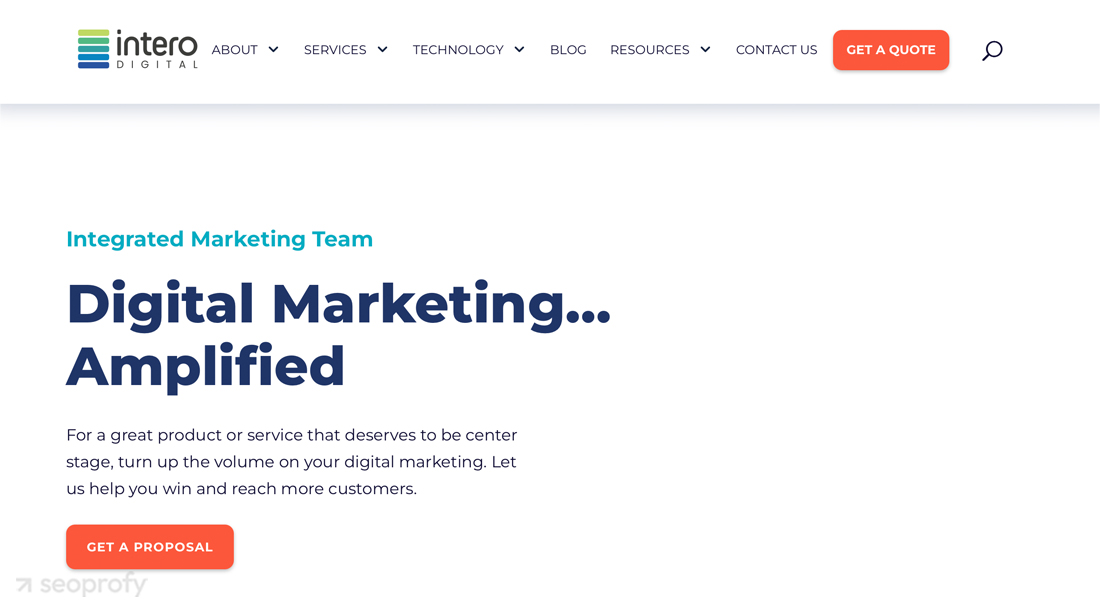
Best fit: Mid-market and enterprise brands seeking one integrated GEO team.
Intero Digital offers GEO services through its Intero GRO™ framework, which brings together technical SEO, entity-focused content, digital PR, and AI search visibility analysis.
Intero Digital’s approach covers multiple stages of search optimization, from AI visibility analysis and topic planning to technical improvements and digital PR. This integrated model may appeal to companies that prefer a single provider for SEO and GEO execution. They back it with tools like InteroBOT®, an AI-powered crawler that mimics search bots for audits and predictions.
- Core services: SEO, GEO via Intero GRO™, paid media, web development, content marketing, digital PR, and brand strategy.
- Tooling and methodology: RASE framework (Relevance, Authority, Structure, Engagement), Intero GRO™ for full-funnel execution, InteroBOT® AI crawler
- Clients: Global Industrial, KitchenSupply, Liaison, Tamron Americas, Quantum Health, Nomadix
- Combined experience: 30+
- Team size: 200+
- Reviews: 4.8/5 on Clutch (147 reviews)
Why choose them:
- Longstanding SEO experience, paired with proprietary frameworks and tooling
- GRO that brings SEO, digital PR, and cross-platform brand signals into one GEO program
- A full-funnel GEO delivery that covers generative visibility analysis, entity-led topic clusters, schema markup, and brand mentions.
8. Victorious
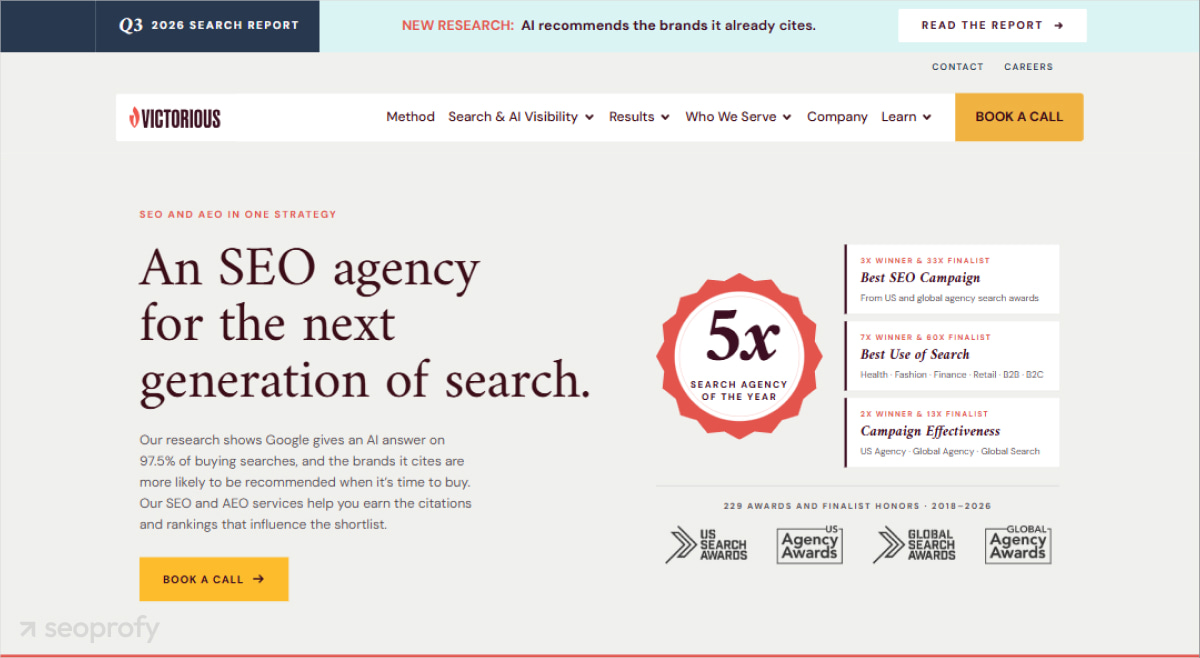
Best for: Mid-market and enterprise brands that are looking for an AEO + SEO strategy
Victorious is an award-winning SEO agency based in San Francisco that approaches Answer Engine Optimization (AEO) as an extension of traditional SEO. Its services focus on improving content visibility and citation opportunities across Google AI Overviews and other AI-powered search platforms.
The agency combines question-based keyword research, content optimization, and technical SEO to strengthen visibility in AI-generated answers. Its team restructures priority pages to deliver clear, relevant information and addresses technical issues that may affect content accessibility for search engines and AI crawlers.
- Core services: SEO, AEO, keyword research, on-page, technical work, content writing, link building, local SEO, and site migrations
- Years of experience: 13+
- Team size: 50+
- Reviews: 4.8/5 on Clutch (119 reviews)
- Tooling and methodology: SEO + AEO audits, query research, content optimization, structured data, and technical execution.
- Clients: GE Digital, Delta Dental, Bitly, Unionbay, SoFi
Why choose them:
- One integrated strategy supports visibility across traditional search results and AI-generated answers.
- End-to-end execution: audits → query mapping → content rewrites → schema/technical fixes
- An SEO-first approach that combines established technical optimization practices with content improvements aimed at AI-generated answers.
9. First Page Sage
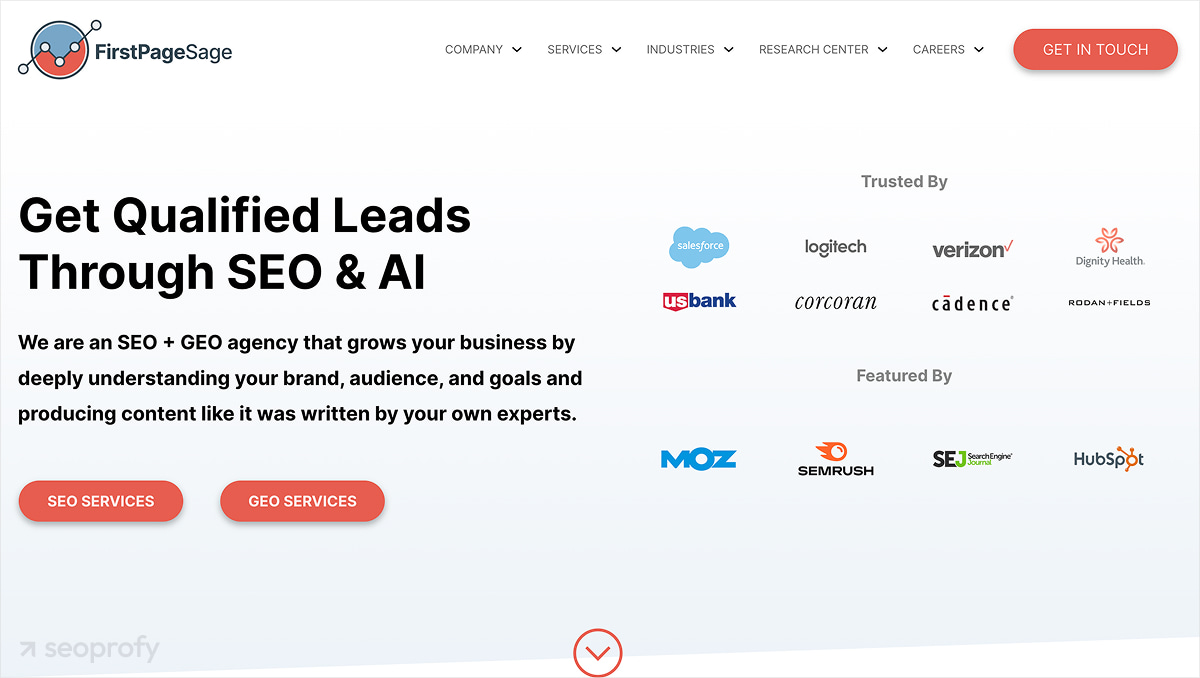
Best for: Brands in high-consideration categories like B2B software, professional services, and specialized products that benefit from list placements and database visibility
First Page Sage positions itself as an SEO and GEO agency. Their campaigns lean on six elements: list placement, database inclusion, authority on Google and Bing, review strength, public proof points like awards and usage stats, and social sentiment monitoring that influences recommendations.
They also spell out the hands-on side of delivery. Their team acts as the content creator, manages list and database outreach, and monitors reputation signals.
- Core services: SEO consulting, SEO strategy, generative AI optimization, web design, and lead generation
- Tooling and methodology: Six-part GEO framework, end-to-end execution
- Clients: Logitech, Salesforce, Alcoa, Rodan + Fields, Cadence, Corcoran, Sierra Wireless
- Years of experience: 17+
- Team size: 50+
Why choose them:
- KPI-driven GEO work built around long-term goals
- One team handles the full GEO scope, from content creation to list and database outreach
- Its six-part GEO framework addresses several factors associated with online brand visibility, including third-party listings, reviews, search authority, and reputation signals.
10. RevenueZen by Eastern Standard
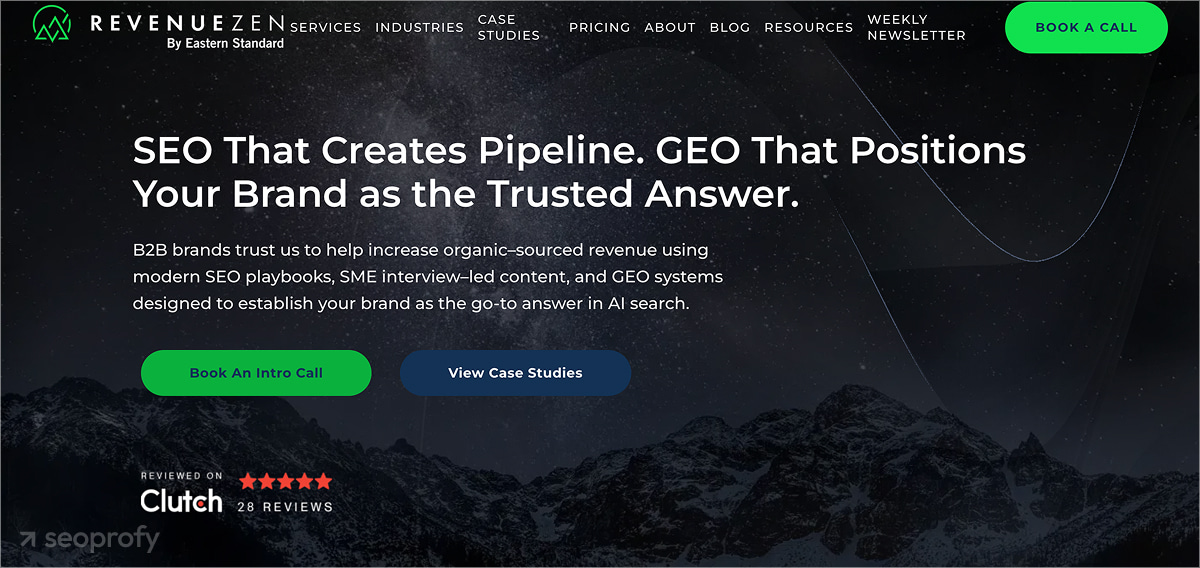
Best for: B2B teams that want GEO connected to pipeline goals, with advanced tracking and reporting
RevenueZen connects SEO and GEO planning with B2B pipeline goals. Its approach includes analytics setup, content strategy, optimization, and ongoing measurement, with an emphasis on tracking how organic and AI search contribute to business performance.
They use GA4 to track referrals from ChatGPT, Perplexity, Gemini, DeepSeek, and Copilot, and pair it with monitoring for brand mentions and citations. Monthly tracking of “customer questions” is part of that routine, so teams see where they show up and what the answers look like.
- Core services: B2B SEO services, GEO, B2B content strategy, SEO audits, LinkedIn content, growth marketing, and interview-led AI content
- Years of experience: 8+
- Team size: 10+
- Reviews: 4.9/5 on Clutch out of 38 reviews
- Tooling and methodology: GA4 tracking for referrals from AI search engines, a 5-stage delivery flow (Analyze → Grow → Expand → Validate → Refine)
- Clients: Expensify, Bloomfire, SmartSheet, Dooly, MainStreet, RallyBright
Why choose them:
- Revenue-first SEO + GEO delivery built for B2B pipeline
- Detailed measurement of AI referrals, mentions, and citations
- Brand presence work across LinkedIn, directories, and roundups.
How to Choose a GEO Agency
Choosing the right GEO agency depends on your industry, website complexity, target markets, and business goals. Before comparing proposals, assess each provider’s experience, measurement methods, technical capabilities, and approach to AI search optimization.
Unlike traditional SEO reporting, which often centers on rankings and organic clicks, GEO also looks at whether AI models mention a brand or cite its pages in AI-generated responses. Agencies may use AI tools to test conversational queries and track citations across platforms.
Ask which models, prompts, and sources each tool includes so you know what its visibility data represents. If your buyers use AI agents to compare vendors, ask whether the agency monitors those experiences too.
Key Selection Criteria
Here are the factors worth checking:
- Industry knowledge: Search for experience with businesses that have similar audiences, sales cycles, and search behavior. Ask how the agency identifies relevant AI search queries, evaluates competitors, and adapts its approach to your market.
- Case studies and reviews: Use case studies or client references to assess an agency’s proven track record where evidence is available. Check that the results match the metrics you care about, such as citations for priority topics or brand mentions. Ask for the baseline, dates, platforms, prompts, and metric definitions. Distinguish brand mentions, linked citations, and referral visits; these are separate signals. Treat results from a small prompt sample as a snapshot, not a market-wide visibility rate.
- SEO + GEO expertise: An AI search strategy should build on sound technical SEO and useful content. Depending on the site and its goals, it may also involve structured data, authority building, digital PR, and credible AI trust signals. A team that can coordinate this work can reduce vendor handoffs. Google says AI Overviews and AI Mode do not require special schema markup. Pages must be indexed and eligible to appear in Google Search with a snippet. Structured data can still describe page content for supported search features, but it is not a shortcut to AI citations.
- Prompt testing and monitoring: Ask how the agency selects prompts and platforms to monitor, how often it runs checks, and how it accounts for changes in AI answers. Prompt tests can show how a brand appears at a given time, but results may vary across runs and platforms.
- AI attribution and tracking setup: Ask how the agency tracks AI visibility, citations, and referral visits separately. GA4 can report visits attributed to identifiable referral sources, but it does not capture every brand mention or citation in an AI answer.
- Monitoring and reporting: GEO moves fast, so reporting is one of the essential parts. Look for a team that shares regular updates on how many mentions and citations your brand got, what changed in visibility and identifiable AI referral traffic, and the next set of priorities.
- Contract terms: Before signing, check the scope, initial term, renewal and cancellation terms, reporting schedule, and review milestones. Agree in advance on how progress will be assessed.
How to Measure GEO Agency Results
To measure AI search visibility, track AI mentions and citations alongside rankings and clicks from traditional search engines; report referral visits and conversions separately.
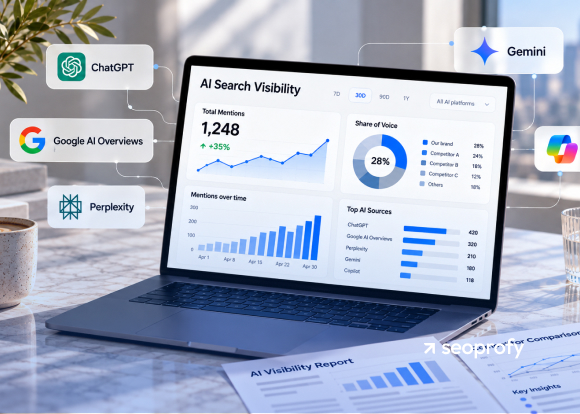
- AI visibility and citation tracking: Use AI search monitoring tools like Peec AI, Profound, Ahrefs Brand Radar, or Semrush’s AI Visibility Toolkit to monitor brand mentions and citations across the AI platforms each tool supports. Compare results over time using a consistent set of prompts, and check each tool’s platform coverage before comparing numbers.
- AI referral traffic in GA4: Use GA4’s AI Assistant channel to review identifiable referral sessions from supported AI services. Google AI Overviews and AI Mode are not included in that channel; use the Generative AI performance report in Search Console to monitor visibility in those features. Log file analysis can show visits from identifiable AI crawlers, but crawler activity is separate from referral sessions and does not show whether a page was cited.
- AI share of voice: Measure how frequently your brand appears in AI-generated responses compared with selected competitors. Use the same set of relevant prompts, platforms, and measurement periods to make comparisons more consistent. Report brand mentions and linked citations separately, as they represent different types of visibility.
- Citation quality: Review whether AI responses describe your brand accurately and in relevant context and whether cited pages support the claims. Track sentiment separately; mentions may be positive, neutral, or negative.
- Conversions from AI referral traffic: Track leads, signups, and sales from identifiable sessions in GA4’s AI Assistant channel. This report shows conversions attributed to measurable AI referrals, but it won’t capture every conversion that an AI answer may have influenced.
GEO performance should not be evaluated through referral traffic alone. A more complete assessment combines brand mentions, linked citations, AI share of voice, identifiable referral sessions, and attributed conversions. Reviewing these metrics by platform and topic helps distinguish visibility gains from measurable business outcomes.
GEO Agency FAQ
How Much Does a GEO Agency Cost?
GEO agencies typically charge 1,500–3,000 per month for startups and small businesses, 3,000–10,000 for mid-market companies, and 10,000–25,000+ for enterprises.
Pricing depends on website complexity, target markets, and the scope of services, including technical SEO, content optimization, digital PR, and AI visibility monitoring. These are estimated ranges, not standardized industry rates.
How Long Does GEO Take to Show Results?
GEO results depend on the website’s starting position, the scope of optimization, and how frequently AI search systems update their sources.
Initial audits and visibility baselines can be completed before meaningful changes in citations or referral traffic become apparent. Ask agencies to define implementation milestones and reporting intervals rather than promise a fixed date for results.
Is SEO Still Worth It in 2026?
Yes. GEO/AEO does not make SEO obsolete. Google says its AI Search features rely on core Search ranking and quality systems, and that foundational SEO practices remain relevant.
Keep technical access, indexing, and useful content in place while adding AI visibility and citation tracking where relevant to your goals. Google says there are no extra technical requirements for inclusion in AI Overviews or AI Mode.
GEO vs AEO: Is There a Difference?
There’s no universally agreed distinction between GEO and AEO. Google describes both as terms used for work focused on improving visibility in AI search experiences.
Some providers may use GEO for generative AI responses and AEO for direct answers, but definitions vary. When comparing agencies, ask which platforms, deliverables, and metrics each term covers.
Can an Agency Guarantee Citations?
No. An agency cannot guarantee that ChatGPT, Perplexity, Gemini, or Google AI features will cite your pages for specific queries.
The platforms choose what to show, and visibility can change by question and over time. A responsible provider can explain its approach, agree on measurable work and reporting, and track citations, but should not promise fixed placements or citation counts.
Partner with an Expert GEO Agency
The best GEO partner is not necessarily the agency with the broadest service offering. Look for a provider whose expertise matches your industry, technical requirements, and business goals. A reliable agency should also demonstrate measurable results, explain its optimization methods, and provide transparent reporting.
Compare agencies based on documented results, their approach to AI visibility measurement, and how effectively they integrate GEO with technical SEO, content, and authority building. Consider whether they can adapt their strategies as AI search platforms evolve and connect improvements in brand visibility with meaningful business outcomes.
GEO works best as part of a broader organic search strategy rather than a standalone effort. Combining technical improvements, high-quality content, and credible authority signals can help businesses strengthen their presence across traditional search engines and AI-generated answers.
Contact an ROI-driven SEO partner today to assess your current AI search visibility, identify optimization opportunities, and build a strategy focused on qualified traffic, leads, and long-term business growth.

Khrystyna Dzhumaryk is a content writer at SeoProfy with four years of experience in SEO and content strategy. At the company’s main blog, she writes in-depth articles and guides to help businesses improve their online visibility through proven tactics. Her work brings together hands-on SEO experience with ongoing research into algorithm updates, search trends, and the growing impact of AI on content and optimization.