

 Add SeoProfy as a preferred source on Google

The influence of AI on SEO in 2026 is twofold: it has changed the way people search, and it has transformed SEO workflows. Our AI SEO statistics confirm a seismic shift in search, an ongoing visibility crisis, and marketers’ fears of AI answers replacing clicks. We’ve also covered how SEO specialists are using AI tools to keep up with shifting search behavior and improve AI visibility.


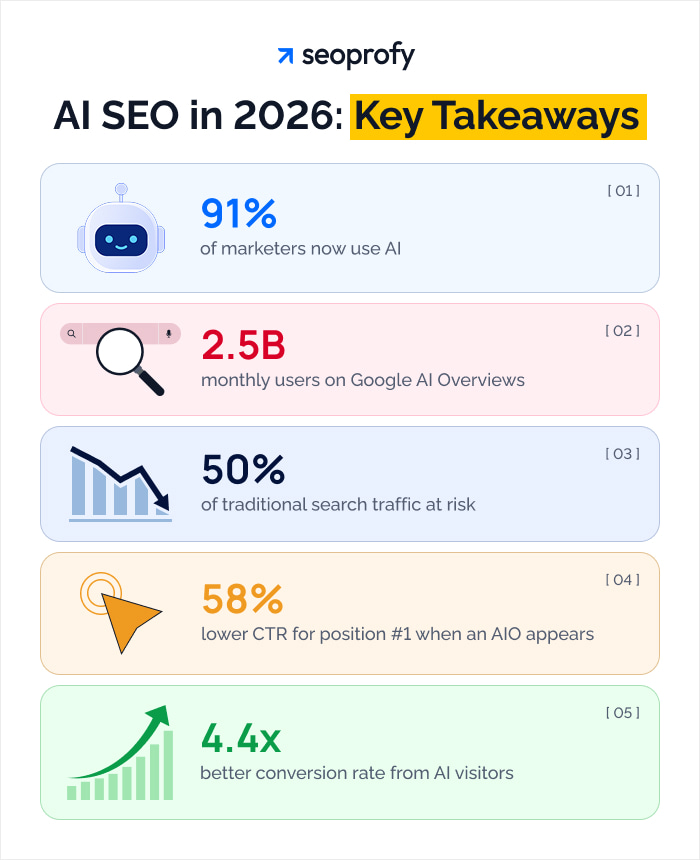
- 91% of marketers use AI in 2026.
- Text-based content creation is the most popular AI use case, reported by nearly half of marketers (47%).
- 64% of marketers see increased productivity as the top metric for measuring AI tool effectiveness.
- AI-generated answers threaten up to 50% of traditional search traffic.
- 99.9% of keywords that trigger AI Overviews are informational.
- The average visitor from AI search is 4.4x more valuable than the average organic search user, based on conversion rates.
Top AI SEO Statistics
Marketers are going all in on AI for their everyday tasks. The most common uses fall exactly where you would expect: content creation, SEO, brainstorming, and analyzing data. That said, let’s look at the most recent SEO statistics around AI adoption and use cases:
- In 2026, the number of marketers actively using AI in their work grew from 63% to 91%. (Jasper)
- About 40% of Google search sessions end in zero clicks for 80% of users. (Bain)
- 83% of users say answer engines are more efficient than traditional search. (HubSpot)
- One in three marketers now has AI-related work responsibilities built into their role. (Jasper)
- 56% of marketers use AI to generate ideas. (Jasper)
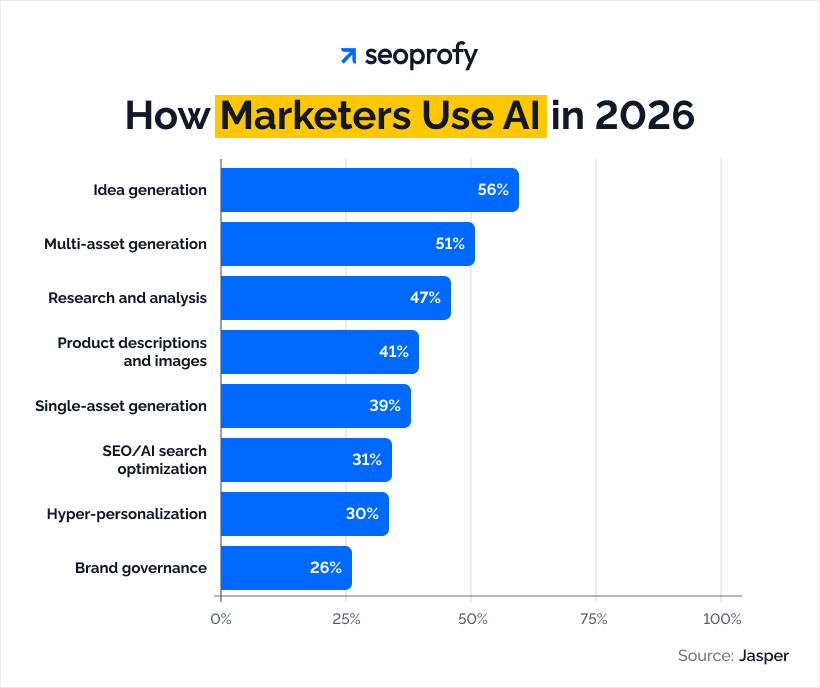
Here’s how marketing experts use AI, by share of adoption:
|
Use case |
% marketers using AI |
| Idea generation | 56% |
| Multi-asset generation | 51% |
| Research and analysis | 47% |
| Product descriptions and images | 41% |
| Single-asset generation | 39% |
| SEO/AI search optimization | 31% |
| Hyper-personalization | 30% |
| Brand governance | 26% |
66% of Marketers Use AI in Their Role
AI tools are effective at streamlining time-consuming search engine optimization tasks such as keyword research, writing optimized meta tags, structuring articles, and even analyzing competitors. Studies from HubSpot, Zebracat, and Jasper show how artificial intelligence simplifies SEO processes and frees up time for teams:
- Worldwide, 66% of marketers use AI in their role. This number is 74% among US experts. (HubSpot)
- 29% of marketing organizations say it takes three to five months to execute multi-asset campaigns involving AI. (Jasper)
- 27% of marketers cite legal compliance as the main reason for not using AI across all work processes. Other concerns include output quality (20%), data privacy (16%), ROI measurement difficulties (8%), insufficient budget (6%), lack of expertise (6%), integration challenges (5%), and limited leadership support (4%). (Jasper)
What Does This Mean for SEO Teams?
Recent research shows that faster time-to-market is the main benefit of AI implementation for 51% of marketers. According to HubSpot, 67% of marketing teams save 10 or more hours per week thanks to AI. Separately, 68% report that AI has increased their productivity, giving them extra time to focus on customer engagement.
AI Search and SERP Evolution Statistics
Search discovery is moving fast. Google is continuously expanding AI Overviews and AI Mode, and we’re now seeing large language models (LLMs) send measurable referral traffic across almost every industry. The biggest shift for SEO teams today is balancing traditional blue links and winning AI visibility battles inside generated answers. Here are the statistics that demonstrate this:
- AI Overviews in Google show up for about 21% of keywords. (Ahrefs)
- One in six AI Mode searches in the US use voice or images. (Google)
- Brainstorming queries from US users have grown 30% faster than queries overall since the launch of Google AI Mode. (Google)
- In 97% of cases, AI Overviews pull at least one cited source from pages ranking in the top 20 organic results. (SeoClarity)
- 99.9% of keywords triggering AI Overviews are related to informational queries. Only 5.5% of keywords that can trigger this feature are related to commercial queries, 1.2% are transactional, and 0.1% are navigational. (Ahrefs)
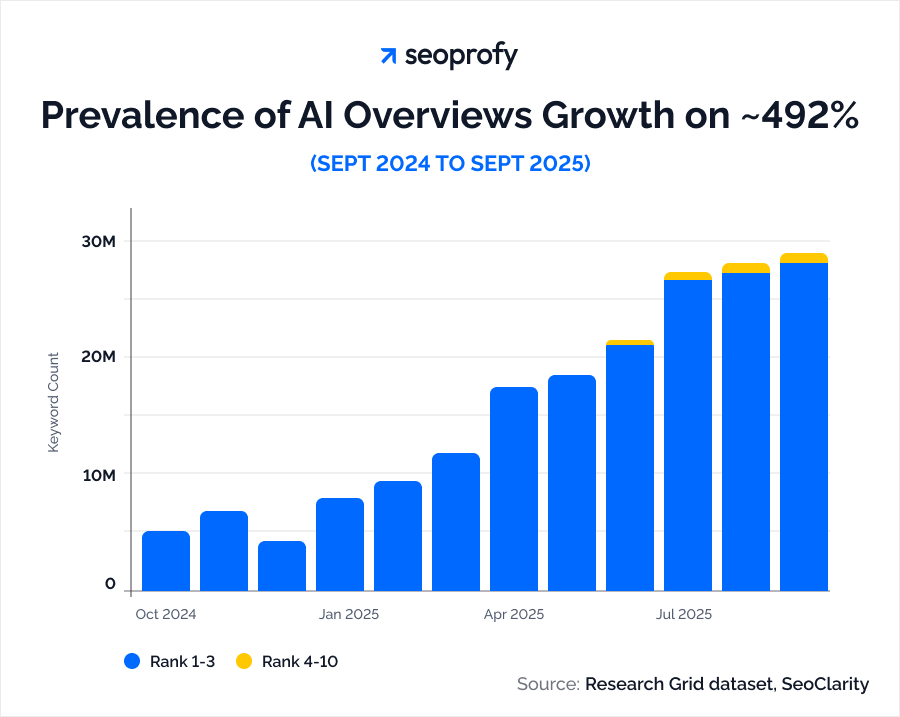
- The appearance of AI Overviews on desktop in the U.S. rose by approximately 492% from September 2024 to September 2025. (SeoClarity)
- 50% of users now turn to AI-powered search. (McKinsey)
- Brands that haven’t implemented GEO solutions may experience a 20-50% decline in traffic due to the rise of AI-powered search. (McKinsey)
- 44% of shoppers name AI as their preferred source of information, which comes ahead of traditional search (31%), retailer websites (9%), and online reviews (6%). (McKinsey)
Google AI Overviews Now Reach 2.5 Billion Monthly Users
According to Google, AI Overviews are now available in more than 200 countries and have reached more than 2.5 billion monthly users, appearing in a massive share of global searches.
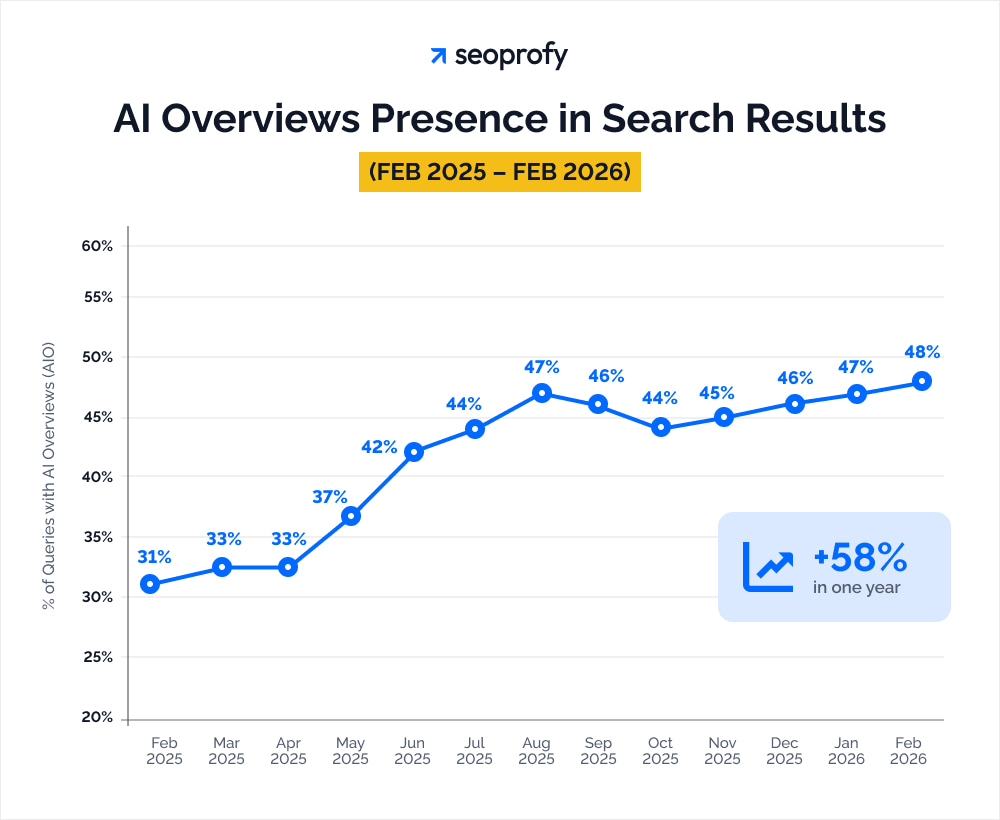
- The presence of AIOs grew by 58% in a year, from roughly 30% to 48% of tracked queries. (Brightedge)
The table below shows a steady growth of AI Overviews in the search results from 2025 to the beginning of 2026:
|
Month, year |
Average AIO presence |
| February 2025 | ~31% |
| March 2025 | ~33% |
| April 2025 | ~33% |
| May 2025 | ~37% |
| June 2025 | ~42% |
| July 2025 | ~44% |
| August 2025 | ~47% |
| September 2025 | ~46% |
| October 2025 | ~44% |
| November 2025 | ~45% |
| December 2025 | ~46% |
| January 2026 | ~47% |
| February 2026 | ~48% |
- In March 2025, 58% of Google users came across at least one AI summary during their browsing sessions. (Pew Research Center)
- On average, AI Overviews cite five sources. (HubSpot)
- The percentage of Google searches with AI summaries is expected to grow from 50% to 75% by 2028. By this time, nearly $750 billion in US revenue will funnel through AI-powered search. (McKinsey)
However, this data likely doesn’t account for Google’s goals of implementing AI Mode more widely.
AI Overviews Reduce Organic Click-Through Rates
Multiple industry studies confirm that when an AI overview takes the top spot, the traditional click-through rate for the first organic position plummets. This leads to so-called zero-click searches, where users find their answers directly on the results page without visiting an external site.
- In 2026, a typical AI overview summary averaged more than 1,200 pixels in height, pushing the organic search results page below the fold in a standard screen layout. Fewer users scroll down to the organic listings when an AIO is present. (Brightedge)
- Nearly 70% of readers move on after scanning just the opening section of an AI overview. (Semrush)
- 49% of marketers agree that search traffic has decreased due to AI overviews and Google AI mode. (HubSpot)
- As of December 2025, AI Overviews reduced position-one organic CTR by 58%. (Ahrefs)
- Users click on traditional search links in only 8% of visits when an AI summary appears, compared to 15% when there are no AI-generated answers. (Pew Research Center)
- In the US, early 92-94% of AI Mode searches end without a single click on desktop devices (compared to 43% for AI Overviews in the same dataset). (Semrush)
- 99% of users who see AI summaries don’t click the cited sources. (Pew Research)
AI Statistics in Voice Search
AI-powered voice assistants have gone from being a novelty to a daily habit for a growing share of users. AI gives these assistants better context understanding and makes conversations with smart speakers feel more natural. Here’s a look at the data behind this shift and where voice search optimization is headed:
- The global voice commerce market is estimated to reach over US$186 billion by 2030. (Grand View Research)
- One in three voice assistant users leverages AI platforms like ChatGPT. (DomainDetails)
- 38.8 million US residents use smart speakers for shopping-related activities. (DomainDetails)
- Voice assistants are expected to reach 157 million users in the US in 2026. (Statista)
- In 2025, 62.1% of regular voice assistant users in India learned about new financial products through voice search. (ResearchGate)
- Voice is projected to become the primary interface for most digital interaction by 2035. (Ian Khan)
- Voice-driven search on AR and VR platforms is expected to exceed 1 billion users by 2030. This will result in the development of new interface paradigms. (DomainDetails)
Why Rankings Alone No Longer Measure SEO Success
AI-powered chatbots like Gemini, ChatGPT, and Claude handle millions of user requests every day. They’ve become go-to platforms for informational searches across a wide range of topics. For example, OpenAI’s data show that 18.9% of ChatGPT messages have search intent. High rankings are becoming less important for your online visibility. Today, getting your brand cited by these AI systems often matters more.
- Only 17% of sources cited in AI Overviews rank in the organic top 10. (Brightedge)
- Almost 90% of pages cited in ChatGPT search results rank 21+ in traditional organic search. (Semrush)
- Healthcare has the highest overlap between the top 10 and AI citations at 24%. (Brightedge)
Here’s an overview of the AI citation vs. organic top 10 overlap across different industries and how it has changed in 2026 compared to 2025:
|
Industry |
AI Citation Overlap in 2026 |
AI Citation Overlap in 2025 |
| Healthcare | 24% ⬆️ | 23.9% |
| B2B Tech | 22.6% ⬇️ | 23.9% |
| Education | 23.1%⬇️ | 26.9% |
| Insurance | 22.4%⬇️ | 22.7% |
| Entertainment | 18.5%⬆️ | 3.2% |
| Travel | 17.7%⬆️ | 5.7% |
| Ecommerce | 13.4%⬆️ | 2.9% |
| Finance | 11.3%⬆️ | 7.6% |
| Restaurants | 9.3%⬆️ | 5.1% |
Consider that the way Google chooses sources for the AI Overview also depends on the industry. For example, in health-related AIOs, its algorithms lean heavily on sources that are already trusted and high-ranking, so if you rank high in organic search, you’re likely to be cited.
At the same time, there is no connection between the sites that rank on page 1 and get referred by AI search platforms in the finance industry. Financial websites would likely need to consider different content signals for ranking in overviews than in SERPs.
What About AI Search Traffic?
AI search tools still represent a small slice of total site traffic for most brands. The speed of growth, though, has been hard to ignore, and it’s already measurable in GA4 datasets across multiple industries.
- AI tools accounted for 0.24% of total web traffic as of April 2026. (Ahrefs)
- AI search holds 0.19% combined traffic share. (Ahrefs)
- The average AI search visitor is 4.4 times as valuable in terms of conversion rates as the average user from traditional organic search. (Semrush)
Someone clicking through from an AI search has likely already read a summary, compared options, and narrowed down their choices. This makes them way more likely to convert.
- Business and service sites account for 50% of the pages ChatGPT 4o links to. (Semrush)
The overall distribution:
|
Website type |
% of links |
| Business and service | 50% |
| News and media | 9.5% |
| Blogs and content pages | 8.3% |
| Ecommerce | 7.6% |
| Unsure/other | 7.3% |
| Communities and forums | 5.6% |
| Education | 4% |
| Directories and review platforms | 3.7% |
| Social Networks | 2% |
| Government and institutional websites | 2% |
This suggests LLMs primarily direct users to business and service websites when answering product or brand-related questions.
- The rates of AI referral traffic have increased by 600% since January 2025. (HubSpot)
- One in four (26%) searches with AI summaries end with the user abandoning their browsing session entirely. (Pew Research)
- An analysis of 81,947 sites shows that AI-driven traffic differs from that of users visiting your website via traditional search engines. (Ahrefs)
The study highlighted the main differences between these two types of traffic:
|
Metric |
AI search traffic |
Traditional search traffic |
| Average number of pages visited | 4 | 5.2 |
| Average page per session duration | 2.27 | 2.79 |
| Average time on site | 86 seconds | 78 seconds |
| Average bounce rate | 67.8% | 63.7% |
- Traffic from LLMs grew 527% year over year, increasing from 17,076 sessions to 107,100 across 19 GA4 properties. (Search Engine Land)
- AI search visitors are expected to surpass traditional search traffic by early 2028. (Semrush)
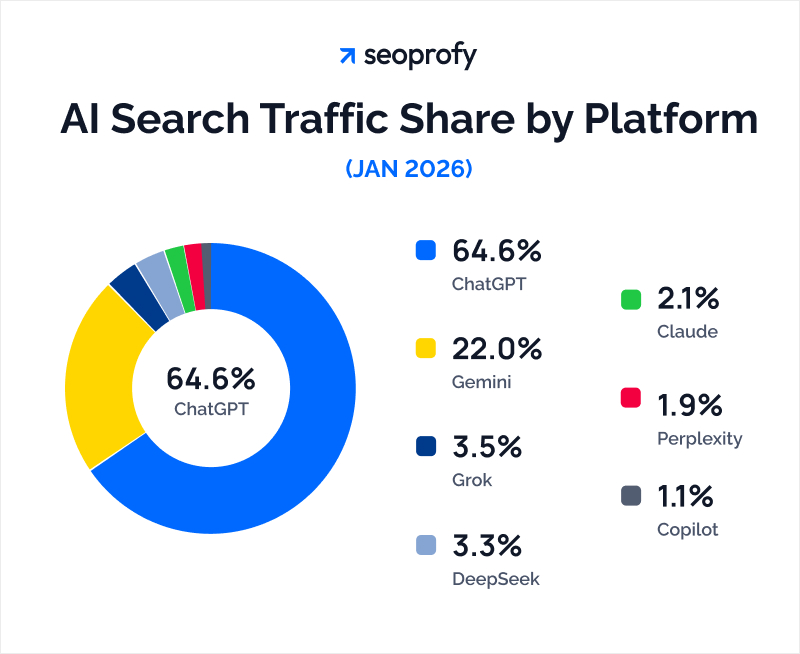
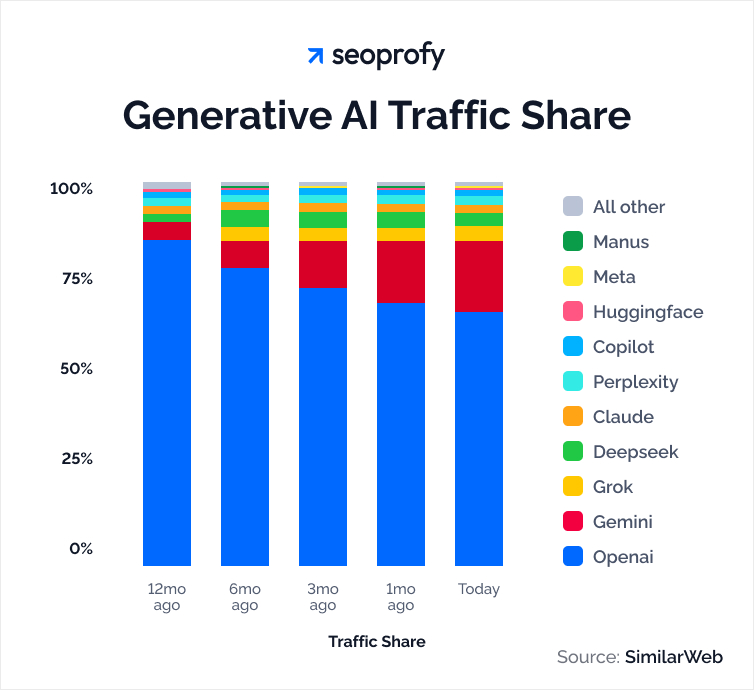
As of January 2026, Similarweb data shows the following AI search traffic share by platform: ChatGPT (64.6%), Gemini (22.0%), Grok (3.5%), DeepSeek (3.3%), Claude (2.1%), Perplexity (1.9%), and Copilot (1.1%). (Similarweb on X)
AI Citations and Brand Mentions
What websites get cited by AI tools the most? Ahrefs discovered that brands with many web mentions earn up to 10x more AI citations. Here’s what else the data shows:
- ChatGPT’s cited links point to about half (49.98%) of the URLs it actually uses to answer a single query. (Ahrefs)
- Quora is the most-cited site in Google’s AI Overviews. (Semrush)
Other platforms AI systems frequently cite include:
- YouTube
- The New York Times
- Amazon
This is why building a presence on forums like Quora and Reddit matters in 2026. You can put your brand in front of both users and AI systems.
- YouTube and Wikipedia have low citation volatility across all modern LLMs, meaning they get mentioned consistently. (Brightedge)
- Forums and Q&A platforms have the highest citation volatility (50%-3,600%), as it largely depends on the specific LLM. These websites are followed by news and media sites (20%-1,900% volatility) and blogs (25%-76% volatility). (Brightedge)
Ranking vs. Visibility as the New KPI
In the past, SEO reporting was almost entirely about rankings and organic clicks. But with the rise of generative AI, that model just isn’t sufficient on its own anymore. As search moves into a “multi-surface” world, industry reporting is shifting toward visibility metrics.
This means tracking how often a brand is cited and its total share of voice across platforms like Google AI Overviews, ChatGPT, Perplexity, and Gemini. That’s where generative engine optimization (GEO) enters the game.
GEO and AI-First SEO Strategy
Generative engine optimization is a set of tactics aimed at increasing how often a brand or page is cited and recommended by generative systems. In controlled tests, GEO-style changes increased content visibility in generative engine responses by up to 40%. (Arxiv)
How GEO Differs From Traditional SEO
What is the difference between traditional SEO approaches and generative engine optimization solutions? The following statistics highlight the key facts to consider:
- The average length for search-enabled queries in AI chatbots is nearly 8.7 words, while it’s 13.5 words for non-search. (Semrush)
- The share of prompts using traditional search language went from 18.9% in October 2025 to 34.9% in February 2026. (Semrush)
- From 65% to 85% of ChatGPT’s prompts couldn’t be matched to any traditional search keyword in Semrush’s database (nearly 27 billion keywords). (Semrush)
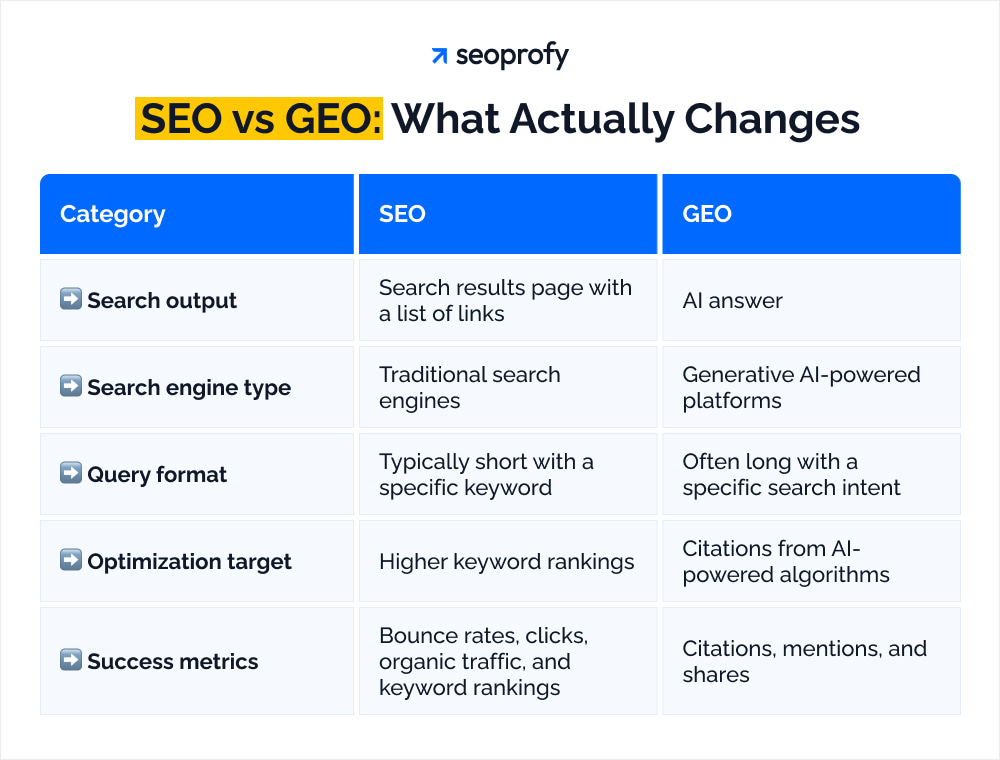
Semrush also highlights that SEO and GEO mainly differ in how content is displayed and how success is estimated:
|
Category |
SEO |
GEO |
| Search output | Search results page with a list of links | AI answer |
| Search engine type | Traditional search engines | Generative AI-powered platforms |
| Query format | Typically short with a specific keyword | Often long with a specific search intent |
| Optimization target | Higher keyword rankings | Citations from AI-powered algorithms |
| Success metrics | Bounce rates, clicks, organic traffic, and keyword rankings | Citations, mentions, and shares |
Practical GEO Levers SEO Teams Use Most Often
Ahrefs research identified the most effective GEO levers teams can act on:
|
GEO lever |
How it helps with AI visibility |
| Mentions in industry rankings and lists, PR and media coverage, reviews, and case studies | Gives generative systems reliable sources to quote and attribute. Branded web mentions are the top factor that correlates with brand appearance in AI overviews. |
| Multi-platform presence | Ahrefs recommends growing your brand’s presence on Wikipedia, YouTube, and Reddit, as these are the most-cited domains in AI Overviews. |
| Structured data | Relevant subheadings with logical formatting levels, bulleted and numbered lists, tables, and schema markup improve entity clarity and page interpretation. |
| Right content format (“best” and “top” lists, comparisons, how-to guides, and product-focused pages) | Ahrefs found that content with “best” in the title accounts for 7.06% of AI traffic, followed by contact pages (6.8%) and how-to guides (6.35%). |
| Excellent user experience on homepage and product landing pages | Make it easy for users and algorithms to find your contact details and navigate through your website. Ensure your products and services have clear descriptions to make them easier for AI to cite. |
The technical part also matters. Although nearly 75% of sites blocking AI crawlers, like OpenAI and Google AI bots, still get AI summaries, consider allowing them to parse your pages to increase your chances of AI mentions.
How AI Is Changing SEO Content Production
One of the trending topics in SEO right now is how AI impacts the content creation process. Generative AI can significantly help marketers and business owners with tasks like initial research, ideation, meta tag creation, and A/B testing.
While AI tools can streamline the content creation process, you’ll still need to edit and revise the copy before adding it to your site. Here are the key numbers:
- More than 50% of marketers optimize content with the help of AI. (SurveyMonkey)
- AI use allows companies to publish 47% more content each month. (Ahrefs)
- 52% of marketing specialists believe AI makes content so easy to create that it becomes less effective. (HubSpot)
- 71% of marketers say they create significantly more content with AI, but they still struggle to create content that performs. (HubSpot)
- 47% of ecommerce businesses use AI-generated product descriptions. (Liquid Web)
- Video is the content format most often cited by AI algorithms. (HubSpot)
LLMs also frequently cite FAQs, since these sections answer specific questions directly, which makes them easy for AI to reference.
- 40% of SEO specialists use AI for content updates. (Brightedge)
- AI-powered copywriting tools can improve ad click-through rates (CTR) by 38% while reducing cost per click by 32%. (Zebracat)
97% of Content Marketing Programs Involve AI
How many content marketers have implemented AI into their work processes, and which LLMs are the most popular with them? Here’s what the data shows
- The percentage of content marketing programs involving AI rose from 90% in 2025 to 97% in 2026. (Siege Media)
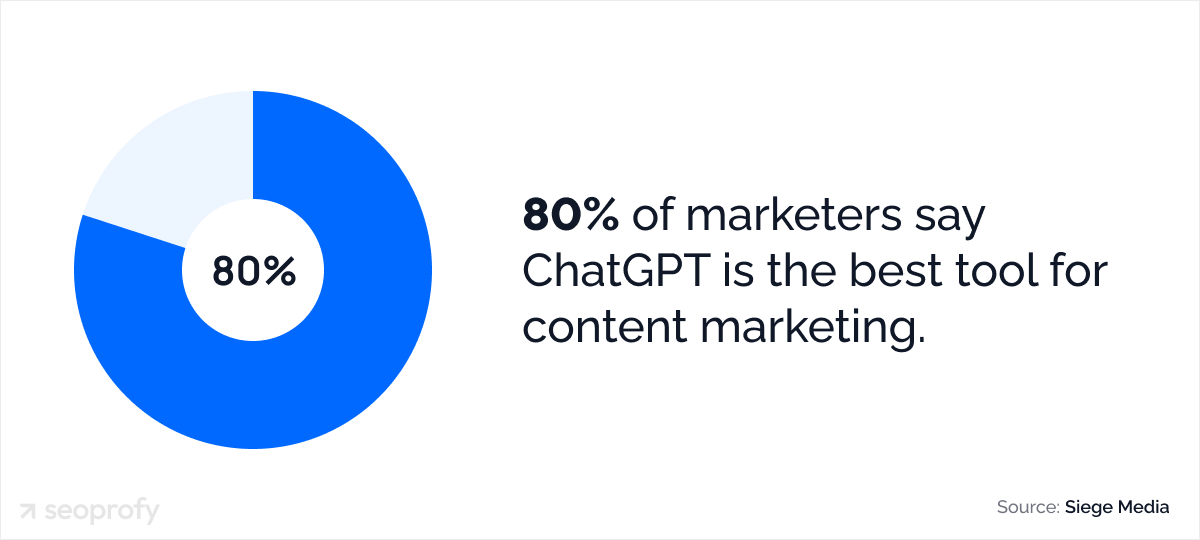
- 80% of marketers say ChatGPT is the best tool for content marketing. (Siege Media)
That said, ChatGPT isn’t the only tool marketers reach for. Claude, Gemini, and Perplexity are also widely used.
Why Human Review Still Matters
According to HubSpot, only 7% of marketers don’t edit generative AI output. At the same time, 56% of marketing specialists rewrite AI-generated texts, while 38% make minor edits. The numbers below show that most content creators use AI for specific tasks, not as a wholesale replacement for human judgment:
- Only a small fraction of marketers (1%) completely rely on AI when working with content. (Siege Media)
The data shows that most marketers blend human input with AI rather than relying on it as a full replacement:
|
AI Usage |
% of marketers |
| Human-only | 3% |
| Minimal AI use | 19% |
| Moderate AI use | 48% |
| Substantial AI use | 15% |
| Dominant AI use | 15% |
| AI only | 1% |
After the “boom” in AI-generated texts, Google announced that its algorithms reward only high-quality, original, people-first content. At the same time, pages are not penalized solely for AI content.
- The percentage of specialists using AI to generate ideas fell from 72% in 2025 to 61% in 2026. The same trend applies to content drafting: 57% used LLMs for it in 2025, down to 44% in 2026. (Siege Media)
- Purely AI-generated content ranks in the top spot just 9% of the time, based on data from AI detection tools. Meanwhile, human-written texts rank high in 80% of the analyzed cases. (Semrush)
- More content marketers are using AI for editing (38% in 2026, up from 19% in 2025). Also, 74% use this technology for content ideation. (Siege Media)
The table below shows how marketers’ approach to AI for content generation has changed over the years:
|
Activity |
% of marketers in 2024 |
% of marketers in 2025 |
% of marketers in 2026 |
| Content ideation | 71% | 68% | 74% |
| Brainstorming | 68% | 72% | 61% |
| Content strategy development | 40% | 42% | 55% |
| Design ideas generation | 32% | 25% | 47% |
| Content drafting | 47% | 57% | 44% |
| Editing | 19% | 19% | 38% |
| Email drafting | 32% | 39% | 37% |
Content marketers remain cautious about AI’s tendency to hallucinate or produce factual errors, which explains the ongoing reluctance to rely on it for drafting. Editing is an exception: AI use for editing nearly doubled.
AI SEO Performance, Traffic, and ROI
AI is changing marketing through improved data analysis, more personalized user experiences, and greater productivity. AI-driven SEO campaigns can increase organic traffic for e-commerce businesses and improve the effectiveness of on-page SEO. These AI SEO statistics show how AI can boost performance:
AI-Powered SEO Tools Can Help Increase Traffic by 49% in 6 Months
AI acts as a budget multiplier: teams get more done with the same spend by cutting time-consuming manual work. Multiple case studies and surveys back this up:
- AI content can boost SEO-driven organic traffic for online courses by 48%. (Zebracat)
- 65% of marketers say AI frees up their time, allowing them to focus on more creative aspects of their job. (HubSpot)
- AI-written blog posts that are edited for SEO see 32% higher engagement. (Zebracat)
- 27% of marketers say AI simplified their martech (marketing technology) stack, while 51% say it expanded it. (Jasper)
- Implementing AI-powered SEO tools can help increase organic traffic by 49% in six months. (Zebracat)
AI Traffic Conversion Rates
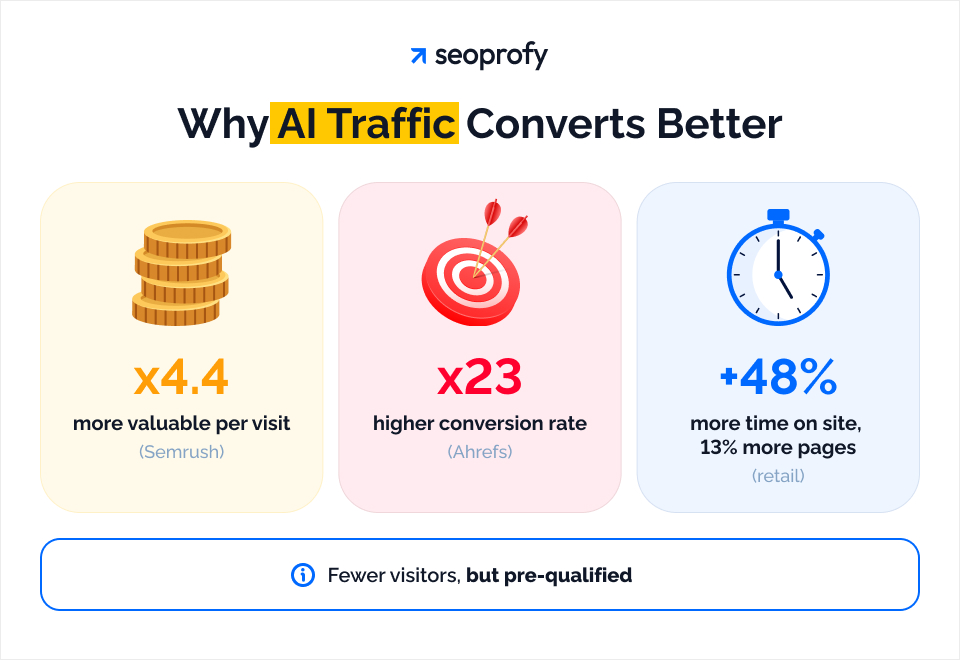
HubSpot reports that AI referral traffic converts at 3x the rate of traditional search traffic. In Ahrefs’ own analysis of its website traffic, AI search visitors converted at a rate 23x higher. The reason is straightforward: users who visit your website from AI search have already read a summary, compared alternatives, and are researching your product or services. If they click through to your site, they’re already seriously considering your brand.
The quality gap shows up in other metrics too. In ecommerce, AI traffic shows a 12% higher engagement rate. Visitors from AI platforms tend to spend 48% more time on retail sites and view 13% more pages per visit than visitors from non-AI sources.
Can AI-Driven Campaigns Improve ROI?
The short answer is yes. AI has moved from an “experiment” to a proven revenue driver. Let’s look at the stats that show it:
- 40% of marketers have seen a 6-10% increase in revenue after implementing AI in their SEO efforts. (SEO.AI)
- Increased productivity is the key metric in measuring the effectiveness of AI tools, considered by 64% of marketers. (HubSpot)
Here’s what marketers measure:
|
AI metric |
Share of marketers |
| Increased productivity | 64% |
| Time saved | 55% |
| Improved role performance | 43% |
| Better customer personalization | 39% |
| Deeper data insights | 39% |
| Increased ROI | 37% |
| Positive feedback from colleagues | 22% |
- Despite the benefits of AI-driven traffic, 49% of digital marketing specialists still say organic search provides the best ROI. (SEO.AI)
Future Outlook on AI Adoption
The data makes clear that AI adoption isn’t slowing down — and more marketers plan to expand their use of AI tools over the next year. Here’s what they have in mind:
- About 94% of marketers plan to integrate AI into their content creation and blogging workflows throughout 2026. (HubSpot)
- Over the next 12 months, 57% of marketers plan to use AI to scale content production. Other top fields also include personalization improvement (49%), optimization for AI and traditional search (44%), and multimedia asset creation (34%). (Jasper)
- In 2026, AI chatbots top the list of channels companies plan to invest more in (38%), just ahead of paid social (37%) and video marketing (37%). (HubSpot)
- Over 40% of agentic AI projects may be canceled by 2027. (DigitalApplied)
- It’s expected that in 2028, over 50% of knowledge workers will be creating and governing their own AI agents. (DigitalApplied)
Concerns Regarding Using AI in SEO
Even with the clear benefits of AI, many businesses still have concerns. Ahrefs’ data shows that the primary reason for avoiding AI is the low accuracy of generated content at 60%. This is followed by plagiarism concerns at 57% and bias within AI content at 36%. Here are some other stats related to it:
- 53% of marketers struggle to differentiate their content in an AI-saturated market. (HubSpot)
- CJR reported that eight generative tools, including ChatGPT Search and Perplexity Pro, gave incorrect answers on more than 60% of tested news-citation queries. (CJR)
- One out of 10 AI Overviews contains inaccurate or misleading content. Nearly half of AI answers include facts not supported by the cited sources. (Oumi)
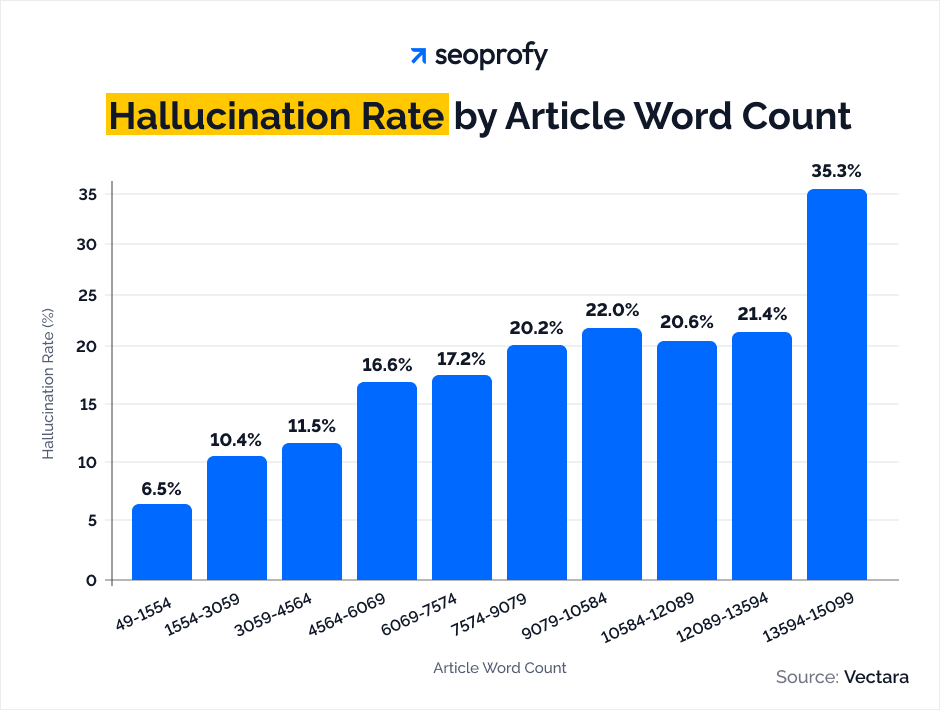
- The highest hallucination rate (35%) appeared in cases when AI was asked to generate longer articles (13,594-15,099 words). (Vectara)
What These AI SEO Stats Mean for Your 2026 Strategy
SEO is no longer just about traditional search engines. With Google AI Overviews reaching 2.5 billion users and AI-driven results appearing for a huge share of informational keywords, success now requires a focus on tracking search visibility alongside AI mentions. Here’s a playbook to act on that:
- Keep implementing SEO best practices: Google notes that its AI Overviews’ algorithms are still based on its search ranking and quality systems. It also recommends publishing non-commodity content, providing unique points of view, and adding high-quality videos and images on your pages.
- Follow Google’s guidelines for AI-generated content: If you use LLMs to produce content for your site, ensure that it complies with the Search Essentials and Google’s spam policy. It’s also worth being transparent with readers about the use of AI.
- Track AI visibility as a KPI alongside rankings: Add citations, brand mentions in AI-generated answers, and AI share of voice to your reporting. Tools like Ahrefs’ Brand Radar and Semrush’s AI Visibility Toolkit are useful for tracking this.
- Build pages that AI systems can cite: Use question-style subheadings, short quotable answers, and clear definitions. Add references to primary sources where appropriate, since AI systems rely on pages that provide clear evidence for their claims.
- Use structured data to improve entity clarity: Product, Review, Organization, FAQ, and Article markup help search engines and AI systems interpret what the page is about, plus which entity the content belongs to.
- Invest in brand authority outside your site: Mentions (both linked and unlinked) in trusted publications, reviews, roundups, and niche communities (especially on Reddit and Quora) feed both Google and LLMs.
Final Thoughts
Although Google continues to dominate the market, the growing popularity of AI-powered chatbots is starting to change the search landscape. The statistics show that artificial intelligence helps users not only with their work tasks but also with making purchase decisions and reviewing brands.
AI has cut into website CTRs, and it still doesn’t generate as much traffic as organic search. However, visitors who land on your pages from AI tools can be more ready to purchase because they’ve already done the research.
The best strategy for most businesses is to combine traditional SEO and GEO. Unique and useful content, a clear structure for web pages, a bug-free technical foundation, and mentions on popular, relevant external websites remain important to your success.
Ready to improve your site’s AI visibility? At SeoProfy, we help you spot key growth opportunities and build your brand’s presence across the major AI platforms.

Khrystyna Dzhumaryk is a content writer at SeoProfy with four years of experience in SEO and content strategy. At the company’s main blog, she writes in-depth articles and guides to help businesses improve their online visibility through proven tactics. Her work brings together hands-on SEO experience with ongoing research into algorithm updates, search trends, and the growing impact of AI on content and optimization.