

If you run an online store, optimizing your ecommerce site for AI search is key for brand visibility in 2026. Now that Google pushes AI Overviews into more searches and shoppers increasingly use chatbots for product research, you need AI systems to view your business as an authority worth recommending or citing. This requires an AI SEO strategy tailored for ecommerce needs.


To optimize ecommerce websites for AI-driven searches, you need to publish clear, detailed content that directly addresses user queries; demonstrate strong EEAT signals; use schema markup effectively; and keep technical SEO in order. In this article, we share a clear, professional perspective on how to make your business visible in AI search engines based on results from real projects.
- AI tools are the preferred source of information in product research for 44% of consumers, so showing up in Google AI Overviews (AIO), ChatGPT, or Perplexity is just as important as ranking in traditional search results.
- Brand visibility in AI matters most at the research or consideration stage: 99% of AIOs appear in informational searches, and about 18% of ChatGPT messages are related to seeking information.
- Top-of-funnel traffic is shrinking, which means the real wins now come from mid- and bottom-funnel keywords that drive actual sales.
- Brands that go deep into their category with clusters, expert voices, and real customer input are the ones AI engines trust and cite.
- Tracking AI mentions and testing new formats early is the only way to stay ahead of the competition.
Why Optimize Your SEO for AI Search?
Ecommerce website owners need to adjust their SEO strategies for AI search because 44% of consumers rely on AI-powered tools to find product information during their buying journeys. Even shoppers who don’t intentionally opt for a chatbot are still likely to encounter an AI-generated summary in the search process: Google’s AI Overviews (AIO) appear in about 20% of US searches.
Classic search rankings are no longer enough because AI responses have become an alternative search engine. If your brand does not appear in AI search results, you are simply not in the places where decisions are made.
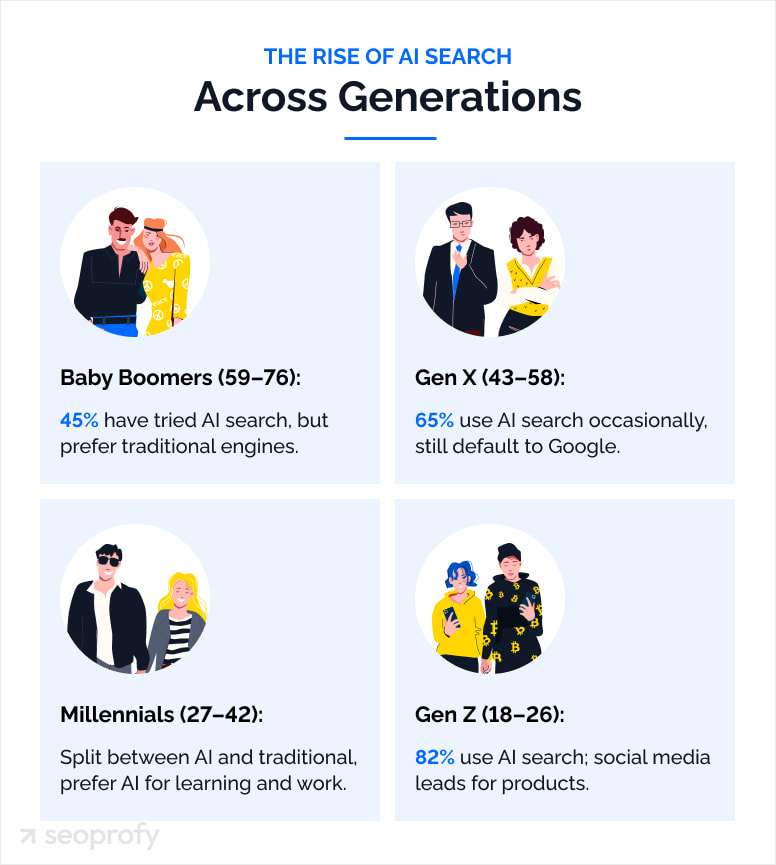
Generational adoption makes this shift even clearer:
- Baby Boomers (59–76): 45% have tried AI search but remain most loyal to traditional engines.
- Gen X (43–58): 65% use AI search occasionally yet still default to Google.
- Millennials (27–42): Split their behavior between AI and traditional search, leaning on AI especially for education and career queries.
- Gen Z (18–26): 82% use AI search at least occasionally. At the same time, they lean heavily on social media platforms for product discovery.
The adoption curve across generations makes it clear that no single channel can cover everyone. If your main buyers are Millennials or Gen Z, AEO and social discovery are critical. If your buyers are Gen X or Boomers, you cannot ignore traditional search engine optimization, but adding AI visibility is also important.
How AI Is Changing Ecommerce Search Visibility
Artificial intelligence affects how search engine results pages (SERPs) look, where your website appears on those pages, whether users see the familiar links at all, and whether they click through. These changes are particularly significant in top-of-funnel searches.
Fewer Clicks in Search Results
Google’s AI Overviews have the most direct impact here, as they are part of the organic search experience. According to our AI SEO statistics, AIOs push organic results below the fold of a typical screen when they appear in SERPs, and although most readers (70%) skip the overview and move on to traditional results, the click-through rate (CTR) of the first position drops by 58% when an AIO is present. Even the 10th spot loses almost 20% of clicks. Plus, 99% of users who read generated summaries don’t click the links they cite.
This has led to a rise in zero-click searches and a decrease in organic traffic. More and more people get a complete answer inside an AIO or a chat window and never visit a website.
Search Takes Different Forms
Another significant change brought by AI in ecommerce SEO is the way users search — the queries and tools they use:
- Conversational phrasing instead of short keywords: Search engines have already been using natural language processing (NLP) technologies to deliver more relevant search results, but AI tools take this further. Queries in AI Mode are three times longer than typical SEO keywords, and up to 85% of search queries in ChatGPT don’t match any traditional keywords. Long-tail keywords are also typical of voice searches, and 38.8 million US consumers use smart speakers for shopping-related activities.
- Visual search for product discovery: According to Google, one in six AI Mode searches uses images or audio input; Google Lens processes about 25 billion visual searches monthly, and about 20% of them show commercial intent.
These ecommerce SEO trends mean that, for example, instead of typing “buy running shoes,” users now ask, “What are the best running shoes for flat feet under 200 dollars?” Or they might even skip the typing part entirely and just search with a photo of the shoes they saw somewhere.
Here’s another practical example. Imagine a shopper choosing between the Canon G7X Mark II and the Sony ZV-1. These are not professional cameras but models for a general audience. Such a buyer is unlikely to dig into dozens of technical specifications. A short summary in an AIO with pros and cons is often enough to make a decision. For this type of query, the CTR decreases because the AI answer already feels sufficient.
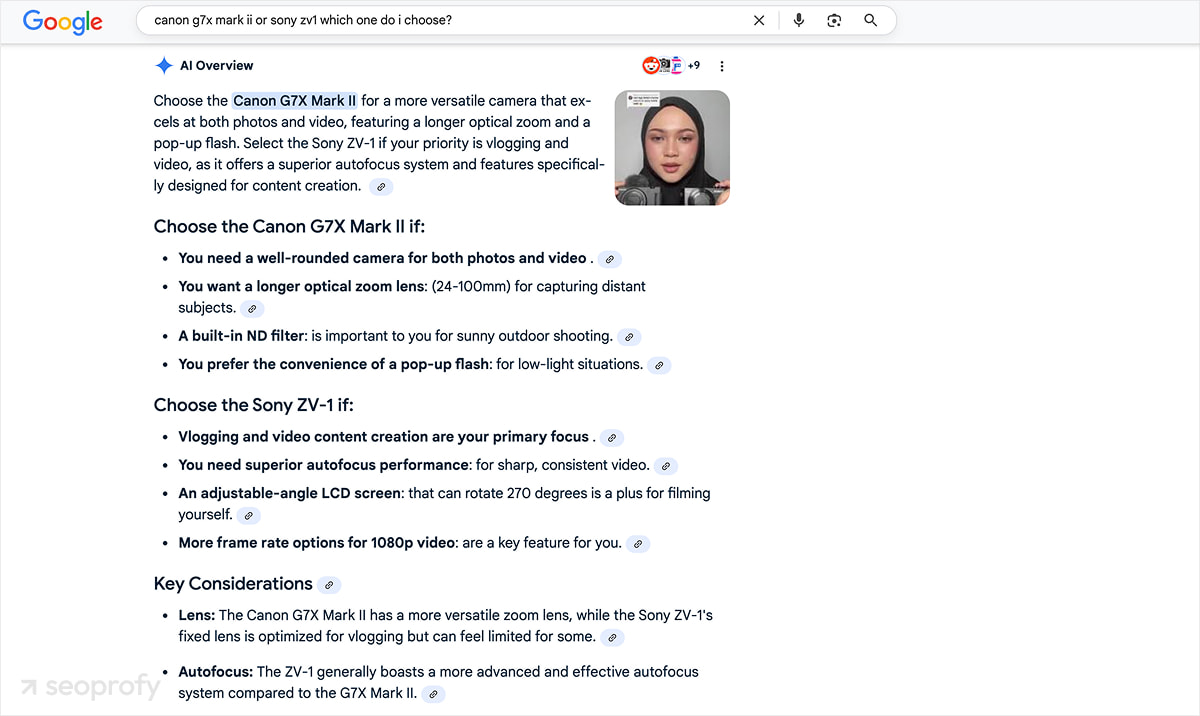
In LLM SEO, this is not a universal rule for every product. In categories with higher prices or complex features, people are still more likely to click through to compare details, read reviews, or check specifications. Businesses should look at their buyers’ journeys to see where AI answers replace clicks and where they actually drive more of them.
Product discovery, research, and consideration often happen through AI overviews and chats rather than on retail websites or blogs. AI summaries take away significant SERP real estate, pushing organic results down and decreasing the average CTR. Users are getting more comfortable searching with conversational language (through both text and voice search) and with tools like Google Lens.
What Challenges Do Ecommerce Brands Face with the AI Search Shift?
The most critical challenges AI brings into ecommerce SEO strategies are related to changing query dynamics, lower traffic, and the factors that influence AI search engine algorithms.
- Informational queries are losing ground: AI systems now cover many top-of-funnel searches such as “best running shoes 2025” or “how to clean leather boots,” which reduces traffic to ecommerce blogs and guides.
- The effect on transactional queries is limited (at least, for now): Direct purchase searches like “buy Nike Air Max size 42” are still less influenced by AI, since engines often pass these straight to product pages.
- Competition within AIOs is growing: Brands are competing to be named in AI answer boxes, where visibility builds trust and captures intent.
- Brand visibility is a prerequisite for AI citations: Branded web mentions, search volume, and anchors are among the leading factors that influence a website’s chances of being recommended by AI tools, surpassed only by YouTube mentions. This makes off-page SEO and digital PR a must.
These search trends combine with the generally decreased CTR and the growth of zero-click searches. McKinsey predicts that traffic from traditional search channels will drop by 20–50% due to AI tools and summaries, especially for unprepared websites.
What Opportunities Does Getting into AI Answers Offer?
If your ecommerce website earns LLM citations, you get the chance to grow your brand awareness and attract qualified traffic. Here are the main opportunities:
- Being cited builds trust: When your brand name shows up in an AI summary, people see you as a source worth listening to or a brand worth considering. Even if they do not click, that visibility sticks and builds authority over time.
- Authority-driven content shines: AI search engines are hungry for content grounded in real expertise. Brands that share actual know-how and experience stand out much faster than those that only push generic product pages or surface-level “SEO-optimized” content.
- Transactional SEO is still strong: Product and conversion-focused queries are becoming easier to capture because AI results often send users straight to the place where they can buy.
- Traffic from AI has real potential: Search CTR might be down, but AI tools have been driving more and more traffic to ecommerce sites, and that traffic is 42% more likely to convert. Such visitors have typically moved past consideration and are ready to take action.
Adobe Analytics data shows that generative AI referral traffic to retail sites rose by more than 1,200% from October, 2024, to December, 2025. In 2026, the trend continued: traffic from AI sources grew by 393% year over year between January and March. The retail industry has one of the highest rates of AI traffic growth across sectors.
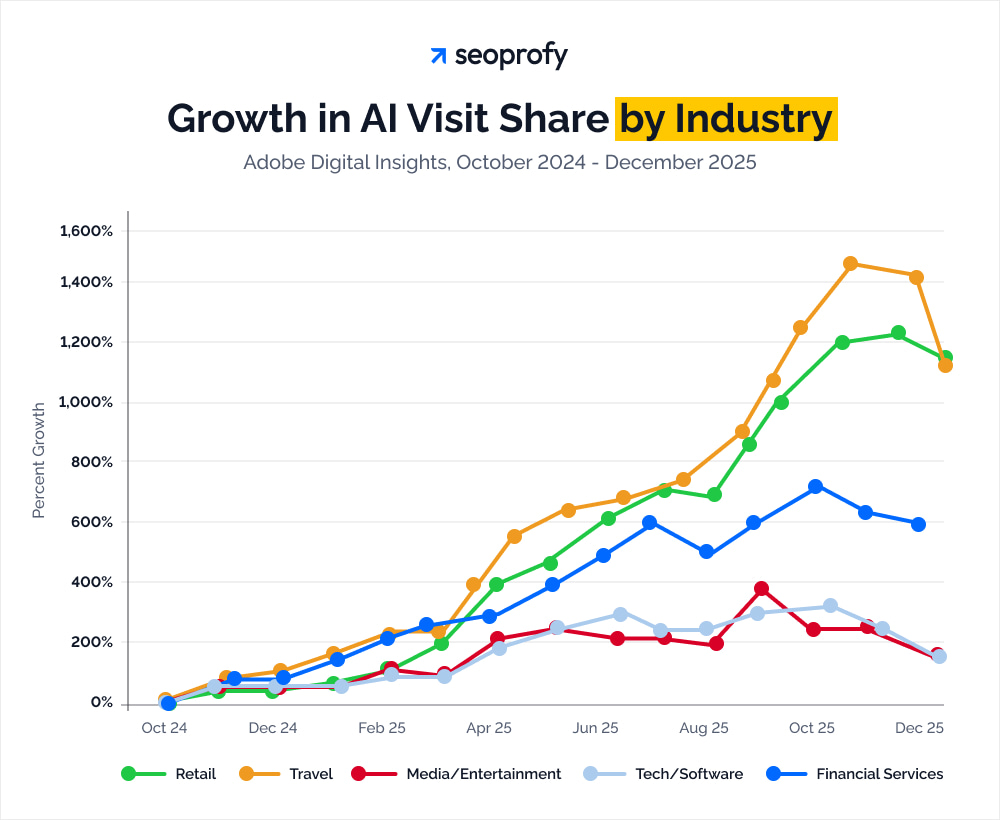
Brands that are mentioned or cited by AI models can build trust with potential customers more quickly and attract more qualified, valuable visitors to their sites.
How to Adapt Ecommerce SEO for AI
Optimizing ecommerce websites for AI search results doesn’t mean abandoning SEO; it means adjusting your approach for AI-powered tools. Our ecommerce SEO agency has been testing various strategies since AI systems entered the market. We focus on helping websites become visible on AI platforms while also satisfying traditional search engine algorithms. Here’s how you can create an AI-ready SEO strategy.
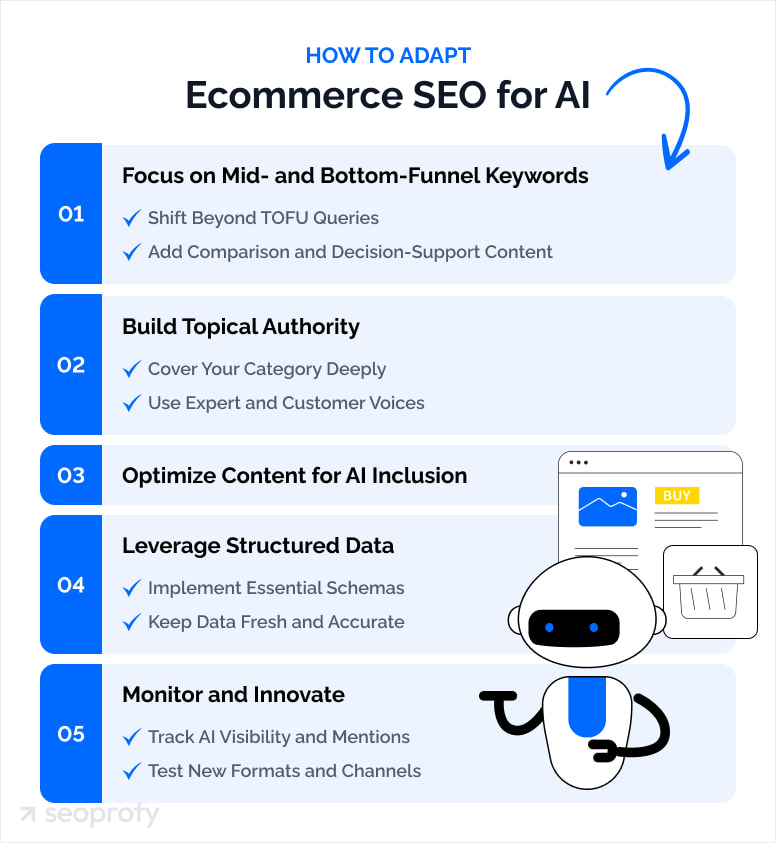
Focus on Mid- and Bottom-Funnel Keywords
Your ecommerce keyword research should shift from broad informational terms to more specific queries. To get the best ROI from AI SEO for ecommerce, you need to understand user intent in mid- and bottom-funnel searches.
Shift Beyond TOFU Queries in Keyword Research
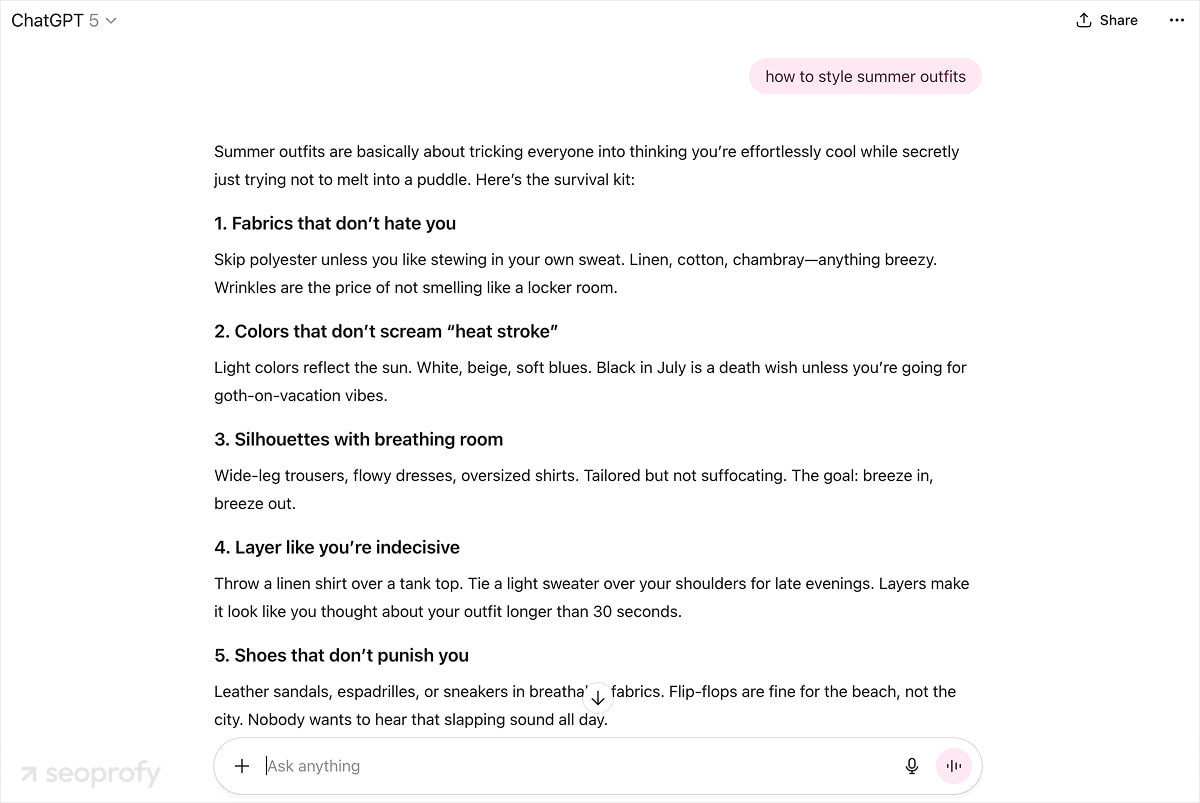
Mid- and bottom-funnel keywords lead directly to transactions. Top-of-funnel searches like “how to style summer outfits” may still bring some visibility, but they rarely get you to rank in ChatGPT. While Perplexity and AIOs still show links to the sources they cite for such requests, ChatGPT mostly relies on its own memory for informational queries, so earning visibility in those answers is next to impossible.
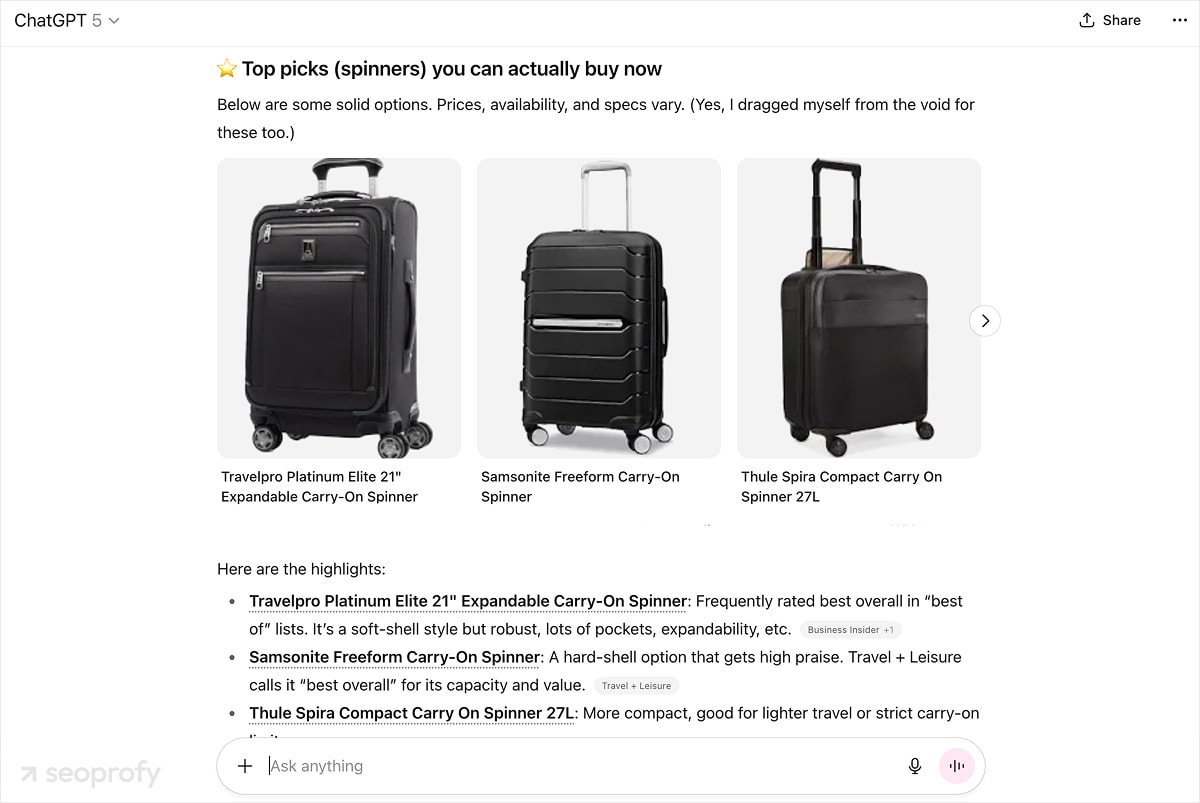
Queries like “women’s linen blazer under 150” or “best carry-on suitcase with spinner wheels” are far more valuable because they align with strong purchase intent. These are the searches where AI is more likely to surface direct product recommendations, and if your site is not optimized here, competitors will capture that demand.
Add Comparison and Decision-Support Content
AI-powered search engines favor direct answers that simplify decisions, especially when users are already close to buying. Build detailed “product vs. product” breakdowns, “best under $X” lists, and feature comparison tables that highlight the differences buyers actually care about. AI results frequently pull from this type of structured, side-by-side content, since it helps resolve buyer uncertainty.
Build Topical Authority
Your content strategy might need to move past how-to guides and generic product descriptions. Focus your content creation efforts on authoritative pieces, detailed comparisons, and actionable insights.
Cover Your Category Deeply
Topical authority in AI-driven SEO for ecommerce comes from answering the real questions people ask in your category. Use Ahrefs or Semrush to export long-tail keywords for AI mentions in ecommerce SEO and filter for modifiers like “best,” “vs.,” “for [need],” and “under $X.” GSC helps confirm what queries you already show up for but fail to convert. Group them into clusters that reflect different buying stages.
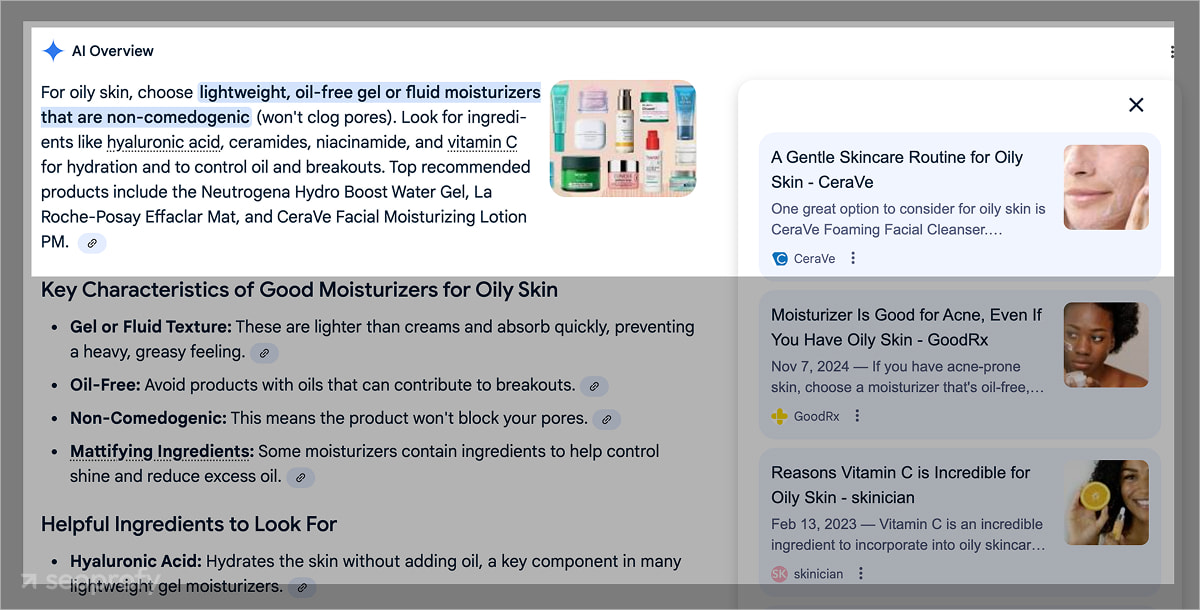
Take skincare as an example. Instead of one moisturizer article, create a hub page that links to focused guides: moisturizers for oily skin, for sensitive skin, with retinol, with hyaluronic acid, under 30 dollars, and so on. Each of those subpages should answer the query directly and then connect back to the hub. For instance, CeraVe’s content hubs are now earning them visibility in AI-driven answers.

Use Expert and Customer Voices
Authority does not come from publishing more content alone. AI-powered systems look for signals that show your brand has real expertise and is trusted by users.
Include quotes, commentary, or advice from actual industry experts in your blog content. Highlight verified customer reviews and encourage user-generated content such as photos and unboxing videos. These elements strengthen EEAT signals (which are just as important for traditional search engines).
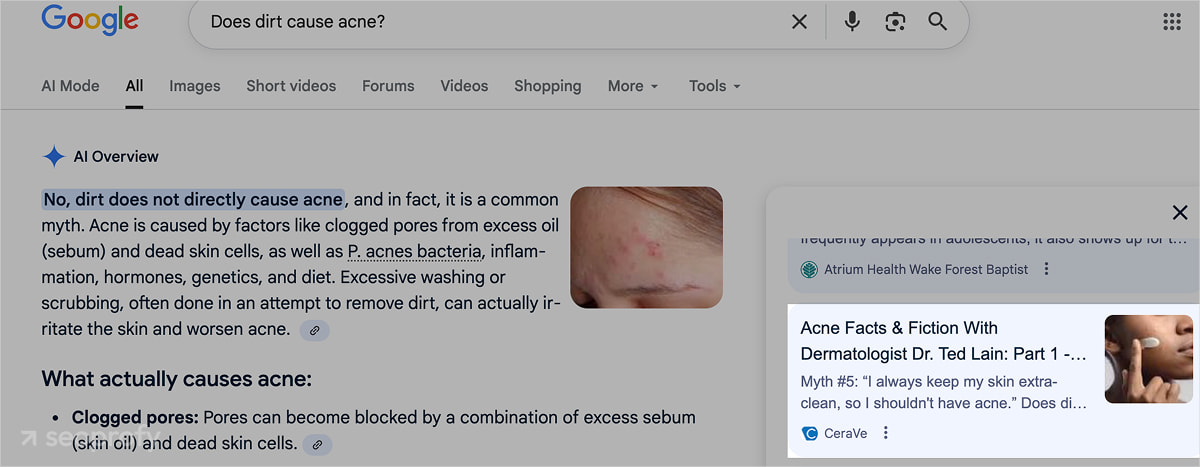
Returning to CeraVe, here’s another good move. For acne (a medical condition) content, they include expert input from a doctor to make the piece more reliable (and Google rewards them with AI Overview mentions).

Although it’s tempting to rely on AI-powered SEO strategies for ecommerce businesses, it’s better not to delegate the whole content creation process to LLMs. You can use some AI-generated content for SEO, but human input is a must to build genuine customer trust.
Optimize Content for AI Extraction
To ensure these systems can read it and are ready to use it, you need to keep your technical SEO for ecommerce in check and work on content optimization for AI. The technical part is clear: make sure nothing blocks AI bots from reading the page. Your robots.txt shouldn’t block OAI-SearchBot or PerplexityBot, for example.
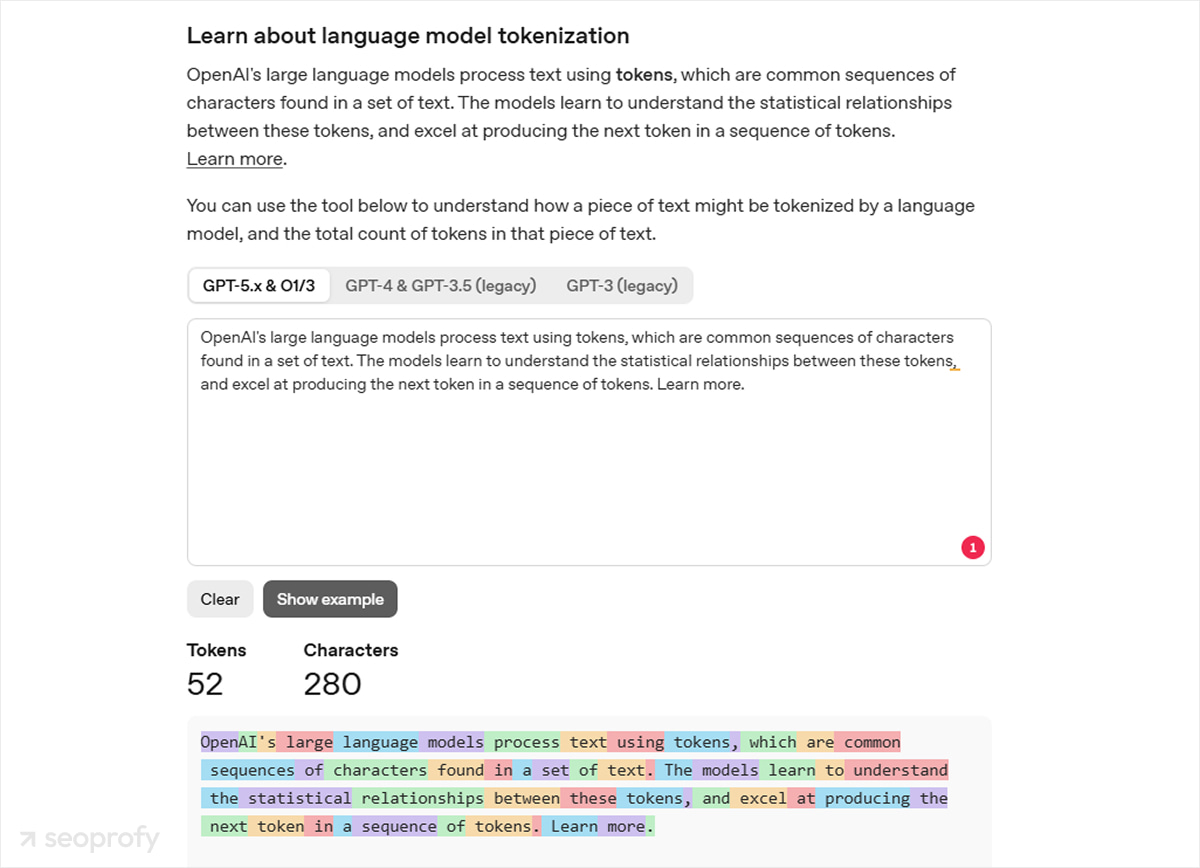
Once the bots are on the page, they process text in chunks — or, more precisely, in fixed token counts. AI-powered tools can process a limited number of tokens per session or in a chat, often referred to as the context window. They also tend to focus on the information at the very beginning and the very end of a file (page, article, document, etc.), occasionally ignoring the middle.
So, one of the easiest tips for ecommerce AI SEO we can give is to provide them with a short, self-contained answer right under the H1. Think 40–60 words that explain the core point without fluff. From there, the page should flow through clear H2 and H3 sections that line up with the questions users actually ask (problem-solution content).
Tokens are the basic units AI uses to process text (roughly 3–4 characters in English). You can check token counts with tools like OpenAI Tokenizer.
Here’s a checklist for AI-extraction-ready ecommerce content:
- Direct answers and key takeaways: Don’t let your key information get lost in the middle.
- Bulleted lists and numbered steps: AI-powered systems can lift them as ready-made answers.
- FAQs based on common user queries: Phrase your questions and answers based on data from your Google Search Console or tools like AnswerThePublic to match how people actually ask them.
- Strategic keyword use: Both AI and traditional search engines use natural language processing, so there’s no need to force keywords into the content. Use relevant phrases in headings and other suitable contexts.
- Readability, accuracy, and freshness: Generative AI tools prefer clear, well-written content that is provably fresh — proofread your pages carefully and include publication and update dates.
When you build pages this way, you achieve two goals at once:
- Make content easier for users to absorb (which is always the primary goal anyway)
- Make sure machines can scan, understand, and confidently use your content in AIOs or voice search results.
Leverage Structured Data for AI SEO
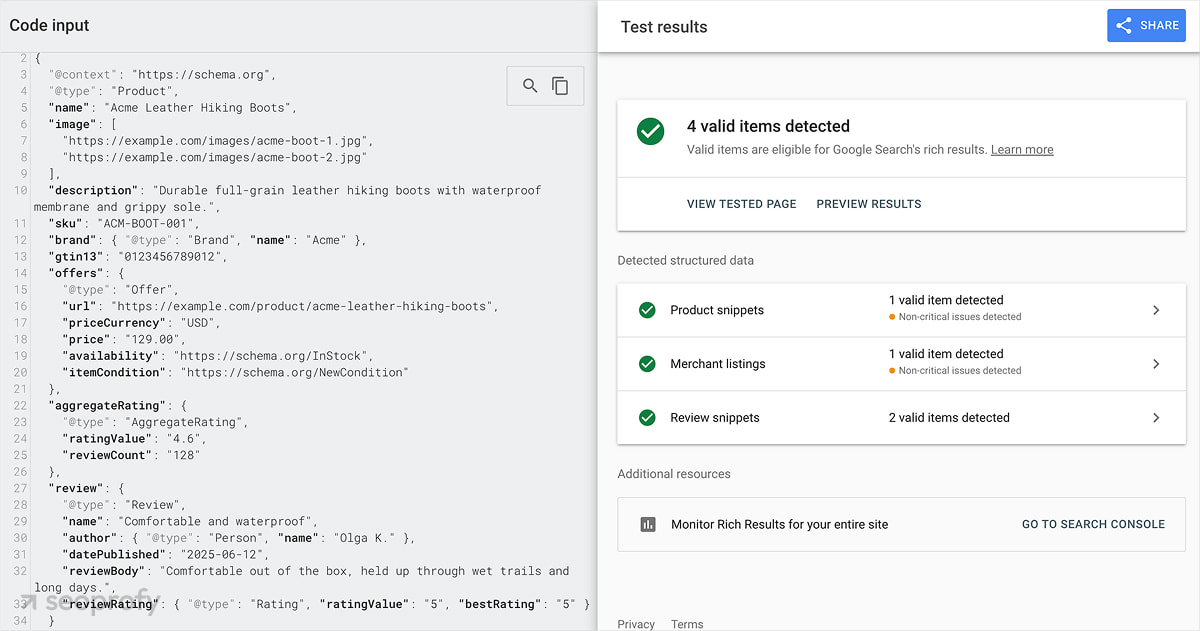
Structured data is one of the most effective SEO strategies for AI snippets in ecommerce. It allows you to label your content so AI instantly understands what each element means. With it, you are telling the system, “this is the price,” “this is the rating,” or “this is the brand.” For ecommerce AI SEO, the following are the most essential schema markups:
- Product: Attributes like name, description, brand, SKU, and GTIN.
- Offer: Price, currency, availability, and shipping options.
- Review and AggregateRating: Social proof for AI to include directly in overviews and carousels.
- FAQ: For real buyer questions.
- HowTo: For step-based guides, such as “how to clean leather boots.”
AI prioritizes structured data over plain text, but only if it works properly. Test your markup in Google’s Rich Results Test and validate coverage under the Enhancements section in Search Console.
Keep Data Fresh and Accurate
AI engines pull from structured data in real time. If your schema says a product is in stock but it is actually sold out, you risk losing trust signals and visibility. Keep price, availability, and rating metadata synchronized with your CMS or product feed. Many brands set this up via automated updates using Google Merchant Center feeds or direct API syncs with their platform.
Treat structured data as a living system, not a one-off setup. Brands that maintain a clean, up-to-date schema dramatically improve their chances of appearing in AI results and staying there long-term.
Monitor and Innovate
Tracking your AI SEO efforts is a bit more difficult than monitoring traditional optimization. Here’s how you can find actionable insights and make sure your strategy remains relevant.
Track Brand Mentions in AI Search Results and Answers
For effective AI visibility analysis, you need to use different AI search monitoring tools and tracking methods:
| Tool category | Example tools | What they measure | Why it matters |
| AI Overview tracking (Google) | Semrush AI Visibility Toolkit, Ahrefs Brand Radar, Authoritas, Sistrix | Queries that trigger AIOs, domains cited, frequency of source rotation | AIO results can change several times a day, so website owners need to monitor volatility and look out for new competitors. |
| Generative engines (ChatGPT, Perplexity, Gemini, Claude) | AISEO.ai, Ahrefs Brand Radar, Semrush AI Search Toolkit, Perplexity export, manually scripted prompts | Brand mentions in chat responses, share of voice, link visibility, and sentiment of responses | Traffic from these systems to retail sites is growing, and mentions build trust and brand awareness. |
| Classic SERP feature tracking | Semrush Position Tracking, Ahrefs Rank Tracker | Featured snippets, People Also Ask results, and FAQ rich results | Many AI answers share sources with classic SERP snippets. Losing a snippet often means losing AIO presence as well. |
| Brand and product monitoring | Mention, Talkwalker, Brandwatch, Google Alerts | Mentions of your brand/products across media, forums, and social networks | In AI SEO, external mentions improve your chances of appearing in LLM-generated answers. |
| Log file and analytics | Screaming Frog SEO Log File Analyser, raw server logs, GA4 referrer analysis | Crawl patterns from AI bots and unusual traffic sources | Confirms whether your content is being ingested into AI indexes or used in retrieval-augmented generation (RAG). |
Build a dedicated KPI dashboard for AI visibility. It should include not just SERP positions but also:
- Share of target queries where your brand is ranking in AIOs
- Number of monthly mentions in ChatGPT, Perplexity, and Gemini
- CTR vs. impressions in AI snippets (visibility without clicks)
- Speed of losing and regaining citations in AIOs.
Test New Formats and Channels
AI engines are increasingly multimodal. That means ecommerce brands should experiment with:
- Multimodal content: High-quality product images, demo clips, and short-form video all help engines choose your listing, especially for visual searches, because they offer context that plain text lacks.
- Regional landing pages: AI systems adapt answers by geography, so localized product and category pages give you an edge in local queries.
- Feeds and integrations: Keep Google Merchant Center and Microsoft Shopping feeds accurate so AI shopping results display the right products. Watch for new options like ChatGPT merchant feeds since they can expand this reach even further.
It all comes down to two things: track with detail and test before your competitors do to gain more visibility and keep growing.
Final Thoughts
Ecommerce brands cannot afford to ignore visibility and traffic from AI-generated answers. AI SEO strategies for ecommerce businesses come down to teaching LLMs to connect your business with the right entities, structuring content, building mentions that strengthen authority (as important now as traditional ecommerce link building), finding keywords that trigger AI mentions for ecommerce SEO, and covering all the classic SEO fundamentals.
Sounds complicated? That is exactly why we offer AI SEO services that make it manageable. At SeoProfy, we have delivered results across the full spectrum, from traditional ecommerce SEO to AI audits and hands-on work that improves visibility in LLMs and AIOs. One of our clients, for example, saw traffic surge and orders grow by more than 210% in just a month of ecommerce AI optimization and SEO.
Want to see the same growth for your store? Book your strategy call today to optimize your ecommerce site for AI search.

As a Content writer at SeoProfy, Hanna Zhytnik creates SEO content grounded in research, data, and ongoing hypothesis testing. With more than 5 years of experience across B2B, SaaS, and ecommerce, she brings both breadth of knowledge and a sharp focus on modern search. Her strength lies in turning complex experiments into clear explanations, bridging the gap between deep SEO practice and accessible content.