
 Add SeoProfy as a preferred source on Google
Finding the top AI models is harder than it should be. One leaderboard puts Claude first. Another favors Gemini. And with new releases appearing every few weeks, even recently published comparisons can fall behind.


Among the ten models in this comparison, Claude Opus 5.5 ranks first with a score of 58 on the Artificial Analysis Intelligence Index. But the highest score doesn’t automatically make it the best choice for every task or budget.
We compared ten leading models from Anthropic, OpenAI, Google, Meta, and Xiaomi, looking at intelligence scores, cost per task, output speed, and access. Here’s how they compare and where each makes sense.
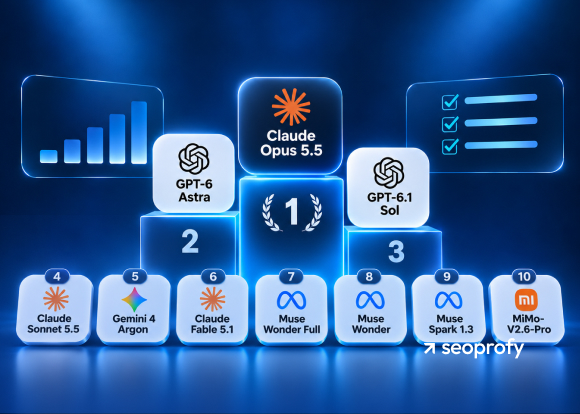
- Claude Opus 5.5 ranks first among our ten selected models, scoring 58 on the Artificial Analysis Intelligence Index.
- MiMo-V2.6-Pro has the lowest estimated cost per task at $0.26 among the 10 models.
- MiMo-V2.6-Pro is the highest-ranked open-weights option among our ten selected models on the Artificial Analysis index, although other open-weights models score higher on the full leaderboard.
- The current best AI model for your team depends on its workload, budget, and performance needs.
Note: Gemini 4 Carbon currently leads the Artificial Analysis Intelligence Index with a score of 59, but it is excluded from our top 10 because access remains limited to selected users.
Top AI Models at a Glance: How We Ranked Them
We compared ten selected AI models using the Artificial Analysis Intelligence Index, which combines results from several independent tests of reasoning, coding, and knowledge work. The list follows their reported scores. Note that Muse Spark 1.3 has been deprecated.
For each model, we used its highest-scoring available setting. When scores are tied, the model with the lower cost per task comes first. If Artificial Analysis doesn’t report a cost, that model follows the other entries with the same score.
These AI model rankings can change as new releases arrive or benchmark methods are updated. This comparison covers ten selected models as of October 29, 2026. It is not an exhaustive list of the highest-scoring releases; Gemini 4 Carbon, for example, currently scores above several models included here.
Even independent AI model rankings can disagree, making it harder to determine which AI model is best for your specific needs.
The best LLM models for one test may perform differently on another. One benchmark may give more weight to coding and reasoning, while another measures which responses people prefer. That is why an AI benchmark ranking needs context: check how each leaderboard calculates its scores before trusting the order.
For example, Arena’s Text leaderboard uses human votes to compare responses. On October 27, Gemini 4 Carbon (High) ranked first with 1,528 points, Gemini 4 Argon (High) second with 1,520, and Claude Opus 5.5 (High) third with 1,509. Artificial Analysis also places Carbon first, but ranks Opus ahead of Argon.
The table below compares intelligence, estimated cost per task, output speed, and context window of the top AI models. Cost reflects Artificial Analysis’s standardized workload, not a fixed API price. Speed is measured in generated tokens per second, excluding initial response latency.
Model Comparison Table
| Rank | Model (Setting) | Developer | Intelligence Index | Cost/Task | Output Speed | Context Window |
| 1 | Claude Opus 5.5 (max, fallback) | Anthropic | 58 | $10.04 | 98 tok/s | 1M |
| 2 | GPT-6 Astra (max) | OpenAI | 57 | $6.24 | 76 tok/s | 1M |
| 3 | GPT-6.1 Sol (max) | OpenAI | 55 | $1.27 | 81 tok/s | 1M |
| 4 | Claude Sonnet 5.5 (max, fallback) | Anthropic | 54 | $10.02 | 138 tok/s | 1M |
| 5 | Gemini 4 Argon (high) | 50 | $7.68 | 82 tok/s | 1M | |
| 6 | Claude Fable 5.1 (xhigh, fallback) | Anthropic | 50 | $10.85 | 67 tok/s | 1M |
| 7 | Muse Wonder Full (max) | Meta | 50 | — | — | 1M |
| 8 | Muse Wonder (max) | Meta | 43 | $6.95 | 204 tok/s | 1.05M |
| 9 | Muse Spark 1.3 | Meta | 36 | $2.39 | 208.5 tok/s | 1M |
| 10 | MiMo-V2.6-Pro | Xiaomi | 30 | $0.26 | 63 tok/s | 1M |
Sources: Artificial Analysis LLM Leaderboard, checked October 29, 2026. The table compares ten selected models, not the ten highest-scoring models available. Muse Spark 1.3 is included as a historical reference. Its earlier benchmark results are not directly comparable with scores calculated under the current methodology.
Intelligence Index of the Top 10 AI Models
The chart below compares the Artificial Analysis Intelligence Index scores of our ten selected AI models. Higher scores indicate stronger overall benchmark performance across reasoning, coding, and knowledge-based tasks.
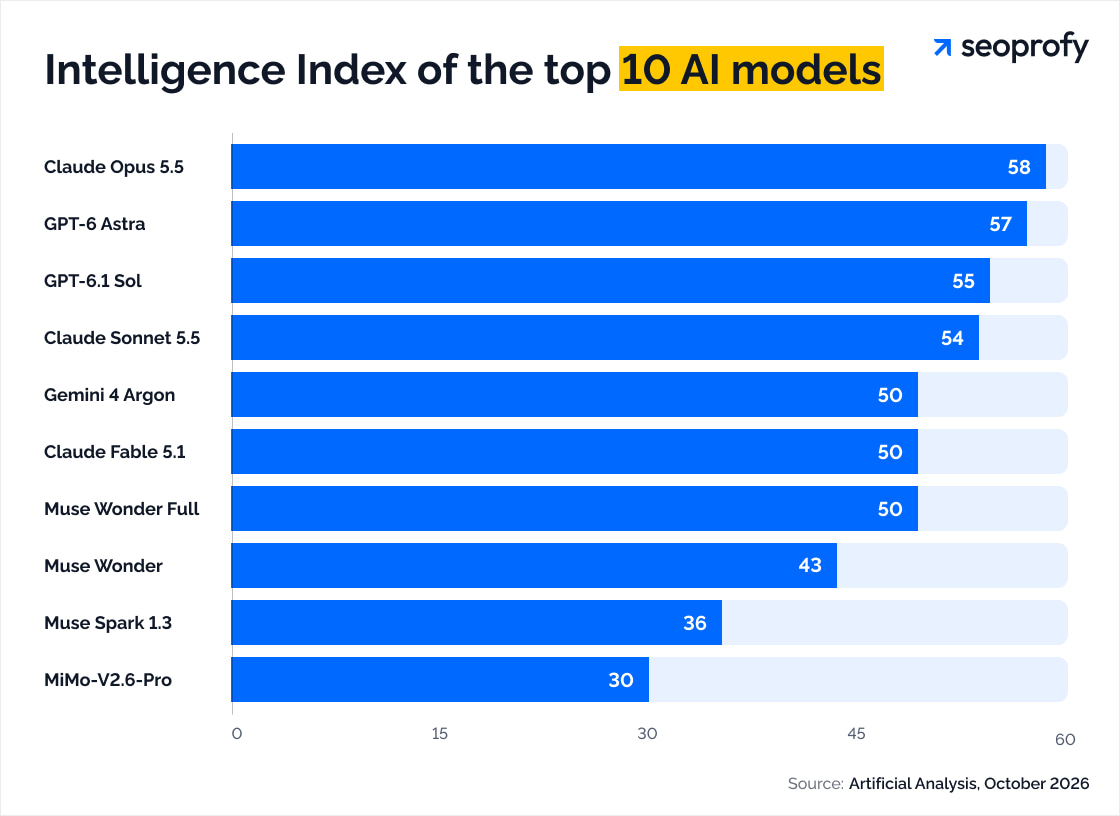
Claude Opus 5.5 leads the selected models with 58 points, followed closely by GPT-6 Astra and GPT-6.1 Sol. The lower-ranked models may still be competitive in terms of cost, speed, or specific use cases, so a higher Intelligence Index score doesn’t necessarily make a model the best choice for every task.
The Top 10 AI Models, Ranked
The following ten models are arranged by their reported Intelligence Index scores. They differ in pricing, output speed, and availability, so benchmark performance alone won’t determine the best fit for your workload.
1. Claude Opus 5.5 (Anthropic)
Claude Opus 5.5 leads our selection with a score of 58 on the Artificial Analysis Intelligence Index at max effort with fallback. It’s a strong choice for complex research, coding, and tasks that require several connected reasoning steps.
Key Specs
- Intelligence Index: 58 (max with fallback)
- Cost per task: $10.04
- Output speed: 98 tokens/s
- Context window: 1M tokens
Performance & Trade-offs
Opus delivers the highest score in this selection, but its maximum configuration is expensive. The high-effort setting provides a cheaper alternative, scoring 52 at $3.46 per task.
That’s roughly two-thirds less expensive, although the model gives up six benchmark points. Whether the extra reasoning is worthwhile depends on the difficulty of your workload.
Teams working with detailed technical documentation or complicated analysis may benefit from max effort. For straightforward research and summaries, high effort could be sufficient.
Best For: Complex coding, demanding research, and multi-step reasoning where output quality takes priority over cost.
2. GPT-6 Astra (OpenAI)
GPT-6 Astra is one of the most powerful AI models in this comparison, scoring 57 at maximum effort. That puts it just one point behind Claude Opus 5.5, although its estimated cost per task is considerably lower.
Key Specs
- Intelligence Index: 57 (max)
- Cost per task: $6.24
- Output speed: 76 tokens/s
- Context window: 1M tokens
Performance & Trade-offs
Astra Max costs $6.24 per task, compared with $10.04 for Opus Max. Its output speed is lower, at 76 tokens per second compared with Opus’s 98. Still, Astra costs considerably less per task, making it worth considering for reasoning-heavy workloads.
The high-effort setting offers another option. It scores 55 and costs $3.24 per task, reducing the estimated expense by nearly half for a two-point drop.
When choosing between the top AI models for frequent research or coding, that flexibility matters. Not every request requires the strongest setting, and choosing one automatically can waste money.
Best For: Technical research, advanced coding, and business applications that need strong reasoning with adjustable computational effort.
3. GPT-6.1 Sol (OpenAI)
GPT-6.1 Sol stands out among the best AI models right now for its balance of reasoning performance and cost. Its max setting scores 55 on the Artificial Analysis index, yet the estimated cost is just $1.27 per task.
Key Specs
- Intelligence Index: 55 (max)
- Cost per task: $1.27
- Output speed: 81 tokens/s
- Context window: 1M tokens
Performance & Trade-offs
Sol’s biggest advantage is its pricing flexibility. The xhigh setting scores 52 at $0.76 per task, while high effort scores 50 at $0.59. Medium effort drops to 46 but costs only $0.36.
Those differences are worth considering when running thousands of requests.
A marketing team processing customer feedback or classifying search queries may not need maximum reasoning on every task. Developers can test several configurations and choose the cheapest one that consistently meets their quality requirements.
A composite score cannot reveal every weakness. The smartest AI model right now for your workflow may be a less expensive setting.
Best For: High-volume analysis, document processing, and applications where balancing reasoning performance with cost is essential.
4. Claude Sonnet 5.5 (Anthropic): Strong Output Speed for Coding
Claude Sonnet 5.5 scores 54 on the Artificial Analysis index at max effort with fallback. It’s particularly interesting for teams building coding assistants and AI agents that need to generate substantial amounts of text quickly.
Key Specs
- Intelligence Index: 54 (max with fallback)
- Cost per task: $10.02
- Output speed: 138 tokens/s
- Context window: 1M tokens
Performance & Trade-offs
At maximum effort, Sonnet costs almost the same as Opus 5.5 but scores four points lower. Sonnet generates 138 tokens per second, compared with Opus’s 98. That faster output may matter for applications that produce long responses, although overall task completion time also depends on reasoning and latency.
Another distinction appears in Mercor’s APEX-Agents benchmark. Sonnet Max achieved 75.5% Pass@1, slightly ahead of Opus Max at 73.5%.
That doesn’t mean Sonnet is universally stronger. It suggests that different evaluations reward different capabilities.
For businesses developing agents that work with files, software, and multiple instructions, Sonnet deserves testing alongside Opus rather than being dismissed because of its lower overall score.
Best For: Coding assistants, document-heavy workflows, and professional agents where fast output and task completion matter.
5. Gemini 4 Argon (Google)
Gemini 4 Argon reaches an Intelligence Index score of 50 using its high-effort setting. Although it sits below several competitors on this particular benchmark, other evaluations show why it deserves attention.
Key Specs
- Intelligence Index: 50 (high)
- Cost per task: $7.68
- Output speed: 82 tokens/s
- Context window: 1M tokens
Performance & Trade-offs
Gemini’s setting matters because cost and reasoning performance can change depending on how much computation it uses.
Its results on professional-agent evaluations are particularly interesting. Gemini 4 Argon achieved 82.4% Pass@1 on Mercor’s APEX-Agents benchmark, outperforming the selected Claude configurations.
For teams developing agents that work across applications, that result may matter more than the index alone. These AI model rankings depend on what gets tested.
Still, benchmark performance isn’t a guarantee. Before using Gemini in production, test how reliably it completes the specific actions your application requires, particularly those involving several steps or external tools.
Best For: Multi-step business agents, document analysis, and workflows requiring reliable tool use and sustained reasoning.
6. Claude Fable 5.1 (Anthropic)
Claude Fable 5.1 scores 50 on the Artificial Analysis index at xhigh effort with fallback. It’s capable of handling demanding analytical tasks, but its relatively high price makes choosing the right workload especially important.
Key Specs
- Intelligence Index: 50 (xhigh with fallback)
- Cost per task: $10.85
- Output speed: 67 tokens/s
- Context window: 1M tokens
Performance & Trade-offs
Fable has the highest published cost per task among the ten selected configurations. Its max setting costs $12.99 per task but scores slightly lower at 49.
That difference shows why more reasoning effort doesn’t always produce a better combined benchmark result.
On Mercor’s APEX-Agents evaluation, Fable Max achieved 68.6% Pass@1. It’s a capable result, though several competing models performed better.
For general content creation or routine analysis, its pricing may be difficult to justify. Fable becomes more attractive when a team has identified specialized tasks where its output consistently performs better than cheaper alternatives.
Best For: Specialized professional workflows where extensive testing demonstrates an advantage worth the additional cost.
7. Muse Wonder Full (Meta)
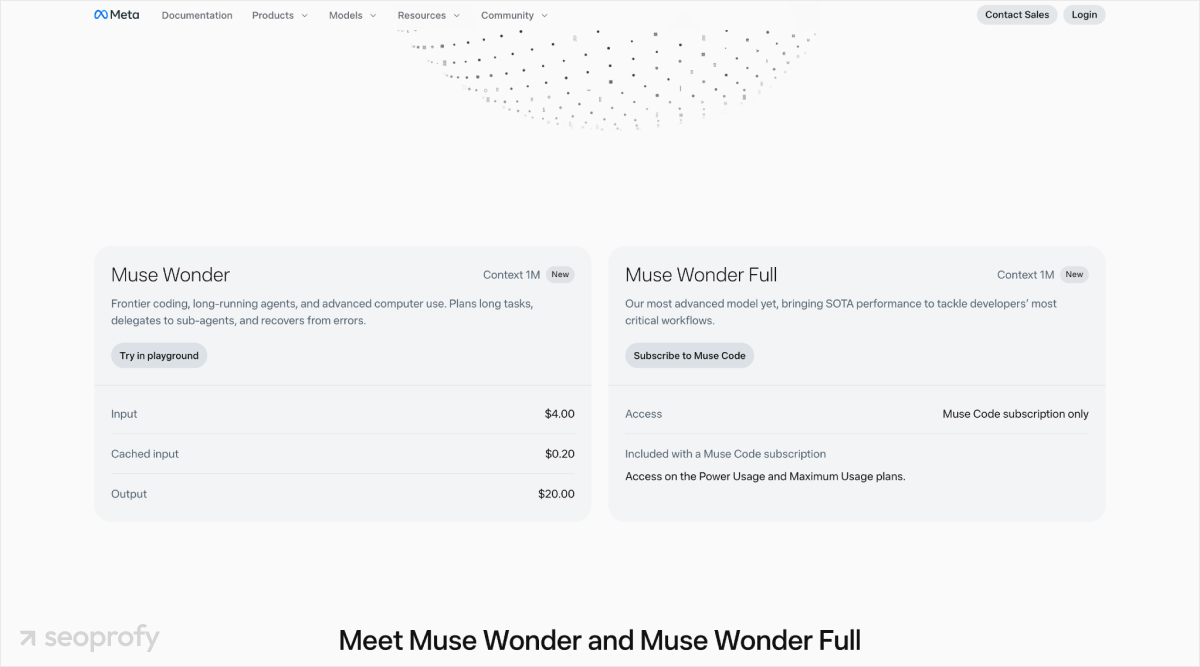
Muse Wonder Full is Meta’s more capable Wonder configuration, introduced in October 2026. It scores 50 on the Artificial Analysis Intelligence Index at max effort, matching Gemini 4 Argon and Claude Fable 5.1.
Key Specs
- Intelligence Index: 50 (max)
- Cost per task: — (not reported)
- Output speed: — (not reported)
- Context window: 1M tokens
Performance & Trade-offs
Access is the main limitation. Wonder Full is available to Muse Code subscribers but isn’t offered through the Meta Model API.
That restricts its usefulness for companies building applications that depend on direct API integration.
Artificial Analysis also doesn’t provide comparable cost or output-speed figures, making it difficult to estimate operating expenses against the other models.
Wonder Full is comparatively new, so additional independent evaluations may change its position.
For developers already using Muse Code, it’s worth testing on complicated coding and agent tasks. Businesses requiring API access may find standard Muse Wonder or another available model more practical.
Best For: Muse Code subscribers exploring advanced coding, research, and agent-based workflows.
8. Muse Wonder (Meta)
Muse Wonder is the API-accessible model in Meta’s Wonder family. It supports developer integrations through the Meta Model API and Muse Code, making it more flexible than the subscription-only Wonder Full configuration.
Key Specs
- Intelligence Index: 43 (max)
- Cost per task: $6.95
- Output speed: 204 tokens/s
- Context window: 1.05M tokens
Performance & Trade-offs
Wonder generates text considerably faster than many higher-scoring models in this selection, although output speed alone doesn’t determine total response time.
Wonder Full scores higher at 50, but its restricted access makes it less suitable for API-based applications.
Meta has also highlighted memory-related capabilities intended to support longer interactions. These could be useful for assistants working on ongoing projects, although businesses should test their reliability before depending on them.
Wonder’s estimated cost is relatively high compared with some alternatives offering stronger composite intelligence scores. Its value therefore depends on whether its speed, available tools, and development ecosystem suit your application.
Best For: Developers exploring Meta’s ecosystem, long-context applications, and agents requiring API access.
9. Muse Spark 1.3 (Meta)
Muse Spark 1.3 is a deprecated model from Meta’s earlier generation. Its historical benchmark results offer a useful reference for comparing low-latency models, though they shouldn’t be treated as current deployment recommendations.
Key Specs
- Intelligence Index: 36 (max)
- Cost per task: $2.39
- Output speed: 208.5 tokens/s
- Context window: 1M tokens
Performance & Trade-offs
Muse Spark 1.3 prioritizes speed and affordability over advanced reasoning capabilities. According to Artificial Analysis, the model scores 36 on the Intelligence Index, below the median score of 42 among comparable models. However, its fairly low cost per task and fast output speed make it an interesting reference point for earlier low-latency model designs.
The model is now deprecated, and Artificial Analysis continues performance benchmarking only for its default 10k-input-token workload. Results for other workloads are historical and no longer updated, limiting direct comparisons with newer models.
While Spark may still be relevant to existing applications, developers building new solutions should consider Muse Wonder or other currently supported alternatives.
Best For: Maintaining existing Spark-based workflows and evaluating earlier approaches to affordable, low-latency AI.
10. MiMo-V2.6-Pro (Xiaomi): Open Weights for Self-Hosting
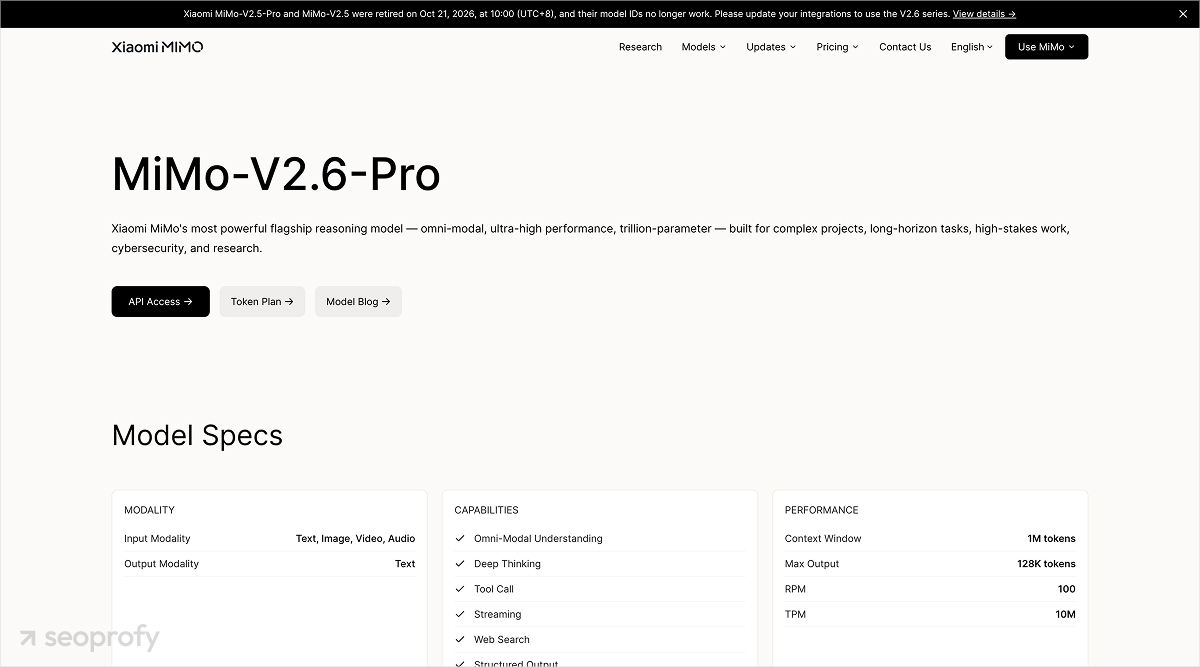
MiMo-V2.6-Pro is one of the open-weights artificial intelligence models worth considering for developers who want more control over deployment. Unlike proprietary alternatives, its published weights can be downloaded and run on suitable infrastructure.
Key Specs
- Intelligence Index: 30
- Cost per task: $0.26
- Output speed: 63 tokens/s
- Context window: 1M tokens
Performance & Trade-offs
MiMo has the lowest estimated cost per task in this comparison, although its intelligence score is substantially lower than those of the leading proprietary alternatives.
On the Artificial Analysis Intelligence Index, MiMo-V2.6-Pro scores 30, below the 32 points recorded by DeepSeek V4.1 Flash and GLM-5.3.
Open weights allow developers to download and run the model, subject to the applicable license. Xiaomi’s MiMo-V2.6-Pro-RL repository specifies an MIT license, which permits commercial use under its conditions.
Self-hosting also incurs infrastructure and maintenance costs that the benchmark’s API-based task estimate does not reflect.
Best For: Developers interested in self-hosting, customization, and cost-conscious deployments with suitable technical resources.
Why the Top AI Models Matter for AI Search Visibility
People use AI assistants to research products, compare companies, and make buying decisions without visiting a website. A brand may appear in ChatGPT’s recommendations but be absent from Claude’s, making visibility across platforms worth measuring.
The best AI models right now aren’t necessarily those influencing the most purchases. Users around the world read AI-generated comparisons and share recommendations across different assistants.
The top AI models also change over time. A Sep benchmark snapshot may differ from October’s results, but rankings don’t measure adoption. Our LLM usage statistics help identify which platforms people use. For practical optimization, see how to rank on ChatGPT for improving brand visibility in its answers and how to rank on Claude for understanding how Claude discovers and references sources.
AI-generated answers can influence how potential customers discover and compare companies. SeoProfy helps businesses measure their AI search presence and build an SEO strategy tied to qualified traffic and measurable revenue growth.
Frequently Asked Questions
What Are the Top 3 Most Used AI Models?
The three most popular AI models in 2026, based on the number of tokens processed, are:
- DeepSeek V4.1 Flash (DeepSeek): 32.8 trillion tokens processed.
- GLM 5.3 Flash (Z.ai): 12.2 trillion tokens processed.
- Step 5 Preview (StepFun): 11.5 trillion tokens processed.
These rankings reflect usage through the OpenRouter API, not total worldwide adoption. Token volume measures how extensively developers use a model through the platform, rather than its intelligence or benchmark performance.
What Is Another AI Like ChatGPT?
Claude and Gemini are two major alternatives to ChatGPT. Both offer conversational interfaces powered by large language models and support tasks such as writing, research, analysis, and coding. The better choice depends on what you’re doing, which tools you need, and what subscription or API access costs.
What Is the Difference Between an AI Model and an AI Chatbot?
An AI model is the underlying system that processes inputs and generates outputs. A chatbot is an application built around one or more top AI models. ChatGPT, for example, is an assistant product that can offer different OpenAI models. The interface, tools, settings, and subscriptions are separate from the model itself.
The Best AI Model Is the One That Fits Your Task
Wondering what is the best AI model right now? Start with the task you need to complete, not just the leaderboard. Benchmark results change as new versions arrive, and a model that excels at coding may be unnecessarily expensive for everyday content work.
Pick two promising options. Test them on the same tasks, compare output quality and total cost, and pay attention to the time each takes to complete useful work.
Then repeat the comparison when meaningful new versions arrive.
That’s more useful than assuming the most powerful AI models are always the right choice simply because they lead a leaderboard.

Julia Lubianytska is a Copywriting Team Lead at SeoProfy with over 7 years of experience in copywriting and editing. She works closely with copywriting teams, helping writers craft clear and thoughtful content for SaaS products, IT services, and businesses in the legal and medical fields. Julia enjoys turning complex topics into easy-to-understand, trustworthy content, focusing on structure, clarity, and consistency to ensure the content is genuinely helpful for real people, not just search engines.