


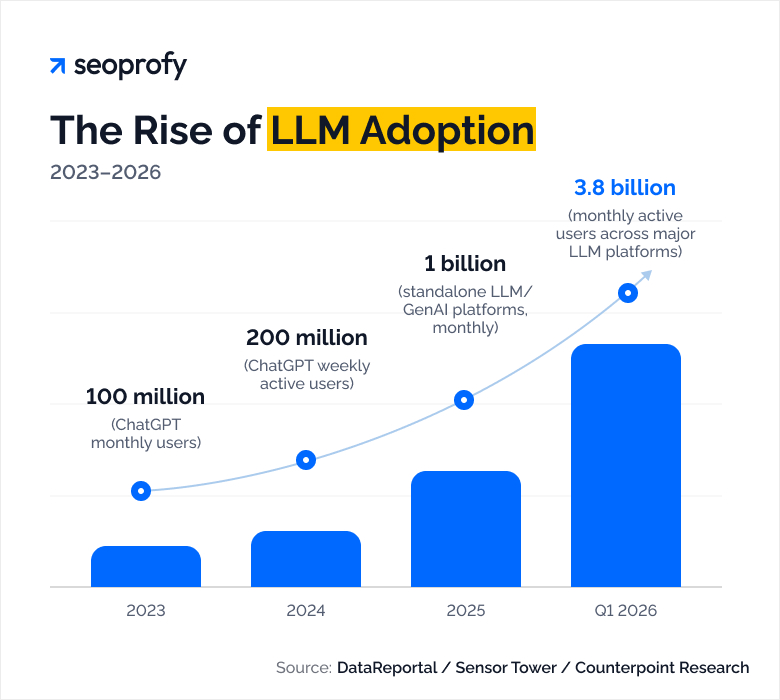
Large language models (LLMs) went from a novelty to a daily work tool in only a few years. By Q1 2026, major LLM platforms were already recording more than 3.8 billion monthly active users, and adoption was still climbing. The harder problem with LLM usage statistics is finding figures that are current and comparable, and that have a clear source.


Many roundups mix 2023 data with 2026 numbers or compare metrics that measure different things. This guide keeps the time frame tight and the definitions separate. It shows how fast LLM use is growing, which models lead, who uses them, how businesses deploy them, and where the market is heading next, giving business owners and marketing teams a clearer view of how AI adoption may affect their strategy.
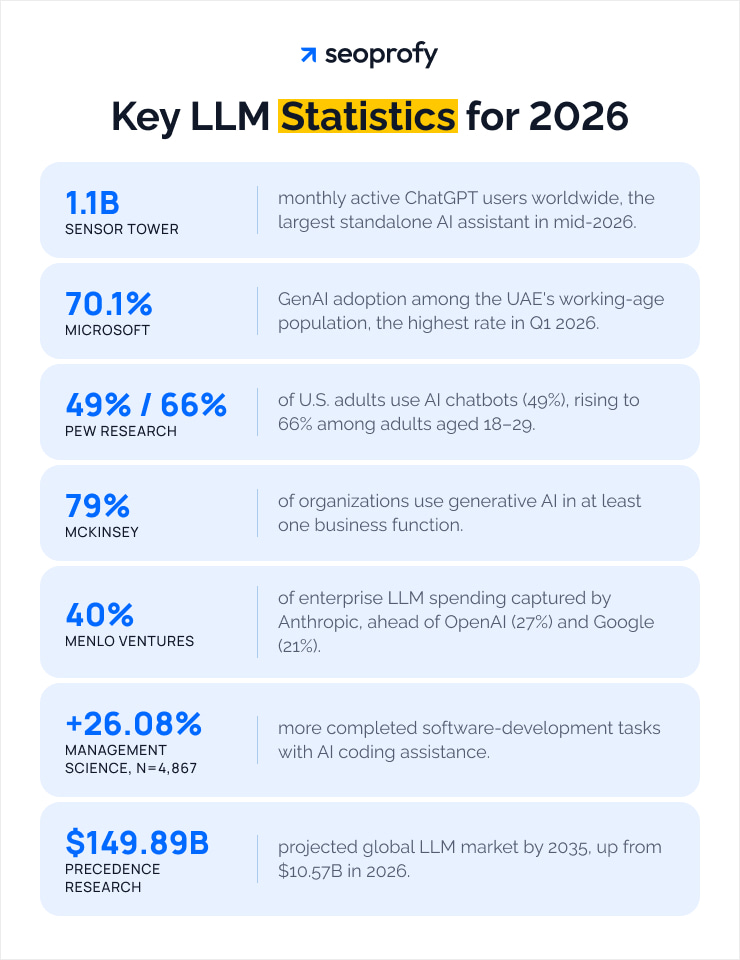
- ChatGPT remains the largest standalone assistant, with about 1.1 billion monthly active users worldwide in mid-2026, according to the latest ChatGPT statistics.
- The UAE reached 70.1% GenAI adoption among working-age people, the highest rate recorded in Microsoft’s Q1 2026 data.
- 49% of U.S. adults use AI chatbots, rising to 66% among adults aged 18–29.
- 79% of organizations use generative AI in at least one business function, showing how far adoption has moved beyond experimentation.
- Anthropic captured 40% of enterprise LLM spending, ahead of OpenAI and Google in that segment.
- AI coding assistance increased completed software-development tasks by 26.08% in field experiments involving 4,867 developers.
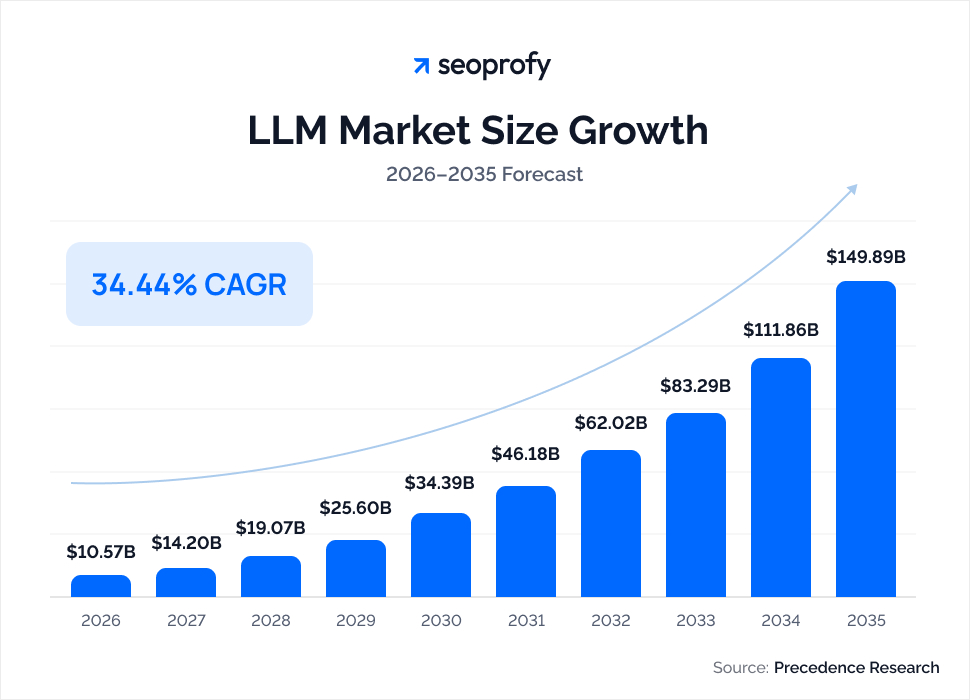
- The global LLM market is projected to grow from $10.57 billion in 2026 to about $149.89 billion by 2035.
Our Methodology and Data Sources
In this analysis, we prioritized 2026 data from trustworthy primary research and established research organizations, using company disclosures where relevant. Sources include Counterpoint Research and McKinsey, plus developer data from Stack Overflow. Demographic findings come from Rethink Priorities and Elon University.
Each figure in these LLM usage statistics was checked against its source definition and publication date. We kept consumer usage metrics separate from enterprise AI adoption statistics so different measures were not treated as direct equivalents.
Global and Regional LLM Adoption Statistics
LLM use now spans billions of monthly active users, but adoption is far from uniform. The LLM statistics below show how quickly usage has expanded since 2023, while the regional AI adoption statistics reveal where GenAI penetration and growth are strongest in 2026.
Global LLM Adoption and User Growth
In Q1 2026, major LLM platforms recorded more than 3.8 billion monthly active users. That puts LLMs at the scale of the world’s largest digital channels, large enough to influence how people research products and begin purchase journeys before visiting a company website or speaking to a sales team.
- Standalone GenAI platforms reached 2.42 billion active users in April 2026, up by more than 1.4 billion in 12 months. That equals 141% year-over-year growth and 29.2% of the global population. (DataReportal)
- Generative AI use reached 17.8% of the world’s working-age population in Q1 2026, rising from 16.3% in H2 2025. The 1.5-percentage-point increase happened in a single quarter, showing that adoption is still climbing after the initial ChatGPT-driven surge. (Microsoft AI Economy Institute)
- People are projected to spend 36 billion hours in GenAI mobile apps in H1 2026, more than double the 17.2 billion hours recorded in H1 2025. GenAI websites also generated over 67 billion visits and roughly 23 billion hours of engagement in Q1 2026. (Sensor Tower)
- Generative AI reached 53% population adoption within three years, a faster early adoption curve than either the personal computer or the internet. Few consumer technologies have moved from launch to mass adoption on a comparable timeline. That pace leaves businesses less time to treat LLM visibility as an experimental channel. (Stanford HAI)
Regional and Country-Level Adoption Statistics
The UAE reached 70.1% GenAI adoption among its working-age population in Q1 2026, almost four times the 17.8% global rate. South Korea posted the fastest quarterly increase, gaining 6.4 percentage points to reach 37.1%. These generative AI statistics show how differently adoption is progressing from one market to another.
- Singapore reached 63.4% adoption, followed by Norway at 48.6%, Ireland at 48.4%, and France at 47.8%. The United States stood at 31.3%, ranking 21st among 147 economies. (Microsoft AI Economy Institute)
- GenAI usage reached 27.5% of the working-age population in the Global North and 15.4% in the Global South. The gap widened from 10.6 to 12.1 percentage points in one quarter. (UNDP)
- OpenAI’s Q1 2026 per-capita ChatGPT rankings showed the biggest jumps in the Dominican Republic and Haiti, both up nine places, followed by Japan, up eight, and Mexico and Tanzania, up six. (OpenAI)
- Workplace adoption reached 43.0% of workers in the United States, compared with 36.3% in the UK and 25.6% in Italy in early 2026. (Federal Reserve Bank of St. Louis)
Model-by-Model Usage Statistics: ChatGPT, Gemini, and Claude
Current LLM usage statistics show that consumer adoption is concentrated around three major assistants. Their positions differ by audience and business use though. As the LLM market size expands, ChatGPT leads overall reach, Gemini is closing the gap, and Claude is gaining ground in enterprise adoption.
ChatGPT Usage Statistics
ChatGPT remains the most-used standalone AI assistant in 2026. Sensor Tower’s ChatGPT usage statistics put its share of global AI-assistant usage at 46.4% in May, compared with 27.7% for Gemini and 10.3% for Claude, giving OpenAI a clear lead even as competitors gain share.
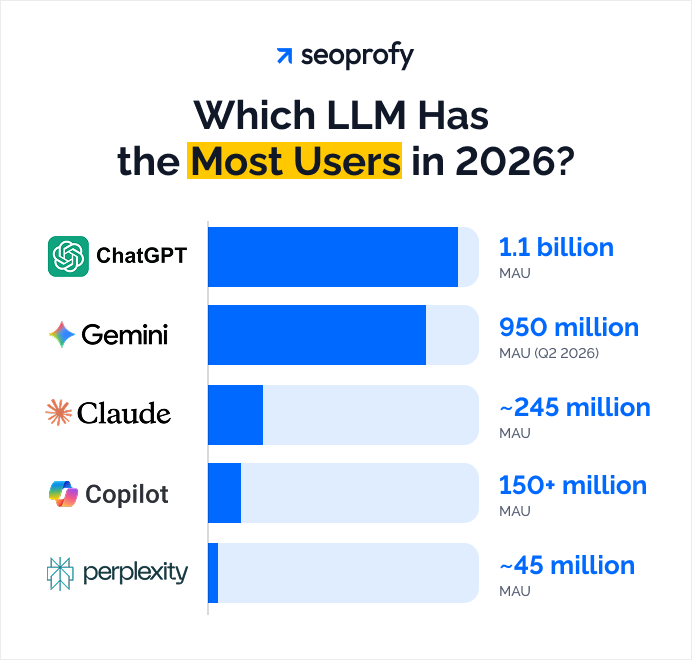
- ChatGPT statistics put monthly active users above 1.1 billion by June 2026. That makes its consumer audience larger than any other standalone AI assistant tracked by Sensor Tower. (TechCrunch / Sensor Tower)
- OpenAI’s ChatGPT user statistics reported more than 900 million weekly active ChatGPT users in February 2026, alongside over 50 million consumer subscribers and more than 9 million paying business users. (OpenAI)
- ChatGPT became the fastest mobile app ever to reach 1 billion monthly active users in May 2026, reaching the milestone in roughly three years. The scale of LLM usage is therefore not limited to occasional web visits; ChatGPT now combines mass reach with frequent repeat use. (Sensor Tower)
- OpenAI also reported 6 times as many monthly web visits and mobile sessions as the next-largest AI app, while total time spent was four times higher. (OpenAI)
Gemini and Claude Usage Statistics
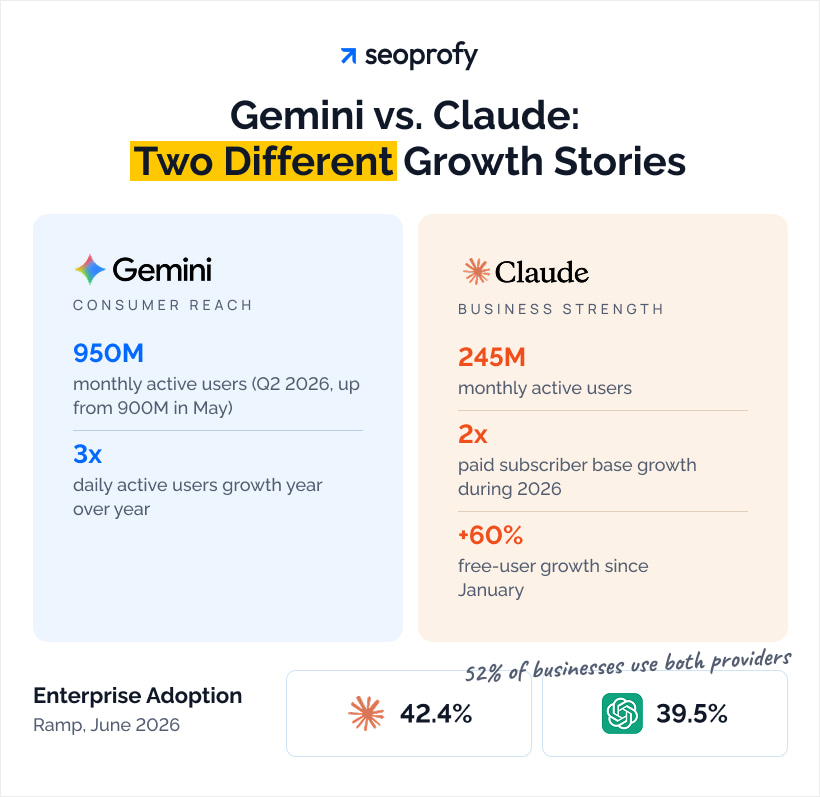
Gemini and Claude are growing in different ways. Gemini’s daily active users tripled year over year by Q2 2026, while Claude’s paid subscriber base more than doubled during 2026 and its free-user count rose over 60% from January. Those trends show why the LLM market size is better understood through both consumer reach and paid adoption. Claude is therefore much stronger in business than its consumer audience suggests.
- Gemini reached 950 million monthly active users in Q2 2026, up from more than 900 million in May. (Google)
- Sensor Tower estimated Claude at about 245 million monthly active users in June 2026, giving it a much smaller consumer audience than Gemini. (TechCrunch / Sensor Tower)
- Anthropic reached 42.4% adoption among businesses tracked by Ramp in June 2026, ahead of OpenAI at 39.5%. Among businesses using either provider, 52% used both, showing that enterprise LLM usage is often multi-model. These enterprise AI adoption statistics also explain why provider market share cannot be judged by exclusive usage alone. (Ramp)
LLM Market Share Statistics
Three providers now capture 88% of enterprise LLM API spending, yet no single company leads both consumer attention and enterprise spending. The 2026 LLM market share therefore changes with the metric: consumer referrals favor OpenAI, while paid enterprise usage favors Anthropic in this segment. These LLM statistics need to be read by segment rather than as one universal ranking. For Generative Engine Optimization (GEO), tracking only one assistant now leaves a meaningful part of AI discovery unmeasured.
- ChatGPT is losing share in website referrals: its global share fell from 84.21% in April 2025 to 76.85% in April 2026. Gemini reached 9%, Perplexity 7.73%, Copilot 3.76%, and Claude 2.66%. So yes, ChatGPT is losing market share on this metric, although it remains the consumer leader. (Statcounter)
- Anthropic captured 40% of enterprise LLM spending in 2025, compared with 27% for OpenAI and 21% for Google. (Menlo Ventures)
- Enterprise LLM adoption is increasingly multi-model: 81% of large enterprises surveyed by a16z now use three or more model families in testing or production, up from 68% less than a year earlier. (Andreessen Horowitz)
| Company | Market share | Main segment |
| Anthropic | 40% | Enterprise APIs and coding |
| OpenAI | 27% | General-purpose enterprise APIs |
| 21% | Enterprise APIs and cloud ecosystem |
Who Uses LLMs? Demographic Statistics
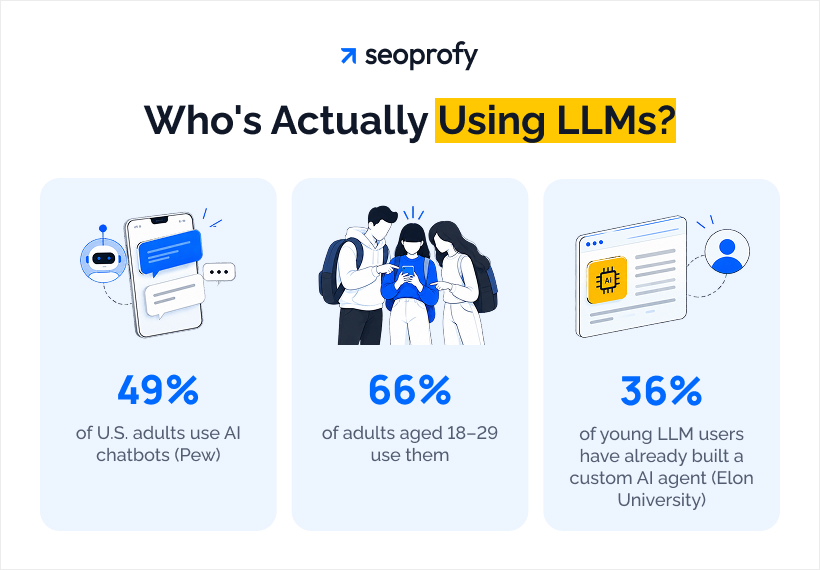
The latest generative AI statistics show a strong age gap in the U.S. Pew found that 49% of adults use AI chatbots, rising to 66% among 18–29-year-olds, so more than half of young adults now use them, compared with 23% of those 65+. Younger adults are not only more likely to try LLMs, their use is also more intensive, and usage falls steadily with age.
- Among Americans familiar with AI, 68% of 18–34-year-olds use generative AI at least sometimes, compared with 43% of adults aged 55+. (Ipsos)
- Elon University found that 36% of LLM users aged 18–29 had built a custom AI agent, versus 20% overall. Its 2026 survey also recorded the strongest weekly use among young adults, Black and Hispanic Americans, parents, and workers. (Elon University)
- Gallup reported that 51% of Gen Z respondents aged 14–29 use AI at least weekly: 22% daily and 29% weekly. The rate reached 60% among Asian Gen Z respondents and 57% among Black respondents. (Gallup)
- Rethink Priorities found that 91% of U.S. respondents with software-development backgrounds had used an LLM for work in Q1 2025; 29% used one daily or several times a day. (Rethink Priorities)
Enterprise and Business Adoption Statistics
AI has moved well beyond experimentation: 44% of U.S. workplaces were using it by May 2026. The enterprise AI adoption statistics below show how deeply companies are deploying these tools, followed by the productivity gains businesses report once AI becomes part of everyday work.
Enterprise Adoption Statistics
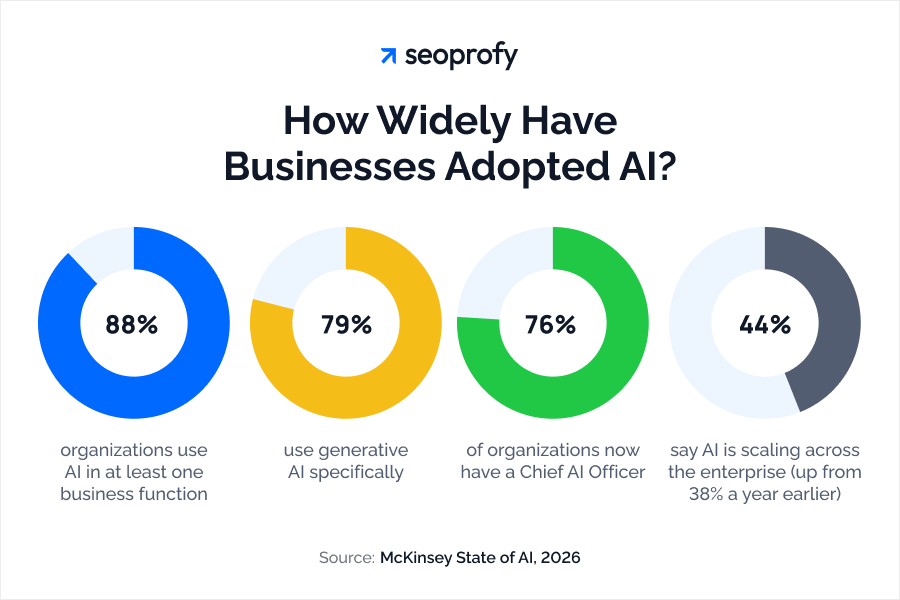
For many organizations, enterprise AI is moving beyond isolated pilots. In McKinsey’s 2026 survey, 44% of organizations said AI was scaling across the enterprise, up from 38% a year earlier, and 56% now use AI in three or more functions. The shift is not just wider adoption; AI is spreading into more workflows across departments and teams.
- Access to employer-approved AI tools reached about 60% of workers, up from under 40% a year earlier. Only 34% of organizations, however, said AI was already deeply transforming products, processes, or business models. (Deloitte)
- Only 25% of employees use AI regularly at work, even though 86% of CEOs believe their workforce is ready for it. At the same time, 76% of organizations now have a Chief AI Officer, up from 26% one year earlier. (IBM)
- Agent deployment reached 53% of organizations in Q2 2026. The share orchestrating multiple AI agents across workflows doubled from 9% to 18% in a single quarter. (KPMG)
These generative AI statistics show that enterprise LLM adoption is broad, but true company-wide integration still lags behind basic access and experimentation. 88% of organizations use AI in at least one business function; 79% use generative AI.
Productivity Gains and Business Impact
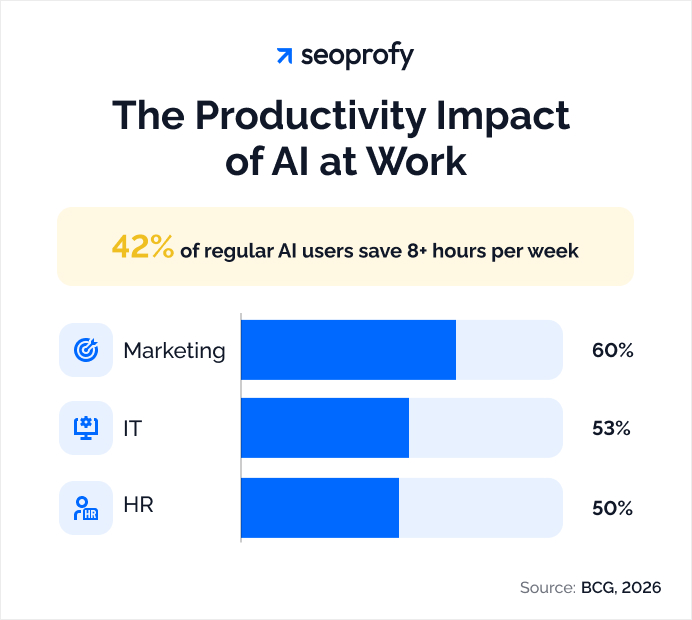
AI is producing measurable productivity gains, but results vary sharply by task. PwC found that productivity growth was 40% higher at companies most exposed to AI than at the least-exposed companies, showing that the payoff is already visible at firm level.
- Among regular frontline AI users, 42% report saving at least eight hours per week. The figure rises to 60% in marketing, 53% in IT, and 50% in HR. (BCG)
- In a 2026 survey of nearly 6,000 senior executives, nine in ten reported no measurable productivity impact from AI over the previous three years. They still expect AI to raise productivity by 1.4% over the next three. (Becker Friedman Institute)
- Three field experiments involving 4,867 software developers found that AI coding assistance increased completed tasks by 26.08%, with larger gains among less-experienced developers. (Management Science)
- AI tools save workers approximately 40–60 minutes per day when successfully integrated into their jobs. (Goldman Sachs / Fortune)
Developer and API Usage Statistics
AI and LLM tools are now part of the standard developer toolkit instead of being an occasional add-on. JetBrains found that 90% of professional developers used at least one AI tool for coding or development work in January 2026, while 74% had adopted a specialized coding assistant, editor, or agent. So, following LLM statistics show AI usage is a default part of software production:
- 89% of developers use generative AI in their daily work, yet only 24% design APIs with AI agents in mind. Postman also recorded 7.53 million calls to AI APIs over 12 months, up 40% year over year. (Postman)
- AI-agent use nearly doubled to 59% in Stack Overflow’s April 2026 pulse survey. Daily use reached 37%, but 63% of technologists still rarely or never allow agents to operate fully autonomously. (Stack Overflow)
- 1.13 million public GitHub repositories now import an LLM SDK, a 178% year-over-year increase. Developers also created 693,000 new AI repositories in 2025. (GitHub)
Top LLM Use Cases: How People Actually Use AI
The most common AI use cases now center on practical knowledge work rather than novelty. Among British workers using AI in 2026, 60% used it to summarize information, 58% for research, and 56% to edit or check text. That pattern shows LLMs becoming everyday tools for finding and condensing information.
| Use case | Share of AI-search users |
| Seeking knowledge or advice | 55% |
| Finding general information | 48% |
| Researching health and wellbeing | 35% |
| Drafting emails, CVs, or other writing | 32% |
- Among people using LLMs for informal learning, 69.5% asked for explanations, 63.3% made factual queries, and 61% requested tutorials or step-by-step guidance. (Computers & Education: Artificial Intelligence)
- AI also changes how people search rather than simply shortening the process: 31% of U.S. consumers said AI summaries made them spend more time researching, compared with 16% who said they spent less. (Gartner)
- In the U.S., 45% of adults now use AI for writing at least sometimes, including 17% who do so weekly. This confirms writing is no longer a niche use case. (YouGov)
LLM Market Size and Revenue Statistics
Current generative AI market statistics put the global LLM market at a projected $10.57 billion in 2026 and $149.89 billion by 2035, implying a 34.44% compound annual growth rate and roughly fourteen-fold expansion. The forecast shows how quickly investment in model technology is scaling, but provider revenues are already growing across a broader mix of subscriptions, APIs, coding tools, and enterprise products.
- OpenAI’s annualized revenue run rate passed $40 billion in August 2026, roughly double its pace at the end of 2025. Bloomberg linked the acceleration to subscription sales, enterprise demand, coding software, and the company’s emerging advertising business. (Bloomberg Law)
- Anthropic’s annualized revenue run rate exceeded $65 billion by the end of July 2026, more than seven times its year-end 2025 pace. Preliminary second-quarter revenue topped $11.5 billion, more than double the previous quarter, showing how rapidly enterprise demand for Claude and related products is monetizing. (Axios)
- Europe’s Mistral generated more than $400 million in revenue in 2026, about twenty times its prior-year level, and expected to pass $1 billion in annual recurring revenue by year-end. Around 60% of its revenue came from Europe, reflecting demand for regional alternatives to U.S.-based AI providers. (Financial Times)
These figures also show why the LLM market is no longer defined only by chatbot subscriptions. Revenue is increasingly coming from enterprise APIs, coding products, private deployments, and model access embedded inside other software. This all broadens the commercial base behind continued market growth.
LLM Trust, Risk, and Security Statistics
Trust remains a major constraint on deeper LLM use. The latest generative AI statistics from S&P Global shows that 51.3% named data-privacy risks as their top concern about generative AI, ahead of fraud, scams, and job displacement. The issue is not simply whether people use AI, but what information they are willing to share with it.
- AI errors, misinformation, and hallucinations were the most cited business risk in Gallagher’s 2026 survey, selected by 57% of companies. Legal and reputational risks followed at 56%, with privacy violations and data breaches at 55%. (Gallagher)
- Only 38% of organizations surveyed by ISACA had a formal, comprehensive AI policy in 2026. Another 30% had limited policies, while 25% had no active policy, leaving clear gaps in governance and risk management as usage expands. (ISACA)
- Human oversight remains common in higher-stakes settings. Cambridge’s 2026 financial-services study found 29% of AI vendors required human approval before AI actions, while another 26% allowed systems to act with humans able to intervene. (Cambridge Centre for Alternative Finance)
The Future of LLM Usage: 2026 Trends and Predictions
By 2030, LLM usage is likely to shift from standalone chats toward agents embedded in software and workflows. Current generative AI market statistics suggest that this shift will expand the market beyond standalone assistants as AI becomes built into more business software. IDC expects 40% of job roles in large global enterprises to involve working with AI agents by 2027, suggesting the next growth phase will come from delegated tasks rather than prompting alone.
- Companies will increasingly route work between models instead of relying on one provider for every task, balancing capability, cost, speed, and data requirements. (AWS)
- OECD research suggests lower model prices will not automatically mean lower AI costs because agents consume more tokens and operate across longer task chains. Governance, security, and efficient orchestration will become part of adoption economics. (OECD)
- MIT expects organizations to redesign workflows around systems that pursue goals, use tools, and act on their behalf. By 2030, the question will be less “Which chatbot do we use?” and more “Which processes can AI reliably run?” (MIT Sloan)
Frequently Asked Questions
Which LLMs are most used?
ChatGPT leads consumer use, followed by Gemini, while Claude remains smaller. Current SEO statistics point to a multi-platform AI search environment.
Is ChatGPT losing market share?
Yes, on referral-share measures, even as its user base grows. A ChatGPT SEO strategy should track visibility across competing assistants. Teams asking how to rank in AI Overviews also need to track Google’s AI surfaces.
How many active users do major LLM platforms have worldwide?
Major LLM platforms recorded more than 4.7 billion monthly active users combined in April 2026, according to Counterpoint Research. This figure reflects activity across platforms rather than 4.7 billion unique individuals, since one person may use multiple LLM services. An AI SEO audit should treat that as platform activity (not unique people).
What percentage of businesses have adopted generative AI?
McKinsey reports that 79% of organizations use generative AI in at least one business function. AI is already part of routine company workflows.
Which company leads LLM enterprise market share?
Anthropic leads enterprise spending in Menlo Ventures’ estimate. This LLM market share measure differs from consumer reach, so SEO statistics based only on chatbot traffic miss part of the picture.
What These LLM Usage Statistics Mean for Your Business
The latest LLM usage statistics show that AI assistants are becoming a separate place where customers discover brands and compare options. Current LLM statistics also show that visibility can differ from one model to another, so strong Google rankings do not automatically carry over to ChatGPT or Gemini. The same applies to local SEO statistics: strong performance in local search does not guarantee that a business will appear when users ask AI tools for recommendations. Perplexity may rely on another set of sources for the same query.
SeoProfy’s AI SEO services help you see where your brand appears and where competitors are being cited instead. We review the sources behind those answers and find the pages that need stronger coverage. Our team can then build an AI visibility strategy around those specific gaps.

Julia Lubianytska is a Copywriting Team Lead at SeoProfy with over 7 years of experience in copywriting and editing. She works closely with copywriting teams, helping writers craft clear and thoughtful content for SaaS products, IT services, and businesses in the legal and medical fields. Julia enjoys turning complex topics into easy-to-understand, trustworthy content, focusing on structure, clarity, and consistency to ensure the content is genuinely helpful for real people, not just search engines.