

 Add SeoProfy as a preferred source on Google

In October 2026, AI token costs range from $0.10 to $10 per million input tokens and from $0.50 to $50 per million output tokens across leading OpenAI, Anthropic, and Google models. That range matters: even a modest price difference adds up across thousands of API requests.


Gartner forecasts worldwide AI spending will reach $2.7 trillion in 2026. Our generative AI statistics explore the broader adoption trends, while this guide focuses on what developers, product teams, and finance managers actually pay.
We compare published rates by model, explain input and output charges, and show how caching, batch processing, reasoning, and additional tools affect a monthly bill. Prices are based on official provider pages checked in October 2026. Any sample costs, comparisons, or projections calculated from those prices are labeled as SeoProfy calculations.
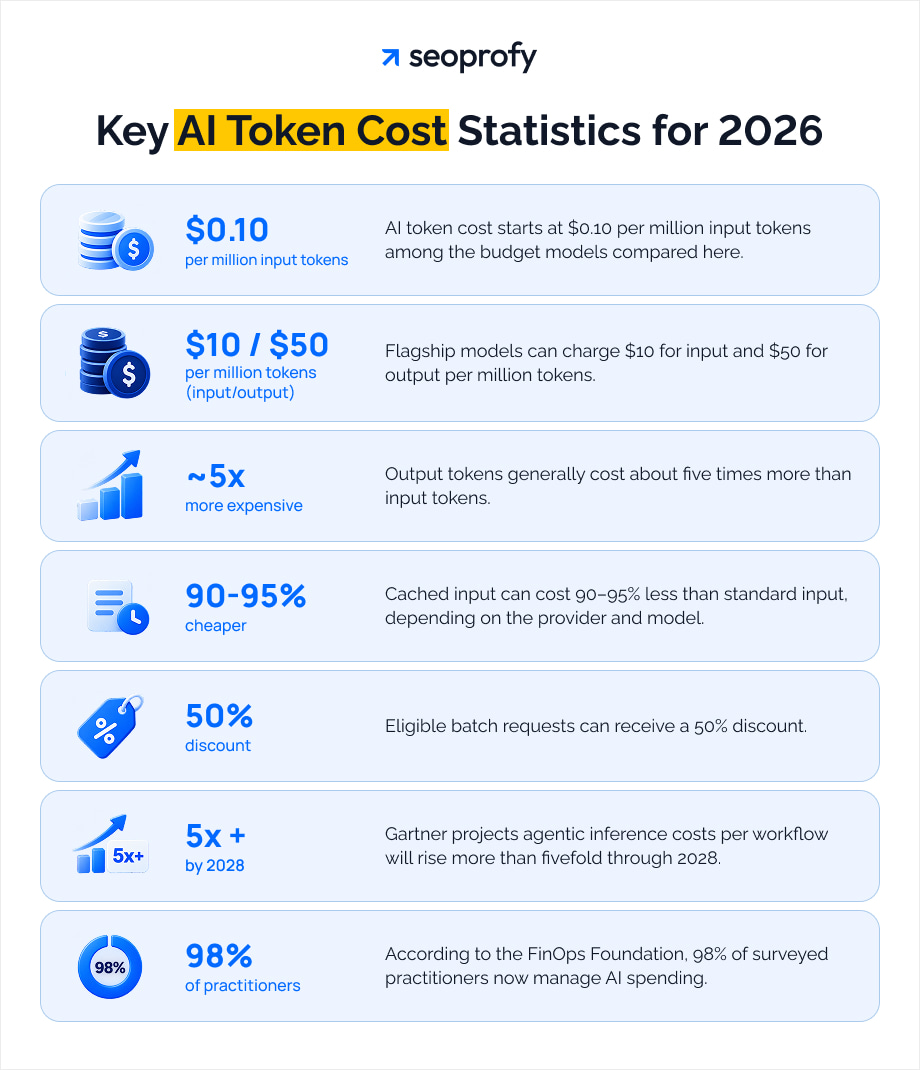
- AI token cost starts at $0.10 per million input tokens among the budget models compared here.
- Flagship models can charge $10 for input and $50 for output per million tokens.
- Output tokens generally cost about five times more than input tokens.
- Cached input can cost 90–95% less than standard input, depending on the provider and model.
- Eligible batch requests can receive a 50% discount.
- Gartner projects agentic inference costs per workflow will rise more than fivefold through 2028.
- According to the FinOps Foundation, 98% of surveyed practitioners now manage AI spending.
What Is an AI Token and How Is It Priced?
A token is a unit of text that an AI model processes when reading input or generating a response. It can be an entire word, a portion of a word, or even a punctuation mark. For English text, a single token typically represents around four characters, or about 0.75 words. API providers generally charge per million tokens, with different rates for input and output.
So, what is an AI token in practical terms? It’s a small piece of text that determines how much information a model processes and how much the provider charges.
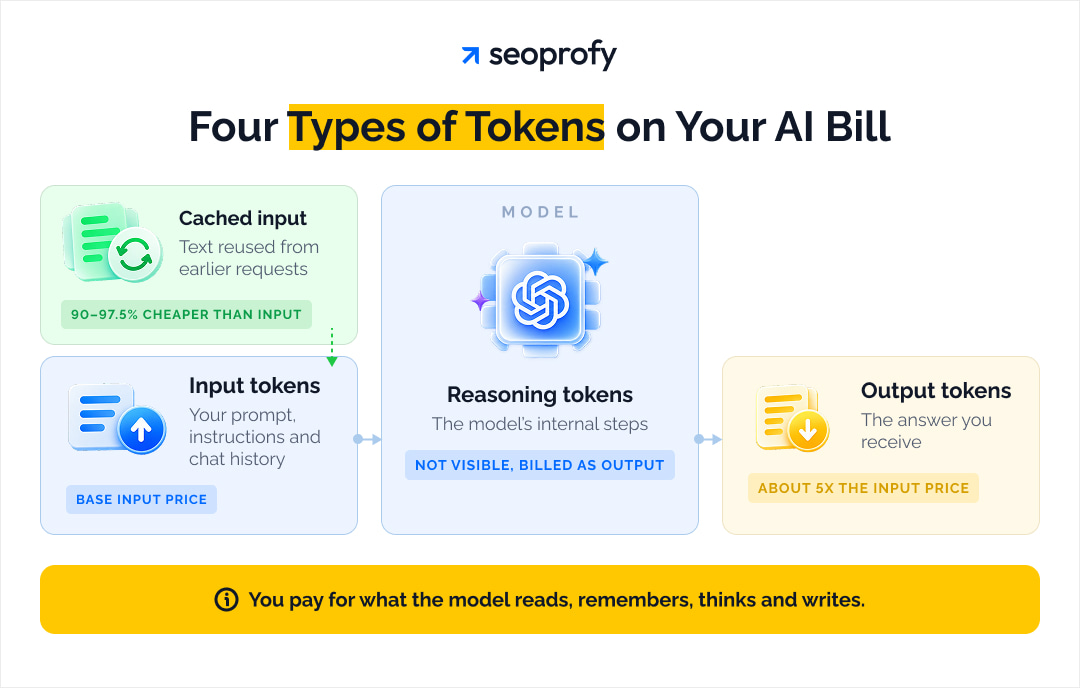
Four categories determine how those charges appear on a bill:
- Input tokens: The instructions, conversation history, and text sent to the model.
- Output tokens: The answer the model generates, priced higher than input.
- Cached input tokens: Previously processed prompt content reused in later requests at a discounted rate.
- Reasoning tokens: Internal steps some models generate while working through a task.
These may not appear in the visible answer but can still be charged at output rates.
Token counts are not universal. The same sentence may be divided differently across models, languages, or formatting choices. Anthropic says it’s Claude 4.7 and the later tokenizer produces about 30% more tokens for identical text than earlier Claude models. For budgeting, measure usage with the specific model you plan to deploy.
AI Token Cost by Model
The table compares standard AI token pricing for nine OpenAI, Anthropic, and Google models as of October 2026.
| Provider | Model | Input per 1M tokens | Output per 1M tokens | Cached input per 1M tokens |
| OpenAI | GPT-6 Astra | $10.00 | $50.00 | $1.00 |
| OpenAI | GPT-6.1 Sol | $2.00 | $10.00 | $0.10 |
| OpenAI | GPT-6 Luna | $0.10 | $0.50 | $0.01 |
| Anthropic | Claude Fable 5.1 | $10.00 | $50.00 | $0.25 |
| Anthropic | Claude Opus 5.5 | $4.00 | $20.00 | $0.20 |
| Anthropic | Claude Sonnet 5.5 | $2.00 | $10.00 | $0.10 |
| Anthropic | Claude Haiku 5.5¹ | $0.10 | $0.50 | $0.01 |
| Gemini 3.1 Pro Preview² | $2.00 | $12.00 | $0.20 | |
| Gemini 3.8 Flash³ | $0.75 | $3.75 | $0.075 |
Sources: Official API pricing pages from OpenAI, Anthropic, and Google.
| ¹ Claude Haiku 5.5 pricing covers prompts of up to 100,000 tokens. Higher rates apply beyond that limit.
² Gemini 3.1 Pro Preview pricing is based on prompts of up to 200,000 tokens, with increased rates for longer inputs. ³ Promotional pricing for Gemini 3.8 Flash remains valid until December 31, 2026. |
At the budget end, the OpenAI token cost for GPT-6 Luna starts at $0.10 per million input tokens, matching the Claude token cost of Haiku 5.5 for shorter prompts. The Gemini token cost for 3.8 Flash is higher at $0.75 per million input tokens, although these models differ in capabilities and intended use cases.
Budget models offer the lowest cost per token, with GPT-6 Luna and Claude Haiku 5.5 charging up to 100 times less than flagship models at standard input and output rates, provided Haiku requests remain within its lower pricing tier.
Mid-tier options are closely matched: GPT-6.1 Sol and Claude Sonnet 5.5 have identical published input and output prices, although they may differ in performance and token consumption.
Still, identical rates do not guarantee identical bills, since tokenizers divide text differently across models, meaning the same prompt can consume more tokens with one provider than another.
Input vs Output Token Cost
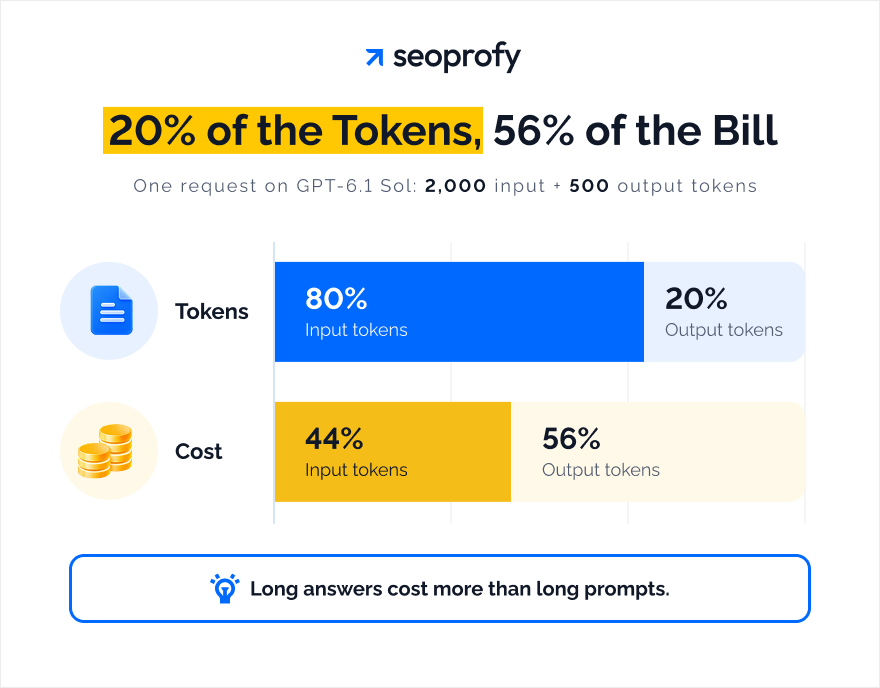
The difference between input vs output tokens can affect an API bill more than prompt length alone. For most models in the comparison above, generated tokens cost about five times as much as tokens sent to the model. Gemini 3.1 Pro Preview has a wider gap: its output rate is six times its input rate for shorter prompts.
The difference reflects how models process requests. A model can process an incoming prompt together during its initial computation. Generating a response is sequential: each new token depends on the preceding text, requiring repeated computation. Providers charge more for that work.
A short question can become expensive if the model produces a lengthy report, several drafts, or detailed code. The prompt may contain few tokens, while the response accounts for most of the usage. Reasoning-capable models add another consideration. Their internal reasoning tokens may not appear in the answer shown to users, but OpenAI bills them at output rates.
To estimate costs, measure input and output separately rather than relying on the total token count. It helps to set response-length limits and inspect actual API usage, especially for tasks generating multiple completions. A longer prompt is not automatically the expensive part of a request. Long answers typically raise the bill faster than long prompts.
How Much Do 1,000 to 1,000,000 Tokens Cost?
So, how much do AI tokens cost at different volumes? The following table compares output expenses for budget, mid-tier, and flagship models:
| Tokens | About how many words | Budget output ($0.50 per 1M) | Mid-tier output ($10 per 1M) | Flagship output ($50 per 1M) |
| 1,000 | 750 | $0.0005 | $0.01 | $0.05 |
| 10,000 | 7,500 | $0.005 | $0.10 | $0.50 |
| 100,000 | 75,000 | $0.05 | $1.00 | $5.00 |
| 400,000 | 300,000 | $0.20 | $4.00 | $20.00 |
| 1,000,000 | 750,000 | $0.50 | $10.00 | $50.00 |
Our calculations are based on published output rates. English word equivalents use OpenAI’s approximate ratio of 0.75 words per token.
These figures cover generated text only; real requests also incur input charges and sometimes other fees.
How many tokens is $100? At a rate of $10 per million output tokens, a budget of $100 buys 10 million generated tokens; at $0.50 per million, it purchases 200 million. These theoretical totals exclude prompt costs, and neither represents how much a model can produce in one request.
Is 10,000 tokens a lot? It is roughly 7,500 English words, enough for a substantial report, but little for an application processing thousands of conversations. What matters is how often those tokens are consumed: a single response might cost pennies, while repeated responses increase monthly spending.
For budgeting, use the table as a starting point, not a final invoice. Compare costs at the request level, accounting for both input and output. Postman recorded 7.53 million calls to AI APIs over 12 months, a 40% year-over-year increase. Growing request volumes make accurate cost estimates increasingly important.
How Caching and Batch Processing Cut Token Costs
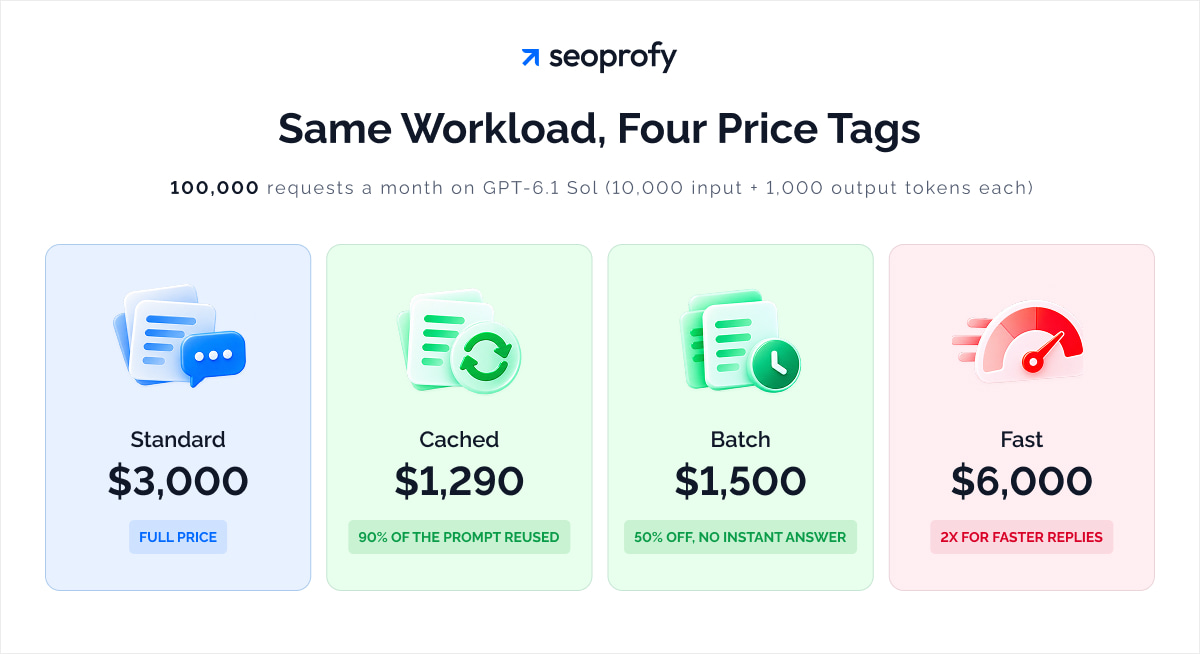
Two options can reduce AI token cost without changing the model: reuse prompt content through caching or process non-urgent requests in batches.
Caching helps when an application repeatedly sends the same instructions, reference documents, or conversation history. Instead of charging the full input rate each time, providers can reuse previously processed content at a discount.
The savings depend on the provider:
- OpenAI: Cached input costs 90–95% less than standard input, depending on the model.
- Anthropic: Cache reads cost 90–97.5% less, with the largest discount available on Claude Fable 5.1.
- Google: Gemini offers a 90% discount on cached input, although explicit caching can also incur storage charges.
Caching has an upfront cost in some cases. Anthropic charges 1.25 times the standard input rate for a five-minute cache write and twice that rate for a one-hour entry. According to its pricing documentation, these options generally become cost-effective after one or two successful cache reads, respectively.
Batch processing offers another way to lower expenses. OpenAI, Anthropic, and Google provide 50% discounts on eligible asynchronous workloads. This approach works well for document classification, bulk content analysis, and other tasks that don’t require immediate responses. Anthropic and OpenAI publish their respective batch rates.
Faster processing has the opposite effect. OpenAI’s Fast mode can double standard rates, while Google’s Priority tier also costs more. Reserve premium processing for requests where response time justifies the expense.
More on How AI Token Prices Are Changing
Published prices show substantial differences between model generations, although a lower rate does not always mean a cheaper completed task.
| Model comparison | Earlier input / output per 1M | Newer input / output per 1M | Change |
| GPT-5.6 Sol → GPT-6.1 Sol | $4 / $20 | $2 / $10 | 50% lower |
| Claude Opus 4.1 → Opus 5.5 | $15 / $75 | $4 / $20 | About 73% lower |
| Claude Haiku 4.5 → Haiku 5.5 | $1 / $5 | $0.10 / $0.50 | 90% lower |
| Gemini 3.8 Flash, 2026 → 2027 | $0.75 / $3.75 | $1.50 / $7.50 | 100% higher |
Comparison of official published standard API rates. Percent changes calculated by SeoProfy.
The first three rows compare different model generations, not price cuts to the same model. OpenAI’s newer Sol costs half as much per input and output token as GPT-5.6 Sol; Anthropic’s Opus and Haiku comparisons show steeper reductions. This analysis does not establish equal performance, token counts, or output quality.
Google illustrates the reverse. Its introductory Gemini 3.8 Flash rates apply through December 31, 2026, with both prices scheduled to double on January 1, 2027. Teams should account for that change when forecasting spending.
Lower published rates are encouraging, but the expense of completing a task still depends on actual usage patterns. Our Claude AI statistics show that 52% of interactions involved augmentation, where users work alongside AI rather than fully delegate tasks. Such workflows may require repeated requests, making actual usage more important than list prices alone.
Why AI Bills Keep Rising as Token Prices Fall
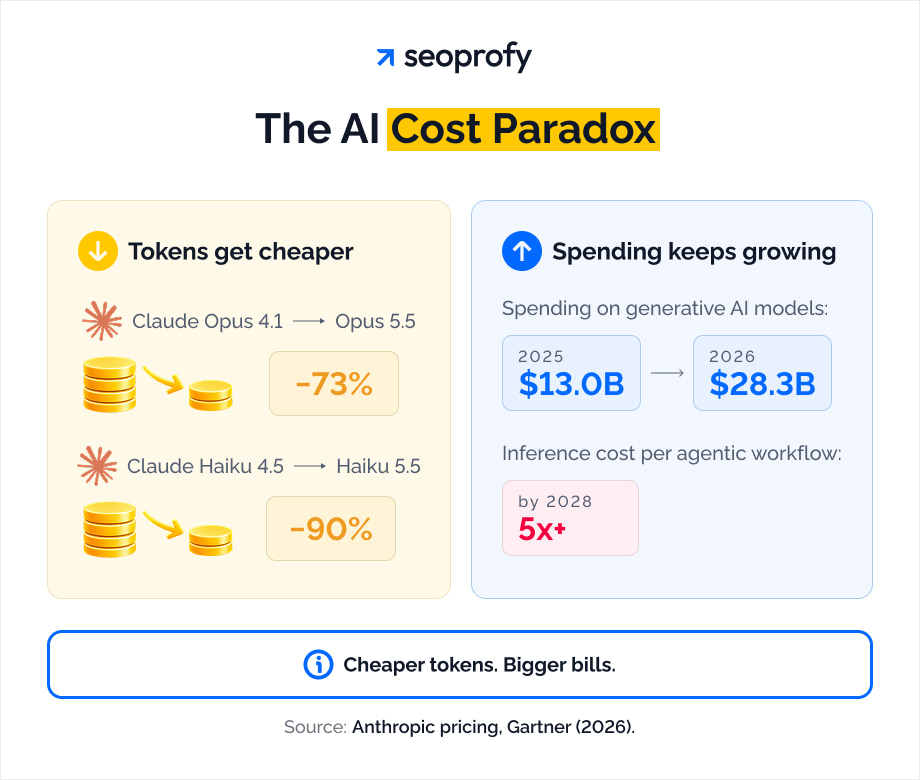
Although individual AI tokens are becoming cheaper, total bills keep growing because agents use more tokens per task and organizations spend more on AI, as the following sections explain.
AI Agents Use Far More Tokens
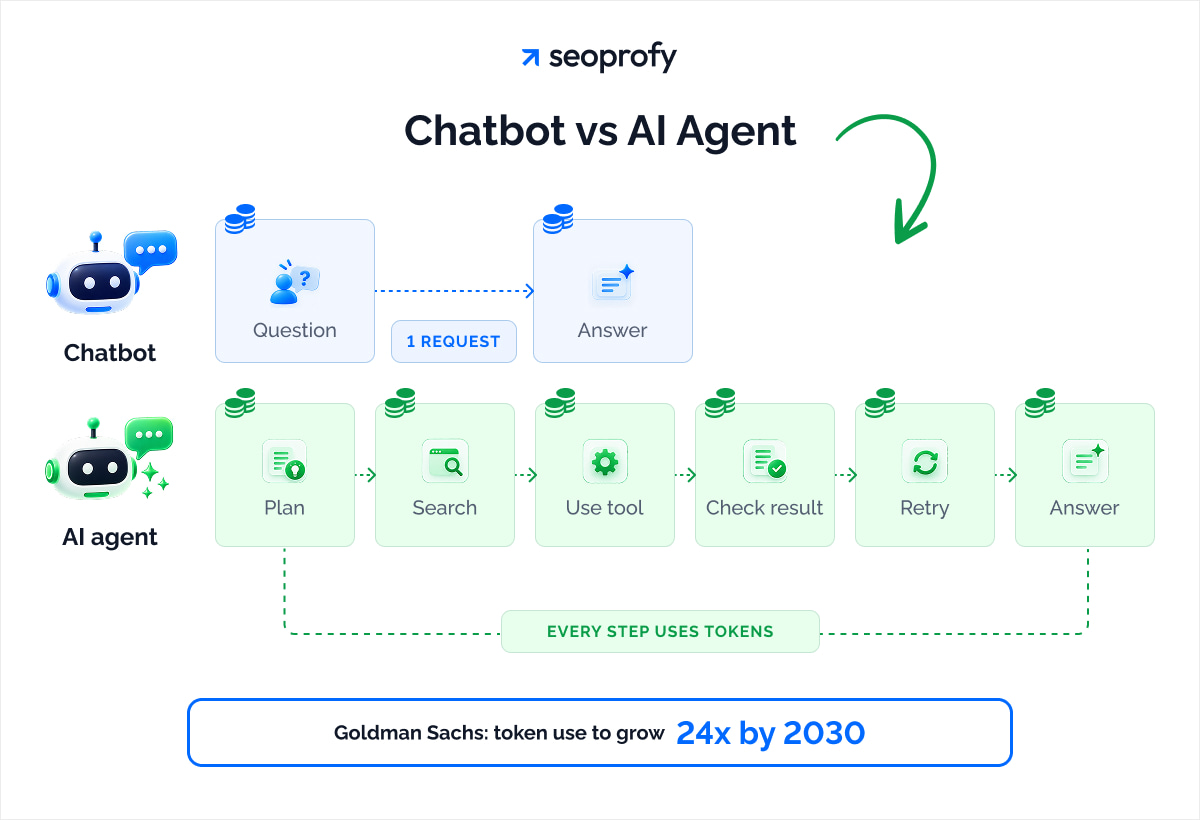
Gartner calls this phenomenon the “inference paradox”: better unit economics encourage more complex AI workflows, pushing costs up even as individual tokens become cheaper. Gartner expects that inference costs for agentic workflows will increase by more than fivefold by 2028.
Unlike a basic chatbot that responds to a single prompt, an AI agent may break a task into steps, gather information, use external tools, evaluate the results, and repeat actions when needed. Each step consumes additional tokens. According to Gartner, handling a task with an agentic reasoning model already costs providers at least five times more than a standard chatbot exchange.
Goldman Sachs Research expects worldwide token consumption to grow 24-fold between 2026 and 2030, reaching 120 quadrillion tokens per month as agent use expands. That is an industry-wide projection, not a multiplier for every individual request. Teams need usage measurements by workflow, including tool calls and retries, to understand where budgets are going.
AI Spending Keeps Growing
The spending outlook reflects this pressure. Gartner forecasts $2.7 trillion in worldwide AI expenditure for 2026, up 49.5% from 2025. Within that total, spending on generative AI models is projected to reach $28.3 billion, compared with approximately $13.0 billion in 2025.
Adoption extends well beyond developers. Our ChatGPT statistics report OpenAI’s August 2026 milestone of one billion weekly ChatGPT users. That figure measures consumer reach, not paid API requests, but illustrates how widely AI interactions have spread.
Cost oversight is spreading as well. According to the FinOps Foundation’s 2026 survey, 98% of respondents now manage AI spending, up from 31% in 2024. The sample covers FinOps practitioners rather than all companies, but the trend is clear: usage-based AI bills are becoming part of routine financial planning. Tracking budgets by model and team helps reveal where spending is concentrated.
Hidden Costs Beyond the Per-Token Price
The advertised cost per token is only part of an API bill. Long prompts, tools, and regional processing can change the rate.
The following table compares additional charges across the three major AI providers:
| Extra cost | OpenAI | Anthropic | |
| Very long prompts | GPT-6 Astra: $20 input / $75 output per 1M, versus $10 / $50 normally | Haiku 5.5: $0.50 / $2.50 above 100,000 tokens, versus $0.10 / $0.50 | Gemini 3.1 Pro: $4 / $18 above 200,000 tokens, versus $2 / $12 |
| Web search | $10 per 1,000 calls | $10 per 1,000 searches | 5,000 free monthly queries, then $14 per 1,000 |
| Regional processing | 10% premium for eligible data-residency models | 10% premium for US-only inference | No comparable surcharge listed |
Long-context pricing applies when a request exceeds a provider’s threshold. Search fees are charged separately from token usage, and one request may trigger multiple searches.
The scale of AI usage makes these charges worth tracking. Our Google Gemini statistics report that Google’s model APIs processed approximately 22 billion tokens per minute in Q2 2026, up from 16 billion in the previous quarter. These are provider-wide figures, illustrating how quickly token consumption can grow.
Tool definitions and retrieved content also increase input usage, while retries and alternative completions add output tokens. Reasoning tokens can increase charges without appearing in the visible response. Accurate AI token cost estimates should therefore account for the full workflow.
API Token Pricing vs AI Subscriptions
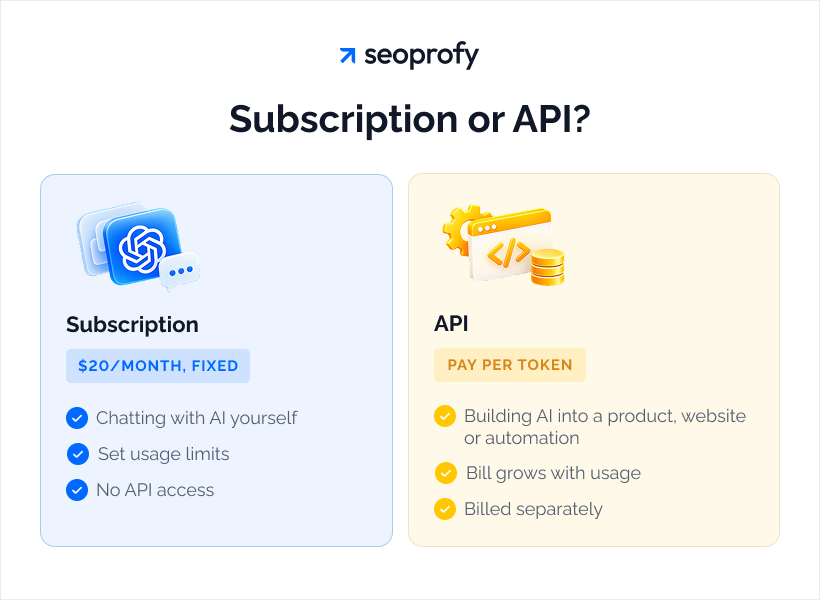
AI token pricing and chatbot subscriptions follow different billing models, which affects how businesses calculate their monthly expenses. A subscription provides access to an AI assistant for a fixed monthly fee. In the US, ChatGPT Plus costs $20 per month, Claude Pro costs $20, and Google AI Pro costs $19.99. These plans offer enhanced features and usage allowances, but not a fixed pool of API tokens.
With an API, applications send requests directly to a model. The bill depends on the model, input and output tokens processed, and additional services used. A small integration might cost a few dollars, while a busy customer-support system could process millions of tokens daily.
The distinction also matters when choosing tools. Our Perplexity vs ChatGPT comparison explores their different strengths in research and conversational writing. A subscription can make sense when employees perform those tasks manually. Automating similar workflows introduces usage-based costs.
Importantly, ChatGPT Plus and Claude Pro subscriptions do not include standard API access. API usage is billed separately.
The rule is simple: choose a subscription for personal AI chats; use API pricing when budgeting for an AI-powered product, website, or automation.
How to Estimate Your Monthly AI Token Cost
To estimate your monthly AI token cost, start with average input tokens, average output tokens, and expected requests per month. Find the chosen model’s rates per million tokens, then calculate:
- Multiply input tokens by the input rate and divide by 1,000,000.
- Multiply output tokens by the output rate and divide by 1,000,000.
- Add both amounts, then multiply by monthly request volume.
Suppose a model charges $2 per million input tokens and $10 per million output tokens. For a request containing 2,000 input tokens and 500 output tokens, the calculation is $0.004 + $0.005 = $0.009. At 10,000 monthly requests, that comes to $90.
But don’t assume that all requests are the same. Our LLM usage statistics report that 81% of large enterprises use at least three model families in testing or production. If your application routes requests between models, estimate each model’s traffic separately and add the totals.
Actual bills can also exceed a simple forecast. Retries generate new requests; conversation history enlarges inputs; reasoning tokens increase billed output; and external tools may carry separate fees. Cached tokens or batch processing can reduce eligible charges. Test both typical and high-volume scenarios to see the possible spending range.
For more precise estimates, use OpenAI’s free Tokenizer or Anthropic’s free token-counting API to measure sample prompts.
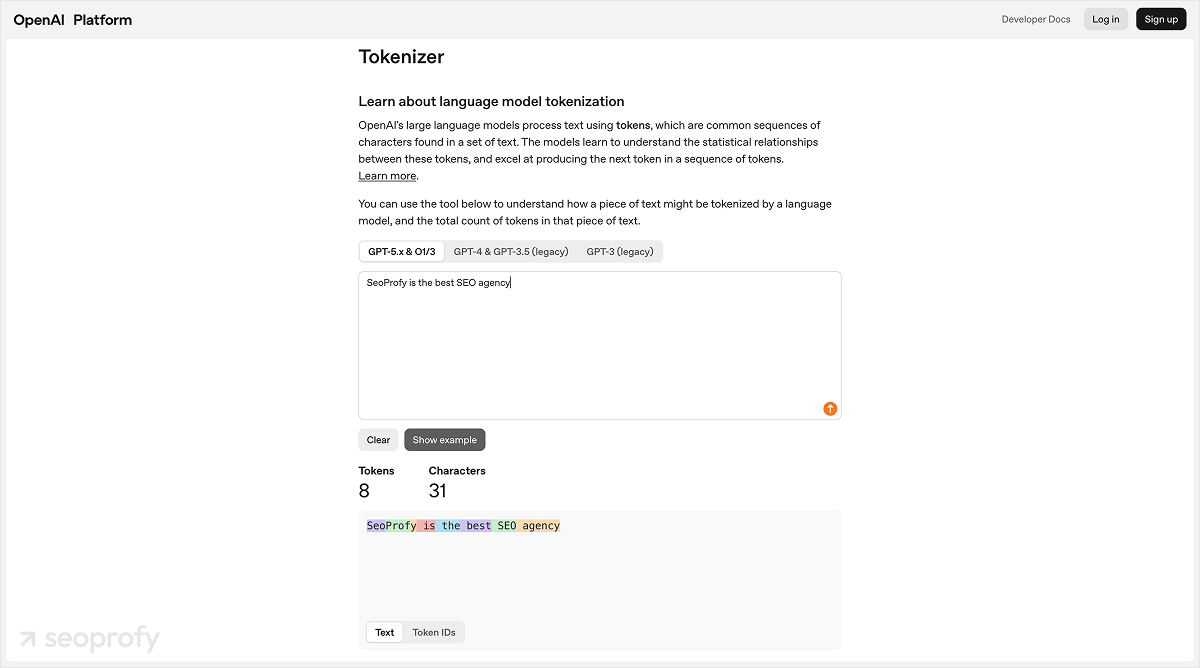
Compare projections with real usage after launch.
What AI Token Costs Mean for Your AI Budget
AI pricing is becoming less about the headline rate and more about the work completed for each dollar. New model generations keep pushing per-token prices down, but a cheaper model will not necessarily produce a cheaper workflow. Tasks requiring repeated attempts, lengthy outputs, or complex reasoning can consume far more tokens than straightforward requests.
This matters as companies move from individual chats to automated processes. AI agents can search, call tools, inspect results, and try again before returning an answer. Each step may add billable usage, even when users see only a short response.
For budgeting, the meaningful comparison is therefore the total cost of completing a task reliably, not simply the listed price per million tokens.
Check providers’ price lists when setting your budget, match each model tier to the task, and measure actual usage before scaling.

Julia Lubianytska is a Copywriting Team Lead at SeoProfy with over 7 years of experience in copywriting and editing. She works closely with copywriting teams, helping writers craft clear and thoughtful content for SaaS products, IT services, and businesses in the legal and medical fields. Julia enjoys turning complex topics into easy-to-understand, trustworthy content, focusing on structure, clarity, and consistency to ensure the content is genuinely helpful for real people, not just search engines.