


AI Overviews answer most user questions by pulling key points from authoritative sites. The feature now reaches over 2.5 billion monthly active users, while AI Mode has passed the 1 billion milestone. Search is clearly moving toward longer, more specific questions where users expect a crisp answer without extra digging.


For businesses, it creates another route to prospective clients. When Google includes your link in an AI Overview, a user may visit your website to get more context and useful details on the topic. So, how can you make your web pages get spotted and recommended by this AI-powered feature? We’ve prepared 12 time-tested strategies to help you understand how its algorithms work and earn more mentions.
- AI Overviews appear in over 21% of long-tail, question-based informational queries, but only in 4.3% of commercial, 2.1% of transactional, and 0.9% of navigational searches.
- Your brand’s visibility in Google Overviews largely depends on your content’s compliance with the E-E-A-T principles.
- Mentions in AI summaries boost brand authority and positioning but also contribute to zero-click searches and lower CTRs.
- In 78% of cases, AI Overviews include lists, so structuring your content with them and other scanable formats increases the likelihood that it will be included in the summaries.
- A strong technical background, semantic clustering with natural entity usage, and regular content updates also increase the chance of AIO inclusion while ensuring high performance in traditional search results.
What Are Google AI Overviews?
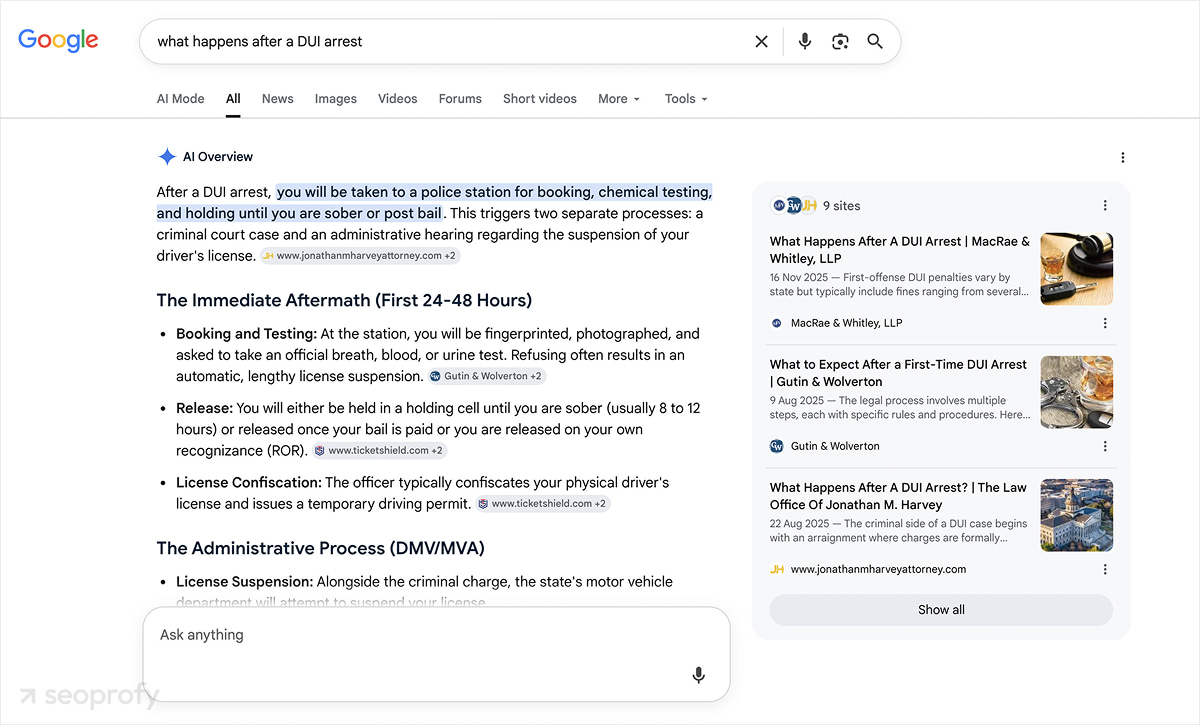
Google Overviews, formerly known as Search Generative Experience, are summaries that appear at the top of search results. These overviews aim to provide readers with quick answers without requiring them to click through. You’ll see them show up in Google’s search like this:
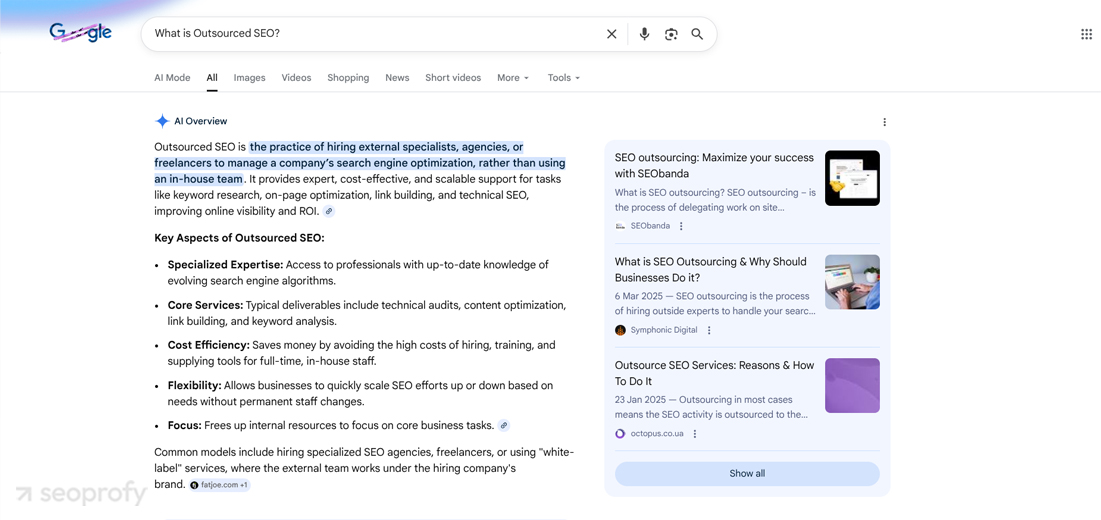
If a person wants more context, they can click a link to visit the source and review the original information or use the special AI Mode. Compared with featured snippets, whose visibility fell by 64% in Ahrefs’ 2025 analysis of 1 million US desktop SERPs, AI Overviews work with a wider pool of sources and can pull information from several websites at once.
Their reach is already large. A 2026 study of 11,500 real-user queries found that AIOs appeared in 51.5% of representative searches. Other tracking shows a lower average across broad search engine results pages (SERPs), with AI Overviews present in nearly 20% of searches after a sharp 2025 rollout. So, the exact number depends on the country, query type, and dataset.
Their appearance also depends heavily on search intent. AIOs are most common for informational queries, such as questions, explanations, and how-to searches, while commercial, transactional, and navigational searches trigger them far less often.
Overall, this changes the value of a top organic position. When Overviews appear above the standard results, users often get enough information before they reach the first blue link. Studies show that top-ranking pages can lose 34.5%–64.4% of clicks in SERPs. User behavior points in the same direction: only about 8% of users click results after seeing an AI Overview, while around 26% end the session right there.
How Do Google AI Overviews Work?
To discover trustworthy information, they perform the following actions:
- Scan content on the relevant web pages
- Recognize the mentioned concepts, brands, people, or products
- Summarize the most relevant data and provide it to the user.
When algorithms scan a page, they pay close attention to E-E-A-T signals: experience, expertise, authoritativeness, and trust. A page can still earn a citation without huge brand fame if it references reliable sources and covers the topic with substance.
That is also the basic idea behind GEO, or Generative Engine Optimization: SEO for AI-generated search answers. It prepares your content to appear in AI Overviews, AI Mode, ChatGPT, Perplexity, and other answer engines by making the page useful enough to cite.
You should understand that AI-driven systems place less weight on exact keyword matches and more on intent. They assess the broader meaning of a query and the type of response the user expects. The following numbers illustrate how strongly intent affects AI Overview visibility.
Informational queries trigger them in around 21% of searches, compared with 4.3% for commercial queries, 2.1% for transactional queries, and just 0.9% for navigational searches. Common informational triggers include:
- Non-branded searches
- Question-based queries
- Multi-step instructions
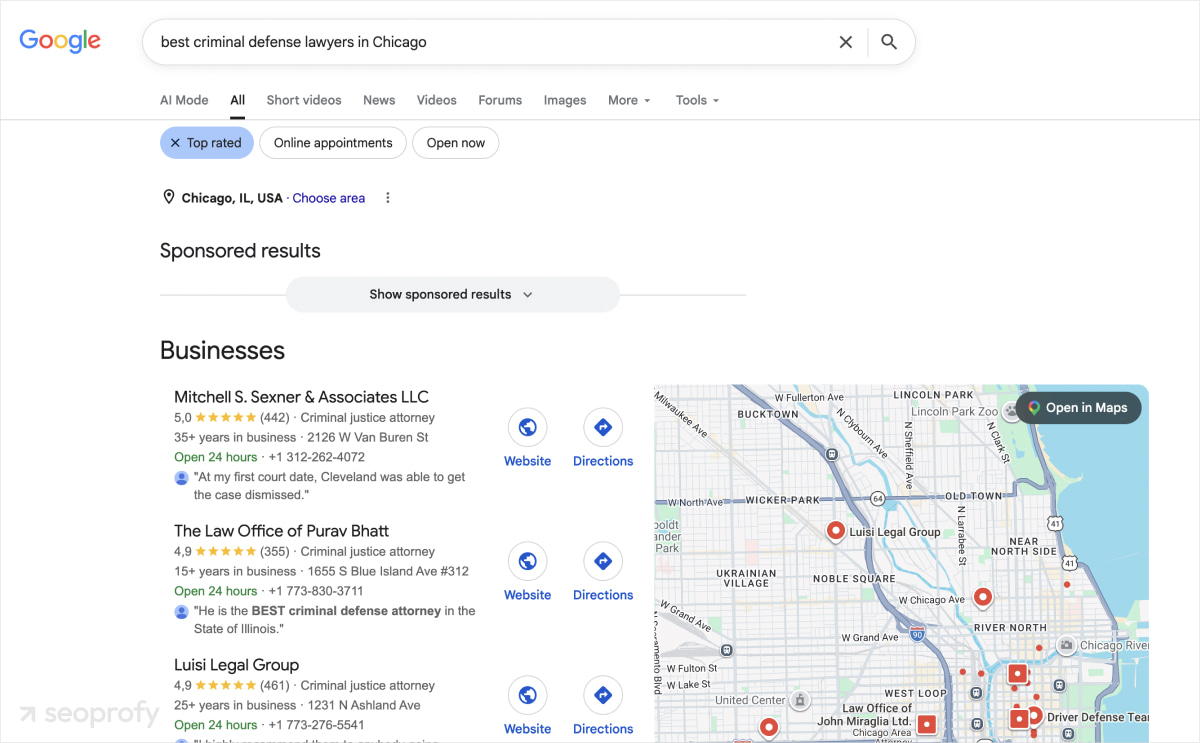
You can observe the same pattern through a simple manual check. For a purely informational query, such as “what happens after a DUI arrest,” Google is more likely to display an AI Overview because the user is looking for an explanation. By contrast, “best criminal defense lawyers in Chicago” combines commercial and local intent, so Google is more likely to prioritize the local pack and other conventional search features.
If one thing is clear, it’s that Google AI-generated results favor top-of-funnel, informational content. And even though many brands experience fewer clicks because of this, ranking in AI search results is still important, and in the next section, we’ll explain why.
Why Are AI Overviews Important for SEO?
AI Overviews are important for SEO because they can intercept demand before it turns into a website visit. They sit above organic results, answer the query directly, and often satisfy the user before the first traditional listing gets a click. That changes the value of SEO: rankings still matter, but the bigger question is whether Google can trust your content enough to use it inside the answer.
Google’s John Mueller explained this new reality well:
“If you have an online business that makes money from referred traffic, it’s definitely a good idea to consider the full picture and prioritize accordingly. What you call it doesn’t matter, but ‘AI’ is not going away, but thinking about how your site’s value works in a world where ‘AI’ is available is worth the time.”
John Mueller
Many business owners are concerned that AI Overviews affect SEO efforts. And the truth is, they do change how users engage with your website. As we mentioned earlier, in some cases, they lead to zero-click searches, where users get the information they need directly from the results pages and skip the website visit.
But Google Overviews also give brands something in return: visibility.
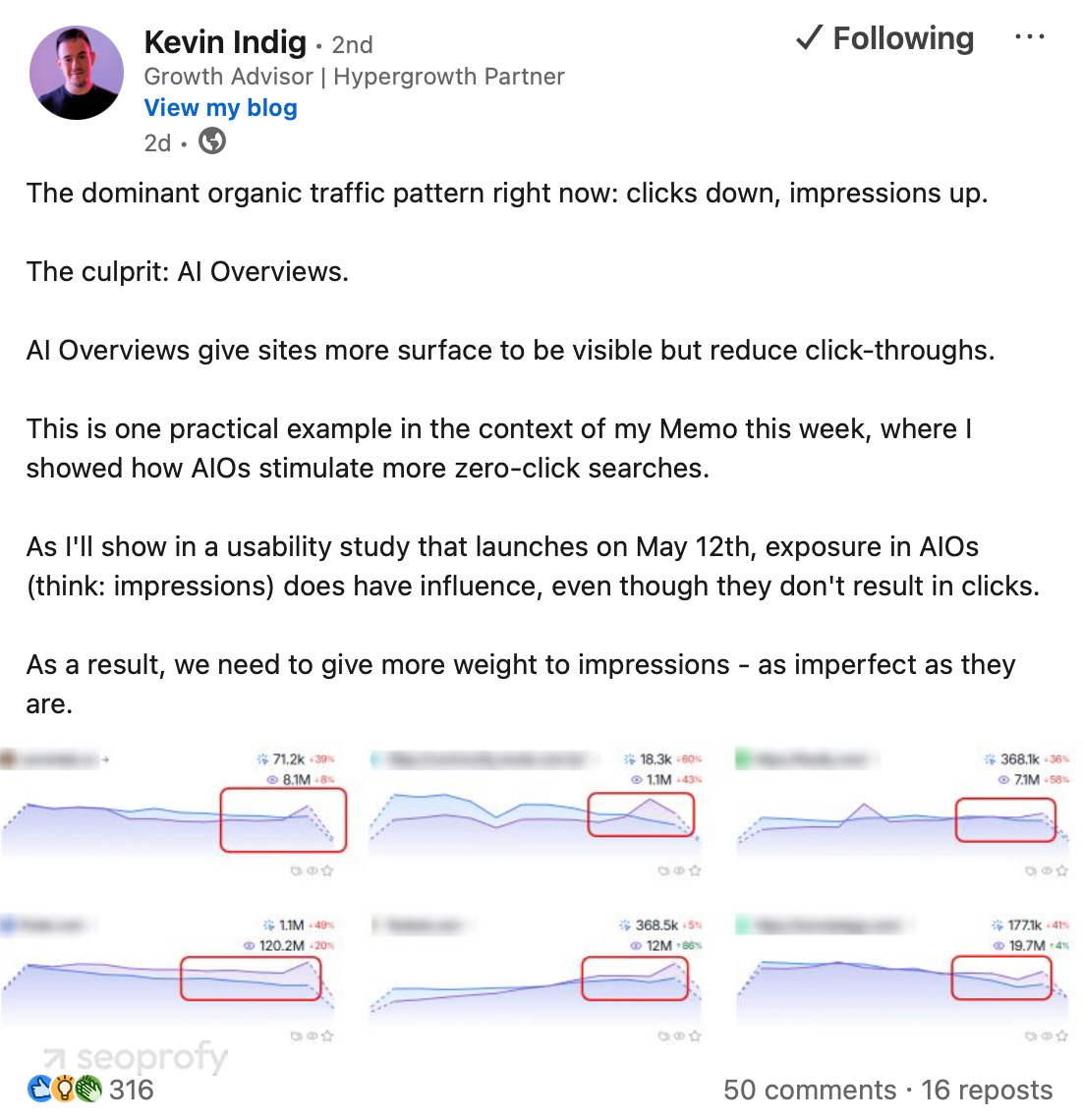
As Kevin Indig, a growth advisor at HyperGrowth, said on LinkedIn, some websites are seeing “clicks down, impressions up.” This means your link may receive fewer visits, while your brand appears more often in the part of the SERP and can influence user decisions later.
Being cited in AI Overviews can raise your brand’s perceived authority in the niche. Google places your content inside the answer users see first, which can make your page feel less like another result and more like a trusted reference. There is no shortcut or guarantee to AIO placement, but a strong mix of traditional SEO and AEO gives your pages a better shot at being cited.
How to Rank in AI Overviews: 12 Practical Strategies
A big part of how to optimize for AI Overviews comes from the same technical and on-page work you already use in SEO, paired with elements that sit closer to generative engine optimization.
Here’s the full Google Overviews optimization process in one practical checklist. Each step below is explained in more detail in the following sections.
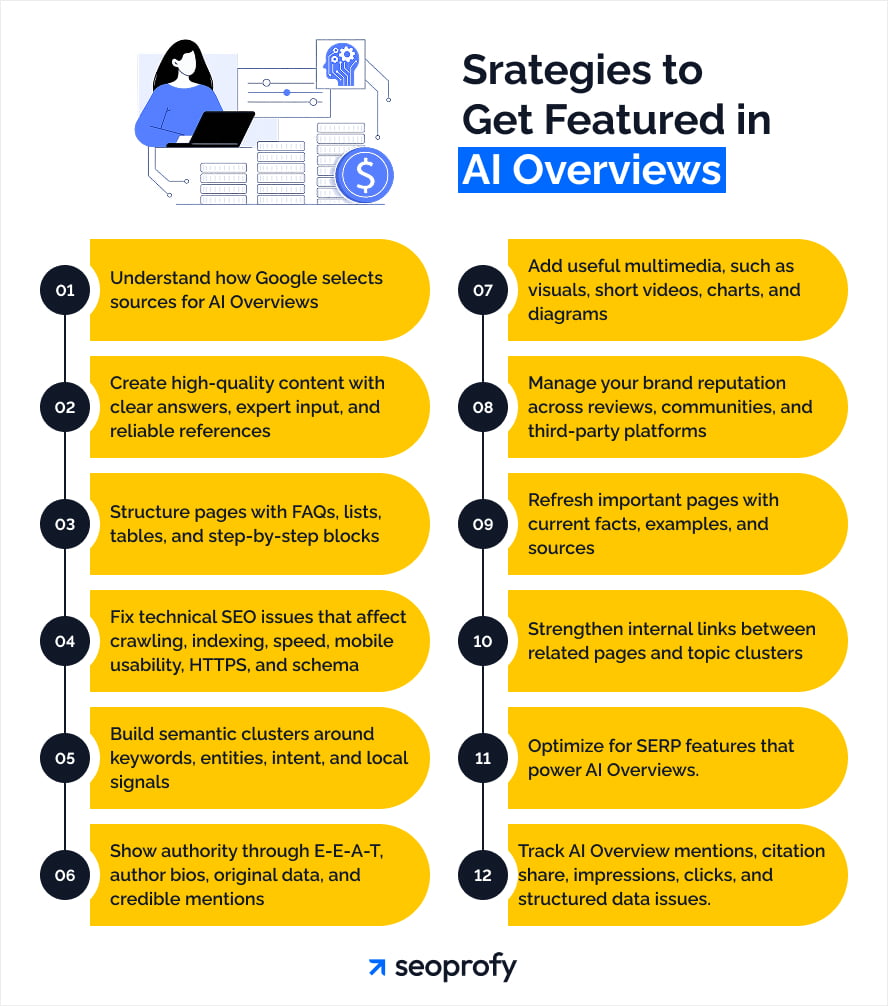
- Understand how Google selects sources for AI Overviews
- Create high-quality content with clear answers, expert input, and reliable references
- Structure pages with FAQs, lists, tables, and step-by-step blocks
- Fix technical SEO issues that affect crawling, indexing, speed, mobile usability, HTTPS, and schema
- Build semantic clusters around keywords, entities, intent, and local signals
- Show authority through E-E-A-T, author bios, original data, and credible mentions
- Add useful multimedia, such as visuals, short videos, charts, and diagrams
- Manage your brand reputation across reviews, communities, and third-party platforms
- Refresh important pages with current facts, examples, and sources
- Strengthen internal links between related pages and topic clusters
- Optimize for SERP features that feed AI Overviews, such as featured snippets, People Also Ask, local packs, videos, images, forums, tables, and knowledge panels
- Track AI Overview mentions, citation share, impressions, clicks, and structured data issues.
1. Understand How Google Selects and Cites Sources
Google selects sources for AI Overviews based on how well a page answers the query, how much topical authority it shows, and how trustworthy the source appears. Its language models, based on Gemini 3 technology, analyze multiple pages to build a concise answer at the top of the results.
The sources Google cites often rank well in traditional SERPs, though not always. Based on what we’ve seen across clients’ websites and SEO case studies, cited pages usually:
- Prioritize search intent: AI models look for content that directly satisfies the underlying intent of a query, which is the reason someone searches.
- Focus on relevance and context: They parse semantic meaning, so content with clear topical coverage and strong context is more likely to be selected.
- Show topical authority and source trust: These cite credible sources that cover the subject with essence and make their expertise easy to verify.
- Optimize for NLP: They answer questions the way a helpful expert would, instead of sounding written only for rankings.
That said, let’s look at several ways you can optimize your site to meet these criteria, along with some AI Overviews ranking tips.
2. Answer the Main Intent Directly and Avoid Content Bloat
Pages that show up in AI-driven search results tend to answer the user’s question directly, stay close to the main intent, and support the answer with context, data, and expertise. Here’s what that looks like in practice:
- Use a direct-answer structure: The first thing to do is to organize the core content using a clear sequence: definition → steps → proof → example. Start by defining the answer, explain what the reader should do, support the guidance with evidence or experience, and show how it works in practice.
- Keep the intent tight: It is important to avoid sections that pull the page away from the main query. Extra angles, loose definitions, and side topics can dilute the page’s intent and make it harder for AI systems to choose it as a source.
- Start with concise answers: The first 2–3 lines on each page should answer the main question directly. This format works well for LLM SEO, too, since it gives AI models a ready-to-use response that matches how users search.
- Meet E-E-A-T expectations: Google favors pages written by people who understand the topic. It means you need to publish valuable content that demonstrates authority and first-hand experience to rank in an AIO.
- Publish original data: If you have your own research, case studies, or survey results, use them. AI models prefer sources that offer something fresh.
At SeoProfy, we combine time-tested SEO with new strategies built for how AI reads and ranks content. We’ll help you:
- Appear in AI-generated answers
- Build authority as a trusted source
- Grow your AI visibility
3. Structure Content for AI Extraction
It’s easier for AI to extract data from well-structured, easy-to-scan pages. So, when creating high-quality content, organize it for better readability.
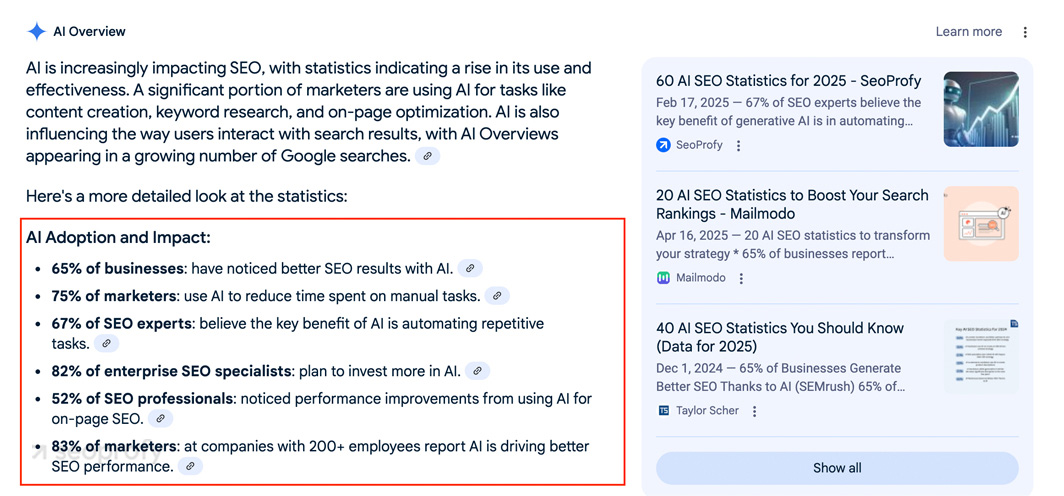
One format AI-powered search engines like Gemini love is lists. Surfer’s data found that in 78% of the cases, AIOs contain either an ordered or unordered list. We’ve seen this firsthand, too. In our article on AI SEO statistics, the key takeaway section was displayed almost exactly as written in an AI Overview, pulled straight from our page.
Apart from lists, you could also try these formatting best practices to rank in Google Overviews:
- Keep sentences short and use bullet points
- Use Q&A formatting, as these are frequently included in results
- Add tables and step-by-step instructions to make it easier for AI to parse.
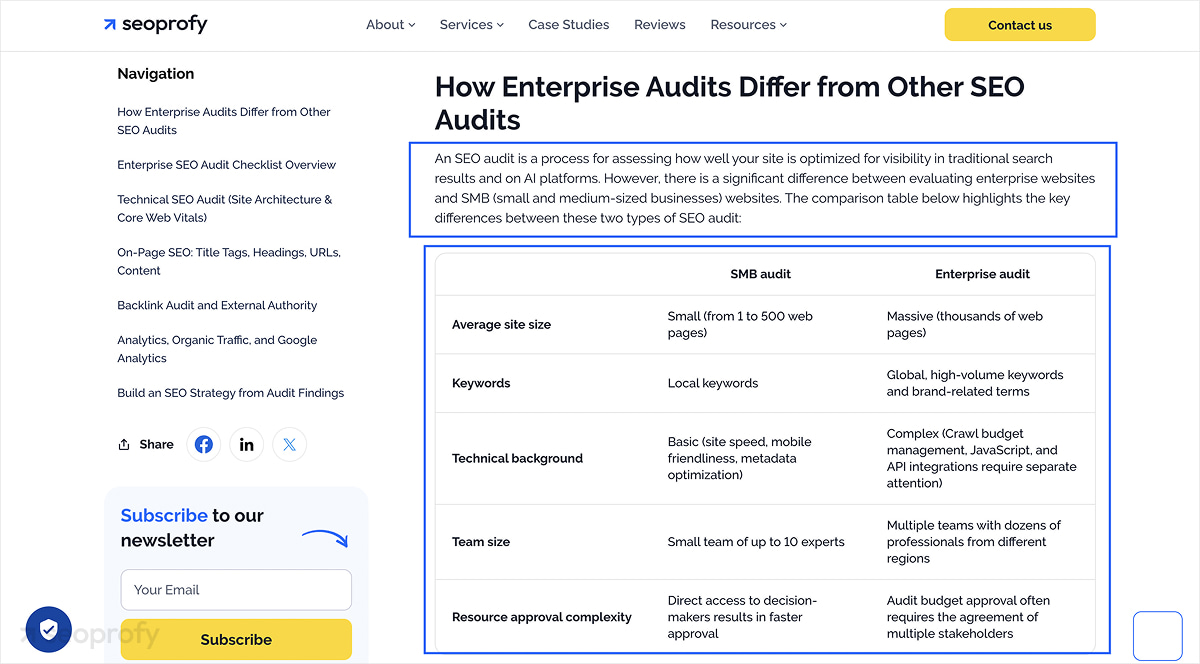
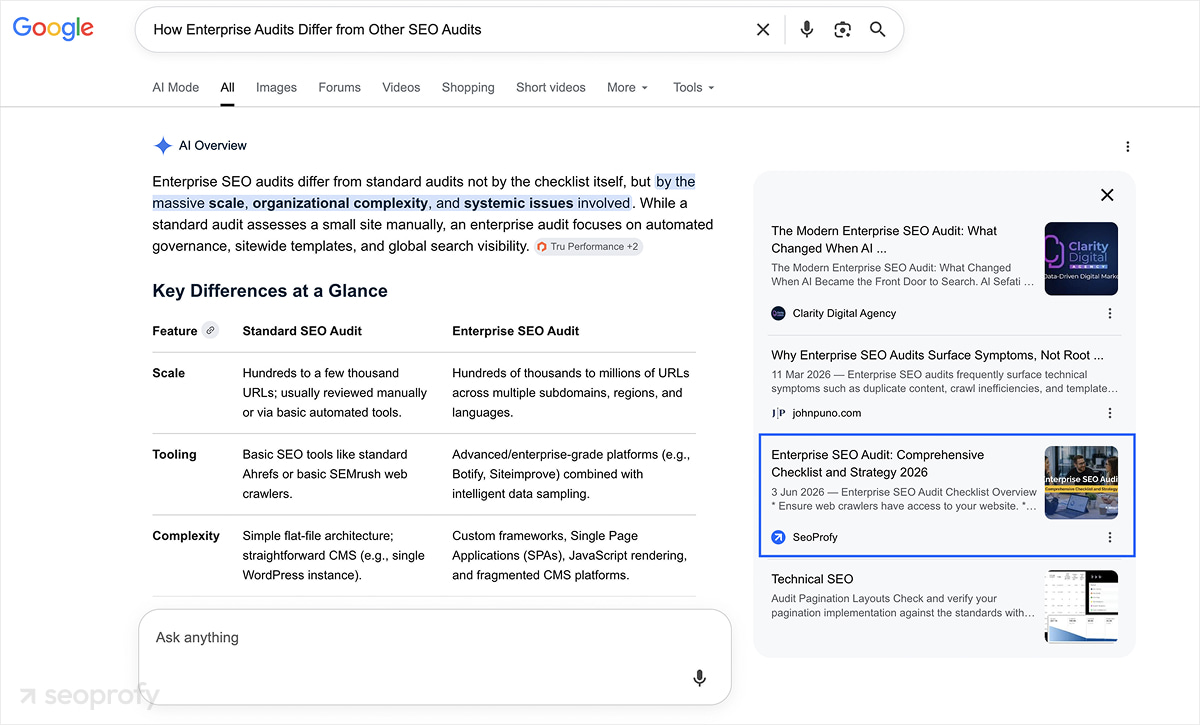
Look at how SeoProfy specialists structured the content on our page: right under the question, they gave a direct answer, followed by a table that lays the information out cleanly. Naturally, this approach helped us earn a mention in an AI Overview:
4. Make Pages Crawlable, Indexable, and Machine-Readable
Google can cite your page in AI Overviews only if it can access the URL, index the content, read the main answer in HTML, and understand the page structure. For AI search, technical SEO removes the barriers that stop crawlers from processing your copy correctly: blocked URLs, weak rendering, messy JavaScript, invalid schema that don’t match the visible content, and slow pages.
Here are the areas you’ll need to monitor:
- Crawlability and indexing: Make sure Google can access your content. Googlebot should not be blocked, and key pages should return a 200 status code.
- Raw HTML accessibility: Keep the main content, headings, internal links, and direct answers visible in the HTML.
- Server-rendered content: Use server-side rendering or pre-rendering for important content. Pages that rely heavily on JavaScript can be slower or harder for Google to process.
- JavaScript optimization: Avoid placing key answers, links, or structured content behind delayed scripts, hidden tabs, or complex interactive elements.
- Page speed: Run your site through PageSpeed Insights and fix what slows it down. It is essential to compress images, reduce heavy scripts, and improve load times for returning visitors.
- Mobile optimization: Prioritize the mobile version of your site, since Google uses it as the main version for indexing and ranking.
- HTTPS: Secure your site with a valid SSL certificate. It supports SEO and signals to visitors and search engines that your site is trustworthy.
- Schema validation: Another important part of technical SEO when optimizing for generative AI tools is schema markup. Add schema markup to clarify page context, then validate it through the Rich Results Test.
If you don’t have an in-house team for technical optimization, you could always outsource it to an ROI-driven SEO partner. It keeps the work in experienced hands, reduces the risk of costly site issues, and saves your team from a long hiring process.
5. Map Entities, Related Queries, and Semantic Clusters
AI Overviews cite pages that satisfy a clear search intent around a topic: the main entity, related questions, supporting terms, location signals, and proof that the source fits the query. For Google, this makes the page easier to classify as a complete answer.
How Entities and Semantic Clusters Help AI Understand Your Page
An entity is a recognizable “thing,” such as a brand, service, location, feature, product, or role. A semantic cluster is the set of related queries and concepts around the main topic.
Here’s how you can build them into the page:
- Use the main entity naturally in the title, H1, intro, and key sections
- Add related entities, attributes, and subtopics that match search intent
- Pull recurring entities from top results and PAA questions into headings, FAQs, and copy
- Interlink related pages with descriptive, entity-rich anchors
- Merge the same-intent keyword variants into one cluster and cover it in a single strong page.
In short, entities tell Google what the page covers. Semantic clusters show how fully it answers the topic.
Optimize Local SEO for Google AI Overviews
For local searches, Google also reads business-level signals: your Google Business Profile (GBP), reviews, NAP details, service areas, and location pages. Recent data shows that 40.2% of local queries now trigger Google’s AI-generated summaries, so local signals need to stay accurate and consistent.
To improve local visibility in AI Overviews:
- Fill out your GBP with working hours, categories, services, and links
- Collect detailed reviews on Google and relevant industry platforms
- Keep NAP details consistent across directories and your site
- Update location pages, service pages, and profile details regularly.
6. Prove E-E-A-T with Authors, Reviewers, Sources, and Experience
E-E-A-T signals matter for AI Overviews because Google needs sources it can trust, especially in sensitive niches like health, finance, and legal. Strong pages show who created the content, why they know the topic, which sources support the answer, and when the information was last reviewed or updated.
This lines up with what Matt Lerner and Amanda Natividad mentioned in their webinar on Content Marketing in a Post-SEO World. They recommend businesses find relevant and credible websites in their niche and get cited there. These mentions send strong trust signals to AI tools and carry even more weight in “Your Money or Your Life” topics.
To show your credibility and E-E-A-T, try these best practices:
- Add detailed author bios with credentials and links to professional profiles
- Use the author property within the Article or BlogPosting schema to provide structured author data
- Add content update notes that show when the page was reviewed, refreshed, or checked by an expert
- Include expert quotes from your team, clients, partners, or niche specialists
- Use original screenshots, internal data, case studies, and examples to show first-hand experience
- Cite reputable sources in your content and get your brand mentioned in relevant external sources.
All of these signals make your brand easier to trust across search. Over time, they can also support better SEO ROI through stronger visibility in organic results and AI-generated answers.
7. Create Citable Assets: Tables, Images, Videos, and Original Data
One of the often-overlooked tactics in how to rank in Google AI Overviews is using multimedia content. Multimedia can improve your chances of ranking in AIOs because it gives both users and search engines more context. Visuals, videos, charts, and screenshots make complex information easier to understand, and AI systems can sometimes pull these elements into summaries or nearby SERP features.
Depending on your niche, you could add rich content in several ways:
- Annotated images and step-by-step visuals: Show people exactly what to do with screenshots that have arrows or labels. AI can recognize these visual cues and feature them in its responses.
- Short instructional videos (30–60 seconds): Record videos that solve one specific task at a time. These videos can appear as video results next to AI Overviews, link directly to your website when embedded there, or point users to your social profiles, such as YouTube. In each case, they add another visibility path for your brand.
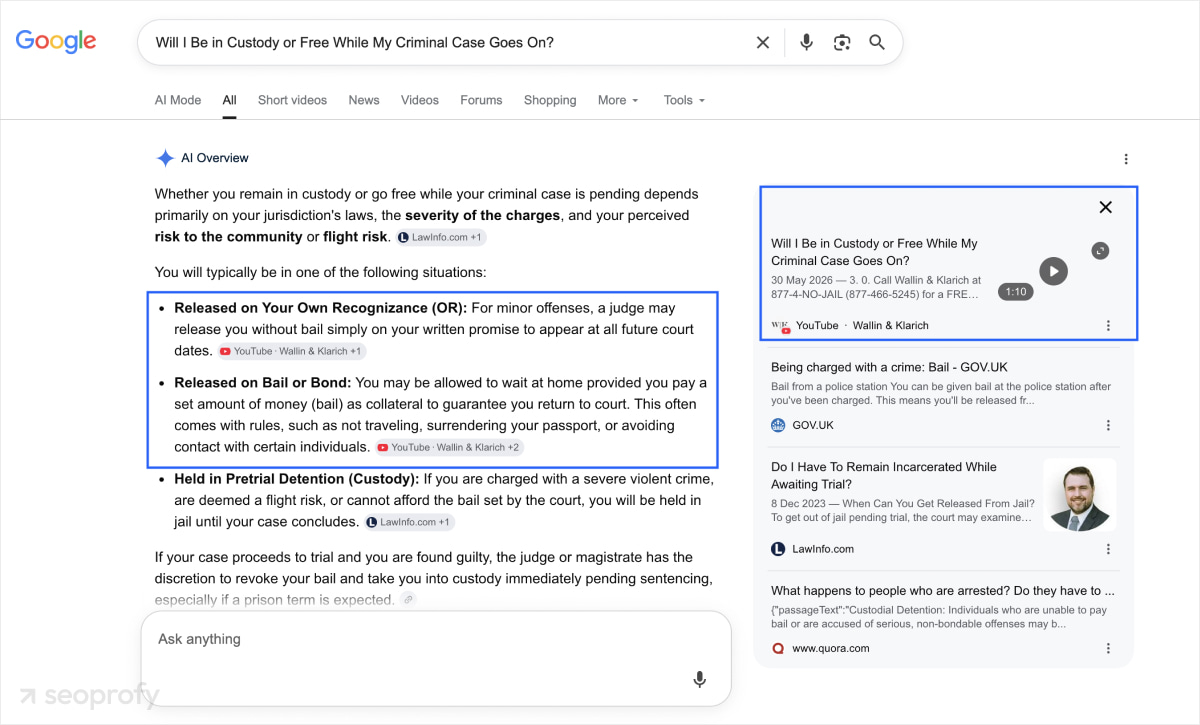
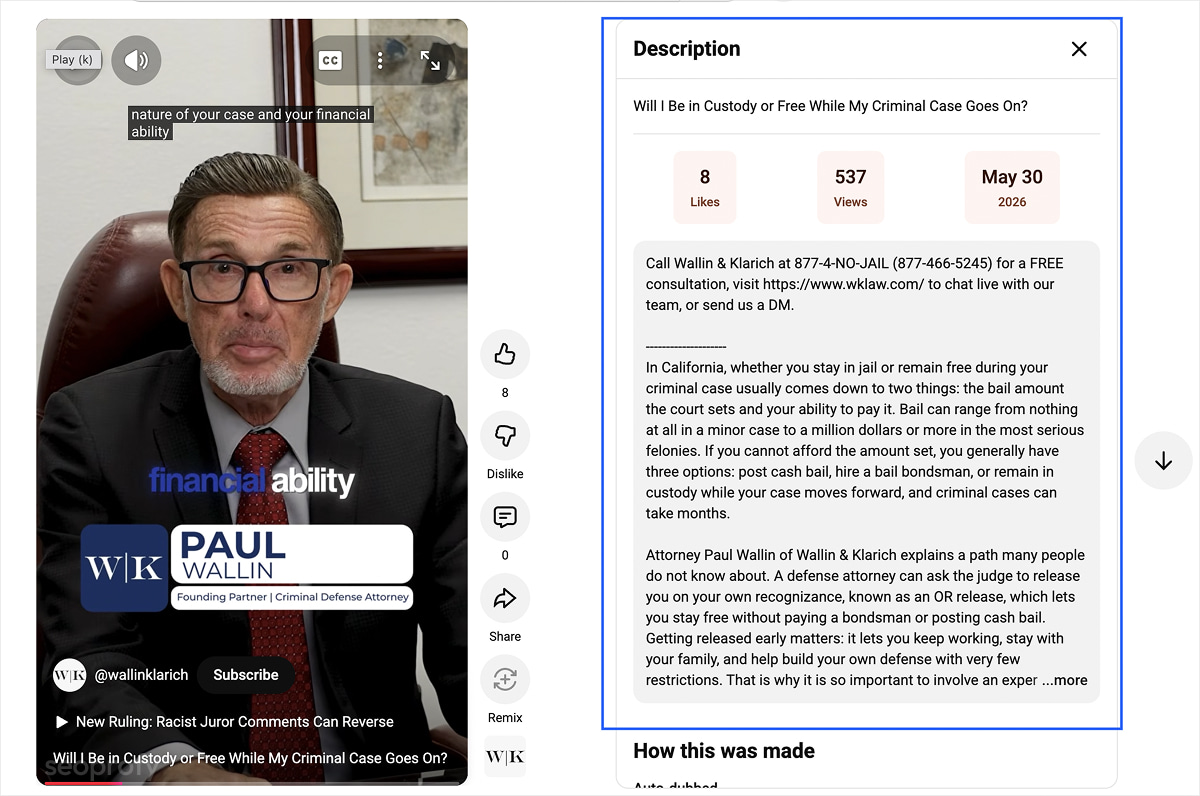
- Charts, tables, and diagrams: When you compare something on a page, put the main differences like plans or features into a table or chart. This creates structured data blocks that AI can easily turn into bullets or summary lines in an overview.
Add structured data to signal to search engines that something is an image or a video. It doesn’t take much effort, but it can help your content be included in AI-generated summaries.
8. Build Brand Mentions Across Trusted Sources
Ranking in AI Overviews depends on how often trusted external sources confirm that your brand is relevant, credible, and worth mentioning. Google does not read your website in isolation. It also looks at reviews, third-party lists, niche publications, social platforms, community threads, videos, and unlinked brand mentions across the web.
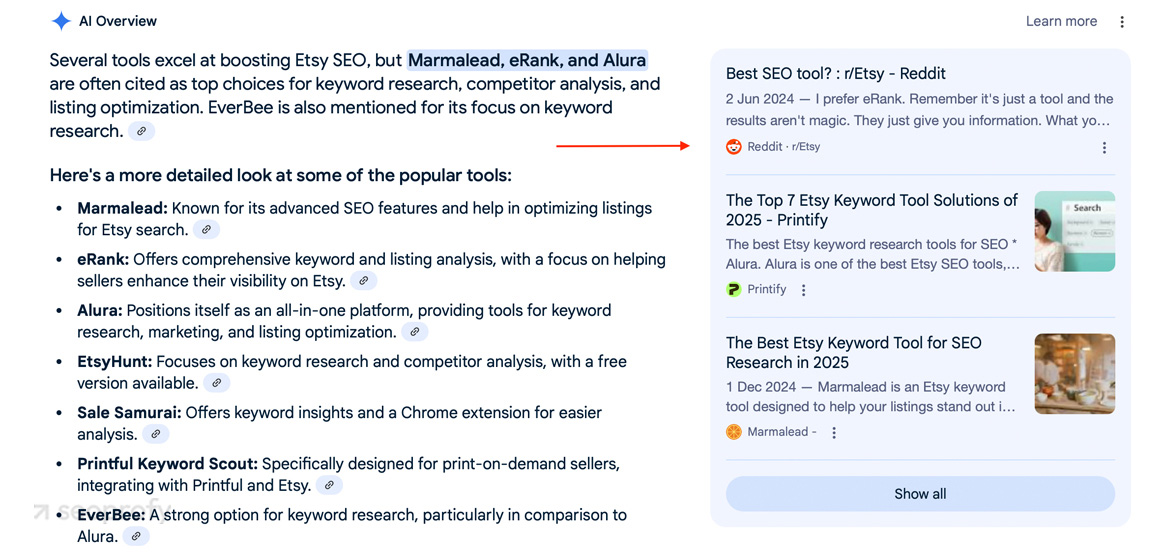
Reviews and user-generated content (UGC) matter a lot. When AI pulls information to build its summaries, it can use customer feedback from platforms like Trustpilot, G2, Capterra, Google, or niche review sites.
Reddit, Quora, YouTube, niche publications, “best” lists, and industry roundups are worth attention, too. Over the past few years, search engines have given these platforms higher visibility in traditional search results, and AI Overviews are following the same trend. A relevant mention in these places can help AI systems connect your brand with the topics, services, and problems your audience searches for.
9. Keep Content Fresh with New Data, Examples, and SERP Checks
AI Overviews are more likely to cite pages that reflect the current state of the topic. Fresh statistics, updated screenshots, current tool workflows, recent Google guidance, and new competitor gaps all help Google treat the page as a more useful source.
Here’s a simple refresh checklist you can use:
- Stats and studies: Update every 3–6 months.
- Screenshots: Refresh SERPs, tools, and schema tests every 3–6 months.
- Tools and workflows: Check UI steps and reports every 3–6 months.
- Google guidance: Review documentation every 3–6 months.
- Competitor gaps: Check AIO sources, PAA, forums, and top pages every 3–6 months.
- Examples and expert input: Refresh every 6–12 months.
- Internal links: Update every 3–6 months.
10. Build Topic Clusters and Internal Links Around AIO Queries
Topic clusters and internal links are an essential element of every SEO campaign setup because they reinforce your topical authority, spread link power, and help users and search crawlers find valuable information. Generative AI models also analyze your internal links to find out how each of your pages fits into the broader context of your site.
To build a clustering and internal linking strategy that supports better visibility and helps you rank in AI Overviews, you should:
- Create a cluster map: Map one hub page, supporting pages, related queries, long-tail keywords, and target anchors uniting them
- Interlink related pages: Connect pages that cover close subtopics and search intents
- Use descriptive anchors: Write anchors that name the entity, query, or page topic
- Fix orphan pages: Run a crawl audit in Screaming Frog, Ahrefs, or Sitebulb, and add links to isolated pages
- Link from top URLs: Use high-traffic pages to support relevant lower-ranking pages
- Clean links monthly: Fix broken, redirected, or outdated internal links.
11. Track AI Overview Visibility, Citations, and Competitors
Websites that already perform well in traditional search have a stronger chance of being cited in AI Overviews. Strong SEO makes your content easier to crawl, trust, understand, and match with the right query. You should add AI visibility monitoring to the process, since your competitors now track AIO mentions, citation share, and brand presence, not only rankings.
Use this workflow to keep the checks clear:
|
Tool/data source |
What to check |
Action |
| Google Search Console | Queries with impressions, CTR drops, and rising visibility | Update pages that gain impressions but lose clicks |
| Ahrefs/Semrush | Keywords that trigger AI Overviews | Prioritize pages with citation potential |
| AI Overview tracking tools | Brand mentions, cited URLs, and competitor citations | Track where you appear and where competitors win |
| SERP checks | PAA, featured snippets, forums, videos, local packs | Add formats that already appear in the SERP |
| Content audit | Missing entities, outdated stats, weak sections | Refresh content and close competitor gaps |
| Schema testing tools | Valid structured data and page type coverage | Fix errors and add missing schema |
| Brand mention tools | Unlinked mentions and trusted third-party sources | Turn strong mentions into links where possible |
In Ahrefs, go to Site Explorer, and in the main overview, you’ll see how many mentions in AI Overviews you already have:
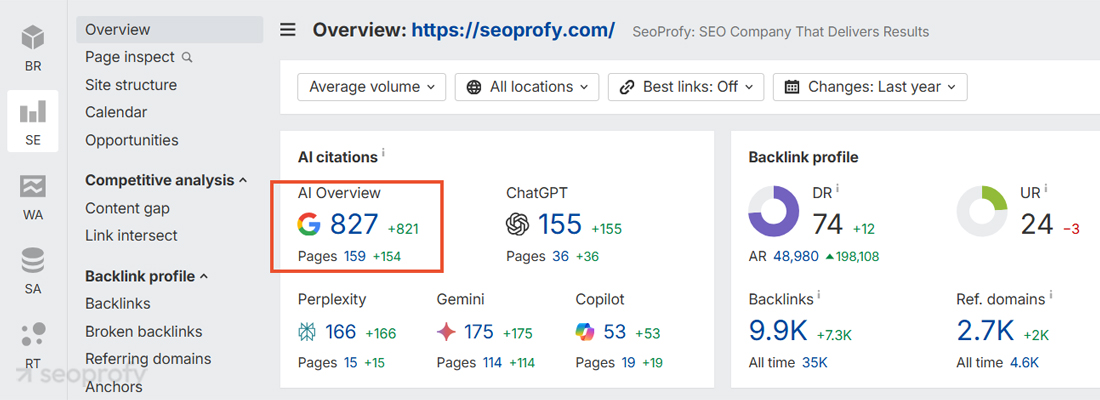
You can click on the number of pages to see which ones trigger an AI summary. To check what queries appear there, navigate to the organic keywords report. Here, you can filter them to only see the ones that result in a summary:
- Click on the SERP Features filter
- Select AI Overviews from the dropdown
- Look through the related keywords
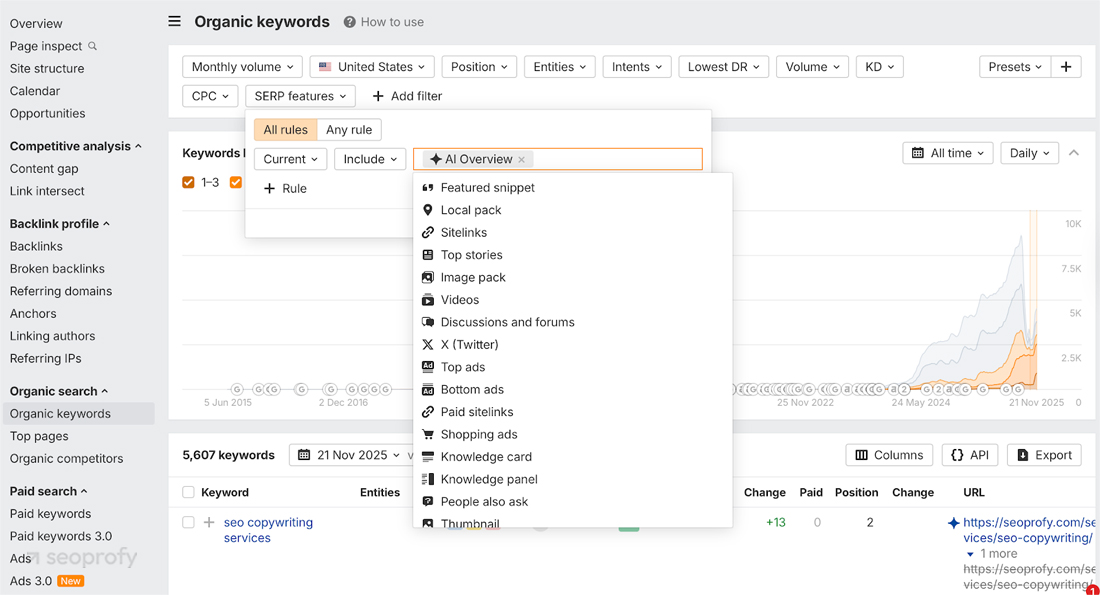
If you want to check your results in real time, you can use plugins. Google AI Citation Analysis and AI Search Impact Analysis show you which keywords are currently triggering summaries and whether your site is mentioned.
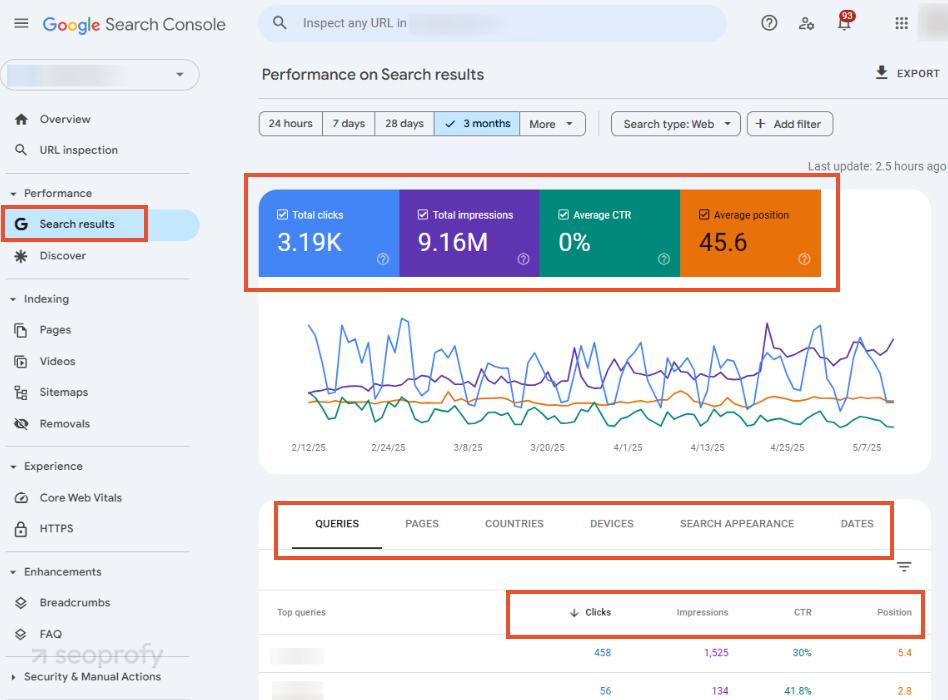
Additionally, you could monitor your data and measure SEO in Google Search Console. In the Performance tab, you can find the top queries your site is being surfaced for, along with the number of clicks and impressions they receive.
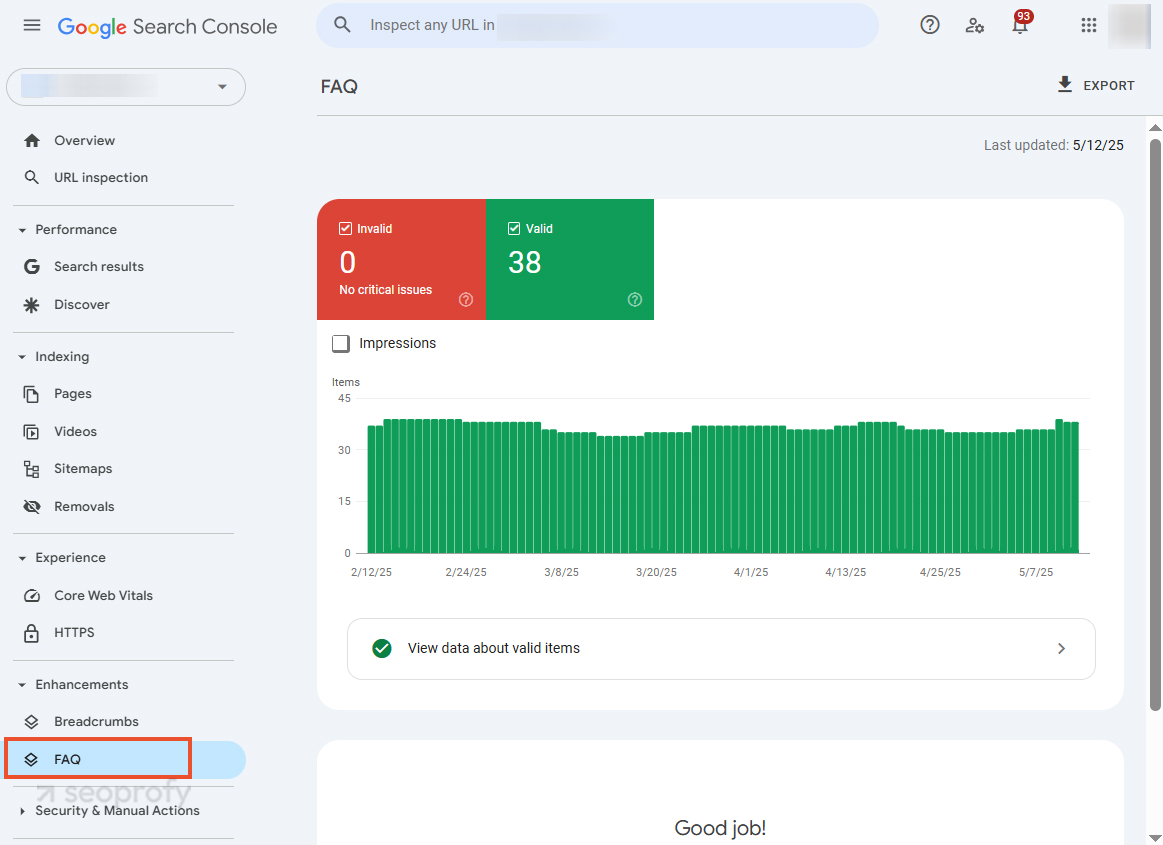
The other section worth looking at is the Enhancements tab. That’s where you’ll see the types of structured data Google has detected. Each one will show a status: valid, warning, or error. If you aim to rank in AI Overviews, these need to be marked as valid.
To take your findings further, export your query data from Search Console or Ahrefs and feed it into AI SEO tools like ChatGPT. These can save you the headache of analyzing it yourself and summarize which formats perform best, so you can spot patterns.
12. Optimize for SERP Features That Feed AI Overviews
AI Overviews often borrow the same formats Google already rewards in the SERP: People Also Ask, featured snippets, videos, images, reviews, comparison tables, forums, and local results. If these features appear for your target query, treat them as clues. They show what type of answer Google considers useful.
Before updating a page, check the live SERP and note which formats appear most often:
- People Also Ask: Add short FAQ answers for recurring questions.
- Featured snippets: Place a concise answer near the top of the page.
- Videos: Add a short video for practical, step-based queries.
- Images: Use original visuals, screenshots, diagrams, or labeled examples.
- Reviews: Add review signals, client feedback, ratings, or third-party proof where relevant.
- Comparison tables: Use tables for tools, pricing, services, features, pros and cons, or legal/process differences.
- Forums and community results: Check Reddit, Quora, and niche discussions for wording users actually use.
- Local packs: Keep your Google Business Profile complete and current.
Traditional SEO vs. AI Overview Optimization
Traditional SEO still leans on familiar ranking signals like keyword targeting, backlinks, crawlability, and on-page structure. GEO looks at the page from another angle: can Google pull a clear, trustworthy answer from it and place that answer inside an AI Overview?
The table below breaks down how traditional SEO and AI Overview optimization differ, and where the two approaches still overlap.
|
Factor |
Traditional SEO |
AIOs optimization |
| Core goal | Rank for target keywords, increase organic traffic, and drive clicks | Get cited in AI-generated answers and earn visibility in AI search |
| Key focus | Keywords, metadata, backlinks, technical health, and content relevance | Topic authority, direct answers, semantic relevance, and source-worthy content |
| Ranking signals | Domain authority, keyword relevance, technical SEO, and backlink profile | Content clarity, structured data, E-E-A-T, entity alignment, and trusted citations |
| Content format | Well-optimized pages and content hubs. Structure helps, but it is usually not the main differentiator | Clear FAQs, answer blocks, scannable tables, lists, and well-structured sections |
| User intent | Match informational, commercial, transactional, or navigational queries | Intent matters more than exact-match wording. Informational queries trigger AI Overviews most often |
| Main methods | Keyword research, on-page SEO, technical SEO, link building, and digital PR | Content refinement, answer formatting, structure improvement, entity clarity, and reputation management |
| Brand mentions | Helpful for authority and awareness, but usually indirect as a ranking factor | More important for recognition and citation potential across AI-generated answers |
| Metrics | Search rankings, organic traffic, CTR, and conversions | Citation share, brand visibility, mentions, assisted clicks, and impression lift |
Need Help Improving AI Search Visibility?
Combining efficient traditional search engine practices with the strategies from our guide raises your chances of conquering AI platforms. However, it may be difficult to implement all the mentioned techniques without sufficient experience.
Luckily, SeoProfy is always ready to support your business with professional AI SEO services. Our experts will help you achieve your specific goals and make your brand visible in both traditional and AI-driven search results.

Khrystyna Dzhumaryk is a content writer at SeoProfy with four years of experience in SEO and content strategy. At the company’s main blog, she writes in-depth articles and guides to help businesses improve their online visibility through proven tactics. Her work brings together hands-on SEO experience with ongoing research into algorithm updates, search trends, and the growing impact of AI on content and optimization.