
 Add SeoProfy as a preferred source on Google
AI has pushed investment and construction activity in the U.S. data center industry to a new level. Top companies are spending billions on facilities that can support increasingly powerful AI systems and cloud services. But how do you tell which data center companies are already operating at scale and which are still building toward it?


We put together this guide to the 20 largest data center companies in the U.S. so you can see how they compare. Each profile examines the company’s infrastructure and the decisions behind its expansion. You’ll learn why certain operators are investing in their own power generation, how others are adapting existing facilities for AI, and what their latest projects reveal about the direction of their business.
Largest Data Center Companies in the US by Active IT Capacity
U.S. private AI investment reached $109.1 billion in 2024, according to our AI adoption statistics. Since AI development now attracts much more capital, demand for computing infrastructure is growing too. Data center operators are responding with new facilities and major expansion projects across the country.
To see how these operators compare in scale and growth plans, we’ve put together a table of the 20 largest data center infrastructure companies in the U.S. Below, we’ll look at each company closer, its headquarters, and its plans for further growth.
| Company | U.S. data centers | U.S. active IT capacity | Major U.S. expansion | What sets it apart |
| Amazon Web Services (AWS) | 105 | 2.3 GW | Northern Indiana: 2.4 GW planned | Own Trainium processors and large AI clusters, including Project Rainier for Anthropic. |
| Meta Platforms | 63 | 1.5 GW | Hyperion, Louisiana: 5 GW planned | Builds infrastructure for Facebook, Instagram and its own AI models; develops custom interconnects. |
| Microsoft Azure | 55 | 1.2 GW | Pecos, Texas: ~2 GW planned | Azure AI Superfactory connects GPU clusters across states through dedicated fiber. |
| Equinix | 91 | 995 MW | U.S. xScale program: >1.5 GW planned | Connects enterprise colocation services (IBX) with investor-backed hyperscale campuses (xScale). |
| QTS Data Centers | Not disclosed | 811 MW | Cedar Rapids, Iowa: 7 buildings; $10B planned | Blackstone-backed hyperscale leasing and closed-loop cooling that avoids continuous cooling-water use. |
| Digital Realty | 118 | 686 MW | Atlanta, Georgia: >1 GW planned IT capacity | Public REIT with high-density AI colocation and an Innovation Lab for testing equipment. |
| CyrusOne | 27 locations / groups | 674 MW | Bosque/Freestone, Texas: >1.1 GW contracted power | Build-to-suit campuses and Intelliscale designs with rack densities up to 300 kW. |
| Aligned Data Centers | Not disclosed | 548 MW | Project Phoenix, Pennsylvania: 2 GW planned | Patented Delta³/DeltaFlow cooling and an independently powered AI campus on a former power-plant site. |
| DataBank | 63 | 544 MW | Red Oak, Texas: 480 MW planned IT capacity | Combines hyperscale growth with edge locations within 100 miles of 60% of the U.S. population. |
| Google Cloud | 23 locations | 508 MW | Texas: $40B planned cloud/AI investment | Shares data-center infrastructure across Google Cloud, Gemini, Search and YouTube. |
| Oracle Cloud Infrastructure | 28 | 470 MW | OpenAI/Stargate: 4.5 GW additional planned | Relies on developer-built AI campuses and customer-provided or prepaid GPU equipment. |
| Switch | 18 | 445 MW | The Citadel / Keep 2.0: multigigawatt expansion plans | EVO AI Factories are designed for up to 2 MW per rack; CoreWeave already uses NVIDIA GB300. |
| STACK Infrastructure | 35 | 410 MW | Stafford, Virginia: 1.1 GW; 19 planned buildings | Powered Land approach prioritizes prepared sites and electricity access for hyperscale clients. |
| CoreSite | 30 | 340 MW (operating portfolio) | 487 MW reserved for future expansion; 36 MW under construction | High interconnection density, direct cloud access and operational NVIDIA B200 deployments. |
| NTT Global Data Centers | 8 locations | ~675 MW | U.S. pipeline: ~690 MW planned | Integrates colocation with NTT optical networking and trans-Pacific connectivity. |
| Vantage Data Centers | 20 | 314 MW | Frontier, Texas: 1.4 GW planned IT capacity | Builds preleased hyperscale campuses and uses on-site generation partners to address grid delays. |
| CloudHQ | 7 | 260 MW | LC Campus, Virginia: >1.7 GW long-term plan | Campus-within-a-campus model lets hyperscalers reserve adjoining buildings and future space. |
| Hut 8 | 7 | 240 MW | Beacon Point, Texas: 704 MW contracted AI IT capacity | Uses its Bitcoin-mining energy experience to develop large AI facilities under long leases. |
| Iron Mountain Data Centers | Not disclosed | 419.9 MW (leaseable) | Richmond, Virginia: >200 MW planned | Secure-records expertise extends to high-security colocation, including an underground facility. |
| Cipher Digital | Not disclosed | Not disclosed | Colchis, Texas: up to 1 GW planned power | Converts former Bitcoin-mining infrastructure into AI space; Black Pearl plans to reuse ~85%. |
Based on the supplied data center providers profiles and research. Figures refer to different reporting periods in 2025–2026; some IT-capacity values are independent estimates. “Locations” and “groups” are not physical-building counts. CoreSite and Iron Mountain report operating/leaseable capacity rather than measured server load. Planned, contracted and electrical power figures are separate from live U.S. IT capacity.
1. Amazon Web Services (AWS)
- HQ: Seattle, Washington, US
- Data centers (U.S.): 105
- IT capacity (U.S.): 2.3 GW
AWS is Amazon’s cloud business, providing computing power to leading companies and government agencies through its U.S. data centers. Its four commercial regions sound modest until you look inside them. Each region contains multiple availability zones, and a single zone can span several physical facilities. ABI Research ranked AWS first among U.S. operators by active IT capacity in 2025.
As one of the biggest data center companies, AWS has invested over $119 billion in Virginia alone. Indiana is now a major part of AWS’s AI expansion. Project Rainier already uses roughly 500,000 custom Trainium2 chips to train Anthropic’s models. AWS has announced another $15 billion for northern Indiana, with 2.4 GW of capacity planned.
Federal AI infrastructure is another priority. AWS plans to add nearly 1.3 GW for government AI and high-performance computing. These projects follow more than $184 billion invested in cloud infrastructure in the U.S. between 2011 and 2024.
2. Meta Platforms

- HQ: Menlo Park, California, US
- Data centers (U.S.): 63
- IT capacity (U.S.): 1.5 GW
Facebook and Instagram run on the infrastructure Meta builds for itself. Its American data center network also supports increasingly demanding AI training, placing Meta second in ABI Research’s 2025 ranking of top data center companies by active U.S. IT capacity.
The biggest bet is Hyperion in Louisiana, a planned 5 GW AI campus with over $50 billion in investment, expected to begin operations in 2028. Ohio’s Prometheus project aims for 1 GW using a different setup. It is designed to connect GPUs across multiple buildings and colocation facilities through Meta’s own networking system.
To power projects at this scale, Meta has signed agreements covering up to 6.6 GW of U.S. nuclear generation by 2035. The company also focuses on reducing electricity and water consumption at its AI data centers.
3. Microsoft Azure
- HQ: Redmond, Washington, US
- Data centers (U.S.): 55 operational facilities
- IT capacity (U.S.): 1.2 GW
Microsoft Azure provides cloud computing to businesses and government agencies. Its U.S. expansion now centers on an unusual AI setup: GPU clusters in different states connected to train models as one system. Microsoft calls it the Azure AI Superfactory.
- Wisconsin: Fairwater began operating in April 2026. Its racks support up to 140 kW, with closed-loop liquid cooling and a two-story GPU layout to shorten cables. Microsoft uses renewable energy purchase agreements and water replenishment programs to address the environmental impact of its data centers.
- Georgia: Another Fairwater hub connects to Wisconsin, creating a distributed system designed for hundreds of thousands of NVIDIA GPUs.
- Texas: A planned 2 GW campus in Pecos will initially use an on-site gas power plant financed by Microsoft.
The company added 120,000 miles of U.S. fiber in the year before November 2025 to connect distant facilities at AI-training speeds. It is also designing its own AI chips. Microsoft has deployed its Maia 200 AI accelerators in Iowa and Arizona, with additional international deployments planned. Microsoft also plans to invest over US$80 billion in AI infrastructure to support its growing computing needs.
4. Equinix
- HQ: Redwood City, California, US
- Data centers (U.S.): 91 facilities
- IT capacity (U.S.): 995 MW
Equinix has a different business model from the hyperscalers above it. Companies rent space for their servers and connect directly to cloud and network providers. Equinix concentrates its IBX facilities in major interconnection markets such as Northern Virginia and Silicon Valley, where access to these networks is particularly valuable.
Equinix is extending this model to hyperscale clients through xScale. In San Jose, its planned 28 MW SV12x facility will stand beside four existing IBX data centers, giving large deployments access to established connectivity infrastructure. A $600 million joint venture with PGIM Real Estate is funding the project.
For larger U.S. campuses, Equinix has another venture with institutional investors GIC and CPP Investments. Equinix holds just 25%, with the partners owning 37.5% each. The program has over $15 billion in raised and planned capital and targets more than 1.5 GW of additional capacity. Equinix also prioritizes energy efficiency and lower construction emissions when designing new data center campuses.
5. QTS Data Centers
- HQ: Sterling, Virginia, US
- Data centers (U.S.): 33
- IT capacity (U.S.): 811 MW
QTS develops and operates U.S. data center campuses for cloud providers, enterprises, and government agencies. Much of its business comes from long-term hyperscale leases. A 2026 financing review identified 12 fully leased buildings across four states with 493.5 MW of stabilized capacity, a figure covering only that portfolio.
Power and water requirements have a direct influence on QTS’s new sites. In Hall County, Texas, the company is working with energy developer Lancium, which will supply the land and power infrastructure while QTS builds and operates the data centers. The project has more than $10 billion in planned investment.
QTS has used closed-loop cooling in all new builds since 2019. At its seven-building Cedar Rapids campus, the system is expected to save four billion gallons of water annually at full operation.
6. Digital Realty
- HQ: Austin, Texas, US
- Data centers (U.S.): 110+
- IT capacity (U.S.): 686 MW
Digital Realty works as a publicly traded real estate investment trust (REIT), a company that earns rental income and distributes most taxable earnings to shareholders. It leases data center space and power to enterprises and hyperscale operators, with direct network connections available on site.
At its Innovation Lab in Northern Virginia, customers can test GPU configurations, cooling systems, and network performance before deploying equipment at scale. Digital Realty also offers high-density colocation with rack capacities reaching 150 kW. To support further expansion, the company secured a US$373 million supply agreement.
Its U.S. expansion includes Virginia, Georgia, and Oregon, with an Atlanta campus planned for over 1 GW of future IT capacity. Digital Realty also invests in sustainable upgrades to existing facilities and cleaner electricity supply contracts.
The company reported 1,421 MW of operational UPS-backed capacity across the Americas in Q2 2026. That figure includes facilities outside the U.S., and the company has yet to disclose a separate U.S. active IT capacity total.
7. CyrusOne
- HQ: Dallas, Texas, US
- Data centers (U.S.): 43 (27 locations / groups)
- IT capacity (U.S.): 674 MW
CyrusOne designs entire data centers around individual hyperscale customers’ requirements. Its Intelliscale architecture is designed to scale power density up to 300 kW per rack and can reduce floor-space requirements by 75% in certain configurations.
Power access is another design priority. For its planned 200 MW DFW7 campus in Fort Worth, CyrusOne will use high-voltage infrastructure beside an existing battery storage facility, accelerating grid connection.
In Bosque and Freestone counties, agreements with energy efficiency partners cover over 1.1 GW of contracted electricity for future campuses. The company has already invested more than $5 billion across five Texas construction sites.
8. NTT Global Data Centers
- HQ: Sacramento, California, US
- Data centers (U.S.): 8 listed locations (building count undisclosed)
- IT capacity (U.S.): Approximately 675 MW
NTT combines colocation with a telecommunications network of its own. Its IOWN optical technology achieved 0.062 ms latency between two Virginia data centers, which matters for distributed AI workloads.
Its U.S. expansion pipeline holds another 690 MW, nearly enough to double current capacity. Phoenix accounts for 324 MW of planned capacity and Hillsboro for 216 MW. The Oregon campus also connects to trans-Pacific routes for cloud traffic to Asia.
NTT signed more than 245 MW in new leases from December 2025 to March 2026. One hyperscaler alone reserved over 90 MW in Gainesville.
9. Aligned Data Centers
- HQ: Dallas, Texas, US
- Data centers (U.S.): 15
- IT capacity (U.S.): 548 MW
Aligned is a data center company that builds hyperscale facilities for Artificial Intelligence customers, with its own cooling technology designed for dense GPU installations. Its patented Delta3 and DeltaFlow systems allow operators to switch from air to liquid cooling without shutting down equipment. Hybrid configurations can remove over 600 kW of heat per rack.
Its most ambitious U.S. project, the 2 GW Project Phoenix in Pennsylvania, will use a former coal power plant converted to gas generation. This will allow three planned data centers to operate independently of the local grid. Construction began in September 2026.
Aligned is also building the six-building, 540 MW Project Caprock in Texas. Its first facility is scheduled to open in early 2027, adding capacity to the company’s growing AI portfolio.
10. DataBank
- HQ: Dallas, Texas, US
- Data centers (U.S.): 70+
- IT capacity (U.S.): 544 MW
DataBank has grown from 6 data centers in 2016 to a portfolio of more than 70, but its reach matters too. Its edge data centers are located within 100 miles of 60% of the U.S. population, and the company operates 20 interconnection hubs with over 30,000 cross-connects. That network supports edge computing and AI inference, which require processing data closer to users.
Red Oak near Dallas marks its move into much larger cloud and AI deployments. The eight-building campus is planned for 480 MW of IT capacity. The first three buildings, totaling 180 MW, are already fully leased, and DataBank had secured $2.65 billion in construction financing by June 2026. Its Universal Data Hall design accommodates traditional enterprise servers and AI racks exceeding 250 kW within a standardized layout.
11. Google Cloud
- HQ: Mountain View, California, US
- Data centers (U.S.): 23
- IT capacity (U.S.): 508 MW
Google Cloud draws on infrastructure that also powers Google’s consumer services, including Search and YouTube. Gemini adds more demand, so new U.S. capacity has to support Google’s own products and the AI services it sells to enterprises.
Google Cloud revenue reached $24.8 billion in Q2 2026, up 82% year over year globally. Among AI data center companies, Google has announced $40 billion for cloud and AI infrastructure in Texas through 2027 and another $9 billion in Virginia through 2026.
In Texas, Google has already contracted over 6,200 MW of new energy generation and capacity through agreements with developers. One planned data center in Haskell County will stand alongside a solar and battery storage plant. These power commitments are separate from operational IT capacity.
12. Oracle Cloud Infrastructure
- HQ: Austin, Texas, US
- Data centers (U.S.): 28
- IT capacity (U.S.): 470 MW
Oracle Cloud Infrastructure sells cloud computing and AI capacity, increasingly from campuses built by outside developers. The Stargate site in Abilene, Texas, shows how quickly this approach is growing: six of eight buildings had been handed over by September 2026, representing 618 MW of delivered customer capacity. Oracle supplied 131,000 GPUs there during its latest quarter.
The OpenAI partnership calls for another 4.5 GW of planned U.S. capacity. OCI infrastructure revenue also grew 121% year over year in Q1 FY2027 (quarter ended August 31, 2026).
Crusoe builds the Abilene facilities, and Oracle runs the computing infrastructure. Some GPU equipment for its major AI contracts is provided or prepaid by customers. That financing arrangement helps Oracle meet large orders without buying every component itself.
13. Switch
- HQ: Las Vegas, Nevada, US
- Data centers (U.S.): 18
- IT capacity (U.S.): 445 MW
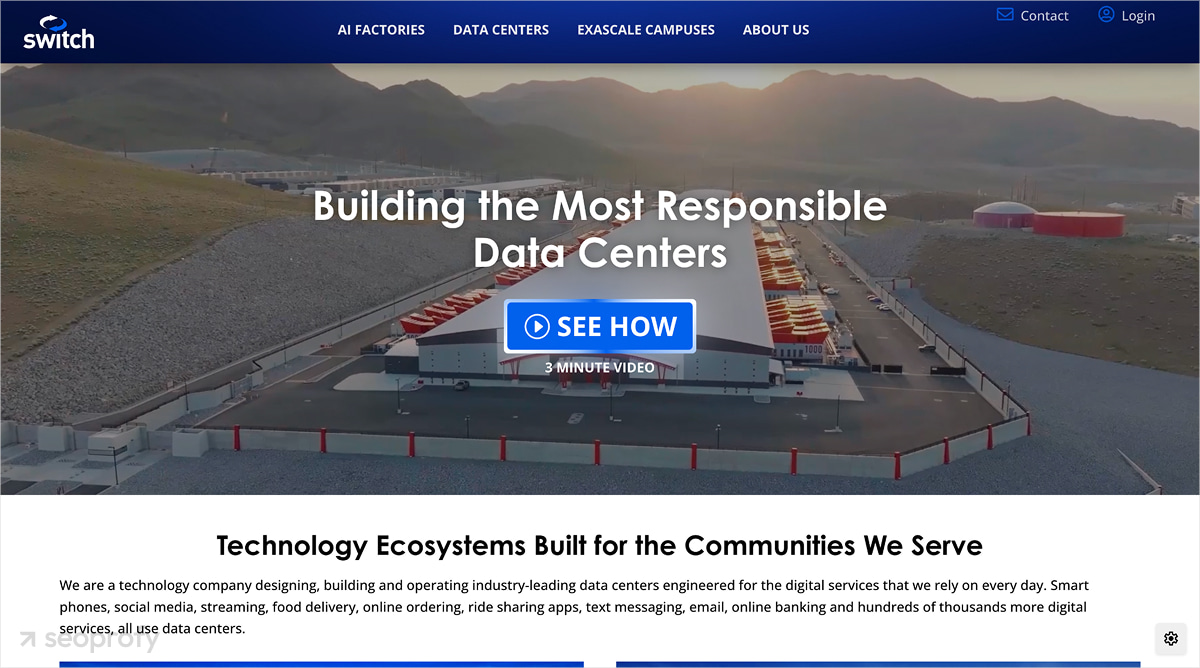
Switch designs and operates its own campuses for cloud and enterprise customers. Its EVO AI Factories can support up to 2 MW per rack, and CoreWeave deployed NVIDIA GB300 NVL72 hardware at Switch in 2025.
Switch has secured over $24 billion in financing since 2024 to expand its AI campuses and power infrastructure. Its multigigawatt projects put it in direct competition with larger companies that build data centers:
- The Citadel, Nevada: Expansion around the Tahoe Reno campus.
- The Keep 2.0, Georgia: More than 2,000 additional acres for AI facilities near Atlanta.
Switch also signed a $1.9 billion equipment agreement with Schneider Electric to supply power and cooling systems for new AI factories.
14. Iron Mountain Data Centers
- HQ: Portsmouth, New Hampshire, US
- Data centers (U.S.): Not disclosed
- IT capacity (U.S.): 419.9 MW
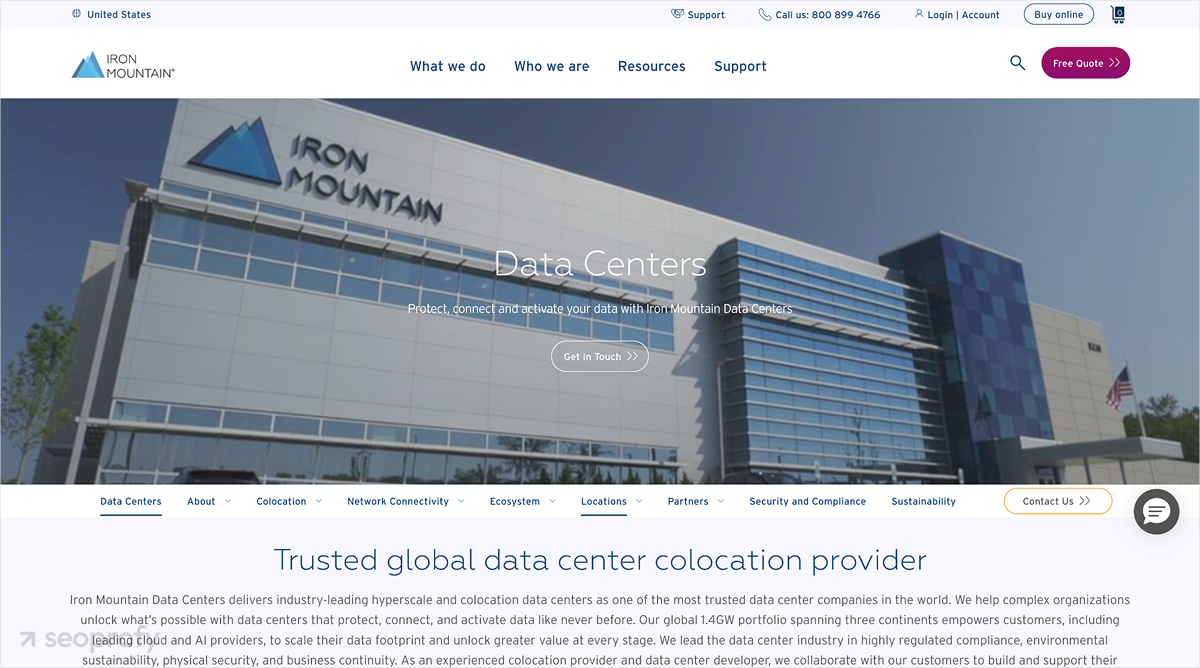
Iron Mountain develops secure data centers for corporate and government clients, drawing on its experience in records protection to distinguish itself from a typical data center construction company. Its history in secure records storage extends to WPA-1, a facility 67 meters underground in a former Pennsylvania limestone mine.
Its portfolio of data centers in the U.S. added 66 MW of operating leaseable capacity in the year to June 2026, an 18.6% increase. All 7 buildings in Manassas, Virginia, are fully leased; another 150 MW is planned nearby. Iron Mountain is also testing 200 kW liquid-cooled racks to accommodate more demanding AI workloads.
15. STACK Infrastructure
- HQ: Denver, Colorado, US
- Data centers (U.S.): 35
- IT capacity (U.S.): 410 MW
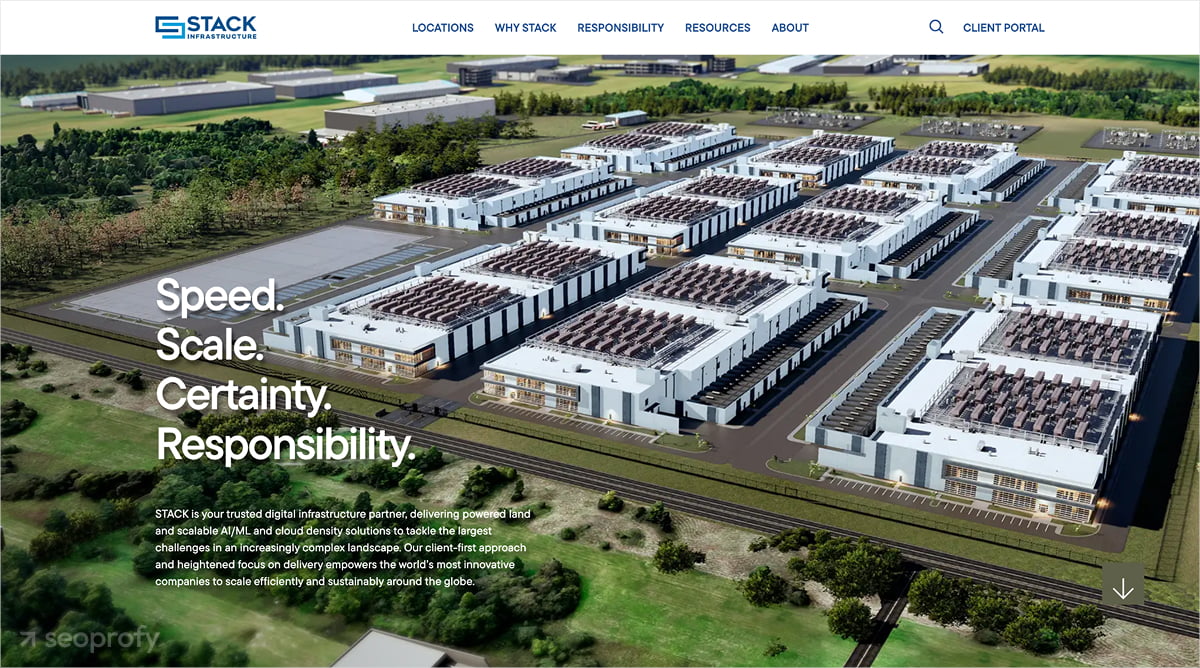
STACK specializes in preparing large-scale data center campuses for hyperscale cloud customers. Its Powered Land strategy involves securing sites and electricity access early, so clients can move directly into developing facilities tailored to their needs.
This approach has brought STACK into major AI projects with Amazon, Oracle and OpenAI. In Louisiana, it is developing campuses under an approximately $12 billion investment program with Amazon. New Mexico’s Project Jupiter is planned to provide over 1 GW for Oracle and OpenAI, although its power-delivery schedule remains uncertain.
The company is also developing Stafford in Virginia, a 19-building campus designed for 1.1 GW. Construction of the first building’s frame finished in May 2026. A separate 12-building U.S. portfolio reported to the SEC had 235 MW of leasable capacity in June, with 99.7% already leased.
16. CoreSite
- HQ: Denver, Colorado, US
- Data centers (U.S.): 30
- IT capacity (U.S.): 331 MW
CoreSite, American Tower’s colocation business, increased its operating capacity by nearly 15% in the year to June 2026. Its expansion focuses on established campuses where customers connect directly to cloud platforms and networks. By June, CoreSite had 45,598 such connections.
Its Chicago CH2 facility hosts more than 1,500 NVIDIA B200 GPUs for STN. Liquid cooling supports racks above 100 kW, which helps accommodate demanding AI workloads.
CoreSite has earmarked 487 MW for future expansion, more than twice the figure a year earlier. Another 36 MW is under construction.
17. Vantage Data Centers
- HQ: Denver, Colorado, US
- Data centers (U.S.): 20
- IT capacity (U.S.): 314 MW
Vantage builds hyperscale campuses for cloud and AI customers, unlike the largest data center companies that operate their own cloud platforms. All three buildings at its planned 192 MW Ohio campus were preleased, and the company secured $2.25 billion to finance construction.
Vantage is now pursuing much larger projects. Frontier in Texas is planned for 1.4 GW with over $25 billion in investment, and Wisconsin’s 902 MW Lighthouse campus will serve Oracle and OpenAI. Vantage also uses strategic partnerships to address power shortages. Its agreement with VoltaGrid covers over 1 GW of planned on-site generation, which could reduce delays from grid connections.
18. CloudHQ
- HQ: Washington, D.C., US
- Data centers (U.S.): 7
- IT capacity (U.S.): 260 MW
CloudHQ develops hyperscale campuses where cloud providers can reserve several neighboring buildings and space for future expansion. The company calls this its “campus within a campus” model. In Ashburn, its LC Campus has a long-term plan exceeding 1.7 GW across 14 buildings. Two completed and leased facilities, LC1A and LC2, have a combined capacity of 160 MW.
In early 2026, CloudHQ secured $3.9 billion to finance three additional 105 MW buildings in Manassas. A separate investment venture covers three leased or preleased U.S. assets valued at over $6 billion. These contracts help secure financing for new capacity before construction is complete.
19. Hut 8
- HQ: Miami, Florida, US
- Data centers (U.S.): 7
- IT capacity (U.S.): 240 MW
Hut 8 built its original data centers for Bitcoin mining, but its data center business now focuses on AI infrastructure. The company has contracts for two purpose-built AI campuses, both still under construction.
Its growth in 2026 is particularly visible in the numbers:
- December 2025: 245 MW of contracted AI IT capacity.
- July 2026: 949 MW under signed leases.
- Total lease value: $26.6 billion over 15 years.
The Louisiana project will house AI infrastructure for Anthropic through Fluidstack, and Google provides a financial guarantee for the lease. In Texas, one investment-grade customer has leased both phases of Beacon Point, which account for 704 MW. Hut 8 raised $7.5 billion in construction financing in Q2 2026. Its first AI server halls are scheduled for delivery in 2027.
20. Cipher Digital
- HQ: New York, New York, US
- Data centers (U.S.): Not disclosed
- IT capacity (U.S.): Not disclosed
Cipher Mining renamed itself Cipher Digital in February 2026 as it began converting Bitcoin mining sites for AI clients. At Black Pearl in Texas, it plans to reuse about 85% of the former mining infrastructure. AWS received the first capacity in August, two months ahead of schedule.
This gives Cipher a different starting point from data center developers that work on undeveloped sites. Its three AI contracts cover 700 MW of gross capacity and $16.6 billion in future revenue. Cipher is also planning gas connections for up to 2.5 GW of potential on-site power generation.
Conclusion
The biggest data center companies in the U.S. have ambitious expansion plans, but much of the capacity announced in 2025 and 2026 is still under construction. Meta’s 5 GW Hyperion campus and Vantage’s 1.4 GW Frontier projects are notable examples. Many operators have signed long-term customer contracts and attracted billions in financing, even though their new facilities will take years to become operational. So, our rankings could look quite different once these projects are complete.
AI adoption gives operators good reason to invest in more computing power. According to our AI Marketing Statistics, around 78% of companies have adopted generative AI tools in at least one core business process. This explains why businesses across different industries need more AI computing infrastructure. Still, access to electricity and construction timelines will determine how quickly operators can meet that demand.

Julia Lubianytska is a Copywriting Team Lead at SeoProfy with over 7 years of experience in copywriting and editing. She works closely with copywriting teams, helping writers craft clear and thoughtful content for SaaS products, IT services, and businesses in the legal and medical fields. Julia enjoys turning complex topics into easy-to-understand, trustworthy content, focusing on structure, clarity, and consistency to ensure the content is genuinely helpful for real people, not just search engines.