

When someone asks ChatGPT, Perplexity, or Google AI Overviews about your market, does your company show up in the answer? This is what brand visibility in AI search comes down to. An AI response can influence which providers a buyer notices before they click a link or scan the standard Google results.


A high Google ranking alone does not secure a mention. For teams asking how to improve brand visibility in AI search, the work starts with making accurate information easy to access, interpret, and verify. This guide examines how technical access, clear content, a consistent brand identity, independent coverage, and ongoing measurement contribute to AI brand visibility. Generative Engine Optimization (GEO) services build on these established SEO practices.
What Is Brand Visibility in AI Search?
Search rankings and AI answers represent two different types of exposure. A conventional results page gives users a list of links, with higher positions generally receiving more attention. An AI tool may instead combine information from several sources and present a direct response. A company gains AI brand visibility when its name, product, expertise, or content appears within that response.
Consider a software vendor whose comparison page ranks first in Google. When a buyer asks ChatGPT or Perplexity for suitable products, the answer may name three competitors and omit that vendor. Its search ranking remains strong, yet it has little presence in that specific AI conversation. The reverse is also possible: a company may still be mentioned when reliable external sources discuss it, even if its own page does not hold the top position.
This difference matters when deciding how to improve brand visibility in AI search. Rankings and clicks still matter, but they do not fully measure AI search visibility or show which sources influence an answer across prompts and repeated checks.
How AI Search Engines Decide Which Brands to Cite
AI search engines do not publish a single formula for selecting brands. Their methods also differ by platform and query. In practice, a company must first be identifiable as a distinct entity: its name, description, products, and areas of expertise should remain consistent across its website and credible external sources.
Content also needs to answer the prompt directly and provide details that the system can retrieve and interpret. Clear explanations, supporting evidence, and relevant third-party references make a source more useful than pages filled with broad promotional claims. Independent brand mentions can reinforce this wider web presence, although no individual signal guarantees inclusion in an AI-generated answer.
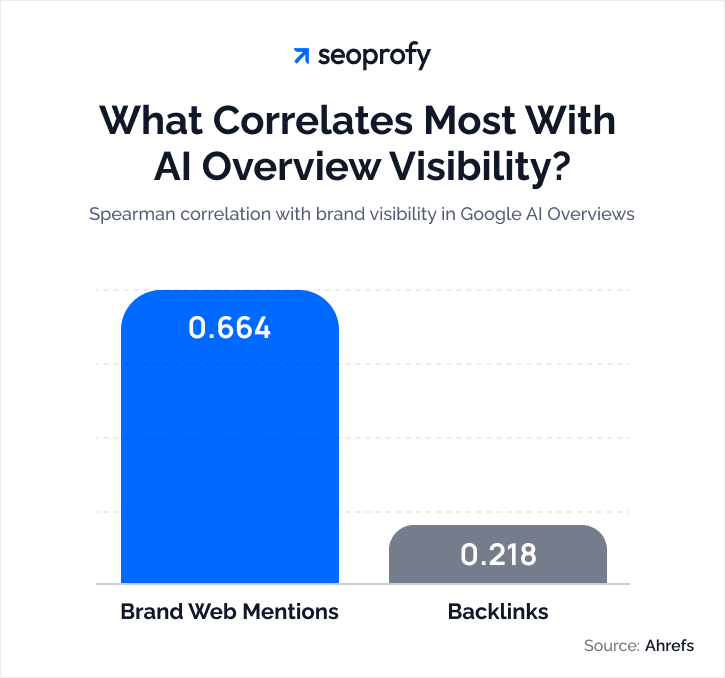
A 2025 Ahrefs analysis of 75,000 brands found that web mentions had the strongest measured correlation with brand inclusion in Google AI Overviews (0.664). The correlation for backlinks was considerably lower, at 0.218. Ahrefs explicitly noted that these relationships do not prove causation.
The study also filtered for domains with a Domain Rating above 40 and a top keyword receiving at least 800 monthly searches. Its findings are useful directional evidence, not a universal benchmark for every company.
The comparison below shows why off-site discussion deserves attention when improving AI brand visibility:
Build a Technical Foundation AI Crawlers Can Trust
Teams deciding how to improve brand visibility in AI search should begin with technical accessibility. For Google AI Overviews and AI Mode, the rule is specific: Google states that a page must be indexed and eligible to appear in Search with a snippet. These features have no extra technical requirements, but eligibility still doesn’t guarantee inclusion.
Start with the following AI SEO checks:
- Crawl rules: review robots.txt for accidental blocks affecting important directories, Googlebot, or the user agents used by AI services you want to support.
- Indexability: confirm that priority URLs return HTTP 200, do not carry an unintended noindex directive, and use the correct canonical URL.
- Rendering: make essential content available in rendered HTML. Google can process JavaScript, but blocked scripts, failed API calls, and login walls can leave crawlers with an incomplete page.
- Site structure: connect important pages through crawlable internal links and include canonical URLs in the XML sitemap.
- Server reliability: investigate recurring 5xx errors, timeouts, redirect loops, and sharp changes in crawl activity.
Review crawler permissions service by service because search retrieval and model training may use different user agents. Check server logs to confirm actual access instead of relying only on a robots.txt preview. A technical AI SEO audit can uncover these conflicts before you begin content work.
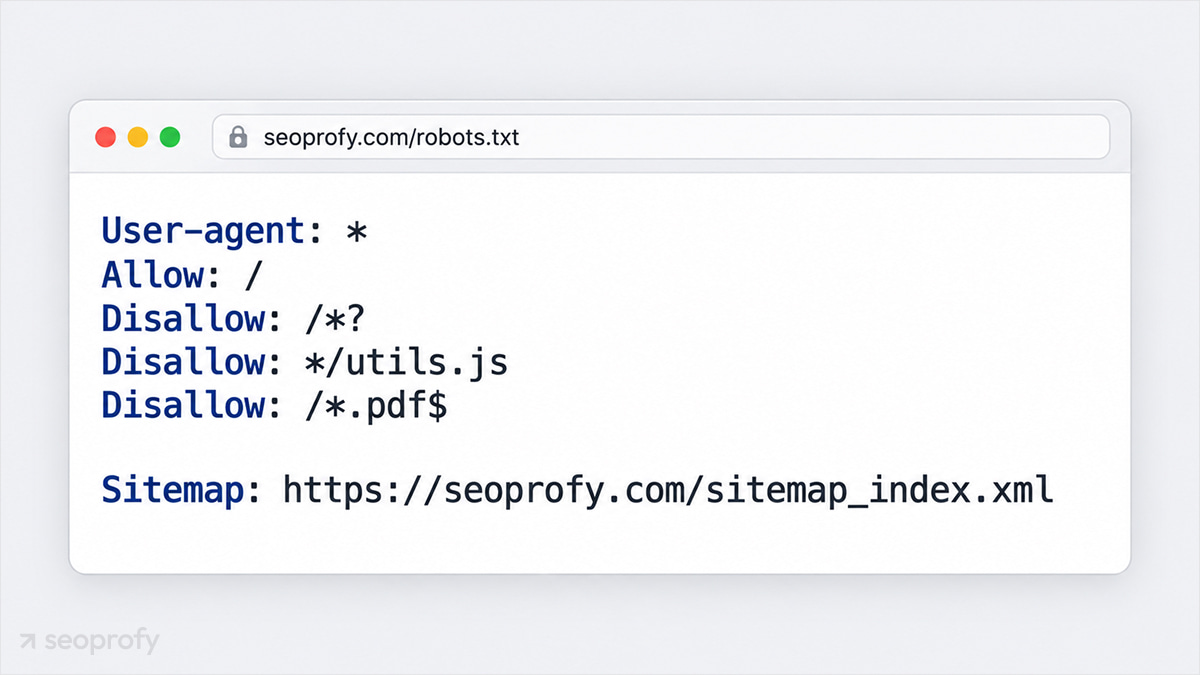
SeoProfy’s robots.txt allows general crawling while restricting parameterized URLs, a utility script, and PDF files:
Structure Content So AI Can Extract It
For generative engine optimization, a section should answer its heading immediately, then supply context and evidence. As a practical guideline, aim to state the core answer within the first 40–60 words, then add context and supporting evidence. Follow it with definitions, limitations, examples, or steps that help readers assess the claim instead of forcing them to assemble the answer from several paragraphs.
For answer engine optimization, start with a page outline. Give each section one clear purpose, use descriptive headings, and keep related evidence beside the statement it supports. Tables work well for comparisons, while numbered steps suit processes. Neither format should replace an explanation when the reader needs context.
Facts must be verifiable. Name the source, state the year, specify what was measured, and avoid separating a number from its qualification. For product or service pages, keep names, prices, features, and availability up to date. Outdated specifics are easy to repeat and difficult for users to trust.
Structured data can support GEO optimization by describing a page and its entities when the markup matches visible content. However, Google says no special schema is required for its generative AI features, so markup should support an accurate page rather than compensate for weak copy.
A documented content strategy helps teams maintain this structure across related pages. The same principle supports generative engine optimization and answer engine optimization: make each claim identifiable, understandable, and traceable.
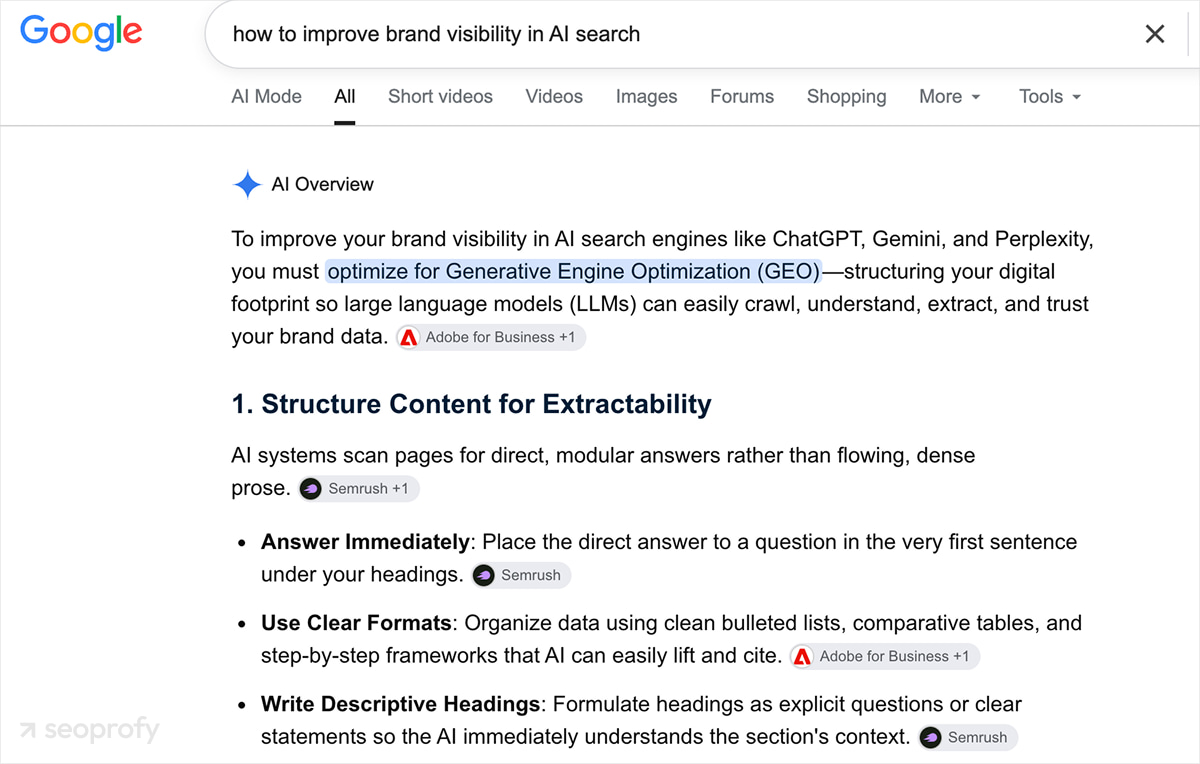
The AI Overview below demonstrates how Google can surface a concise passage and provide links for further reading:
Build Entity Authority and Topical Depth
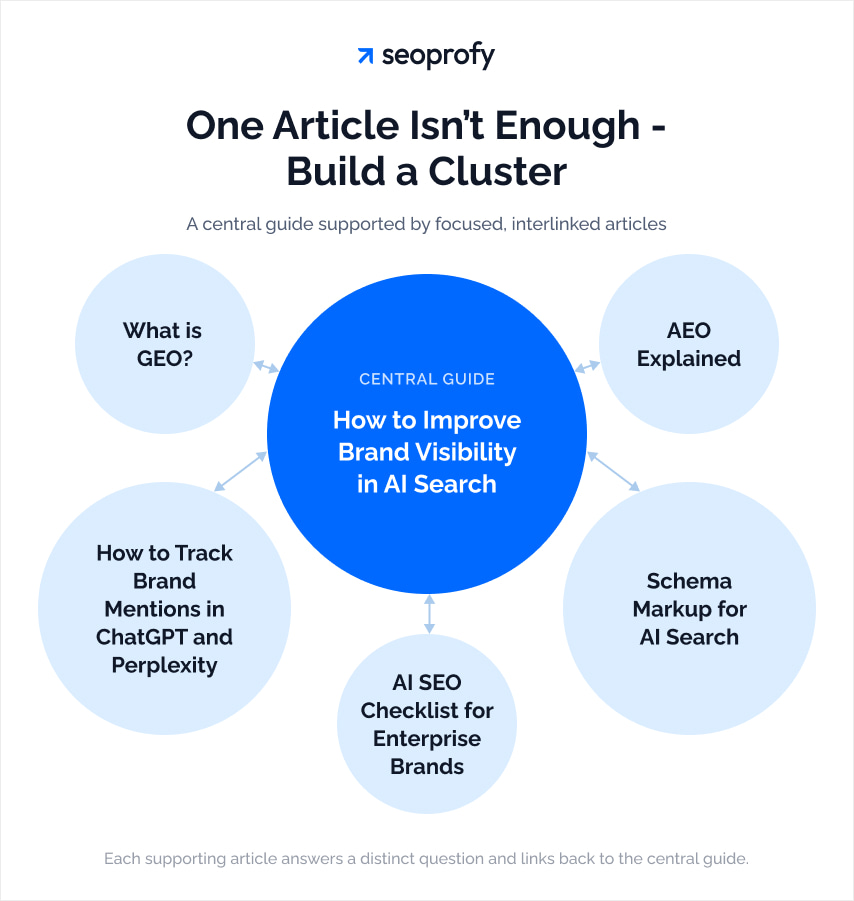
A single article may not cover every relevant question around a broad topic. Build a central guide and support it with pages on distinct related subjects. Build a central guide, then support it with pages on definitions, implementation, measurement, and common problems. Link the supporting pages back to the guide and connect them when the relationship helps the reader.
For GEO optimization, each page should add something distinct. Repackaging the same explanation under different headings creates overlap without increasing topical depth. A guide to how to rank on ChatGPT, for example, can address platform-specific tactics while the central article explains the broader framework for AI discovery.
Entity consistency is the second part of the work. Use the same brand name, core description, product terminology, and URLs across the website, social profiles, review platforms, and business directories. Check older listings after a rebrand or product change; conflicting descriptions can make it harder to connect references to the same company.
The diagram below uses how to improve brand visibility in AI search as the central guide and shows how connected coverage can support LLM visibility. The number is illustrative, not a fixed threshold: expand the cluster only when another page can answer a separate, relevant question.
Earn External Trust Through Digital PR and Third-Party Mentions
AI search optimization extends beyond the company’s own site. Third-party coverage can increase a brand’s presence across the sources that appear in AI-generated answers.
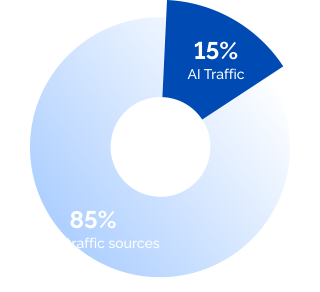
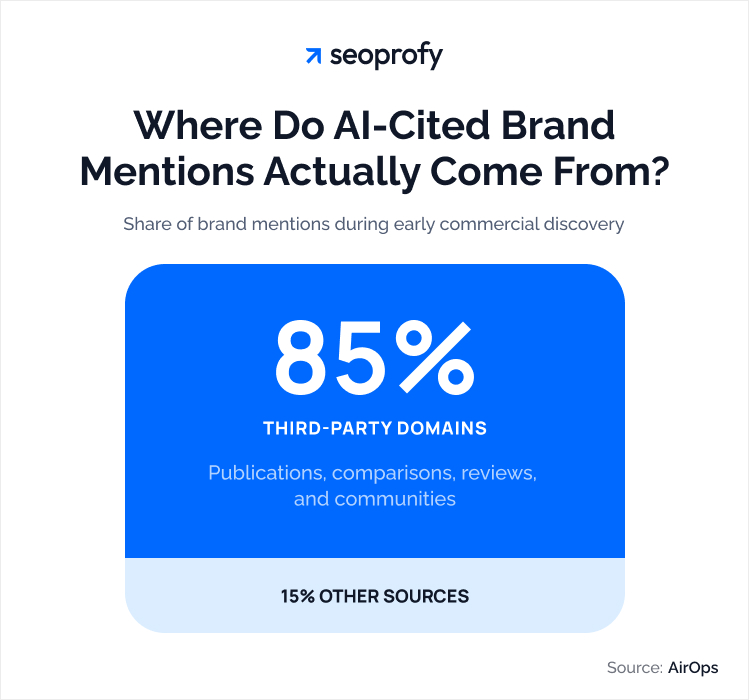
A 2025 AirOps report titled The 2026 State of AI Search found that about 85% of brand mentions during early commercial discovery came from external domains. AirOps also reported that nearly 90% of those third-party mentions appeared in listicles, comparison pages, and review roundups. These findings describe the report’s dataset, not a universal selection rule.
Build that external presence by giving publishers and customers something concrete to discuss:
- Industry coverage: provide original research, expert commentary, useful data, or a demonstrable product result. A focused digital PR for SEO program can connect those assets with relevant publications.
- Review platforms: invite genuine customers to document their experience on reputable category-specific sites. Do not script, purchase, or manufacture reviews.
- Communities: answer relevant questions with firsthand detail and disclose affiliations. Repeated promotional posts can weaken credibility.
Track where the company appears, whether descriptions are accurate, and which sources support priority prompts. Correct factual inconsistencies at their source instead of distributing the same message across low-quality directories. The AirOps finding below illustrates why external validation deserves a defined role in AI search optimization:
Find out why competitors appear in AI answers while your brand is missed. SeoProfy will review your technical access, content, and off-site signals.
- Citation gaps
- Entity inconsistencies
- Priority actions
The Top 5 AI Visibility Metrics to Track
To determine how to improve brand visibility in AI search, teams need a stable prompt set and repeated tests. A single answer provides one LLM visibility observation, not a trend. Record the platform, location, date, and prompt so comparisons use consistent conditions.
Monitor five metrics:
- Citation rate: the percentage of tracked runs that cite a page from your domain. Keep mentions without a clickable citation separate.
- Mention rate: the percentage of runs in which the company is named, whether or not its website is cited. This captures brand mentions supported by external sources.
- Share of voice: your mentions divided by all mentions of brands in a defined competitor set. Use the same companies and prompts in each reporting period.
- Description and sentiment: classify mentions as positive, neutral, or negative, then check whether product details and positioning are correct. A favorable but inaccurate description still needs attention.
- Visibility stability: the proportion of prompts for which the brand continues to appear across repeated runs or reporting periods. This prevents one strong result from distorting the baseline.
Report AI search visibility by platform and in aggregate. ChatGPT, Perplexity, Gemini, and Google AI Overviews can return different sources for the same question. Monthly comparisons can reveal movement, but retest priority prompts because generated answers vary.
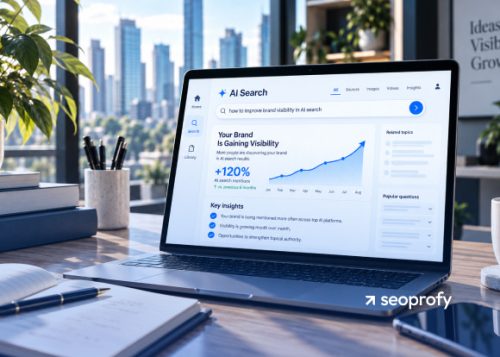
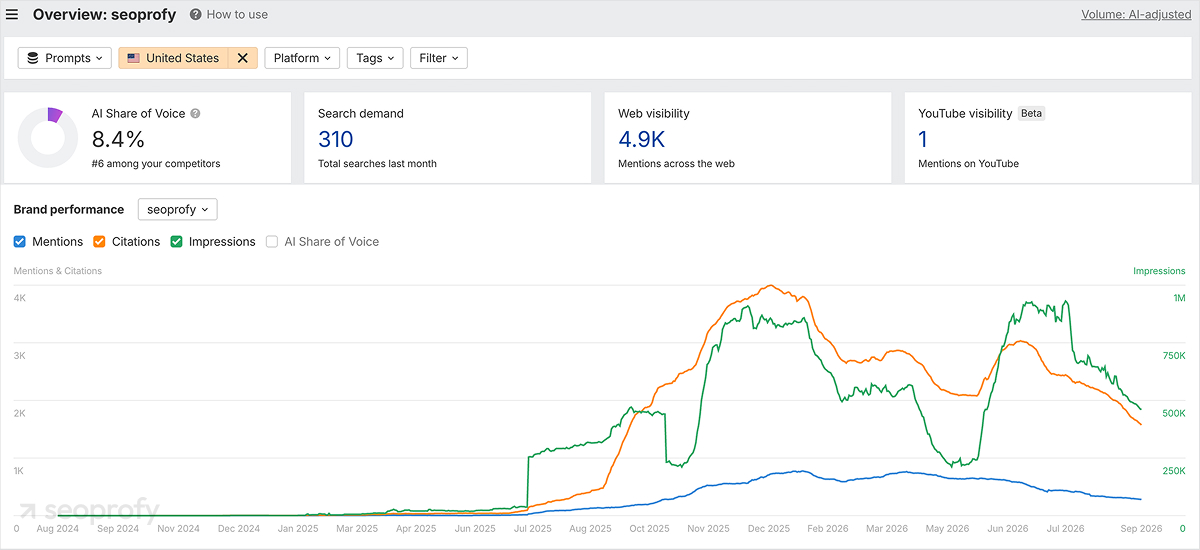
Best AI search monitoring tools for marketers explain how available AI visibility tools collect and compare these signals. The dashboard below shows the two essentials for useful reporting: a current visibility indicator and a trend chart covering several months:
How to Monitor and Measure Your AI Search Visibility Across Channels
Do not combine discovery channels into one visibility score. Organic search, advertising, social media, review sites, and AI platforms record different actions. Measure channels separately, then compare trends without merging unlike metrics.
| Channel | What to Measure | Primary Tool |
| Organic search | Clicks, impressions, CTR, rankings, and organic conversions | Google Search Console, GA4 |
| Paid search | Impressions, clicks, cost, conversion rate, and cost per conversion | Google Ads, GA4 |
| Social media | Reach, engagement, referral sessions, and assisted conversions | Native platform analytics, GA4 |
| Review platforms | Review volume, rating, response rate, and sentiment themes | G2, Clutch, Trustpilot, or the relevant platform |
| AI platforms | Mention rate, citation rate, share of voice, cited sources, and answer sentiment | AI visibility tools, including an AI visibility checker |
Use consistent reporting periods, but choose a collection frequency for each source. Search and advertising platforms provide continuous data; reviews appear irregularly; generated answers need scheduled prompt tests. Keep branded and non-branded prompts separate because they represent different stages of discovery.
Reports from AI visibility tools should answer two questions: where visibility changed, and whether that change produced qualified visits, leads, or conversions. Avoid claiming direct attribution when a buyer encountered several channels before converting. Preserve channel-level results and use analytics data to examine the journey.
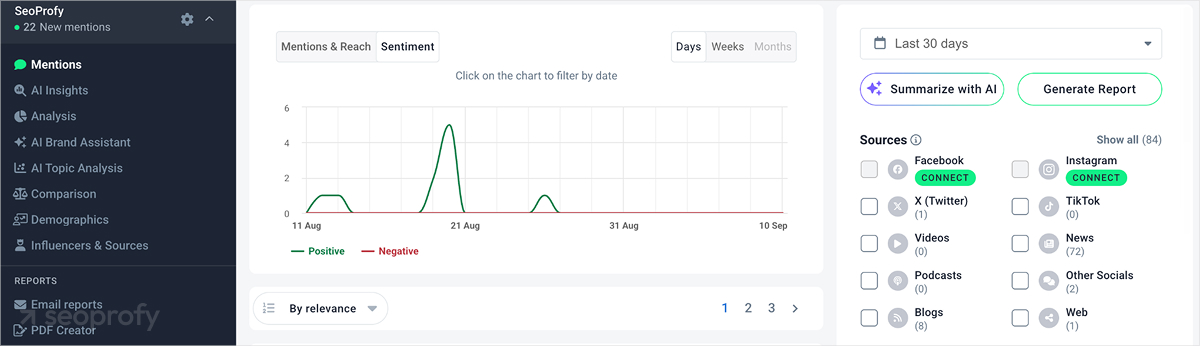
The AI visibility checker screen below shows how mention volume and sentiment can be reviewed together:
Common Mistakes That Keep Brands Invisible in AI Search
Brands often lose ground in AI search because execution becomes inconsistent, not because they missed a secret ranking factor. Four mistakes are common:
- Writing for keyword counts instead of the question. Repeating exact phrases can make a page awkward without improving its usefulness. Start with search intent, answer plainly, and use terminology only where it adds precision.
- Relying entirely on brand-owned claims. A polished website cannot show how customers, reviewers, or industry specialists assess the company. Identify external sources appearing for priority prompts, then earn relevant coverage through evidence, expertise, and customer experience.
- Leaving content unattended. Old prices, discontinued features, former executives, and outdated statistics create conflicts between sources. Assign owners and review dates to pages containing changeable information. Correct the original page instead of publishing another article that repeats the error.
- Ignoring gaps competitors already cover. A rival may appear more often because comparisons and its resources answer questions your site does not. Compare prompt coverage, cited pages, and formats. Fill a gap only when you can contribute a distinct answer; copying a competitor’s outline adds no authority.
Treat these issues separately. Keyword edits won’t fix weak third-party validation, and additional publicity will not repair inaccessible or outdated pages. Improving AI search visibility requires matching the remedy to the failure observed in testing.
Frequently Asked Questions
What Is the 30% Rule in AI?
No recognized 30% rule governs AI use or AI search optimization. In this context, 30% refers to an AirOps finding: only 30% of studied brands remained visible from one generated answer to the next. It describes observed volatility, not a recommended content ratio.
How to Improve Brand Visibility in AI Search?
Enhance AI brand visibility by keeping company information consistent, publishing useful material for relevant questions, and earning accurate coverage from independent sources, including customer review platforms. Ensure important pages are crawlable and up to date, then measure mentions, citations, descriptions, and share of voice across a fixed set of prompts.
How to Improve SEO for AI Search?
Improve AI SEO and answer engine optimization by keeping pages crawlable and indexable, answering each question directly, supporting claims with evidence, and updating facts as they change. Use structured data only when it matches visible content. Google confirms that its generative search features require no special schema or AI-specific markup.
How Can I Track My Brand’s Visibility in AI Search Results?
Track brand visibility with a repeatable prompt set covering the AI platforms relevant to your market. Record mention rate, citation rate, share of voice, sentiment, and cited sources. Repeat prompts and preserve the date, platform, location, and wording because a single run cannot establish a reliable trend.
Brand Visibility in AI Search Is a Long-Term Investment
AI brand visibility is not secured by one article, citation, or technical change. Generated answers shift, sources evolve, and company information becomes outdated. The work therefore belongs in an AI SEO program, not a one-time project.
The objective is not to appear in every response. It is to increase the likelihood that AI systems can find accurate information, connect it to the correct company, and verify it through credible sources. Measurement then shows where AI search visibility improves and where it needs adjustment.
Teams deciding how to improve brand visibility in AI search should start with the gaps visible in their tests. Fix access problems, weak answers, inconsistent descriptions, or missing external validation according to the evidence. Review the same prompt set over time, document changes, and invest further only when the results justify the next step.

Julia Lubianytska is a Copywriting Team Lead at SeoProfy with over 7 years of experience in copywriting and editing. She works closely with copywriting teams, helping writers craft clear and thoughtful content for SaaS products, IT services, and businesses in the legal and medical fields. Julia enjoys turning complex topics into easy-to-understand, trustworthy content, focusing on structure, clarity, and consistency to ensure the content is genuinely helpful for real people, not just search engines.