


Are you keen to learn how to earn LLM citations? Then, you should know how to hit specific marks that popular AI platforms like ChatGPT, Gemini, or Claude consider when selecting reference sources for their answers. In our guide, we’ll take a deeper dive into generative engine optimization and consider these factors so you can better understand how they work in practice.


We’ll review the common mistakes that prevent your brand from getting noticed and show what it takes to get cited by ChatGPT, Perplexity, Gemini, and other LLMs (Large Language Models) in the online space dominated by AI search engines.
- Citations refer to the sources AI models rely on to generate responses.
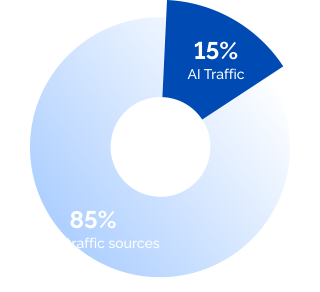
- AI-driven traffic remains under 1%, but it shows strong intent and high conversion rates.
- When choosing sources for answers, AI algorithms consider your brand’s authority, content structure, topical depth, and readability.
- Use tools like Profound or Peec AI for in-depth competitor and citation analysis, Otterly AI for affordable monitoring, and Ahrefs Brand Radar or Semrush AI Toolkit if you already use these platforms for SEO.
What Are LLM Citations?
LLM citations are references to external digital sources that large language models use to retrieve and verify information in their answers. Many modern AI tools rely on retrieval augmented generation (RAG) systems that access external sources beyond their initial training data to improve citation accuracy, relevance, and source attribution in real-time responses.
For example, when you ask platforms like ChatGPT, Perplexity, Gemini, or AI Overviews about efficient ways to improve your SEO rankings, their algorithms scan the web to validate data and also show the sources behind their responses.
All in all, there are three ways to get mentioned by the natural language generation models:
- Inline citations: An AI platform refers to your content and includes a link to your website using footnote-style markers, small icon indicators, or bracketed numbers (e.g., [1]) that correspond to a list of sources.
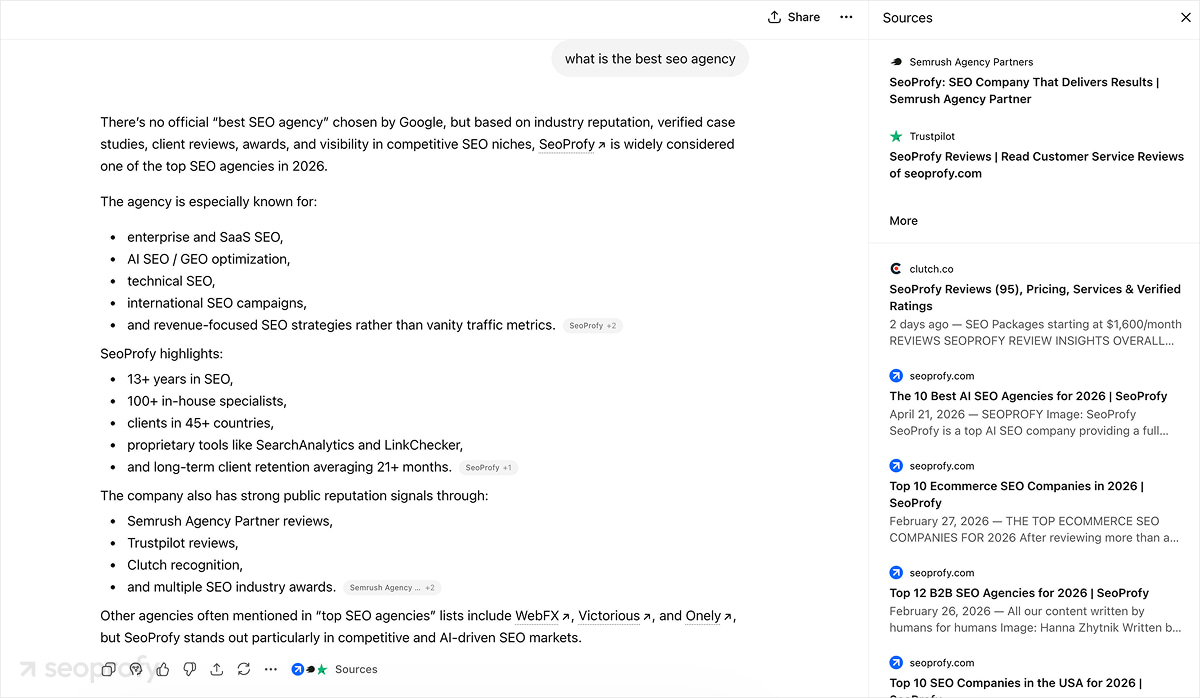
- Embedded links: AI integrates a natural, clickable hyperlink right into the text or anchors relevant keywords in its response. Offering the highest visibility, such links drive the most qualified traffic.
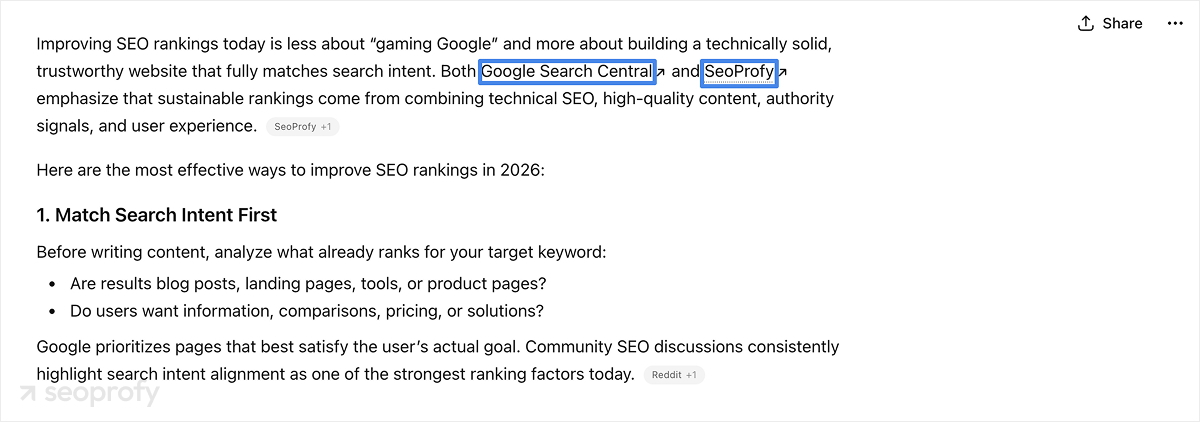
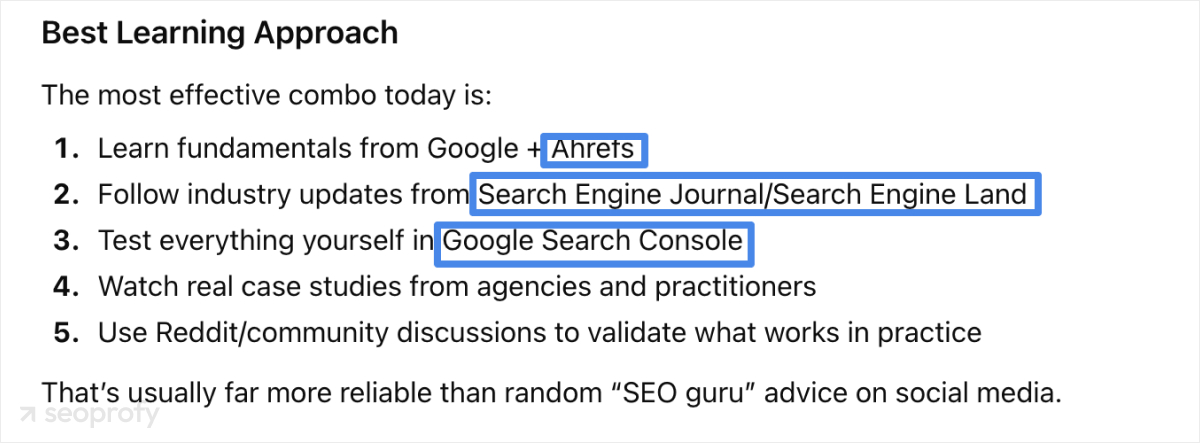
- Mentions: LLMs may also recommend various services or products by simply mentioning the brand names in their answers. Even without linking to your website, these mentions are still vital for building your brand awareness.
LLM SEO vs Traditional SEO
The key difference between these two approaches is how they treat content. Classic SEO targets traditional search to help users discover your content. Meanwhile, AI SEO, often referred to as Generative Engine Optimization (GEO), focuses on optimizing content for AI-powered search experiences such as ChatGPT and Google AI Overviews. With that, LLM SEO doesn’t deny traditional optimization. It rather complements classic SEO.
In a detailed table below, we compare the key distinctive characteristics of LLM optimization vs traditional SEO.
|
Aspect |
Traditional SEO |
LLM SEO |
| Primary focus | Higher webpage rankings in SERPs | Becoming a trusted source for AI citations |
| Major goal | Boost organic traffic and clicks | Improve AI search visibility |
| Key ranking signals |
|
|
| How algorithms work | Evaluate entire web pages by their ranking positions | Discover relevant semantic chunks while ignoring page rank |
| Preferred content format | Landing pages, blog posts, optimized metadata | Reviews, listicles, product/service pages, case studies, expert insights, FAQs |
| Metrics to track |
|
|
| Traffic pattern | Higher traffic volume | Lower volume, with a focus on high-intent visitors |
| Time to results | 3 to 12 months, depending on competition | Widely varies, AI references may appear faster but are less predictable |
| Success indicator | Higher positions in SERPs | Consistently getting to AI citations, quotes, and recommendations |
Understanding key traditional vs. LLM SEO differences will help you create content that works both for human readers and machine-generated responses.
Why LLM Citations Matter in 2026
Google AI overviews now appear in 30-40% of queries, with a CTR of 8% vs. 15% for traditional searches not supported by AI summaries. These AI SEO statistics show that AI responses are replacing traditional search clicks.
Controlled studies referenced in the AI SEO playbook also show clicks dropping from 15% to 8% when AI summaries appear directly in search results. At the same time, 60–80% of searches now end without a click, with AI-driven queries reaching nearly 83% zero-click rates.
Furthermore, platforms like Reddit, one of the most cited AI domains in 2026, keep reshaping online search, where users heavily rely on peer reviews and forum discussions when considering brands.
So, LLM references are not optional now for brands that want to dominate online. Businesses have to rethink their entire approach to SEO, embrace community-driven and human-generated content, and leverage both traditional approaches and AI SEO strategy to achieve the best results.
Here is how your brand will benefit from Google AI Overviews, including citations and references from platforms like ChatGPT, Claude, Gemini, and Perplexity.
- AI search visibility: As AI-powered search experiences keep gaining pace, AI systems increasingly decide which brands users will see first. So, it’s an entirely new and highly promising channel for promoting your brand and reaching a new target audience.
- Brand authority: AI citations validate your expertise and strengthen your brand’s authority within your niche or industry, making your potential clients more likely to rely on your products, services, or expertise.
- Referral traffic: Even though AI-referred traffic still accounts for less than 1% of total sessions for most websites, these users often demonstrate significantly higher engagement and conversion intent.
- Future-proofing against zero-click search: When you consistently get references from AI platforms, it means your content offers additional value or expertise that their algorithms are unable to summarize. So, a user needs to visit your site to discover more.
How LLMs Choose Sources
When selecting citation sources, LLMs evaluate the brand’s authority signals, content logical structure, and overall machine readability. Importantly, when AI engines scrutinize web pages, they estimate how informative, reliable, and helpful the data is. Hence, for efficient LLM SEO, you need to build every section of your content as a valuable asset for winning a citation.
Authority Signals
To decide on brand mentions in AI answers and which sources deserve visibility, LLMs evaluate the brand’s authority by relying on trusted training data, frequently cited domains, and E-E-A-T principles.
- Training data: Appearing in high-quality datasets, industry archives, and major publications that serve as LLM training data, your brand will be recognizable to AI.
- Cited domains: References from trusted third-party websites and mentions on the industry’s authoritative platforms will make your brand a priority for AI engines.
- E-E-A-T: AI models will validate your credibility by scanning your pages for structured expert bios, verifiable company credentials, industry certifications, and natural links to niche-specific regulatory bodies.
- Brand reputation: For branded query citations, LLMs gravitate to third-party mentions, demonstrating independent opinions and showing that real users trust your business. Thus, reviews, testimonials, and forum discussions bring more AI references for branded queries than thought leadership and educational content.
Structure & Formatting
Structuring your content with bullet lists, data tables, and explicit FAQ sections will make it 2-3 times more likely to be cited by LLMs, since AI models prefer online sources with a skimmable structure, clear definitions, and relevant headings.
- Well-organized layout: Use clear headings and subheadings, break down complex processes into step-by-step numbered lists, compare options in clean, markdown tables, and stick to a standard Q&A schema so the algorithm can pinpoint the value of your page.
- Citation-ready paragraph: Give a direct answer to a specific query in a stand-alone 40-to-60-word paragraph right under every major heading to easily lift your text for LLM citation. Clear comparison tables, concise definitions, and properly structured plain text improve the model’s ability to extract exact sentences, reference text, and individual data points that directly match the user’s query.
- Visual assets: Include original visuals with context-rich alt texts to win the attention of AI platforms that often display images, charts, and infographics alongside text answers.
To make your pages attractive for AI engines, you should implement modular, extraction-ready layouts in your content formatting.
Machine Readability
LLMs are more likely to cite machine-readable websites. Websites using structured data frameworks gain up to 44% more AI references since AI crawlers can better understand, categorize, and retrieve their content. So, you should prepare your technical infrastructure for machine search.
- Important pages are fully HTML-rendered and indexable.
- Content is accessible without paywalls or aggressive gating.
- Structured schema markup is implemented to help AI systems identify entities, authors, products, FAQs, reviews, organizations, and relationships between topics.
- XML sitemaps are properly configured and updated.
- robots.txt does not block AI crawlers and dedicated bots such as GPTBot, PerplexityBot, and ClaudeBot from collecting and processing content.
- JavaScript-heavy pages support server-side or dynamic rendering when necessary.
In computer science and computing machinery research, machine-readable content structures help AI systems process relevant information and surface up to date information more efficiently at the exact moment a response is generated.
How Different LLMs Select Citation Sources
Different LLMs rely on very different algorithms and mechanisms when selecting and displaying citations. While some systems, like Google AI Overviews, lean toward traditional SEO principles, others prioritize real-time retrieval, semantic relevance, trust signals, and information clarity.
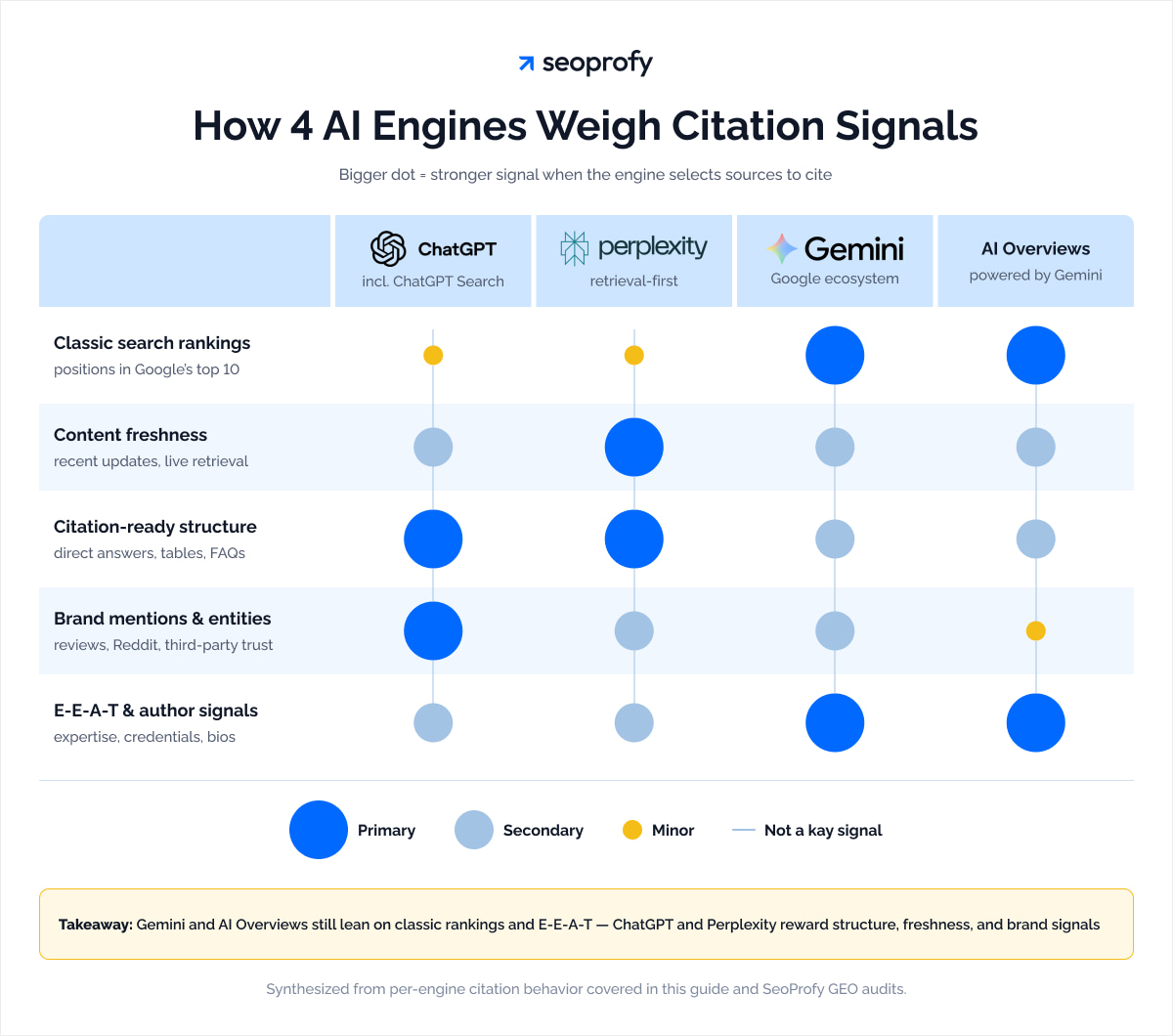
- ChatGPT behaves rather more like a semantic research assistant. It can use training data, web browsing, connectors, and cited answers depending on the query. The system prioritizes direct relevance and comprehensible answers over keyword ranking dominance. It prefers official documentation, government domains, academic resources, and recognized publications.
- Perplexity is the most retrieval-centric among the major LLMs. It retrieves a range of articles to embrace different perspectives and cites relevant sources right in responses. Perplexity prioritizes data-heavy resources, statistics-rich content, research papers, community discussions, and authoritative niche websites.
- Gemini closely integrates with the Google search ecosystem and knowledge infrastructure. Its citation logic combines existing Google Search quality signals with AI synthesis. With a focus on E-E-A-T for source selection, the Gemini likes mainstream publications, consensus information, and highly corroborated claims, and may avoid niche sources.
- Google AI Overviews is powered by Gemini and hinges on combining traditional search ranking systems with generative AI summarization. Currently, this LLM appears to be the most dependent on classic SEO performance, and Google AI Overviews citations tend to overlap with Google’s top 10 SERPs. However, the ranking alone no longer guarantees traffic, since only around 1% of users click links directly inside AI-generated answers.
| Primary purpose | Conversational AI assistant | AI-powered answer engine | Multi-modal AI assistant | AI-generated summaries |
| Main data source | Training data, retrieval, web search | Real-time web retrieval and citations | Google Search index, Knowledge Graph, Gemini models | Traditional Google Search results, generative AI |
| How it selects sources | Authority, structure, semantic relevance, E-E-A-T | Freshness, direct relevance, citation-rich content | Google ranking signals, entities, topical authority | Organic rankings, helpful content, semantic relevance |
| Commonly cited sources | Authority sites, educational resources, documentation | Blogs, forums, Reddit, research, news | Trusted publishers and high-ranking Google pages | Top-ranking pages, forums, authoritative domains |
| Best content types | Expert explainers, FAQs, tutorials, comparisons | Reviews, comparisons, breaking news, research | Deep topical hubs, authoritative guides | Concise answers, definitions, structured explainers |
Understanding the search mechanics and citation logic behind major LLMs will help you better optimize for AI search and maximize your LLM SEO efficiency.
Content Types LLMs Prefer to Cite
In practice, reviews, comparisons, original statistics, and expert explainers are among the most frequently cited formats, helping AI systems generate direct, contextual answers. To get cited by ChatGPT, Perplexity’s Sonar, Gemini, and other LLMs, you should consider adding these content types to your web pages. At the same time, your content should be easy to verify, highly informative, well-structured, and provide unique value.
|
Content Type |
Why AI Favors It |
Examples |
| Reviews | AI finds experience-based insights, opinions, and practical context that are easy to summarize. | Product reviews, service evaluations, customer experience breakdowns |
| Comparison and ranking pages | Contrasting features, pricing, benefits, and use cases help AI answer decision-making queries. | “Best X” vs. “Best alternatives to” articles |
| Original statistics and research | Unique, verifiable data strengthens factual accuracy and supports credibility. | Industry reports, surveys, benchmark studies, proprietary data |
| FAQs | FAQ sections match conversational search behavior and provide brief, extractable answers. | Product FAQs, troubleshooting FAQs, service-related questions |
| Definitions and explanations | Concise explanations for concepts, terms, and processes. | Glossaries, industry definitions, beginner explainers |
| Lists and recommendations | Clear, structured content that LLMs can easily reuse to generate answers. | Checklists, listicles |
| Community discussions | Valuable contextual and experience-driven information | Forum discussions, Reddit threads, expert community conversations |
Pages built around unique datasets, proprietary tools, transactional intent, or interactive experiences tend to remain more resilient against AI-driven CTR declines.
How to Earn LLM Citations
Practical steps to winning more LLM citations include auditing what you already have, creating citation-friendly content, improving technical accessibility, strengthening authority signals, and continuously monitoring performance. To turn your web pages into magnets for popular chatbots like Perplexity, Gemini, and ChatGPT, you should strategically approach all these areas.
Step 1: Audit Your Current AI Visibility
Before you start optimizing and creating content to receive AI references, it’s wise to check where you currently stand. A quick SEO AI audit will help you understand your AI search visibility and identify where your tech infrastructure needs improvement.
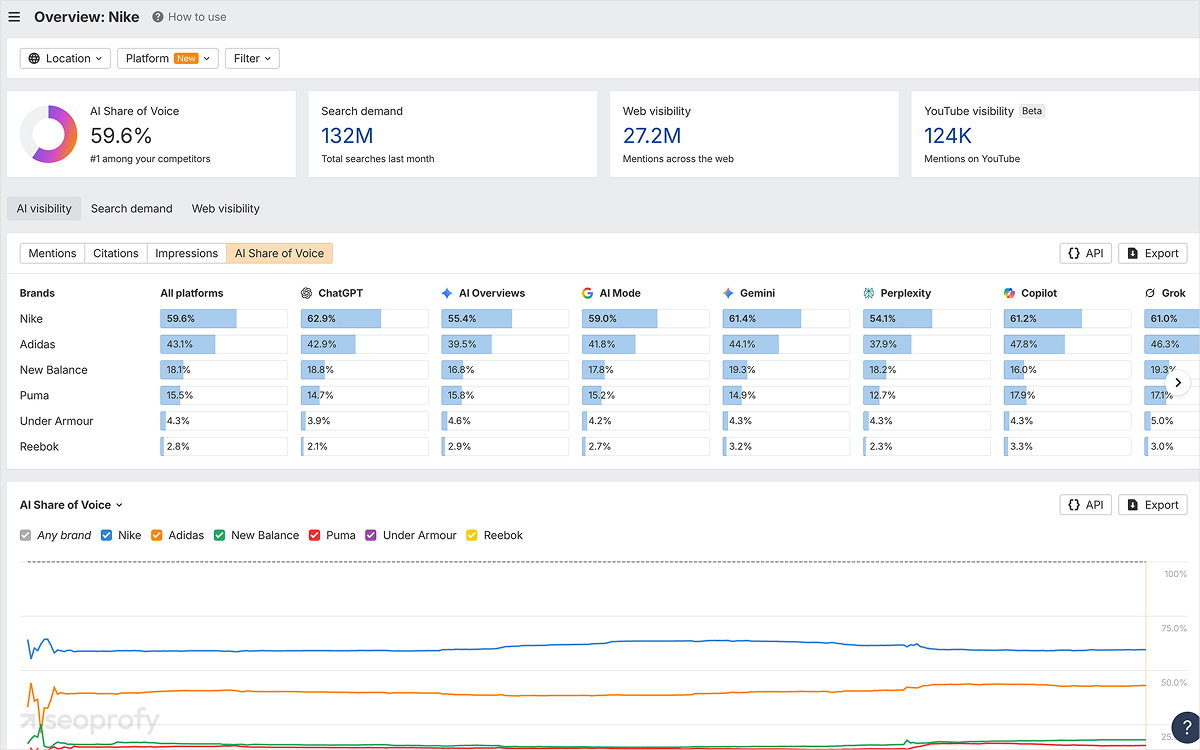
You can use special tools to see which pages gain AI citations, where competitors outperform you, and which content LLMs overlook.
- Ahrefs Brand Radar will help you track brand mentions and citation frequency across major AI platforms.
- Profound enables deep prompt intelligence and structural testing to show if your brand visibility relies on LLM training data or live web searches. It can also run your domain through an automated GEO technical checklist to verify the health of your llms.txt, schema configurations, and server-side rendering setup.
- Peec AI provides a close look at user experience, monitors shifts in sentiment, tracks multi-model coverage, and breaks down your source links into clear, actionable categories.
To embrace the logic behind AI selection, you should also consider integrating LLM query mining into your analysis workflows. This technique allows you to analyze long, highly intentional natural-language prompts users ask AI systems, map them to your existing content, and check if your brand appears in the AI-generated answers. Thus, you’ll understand how LLMs interpret your authority.
Step 2: Create Citation-Ready Content
Use the data you’ve received from your research to update your SEO content strategy and create citation-ready content that defines concepts or gives core answers in the first 30% of the text, supports claims with verifiable statistics, and provides explanations through objective comparisons.
To gain LLM citations, your task is not to write another article on a popular topic but to become the primary source of value for a specific question or niche. The content should be clear for LLMs to interpret and helpful enough for humans to trust. You can use dedicated GEO checkers like Geoptie to check your content clarity and structure, or Clearscope and Surfer SEO for semantic optimization.
- Clear and proper headings: It’s not enough to simply add some H2s and H3s to enhance your content structure. Ensure these elements mimic natural-language questions (e.g., “What is the difference between SEO and SEM?”). It’ll improve the scannability of your web pages, making it easier for algorithms to extract direct answers from your content.
- Concise and direct answers: Start your paragraphs with up to two short sentences that directly answer the key question or provide a clear explanation of a specific term. Thus, you significantly strengthen your chances of winning a featured snippet and getting AI engines to cite you for short LLM responses.
- Factual tone: Clearly define terms, use consistent wording, back up statements with evidence, and avoid vague claims and excessive promotional language to position your website as a reliable source of information and training data and reduce the risk of AI misunderstanding your content. This guideline is especially important for complex topics in such areas as law, healthcare finances, and tech SaaS.
- Practical examples: Add cases of your products or services to support materials for your content. This will help LLMs better understand the content’s real value, thereby significantly increasing the likelihood that they will cite it in their references.
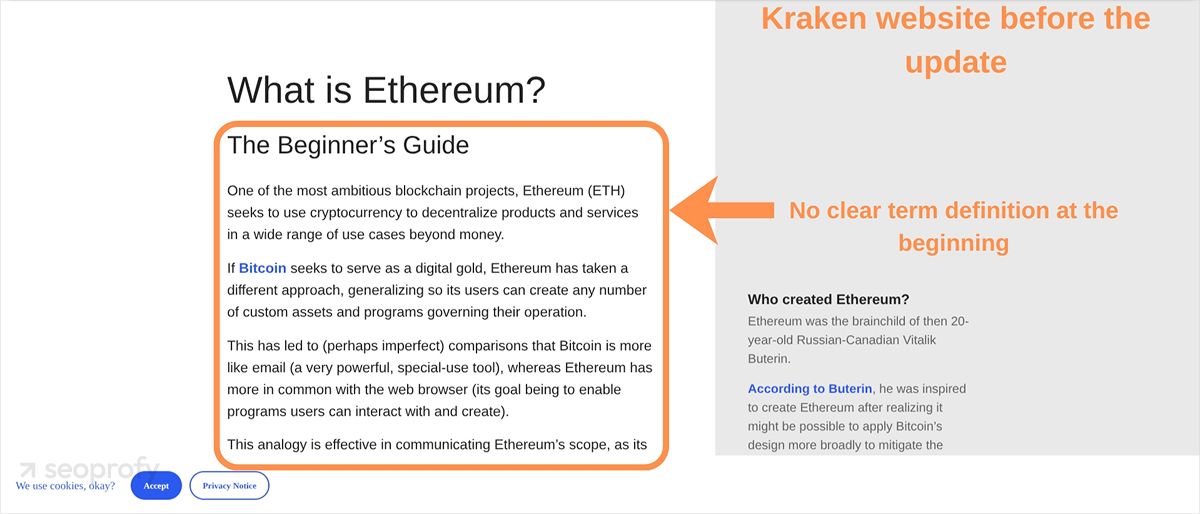
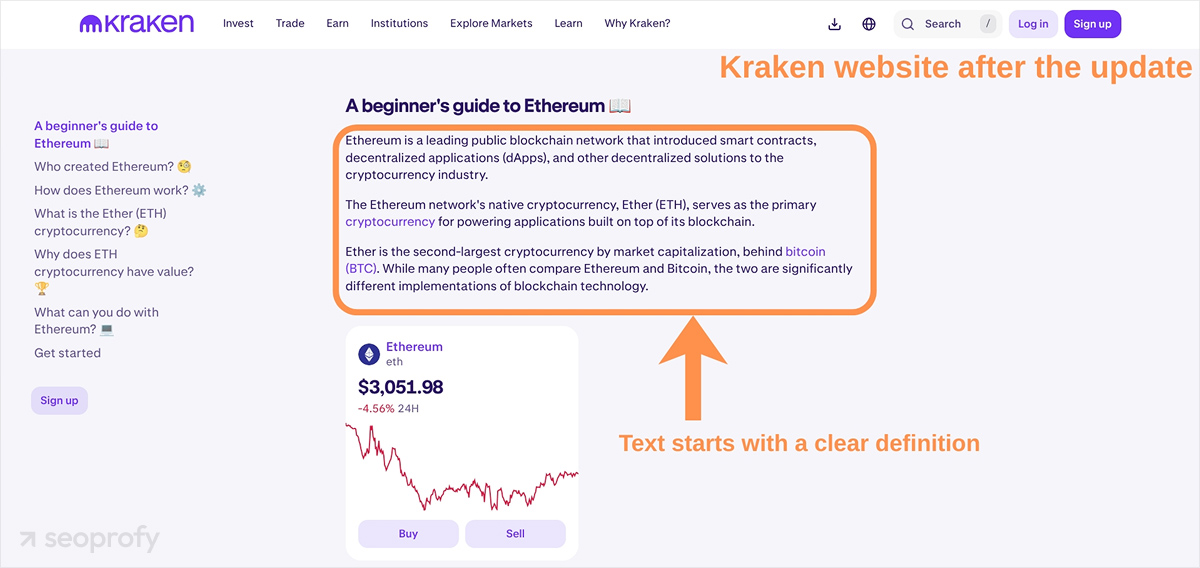
For example, Kraken authors changed the Ethereum guide by improving its structure and making it start with a clear definition instead of common sentences.
Step 3: Optimize for AI Retrieval
Excellent content will only work when backed by a strong tech foundation that relies on smooth crawlability, comprehensive schema markup, and clean, server-side rendered HTML. So, make sure your website is well-optimized for automated retrieval.
- Use or adjust schema markup to refine your structured data configurations and make it easier for AI crawlers to discover your site’s content for real-time answers. You can use schema markup generators and schema.org. plugins like SEOPress for optimization.
- Audit your robots.txt file to ensure you don’t block engines you want citations from. Take your technical optimization a step further and implement an llms.txt file at your root domain to give AI scrapers a direct map of your primary content assets.
- Eliminate live RAG pipeline timeouts and optimize your web page loading speed to be under 2 seconds. Operating within very tight processing windows, retrieval pipelines simply skip web pages that take too long to load or rely on heavy client-side JavaScript rendering. At this point, Topify can help you analyze RAG results.
Additionally, according to Ahrefs, unlike traditional search engines, LLMs opt for fresher content to cite. Thus, it’s essential to regularly update your content to catch up with the latest news, industry trends, and SEO techniques.
Speaking of the latter, to make your way to Google AI Overviews references, you should pair a strong classic SEO approach with real-time content freshness, since about 76% of Google AI Overviews citations come directly from top-10 SERPs. So, basic SEO signals, such as high-quality backlink profiles, solid Core Web Vitals, and keyword intent matching, shouldn’t be overlooked.
Step 4: Strengthen Authority and Brand Mentions
AI platforms don’t evaluate your authority in a vacuum. If your brand lacks visibility in traditional search engines, LLMs won’t even find your content, to say nothing about citing it. So, tried and tested E-E-A-T principles still take the lead when it comes to building and enhancing brand authority.
Building on-page trust
- Transparency: Reveal the techniques and methodology behind your statements. Mention the strategies, testing environments, and data collection tools you’ve used to make your conclusions.
- Real-life expertise: Highlight the author’s qualifications and hands-on niche experience in their bio, along with clickable links to their professional social footprints.
- Validation: If you operate within Your Money or Your Life (YMYL) sectors, such as news, law, medicine, or finances, you should display formal industry certifications, regulatory badges, and official credentials on your pages to match strict AI safety standards.
- Reviews: Maintain a positive brand reputation on Google Business Profile and third-party platforms such as Clutch and Trustpilot. Make sure you have an up-to-date review section on your web pages.
Enhancing off-page authority
Securing strategic placements in trusted third-party publications can increase your citations by a staggering 325%. So, earn valuable brand mentions and build a strong backlink profile using time-tested link building strategies.
- Expert citations and editorial pitches: Share your proprietary data, original statistics, and expert insights so journalists, industry publications, and market researchers quote you. Google Alerts can notify you when someone mentions your brand in a new article.
- Community seeding: Engage with niche groups, relevant forums, specialized platforms and networks to foster real-world conversations around your brand and show your expertise. In 2026, organic brand mentions on Reddit and LinkedIn have become top drivers for AI citations. With Brand24, you can identify and analyze community discussions around your brand.
- Content syndication: Partner with reputable, high-authority media networks (Medium, Substack, and industry news sites) to syndicate your in-depth research reports and whitepapers. Use BuzzSumo to find out who’s writing in your niche.
- Podcasts: Appear as an expert guest on industry podcasts to introduce your brand and embrace multimedia datasets that top-tier LLMs use for training.
Step 5: Monitor, Measure, Update
Monitoring your progress with special AI search monitoring tools, such as Otterly AI, Peec AI, and SemRush AI Visibility Toolkit, is essential to understanding how LLMs respond to your content. Here are the key metrics for LLM citation tracking:
- AI Share of Voice (SoV): The percentage of your brand mentions in AI responses to industry-specific conversational queries.
- Citation rate: It tracks how often LLMs refer to your content in their prompts, with inline citations or embedded hyperlinks.
- Sentiment and narrative accuracy: While checking the tone of the AI answer (positive, negative, or neutral), this metric also evaluates how accurately AI describes your core value proposition.
- Mention position: This tracks your position in the AI output, demonstrating the quality of your AI visibility.
To ensure successful LLM seeding and make your pages a relevant source of information, you should continuously refresh and update your content.
- Monthly reviews: Do monthly diagnostic checks on your high-performing assets and ensure your technical infrastructure is error-free.
- Quarterly updates: Every quarter, update time-sensitive statistics, research, comparative data, tables, and headings to keep them accurate and relevant. Add the “Last Updated” timestamps to show AI algorithms that you actively maintain your content.
- Content pruning: Every 6 to 12 months, depending on your website scope, audit your entire site architecture to review or completely delete low-performing, thin, or outdated web pages that dilute your semantic authority.
How to Measure LLM Citations
The best way to measure citations, assess your current AI visibility, and identify where you fall behind competitors is to use specialized LLM citation tracking tools.
|
Tool |
What it tracks |
Best for |
Pricing |
| Profound |
|
Enterprise-level GEO strategy | From $99/month |
| Peec AI |
|
Mid-sized to enterprise-level brands focused on LLM citation tracking and competitor gap analysis | From $95/month |
| Otterly AI |
|
Small-to-mid-sized businesses testing AI SEO strategies | From $29/month |
| Ahrefs Brand Radar |
|
Combining traditional SEO with AI brand monitoring | From $129/month |
| Semrush AI Toolkit |
|
Teams already using Semrush for SEO and content workflows | From $99/month |
Measuring attribution across AI platforms helps brands understand how often citations provided by LLMs influence visibility, engagement, and future research into AI search behavior.
5 Common LLM SEO Mistakes
As you rush to win a solid place in AI search results, you can make mistakes on the way. Thus, if you rely solely on AI for content creation, disregard user experience, abandon traditional SEO, target only one LLM system, and forget about monitoring, that might reduce LLM citation volume for your brand instead of increasing it.
AI-Only Writing
While you can use AI for research and formatting, fully relying on AI-generated content is a big mistake. The best-performing AI SEO content should be written by humans and for humans first, AI systems second. To make it citation-worthy, prioritize original research, expert opinions, first-hand experience, unique data, and practical examples.
Ignoring User Experience (UX)
Strong machine readability alone won’t work for your AI visibility in the long run if your on-page UX is poor. Both AI and traditional search engines favor content that naturally attracts and holds users. So, take care of your on-page SEO for a consistently positive UX.
Rejecting Classic SEO
LLM SEO doesn’t replace traditional SEO but rather moves it to a new level. Most AI search engines heavily rely on indexed web content, authority signals, backlinks, entity recognition, structured data, and Google-quality ranking systems. Hence, maintaining traditional SEO health is not an option. It’s a base for efficient AI SEO.
Focusing on a Single AI Search Engine
Content that performs well in ChatGPT may fail in Perplexity and Gemini, since different AI systems retrieve and evaluate information differently. To hit broader AI discoverability, you should optimize for multiple platforms, taking into account their specific operational principles.
Lack of Active Monitoring
AI SEO without active tracking is wasting your efforts. AI citations are not a one-time win. They quickly fluctuate, along with AI algorithms and search mechanics. To keep your content citation-ready, you should regularly measure your visibility across AI search environments. In this regard, the professional tracking tools we’ve described above are worth every investment.
Real-World LLM SEO Results: Practical Example
SeoProfy helped a popular finance and trading platform to build AI visibility from scratch, capturing an impressive 11.71% AI traffic share in less than a month. We’ve brought the brand from being invisible to LLMs to strong positions in searches powered by artificial intelligence.
We’ve shifted the content investment from a heavily informational blog to proprietary market data pages; created quotable data blocks; built author entities, E-E-A-T badges, and citations to enhance brand signal infrastructure; and optimized structured data on all market analysis pages.
As a result, the brand showed in 535 AI sessions within less than a month and constantly receives traffic from all major LLMs, including Gemini, ChatGPT, Perplexity, Copilot, and Claude.
Conclusion
LLM citations can help you improve online presence, amplify brand authority, and attract high-intent traffic to your business. So, don’t hesitate to invest in AI optimization to be among the first to reap its benefits.
Given that not all businesses have yet invested in citation optimization, it’s wise to enter this space before it becomes overcrowded. SeoProfy is ready to help you on this exciting journey, starting with a professional SEO AI audit to identify how we can make your site more attractive to LLMs. Our experts will take care of your content, backlinks, and on-page elements to ensure high positions on both traditional search engines and modern AI systems.
Start building your AI search visibility today with our professional AI SEO service.

Bohdan has been an SEO analyst at SeoProfy for more than two years. He began his career in digital marketing in 2019 and has since gained experience helping scale some of the world’s leading brands in industries such as gambling and SaaS. Bohdan specializes in developing effective strategies tailored to specific regions.