
 Add SeoProfy as a preferred source on Google
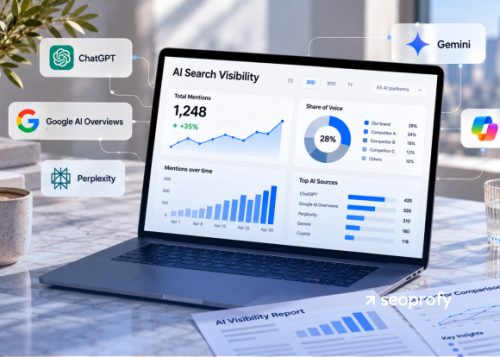
Your brand could appear in dozens of AI-generated answers without earning a single website visit. Traditional rankings and traffic reports won’t show that exposure.


A 2025 Pew Research Center study found that users clicked traditional search results in 8% of visits with a Google AI summary, compared with 15% without one. Links inside summaries received clicks in just 1% of visits.
So, how to measure AI search visibility when clicks tell only part of the story? This guide covers the metrics, calculations, data sources, and reporting process you need to understand your brand’s presence in AI answers.
- It is a good practice to check brand mention rate, AI share of voice, and citation metrics instead of just working with AI rankings.
- Use questions from your customers to build your list of prompts.
- Run each prompt multiple times across platforms to account for variations in AI-generated answers.
- Combine tracking of prompts with reports from Google Search Console, Bing Webmaster Tools, and GA4.
- Use feedback from clients to connect visibility with leads.
What Is AI Search Visibility?
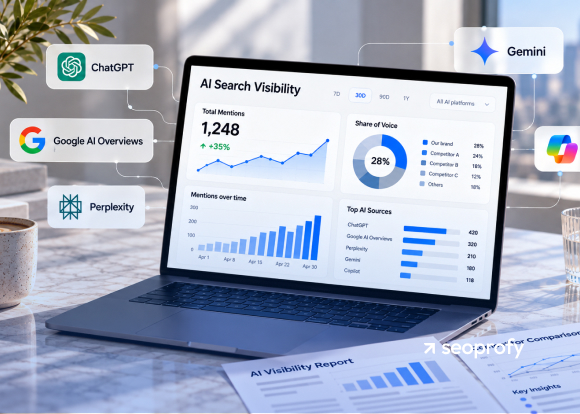
AI search visibility reflects how prominently a brand is represented in answers provided by tools like ChatGPT, Perplexity, Gemini, Claude, Copilot, Google AI Overviews, and AI Mode. It takes into account the frequency of brand mentions, the presence of citations or recommendations, and how the brand is portrayed in responses to questions relevant to its market.
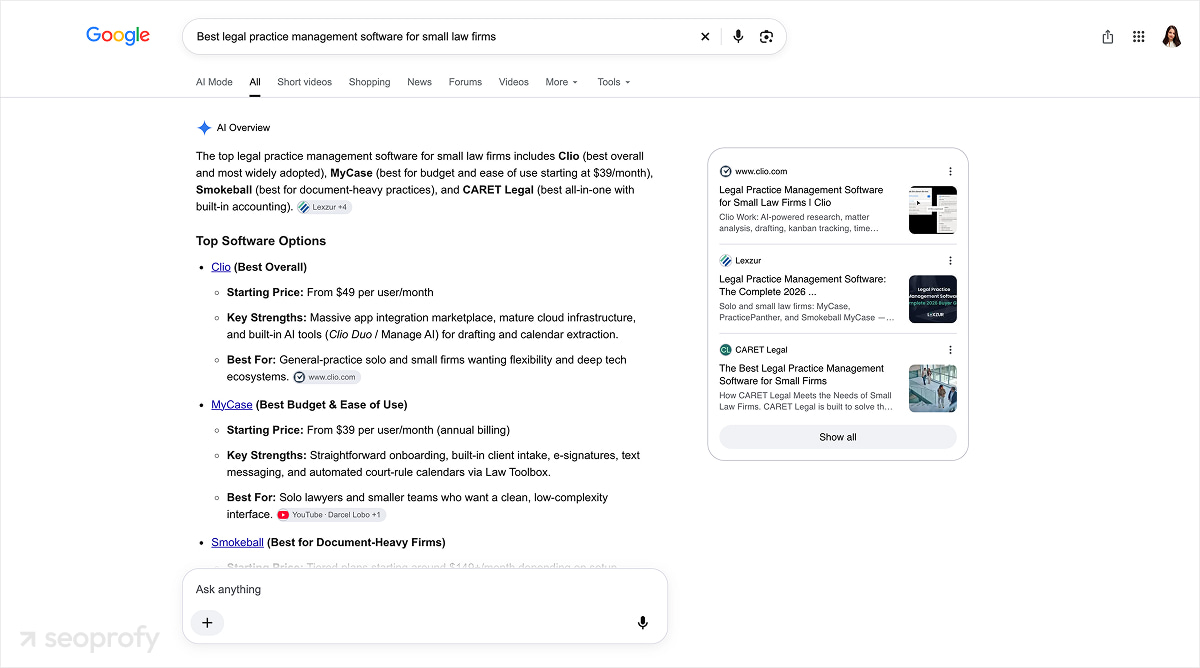
There are two primary methods for AI systems to represent brands in their answers.
- Mentions: This action happens when the AI names a specific brand. For instance, when a user prompts ChatGPT for recommendations on legal practice management tools, it can list Clio.
- Citations: An AI can point to a website or even a particular page as the source. This can happen even when the brand isn’t named.
AI systems may repeatedly recommend a brand without citing its website. Visibility also varies across platforms and depends on the questions users ask. For companies that are competing across several AI search engines, being visible will depend on both the platform and the prompt.
Reports on traditional SEO provide details on how a website ranks, the impressions, and the visits. However, they don’t provide details on brand representation in AI recommendations. An AI can address a user prompt even before the user visits any website. In such cases, there is an increase in brand awareness without a change in the organic traffic of the website.
How AI Search Changes Brand Discovery
AI search changes which brands customers discover and what information influences their decisions. Instead of relying on ranked website lists, AI platforms generate answers using information from multiple sources, including customer reviews, industry publications, and comparison articles.
This gives third-party content a greater role in brand discovery. For example, someone asking ChatGPT to compare project management tools might discover vendors they hadn’t considered before. Reviews and independent recommendations can influence which companies appear in the response.
AI recommendations can also drive branded searches. After discovering a company through an AI-generated answer, a potential customer might search for its name on Google to check pricing or reviews. Analytics would attribute that visit to organic search, even though the initial discovery happened through AI.
Businesses should therefore monitor brand mentions, citations, and branded search trends alongside website traffic. Together, these signals can help identify changes in brand exposure, although they cannot prove that AI recommendations directly caused conversions.
What Influences Brand Visibility in AI Search?
A brand’s AI presence depends on more than its website rankings. AI search platforms evaluate information from multiple sources, while AI models use different retrieval methods to generate responses. As a result, AI mentions can vary across AI engines, even for identical queries.
Several factors influence how brands appear in AI outputs:
- Content accessibility and relevance: Search systems need to discover and interpret your pages. Strong technical foundations and traditional SEO metrics remain important, particularly when AI-generated summaries draw from indexed content.
- Third-party credibility: Reviews, industry publications, and comparison pages can influence recommendations from AI chatbots and other search tools. Consistent information across these sources supports answer engine optimization.
- Query intent and context: AI-driven search responds to specific questions rather than keywords alone. A brand might appear in product comparisons but remain absent from broader industry discussions.
- Competitive exposure: Tracking AI SOV helps identify how frequently your brand appears relative to competitors across relevant prompts.
These factors also affect AI visibility measurement. With zero-click search, growing brand exposure may not translate directly into AI traffic. Businesses can monitor brand search lift alongside mention rates and citations to identify possible changes in awareness, although branded search growth alone cannot establish causation.
Key AI Search Visibility Metrics to Track
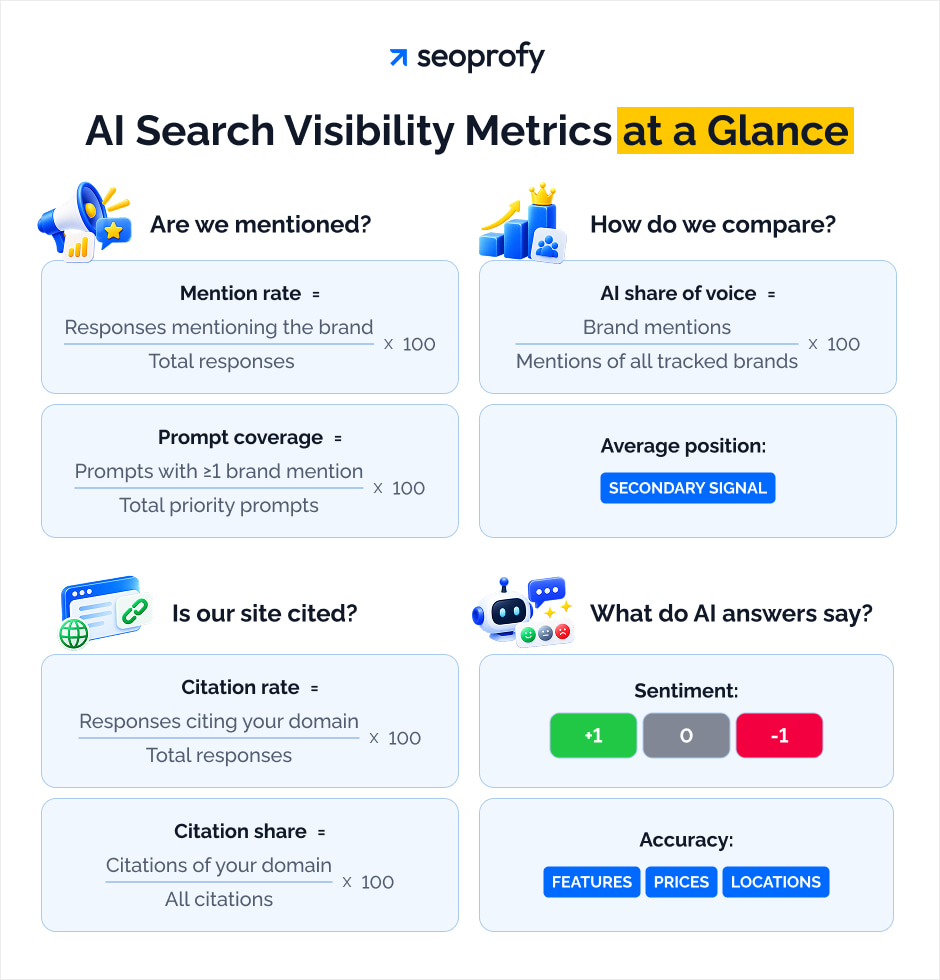
The following AI visibility metrics use the same fixed set of customer prompts, which you’ll build in Step 1.
Mention Rate (AI Visibility Score)
Mention rate shows how frequently a brand appears in AI responses to selected prompts.
Mention rate = (Responses mentioning the brand / Total responses) × 100
For example, you test 20 different prompts, repeating each one three times. Across the 60 AI-generated answers, your brand is mentioned 18 times.
Your mention rate is 30%.
A lot of monitoring services look at the mention rate when they want to measure AI visibility. However, they can have different ways of counting AI presence.
Calculate mention rate separately for ChatGPT, Google AI Mode, and other platforms to identify differences in brand exposure. If we try to summarize everything, we will lose important details.
For example, a brand could regularly appear in responses produced by Google, but it could rarely appear in ChatGPT responses.
Keep the same set of prompts over time. Here, the dynamics of mention rates over a while are more beneficial than a separate score.
AI Share of Voice
AI share of voice shows how much of the visibility within AI-generated responses belongs to your brand versus its competitors. By comparing brand appearances across relevant queries, you can see which companies dominate AI recommendations and how far ahead or behind your business stands.
AI share of voice = (Brand mentions / Mentions of all tracked brands) × 100
For reliable comparisons, track three to five direct competitors and keep the same group over time.
For example, Ahrefs Brand Radar compares Clio with MyCase, PracticePanther, Smokeball, and Filevine in the US legal software market. As of October 21, 2026, Clio led with 63.3% of the tracked AI visibility, followed by MyCase at 36.8%. In ChatGPT, their respective shares were 53.2% and 46.6%, while Google AI Overviews showed a wider gap: 95.4% versus 5.7%.
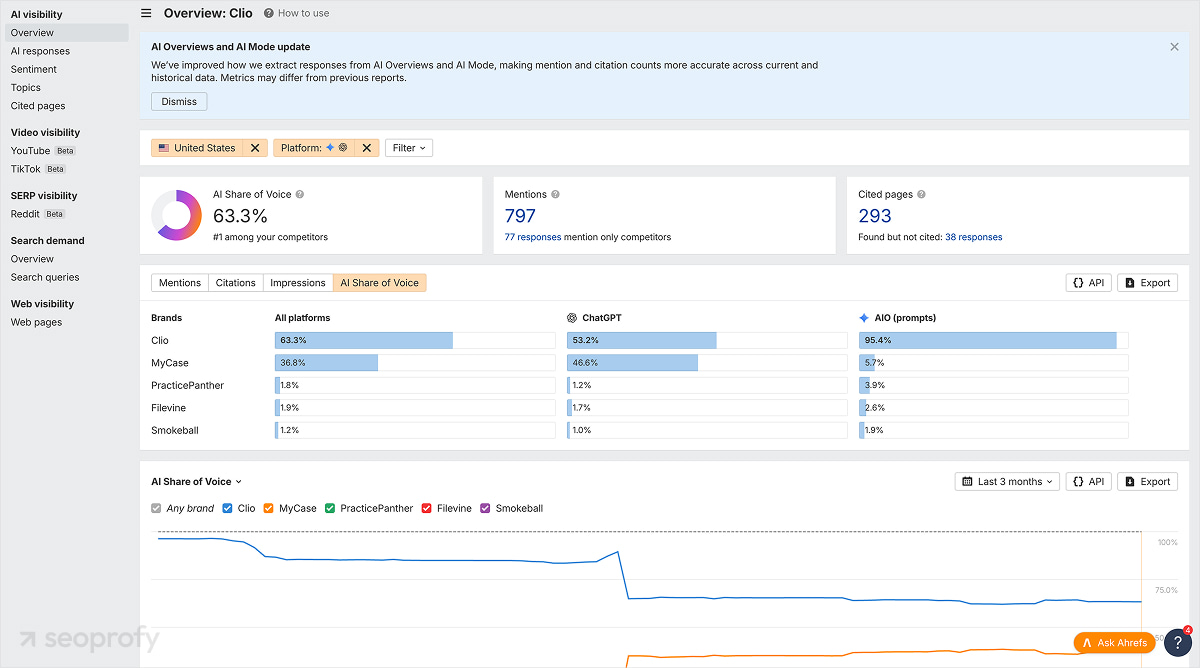
These figures cover the last three months and reflect Ahrefs’ tracking methodology.
Results may differ between platforms. For example, a comparison of Perplexity vs ChatGPT shows why AI search experiences should be evaluated separately.
Monitoring tools also calculate share of voice differently, so their percentages aren’t directly comparable. Use the same tool, competitors, and methodology when tracking changes over time.
Citations, Sentiment, and Answer Accuracy
AI brand mentions tell you whether the system recognizes your company. Citations reveal where it gets the information used in its answers.
Two calculations help evaluate citation visibility:
Citation rate = (Responses citing your domain / Total responses) × 100
Citation share = (Citations of your domain / All citations in tracked responses) × 100
Consider a SaaS company mentioned in 70% of answers but cited in only 15%.
The AI recognizes the company, yet it frequently supports its recommendations with other websites.
Such sources may consist of various platforms for software reviews, publications within the same industry, and pages comparing competitor businesses. Include third-party articles that mention your brand in your analysis, along with sources that refer to your site.
In addition to the identified criteria, you must evaluate each response according to two other criteria:
- Sentiment: Score each response as positive (+1) when it recommends or praises your brand, neutral (0) when it presents information without judgment, or negative (−1) when it highlights drawbacks or criticism.
- Answer accuracy: Verify whether AI provides correct information about your prices, features, services, locations, and other important business details.
Maintain a running log of inaccurate claims, recording the platform, prompt, incorrect statement, and cited source. Use it to prioritize corrections on your website and relevant third-party profiles.
Prompt Coverage and Average Position
Prompt coverage measures how many priority questions produce at least one brand mention.
Prompt coverage = (Prompts with at least one brand mention / Total priority prompts) × 100
Segment prompts by funnel stage: problem research, product comparison, and vendor selection.
A brand might appear regularly in vendor comparisons but rarely when users first research the problem.
Average position measures where the brand appears in ranked AI recommendations. Yet positions change frequently.
In a January 2026 SparkToro and Gumshoe.ai study, the probability of receiving the same brand list twice was under 1 in 100. The same ordering appeared roughly once in 1,000 comparisons.
Treat average position as a secondary measure.
A brand appearing in four of five responses gives you a more useful signal than its position in one answer.
How to Measure AI Search Visibility in 4 Steps
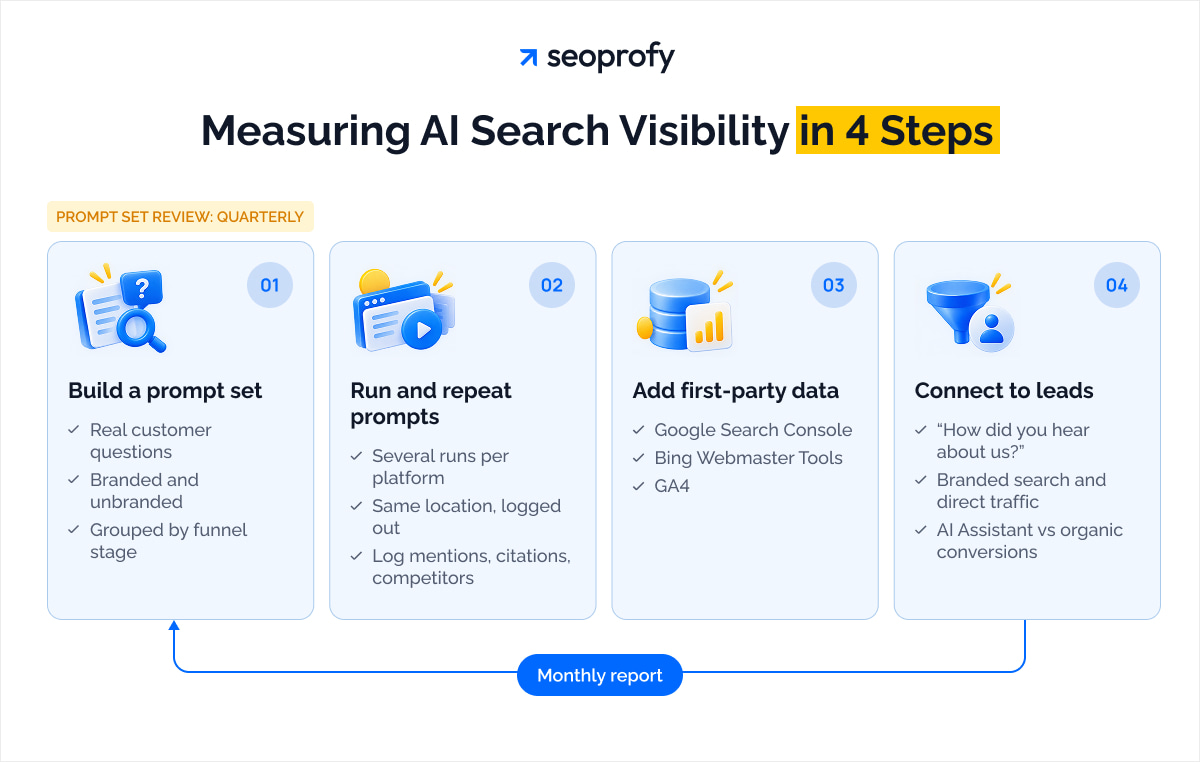
You can track your brand’s presence in AI-generated answers without a complex analytics setup. The following four steps help you turn key AI visibility metrics into a consistent monthly report.
Step 1: Build a Prompt Set From Real Customer Questions
Start with questions people ask before choosing your product or service.
Useful sources include sales calls, support conversations, onboarding records, on-site searches, Google People Also Ask, and long Search Console queries of six or more words.
Group prompts into branded and unbranded categories, then organize them by funnel stage.
For example, a B2B software company might track:
- Problem research: “How can a 30-person sales team reduce manual CRM reporting?”
- Comparison: “Which CRM platforms work best for a mid-sized B2B SaaS company?”
- Vendor selection: “Is HubSpot or Salesforce better for a company with a $2,000 monthly budget?”
Add elements like company dimensions, sector, financial resource allocation, and geographical location. Such factors take inquiries closer to real conversations with prospects.
Do not depend only on automated suggestions generated by tools since some tools gather ideas from existing pages and miss points with intense competition.
Review your prompt set quarterly, but keep it unchanged between reviews to ensure consistent comparisons over time.
Step 2: Run Prompts Across AI Platforms and Repeat Them
If you’re wondering how to track brand mentions in AI search, start by running the same customer prompts across your selected platforms. Repeat each prompt several times and record whether your brand appears, which competitors are mentioned, and what sources AI cites.
Choose platforms based on your audience rather than tracking every available assistant.
Consider Google AI Overviews, AI Mode, ChatGPT, Perplexity, Gemini, Copilot, and Claude. B2B buyers and consumers may use different combinations.
For smaller projects, a spreadsheet with these columns is recommended:
| Field | What to Record |
| Prompt | Exact question submitted |
| Platform | AI assistant or search feature |
| Date | When the response appeared |
| Brand mentioned | Yes or no |
| Position | Position in a ranked answer, if applicable |
| Cited URLs | Sources linked in the answer |
| Sentiment | Positive, neutral, or negative |
| Competitors named | Other relevant brands mentioned |
Use consistent locations and logged-out sessions where possible to reduce personalization.
Calculate how often your brand appears across repeated runs rather than treating one response as a permanent ranking.
Step 3: Add First-Party Data From Search Console, Bing, and GA4
Prompt monitoring estimates visibility across a selected sample. First-party reporting adds observed data from supported platforms.
| Source | What It Shows | Limits |
| Google Search Console Generative AI reports | Impressions for pages appearing in AI Overviews, AI Mode, and generative AI features in Discover, with page, country, device, and date breakdowns where available. | Covers Google surfaces and currently provides impression-focused reporting, not complete brand mention tracking. |
| Bing Webmaster Tools AI Performance | Citations across Microsoft Copilot, Bing AI summaries, and selected partner experiences, including cited pages and grounding queries. | Covers supported Microsoft experiences; citation counts don’t establish ranking or prominence. |
| GA4 AI Assistant channel | Sessions referred by recognized assistants, including ChatGPT, Gemini, and Claude, using the AI-assistant medium. | Tracks identifiable referred visits, not all exposure or visits without a recognized referrer. |
Google introduced its dedicated Generative AI reports on June 3, 2026, and completed the worldwide rollout on August 31, 2026.
Microsoft launched its AI Performance public preview on February 10, 2026.
Google also added its AI Assistant channel in May 2026.
These tools provide useful first-party signals, but none gives a complete account of every brand mention across all AI platforms.
Use them alongside prompt tracking, not as a replacement.
Step 4: Connect AI Visibility to Leads and Revenue
Visibility matters when it contributes to business outcomes.
To connect AI exposure with revenue, start with three measurements.
1. Ask customers where they found you
Add a “How did you hear about us?” question to lead and signup forms, including an AI assistant option. Pass the answer into your CRM.
Self-reported attribution depends on customer memory, but it captures discovery journeys that analytics may miss.
2. Monitor branded search and direct traffic
Look for increases in branded Search Console impressions and direct sessions after sustained visibility improvements. Treat these as supporting signals, not proof of causation.
3. Compare conversion performance
Measure the conversion rate of GA4 AI Assistant sessions against organic search traffic.
Use the same conversion definitions and reporting period.
For a broader financial view, connect these findings with your SEO ROI reporting to understand whether additional brand exposure accompanies qualified leads and revenue.
Knowing your current AI search visibility is the first step toward improving it. SeoProfy helps you understand how your brand appears in AI-generated answers, identify gaps against competitors, and develop an AI SEO strategy to strengthen your visibility and reach potential customers.
Tools for Tracking AI Search Visibility
There are three practical approaches to measuring brand exposure in AI-generated answers.
- Free first-party tools include Google Search Console, Bing Webmaster Tools, and GA4. They help validate impressions, citations, and referred traffic.
- Dedicated AI visibility tracking platforms, including Semrush AI Visibility Toolkit, Ahrefs Brand Radar, and SE Ranking AI Search Toolkit, automate prompt monitoring and competitor comparisons. They help identify changes in brand exposure without requiring repeated manual searches.
- Manual testing works for smaller prompt sets but becomes difficult to maintain at scale.
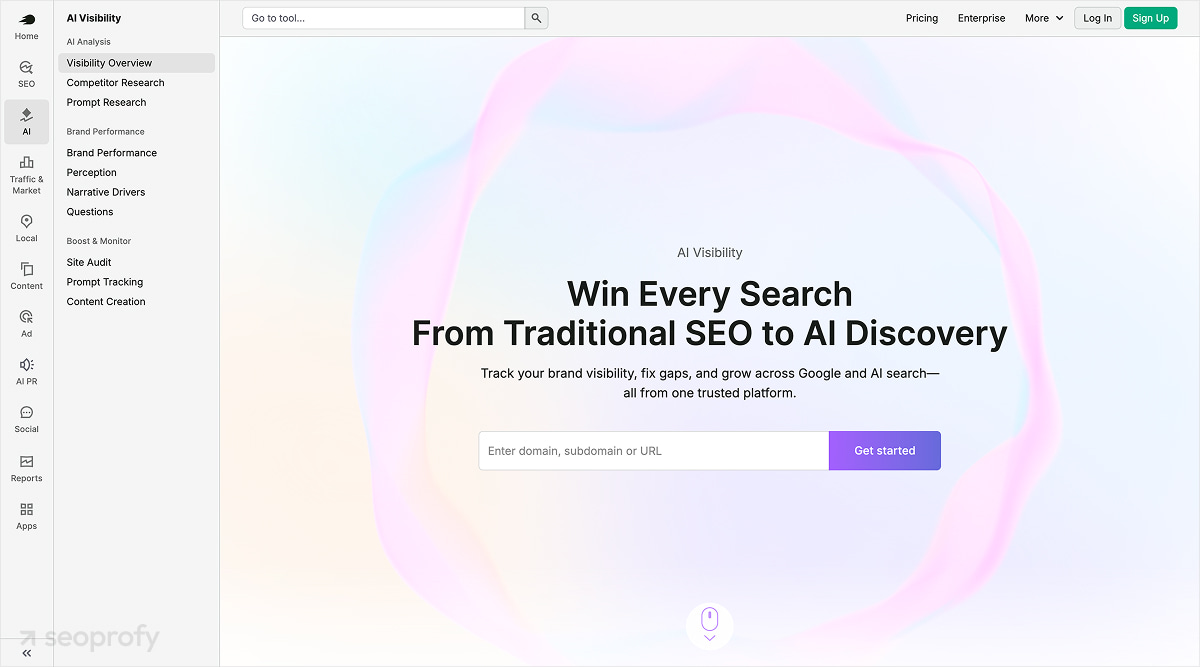
When evaluating AI search monitoring tools, compare the supported platforms, custom prompt options, run frequency, competitor tracking, and export or API capabilities.
Remember that third-party visibility scores generally come from sampled prompts rather than complete records of actual user interactions.
Use them to assess trends and competitive gaps, not as exact measures of audience exposure.
How to Report AI Search Visibility
A useful report distinguishes visibility KPIs from supporting diagnostics and measurable business outcomes.
| Metric | Use As | How Often to Check |
| AI share of voice | KPI | Monthly |
| Mention rate by platform | KPI | Monthly |
| Citation share | KPI | Monthly |
| Sentiment and accuracy issues | Monitor | Monthly |
| AI Assistant sessions and AI-sourced leads | Business result | Weekly check, monthly report |
| Search Console AI impressions | Monitor | Weekly |
Focus on trends over at least three months rather than reacting to individual fluctuations in performance.
Keep the prompt set consistent between quarterly reviews and report AI findings next to traditional SEO performance indicators.
The reports should provide answers to two questions: What has changed since the last observation, and what is the plan from now on?
For additional market context, AI SEO statistics can help explain broader changes in search behavior. Keep these separate from your company’s measured results.
Frequently Asked Questions
What Is a Good AI Visibility Score?
There is no universal benchmark for a good rating. It depends on your industry, competitors, platforms, and tracked prompts. Compare your score with direct competitors and monitor changes over time using the same measurement method.
Why Does AI Visibility Differ Between ChatGPT and Google AI Mode?
AI visibility differs because ChatGPT and Google AI Mode use different models, information sources, and retrieval methods. Their answers also vary depending on the prompt, location, and context, so the same brand may appear more frequently on one platform.
How Often Should You Check AI Search Visibility?
Check AI search visibility monthly to identify meaningful trends and compare performance against competitors. Weekly monitoring can help spot sudden changes, while quarterly reviews allow you to update tracked prompts without disrupting the consistency of historical reporting.
Can You See ChatGPT Visibility in Google Search Console?
No, Google Search Console doesn’t report AI brand mentions or recommendations within ChatGPT. It provides data from Google’s own search features. To measure AI visibility in ChatGPT, you need a dedicated monitoring tool or repeated manual prompt checks.
Does AI Search Visibility Replace SEO?
No, AI search visibility complements traditional SEO rather than replacing it. AI-powered search features such as Google AI Overviews use information from Google’s search index to generate answers, making crawlability, indexability, and content quality essential. Strong SEO foundations help search engines discover and understand your content, while AI visibility tracking shows how often your brand appears in generated responses.
Next Steps for Measuring AI Search Visibility
No tool can measure a brand’s presence in AI-generated answers with the same consistency as traditional search rankings. Responses vary between runs, not every interaction leads to a click, and platforms provide different levels of reporting.
Nevertheless, a fixed prompt collection used on a repeat basis, along with first-hand data collection, provides a fairly accurate picture of brand visibility.
The objective is not to search for individual AI responses but rather to see whether your brand is becoming more visible to the right audience.
So, start measuring as soon as possible this month following a consistent methodology. Record the actions undertaken to compare the results in three months’ time.

Julia Lubianytska is a Copywriting Team Lead at SeoProfy with over 7 years of experience in copywriting and editing. She works closely with copywriting teams, helping writers craft clear and thoughtful content for SaaS products, IT services, and businesses in the legal and medical fields. Julia enjoys turning complex topics into easy-to-understand, trustworthy content, focusing on structure, clarity, and consistency to ensure the content is genuinely helpful for real people, not just search engines.