
 Add SeoProfy as a preferred source on Google

Generative search engines recommend only a handful of brands in their AI answers. Strong Google rankings alone do not guarantee a place in those recommendations.


That matters as fewer users click through search results. According to Pew Research Center’s 2025 study, users clicked traditional results in 8% of visits when an AI summary appeared, compared with 15% when it didn’t.
AI trust signals can help AI systems assess your brand’s credibility when selecting sources and recommendations. But which signals have actual evidence behind them?
This guide explains how AI trust signals work, which ones matter, and what you can do to strengthen your brand’s presence in AI-generated answers.
- AI trust signals help search systems assess brand credibility when selecting sources and recommendations. There is no official checklist.
- Google identifies trust as the most important element of E-E-A-T, and its AI features rely on existing search quality systems.
- These trust signals fall into four groups: entity and identity, content and expertise, third-party reputation, and technical accessibility.
- Evidence varies. Some practices are documented by AI search engines, while others rely on correlations or industry assumptions.
- Measure AI visibility through repeated prompt testing and first-party search data rather than individual AI-generated answers.
What Are AI Trust Signals?
AI trust signals are indicators that help AI systems assess whether a brand or website is a credible source of information. They include identifiable authors, verifiable business details, credible external sources, and evidence supporting a company’s claims.
Google has no published checklist of AI trust signals. The term is used in SEO to describe information that may influence how search systems evaluate sources and select brands to mention. The specific factors behind recommendations from AI models remain largely undisclosed.
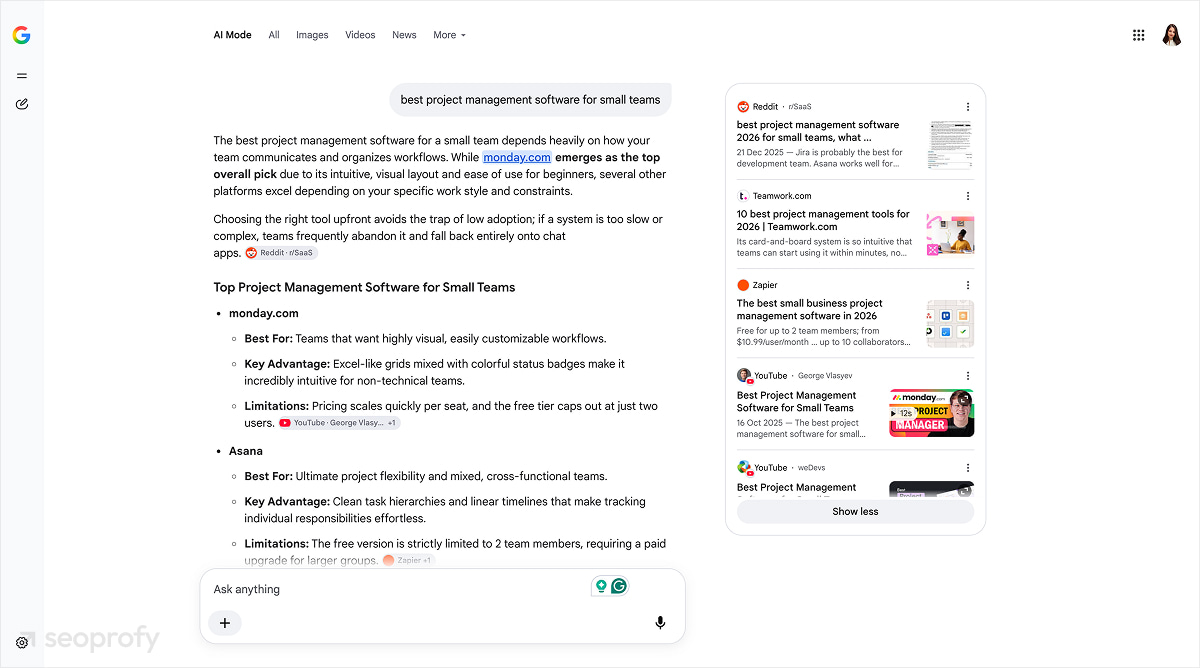
Consider a buyer searching for the best project management software for small teams. Google AI Mode may recommend tools like monday.com and Asana while citing Reddit discussions, comparison articles from Teamwork and Zapier, and YouTube reviews. These sources offer different proof points, from product features and comparisons to real user experiences.
AI Trust Signals vs. E-E-A-T and Traditional Trust Signals
AI trust signals overlap with established website credibility practices, authority signals, and Google’s E-E-A-T principles: Experience, Expertise, Authoritativeness, and Trustworthiness. The distinction lies in how that evidence is evaluated and used.
| Aspect | Traditional Website Trust Signals | E-E-A-T | AI Trust Signals |
| Who judges it? | Website visitors | Google’s search systems | AI search and retrieval systems |
| What it’s used for | Assessing whether a business is credible | Evaluating content quality and reliability | Informing source selection and brand references |
| What you control | Reviews, policies, visible credentials | Content, authorship, supporting evidence | Website information and accessibility, but limited control over external sources |
E-E-A-T provides a useful reference for assessing credibility, although Google does not treat it as a single, measurable ranking factor.
According to Google Search Central, trust is the most important component of E-E-A-T. Experience and expertise contribute to credibility, but neither compensates for unreliable information.
Google also confirms that AI Overviews and AI Mode rely on its existing search ranking and quality systems. There is no documented, separate set of AI trust signals governing these features.
It follows, therefore, that existing credibility evidence has relevance for AI search and can assist in explaining why a brand is worthy of consideration. However, AI-generated answers may also draw on independent sources, thus making a brand’s reputation more meaningful.
Where AI Search Engines Get Their Trust Evidence
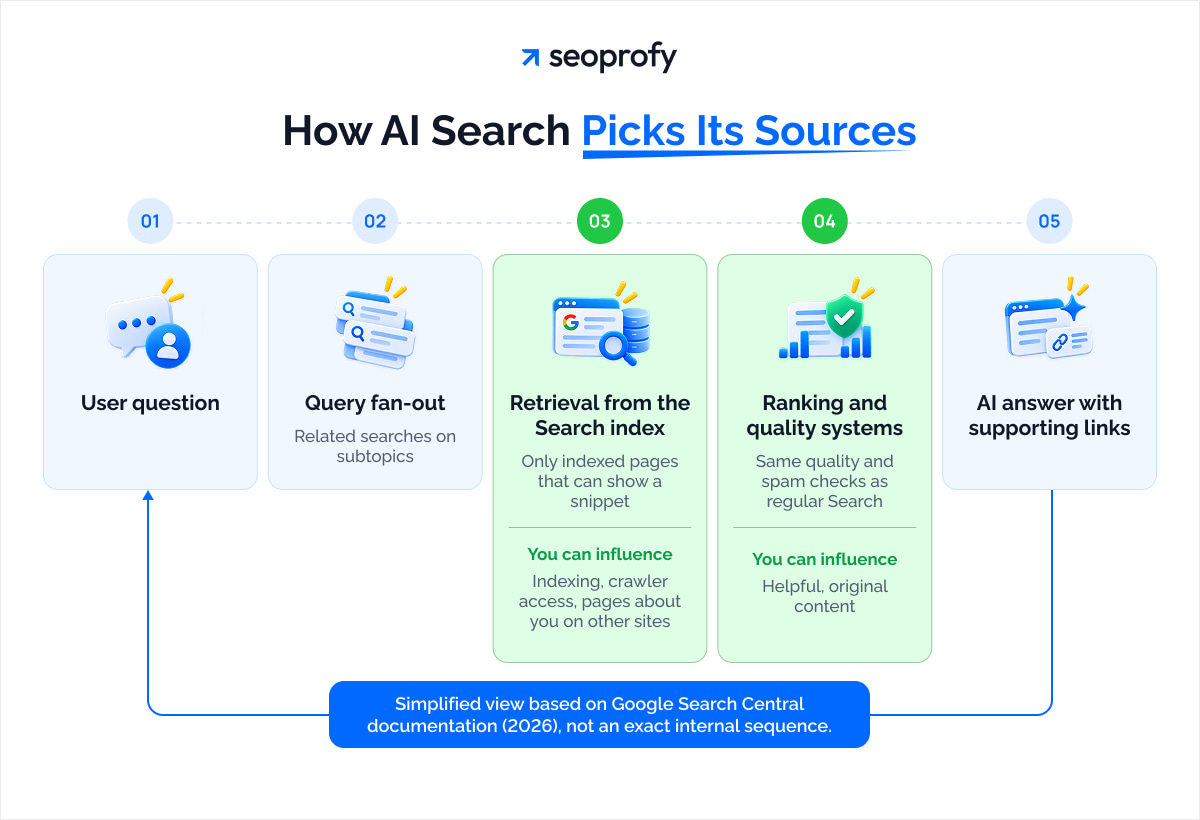
Google’s AI Overviews and AI Mode draw on the same search index that supports traditional results. According to Google Search Central’s 2026 guidance, a page must be indexed and eligible to display a search snippet before it can appear as a supporting link in either feature. Meeting those requirements makes a page eligible, although inclusion is never guaranteed.
In addition to query suggestions, AI Mode uses a related technique called query fan-out. It initiates multiple related searches to capture more data to provide a better answer. While researching accounting software, a search may pull data related to pricing, integrations, and/or user reviews to provide a better answer.
The retrieved material gives AI systems information they can use when assembling an answer.
Google has not disclosed how individual AI trust signals influence source selection, making claims about universal AI trust scores difficult to substantiate. In addition, why one brand receives a citation and another doesn’t is unclear. Given these factors, it is wise to approach universal claims about AI trust scores with caution.
Evidence of a brand’s reputation also exists outside its owned properties, including social platforms and third-party publications. Google states that its AI can reflect user discussions of products and/or services found in user-generated content, such as videos and blog posts. Google’s recommendations still prohibit undesirable brand mentions, as the existing ranking and spam systems still apply.
Types of AI Trust Signals and How to Build Them
Despite publishing accurate content, a company may still leave search engines with questions about who wrote it, whether the business is legitimate, and how its assertions compare with independent sources. To be useful in assessing these issues, AI credibility signals should be classified into four categories:
- Entity and identity: consistent information about the company, presence in the public space, background of its employees, and company record.
- Content and expertise: named authors, original research, demonstrated experience, and references to credible external sources.
- Reputation in the eyes of others: authoritative mentions in earned media, customer reviews, and relevant editorial backlinks.
- Technical and UX: technical SEO fundamentals such as indexing, crawler permissions, accessible HTML, and usability across devices.
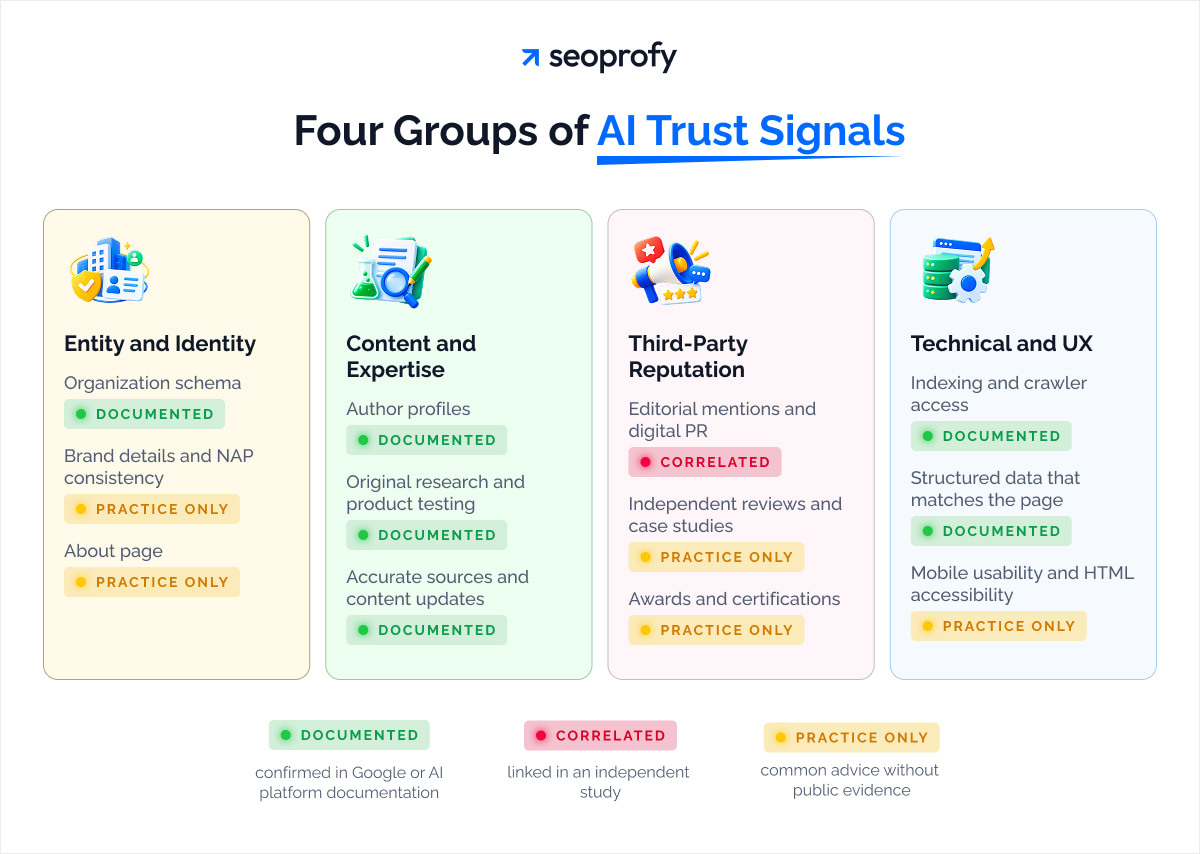
The evidence supporting these practices varies considerably. We will clarify the various types of signals used, such as signals documented in search platform instructions, correlated indicators, which are tied to AI exposure in scientific literature, and practices that aren’t proven to have any effect on AI recommendations. These classifications allow us to identify the limitations that exist and to determine which remedies deserve priority.
Entity and Identity Signals
A company should be identifiable across its website, official profiles, and business listings. Conflicting names, outdated addresses, or missing ownership information make it harder to establish which sources refer to the same organization.
Several practices can improve that consistency:
- Organization schema: Add Organization markup to the homepage, including the official name, logo, website URL, and sameAs links to verified profiles. Check the implementation with Google’s Schema Markup Validator.
- Consistent brand identity: Use the same company name, logo, and business description across your website and major profiles. Review discrepancies manually.
- Company information: Maintain an About page identifying the business, its leadership, and relevant team members. Link to genuine professional profiles where appropriate.
- Business listings: Keep your Google Business Profile accurate. Check name, address, and phone details for NAP consistency, particularly when operating across multiple locations.
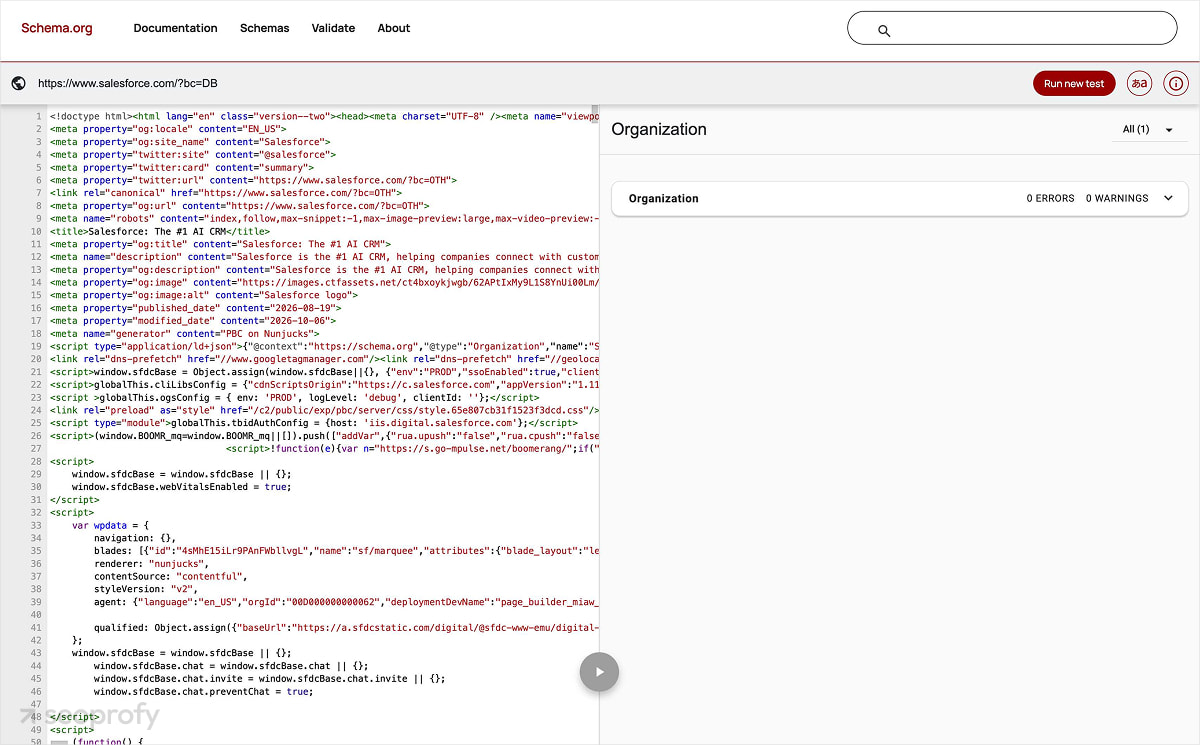
Google documents the organization schema as a way to help its systems understand and distinguish organizations. Accurate structured data helps Google distinguish a business from similarly named organizations, but it cannot compensate for inconsistent information elsewhere.
These practices address identifiable information gaps. Their individual effects on AI trust signals and AI visibility have not been established.
Content and Expertise Signals
An author bio provides little evidence of topical authority if the article itself contains nothing beyond information already available elsewhere. Google’s helpful content guidance asks whether material demonstrates first-hand knowledge, identifies its creator, and gives readers reason to trust its claims.
SEO teams can address these questions through several practical changes:
- Name the author and link to a profile explaining their relevant experience. Credentials should be specific and verifiable.
- Publish original research, product tests, annotated screenshots, or client examples with enough detail to examine the findings. Organize related resources in an educational content hub when it helps readers explore a subject in depth.
- Support factual claims with primary sources. Check that cited research actually supports the statement.
- Display an accurate last-updated date when substantive revisions have been made. Changing the date without updating the content provides no additional evidence.
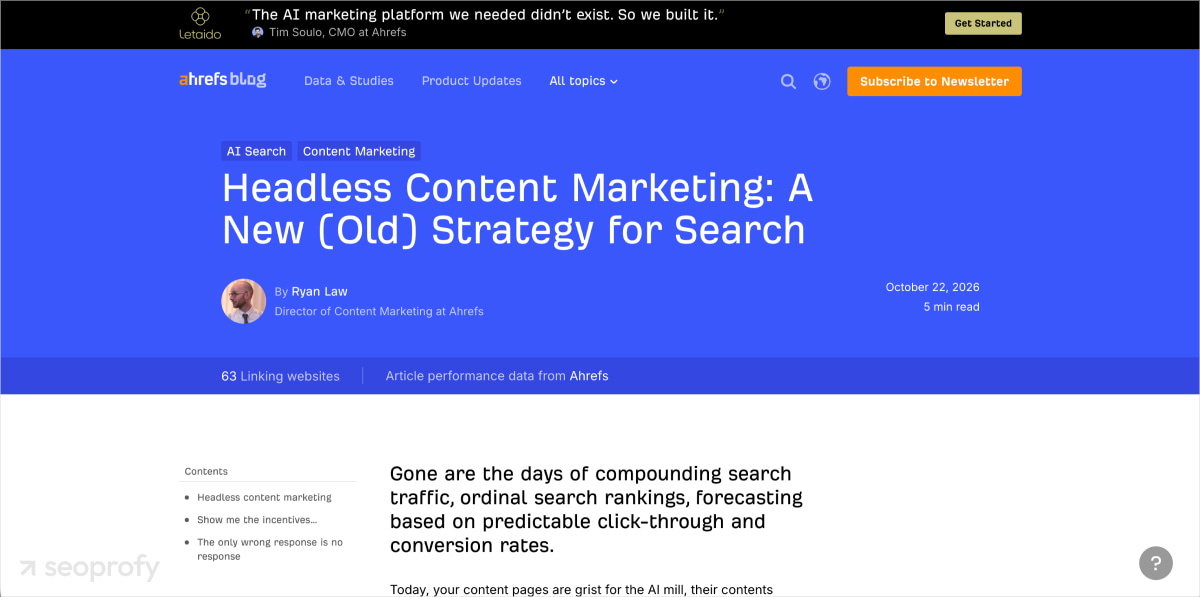
These practices also support efforts to earn LLM citations (large language models), particularly when a page offers evidence that other sources cannot easily reproduce.
Google emphasizes original, useful content and says publishers don’t need to restructure articles specifically for AI features. Clear headings and readable explanations remain sensible editorial choices.
These trust signals make expertise easier to assess, although their effect on individual citations cannot be measured reliably.
Third-Party Reputation Signals
A company’s own website offers limited evidence of its reputation. Independent coverage provides another perspective, particularly when publications discuss the brand’s products, expertise, or customer experience.
In a 2025 study of 75,000 brands, Ahrefs found that web mentions had the strongest correlation with brand visibility in Google AI Overviews (0.664). This suggests that brands mentioned more frequently across the web also tend to appear more often in AI Overviews.
However, the findings show correlation, not causation, and do not prove that increasing web mentions directly improves AI visibility. Ahrefs also offers Brand Radar, a tool designed to track brand visibility across AI search platforms.
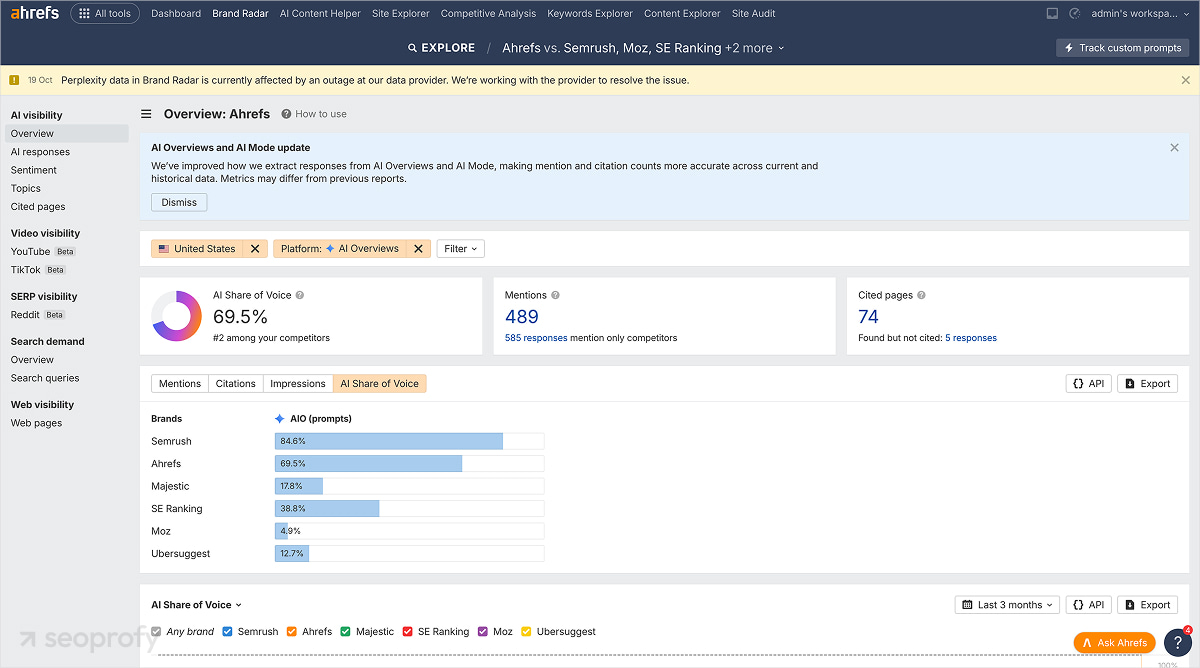
To develop credible AI trust signals beyond your website, consider:
- Earning authoritative mentions through relevant industry publications, podcasts, and professional communities.
- Collecting genuine customer reviews on independent platforms.
- Using digital PR to publish research and secure earned media coverage and editorial backlinks.
- Documenting verifiable awards, professional certifications, and client results.
- Publishing case studies with named clients and measurable outcomes, where permission allows.
Reviews, awards, and case studies are reasonable credibility practices, but their direct effects on AI search visibility remain unproven.
Google also warns against seeking inauthentic trusted brand mentions. Manufactured endorsements may create spam risks without improving how search systems assess a business.
Technical and UX Signals
Even well-researched content has limited AI visibility in tools if retrieval systems cannot access it. After checking Google’s indexing and snippet requirements, examine crawler permissions, server responses, and how the page renders.
Start with robots.txt and firewall rules. AI services use different bots for search, model training, and user-requested access.
| Bot | Owner | Used For | If Blocked |
| OAI-SearchBot | OpenAI | ChatGPT search results | Pages won’t appear as search results, though navigational links remain possible |
| GPTBot | OpenAI | Model training | Signals exclusion from training, without independently blocking ChatGPT search |
| PerplexityBot | Perplexity | Discovering and linking pages in Perplexity | Prevents crawling through this bot |
| ChatGPT-User / Perplexity-User | OpenAI / Perplexity | User-requested page access | robots.txt restrictions may not apply |
Check that structured data remains accessible to search crawlers and accurately reflects information visible on the page.
AI crawler access audit for SeoProfy, showing robots.txt permissions and successful page retrieval by selected AI crawlers. Source: AI Crawler Checker, October 26, 2026.
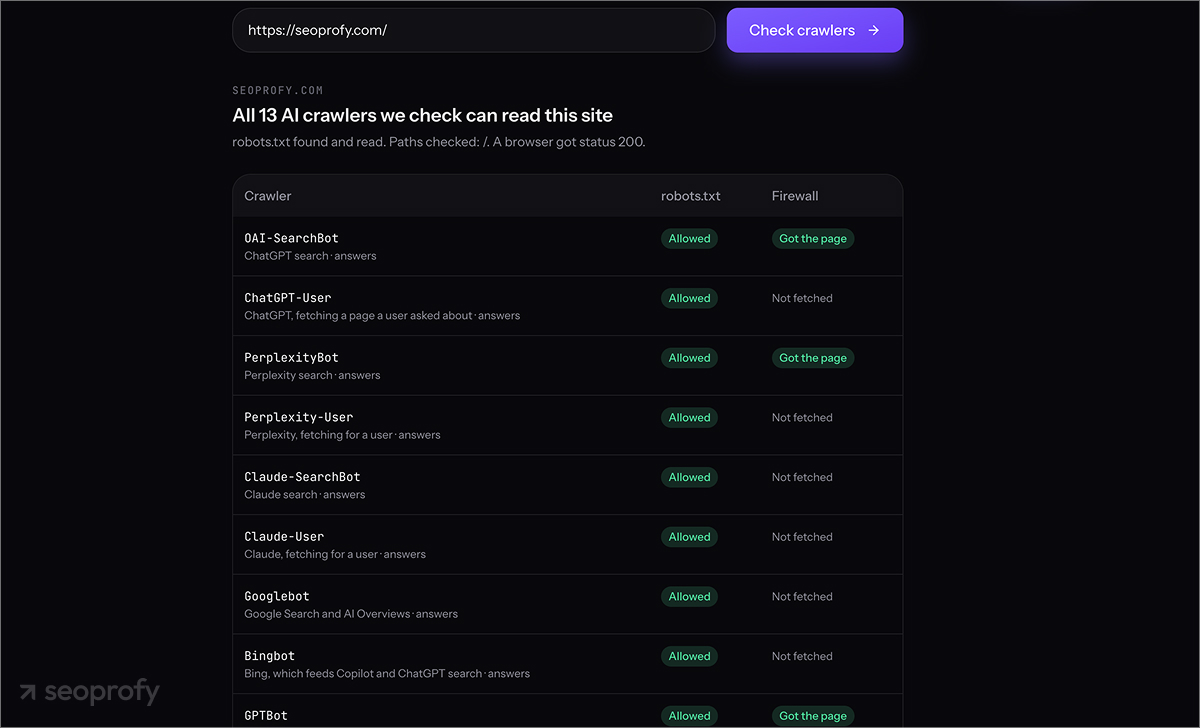
Review your server logs and firewall settings for unintended blocks. Key content should be available in accessible HTML rather than client-side scripts. Test your key pages on both mobile and desktop devices.
Google states that special AI markup and llms.txt files are not necessary for its generative search features.
These are documented accessibility requirements and technical SEO practices. They are unable to guarantee citations, but not resolving access issues can prevent users from retrieving otherwise helpful content.
Which AI Trust Signals to Prioritize First
Some AI trust signals offer quick wins and take only minutes to verify. Others, particularly independent media coverage and original research, require sustained effort. Start with problems that prevent search platforms from accessing or identifying your business, then address gaps in content and reputation.
| Signal | Effort | When to Do It |
| Indexing and crawler access | Low | Immediately |
| Brand details and NAP consistency | Low | First month |
| About page and author profiles | Low | First month |
| Organization schema | Low | First month |
| Accurate sources and content updates | Medium | First month, then ongoing |
| Mobile usability and HTML accessibility | Medium | First month |
| Independent reviews and case studies | Medium | Ongoing |
| Original research and product testing | High | Long-term |
| Editorial mentions and digital PR | High | Long-term |
In the first month, focus on quick fixes for clear weaknesses: confirm your key pages are indexed, correct any inconsistent company details across your site and profiles, and update pages that lack named authors or supporting evidence. None of this requires a big content investment.
Beyond that, build on a solid AI SEO strategy. Original research, independent reviews, and editorial coverage take longer to earn, and it’s hard to measure exactly how much each one improves your AI visibility. Even so, prioritize work that adds credible information or proof that your own website can’t provide on its own.
SeoProfy’s AI search visibility audit examines your brand’s online presence, content clarity, and citation signals. The findings help identify weaknesses and determine which improvements deserve attention first.
How to Check If Your AI Trust Signals Are Working
Start with a baseline of your brand’s current AI visibility to see whether subsequent changes coincide with greater exposure in AI answers. Record which questions produce brand mentions, whether your website gets cited, and which competitors appear alongside you. This gives you something to compare after making changes.
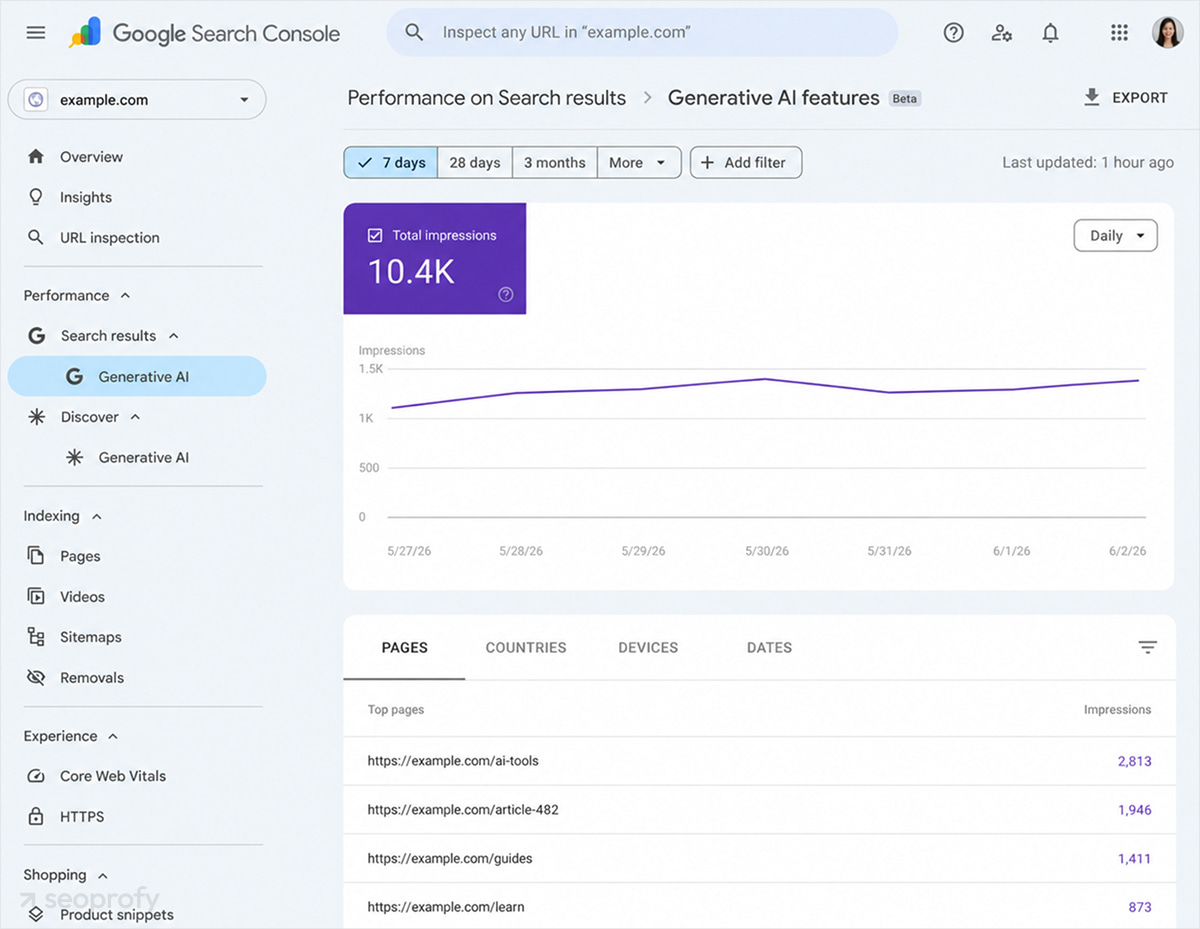
Google offers a free starting point. Its Generative AI performance report, available worldwide since August 31, 2026, shows impressions in AI Overviews and AI Mode. You can examine the data by page, country, device, and date. However, the report covers Google’s features only and does not reveal why a particular source was selected.
For broader AI search visibility, prepare a fixed set of prompts that reflect questions from human buyers. Run each prompt several times in ChatGPT, Perplexity, and Google AI Mode. Record brand mentions, cited URLs, and competing recommendations. Keep the prompts and testing conditions consistent.
AI-generated answers vary between runs, so one favorable response tells you little about progress. Compare multiple observations against your baseline without assuming that changes resulted from a specific optimization. For more detailed tracking methods, see our guide to AI search monitoring tools.
AI Trust Signal Mistakes That Backfire
Some attempts to build trust with AI search platforms create credibility problems of their own. Three practices deserve particular attention.
1. Publishing Fake or Unverifiable Social Proof
Fictitious client feedback and endorsements can create false consumer trust. Under the Consumer Reviews and Testimonials Rule, false reviews, including fake reviews that are attributable to imaginary or AI-generated people, are prohibited and may result in civil monetary penalties.
All testimonials should be verified, permission for displaying client logos should be obtained, and documented proof for published claims should be maintained.
2. Adding Misleading Structured Data
According to Google structured data guidelines, it is not permissible to add review data that is not present on the webpage. For instance, putting review ratings on a page without reviews would violate the rules of the search engine. Not adhering to the rules will result in the loss of eligibility to get rich results. The properties used for the schema must match the information on the published webpage.
Providing markup for fake credentials and reviews is a deceptive practice that violates Google’s terms and conditions.
3. Manufacturing Brand Mentions
Acquiring search placements as an alternative to getting real citations creates little return. Google, in their 2026 AI search suggestions, recommends against using unauthentic citations. Instead, it’s better to build original work that is rooted in real-world expertise and contributions and to work to get the piece placed in industry-relevant publications or social platforms.
Frequently Asked Questions
How Many AI Trust Signals Are There?
While there are many AI trust signals, there is no official number. Categories typically used to describe them include brand identity, content quality, independent reputation, and technical accessibility.
Although Google has provided some indicators and best practices, there is no official checklist. Furthermore, none of these trust signals have assigned weights.
Do AI Trust Signals Work the Same in ChatGPT, Perplexity, and Google AI Overviews?
No. These AI systems retrieve and select information differently, so a brand mentioned in Google AI Overviews may be absent from ChatGPT or Perplexity. Google’s AI features rely on its existing search systems, while other platforms use their own retrieval methods and source selection processes.
Is an On-Site Testimonials Page Enough?
Customer testimonials are most convincing when reviewers can be identified, and their experiences can be verified. Testimonials published by the company carry less weight than independent reviews. Both types of evidence can be helpful, but neither ensures that the company will be mentioned in AI search results.
How Long Does It Take to See Results From AI Trust Signals?
There isn’t a specific deadline for results, and the speed at which improvements will manifest is heavily dependent on Google’s crawl schedule. For the most part, you will need to track your reputation, brand, and citations over time; this is not something you can check once and assume is done.
As Google updates its database, improvements can happen relatively quickly for on-page edits, whereas for editorial coverage and backlinking efforts, you will have to wait for sustained work. Instead of trying to interpret what individual improvements do for your ranking, it’s best to keep a constant baseline of your brand mentions and citations to track progress.
Can Small Businesses Build AI Trust Signals on a Small Budget?
Yes. Small businesses can start by correcting business listings, adding verifiable author credentials, and ensuring their websites are accessible to search crawlers. Genuine customer reviews and contributions to relevant industry publications can strengthen credibility without requiring a large marketing budget. These quick wins improve clarity without requiring a major campaign.
Next Steps for Building AI Trust Signals
Start with information that search engines and potential customers can easily verify. Review your business details, author credentials, content, and supporting sources to make sure they are accurate, consistent, and accessible. Independent reviews and editorial mentions can provide additional evidence of your credibility.
Over the next 30 days, focus on three priorities:
- Fix technical issues that prevent search engines from accessing or indexing important pages.
- Correct inconsistent business information across your website, business listings, and other platforms.
- Review your most important content to ensure that credible sources and relevant documentation support your claims.
After 90 days, compare your AI visibility results with your baseline. Track changes in brand mentions, citations, and recommendations to understand whether your visibility has improved.

Julia Lubianytska is a Copywriting Team Lead at SeoProfy with over 7 years of experience in copywriting and editing. She works closely with copywriting teams, helping writers craft clear and thoughtful content for SaaS products, IT services, and businesses in the legal and medical fields. Julia enjoys turning complex topics into easy-to-understand, trustworthy content, focusing on structure, clarity, and consistency to ensure the content is genuinely helpful for real people, not just search engines.