

Search has stopped sending traffic the way it used to. Ask Google, ChatGPT, or Perplexity a question, and you get a finished answer on the spot, drawn from a handful of sources while everyone else goes unseen. Being one of those sources is the whole contest now.


If you’ve moved past the “What is AEO in digital marketing?” question and want to know more about how it works, this guide covers answer engine optimization as a sequenced framework, not a loose checklist: what to fix first, which levers move visibility fastest, and how you measure the results.
- Measure before you write — benchmark where answer engines cite you first.
- Priority beats volume — fix answer-first structure and schema on pages already ranking, and build topical authority from there.
- Remember that share of voice is a live metric — AI answer positions are volatile and require ongoing tracking.
What Is Answer Engine Optimization (AEO)?
An AEO strategy (AEO stands for Answer Engine Optimization) is a prioritized plan to get your brand quoted as the direct answer in AI-driven search — Google AI Overviews, ChatGPT, Perplexity, and voice results. It’s not a single tactic but a set of steps run in order: find where you’re already cited, structure content so engines can extract it, build authority, and then track citations as they move.
Answer engine optimization is a practical framework with real impact on visibility and traffic — not another buzzword. If you’re still asking “What does AEO mean?” in day-to-day terms, it’s this: structuring pages so an engine can lift your answer directly. And it suits alongside two more optimization strategies.
|
Approach |
What It Does |
| SEO (Search Engine Optimization) | The classic approach to ranking pages in traditional search engines. You work with keywords, links, and technical setup so Google positions your page above competitors and sends clicks. |
| GEO (Generative Engine Optimization) | Teaching AI models to think of your site as an authoritative source. Your research and content feed their knowledge, so the model mentions your brand — often without a direct link. |
| AEO (Answer Engine Optimization) | Answer engine optimization is all about exact answers. You structure content so engines extract a ready-made piece of text and display it as a direct answer — your wording or structured data becomes the response. |
The three overlap but reward different work, and AEO and SEO overlap most — which is why they’re the pair most often confused. For a full side-by-side breakdown, see our guide to AEO vs SEO.
Why AEO Is Worth a Strategy in 2026
In February 2026, OpenAI reported ChatGPT had passed 900 million weekly active users. AI answers are now a default starting point for research, not a novelty, and that changes where digital visibility is won or lost.
Two figures show the scale of the problem:
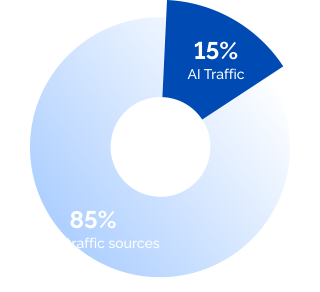
- A 2025 Pew Research study found that when a Google AI Overview appears, users click a traditional result 8% of the time, compared with 15% when no summary shows.
- Ahrefs measured a 58% drop in click-through rate for the top-ranking page when an AI Overview is present, based on December 2025 data. A top ranking no longer guarantees clicks. If your brand is not part of these answers, you are effectively invisible.
AEO in AI search is now in play across a growing share of queries. Google AI Overviews appeared for roughly 16% of US search terms in Ahrefs’ 2025 index, concentrated in informational and question-style user queries where buyers begin their research.
Voice search adds to the pressure: voice assistants usually read only one answer aloud, which makes being that chosen answer so important. Our AI SEO statistics show the same pattern, with visibility shifting into answers and clicks following.
The business case follows from this. When a top ranking returns a fraction of its former traffic, the value of being cited inside the answer rises accordingly. Treating voice search and AI Overviews as optional cedes ground to competitors who structure their content in ways that help it be seen and cited by AI.
AI answers reward focus, not volume. The formats and citations that move share of voice are specific, so effort has to be directed rather than spread across every page. That direction starts with knowing where you already stand.
How AI Engines Choose Answers and What It Means for Your Strategy
Understanding how an answer engine gets from a query to a cited answer makes the framework described below a natural next step rather than a random checklist.
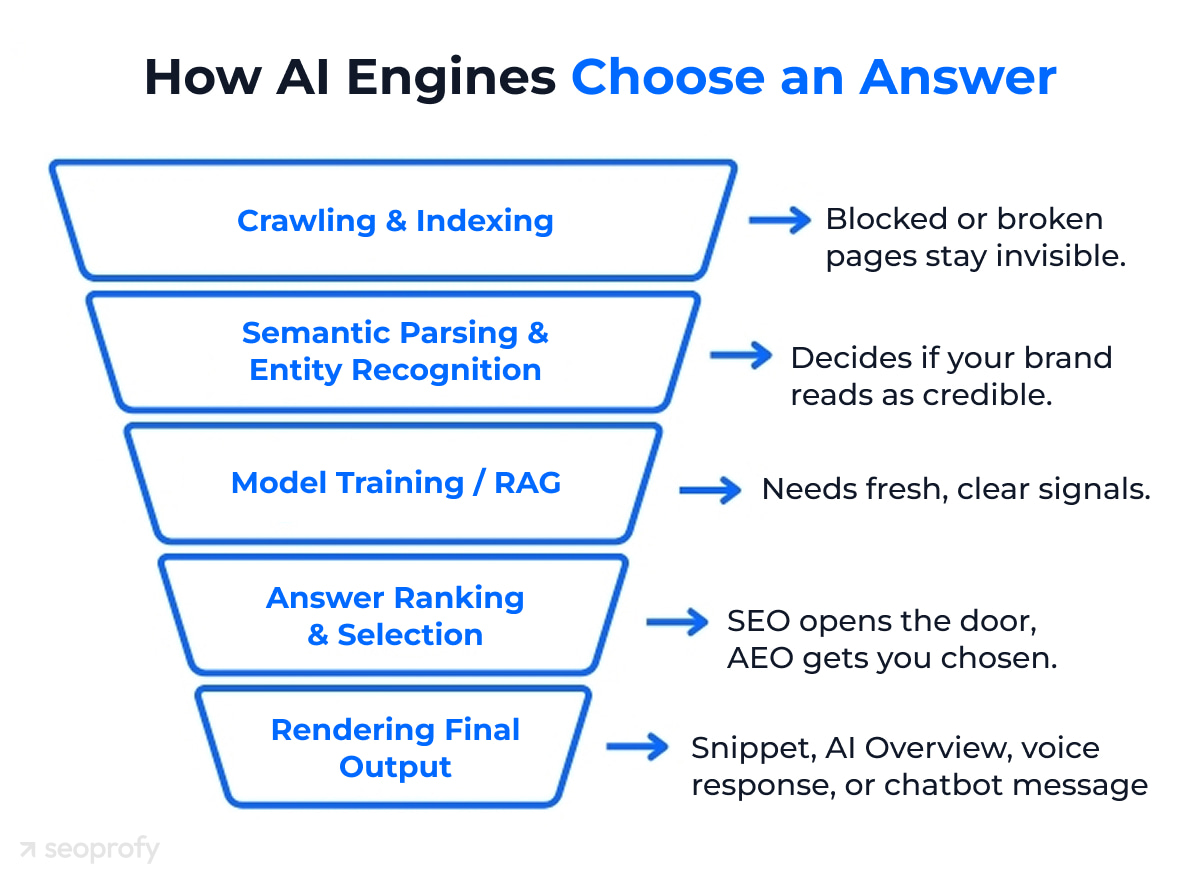
- Crawling. Engines still fetch and index pages first, so a page that blocks crawlers or has a broken structure is invisible to the system no matter how good the content is. Technical health is the baseline for AEO search visibility.
- Semantic parsing. Using natural language processing, systems map facts, numbers, names, and topics to a knowledge graph, and that mapping determines whether your brand reads as credible on a topic — which is why schema and authority signals matter.
- Training and retrieval. From there, the data either becomes part of the model’s training set or is used dynamically with retrieval-augmented generation (RAG) — both of which require clear, current signals, which puts freshness and retrievability at the core of LLM optimization techniques for AI visibility.
- Answer ranking. The engine pulls candidate passages, scores them for relevance, authority, and clarity, and then selects the most relevant answer. Here, Semrush studies show heavy overlap with the top 10 organic results: SEO authority opens the door, but AEO is what gets you chosen.
Even if you are not ranking on the first search engine results page, it is still possible to have your answer surfaced and outrank top competitors inside AI Overviews when your content strategy aligns your texts with more concise answers.
- Rendering. Clean, direct data is more likely to appear in search results, with a link that drives qualified traffic right back to your website.
We benchmark where your brand appears today across ChatGPT, Perplexity, and Google AI Overviews, then build a prioritized, measurable AEO strategy roadmap, so you earn citations and qualified traffic, not just rankings.
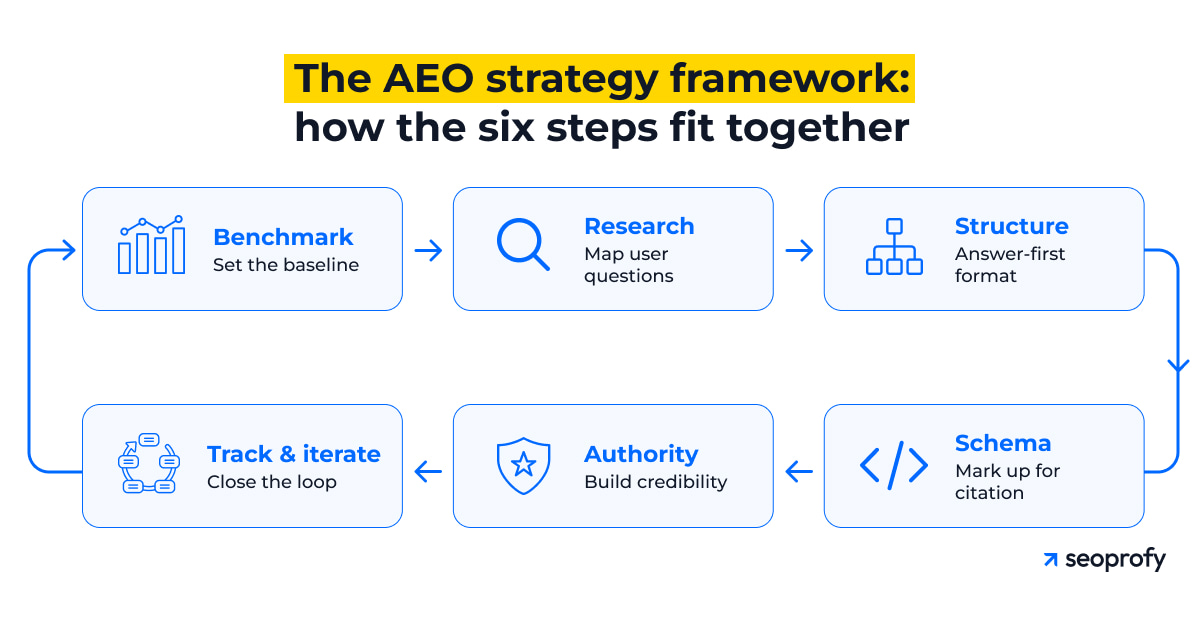
The AEO Strategy Framework: How the 6 Steps Fit Together
A working strategy runs in sequence because each step depends on the one preceding it. You benchmark first, since everything that follows is measured against that starting point. You research questions before developing a content strategy, or you optimize blind.
Structure comes before schema because markup describes content that already answers clearly. Authority then amplifies pages built for extraction, and tracking closes the loop by feeding results back into the next round.
Where to Start: Prioritize Levers by Impact vs. Effort
Not every lever returns the same value for the same effort. The best techniques for answer engine optimization in AI aren’t the most advanced. They’re the ones that drive the fastest visibility gains on pages you already have.
Rank them in two tiers:
- Quick wins (high-impact, low-effort). Restructure pages that already rank in the top 10 for answer-first extraction, and add FAQ schema. These pages are already trusted, so small changes can quickly turn them into cited answers.
- Foundational bets (high-impact, high-effort). Build topical authority across related content and off-domain authority through third-party mentions. These take longer, but they determine whether engines treat your brand as a credible source.
Tie the order to your benchmark. Start with the levers that lift the share of voice fastest for queries where you’re close to being cited, and hold off on the slower foundational work until those quick wins are banked.
When to Deprioritize AEO
Answer engine optimization strategy isn’t the right first investment for every site. In 2025, Ahrefs found that 99.2% of AI Overview keywords are informational, which means they trigger on informational and question-style queries, not transactional or navigational ones. If your money keywords are transactional, the answer box rarely appears for them, so optimizing for it wins little.
Three user intent types where AEO is secondary:
- Transactional. Buyers ready to purchase want a product page and a clear path to checkout, not a summarized answer. For these queries, conversion rate optimization and commercial SEO drive more revenue than AEO will.
- Navigational. Users searching for your brand already know you and want to go directly to your site. There’s no answer to compete for.
- Local-only. Map packs and local search engine results pages, not AI Overviews, own these queries.
When these make up most of your revenue, run AEO strategies behind conversion and local SEO, and skip answer-first restructuring on pages built to convert rather than to inform.
Step 1. Benchmark Your AI Visibility
Before changing a single page, record where your brand stands in AI-generated answers today. This baseline is the reference point against which every subsequent step is judged. Skipping it means guessing whether your work made any difference.
Export your current impressions, clicks, and snippet ownership from GSC and Semrush, then extend the picture into AI surfaces. Three metrics define the starting position: share of voice across answer engines, the number of AI citations your pages earn, and snippet ownership on your target queries. Together they show not just whether you rank, but whether engines are choosing you.
Pull each from a dedicated source:
|
Source |
What to benchmark |
| Google Search Console | Impressions vs. clicks for informational search queries, especially those with featured snippet exposure |
| Semrush/Ahrefs | Featured snippets and People Also Ask wins, plus position history, with alerts for when you lose a snippet |
| AEO software | AI Overview citations, ChatGPT mentions, and Perplexity citations from dedicated trackers |
Record the numbers and date them so when you rerun the same checks after later steps, the movement in citations and visibility shows exactly what worked. For the dedicated tools that track this, our guide to AI search monitoring tools reviews the main options by coverage and price.
Step 2. Research Questions & Map Them to Intent
This step builds the question set that everything downstream answers. It comes before writing or restructuring anything. Pull questions from the places users and engines already reveal them:
- People Also Ask. Type your target question and open the “People Also Ask” box for an instant list of question-based queries, subtopics, and pain points.
- Search console. Filter queries for “how,” “what,” “why,” and similar, then find terms with high impressions but low CTR — cases where you rank but the answer isn’t compelling enough to click.
- Ahrefs and Semrush. Filter organic and keyword reports for question words, sort by traffic potential, and cluster the results by intent.
- AlsoAsked and AnswerThePublic. Map the follow-up questions your target audience asks after their first search to plan subheadings and FAQ sections.
Once you have the full list, group each question by task intent: define, compare, fix, and buy, and by the entity it concerns. Matching content type to intent increases the odds that answer engine optimization earns you the cited answer.
Building a question-intent matrix helps you plan content that covers every stage of the AEO search journey. It can also highlight quick wins.
Your metric here is coverage: how much of the high-intent question set you’ve mapped versus how much you’ve actually addressed on the page.
Step 3. Structure Content for Extractable Answers
Extraction is how engines cite you, so format functions as a ranking factor at this stage. A page that answers clearly in a structure the engine can lift will beat a denser, better-researched page that buries its answer.
Work through each target question in order:
- Lead with the answer in 40–60 words. Write a direct, self-contained answer in the first paragraph under the heading. Voice assistants and AI Overviews favor a short, complete answer over one that builds slowly to a point.
- Use question headings. Phrase H2s and H3s as the question itself, e.g., “What is answer engine optimization?” so engines match a query to your section directly. It also earns you a shot at featured snippets.
- Chunk the content. AI systems read in passages, so keep each section self-contained: one question, one clear answer, then supporting detail and internal links beneath it.
- Use lists and tables. Step-by-step lists, pros and cons, and comparison tables are easy for AI to parse and often preferred for “how to” and “vs” queries.
- Check competitors already cited. Look at pages already selected for AI answers, note their length and format, then make yours clearer and more complete; the same review helps you rank on ChatGPT, where citation patterns are similar.
A quick example shows the pattern. For “how to choose a gaming laptop,” Google favors a structure where the selected source leads with a short, direct answer before adding detail.
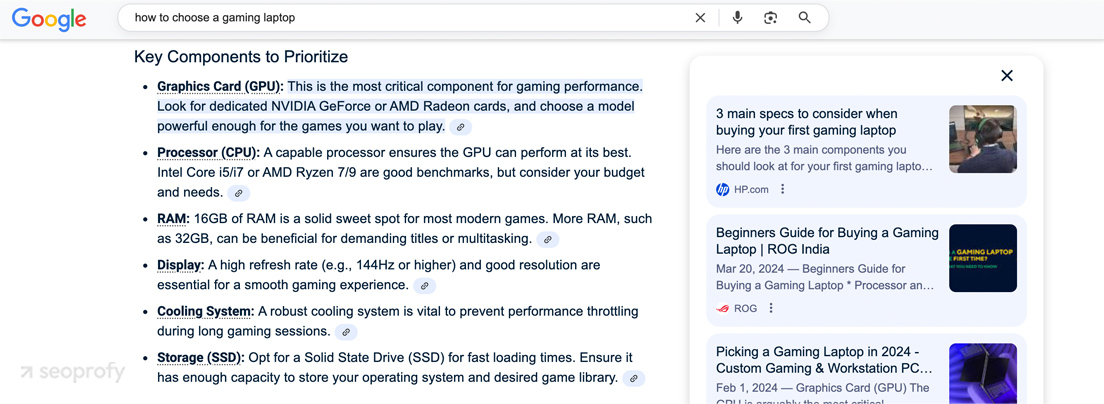
For a step-based legal query like forming an LLC, list-style guides win instead. The format follows the question type, so match it deliberately rather than defaulting to prose.
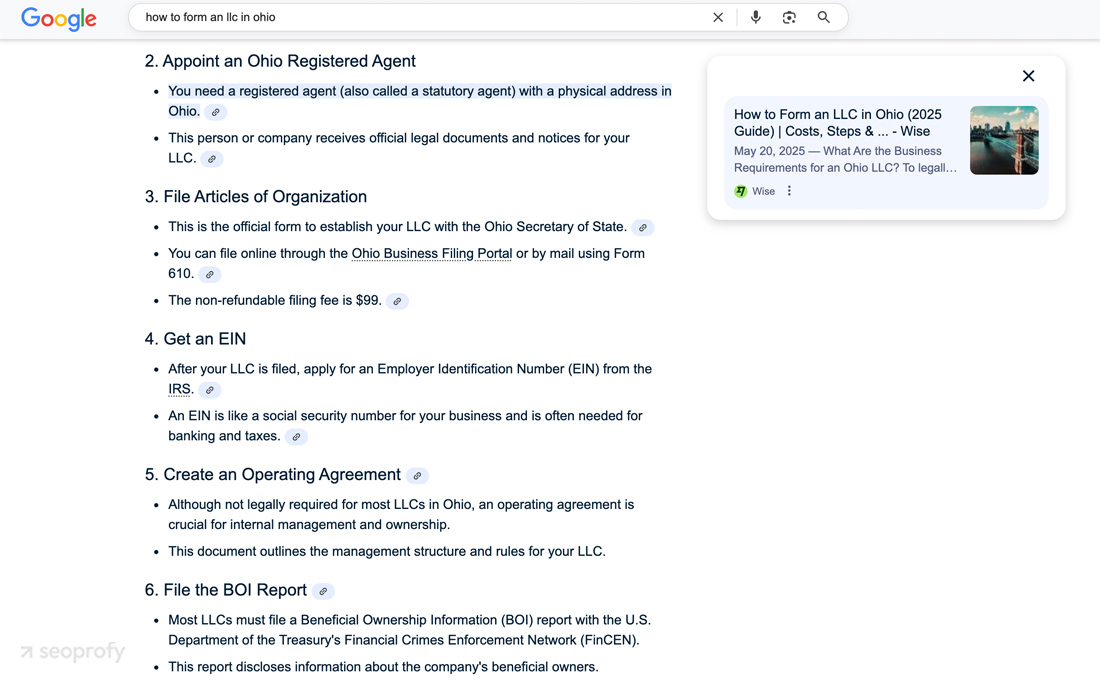
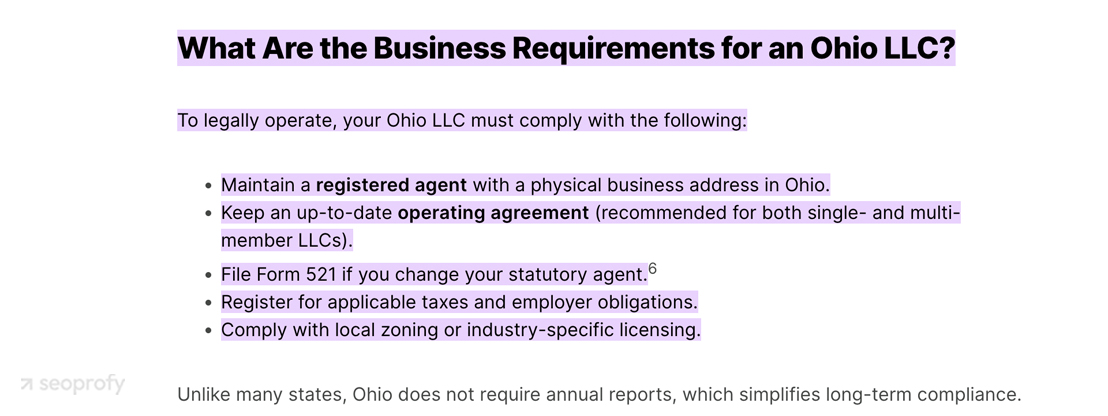
Your metric is extraction: the number of passages featured or cited and whether each target question has a dedicated answer block built to be pulled.
Step 4. Add Structured Data & Schema
AI engines do not just read your content; they parse it. Schema markup labels what each piece of text means, which disambiguates your entities and makes a page eligible for citation rather than merely for crawling. It’s also one of the faster wins in this framework, since it improves how existing content is understood without a rewrite.
Four schema types carry the most weight for AEO:
- FAQ Page. Mark up real user questions and answers. This is often the easiest way to get picked for conversational queries and to appear in People Also Ask boxes.
- HowTo. Perfect for tutorials and step-based content. Mark each step, required tool, and image so AI can reproduce the process in order.
- Speakable. Highlights the sections that should be read aloud by voice assistants — useful for news, quick facts, and LLM optimization targets.
- Article. Adds metadata like headline, author, and mainEntityOfPage, which strengthens authority and trust signals on the page.
Here is a minimal JSON LD example for a delivery question:
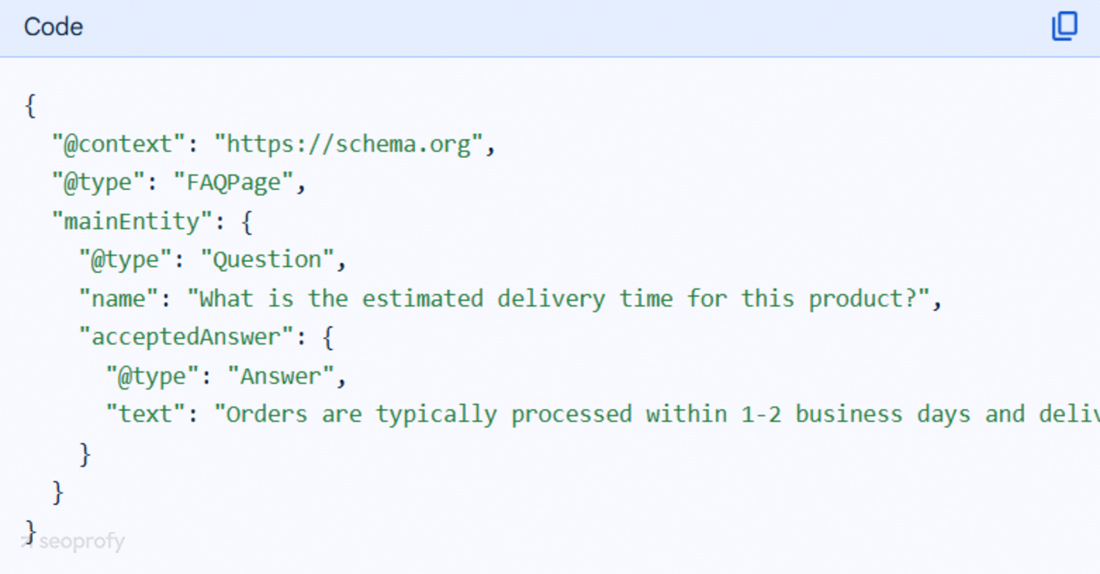
Test your schema with Google Rich Results Test and monitor coverage in GSC. Clean, error-free markup is what lets engines cite your page confidently and show it with attribution.
Your metric is coverage: the share of valid schema across target pages, how many are rich-result eligible, and what proportion of your cited pages carry markup.
Step 5. Build Topical & Off-Domain Authority
Search engines and AI models look for clear signs of authority before they decide which answer to show. A single mention on a thin page rarely qualifies. Engines cite entities they can corroborate — brands that prove a topic on their own site and are confirmed by trusted sources elsewhere.
That splits authority into two jobs. On-domain work proves you know the topic; off-domain work gets that knowledge validated where engines can see it. AEO optimization treats them as one system, since neither carries the citation on its own.
On-Domain Authority: Clusters & E-E-A-T
This is the credibility you build on your own domain. Get it right, and engines have reason to treat your brand as an authority.
- Content clusters. Build a hub-and-spoke structure of in-depth pages across every subtopic, interlinked into a topical map engines can follow.
- Expertise and authors. Show expert bios with credentials, link to LinkedIn profiles, and display publication dates so E-E-A-T signals are visible on the page.
- Trustworthy citations. Reference primary research, government data, or peer-reviewed studies to support claims.
Measure two things: how completely your cluster maps the topic and whether author E-E-A-T signals appear on every page. Thin coverage on either is where the work starts.
Off-Domain Authority: Where AI Corroborates You
On-page signals alone don’t convince an engine you’re credible. It corroborates entities across third-party sources, and this is the part of AEO optimization most brands underinvest in.
Build presence where engines already look for confirmation:
- Community platforms. Reddit, Quora, and YouTube are heavily cited in AI answers, so a genuine presence there places your brand within the corroboration set.
- Professional and social proof. Active LinkedIn profiles and consistent brand mentions mark you as a recognized, established entity.
- Digital PR and original research. Earn mentions on reputable sites and publish data others cite — the strongest third-party signal available.
Track three things: brand mentions across the domains engines cite, referring domains won, and the lift in visibility share that follows. Movement across all three confirms the off-domain work is landing.
Step 6. Track, Test & Iterate
Ranking positions inside AI Overviews shift daily across multiple platforms, and competitors are actively working to replace your content with theirs. Without a running loop, the gains from the previous steps decay.
Treat tracking as a continuous system, run on the same tools you set up in Step 1:
- Watch the trend, not the snapshot. Re-measure your AI citations, snippet ownership, and share of voice against your Step 1 baseline on a set cadence, monthly at minimum, so you catch movement while there’s still time to act on it.
- Segment by intent. Separate branded, informational, and transactional queries so you know which clusters drive real leads, then re-optimize the ones tied to revenue first.
- Run A/B updates. Change headings, tighten answer paragraphs to 40–60 words, and add missing schema, then re-check snippet ownership after two to three weeks to isolate what moved.
- Iterate. If CTR stalls or snippets slip, rewrite for clarity, add supporting data tables, and resubmit via GSC URL Inspection for a faster recrawl.
Your metric is movement: the citation and share-of-voice trend against the baseline, snippet wins and losses, and CTR on the queries you’ve edited. Rising trends confirm the loop is working; flat ones show you where to dig next — a rewrite, fresh schema, or a stronger source.
What AEO Costs & How Long It Takes
There’s no flat rate for AEO. Strategy execution cost depends on where you’re starting, and that varies more than most pricing pages admit.
Three drivers set the range:
- The first is your existing SEO foundation: Sites with clean technical SEO and existing topical authority usually see faster results, while pages that need structural fixes or content expansion take longer and cost more to prepare.
- The second is scope: How many pages, clusters, and target queries you’re optimizing, and whether schema and off-domain work are part of the brief.
- The third is your team: Experience and familiarity with structured data and content optimization decide how quickly changes actually ship, whether that team is in-house or an outside partner.
The timeline follows the same logic. A site already ranking in the top 10 for informational queries can win quick wins in weeks, since answer engine optimization there is mostly restructuring what already performs. A site building topical and off-domain authority from a low base should plan in months — that work compounds, but it doesn’t happen fast.
If you’d rather benchmark where you stand before committing a budget, our SEO performance audit for AI visibility shows where your brand already appears in AI answers and where the fastest gains are.
Frequently Asked Questions
How do you create an answer engine optimization strategy?
Creating an answer engine optimization strategy runs in sequence: benchmark current AI visibility, research user questions, structure content for extraction, add schema, build authority, then track and iterate. The order matters — each step is measured against the baseline you set in the beginning, so benchmarking always comes first.
What is the difference between AEO, GEO, and SEO?
SEO ranks your pages. GEO (Generative Engine Optimization) gets AI models to treat your site as a source and mention your brand. AEO structures content so an engine lifts it verbatim as the answer. SEO earns clicks; GEO earns mentions; AEO earns the citation.
What is the best answer engine optimization tool?
It depends on what you’re measuring. For citation tracking across ChatGPT, Perplexity, and AI Overviews, use a dedicated AEO monitor. For snippets and question data, use Semrush or Ahrefs. For schema, use Google’s Rich Results Test.
How do you measure AEO performance?
To measure AEO in AI answers, start with your benchmark. Track three signals over time: visibility share across answer engines, AI citations your pages earn, and snippet ownership on target queries. Add CTR and AI referral traffic. The point isn’t a one-off score but the trend against your baseline.
Will AEO replace traditional SEO?
No. AEO and SEO work together — engines still crawl, index, and rank pages before selecting answers, and citations overlap heavily with the organic top 10. It’s a layer on a solid SEO foundation, not a replacement. Abandon traditional SEO to chase AI answers, and you lose both.
How to Start Your AEO Strategy
Start where the framework does, by measuring first. Benchmark where AI answers cite you today, so every change afterward has a number to prove it worked. That baseline is what turns the rest of the work from guesswork into something you can steer.
Then prioritize instead of attempting all six steps at once. Restructure the pages already close to being cited for a fast return, and give the slower authority-building a longer runway.
What most teams miss is that this has no finish line — AI answers shift, and competitors move, so a position won this month can be gone the next. The work only holds if you run it as a measurable, continuous loop, and that’s the point at which a visibility audit is worth booking to see where you stand.

As a Content writer at SeoProfy, Hanna Zhytnik creates SEO content grounded in research, data, and ongoing hypothesis testing. With more than 5 years of experience across B2B, SaaS, and ecommerce, she brings both breadth of knowledge and a sharp focus on modern search. Her strength lies in turning complex experiments into clear explanations, bridging the gap between deep SEO practice and accessible content.