

When comparing AEO vs SEO, with SEO being the better-known of the two, the key difference is where your content shows up. Search engine optimization focuses on ranking in traditional search engines and driving organic traffic. Answer engine optimization prepares your content to appear in AI-generated answers across platforms like ChatGPT, Perplexity, and Google’s AI Overviews. A space that’s grown rapidly, with AI-referred sessions jumping 527% year-over-year in 2025.


This shift means businesses must adapt to both traditional search engines and AI systems. Instead of competing only for search rankings, you now need to structure content for concise answers, featured snippets, and voice assistants. To help you figure everything out, we’ll break down AEO and SEO, explain how they differ, and share proven answer engine optimization strategies to stay visible across modern search platforms in 2026.
- SEO drives organic rankings, while AEO positions your content inside AI-generated answers on ChatGPT, Perplexity, and Google AI Overviews
- Around 60% of searches now end without a click, making AI visibility as valuable as traditional rankings
- AI-referred visitors convert about 4.4x better than traditional organic traffic
- Strong SEO foundations directly improve AEO performance since AI platforms rely on the same technical signals
- Concise lead answers, FAQ schema, and Q&A formatting increase citation chances
- Original research and unique data attract more AI citations and natural backlinks.
What Is Answer Engine Optimization (AEO)?
AEO is a newer search strategy that prepares your content to appear in the direct responses people now see in AI-powered search engines.
To understand how AEO works, it helps to look at how these responses are formed. When users submit queries, AI systems analyze multiple sources across the web, evaluate their relevance, authority, and clarity, and then synthesize a single response.
Content that gets selected usually meets a few criteria, it:
- Directly answers the question
- Uses clear structuring (such as headings, lists, or bullet points)
- Includes accurate and up-to-date information
- Appears on trusted domains with strong brand mentions and backlinks.
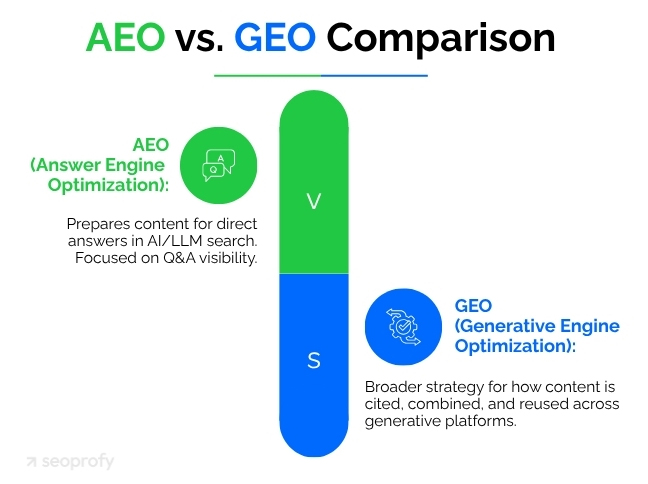
Many people use AEO interchangeably with Generative Engine Optimization (GEO). However, GEO is the broader strategy that looks at how content is chosen, cited, and reused across generative systems, while AEO concentrates on structuring information for quick, Q&A-style visibility.
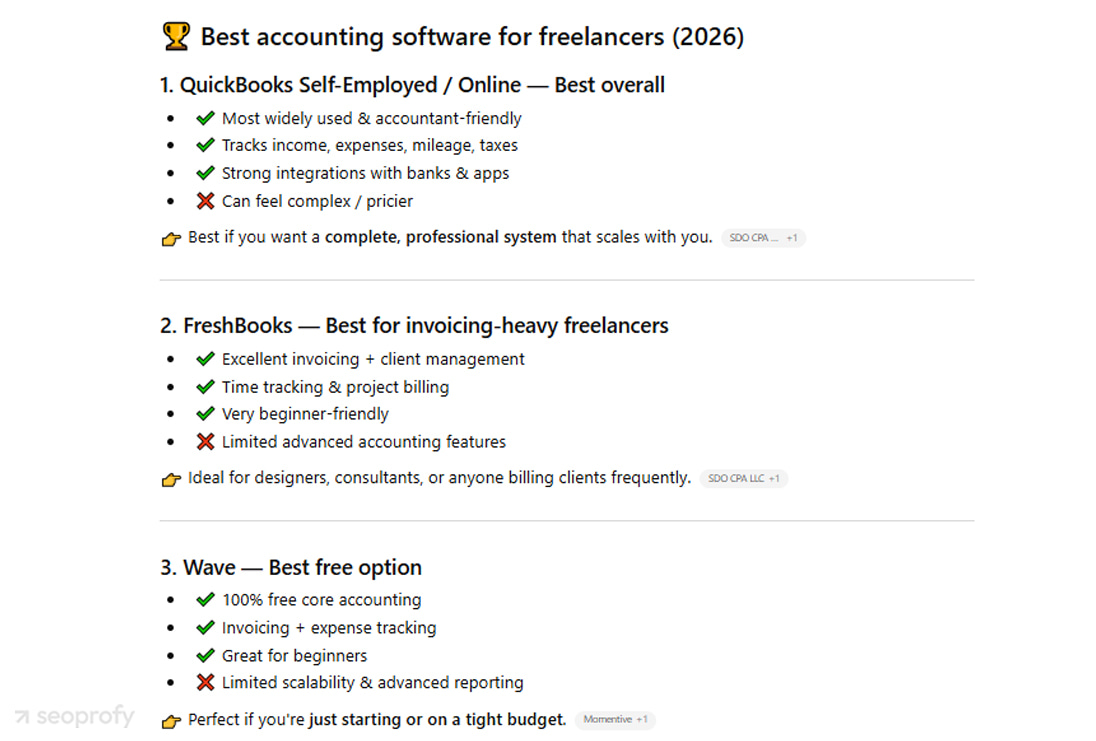
For example, when someone asks, “What’s the best accounting software for freelancers?” these platforms select a few trusted sources to create their answer. If your content isn’t included in these AI responses, your business stays out of sight during that moment. When it is, your brand name appears inside the summary and reaches people exactly when they’re looking for a product or service you offer, just like in the example below:
What Is Search Engine Optimization (SEO)?
SEO is the process of optimizing a website so it ranks organically in search engine results for relevant queries. It’s been part of digital marketing for decades and still attracts a large share of traffic, leads, and conversions for many businesses. Based on SEO data from 119 companies, it drives 8x ROI, which explains why marketing teams continue to invest in it.
The main strategies that go into search engine optimization are keyword research, content creation, link building, and technical and local SEO. All these elements are the central pieces that work together to improve a website’s visibility in search engines.
What Are the Key Differences Between AEO and SEO?
Now that you know the definitions of these two strategies, let’s look at how AEO vs SEO plays out in practice and where the biggest differences appear.
|
Aspect |
SEO |
AEO |
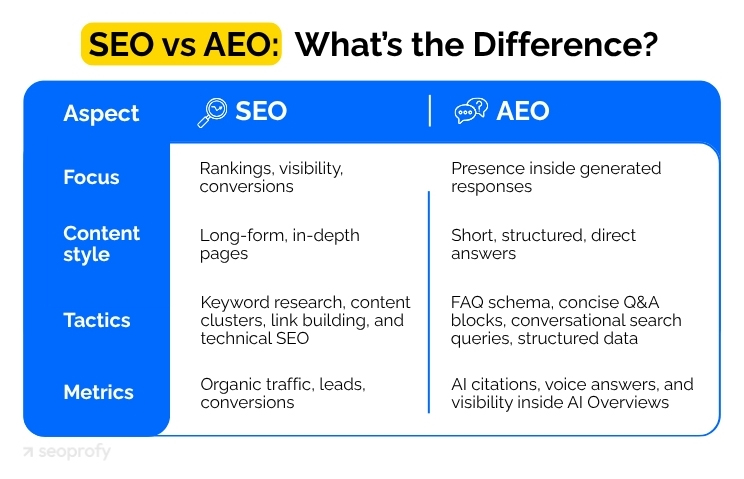
| Focus | Rankings, visibility, website traffic, conversions | Presence inside AI-generated answers, direct responses |
| Content Style | Long-form, in-depth, keyword-rich pages | Short, structured, direct answers |
| Tactics | Keyword research, backlinks, technical SEO, content clusters | FAQ schema, structured data, concise Q&A, conversational search queries, entity optimization |
| Metrics | Organic traffic, rankings, CTR, conversions | AI citations, voice answers, featured snippets, visibility in AI Overviews |
Content Format
Traditional SEO favors long-form content — guides, landing pages, and research pieces that cover a topic end-to-end, earn links, and rank for dozens of variations. Depth is the point.
AEO flips the priority. AI systems pull from pages that lead with a clear, direct answer and mirror how people actually phrase questions. Structure matters as much as substance.
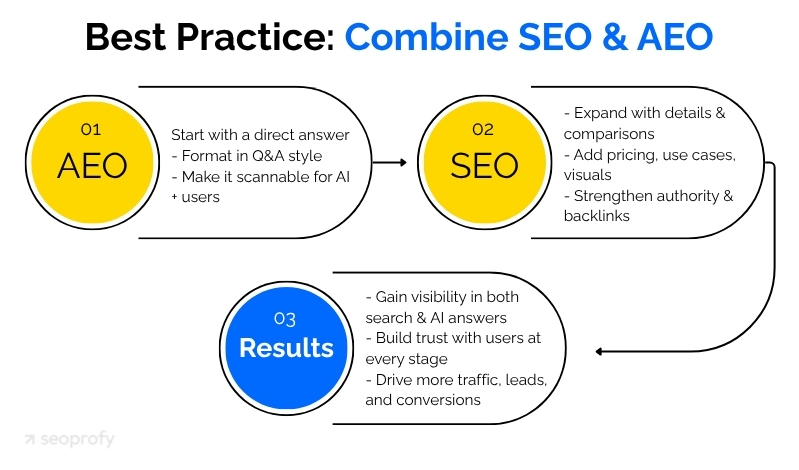
The practical approach most content teams are moving toward: answer first, elaborate second. Open each section with a concise response, then layer in context, comparisons, and detail for readers who want more. This satisfies both a ranking algorithm scanning for relevance and an AI engine scanning for a quotable answer.
Search Behaviors
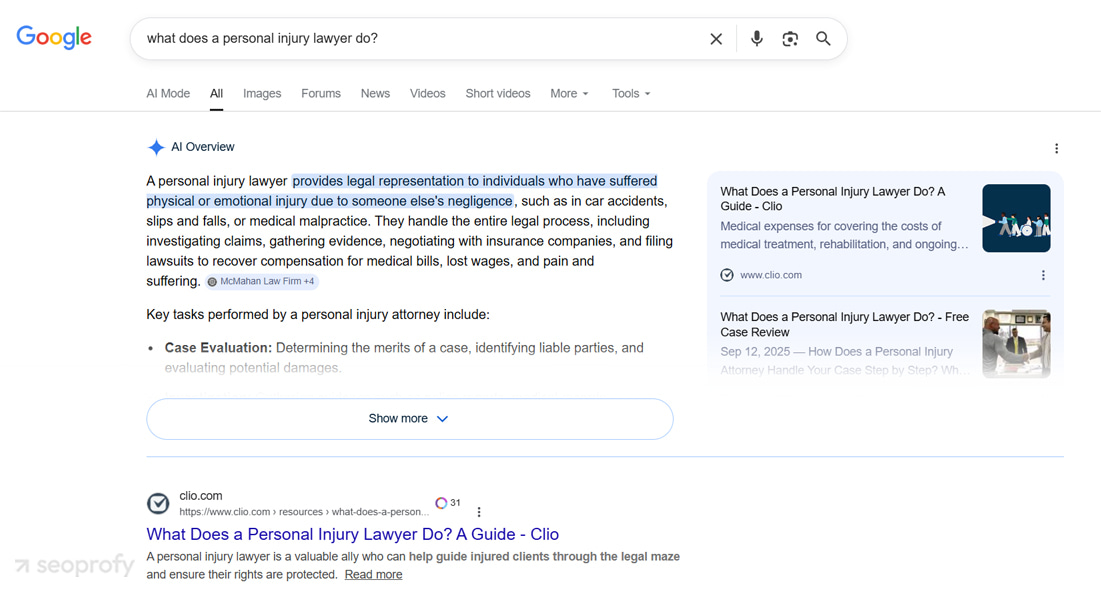
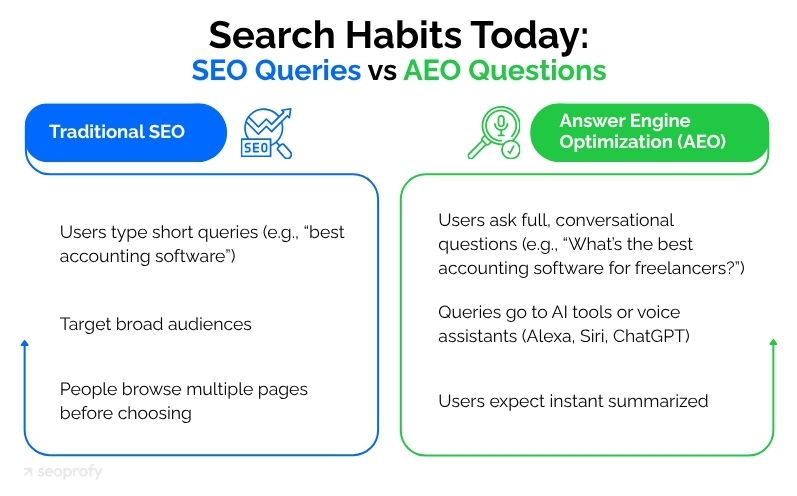
Search engine optimization deals with optimizing content around specific text-based queries or phrases that users type into Google or Bing. These searches generally target broad audiences who review multiple pages before selecting the most relevant links.
AEO, in turn, connects to a context-based habit we see more often now. People phrase their searches as full, conversational questions and often turn to AI tools or voice assistants such as Alexa and Siri. In such cases, users expect to get a summarized response instantly without opening multiple links.
Technical Requirements
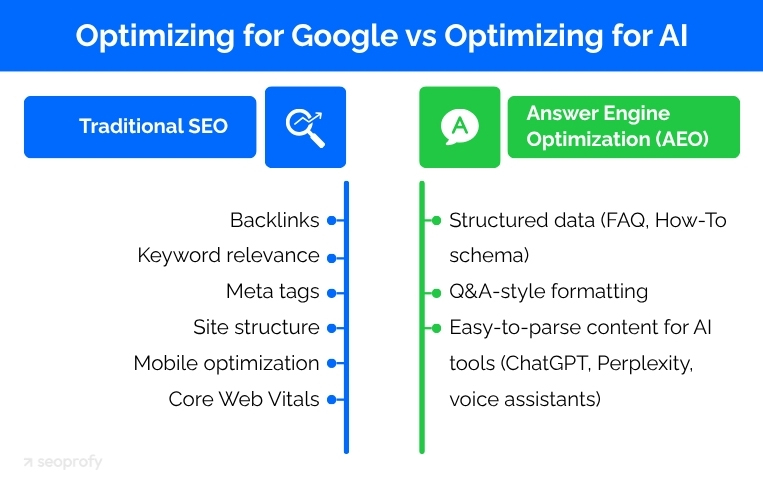
With pure SEO, the technical basics haven’t changed much over the years. Google looks at signals like backlinks, keyword relevance, meta tags, site structure, mobile optimization, and Core Web Vitals to understand and rank your pages.
In answer engine optimization, more attention goes into structured data and content formatting so tools like ChatGPT, Perplexity, and voice assistants can interpret it easily. For this reason, pages that are designed for AEO often include FAQ and How To schema, and well-organized Q&A sections.
Metrics of Success
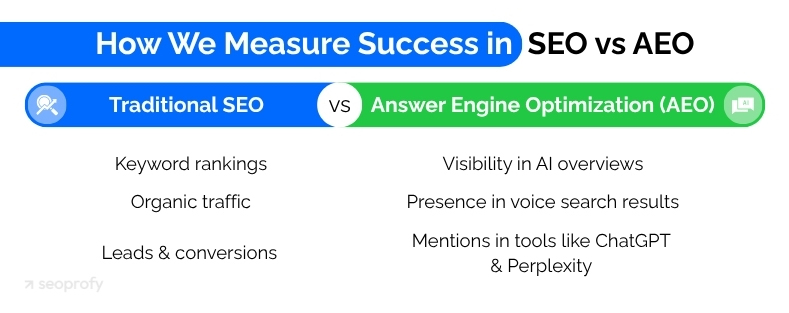
SEO performance is commonly measured through keyword rankings, traffic, leads, and conversions. These metrics show how well your pages draw in visitors and, eventually, turn that attention into leads or sales.
In contrast to traditional SEO metrics, AEO focuses on how well your content ranks in AI overviews and shows up in voice search results and tools like ChatGPT or Perplexity.
Timeframe
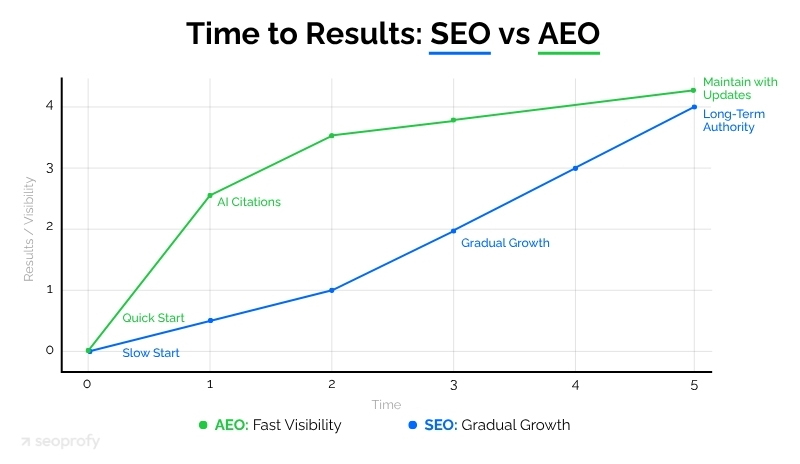
SEO vs AEO also differ in timing. SEO takes longer to show results since rankings improve gradually as a site gains authority, earns backlinks, and builds out topic coverage. This growth compounds over time, but the process is rarely immediate.
AEO can move faster in comparison. The moment you restructure your content, it doesn’t take long for it to get cited by AI systems. That visibility can happen sooner, though maintaining it still depends on keeping your web pages up to date and relevant.
At SeoProfy, we design campaigns that combine SEO and AEO so your brand can see more qualified traffic from Google, LLMs, and virtual assistants. Our team will help you:
- Get your content cited in AI-generated answers
- Win more featured snippets and voice search spots
- Grow your share of voice across answer engines
How to Combine AEO and SEO for Maximum Visibility
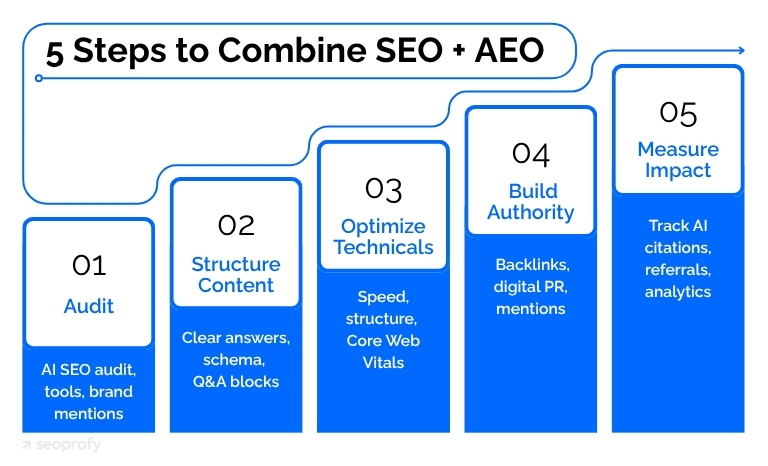
The AEO vs SEO debate tends to focus on differences, but the two strategies share more common ground than most people expect. AI platforms still rely on traditional SEO signals — topical content, backlinks, technical optimization — when deciding what to surface. Strong SEO foundations naturally create more opportunities to appear in AI-generated summaries, voice search, and featured snippets.
Below are the strategies our team has tested and seen results from.
Start with a Detailed AI SEO Audit
Before optimizing anything, run an audit first. Without a baseline, you’re making changes without knowing what actually needs fixing or what’s already working.
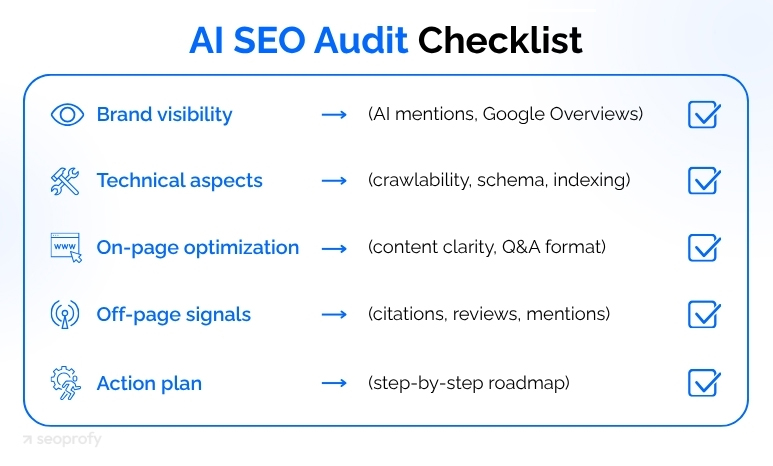
Specifically, you want to map two things: how visible your brand is inside AI-generated answers, and how your site holds up technically in terms of schema setup, content structure, and overall health.
A few tools can help you do this yourself:
- HubSpot AEO: Tracks brand visibility, mentions, and citations across AI search platforms.
- Ahrefs Brand Radar tracks how often your brand gets mentioned and cited in AI systems
- n8n AI SEO Readability Workflow checks how “friendly” your pages are for LLMs
- Google’s Rich Results Test validates schema for FAQ, HowTo, and Q&A sections.
If you’d rather outsource this, our AI SEO Audit covers 53 checkpoints across five areas: brand visibility, technical aspects, on-page optimization, off-page and brand signals, and an action plan. Every audit includes a 60-minute results call, plus optional AI SEO implementation support.
Why this works for both SEO and AEO: The same signals that help Google evaluate your site — structure, authority, technical health — are what AI platforms use to decide which content is worth citing. An audit tells you exactly where those signals are weak.
Structure Your Content for AEO and SEO
The best approach here is to start with your priority pages. The way you format them now matters more than ever. AI models scan for concise and clearly segmented information that they can easily lift. Here are a few tactics AI search optimization agencies use:
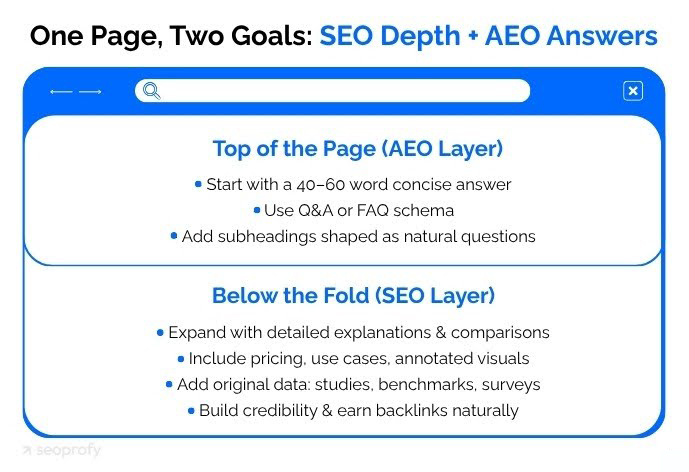
- Lead with clear and concise answers near the top of the page (40–60 words)
- Use subheadings that reflect the natural questions users ask
- Add schema markup like FAQPage, Q&A, HowTo, and speakable schema for voice queries
- Retain detailed explanations below the answer for readers who want context
- Structure the content in formats AI models understand best (Q&A blocks, tables, and lists)
After rewriting existing content, you can also create dedicated AEO-friendly resources. These are designed specifically for LLM SEO and the way voice assistants process information:
- Look for questions in your niche that aren’t well answered yet (the Answer the Public and PAA sections can be helpful here)
- Personalize content to different user personas, industries, or use cases with annotated screenshots to match specific user intents
- Publish unique studies, benchmarks, or surveys that AI systems often favor for factual queries.
These content tactics don’t just work in theory — we’ve tested them ourselves. When we wrote our SEO pricing guide, we researched dozens of companies and industries to build our page.
Now, when you ask ChatGPT or other LLMs about SEO pricing, our guide is cited in almost every related question.
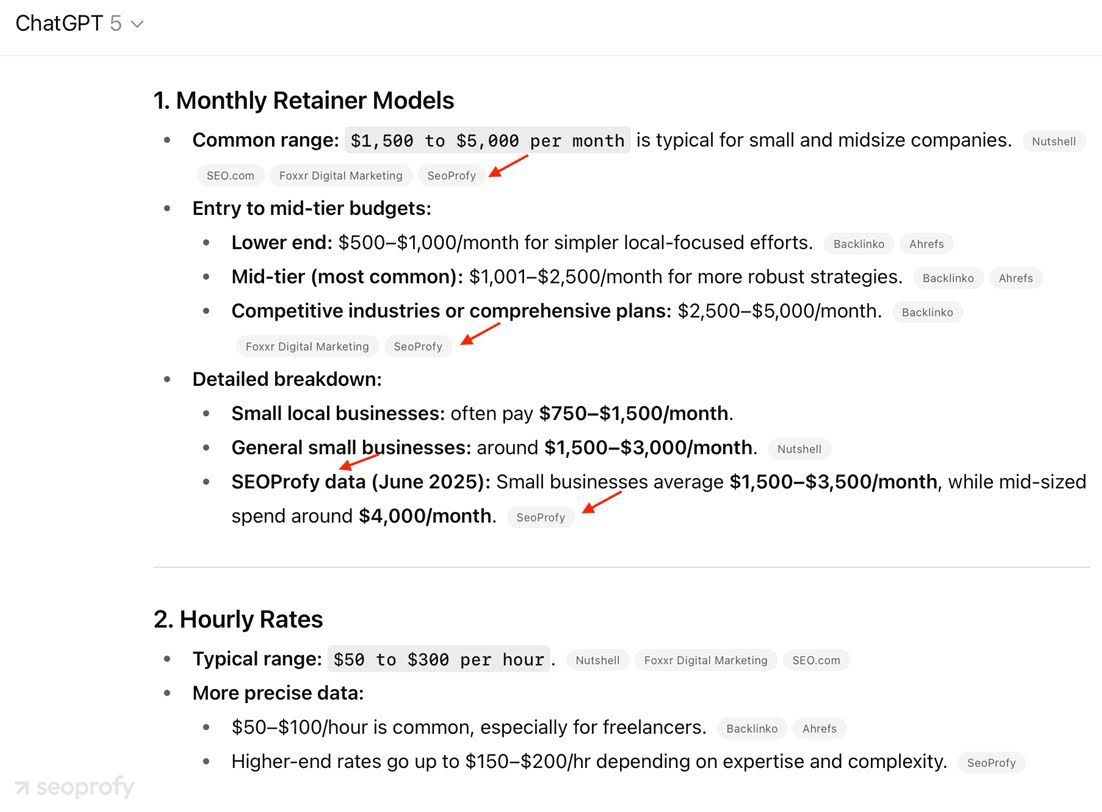
This shows that original data gives your content a better chance to rank on ChatGPT and appear in other AI-generated answers. As a bonus, these kinds of pages also tend to attract backlinks naturally.
Why this works for both SEO and AEO: Well-structured, question-led content satisfies search engine relevance signals while giving AI models exactly the clean, citable format they need to pull answers from.
Work on the Technical Search Optimization
Beyond schema and structured data, three technical areas directly influence how both search engines and AI models process your site. When talking about AEO vs SEO differences, these technical steps support both approaches:
- Page speed: Faster pages help crawlers and AI tools process content without delays, while also reducing bounce rates that signal poor quality to ranking systems.
- Site structure: A logical, well-connected page hierarchy makes it easier for both crawlers and AI bots to understand what your content covers and how it relates.
- Core Web Vitals: A smaller ranking factor, but worth maintaining since they affect usability and cross-device performance, both of which influence how pages are evaluated.
Why this works for both SEO and AEO: Search engines and AI platforms share the same starting point — they need to crawl, process, and evaluate your content before they can rank or cite it. A technically sound site removes the friction that causes either system to deprioritize your pages.
Invest in Digital PR and Backlink Building for Wider Organic Visibility
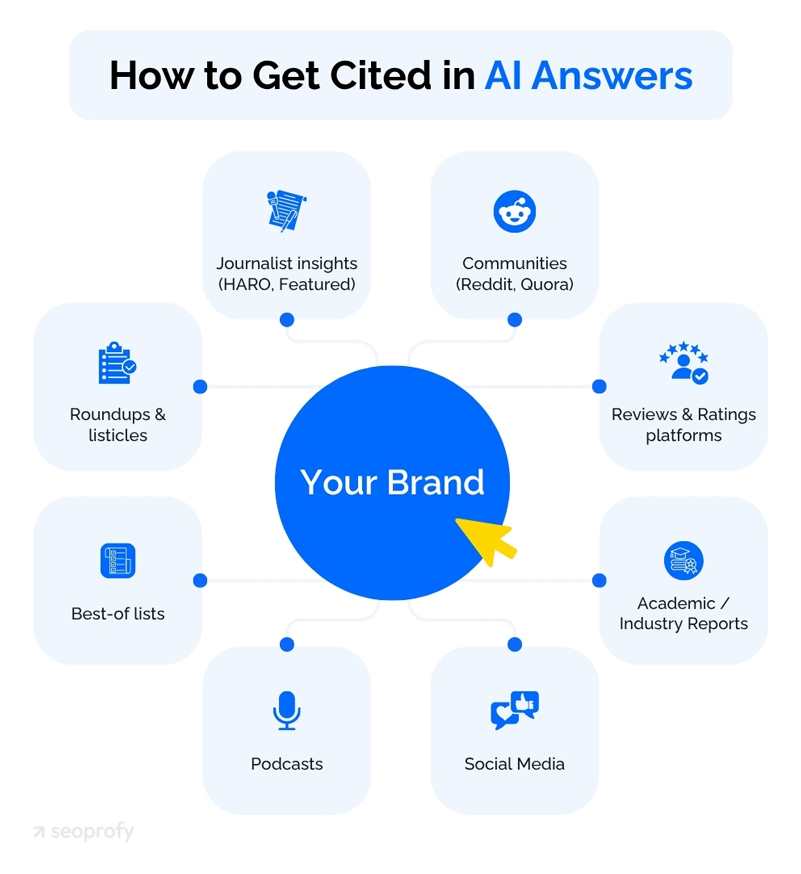
In the context of AEO vs SEO, AI platforms draw from a surprisingly narrow pool of sources. Brand mentions, even unlinked ones, expand your presence in that pool and raise the likelihood of being included in generated responses.
Four tactics that move the needle:
- Reach out to niche blogs and publishers to be included in relevant listicles, which AI-generated answers commonly cite
- Contribute quotes, data, or commentary via HARO or Featured; content on high-authority domains regularly gets pulled into AI responses
- Leverage Reddit and Quora. They are among the most cited domains inside AI models; brand mentions in these threads create footprints both Google and AI platforms reference later
- Monitor referral reports in Google Analytics 4 to identify which mentions already drive traffic, then double down on those sources.
Why this works for both SEO and AEO: Backlinks and mentions build domain authority for search rankings, while simultaneously widening the footprint AI systems use to surface and cite your brand.
AEO vs SEO in 2026: What Trends Will Shape the Future?
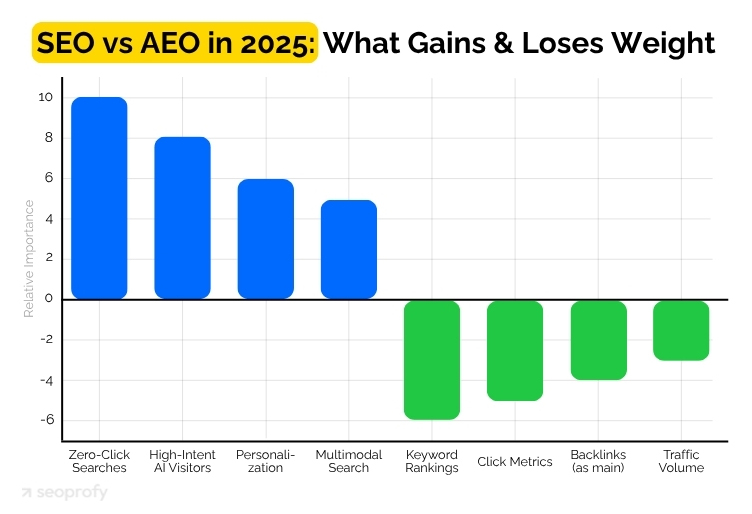
SEO has gone through big changes in the past few years, and the pace isn’t slowing down. At our agency, here are a few direction-of-travel signals we’ve noticed:
- Zero-click searches only increase. Roughly 27.2% of Google searches in the U.S. end without a click. That tells you why citations, snippets, and ranking in Google AI Overviews matter more than they did two years ago.
- AI visitors can be high-intent. Visitors arriving from AI sources convert about 4.4x better than traditional organic on average.
- Personalization is getting more important. The average ChatGPT prompt is roughly 60 words, compared to 3.4 words in traditional search. It means broad, one-size-fits-all content is less likely to surface in AI-generated responses than pages written for specific use cases and intents.
- Multimodal is here. Not only is text being quoted by AI systems. Images, video, audio, and transcripts are being read and cited, too.
So what does that mean for your answer engine optimization?
- Prioritize the SEO foundation
- Optimize for the strategies we listed in this guide
- Track presence as well as website traffic
People will always search, but the “click” is no longer the only metric of success. In 2026, the winners are those who structure their content to be the definitive answer for both humans and the engines that serve them.
Winning the Future of Search with AEO and SEO
As we can see from our AEO vs SEO comparison, the principles and pillars of SEO remain the same when optimizing for AI-generated summaries. Moreover, Google holds close to 90% of the market, and that isn’t changing any time soon. So, while adapting to new strategies makes sense, SEO basics continue to matter just as much.
At our SEO company, we help brands take advantage of both. Our team combines hands-on experience, data-driven research, and advanced tools to make your content visible in traditional search and answer engines. This approach helps you reach more potential customers and capture more qualified traffic for your business.

Khrystyna Dzhumaryk is a content writer at SeoProfy with four years of experience in SEO and content strategy. At the company’s main blog, she writes in-depth articles and guides to help businesses improve their online visibility through proven tactics. Her work brings together hands-on SEO experience with ongoing research into algorithm updates, search trends, and the growing impact of AI on content and optimization.