


ChatGPT has grown from a research preview into one of the world’s largest consumer technology platforms. As of September 2026, OpenAI says its products reach more than 1 billion weekly active users and more than 2 million businesses worldwide.


Our team reviewed recent data from OpenAI, Statcounter, Semrush, Pew Research Center Survey, and other research and analytics sources to compile the latest ChatGPT statistics on adoption, traffic, demographics, market share, workplace use, and OpenAI’s business growth.
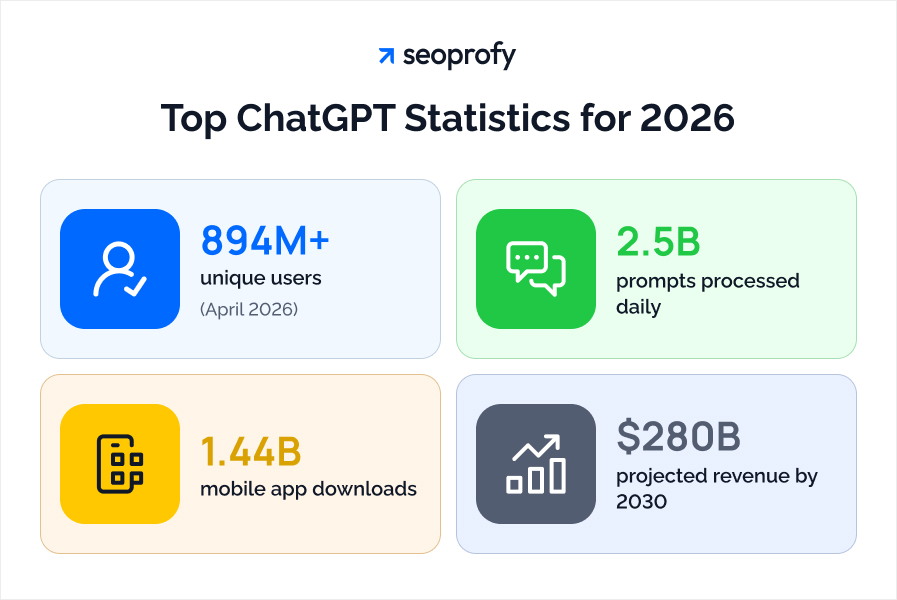
- ChatGPT reached 894 million unique users in April 2026.
- Every day, ChatGPT processes over 2.5 billion prompts from global users.
- As of May 2026, ChatGPT recorded nearly 1.44 billion mobile app downloads.
- OpenAI expects to reach $280 billion in revenue by the end of 2030.
How Many ChatGPT Users Are There Worldwide?
The statistics below dive deeper into the ChatGPT user base worldwide.
Global and Regional Trends
Which countries have the most AI users, and which regions does ChatGPT dominate? Here’s an overview:
- OpenAI currently supports ChatGPT in 208 countries and territories worldwide. (OpenAI)
- In July 2026, the US generated 17.88% of traffic to chatgpt.com, the largest share of any country. (Semrush)
Here is a list of the countries that drive the most traffic to OpenAI’s platform:
US ChatGPT Trends
Since the US leads the list of countries where people use ChatGPT, let’s take a close look at user demographics in this region:
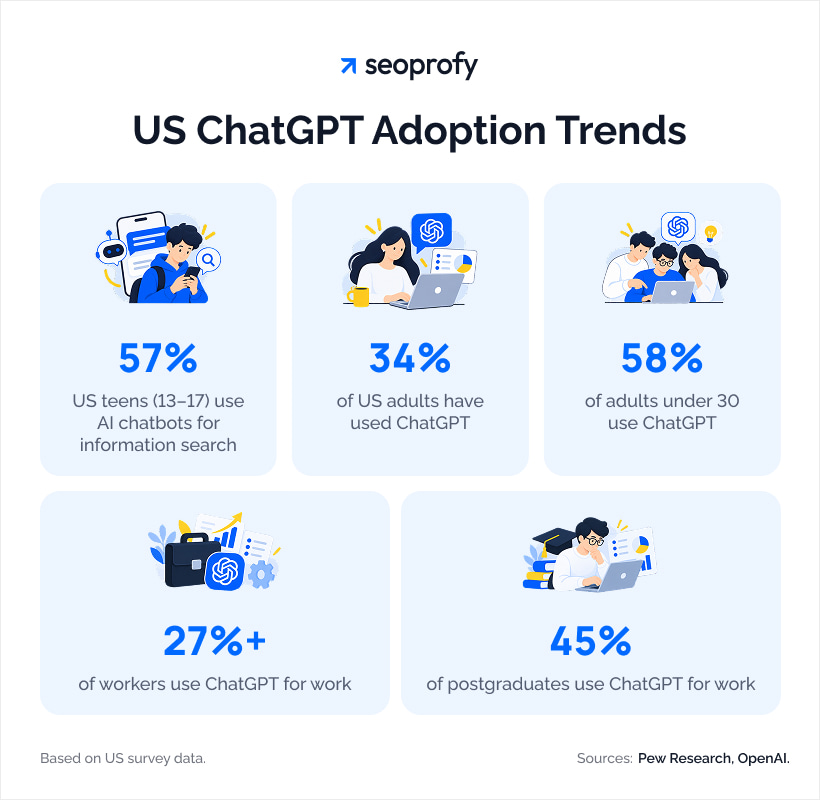
- 57% of US teens ages 13–17 have used AI chatbots to search for information. (Pew Research)
- 34% of US adults reported having used ChatGPT, including 58% of adults under 30. (Pew Research)
- 20% of US adults said they had heard nothing about ChatGPT. (Pew Research)
- Over a quarter of workers and 45% of people with postgraduate degrees in the US report using ChatGPT for work. (OpenAI)
EU ChatGPT Trends
The audience in Europe also actively adopts ChatGPT:
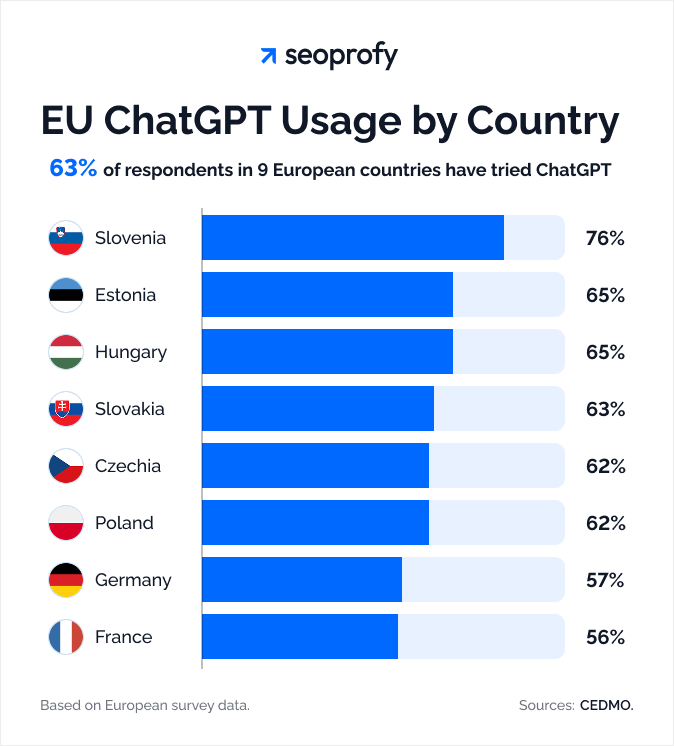
- 63% of respondents across nine surveyed European countries reported having tried ChatGPT. (CEDMO)
- Slovenia leads among European countries, with 76% of respondents having used OpenAI’s platform. (CEDMO)
The table below shows EU countries with the highest percentages of residents who have tried using OpenAI’s platform:
| Country | Share of respondents who have used ChatGPT |
| Slovenia | 76% |
| Estonia | 65% |
| Hungary | 65% |
| Slovakia | 63% |
| Czechia | 62% |
| Poland | 62% |
| Germany | 57% |
| France | 56% |
- Estonians stand out for particularly positive attitudes toward AI: 62% describe it as exciting, while more than half believe AI systems can outperform humans. (CEDMO)
Asian ChatGPT Trends
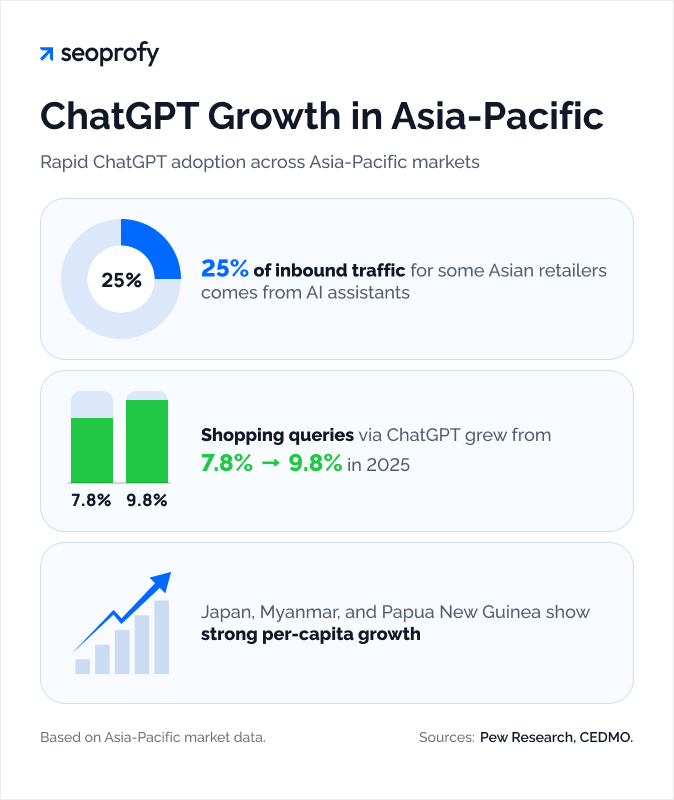
Asia-Pacific countries, such as Japan, Myanmar, and Papua New Guinea, have had some of the largest increases in ChatGPT messages per capita in 2026.
- Some Asian retailers report that AI assistants now account for as much as 25% of their inbound traffic. (Mission Media)
- Shopping-related ChatGPT queries across Asian users increased from 7.8% to 9.8% in the first half of 2025. (Retail Asia)
- ChatGPT is a leading generative AI platform across many Asia-Pacific markets. (Otterly.AI)
ChatGPT Users by Name-Associated Gender
OpenAI’s models are popular with all age groups and genders, thanks to broad access and opportunities to use the product.
ChatGPT Users by Gender
First, let’s find out which gender prefers using the assistant more:
- The gender-associated message split has narrowed considerably since 2024. By May and June 2025, messages were evenly split between users with typically feminine and masculine names, before the feminine-name share began to move ahead later in the year. (OpenAI)
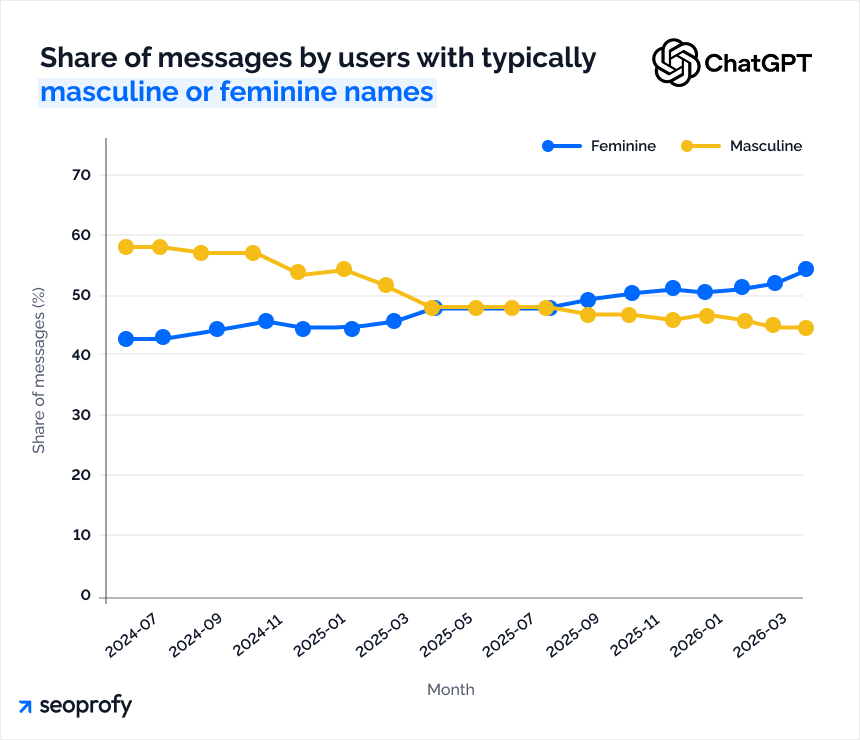
- At the beginning of OpenAI’s audience gender analysis (July 2024), the difference between male and female users was more pronounced (42.1% female vs. 57.9% male name message share). Throughout 2025, there was an almost equal split; in April 2025, the distribution was exactly 50%/50%. (OpenAI)
ChatGPT Users by Age
People of some ages use this platform more than others:
- In March 2026, users ages 25–34 generated the largest share of ChatGPT messages among users who self-reported their age, at 35.8%. (OpenAI)
Of course, people from other age groups also opt for this LLM. Recent trends show that older audiences have begun using the assistant more actively:
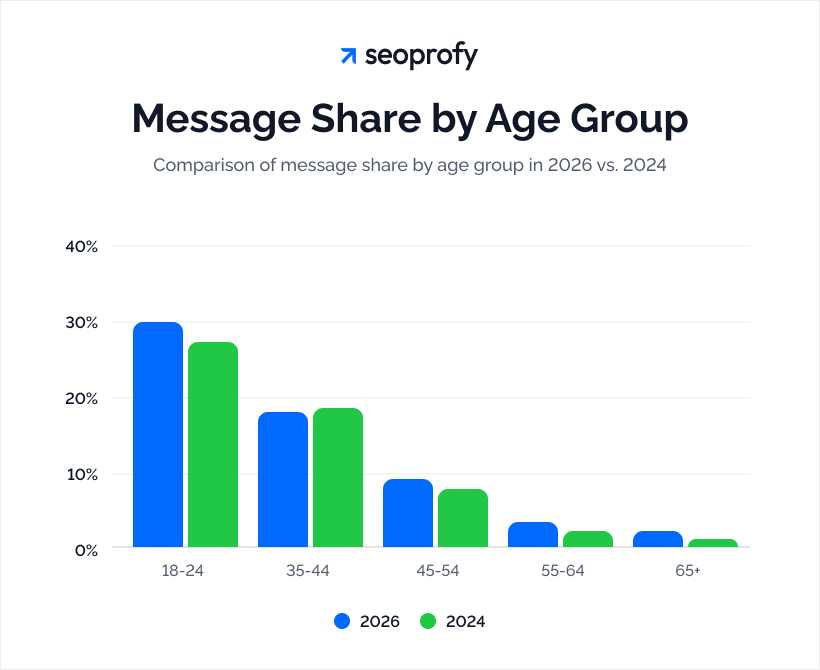
| Age group | Message share, % in 2026 | Message share, % in 2024 |
| 18-24 | 30.3% | 27.1% |
| 35-44 | 18.6% | 18.9% |
| 45-54 | 9.1% | 7.9% |
| 55-64 | 3.7% | 2.7% |
| 65+ | 2.4% | 1.1% |
- Young people (18-24 years old) ask ChatGPT for technical assistance most often, accounting for 33.2% of technical help queries. (OpenAI)
- Employees aged 18-29 are more than twice as likely to solve work tasks with the help of ChatGPT as those over 50. (OpenAI)
Key Growth & Usage ChatGPT Statistics
ChatGPT remains the biggest generative AI platform by web traffic, but its competitors are catching up.
According to Similarweb data cited by FatJoe, ChatGPT’s share of global generative AI web traffic dropped from 76.4% in June 2025 to 52.7% in May 2026. At the same time, Google Gemini grew from 8.9% to 27.3%, while Claude increased from 1.6% to 8.9%.
This does not mean ChatGPT is losing users. Its audience is still growing. What is changing is the market around it: more people are also using Gemini, Claude, and other AI tools.
| AI platform | 12 months ago | May 2026 | 12-month change |
| ChatGPT | 76.4% | 52.7% | −23.7 pp |
| Google Gemini | 8.9% | 27.3% | +18.4 pp |
| Claude | 1.6% | 8.9% | +7.3 pp |
The most significant change is Gemini. Its traffic share more than tripled in one year, making it ChatGPT’s strongest competitor by this metric. Claude is growing quickly too, although it still has a much smaller share.
Growth in ChatGPT Users
How many people use ChatGPT? Here are the main statistics on its user base and growth potential:
- ChatGPT reached 1 million registered users within five days of launch in December 2022. (OpenAI)
- After one year, the platform had already passed 100 million weekly active users. (OpenAI)
- By late 2024, ChatGPT had reached almost 350 million weekly active users. (OpenAI)
- By the end of July 2025, that number had grown to more than 700 million weekly active users, equal to nearly 10% of the world’s adult population. (OpenAI)
- In early 2026, OpenAI reported more than 900 million weekly active users. (OpenAI)
- By August 2026, OpenAI said 1 billion people use ChatGPT every week, the latest ChatGPT-specific user milestone reported by the company. (OpenAI)
The table below shows the clearest growth milestones reported by OpenAI:
| Period | Weekly Active Users | Growth Milestone |
| December 2023 | 100M+ | Passed 100 million weekly users after its first year |
| Late 2024 | ~350M | Nearly 3.5× the level reported a year earlier |
| July 2025 | 700M+ | Reached nearly 10% of the world’s adult population |
| Early 2026 | 900M+ | Continued strong growth into 2026 |
| August 2026 | 1B | Reached one billion weekly users |
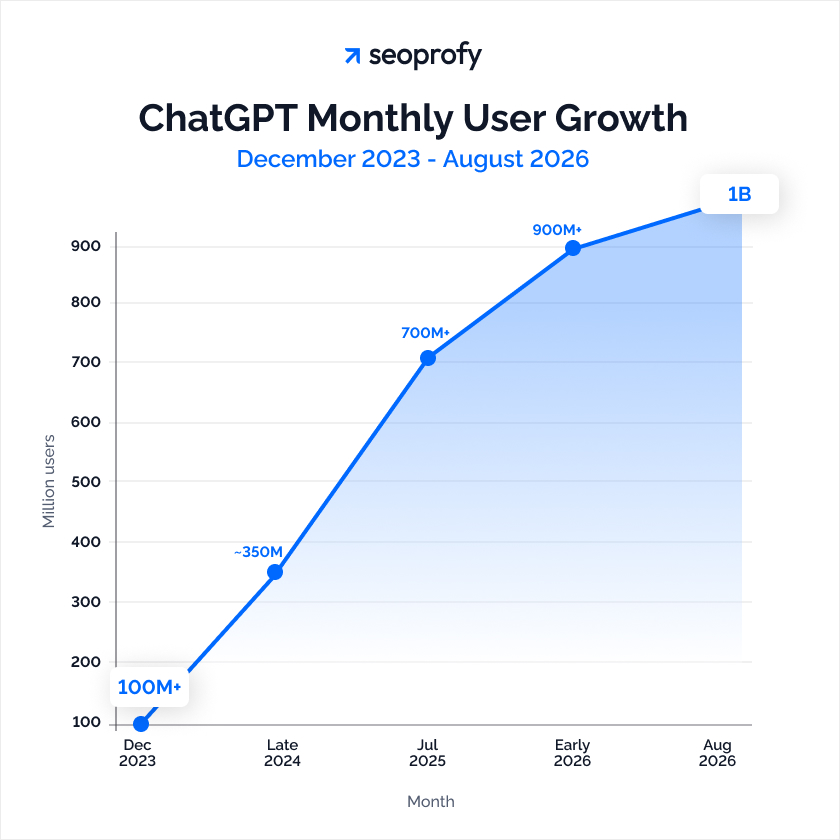
ChatGPT added roughly 300 million weekly users between July 2025 and August 2026, growing from more than 700 million to 1 billion. Growth is naturally slower than it was in the platform’s first years, but the user base is still expanding at a massive scale.
Monthly ChatGPT Traffic and Engagement
ChatGPT outperforms numerous popular platforms when it comes to the amount of traffic and engagement metrics:
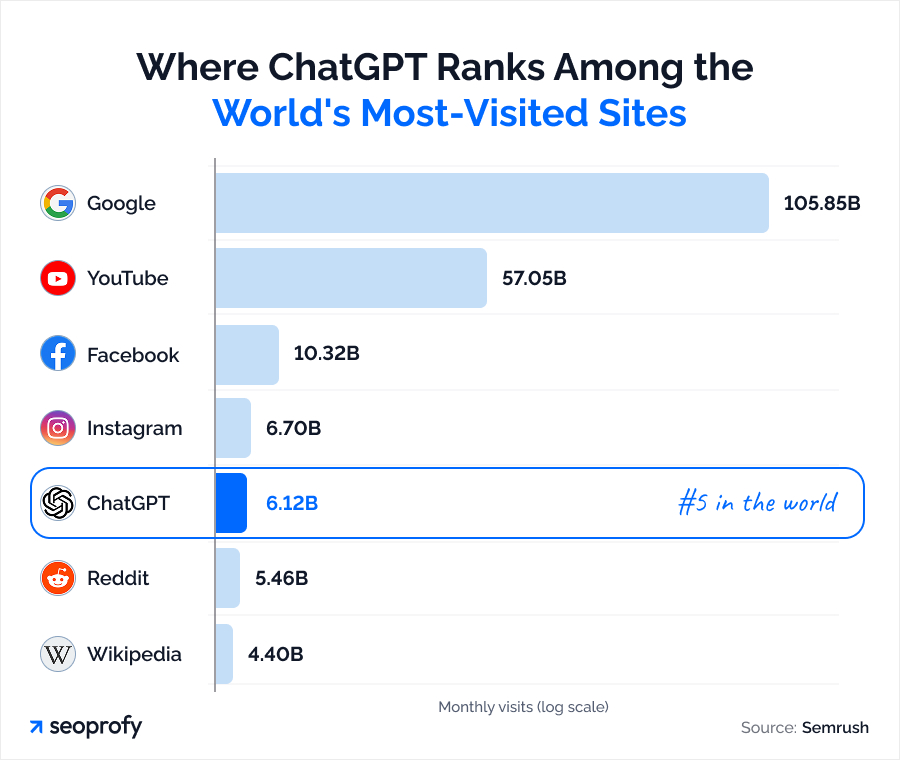
- The platform ranks #5 among the world’s most visited websites, with ChatGPT traffic reaching 6.12 billion monthly visits in July 2026. (Semrush)
Here is a short comparison of the website’s monthly traffic with other popular platforms:
- On average, ChatGPT users spend nearly 12 minutes and 42 seconds on the platform. (Semrush)
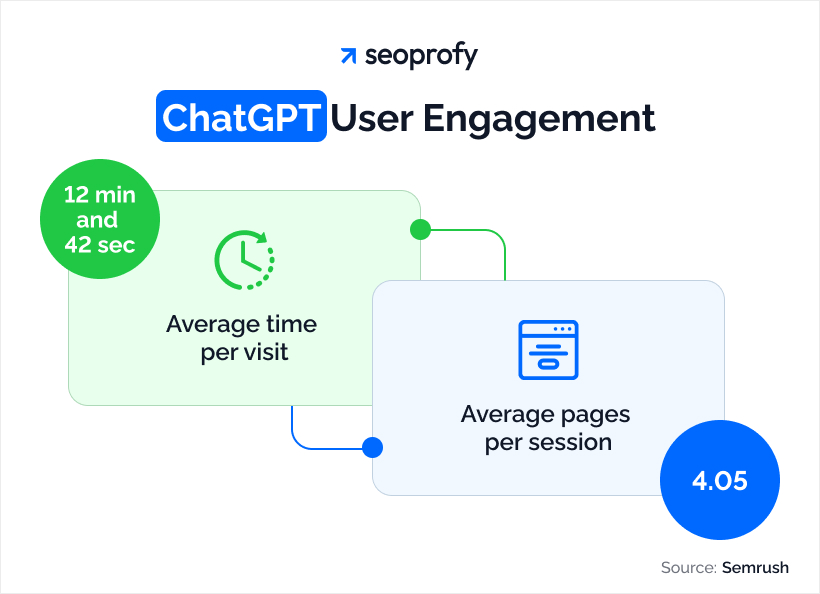
- ChatGPT visitors view an average of 4.05 pages per visit. (Semrush)
- ChatGPT’s bounce rate was 37.48% in July 2026, meaning fewer than four in ten visits ended after viewing just one page. (Semrush)
- Organic search generated about 554.7 million visits to ChatGPT in July 2026, equal to roughly 9% of its total web traffic. (Semrush)
ChatGPT Query Volume
Here’s what OpenAI’s own research and reports from other industry sources reveal about how people use ChatGPT:
- The share of non-work-related messages grew from 59.8% (at the beginning of 2025) to over 68.9% (as of March 2026) of the total ChatGPT usage. (OpenAI)
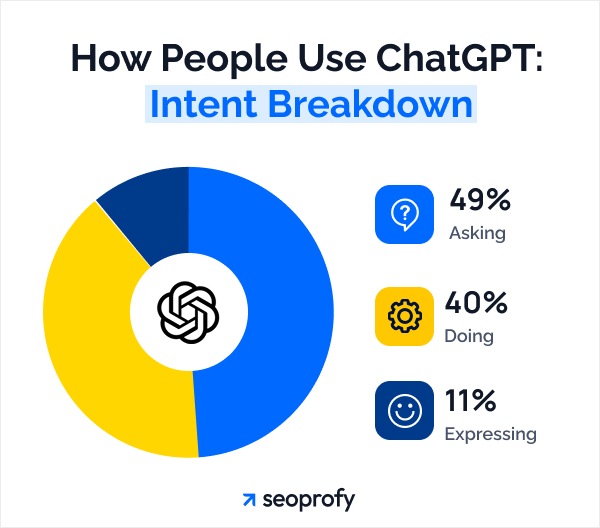
- OpenAI researchers grouped ChatGPT messages into three broad intent types: Asking (49%), Doing (40%), and Expressing (11%). (OpenAI)
- ChatGPT users send about 2.5 billion prompts per day worldwide. (Yahoo Finance)
- The average number of ChatGPT queries per session increased to 1.75 by February 2026. In 2025, it ranged from 1.16 to 1.21. (Semrush)
ChatGPT App Statistics
ChatGPT’s mobile app is one of the most downloaded and highest-earning apps worldwide. Here are the latest figures:
- ChatGPT was the world’s most downloaded app in April 2026, with about 53 million estimated downloads across the App Store and Google Play. (Appfigures)
- The ChatGPT mobile app had about 592 million monthly active users worldwide in February 2026, up 3.6% from November 2025. (Statista)
- ChatGPT generated an estimated $301 million in worldwide mobile consumer spending in April 2026. Its January–April 2026 consumer spending reached about $1.3 billion, up 121% from the same period in 2025. (Appfigures)
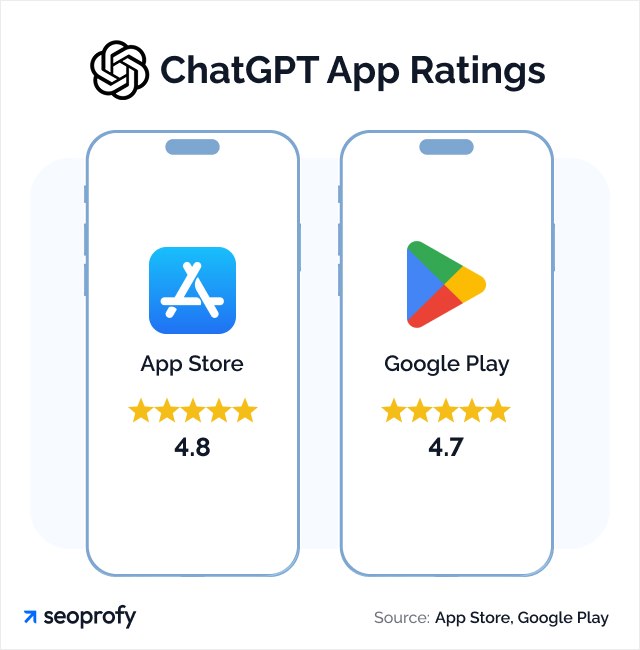
- The ChatGPT app currently has a 4.8 rating on the App Store and a 4.7 rating on Google Play. (App Store, Google Play)
- ChatGPT, Gemini, and DeepSeek accounted for nearly 90% of all time spent in AI assistant apps in Q1 2026. (Sensor Tower)
- ChatGPT generated about $276 million in iOS revenue worldwide in July 2026, while its Android app generated around $89 million. (Sensor Tower).
ChatGPT Market Share vs. Gemini & Claude (2026 Trend)
ChatGPT still leads the market, but users increasingly switch between several platforms depending on the task. Our overview of the top AI search engines compares the main alternatives and how they approach AI-powered search.
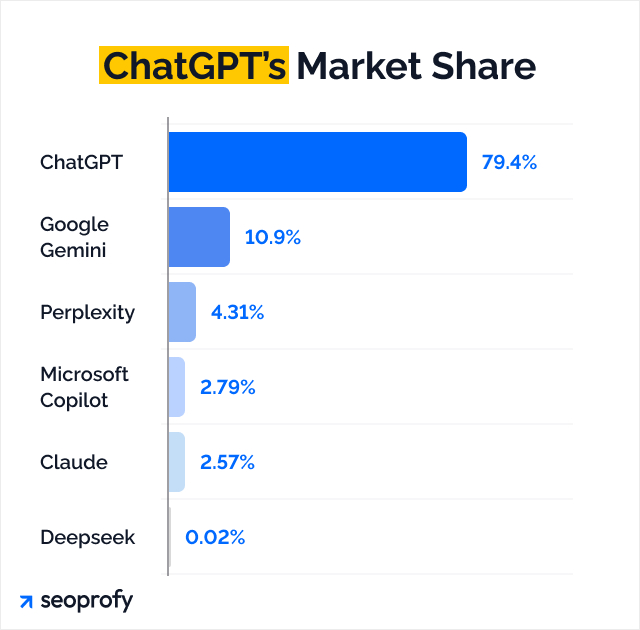
- ChatGPT held 77.92% of the worldwide AI chatbot market in July 2026. Google Gemini followed with 9.9%, while Claude accounted for 3.19%. (Statcounter)
Other big LLMs holding strong positions in the AI industry are:
| Platform | Market share / reach | Latest reported audience | Main use |
| ChatGPT | 77.92% of AI chatbot market share | 1B people use ChatGPT each week | Research, writing, coding, planning, and everyday tasks |
| Google Gemini | 9.9% of AI chatbot market share | 950M monthly active users | General AI help and tasks connected to Google products |
| Claude | 3.19% of AI chatbot market share | Not publicly disclosed | Writing, coding, analysis, and professional work |
| Google AI Overviews | Not directly comparable | 2.5B+ monthly users | AI answers shown directly in Google Search |
These numbers are not measured in exactly the same way. Statcounter tracks chatbot market share, while OpenAI and Google report their audience figures. Google AI Overviews is also part of Google Search, not a standalone chatbot, so it should be treated separately.
- ChatGPT generated about 0.25% of website traffic tracked by Ahrefs in July 2026. AI assistants combined accounted for 0.35%. (Ahrefs)
How ChatGPT Is Changing Search Behavior
The ChatGPT vs Google comparison is not simply about which platform receives more traffic. Users often turn to ChatGPT for conversational research, comparisons, and synthesized answers, while Google remains dominant for broader web discovery and navigational searches.
Here’s what the data says about its influence on search behavior:
- About 18% of non-work-related queries aim to seek information. (OpenAI)
- For work-related use, about 11% of messages involve seeking information. (OpenAI)
- Product and service research also appears in workplace use. In Q1 2026, about 2% of work-related ChatGPT messages focused specifically on information about products or services. (OpenAI)
- ChatGPT enabled web search on 34.5% of queries in February 2026, down from 46% in late 2024. (Semrush)
If you don’t turn on the “Web Search” feature, the platform may use its database to answer your question. It automatically opts for an online search if you ask for recent information, need to get data from specific sources, or if the algorithms aren’t sure how to answer the query.
- The average prompt length for enabling the online search feature is nearly 8.7 words. (Semrush)
- Between 65% and 85% of ChatGPT prompts don’t match any traditional search keyword in the Semrush database. (Semrush)
- At the same time, traditional search language is becoming more common inside ChatGPT. The share of prompts matching conventional search terms increased from 18.9% in October 2025 to 34.9% in February 2026. (Semrush)
- AI is also transforming how people interact with Google results. An Ahrefs study using December 2025 data found that when an AI overview appeared, the average click-through rate for the top-ranking organic result was 58% lower. (Ahrefs)
For SEO teams, this means visibility is far away from being limited to traditional rankings. Users can discover brands through Google results, AI-generated answers, and the sources cited inside them. This makes AI search optimization increasingly important alongside traditional SEO
Traditional SERPs haven’t disappeared, so it still makes sense to include established practices in your SEO strategy, but AI systems are becoming more influential for your online visibility with every passing day. If you want Google’s AI-powered algorithms to mention your brand or your content, AI Overviews SEO is a must.
- When it comes to commercial recommendations, ChatGPT mainly considers authoritative list mentions (41%). (FirstPageSage)
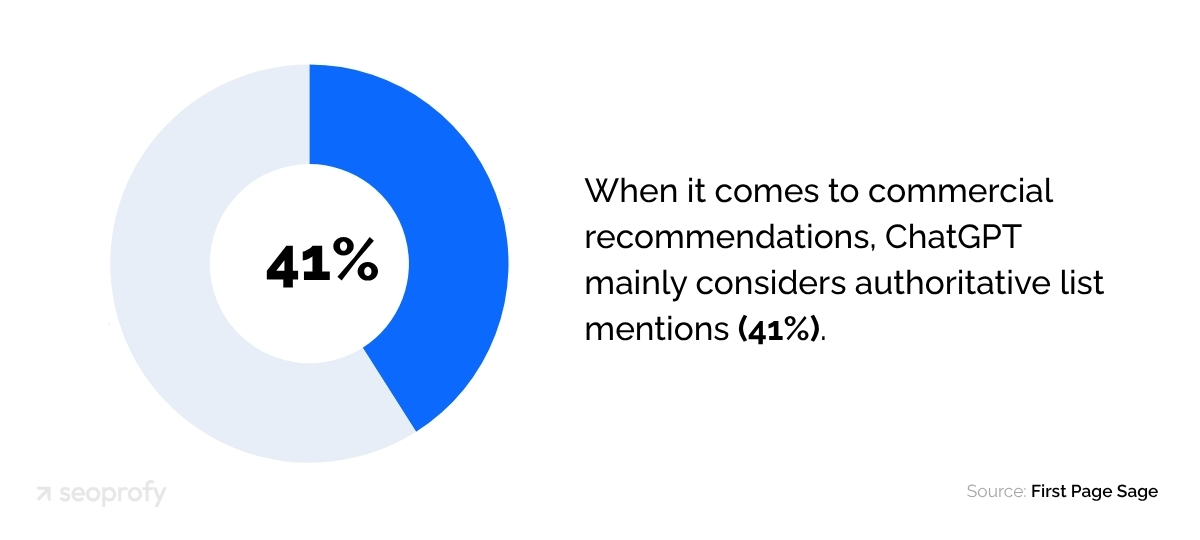
The other details that influence its algorithms include awards and accreditations (18%), online reviews (16%), customer examples and usage data (14%), and social sentiment (11%).
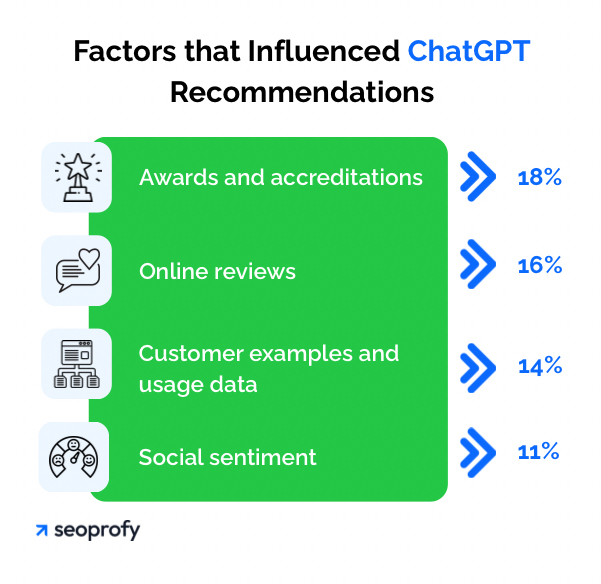
These findings suggest that appearing in AI recommendations depends on more than content published on your website. Third-party mentions, reviews, industry recognition, and clear evidence of customer use can also matter.
These external signals can also affect which sources LLMs reference in their responses. Understanding how citations from AI search work can help identify which websites, page types, and third-party sources are most likely to influence brand visibility.
And that’s precisely where generative engine optimization services are important. Considering the factors that influence AI algorithms’ recommendations, GEO specialists will optimize your content so that LLMs cite it and mention your business.
ChatGPT Usage: Personal vs. Professional (Home vs. Work)
People opt for ChatGPT’s capabilities to handle daily tasks across various industries, including customer service and marketing. Over 86% of SEO specialists have already integrated AI into their strategy and workflows and take it into account when setting SEO goals.
Let’s review how exactly they use this platform for their daily and business tasks:
- Outside of work, people are more likely to use ChatGPT to ask questions and seek information. At work, users are more than twice as likely to ask ChatGPT to produce an output or perform a task. (OpenAI)
- This includes activities such as writing, editing, coding, research, and analysis. OpenAI notes that its consumer-plan dataset excludes enterprise and Codex usage, so it likely underrepresents professional and technical use. (OpenAI)
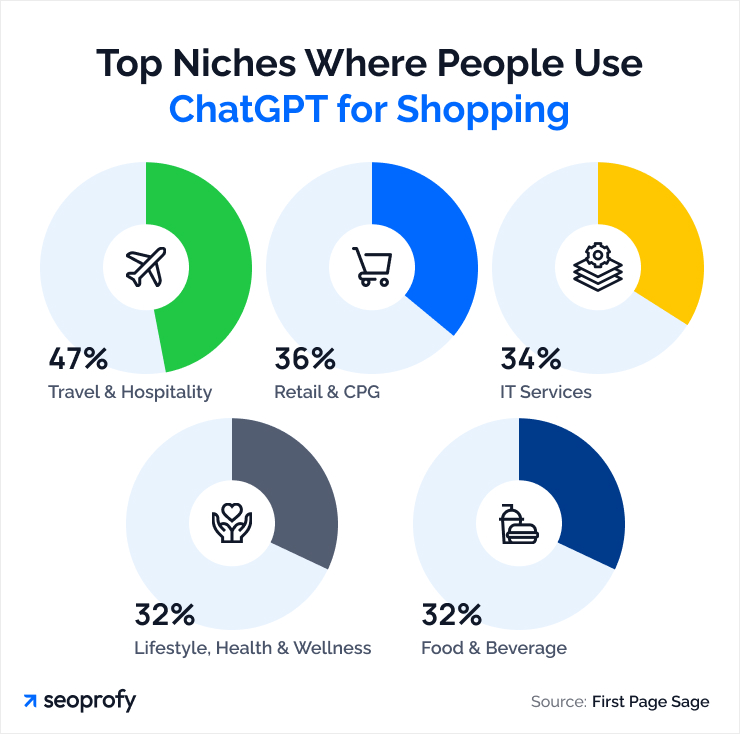
- According to First Page Sage, ChatGPT is most commonly used during the purchasing journey in travel and hospitality (47%), retail and CPG (36%), and IT services (34%). (First Page Sage)
- 28% of employed adults use ChatGPT for their work tasks. (Pew)
- Software development represents the largest industry group among companies where TechnologyChecker detects OpenAI ChatGPT technologies, accounting for 10.27% of its enriched company dataset. IT services and IT consulting follow at 9.06%, while technology, information, and internet companies account for 8.23%. (TechnologyChecker)
At the same time, OpenAI’s platform is also popular with experts from other niches. Here’s an overview:
- In the US, the information technology industry leads in AI adoption, holding the largest share of ChatGPT weekly engaged users (27%). (OpenAI)
According to the FirstPageSage research, other top fields in the US where companies actively implement the AI assistant into their business processes are the following:
| Industry | Share of Customers Using ChatGPT During Purchase Research | Estimated Economic Influence |
| Food & Beverage | 32% | $546 billion |
| Home Services | 31% | $385 billion |
| Healthcare | 29% | $378 billion |
| Automotive | 29% | $243 billion |
| B2B SaaS | 28% | $229 billion |
| Advertising & Marketing | 27% | $156 billion |
| Fintech | 25% | $135 billion |
| Insurance | 23% | $104 billion |
| Real Estate | 21% | $66 billion |
| Financial Services | 21% | $21.7 billion |
| Education | 19% | $12.6 billion |
- The finance and insurance industry ranks 10th out of 11 in usage intensity. (OpenAI)
- Coding, writing, and research are the basic tasks for technical users. (OpenAI)
- Outside of work, people are more likely to use ChatGPT to ask questions and seek information. At work, they are more than twice as likely to use it to produce an output or perform a task. (OpenAI)
- ChatGPT application usage also varies sharply by business function. Writing and communication account for 78.3% of sales messages and 72.8% of marketing messages, while coding accounts for 48.9% of software development messages. (OpenAI)
The most common ChatGPT tasks also vary across technical roles. Coding, writing, and research consistently rank among the top uses, though their order differs by job category.
| Job Category | Top ChatGPT Tools and Features |
| IT | Retrieval, Search, Knowledge Base Access |
| Engineering | GPTs, Programming Tools, Data Analysis |
| Analytics | Data Analysis, Deep Research, Advanced Reasoning |
| Research and R&D | Deep Research, Reasoning Models, Data Analysis |
| Marketing and Sales | Search, File Uploads, Media Generation |
OpenAI notes that most departments rely on core ChatGPT tools such as search, data analysis, file uploads, and retrieval. Technical teams use advanced capabilities more heavily. IT professionals are especially likely to rely on retrieval and search, while engineering teams show stronger use of GPTs, programming tools, and data analysis.
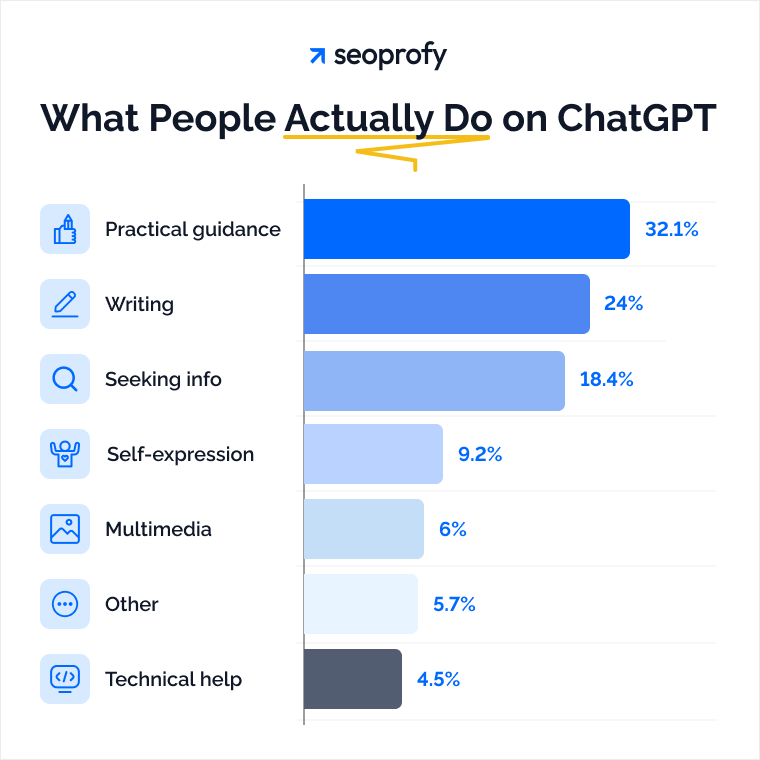
- 32.1% of ChatGPT messages provide practical guidance. (OpenAI)
The table below covers the categories of activities popular with the users of OpenAI’s platform:
| Use case scenario | Share |
| Practical guidance | 32.1% |
| Writing tasks | 24% |
| Seeking information | 18.4% |
| Self-expression | 9.2% |
| Multimedia | 6% |
| Other | 5.7% |
| Technical help | 4.5% |
Overall, ChatGPT application usage is strongly task-oriented. Most conversations center on practical guidance, writing, and information seeking, while self-expression and technical help make up a much smaller share.
ChatGPT Referral Traffic Statistics
Where do people come from to ChatGPT, and what do they do using it? Here are the core sources that drive traffic to OpenAI’s major platform and where users go after leaving it:
- 82.72% of ChatGPT users come from direct traffic. (Semrush)
Other important traffic sources are:
| 8.16% | |
| OpenAI’s website | 0.85% |
| Google Accounts | 0.59% |
- About 16% of users visit OpenAI’s website after using ChatGPT. (Semrush)
The top places that ChatGPT users visit after leaving the platform also include:
| 9.2% | |
| YouTube | 1.9% |
| National Institutes of Health (NIH) | 0.9% |
| Apple’s website | 0.87% |
- In May 2026, ChatGPT accounted for approximately 80% of the overall AI referral traffic. (Trakkr)
ChatGPT’s Impact Stats on SMB Marketing and Operations
Improved customer service, enhanced lead generation, advanced AI SEO techniques, and faster content creation — that’s only the tip of the iceberg.
AI for Customer Support
Companies spend about 8% of their recurring revenue on customer support on average. However, our ChatGPT stats show that AI can significantly reduce this cost:
- 20% of ChatGPT’s API activity is represented by customer service and content generation. (OpenAI)
- Customer support is the most popular use case for ChatGPT among financial organizations. It’s also the 4th most popular use for technology companies and professional services. (OpenAI)
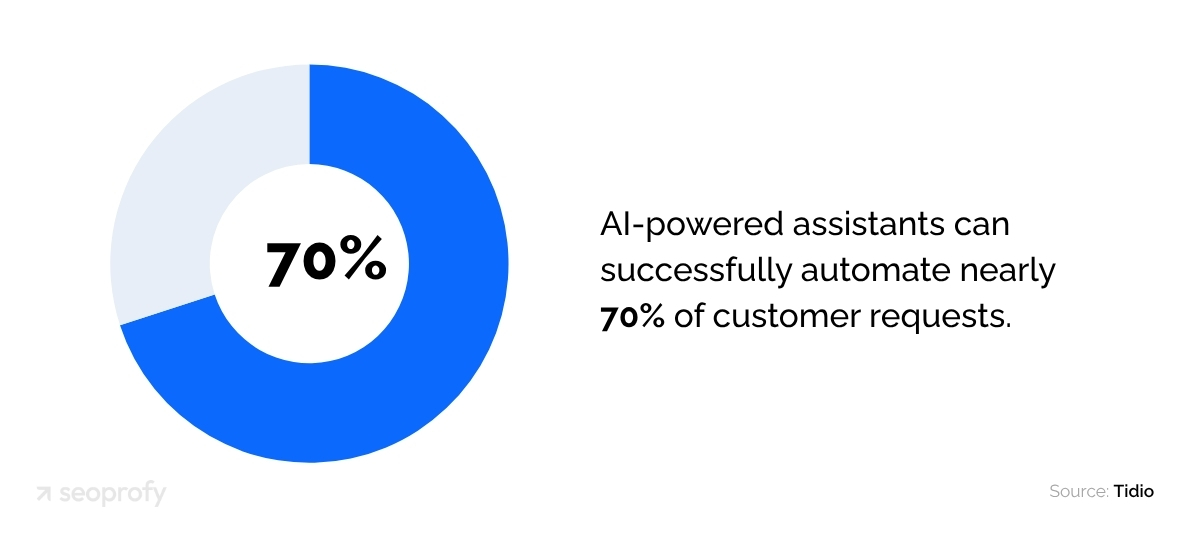
- AI-powered assistants can successfully automate nearly 70% of customer requests. (Tidio)
- ChatGPT officially supports 59 languages. (OpenAI)
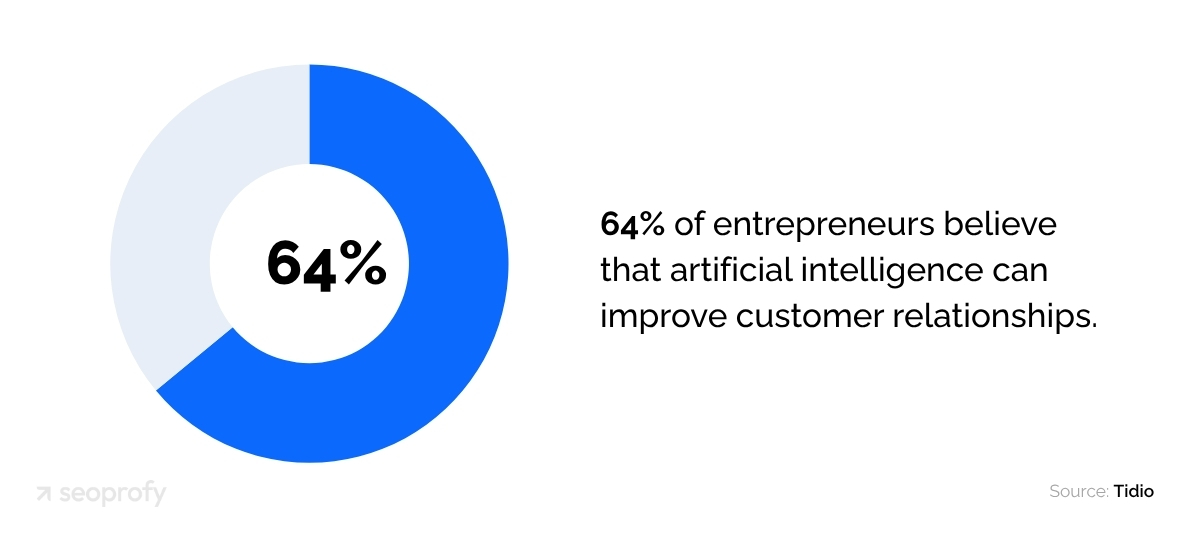
- 64% of entrepreneurs believe that artificial intelligence can improve customer relationships. (Tidio)
- 90% of people still prefer a human customer service specialist to an AI chatbot (SurveyMonkey).
Content Creation & Marketing
People often opt for AI content for SEO, as chatbots can craft blog posts with targeted keywords and a clear structure, increasing website growth by approximately 5%. However, ChatGPT usage statistics reveal that this technology can assist you with other marketing tasks:
- As of April 2026, only 5% of ChatGPT use cases involve marketing copywriting. (FirstPageSage)
- In 2025, 44% of 879 surveyed marketers admitted using ChatGPT, making it the most common AI model for content creation. It was followed by Gemini (15%) and Claude (10%). (Ahrefs)
- A typical 10-page document written in English will cost a user approximately 5,000-7,000 tokens. (AI Toolbox)
- As of 2026, OpenAI’s o1 and o3-mini models have the largest word limit, which is approximately 150,000 words. (AI Toolbox)
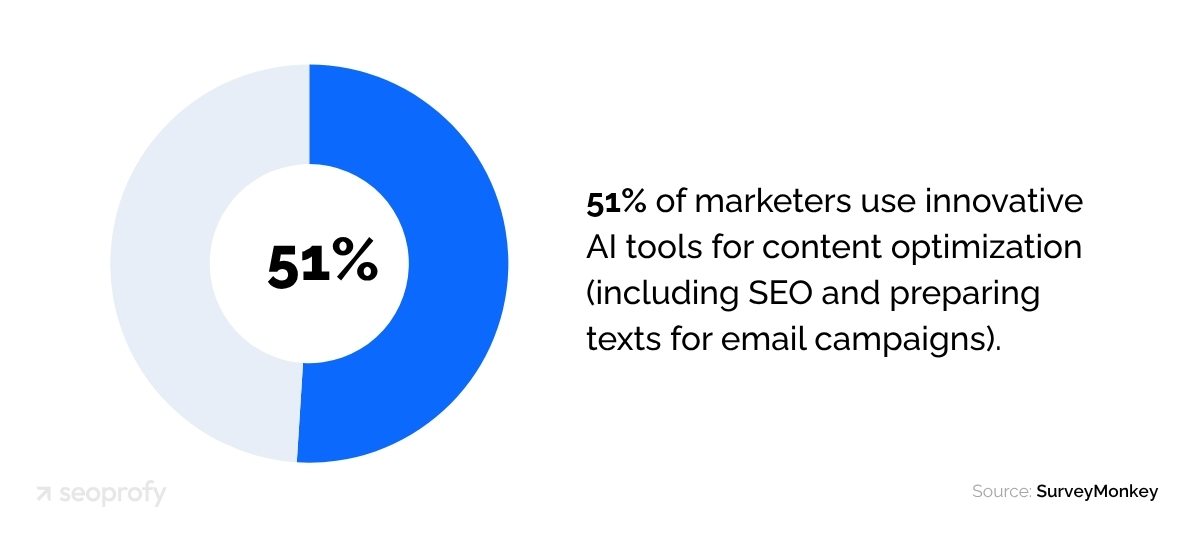
- 51% of marketers use AI tools for content optimization (including SEO and preparing texts for email campaigns). (SurveyMonkey)
- 70% of marketing specialists believe that AI will play a greater role in their work, while 48% of marketers claim that the adoption of artificial intelligence is their primary goal. (SurveyMonkey)
- 43% of marketers believe that AI is important for the development of their SMM strategy. (SurveyMonkey)
Business Process Automation
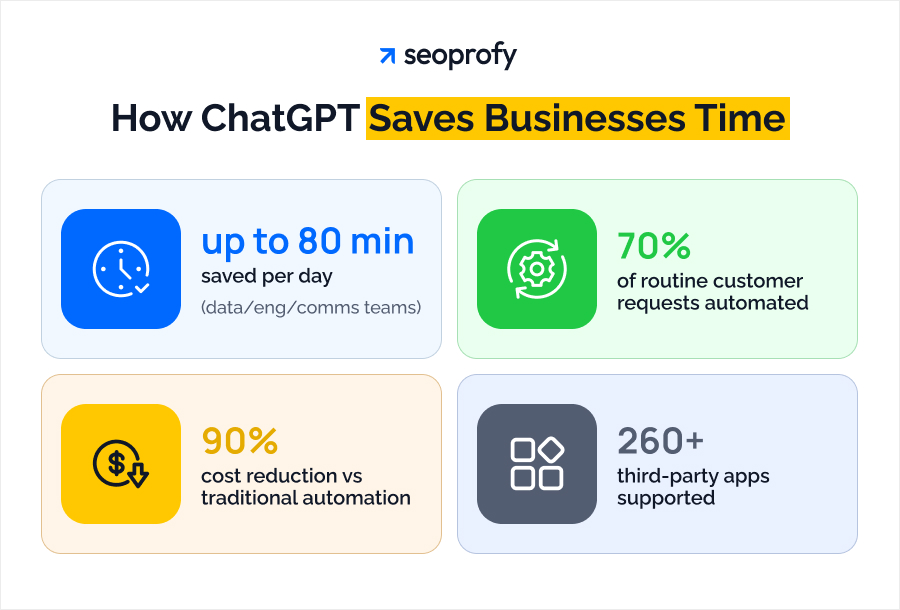
LLMs can automate a variety of business processes, including lead generation, scheduling, data analysis, and even identifying coding errors.
- ChatGPT enterprise users save up to 60 minutes per active working day. Meanwhile, people who work on tasks related to data science, engineering, and communications save up to 80 minutes per day. (OpenAI)
- Agentic workflow automation ranks among the five most common use cases among technology companies, professional services, and financial organizations. (OpenAI)
- OpenAI’s model can automatically handle 80% of routine business tasks, resulting in a 90% cost reduction compared to traditional automation.
- As of May 2026, the platform supports over 260 third-party apps. (ChatGPT)
- ChatGPT can analyze data uploaded in various popular file formats, including XLS/XLSX, CSV, PDF, and JSON. (OpenAI)
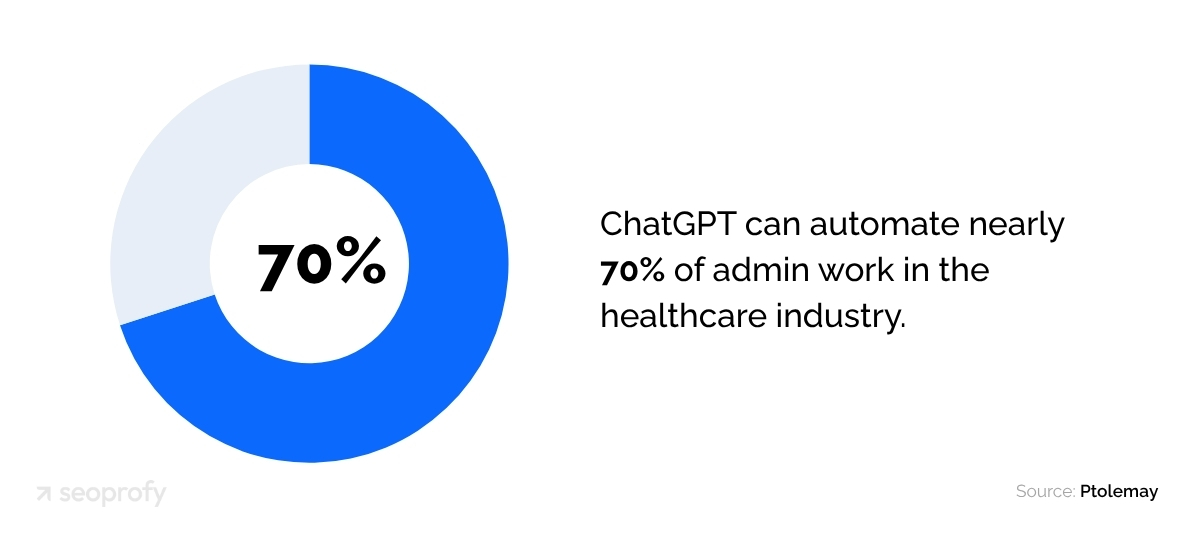
- ChatGPT can automate nearly 70% of admin work in the healthcare industry. (Ptolemay)
OpenAI Revenue & Business Statistics
Although OpenAI started as a non-profit organization, it reported generating $2B in monthly revenue in March 2026.
- Private investors value OpenAI at over $850. (CNBC)
- It took OpenAI less than three years after launching its successful chatbot to hit $10 billion in annual ChatGPT revenue. (CNBC)
- OpenAI expects its revenue to reach $280 billion in 2030. (Fortune)
- The company plans to double its workforce from 4,500 to 8,000 employees by the end of 2026. (Reuters)
- In 2025, only 5% of ChatGPT’s weekly active users (about 35 million people) paid for “Plus” or “Pro” subscriptions. (Reuters)
- OpenAI expects that 8.5% of an estimated 2.6 billion weekly users (nearly 220 million people) will subscribe to ChatGPT by 2030. (Reuters)
Paid-user growth is one indicator of subscription performance, but OpenAI has not disclosed a verified retention rate for ChatGPT Plus or Pro. Public data currently shows how many users pay, not how consistently they remain subscribed over time.
Subscription Tiers & Purchasing Trends
ChatGPT offers paid plans for individual users and businesses, but OpenAI currently publishes much more data on business adoption and workplace usage than on retention by subscription tier.
- OpenAI now serves more than 7 million ChatGPT workplace seats, while the number of ChatGPT Enterprise seats has increased approximately 9× year over year. (OpenAI)
- Weekly ChatGPT Enterprise message volume has grown approximately 8× since November 2024, and the average worker sends 30% more messages than a year earlier. This suggests that companies are adding seats and using ChatGPT more intensively after adoption. (OpenAI)
- The median industry sector expanded its OpenAI enterprise customer base by more than 6× year over year, while even the slowest-growing sector increased by more than 2×. (OpenAI)
- Technology is the fastest-growing sector for enterprise customers at 11× YoY, followed by healthcare at 8× and manufacturing at 7×. (OpenAI)
- By total customer scale, ChatGPT Enterprise adoption is currently highest in professional services, finance, and technology, indicating that these industries are among the largest purchasers of enterprise AI access. (OpenAI)
- OpenAI reports that weekly users of Custom GPTs and Projects have increased 19× year to date, and approximately 20% of Enterprise messages are now processed through Custom GPTs or Projects. This points to a shift from occasional AI use toward repeatable business workflows. (OpenAI)
- OpenAI now has more than 1 million business customers, providing another indication that paid business adoption has moved well beyond early experimentation. (OpenAI)
OpenAI does not currently disclose a verified one-year retention rate for ChatGPT Plus, Pro, Business, or Enterprise. For that reason, figures such as “59% Plus retention” or “88% Enterprise retention” should not be presented as established statistics without a transparent third-party source.
For business buyers, Enterprise seat growth, customer growth by industry, and increasing usage intensity currently provide the strongest public indicators of purchasing momentum.
ChatGPT’s Future: Trends and Expectations for 2026
Any ChatGPT statistics wouldn’t be complete without a review of the project’s future. Here are the latest data and some interesting predictions.
GPT-5.5 and Beyond
On the 23rd of April, 2026, OpenAI finally released its innovative GPT-5.5. Bringing together the best features of OpenAI’s models, it significantly expanded the capabilities of artificial intelligence and laid the foundation for advanced AI SEO tools. So, how has GPT-5.5 shown itself so far?
- GPT-5.5 gets the highest score across nine AI evaluation benchmarks when compared to other LLMs. (OpenAI)
- GPT-5.5 achieved 84.9%, the highest score among competitive models, on GDPval, a special assessment that tests LLMs’ ability to perform across 44 different professions. (OpenAI)
- GPT-5.5 tokens are 2x more expensive than GPT-5.4 on standard pricing, which is $5/$30 per 1 million input/output tokens. (AMP)
- GPT-5.5’s context window is nearly 1 million tokens. (AMP)
ChatGPT’s Market Influence in 2026
OpenAI and its ChatGPT are undoubtedly key players in the AI market. At the same time, the competition continues to grow.
- ChatGPT holds the #1 spot among AI services, according to Cloudflare’s traffic analysis. The platform is followed by Claude, Google Gemini, and Perplexity. (Cloudflare)
- GPTBot is among the most active AI bots that scan websites and collect data. It sends nearly 10.2% of all HTTP requests. (Cloudflare)
- Ahrefs estimated that 0.19% of total web traffic in April 2026 came from ChatGPT, while the combined web traffic share of other popular AI assistants was 0.09%. (Ahrefs)
Enhancements for Business Use
Although the share of work-related consumer queries has been decreasing, reaching 31.1% in March 2026, business users (including entrepreneurs and enterprise accounts) are more likely to pay for higher subscription tiers and APIs. Thus, most updates in ChatGPT target enhancements for professional use.
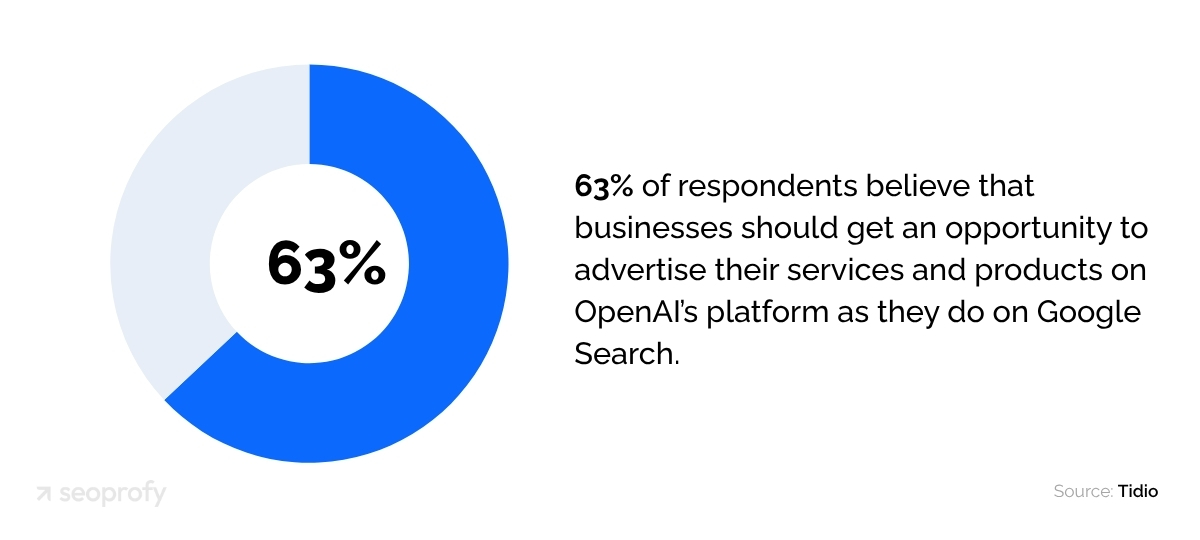
- On the 7th of May 2026, OpenAI began rolling out a version of the chatbot with ads for free accounts. This opens new possibilities to advertise your business’s products or services on the platform. (OpenAI)
- Codex, another popular product developed by OpenAI, is expected to be adopted by more enterprises following OpenAI’s collaboration with Dell. (OpenAI)
- In May 2026, the company launched the OpenAI Deployment Company, which aims to help other companies develop and deploy AI systems. Its investment and consulting partners sponsor more than 2,000 businesses globally, working with them to implement artificial intelligence in their workflows. (OpenAI)
Making the Most of ChatGPT in 2026
ChatGPT consumption data points to a broader shift in how people search: users ask conversational questions, compare options inside AI tools, and receive summarized answers instead of reviewing multiple search results.
For businesses, rankings are no longer the only factor determining discoverability. Content also needs to provide clear, reliable information that LLMs can understand and cite.
SeoProfy combines traditional SEO with AI-focused optimization. Our professional SEO agency can identify which pages and topics already appear in ChatGPT and other LLMs, where competitors are cited instead, and which content or technical gaps need attention.
This includes AEO, topical coverage, entity signals, internal linking, crawlability, source quality, and content structure. These improvements help strengthen your presence for product research, service comparisons, recommendations, and other commercially relevant queries.
Contact SeoProfy to assess your current AI presence and prioritize the pages and topics with the strongest potential across search engines and LLMs.

Julia Lubianytska is a Copywriting Team Lead at SeoProfy with over 7 years of experience in copywriting and editing. She works closely with copywriting teams, helping writers craft clear and thoughtful content for SaaS products, IT services, and businesses in the legal and medical fields. Julia enjoys turning complex topics into easy-to-understand, trustworthy content, focusing on structure, clarity, and consistency to ensure the content is genuinely helpful for real people, not just search engines.