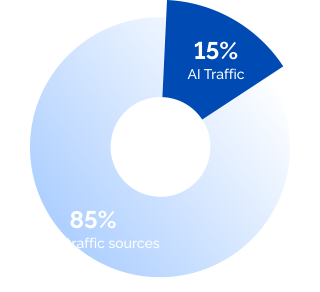



AI content can be good for SEO when it’s accurate, helpful, and genuinely useful to readers — the same standard Google applies to any content. In general, using AI tools in your content creation process won’t get your site penalized. What gets sites penalized is publishing low-quality, unedited AI-generated content at scale.


AI-assisted content can rank just as well as human-written pieces — but only when it’s reviewed, edited, and enhanced with real expertise and a perspective that’s genuinely yours. If it’s not, it carries significant risks to your search visibility and reputation.
This article covers how Google treats AI-generated content, what the data says about its ranking performance, and the specific risks of using it. We’ll also share some tips for strategically using AI for your content needs.
- AI content can rank well in search results as long as it’s accurate, helpful, and meets Google’s quality standards.
- Google doesn’t penalize websites just for using AI. The problem is low-quality content published to manipulate search rankings.
- Over 86% of marketers edit the content generated by AI tools to add their human perspective and expertise.
- The main issues with AI content creation tools are inaccurate data and a lack of E-E-A-T signals.
- The biggest risks come from publishing unedited AI content at scale. Websites that use this tactic lose traffic and rankings after Google’s core and spam updates.
How Does AI Content Affect SEO?
The answer depends on how you use AI in your content process. Here’s what the data shows — and what SEO professionals are seeing in practice.
Flying Cat Marketing surveyed marketing teams to see how content generation correlated with SEO performance. Their findings showed no direct link between AI-generated content and search engine rankings.
The study split respondents into four groups, ranging from “no AI use at all” to “AI-generated blog posts with minimal human editing.” Regardless of AI usage, 67% of all respondents reported an increase in organic traffic over six months. Even the group that relied most heavily on AI (more than 50% of content generated by AI) reported similar results to those who used no tools at all.
That lines up with what Peter Rota shared on LinkedIn. He used AI to publish five blog posts per month, each supported by five quality backlinks. The content made up about 21% of the site’s total indexed pages and grew steadily through four core updates and three spam updates. Peter summed it up like this:
“I’m a proponent of publishing AI content at a steady pace. If you just start blasting a site with AI content that adds no new value, you’re more likely to take some hits.”
Peter Rota
He also flagged some important context. The site he worked with already had strong branded search traffic, and before implementing AI content strategies, he overhauled meta descriptions, titles, internal linking, and headers.
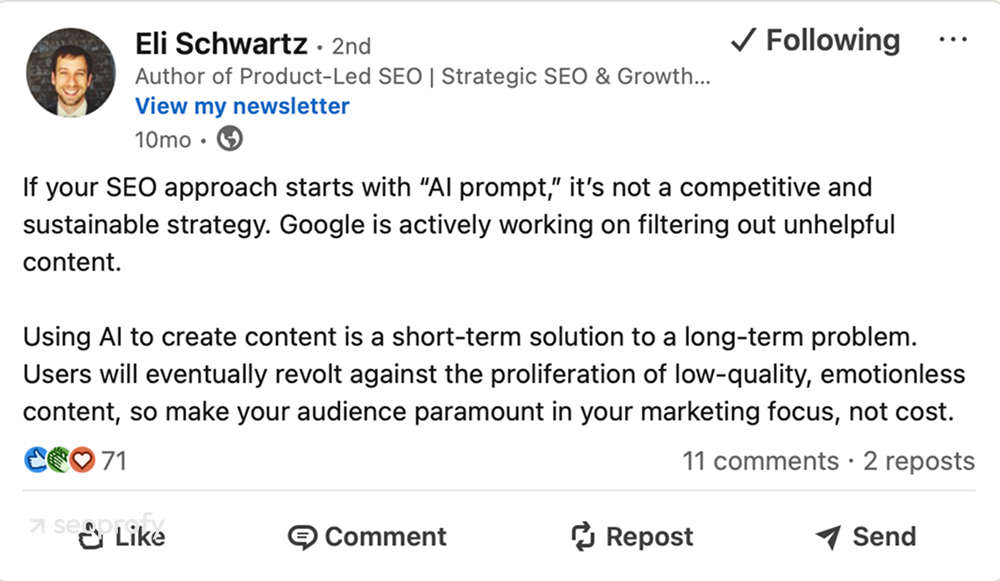
Despite the effectiveness of AI content that some companies have seen, there are still SEO experts who aren’t convinced it’s a long-term strategy. Eli Schwartz, author of Product-Led SEO, wrote on LinkedIn:
But what does Google say about how AI content impacts SEO, and can it lead to penalties? Let’s find out.
Google’s Stance on AI-Generated Content
Back in early 2023, Google published a clear statement on AI-generated content in its Search Central blog. That post remains the foundation of Google’s position today: the search engine doesn’t automatically penalize content just because it was produced with AI.
What matters is whether the content is helpful, accurate, and made with users in mind, not whether a human or a tool wrote the first draft. Here’s how Google phrased it:
“Using automation—including AI—to generate content with the primary purpose of manipulating ranking in search results is a violation of our spam policies. […] This said, it’s important to recognize that not all use of automation, including AI generation, is spam.”
The search engine keeps advancing its spam detection with regular updates. With the March 2026 Core Update, Google continued its push to reward genuinely helpful content. The update followed an established pattern: pages that demonstrate real expertise and serve users well tend to gain ground, while thin, low-effort content — regardless of how it was produced — tends to lose it.
Therefore, AI-generated content can rank as long as it aligns with Google’s broader guidelines.
So, Can Google Detect Content Written with AI?
There’s no simple answer here, and it’s worth separating what Google has confirmed from what’s still speculation.
In 2025, Google made some changes to how it evaluates content quality. Human raters were asked to check whether the main content was created using automated or generative AI tools without any real value or originality. They could assign a lower rating to such text. The information was shared by John Mueller during Search Central Live in Madrid.
The company has developed its own AI watermarking technology called SynthID, built by Google DeepMind. SynthID embeds invisible signals into content generated by Google’s own AI tools — and can detect those signals later. Users can already ask Gemini to check whether an image, video, or audio clip was created or altered by Google’s AI:
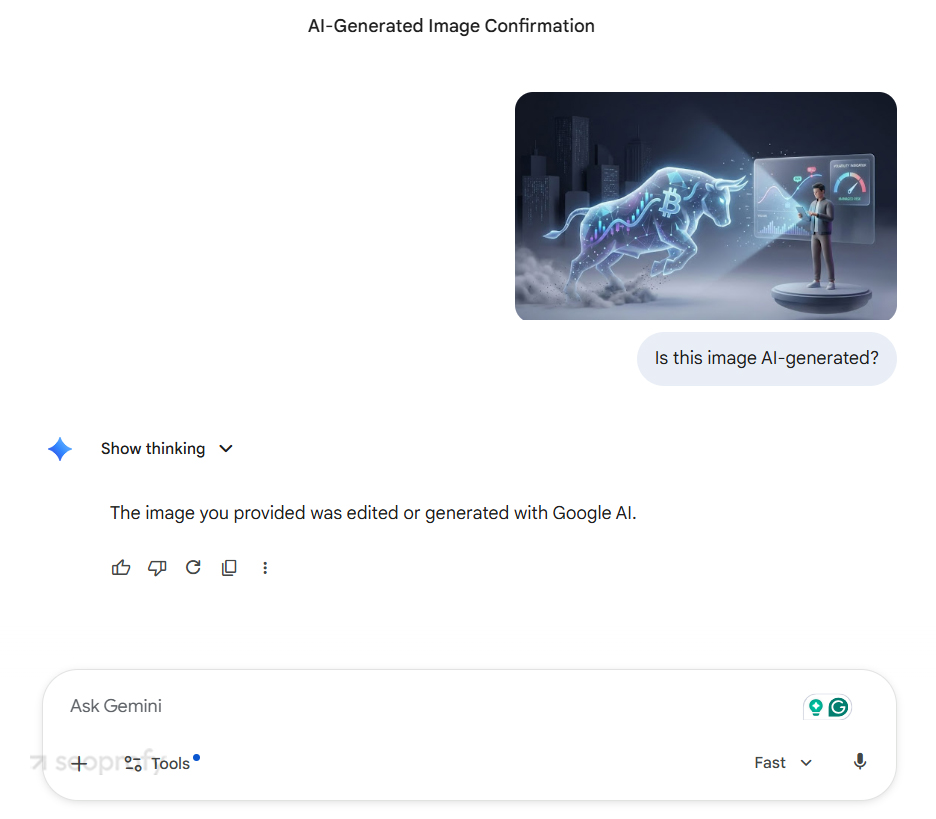
However, SynthID’s full detection features are not publicly available, and Google hasn’t confirmed how broadly the technology is deployed within Search ranking systems. For content generated by other AI tools — ChatGPT, Claude, Grok, and others — there is no confirmed information about Google’s ability to detect it at the text level.
What is clear is that Google’s quality systems are designed to identify and demote unhelpful, low-quality content — and that’s the risk that actually matters.
What’s Wrong with AI-Generated Content?
AI can shorten your SEO timeline significantly — but fast doesn’t mean effective. There are specific ways AI content can fall short for SEO, brand trust, and user experience.
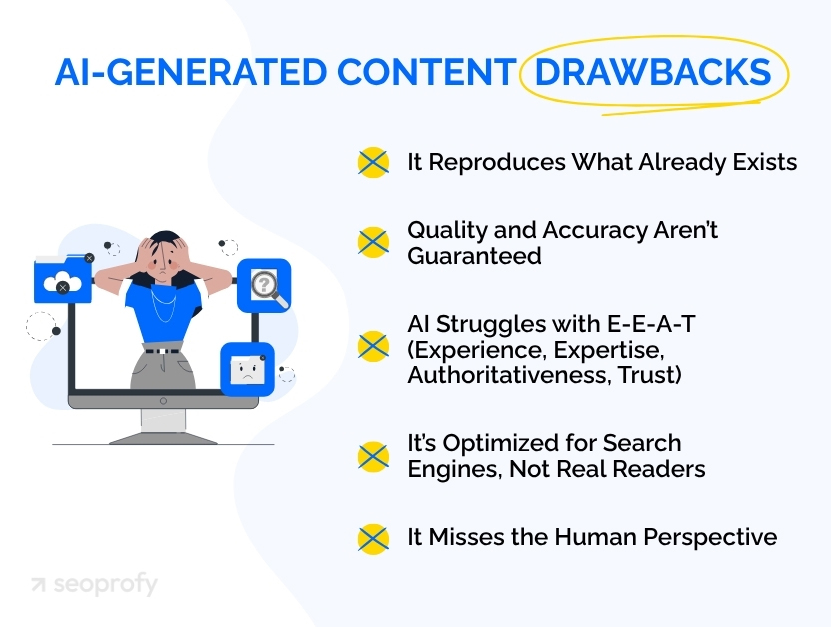
It Reproduces What Already Exists
A major weakness of AI-generated content is that it tends to summarize what’s already online rather than contribute something new. When dozens of sites feed similar prompts into similar models, the output starts to look nearly identical. Google’s SpamBrain system is built to spot this kind of low-effort material. Pages that offer no original value risk penalties under Google’s spam policies, whether they were written by a person or generated by a tool.
Quality and Accuracy Aren’t Guaranteed
According to our statistics, 60% of professionals believe AI-generated content is not always accurate, and they’re not wrong. Large language models (LLMs) like ChatGPT or Claude don’t do actual fact-checking — they generate what sounds plausible based on their training data. This produces hallucinations: confidently stated facts that are simply wrong. One study found that ChatGPT 4.0 hallucinated 28.6% of citations it produced.
What’s more, LLMs have knowledge cutoffs, meaning they can’t account for recent developments without access to up-to-date sources. Some tools can search the web to find supporting information, but they can just as easily hallucinate and cite a webpage that doesn’t exist, choose outdated data, or fail to evaluate the quality of a website.
AI Struggles with E-E-A-T (Experience, Expertise, Authoritativeness, Trust)
Google uses E-E-A-T to evaluate whether a piece of content was produced by someone with actual experience and knowledge in the subject area. The problem with AI-generated content is that it often lacks the things this framework prioritizes: first-hand experience, credibility, and authoritativeness. As a result, it gets deprioritized in search.
This applies across the board but carries more weight in industries like finance, health, legal, B2B software, and any other category that impacts people’s decisions or well-being. These YMYL (Your Money or Your Life) websites face higher stakes because inaccurate or misleading articles can have real consequences for readers.
With the growing popularity of AI search tools and features like Google’s AI mode, clear authority and credibility are getting even more critical. Although the search algorithms AI models use may not be exactly the same as those of traditional search engines, they still aim to deliver reliable results aligned with user intent. That’s why many content marketers believe that E-E-A-T signals are also important for answer engine optimization.
So, if you use AI tools in your SEO content strategy, don’t undervalue human oversight and don’t stop at the first draft. Add your own experience, bring in your brand voice, and have a subject-matter expert review it before it goes live. And to make your content SEO ready for AI search, consider professional AI SEO services.
It’s Optimized for Search Engines, Not Real Readers
Some AI content tools are built to optimize for keywords above all else. In its spam policies, Google has been clear about this. Keyword stuffing is flagged as a manipulative practice. If your content repeats target terms unnaturally or tries to cram in every variation of a keyword, it can be penalized or ignored entirely. Here’s what Danny Sullivan, a Google liaison, says about it:
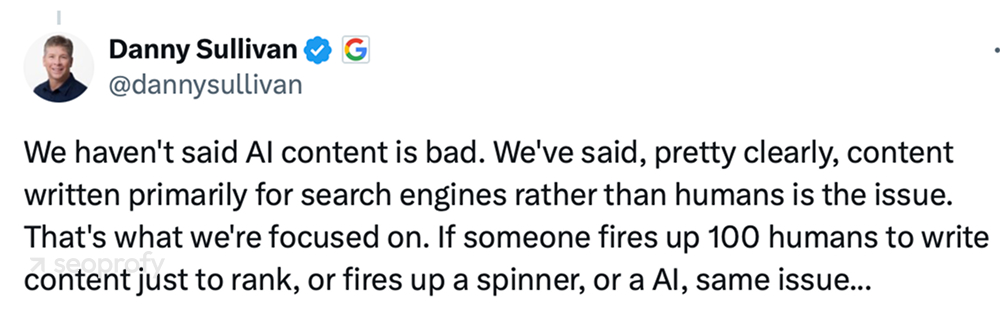
To avoid a negative impact of AI-generated content on SEO, write with intent and use keywords organically. Humans are the ones who will actually read your content, so make sure it sounds like it was written for them.
It Misses the Human Perspective
Human perspective makes a text relatable and interesting, whether it’s sharing a personal experience, addressing specific pain points, or simply knowing when to use a different tone. An average AI-written piece, if left unedited, provides surface-level tips and zero perspective. It won’t earn the kind of engagement — shares, comments, return visits — that both Google and Bing take into account.
The Risks of AI-Generated Content for SEO
Taking shortcuts in your SEO content creation process can come with a cost. These risks are especially serious for websites that use AI heavily and without editing.
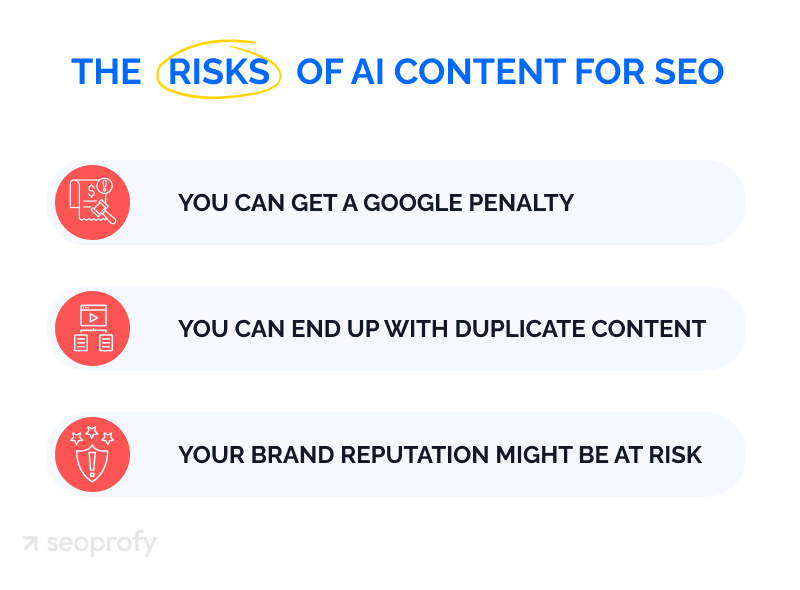
Google Penalties
This is the most serious risk, and it’s already happened at scale. Google’s ranking systems have specific content quality criteria that unedited AI-generated content often can’t meet. Publishing hundreds of low-quality articles to scale content quickly puts you directly in the path of a manual action.
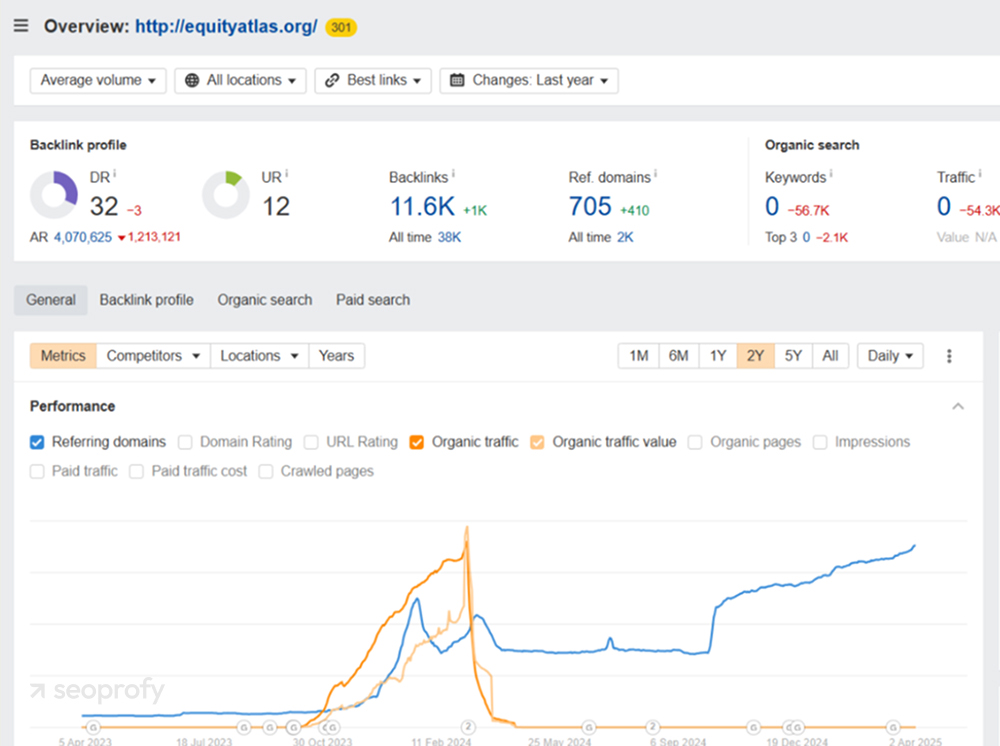
For example, after its March 2024 Core Update, Google issued manual actions against sites that failed to meet its quality guidelines. A manual action means Google moderators have reviewed your content and removed it from search results.
And when that happens, your site can get completely deindexed. Spencer Haws shared it in his tweet:
“At least 1,446 Google Manual Actions have been applied since March 5th… These sites are completely deindexed. Cumulative traffic loss of 20 million visitors per month.”
Spencer Haws
One of the examples of such websites is EquityAtlas. Their site had more than 4 million monthly organic visits. And then in March 2024, they had a sudden drop in organic traffic.
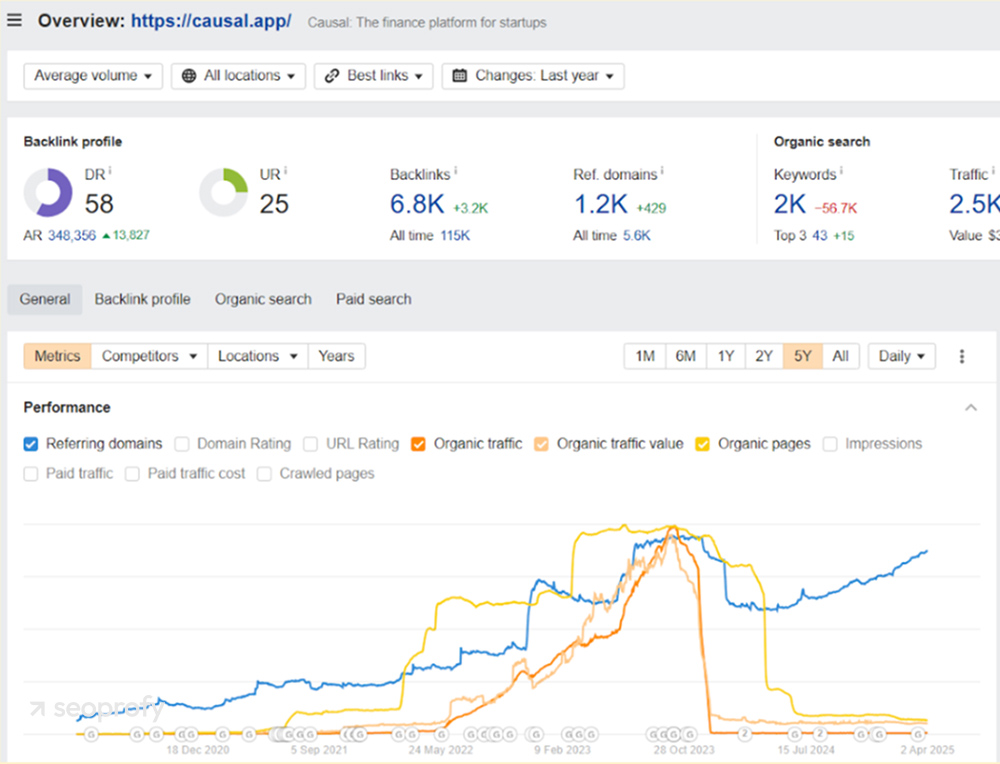
Another example is Casual.App. They used AI content, and after the November 2023 Core Update, which addressed E-E-A-T, their traffic dropped sharply.
We’ve seen similar cases in our work and helped businesses across different niches recover after core updates. You can find examples in our SEO case studies.
Duplicate Content
Using AI-generated content in an SEO strategy can also lead to issues with duplicate content. Since many AI tools draw from the same pool of training data, multiple websites can end up publishing nearly identical pieces if they use similar prompts or templates.
Even if it’s not exact-match plagiarism, it becomes harder for your content to stand out. Google may not penalize them, but it will likely skip your pages in favor of something more original.
Brand Reputation Damage
Research shows that 70% of consumers choose to read blog posts to learn more about a company. That means the way people see your business often depends on the content they find on your site.
If your website offers them mediocre copy or rewritten tips from other blogs, it doesn’t build trust. It makes you look like every other company trying to rank, not like one that understands its audience’s needs.
It’s no longer enough to write generic content and expect results. Here’s what kind of content you get with SeoProfy:
- Optimized for Google, written for humans
- Fact-checked and original
- Aligned with the latest quality guidelines

How to Avoid Risks When Using AI Content for SEO
There are real ways to produce content with AI without running into these problems — but it requires some discipline and a clear workflow.
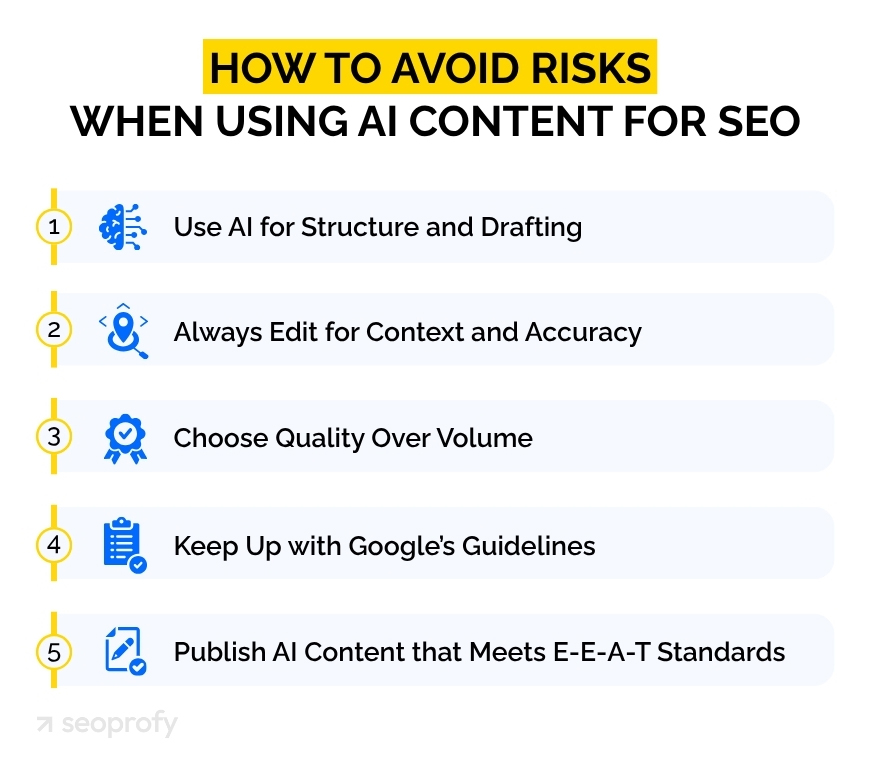
Use AI for Structure and Drafting
AI tools for SEO can be helpful at the beginning of the writing process. When you have your keywords and internal linking ideas, paste them into a tool to create outlines, structure your ideas, speed up research, or find content gaps.
Once you move past that point, the work needs a human hand. Subject-matter experts and editors can review drafts for accuracy, add a real point of view, and make sure the content demonstrates E-E-A-T signals.
Always Edit for Context and Accuracy
Hallucinations and inaccurate statements in AI content are a problem if you’re publishing anything with real-world implications: stats, recommendations, product comparisons, or even basic definitions.
HubSpot’s research found that 86% of marketers edit AI-written content. So, any time you use AI-generated content in SEO, check the claims, verify the sources, and add the most recent information before publishing.
Choose Quality Over Volume
Google may not penalize AI-generated content, but it does take issue with scaled content abuse through mass-produced and low-value content. Focus on the quality and uniqueness of each piece, not the number of articles or their word count. As Ryan Law puts it:
“In the era of generative AI, there is no edge to be found by simply shuffling common knowledge from place to place. We need to find new dimensions of differentiation and lean into our unique strengths.”
Ryan Law
Keep Up with Google’s Guidelines
Google’s algorithm updates come fast, and each one shifts how content is evaluated. To make sure AI content performs well and doesn’t lead to penalties, you need to understand what Google expects from it.
One of the best places to start is with this list of questions designed to help you assess whether your content measures against the standards:
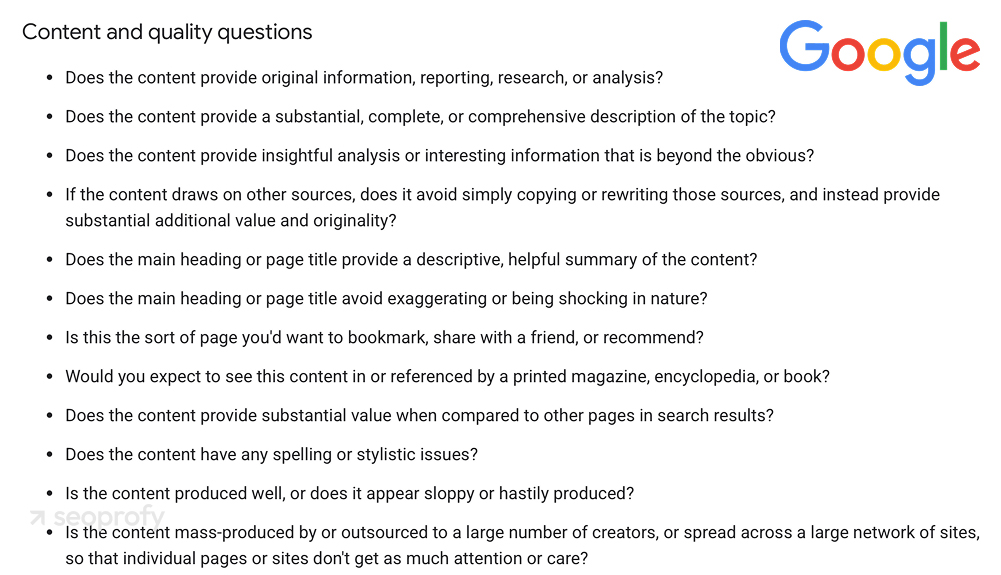
Look through them and assess your AI-generated content. This will help you make sure that your pages are expertly written and offer value to your readers.
Publish AI Content that Meets E-E-A-T Standards
Demonstrating experience, expertise, authority, and trust doesn’t happen automatically — and no AI tool can do it for you. But there are concrete steps you can take to close the gap between a generated draft and content that actually earns trust from both readers and search engines.
| E-E-A-T Risk | How to Address It |
|---|---|
| Content lacks first-hand experience | Add real examples, case studies, quotes from subject-matter experts, or original research. |
| No visible author credentials | Include detailed author bios with relevant qualifications, professional background, or published work. |
| Unverified claims and citations | Cross-check every stat and fact; replace any hallucinated sources with real, verifiable ones. |
| Generic or surface-level coverage | Expand with proprietary data, unique angles, customer examples, or expert commentary. |
| No trust signals on the page | Add authorship info, publication and update dates, citations, and a methodology note where relevant. |
| YMYL topic without expert review | Have a licensed professional (doctor, lawyer, financial advisor) review the copy before it goes live. |
Final Thoughts: Is AI Content Good for SEO?
It can be. When comparing the SEO performance of AI vs. human-generated content, we see that generated pieces can still show great results. However, it takes work. Search engine algorithms consistently reward quality content, so you’ll still need to perform keyword research, ask for input from subject-matter experts, and do plenty of editing.
Unsure what would work best for your business? Consider our SEO copywriting services. We write with rankings in mind, but always for people first. Our clients have already seen top-page rankings and more traffic with our high-quality content, and we’d be happy to help you achieve similar results!

Julia Lubianytska is a Copywriting Team Lead at SeoProfy with over 7 years of experience in copywriting and editing. She works closely with copywriting teams, helping writers craft clear and thoughtful content for SaaS products, IT services, and businesses in the legal and medical fields. Julia enjoys turning complex topics into easy-to-understand, trustworthy content, focusing on structure, clarity, and consistency to ensure the content is genuinely helpful for real people, not just search engines.