

 Add SeoProfy as a preferred source on Google

A few years ago, search meant Google’s traditional search results and a click. Now people use AI-powered search engines like ChatGPT or Perplexity and often get the answer without visiting a site. That shift created a messy tool category. Today’s AI visibility tools cover everything from simple mention tracking to full research and content execution platforms. So how do you choose one for your needs?


We compared 10 AI tools based on engine coverage and prompt source. We also looked at how far the data can take you once a gap appears, plus what the software costs at a realistic campaign scale. Keep reading if you want to choose software that gives your team usable data and makes it easier to tie AEO spend back to traffic and revenue.
- Best free option: HubSpot AEO Grader
- Best for real-conversation data: Profound
- Best for Semrush users: Semrush AI Visibility
- Best for Ahrefs users: Ahrefs Brand Radar
- Best budget-paid tracker: HubSpot AEO
- Best for enterprise teams: Profound, Conductor, and Botify
How We Evaluated These AEO Tools
Our SeoProfy team started testing optimization for AI search back in 2022, before AEO had much of a playbook. Since then, plenty of tools have gone through our stack and become part of the team’s AI SEO audit services workflow.
For this comparison, we evaluated each platform against the same criteria:
- Major AI engines coverage: Which answer engines does the tool track separately, including ChatGPT, Perplexity, Gemini, and Google AI Overviews.
- Prompt source: Where the tracked query set actually comes from (real AI conversations, user-defined prompts, or synthetic prompts built from keyword data).
- Citation tracking: Whether you can drill into the exact domains and URLs cited for individual prompts and compare citation share against competitors.
- Sentiment: How AI frames the brand across tracked prompts, for example, as a recommended option, an authority, a weaker alternative, or something associated with specific concerns.
- Recommendations: Which specific gaps the tool surfaces behind weak visibility, such as missing entity associations or prompts where competitors consistently replace your brand.
- Entry price: The cheapest paid tier with enough citation and competitor data to use in an actual AEO workflow.
AEO Tools at a Glance
The best AEO tools differ most in what job they cover and how far the monitoring goes. Here’s the shortest useful comparison before the detailed breakdowns.
| Tool | Best For | AI Platforms Covered | Starting Price |
| HubSpot AEO | Small AEO campaigns | ChatGPT, Gemini, Perplexity | $50/mo |
| Profound | Enterprise research | ChatGPT, Perplexity, Claude, Gemini, AI Overviews, AI Mode, Copilot, Grok, Meta AI, DeepSeek, Amazon Rufus | $99/mo |
| Semrush AI Visibility | Teams already using Semrush | ChatGPT, Gemini, Perplexity, AI Overviews, AI Mode | $99/mo |
| Ahrefs Brand Radar | Market discovery | ChatGPT, Perplexity, Gemini, Copilot, Grok, AI Overviews, AI Mode, and Claude for custom prompts | $199/mo |
| Scrunch AI | Technical AEO | ChatGPT, Perplexity, Gemini, Claude, AI Overviews, AI Mode, Copilot, Grok, Meta AI | $250/mo |
| Peec AI | Agencies managing multiple client accounts | ChatGPT, Perplexity, Gemini, AI Overviews, AI Mode, Copilot | $80/mo |
| Conductor Intelligence | Enterprise SEO teams | ChatGPT, ChatGPT Search, Claude, Gemini, AI Mode, AI Overviews, Grok, Copilot, Perplexity | Custom |
| SE Ranking AI Search | SEO + AI tracking | ChatGPT, Gemini, Perplexity, AI Overviews, AI Mode | $129/mo |
| AirOps | Content at scale | ChatGPT, Gemini, Perplexity, AI Overviews, AI Mode | Free |
| Botify | Crawl-heavy sites | ChatGPT, Perplexity, Gemini, AI Overviews, AI Mode | Custom |
HubSpot AEO
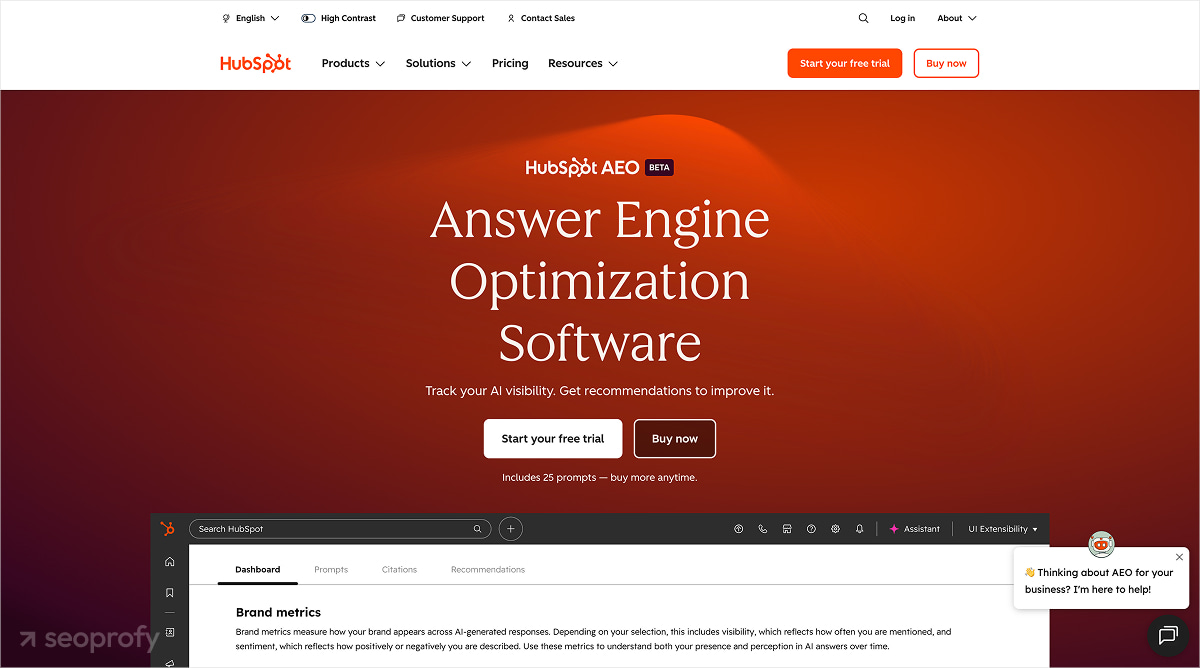
HubSpot AEO is a lightweight tracking tool rather than a full enterprise AEO platform. However, its strongest angle is price. The free AEO Grader gives you an initial visibility read at no cost, and the paid product is still the cheapest step-up on this list.
It makes the most sense for smaller AEO projects or teams already working in HubSpot, especially when the campaign fits within 25 tracked prompts and three engines, so you’re not paying for monitoring capacity you won’t actually use.
Key Features
- AI visibility metrics: HubSpot reruns tracked prompts daily and aggregates brand mentions over time. We’d still check the underlying answers before treating a score swing as meaningful.
- Citation analysis: Exact pages and domains behind AI citations are visible, with source and content-type breakdowns. That makes it easier to separate on-site content gaps from off-site citation gaps.
- Competitor comparison: Share of voice shows who owns mentions across the same prompt set, while prompt-level responses show exactly where competitors replace your brand.
- Sentiment analysis: HubSpot scores brand framing from -100 to +100, so you can catch cases where visibility rises while the recommendation context gets worse.
- CRM-informed recommendations: Marketing Hub Pro and Enterprise use HubSpot business context for prompt suggestions and connect visibility gaps to specific content or outreach actions.
Pricing
- Free trial: 28 days with 25 tracked prompts across ChatGPT, Gemini, and Perplexity; no credit card required.
- Standalone AEO: $50/month or $45/month billed annually, with 2,500 answers per month.
- Extra tracking: $20/month adds 10 prompts and 1,000 monthly answers.
- Marketing Hub Professional: Starts at $890/month for three Core Seats plus a mandatory $3,000 onboarding; AEO is included.
Pros & Cons
Pros:
- Low entry cost: For a focused brand set, 25 prompts is enough to track buyer-intent queries. Great for smaller campaigns before moving to a heavier stack.
- Prompt-level evidence: You can open the exact AI response behind a visibility change, which helps separate a real gain from dashboard movement that changes nothing in the actual answer.
- Citation depth: Exact source pages make outreach research cleaner because you can see which publishers keep feeding the answers you care about and where third-party authority matters most.
Cons:
- Engine coverage: Tracking stops at ChatGPT, Gemini, and Perplexity, so teams that need Claude, Copilot, Grok, or other AI platforms will require another tracker.
- Prompt ceiling: 25 prompts gets tight once you split monitoring by product/funnel stage/market.
- Standalone gap: The $50 plan skips CRM-informed prompt suggestions, so you still need your own demand research and prompt framework.
Profound
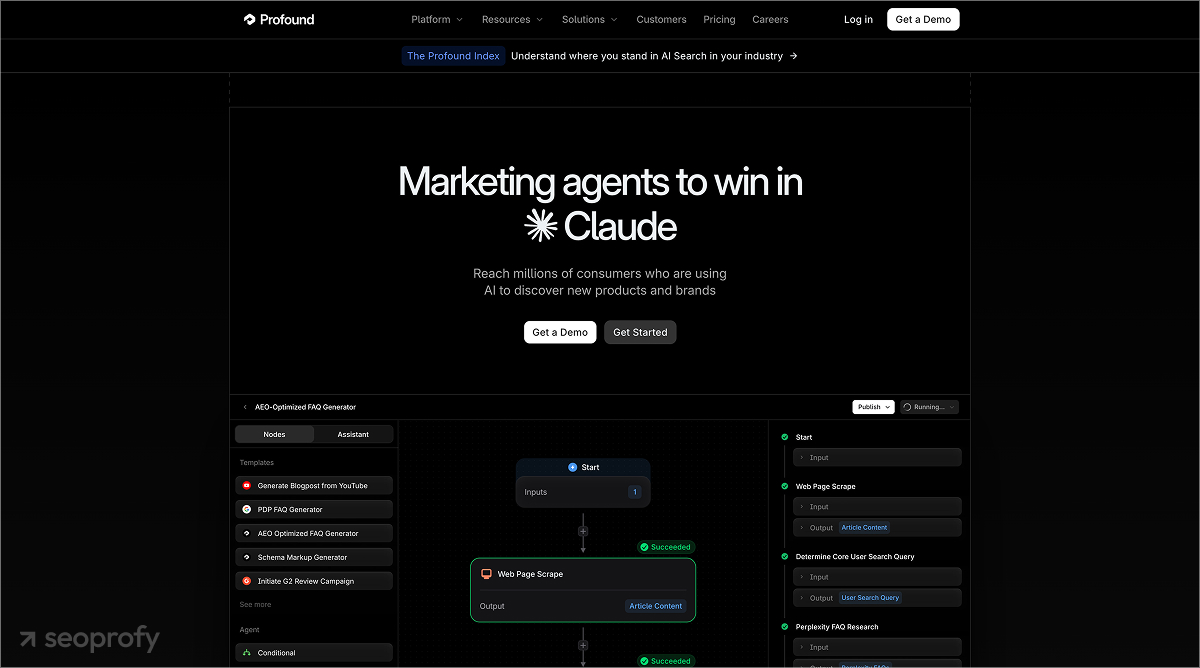
Profound is one of the stronger enterprise AEO tools for teams that need to research AI-search demand and track brand visibility across multiple markets or business units. Its enterprise offering includes the security, access control, and support features larger organizations typically need.
SSO gives IT centralized control over user authentication. SOC 2 Type II covers the security review with an independent audit of Profound’s controls. Enterprise customers also get priority support through email or Slack.
Key Features
- Prompt Volumes: Built on 1.9B+ real user prompts, this is Profound’s biggest research advantage. It shows the language people use with AI search engines, then models demand by intent and audience.
- Answer Engine Insights: Daily browser-based runs track brand visibility and citation share. Separate views cover sentiment and factual accuracy, while competitor data shows who owns the same prompt set.
- Query Fanouts: Shows the hidden searches an answer engine generates from one prompt. This matters when your tracked wording differs from what the model actually researches.
- Agents & Analytics: Supports content creation from Profound data and ties AI crawler activity to GA4 referral performance at the page level.
Pricing
- Starter: $99/month, billed yearly. ChatGPT tracking covers 50 prompts, with 100 agent credits included.
- Growth: $399/month, billed yearly. Coverage expands to three engines and 100 prompts. You also get 400 Agent credits plus CSV/JSON exports.
- Enterprise: Custom pricing. Coverage expands to up to nine engines with tailored prompt limits. API access and SSO sit here.
Pros & Cons
Pros:
- Real-demand data: Prompt Volumes gives you a much better starting point than keyword-generated prompt lists when deciding what to track. The volume layer is still modeled on that corpus.
- Front-end tracking: Profound captures consumer browser responses instead of API outputs. For citation work, that is closer to what users actually see.
Cons:
- Starter limitation: $99 gives ChatGPT only, 50 prompts, and no exports. Teams running multi-engine campaigns will outgrow the Starter plan quickly.
- Data gates: Full Prompt Volumes search and API access sit behind Enterprise, so deeper research costs more.
- SEO gap: Profound does not replace rank tracking, backlink analysis, or technical audits. Traditional SEO tools still stay in the stack.
Semrush AI Visibility Toolkit
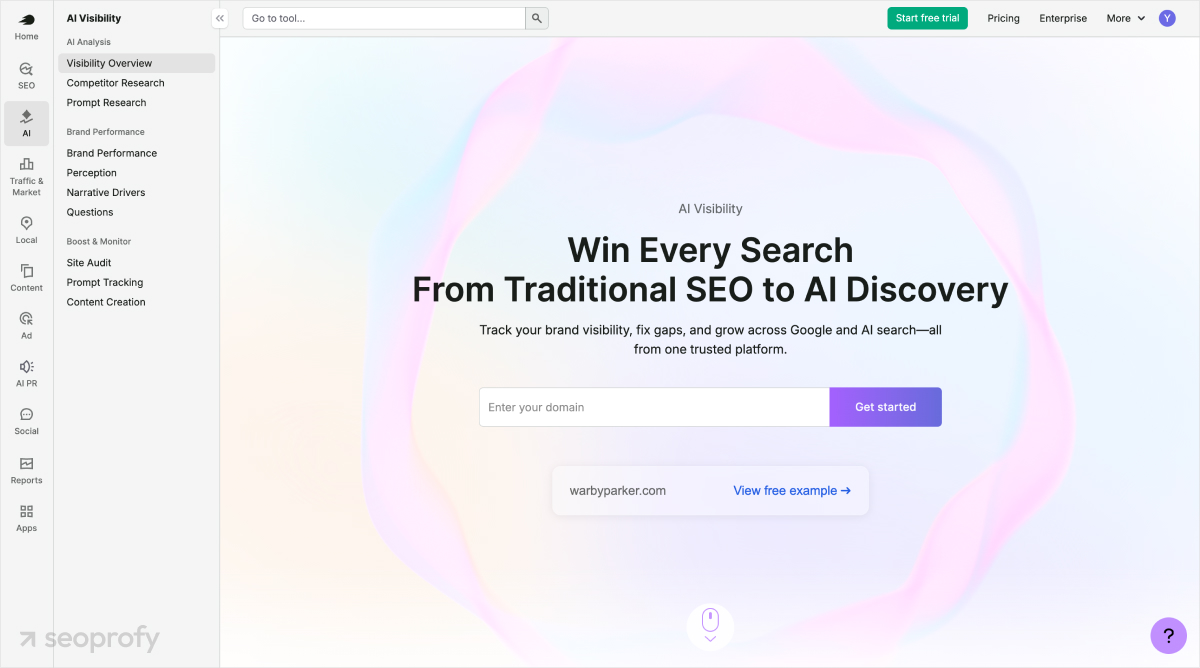
Semrush AI Visibility Toolkit is AEO software for teams already running SEO in Semrush. Its real advantage is workflow continuity. AI visibility insights can be checked against the domain’s keyword data, then carried straight into backlink or technical work.
Key Features
- AI visibility tracking: Brand Performance tracks ChatGPT / Gemini / Perplexity / Google AI Overviews / AI Mode. It uses synthetic prompts tied to the domain and location. AI Analysis uses a separate database captured from real requests, so the reports answer different questions.
- Prompt tracking: You choose high-value prompts, and Semrush reruns them daily.
- Competitor research: Up to four rivals can be compared at prompt and topic level. Source Opportunities exposes third-party sites that keep appearing around competitor mentions.
- Optimization guidance: Brand Performance generates strategic recommendations. Site audits check AI crawler access and technical blockers on up to 100 pages.
- SEO integration: AI findings can be checked against Semrush keyword data, then carried into backlink or technical research.
Pricing
- Standalone: $99/month per domain, billed annually. Includes 25 tracked prompts and 10 CSV exports daily.
- Team access: Each subuser needing AI Visibility costs another $99. An extra Brand Performance domain is $99/month; 50 extra prompts are $60/month.
- Semrush One: Starts at $199/month or $165.17/month billed annually. The bundle has a 7-day free trial; standalone AI Visibility has no trial.
Pros & Cons
Pros:
- Multi-market coverage: Prompt Tracking supports 220+ countries and territories. Brand Performance offers more than 68,000 location-language setups, which is useful for international SEO teams.
- Outreach handoff: Source Opportunities surfaces third-party sites cited around competitor mentions. That gives link building or digital PR teams a place to start prospecting.
- Reporting connection: My Reports can pull AI referral traffic and conversions from Google Analytics into the same report as visibility data.
Cons:
- Scaling economics: One license covers one user and one brand performance domain. Agency costs climb quickly across client properties or teammates.
- Mixed reporting logic: Brand Performance runs weekly on synthetic prompts. AI Analysis uses a separate real-request database with daily updates, so reporting needs clear metric definitions.
- Split execution: Content optimization lives in the separate Content Toolkit. AI traffic benchmarking sits in Traffic & Market, so a full campaign needs additional paid modules.
Ahrefs Brand Radar
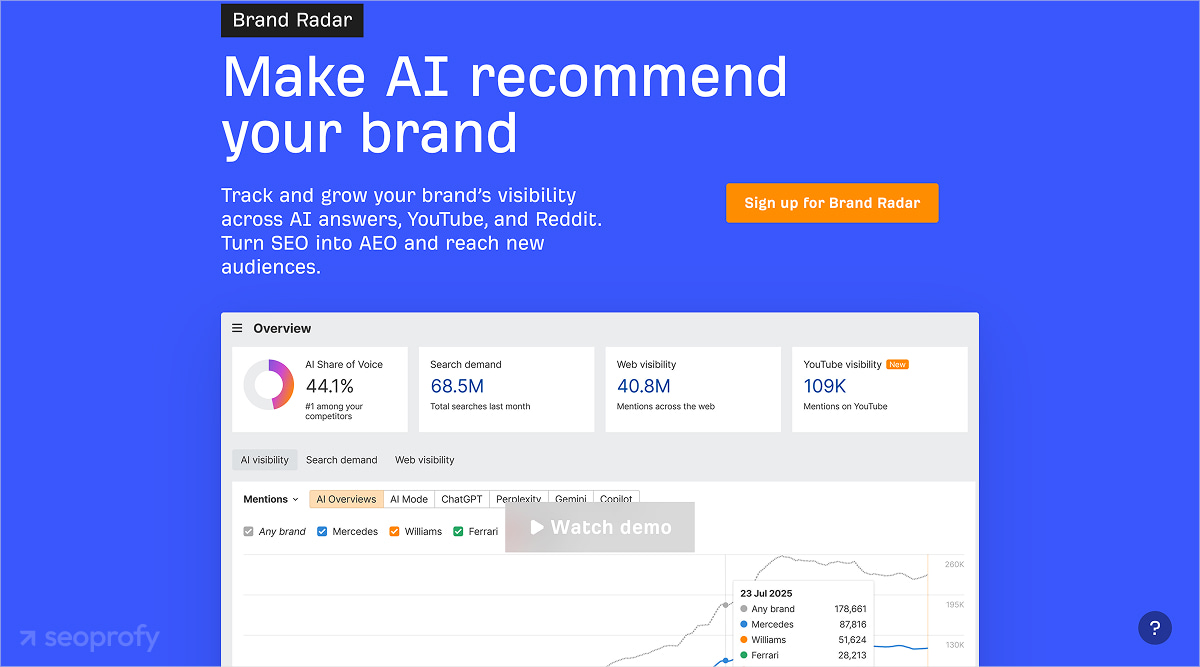
Ahrefs Brand Radar is AEO software built for tracking AI visibility at scale before you narrow the campaign down to a fixed prompt set. You can search a brand or competitor immediately across Ahrefs’ existing AI-response corpus, then move the important queries into custom tracking. This is useful for market mapping and early competitor research.
Key Features
- Prompt database: Brand Radar covers 466M+ monthly prompts. Ahrefs builds the set from its keyword database and Google PAA, then expands topics using semantic fanout. Treat this metric as a search-backed proxy for AI demand.
- AI visibility: Mentions and citations sit beside estimated impressions and AI share of voice. Exposure is modeled from Google search demand, so use it for directional benchmarking.
- Citation research: “Found in” records pages retrieved during answer generation as a separate source layer from inline citations. That gives you another source-gap view.
- Cross-channel research: Separate beta indexes cover YouTube plus TikTok and Reddit. Search demand, traditional blue links, and web visibility add wider brand context.
Pricing
- Single platform: $199/month per AI index. Brand Radar is available as a standalone purchase.
- All platforms: $699/month for the full paid bundle, 2,500 custom prompt checks included.
- Custom tracking: Extra packages cost $50 for 2,500 checks. Growth is $100 for 7,000 checks. The scale is $250 for 25,000 checks.
Pros & Cons
Pros:
- Market discovery: Any brand can be searched across Ahrefs’ corpus. This is useful for competitor research before the team builds a prompt set.
- SEO handoff: Citation gaps can move into the normal Ahrefs workflow. Publishers appearing in AI answers can be checked in Site Explorer for organic traffic and backlink quality before outreach.
- Traffic context: Cited pages pull bot visits from Bot Analytics and AI referral visits from Web Analytics. That shows which cited pages send traffic.
Cons:
- Search-behavior bias: The global corpus is based on Ahrefs keyword data and Google PAA. Niche conversational demand gets weaker coverage outside English.
- Refresh cadence: Chatbot indexes refresh monthly with a 90-day reporting window. Fast testing needs custom prompts on a daily or weekly schedule.
- Execution layer: Content implementation sits in separate Ahrefs products such as AI Content Helper or Agent A. Budget for those when the team wants execution in the same stack.
Scrunch AI
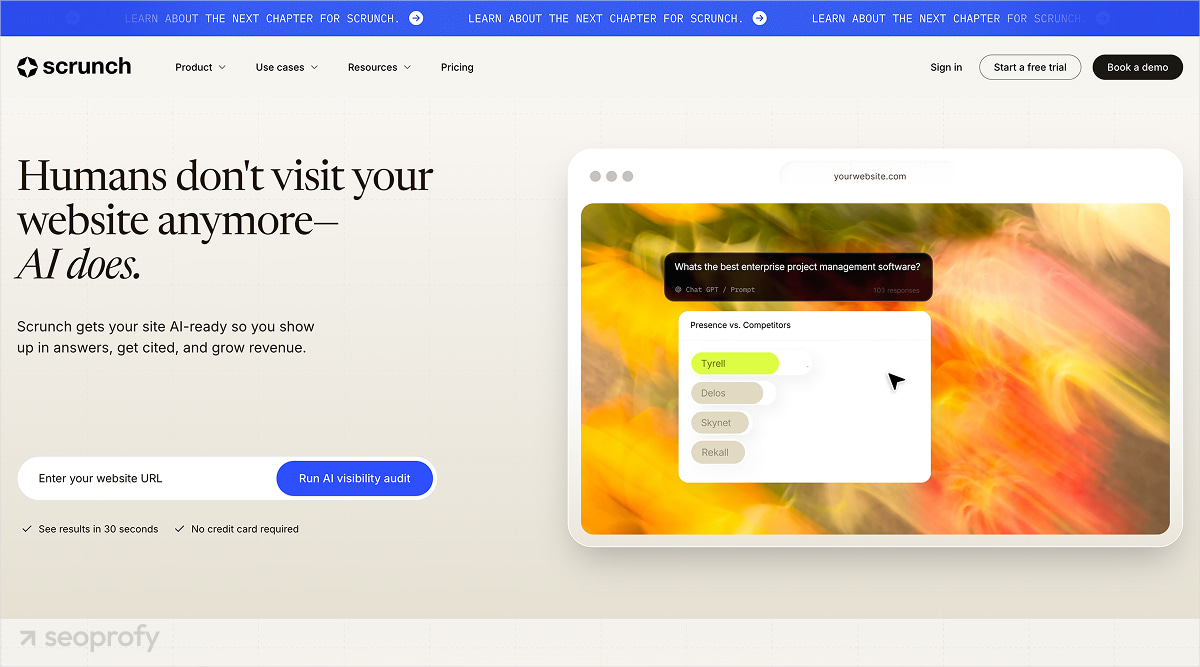
Scrunch approaches AI search visibility from a more technical angle. It tracks what AI says about the brand and also shows how AI agents consume the site. Its AXP layer can serve retrieval bots a simplified version of existing pages. That makes Scrunch relevant for technical AEO on large or JavaScript-heavy websites.
Key Features
- AI search platforms: Tracks ChatGPT, Perplexity, Gemini, Claude, AI Mode, AI Overviews, Copilot, Grok, and Meta AI.
- AXP delivery: AXP detects retrieval agents at the CDN layer and serves clean server-rendered HTML on the same URLs. Human visitors keep the original page.
- AI agent traffic: CDN and hosting integrations capture bot requests that GA4 misses. Scrunch separates retrieval traffic from training and indexing activity.
- Site audits: Page audits connect crawlability and content problems to specific URLs. Site Map then prioritizes pages using citation and agent-traffic signals.
- AI referrals: GA4 integration tracks human sessions arriving from major AI platforms through to conversions and revenue. You can see which cited landing pages bring traffic.
Pricing
- Starter: $250/month billed annually or $300 month-to-month. Includes 350 custom prompts plus three users.
- Growth: $417/month billed annually or $500 month-to-month. Includes 700 custom prompts plus five users.
- Enterprise: Custom pricing adds SAML/OIDC SSO and the Enterprise Data API.
- AXP: Sold separately from Monitoring & Insights. Public AXP pricing is unavailable.
Pros & Cons
Pros:
- Technical AEO: AXP strips JavaScript-heavy pages into clean server-rendered HTML while keeping the public URL intact. That improves machine readability on complex sites.
- Attribution chain: Agent Traffic shows what bots consume. GA4 shows which AI referrals become sessions and conversions. Together, they make citation reporting easier to defend.
- Prompt scaling: Prompt templates generate campaign variants automatically and show the expected response volume before launch. This is helpful when market segmentation would otherwise require a lot of manual setup.
Cons:
- Infrastructure dependency: AXP works at the CDN layer. Technical teams still need to be involved because routing AI user agents becomes part of site infrastructure.
- Coverage clarity: Scrunch’s current FAQ lists eight supported surfaces and says Grok is coming soon. Some other Scrunch pages already reference Grok, so confirm campaign-critical engine coverage during the trial.
Peec AI
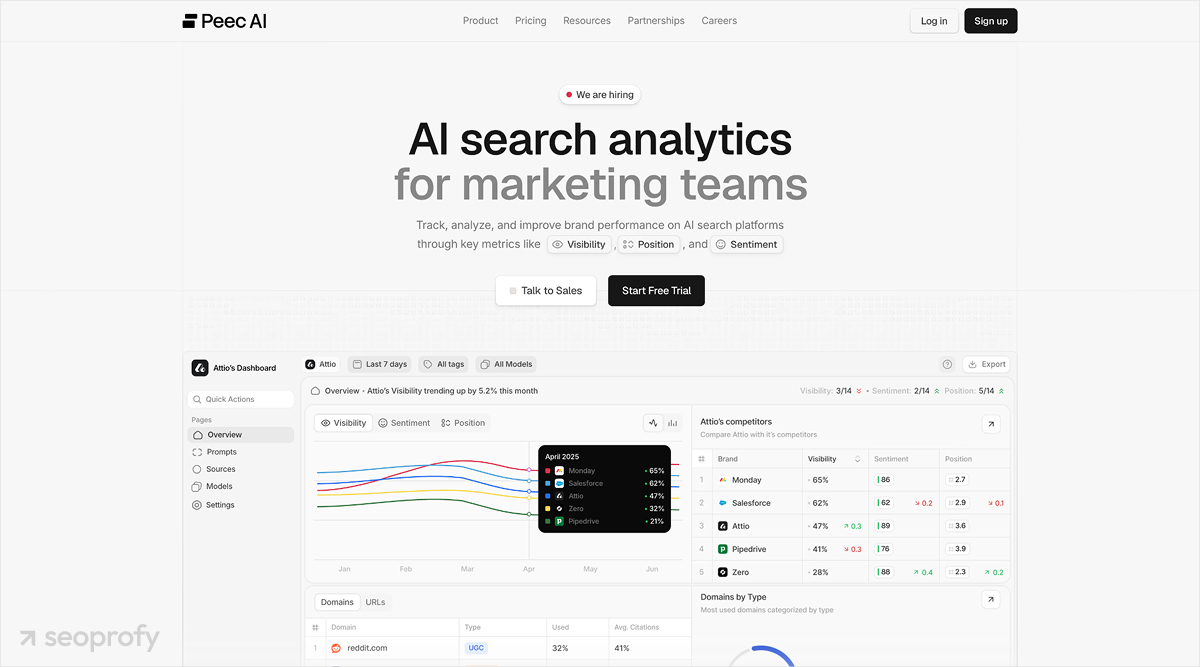
Peec AI is one of the cleaner answer engine optimization tools for teams that care a lot about reporting. Agencies get the most from it because client projects stay separate and prompt capacity can move between accounts. Pitch workspaces also let teams show prospects real data before onboarding.
Key Features
- Daily tracking: Peec reruns every prompt daily on each selected model through browser automation. The underlying chat stays available.
- Sentiment: Brand framing is scored from 0 to 100. Tags can isolate themes such as pricing or trust and show which topic is pulling the score down.
- Prompt segmentation: Tags support AND/OR logic. Topic and country filters make it easy to separate buyer-intent sets or campaign segments inside one project.
- Competitor research: Visibility is benchmarked against tracked rivals. Source-gap analysis surfaces URLs where competitors appear repeatedly, giving outreach teams a concrete prospect list.
- Model coverage: Self-serve plans choose 3 from 6 AI models. Enterprise expands coverage to 11 models and adds Claude Sonnet 4 plus several API-based engines.
Pricing
- Starter: $80/month billed annually. Includes 50 prompts and one project with three selected models.
- Pro: $205/month billed annually. Includes 150 prompts and two projects.
- Advanced: $420/month billed annually. Includes 350 prompts plus five projects and Looker Studio.
- Enterprise: Custom pricing. Adds all-model access plus API and SSO.
Pros & Cons
Pros:
- Client reporting: The interface stays unusually easy to read even with several brands in one account. That helps when reports go straight to clients or non-SEO stakeholders. Multiple G2 reviewers specifically praise the UI clarity.
- Consumer-facing data: Peec runs prompts through the actual web interfaces. The responses reflect what a logged-out user sees more closely than API-based tracking.
- Agency economics: Unlimited users are included on paid plans. Client stakeholders can get access without turning every extra seat into another recurring software cost.
Cons:
- Source extraction: Deeper source work can become manual. G2 reviewers mention relying on exports and extra filtering when they need larger citation datasets.
- Integration gate: Looker Studio starts on Advanced. API access sits in Enterprise. Teams building automated client dashboards will hit those plan boundaries early.
- Coverage limits: Self-serve plans include three models. Claude sits in Enterprise, and Gemini prompts currently run only from the United States, which weakens locale-specific tracking for international campaigns.
Conductor
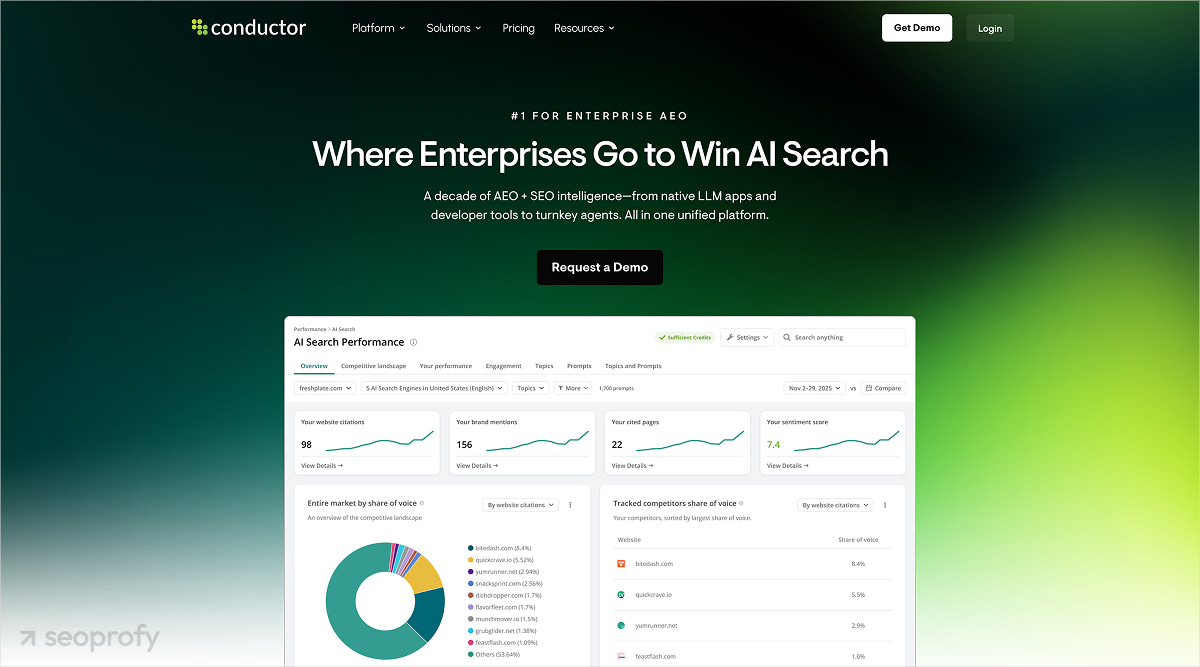
Conductor is the search intelligence product inside Conductor’s enterprise AEO and SEO platform.
It brings AI search optimization into the same environment. Conductor is used for traditional search performance and website analytics.
For existing conductor teams, it’s a natural expansion of the current workflow. Teams coming from Semrush or Ahrefs are effectively adding another enterprise SEO platform, so the purchase makes more sense when Conductor’s broader search stack is part of the plan.
Key Features
- AI Search Performance: Tracks prompt-level visibility with the AI-generated responses behind each result and source-backed sentiment. Topics can generate persona-aware prompts with custom instructions and a cadence set per topic from daily to monthly.
- Workflow integration: AI visibility data sits beside traditional search rankings and website analytics. Page Groups can narrow citation reporting to the exact section a team owns.
- AI crawler analytics: Conductor Monitoring turns server-log data into page-level reports for crawlers such as GPTBot and PerplexityBot, including visit frequency and crawl errors.
- International coverage: Conductor supports 9 engine modes across 160+ countries. Most engines also support state or city tracking.
Pricing
- Published pricing: Conductor lists Essentials, Growth, and Enterprise plans without public dollar amounts.
- Usage model: Pricing is usage-based rather than seat-based. Growth includes 2,500 AI Search Credits per year; Enterprise starts at 2,500+.
- Quote required: Final cost depends on selected capabilities and usage. Conductor currently promotes a three-week free trial.
Pros & Cons
Pros:
- Reporting ownership: Page Groups can report only on URLs a specific team owns, even when those pages sit across different folders. Useful for enterprise reporting.
- Data portability: Full AI responses and fan-out searches can be exported. Data API and MCP access make it easier to push AI-search data into internal reporting.
- Sentiment diagnosis: Conductor traces sentiment back to exact statements and source URLs. PR teams can see which publishers are shaping a negative or positive narrative.
Cons:
- Synthetic prompt set: Suggested prompts come from Conductor’s keyword data, domain context, and site content. Teams that need real-conversation demand data will need another source of research.
- Credit pressure: Daily tracking burns AI Response Credits quickly. ChatGPT Search and Gemini cost two credits per prompt, so cadence needs active management.
- UI validation: Conductor collects responses through official APIs. Campaigns that need exact consumer-interface reproduction should add a browser-based tracker for spot checks.
SE Ranking AI Search
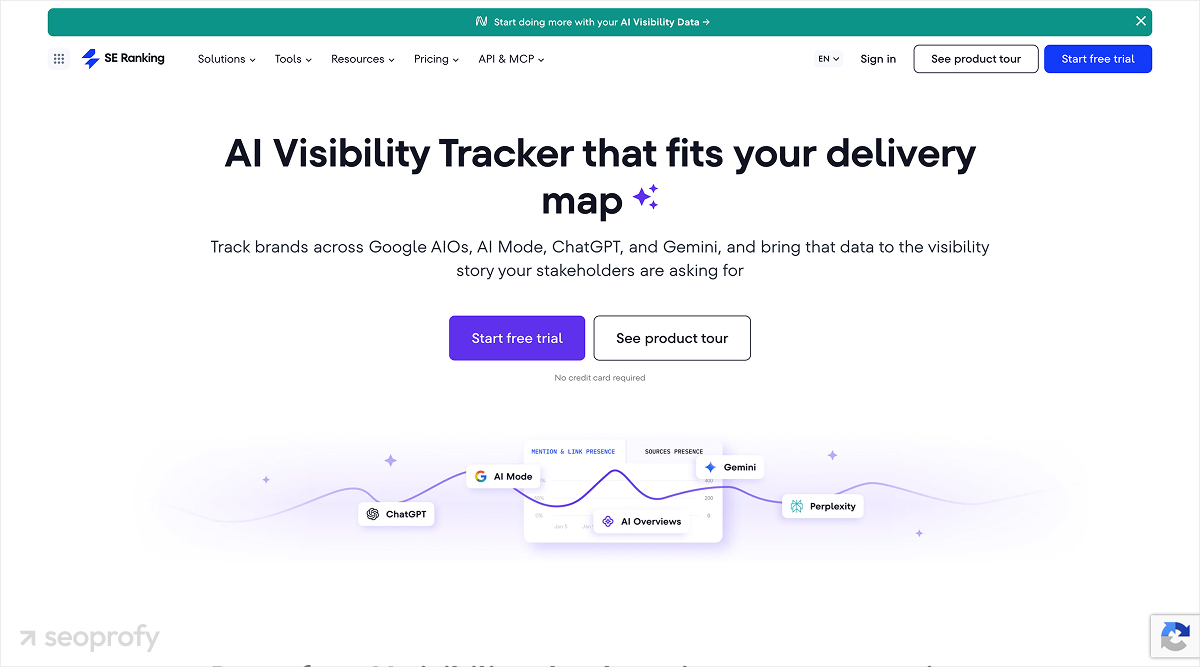
SE Ranking is a full SEO platform that now includes daily AI visibility monitoring in its core plans.
For teams already using it for SEO, that changes the economics of an Answer Engine Optimization strategy because basic AI monitoring is already paid for. The add-on is mainly a capacity upgrade for higher prompt volume and broader competitor research.
Key Features
- AI Results Tracker: Checks ChatGPT, Gemini, Perplexity, AI Overviews, and AI Mode through live UI-based monitoring.
- Competitor research: Any domain can be researched across the five engines. Reports expose the prompts and citations behind a competitor’s visibility.
- Source analysis: Exact domains and URLs are mapped from AI answers, so it is easier to find publishers or pages worth investigating for outreach.
- GA4 and GSC: Both connect directly to projects. GA4 brings traffic and conversion data into reporting, and Google Search Console keeps traditional search performance.
Pricing
- Core: $129/month or $103.20/month billed annually. It includes 100 daily prompts across five LLMs and a 14-day free trial.
- AI Search Add-on: Starts at $89/month or $71.20/month annually for 200 checks. One prompt on one engine uses one check.
- Growth: $279/month or $223.20/month annually, with 250 daily prompts.
Pros & Cons
Pros:
- Unified workflow: A visibility gap can move straight into keyword research or backlink work inside the same project. Useful when AI search and classic SEO share one campaign roadmap.
- UI-based tracking: SE Ranking captures responses through consumer interfaces. The dataset stays close to what users actually see, which helps when citations or answer wording need manual validation.
- Agency research: The AI Search Add-on removes brand limits from competitive research, so one account can investigate a larger client or prospect set.
Cons:
- Engine ceiling: Coverage stops at five engines. Teams tracking Claude, Copilot, or Grok still need another source for those channels.
- Check economics: The smallest add-on gives 200 checks. One prompt across all five engines burns five checks and leaves only 40 full-platform prompt runs.
- Split setup: SE Visible uses a separate analysis system and requires manual brand setup after purchase, adding admin for agencies managing many accounts.
AirOps
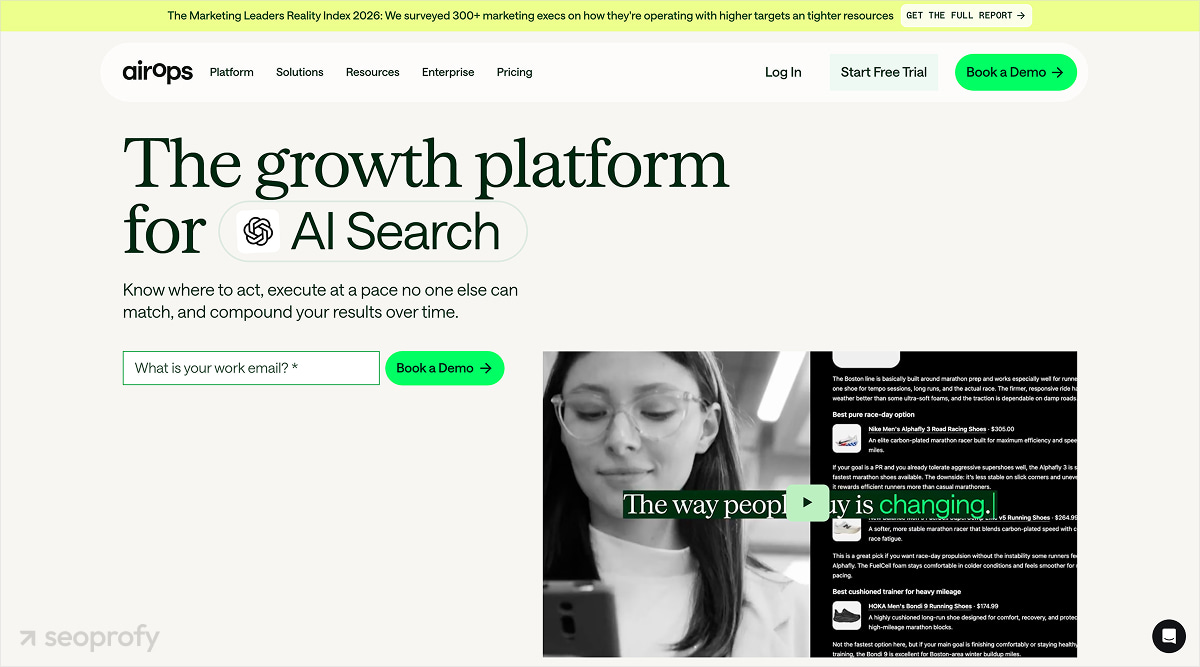
AirOps is an AEO-based software for teams with large content libraries that need to apply the same optimization logic across hundreds of pages.
It also fits an AEO strategy for Ecommerce, where category and product pages often need optimization at scale.
Once the team defines the workflow, AirOps can repeat it across the site with review steps built into the process. The strongest use case is high-volume content operations where production speed and consistency are the real bottlenecks.
Key Features
- Grid: Runs one workflow across hundreds or thousands of rows. Each URL follows the same logic, and approved outputs can move directly back to the CMS.
- Power Agents: Reusable workflows package recurring jobs such as content refreshes or brief creation.
- AI Search Insights: AirOps monitors five AI surfaces daily. Reports cover mention rate and citation rate, with share of voice plus sentiment and average position available for diagnosis.
- CMS publishing: Approved content can be pushed directly into supported CMSs like Webflow or WordPress with formatting preserved.
- Search data connections: GSC and GA4 can feed performance data into Insights. You can pull Semrush or Ahrefs data into content workflows for prioritization.
Pricing
- Solo: $0/month with 100 tracked prompts and pages, ChatGPT-only insights, 20,000 content tasks, and one user.
- Pro: Public recurring pricing is not listed. It includes 250 tracked prompts and pages, multi-engine insights, 75,000 tasks, and unlimited seats.
- Enterprise: Custom pricing with tailored limits plus multi-region tracking, custom agents, and dedicated onboarding.
Pros & Cons
Pros:
- Bulk refresh economics: AirOps is strongest when the same fix needs to reach a large content library. Workflow logic can run across hundreds of pages while review checkpoints keep editors in control.
- Execution handoff: Insight can move into a content workflow and then into the CMS. That cuts the lag between finding a visibility problem and shipping page changes.
- Team scaling: Pro includes unlimited seats, useful when SEO and content teams share a production workflow.
Cons:
- Learning curve: G2 reviewers repeatedly mention setup friction around advanced workflows. Teams need time to understand the builder and debug complex logic.
- Usage forecasting: Billing is task-based. Multi-step workflows consume more tasks as model calls and data actions increase, so monthly usage gets harder to predict.
- Monitoring-only fit: AirOps is less of a pure AEO tracker and more of an AI-powered content execution platform with AEO monitoring built in.
Botify
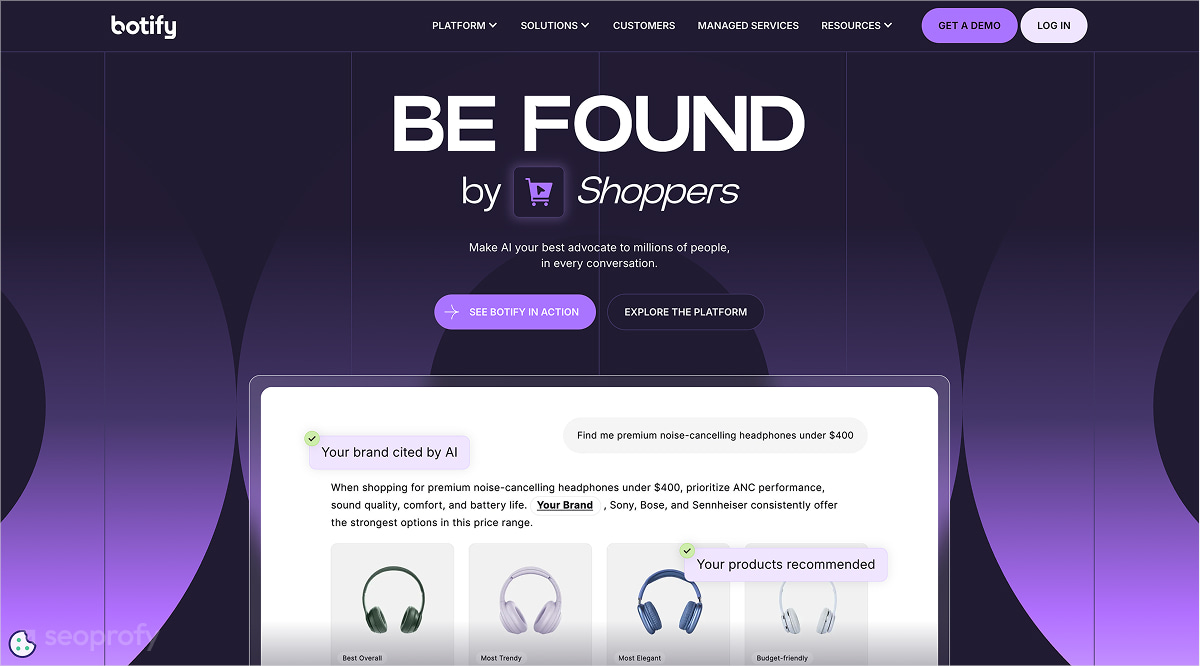
Botify is one of the more technical AI search monitoring tools for enterprise websites. Its AI Visibility module works with the crawl and log-file data Botify already collects, so teams can investigate AI mentions at the URL level and see whether AI bots can actually reach the pages meant to earn citations. It is built for technical AEO programs where crawlability and indexation are part of the visibility problem.
Key Features
- AI Visibility campaigns: Tracks AI-generated search results across ChatGPT / Perplexity / Google AI Mode / AI Overviews / Gemini.
- Citation analysis: Mentions and citations are separated at the domain and URL level. You can see the citation rate, uncited brand mentions, and the exact answers behind each source.
- AI Discovery: Compares live AI-bot behavior with GSC impressions to surface high-value pages that search demand already supports but AI systems are failing to discover.
- Botify Intelligence: ActionBoard ranks technical fixes by projected impact using Botify’s crawl and performance data. This helps move from a visibility gap to a prioritized technical queue.
- Bot tracking: LogAnalyzer shows which AI crawlers hit the site and which strategic pages they reach.
Pricing
- Plan structure: Botify currently offers Essential, Accelerate, Growth, Pro, and Enterprise tiers but does not publish plan prices.
- AI Visibility access: The dashboard is sold as an option across Botify plans, so the final quote depends on the subscription and selected capabilities.
Pros & Cons
Pros:
- Technical diagnosis: Botify connects AI visibility gaps to crawl behavior, indexation signals, structured data, and other technical factors. On giant sites, the tool shows whether discoverability sits upstream of the visibility problem.
- First-party grounding: Prompt generation starts with GSC performance and site structure, anchoring tracking to topics with proven search demand.
Cons:
- Reporting cadence: Standard AI Visibility campaign results land weekly. Daily testing cycles therefore need a second monitoring layer.
- Prompt source: The default set comes from GSC keywords plus Google PAA. Real AI conversation demand requires another dataset.
- Enterprise overhead: Botify is a large technical SEO platform with sales-led pricing. Prompt tracking alone leaves most of the platform unused.
Choosing the tool is only the measurement layer. The harder part is turning those findings into content, technical, and authority improvements.
SeoProfy audits your AI search visibility against competitors and prioritizes the gaps worth fixing first:
- See which platforms mention your brand
- Find competitor-owned prompts
- Track visibility gains over time
How to Choose the Right AEO Tool for Your Team
Just a couple of years ago, choosing answer engine optimization tools was difficult because there simply weren’t many on the market. Now the problem is the opposite: there are dozens of options, and they differ a lot in data sources, tracking logic, workflow depth, and pricing models. Here’s what to look at when choosing the right one:
- Workflow fit: After a visibility gap appears, trace how far the AEO tracking tools carry work. In execution-focused platforms, the finding can move into a brief or page update.
- Prompt source: For campaign trends, use a fixed prompt set. Market discovery calls for broader coverage. With synthetic data, quality depends on how the seeds were built and expanded.
- Measurement model: Before trusting the headline score, check the mechanics behind it. At the prompt level, raw metrics are easier to audit. Composite scores work best with a transparent formula and accessible data.
- Scaling economics: Build the cost from prompts × engines × markets × refreshes, then add domain licensing and user seats. Export or API access is often an additional layer on top of the score.
There isn’t one AEO tool that wins across every use case. The right choice depends on whether you need simple AEO tracking tools, broader prompt research, technical diagnostics, or an execution layer for content and SEO. The comparisons below show where each platform is strongest, what you give up at the entry price, and when it makes sense to move to a more advanced tool.
FAQ
What is an AEO tool?
AI visibility tools show how a brand surfaces inside AI-generated answers and give you the evidence behind that visibility. At minimum, you want prompt-level responses with cited sources. Stronger platforms used by the best AI SEO agencies add competitor analysis and history so you can see whether optimization changes the answer set.
How is AEO different from regular SEO?
The clearest way to think about AEO vs. SEO is the level being optimized. SEO works at the page and SERP level. Answer engine optimization (AEO) focuses on answer selection in AI-driven search, where a model may cite your page or surface the brand through a third-party source. The core metrics for that are mention rate and citation share.
Are there any free AEO tools?
Yes. Free options are useful for a first read, but they usually stop at a snapshot or a very small prompt allowance. HubSpot offers a free AEO Grader. Ahrefs also has a free AI-visibility preview. Ongoing monitoring usually requires a paid plan.
What’s the difference between AEO and GEO?
The boundary is fuzzy because vendors use the terms differently. AEO usually covers visibility inside direct AI answers. Generative engine optimization (GEO) is often used for the same work around LLM-generated responses. So, both usually lead to the same research and optimization workflow.
Do I still need an AEO tool if I already use Ahrefs or Semrush?
Often, the built-in Ahrefs or Semrush modules are enough for basic AI search tracking. A separate Answer Engine Optimization tool earns its place once you need broader engine coverage or stronger prompt discovery. Browser-level response capture can also justify a dedicated platform when exact answer reproduction matters.
Which AEO Tool Is Right for You?
The right AEO tool depends on the job you need it to do. The biggest quality difference is the data behind it. Real conversation data gives you a much cleaner view of how people use AI search than prompt sets built from keyword guesses.
Tracking with the help of dedicated AEO platforms only tells you where visibility is weak. The next step is fixing the content and strengthening the external sources AI relies on. SeoProfy’s AI SEO Services cover that work end to end, so send us your current setup and we’ll show you where we’d start.

Julia Lubianytska is a Copywriting Team Lead at SeoProfy with over 7 years of experience in copywriting and editing. She works closely with copywriting teams, helping writers craft clear and thoughtful content for SaaS products, IT services, and businesses in the legal and medical fields. Julia enjoys turning complex topics into easy-to-understand, trustworthy content, focusing on structure, clarity, and consistency to ensure the content is genuinely helpful for real people, not just search engines.