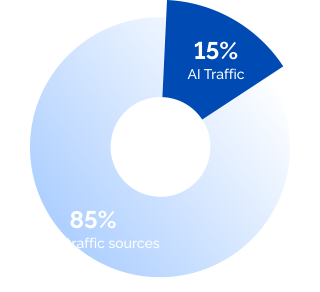



More than one-third of consumers now start their search with an AI tool, not Google. And ChatGPT, Google AI Overviews, Perplexity, Gemini, and Copilot don’t give users ten blue links. They give one answer. If your brand is missing from that answer, you are invisible where the decision starts.


This guide explains how to optimize for AI search without chasing fake hacks or rebuilding your whole traditional SEO strategy from scratch. You’ll see how each engine chooses sources, which platform signals matter, and how to improve citation visibility step by step. We’ll also cover the 8-step optimization playbook and a compact 30-60-90 plan you can start using today.
- Generative search works like an answer engine: write each H2/H3 so it can give a standalone 40–60-word answer.
- Each engine trusts different sources: ChatGPT and Perplexity favor lists, Reddit, G2, and reviews; AI Overviews favor search engine rankings and RAG; Claude favors traditional databases.
- Original statistics, fresh updates, and named sources make pages easier to quote and cite by LLM-powered search engines.
- llms.txt, aggressive “chunking,” and AI-only copy are not worth it. Google’s own guidance says they are not needed.
- It is important to measure citation share, referrals, and brand sentiment, not just CTR, with AI-powered tools.
| Right expectations | Wrong expectations |
| Generative search rewards source authority and original data | Generative search is a separate channel that needs separate content |
| Strong Google rankings still matter | You can win AI visibility with prompts and hacks alone |
| Each LLM-powered search engine has different citation patterns | One generic AEO checklist fits every platform |
| Fresh, specific claims are easier to cite | Bumping the date without updates improves trust |
| Clean structure helps extraction | Tiny artificial chunks are required for AI visibility |
What Is AI Search Optimization and Why It Matters in 2026
AI search optimization, also called generative engine optimization (GEO), answer engine optimization (AEO), or LLM SEO, is the practice of making your content easy for AI systems to understand, trust, cite, and recommend inside generated answers. It covers artificial intelligence platforms like ChatGPT, Google’s answer snapshots, Perplexity, Gemini, Microsoft Copilot, and Claude.
Let’s look at how Google frames it. In its guide to generative AI search, it says traditional engine optimization still matters because generative AI features in Search rely on the same ranking systems and search engine algorithms that evaluate relevance, authority, and page quality.
Google’s John Mueller gives the same advice for AI search experiences:
“The underpinnings of what Google has long advised carries across to these new experiences. Focus on your visitors and provide them with unique, satisfying content.”
John Mueller
That said, generative search changes the mechanics. Traditional SEO still works through rankings, snippets, and clicks. LLM-powered search engines add another layer: whether the system treats your page as a useful source worth citing. Look at the table below to see the AEO vs SEO difference more clearly:
| Area | Traditional SEO | AI-driven search optimization |
| Goal | Rank high in SERPs | Get cited in AI answers |
| Query format | Short relevant keywords | Long, specific questions |
| Content style | Keyword-targeted pages built around search intent | Direct answers, source-backed claims, clean structure, and entity-rich context |
| Success metric | Rankings, CTR, organic traffic | Citation rate, reference rate, and AI-assisted leads |
| Time-to-result | Slower compounding | Faster tests on cited queries |
Here is the uncomfortable part for brands: a user may learn, compare, and form a preference before your analytics ever records a session. AI answers sit above the click, so visibility now has a pre-traffic layer.
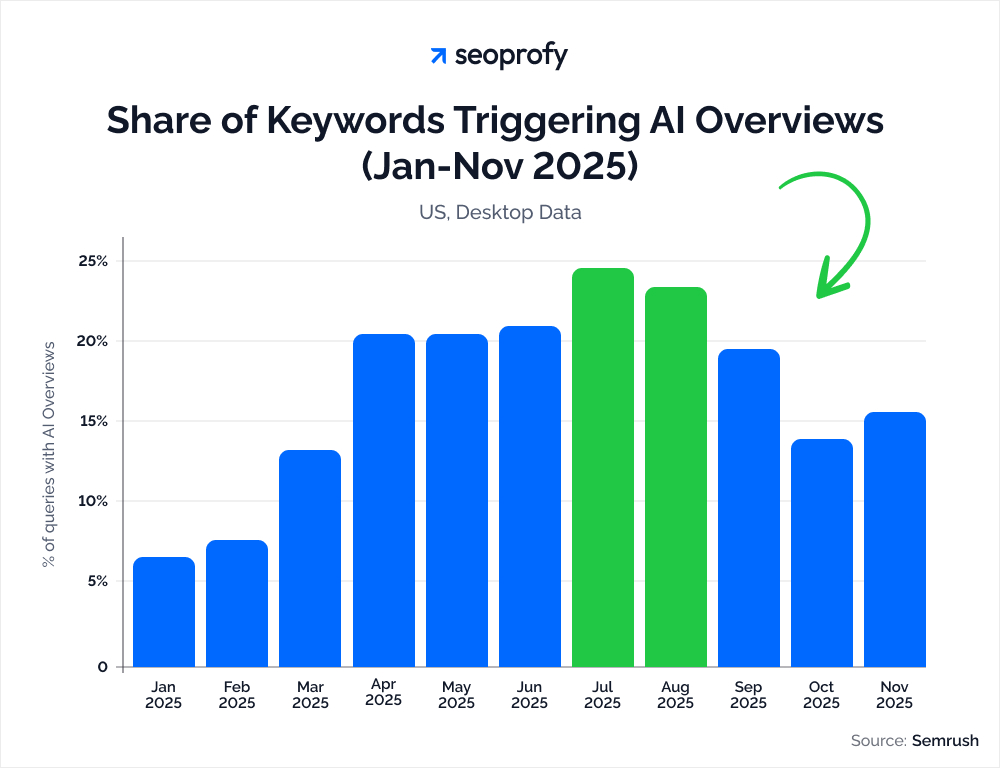
It is reported that 37% of consumers begin searches with AI search tools instead of traditional search engines. Semrush, after analysis of 10M+ keywords, found that Google’s AI-generated summaries appeared for an average of about 16% of queries across January–November 2025, with the share peaking in July and cooling by November.
There is also the research, where they say the average answer engine visitor is worth 4.4 times more than a traditional organic search visitor by conversion rate. The Princeton GEO paper explains why answer-first search needs its own optimization layer: GEO methods can lift a website’s visibility in generative responses by up to 40%.
How AI Search Engines Actually Pick What to Cite?
To decide what deserves a citation, AI-powered search engines use a mix of natural language processing, retrieval-augmented generation, or RAG, and query fan-out. They break a user’s question into related searches, interpret user intent, retrieve relevant pages from the search index, review the strongest chunks, and synthesize them into one answer with supporting citations.
Here is the rough path from prompt to cited answer:
- Query: The user asks a question, often longer and more specific than a classic keyword.
- Memory check: The model checks what it can answer from its trained knowledge and what needs fresher support.
- Live search fan-out: LLM-powered search engines create related sub-queries to cover different angles behind the question.
- Source evaluation: It reviews pages for relevance, authority, freshness, clarity, and topical fit.
- Chunk selection: It pulls the passages that answer the question with the least friction.
- Generated answer: It combines those chunks into one response and cites the sources that support the answer.
Per-Platform Breakdown: What Each AI Engine Prioritizes
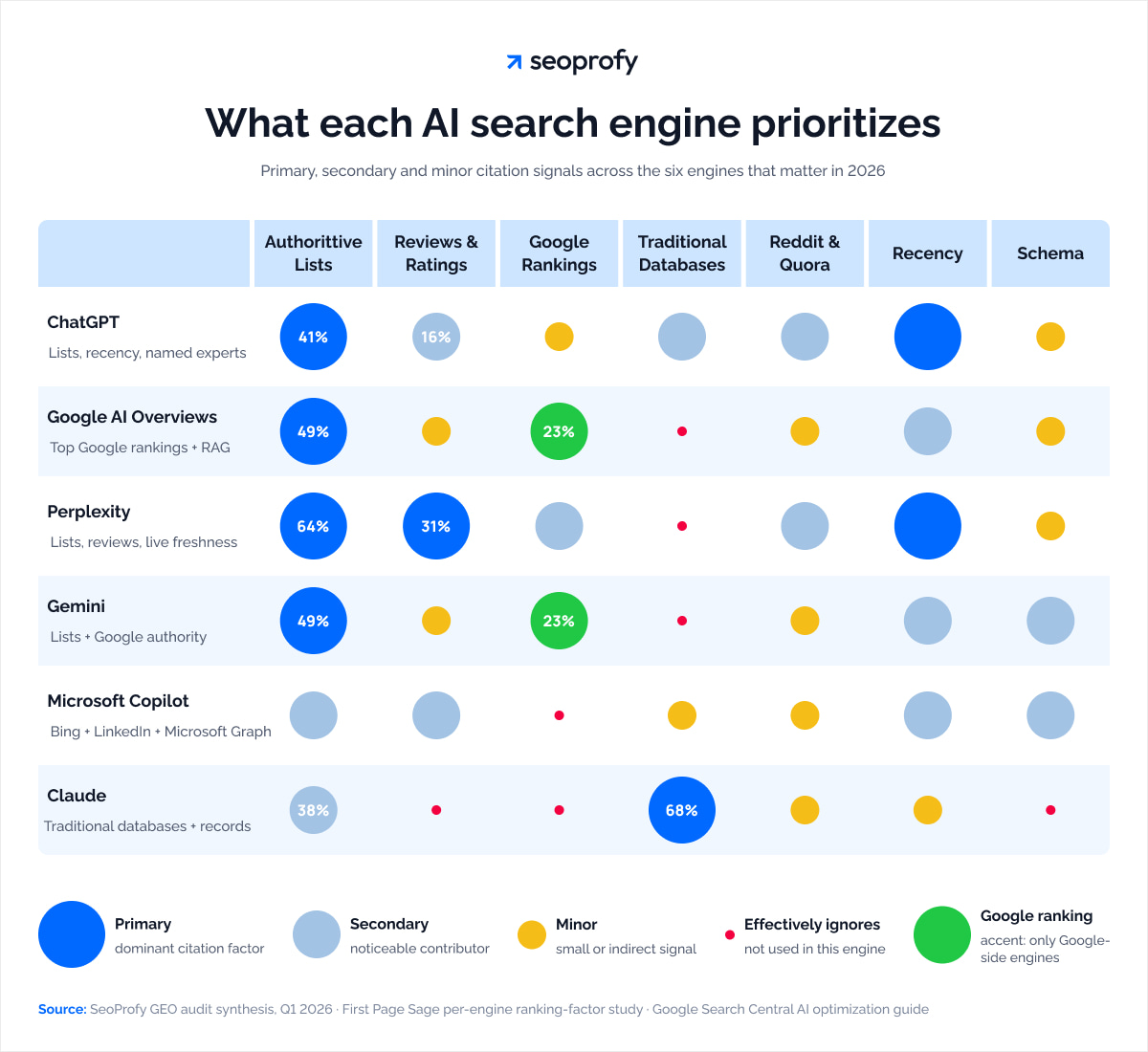
Each AI engine weighs sources differently. ChatGPT tends to reward authoritative list mentions. Google’s answer snapshots and Gemini stay closer to Google’s search and authority systems. Perplexity leans harder into reviews. Claude relies more on traditional databases. Microsoft Copilot often behaves like a Bing-connected answer layer, so classic search visibility and credible third-party mentions carry extra weight.
| LLM-powered search engines | What they tend to trust | Quick win this week | Where SeoProfy can help |
| ChatGPT | Authoritative listicles | Find “best X” and comparison pages where your brand should appear | Build a citation map and secure mentions in sources ChatGPT can reference |
| Google’s AI-generated summaries | Strong Google rankings | Add concise answer blocks to pages already close to page one | Improve page structure, topical depth, internal links, and AIO citation tracking |
| Perplexity | Reviews | Update review profiles and pitch fresh comparison pages | Build visibility across reviews, communities, listicles, and niche publishers |
| Gemini | Google-side authority | Tighten brand, product, and service signals across key pages | Enhance Google crawlability, entity signals, page structure, and AI Mode/Gemini visibility tracking |
| Microsoft Copilot | Bing-visible sources | Check brand visibility in Bing for commercial prompts | Improve Bing indexation, technical access, and third-party citation coverage |
| Claude | Databases and directories | Audit durable reference sources where your company should be listed | Build a stronger footprint across databases, directories, and industry sources |
Of course, the table cannot cover every signal, quirk, and source preference behind each one of the LLM-powered search engines. We’ll break the key engines down in more detail below.
ChatGPT
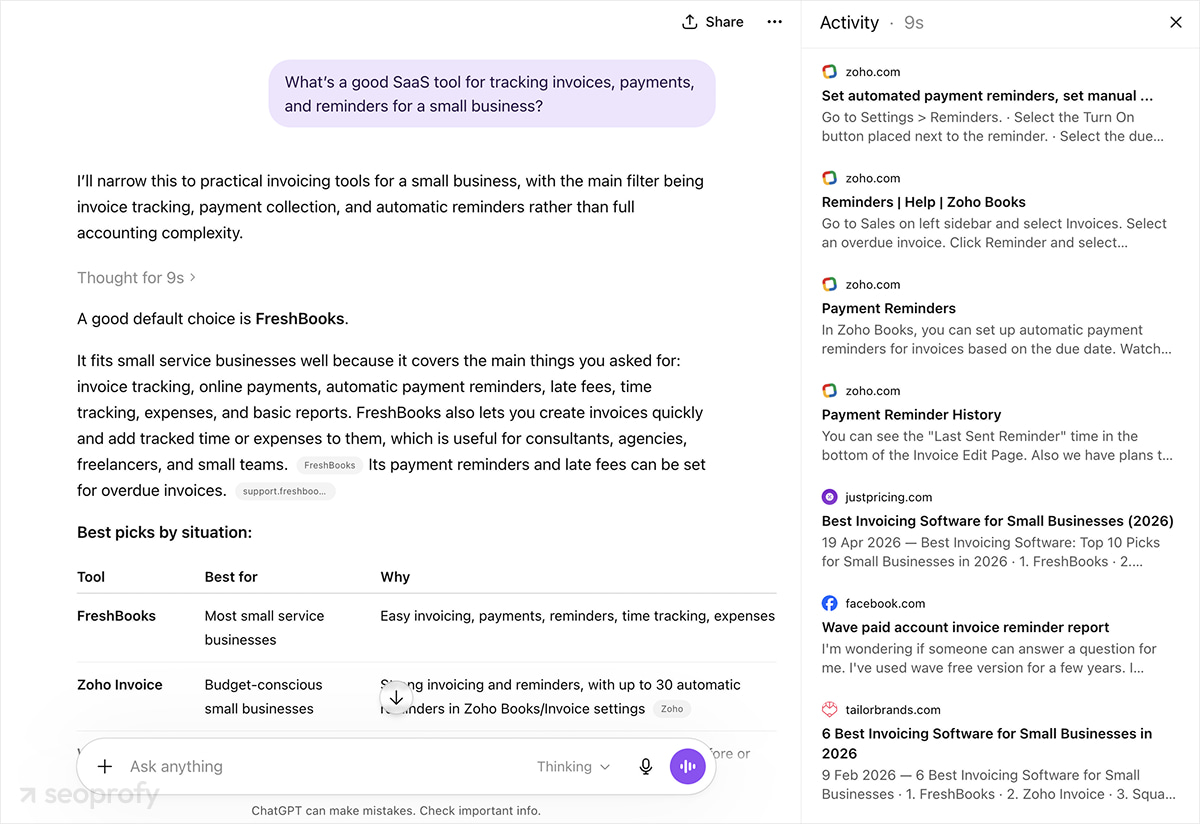
ChatGPT is one of the top AI search engines for 2026. According to our AI chatbot statistics, it holds 79.79% of the global market share. The platform tends to trust sources that make claims easy to verify and place the brand inside a wider expert conversation.
It pays close attention to:
- Fresh sources
- Original stats
- Named experts
- Reddit threads
- G2 reviews
- Quora discussions
- Clear brand mentions
Tactic: Add dated stats, named sources, or expert-backed claims to priority pages.
Google AI Overviews
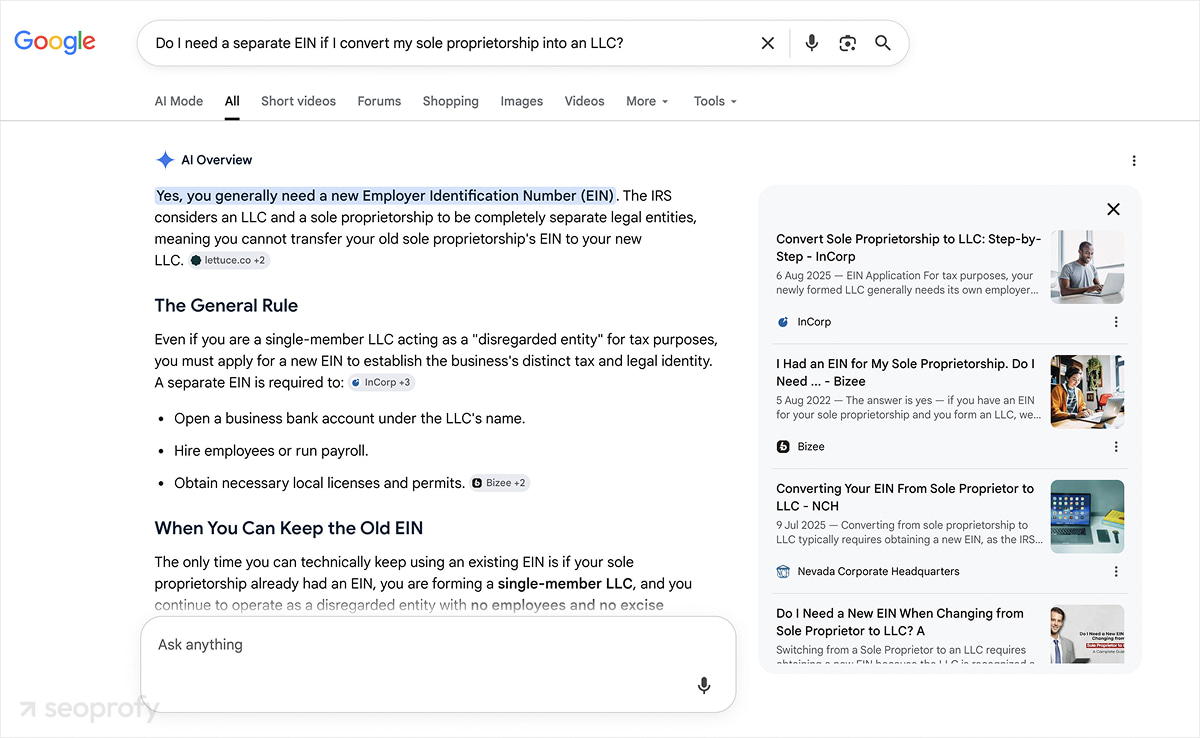
Google’s AI-generated summaries stay close to Google’s search systems, so visibility often starts with the pages already ranking for the same query.
It pays close attention to:
- Top Google rankings
- Clear answer blocks
- Strong on-page structure
- Helpful supporting sections
- Source-backed claims
- Internal links around the topic
Tactic: Treat AI Overview optimization as classic search engine optimization first. You should try to rank in the top for the underlying query, then refine the page for citation. Check out our guides on how to rank in AI Overviews for more tactics and Google AI Overview trends 2026 for fresh insights on where answer engines are moving next.
Perplexity
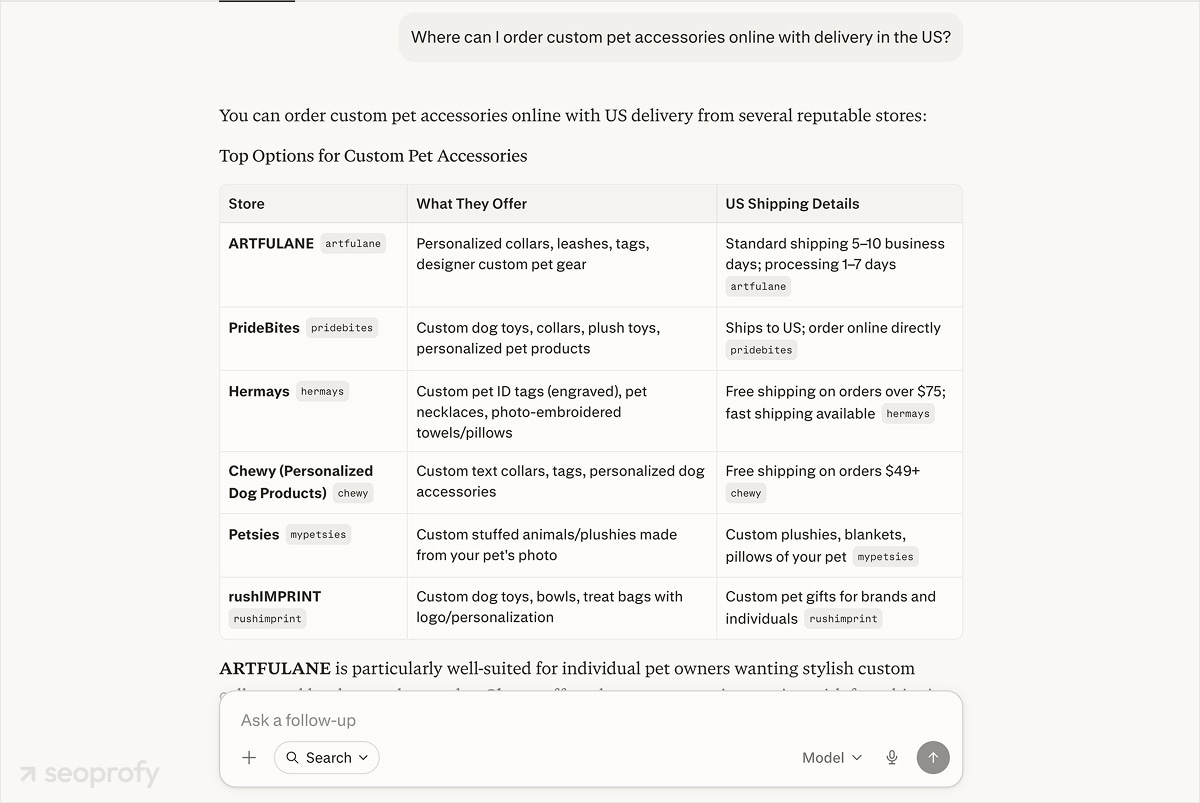
Perplexity works like a citation-first answer engine. It usually cites several sources per answer, so the page needs to look fresh, have structured data, and be easy to reference.
It pays close attention to:
- Structured headers
- Recent publication dates
- Reviews
- Comparison pages
- G2 profiles
- Trustpilot profiles
- Fresh third-party sources
Tactic: Use question-format H2s, show visible publish dates, and keep G2 or Trustpilot profiles current.
Gemini
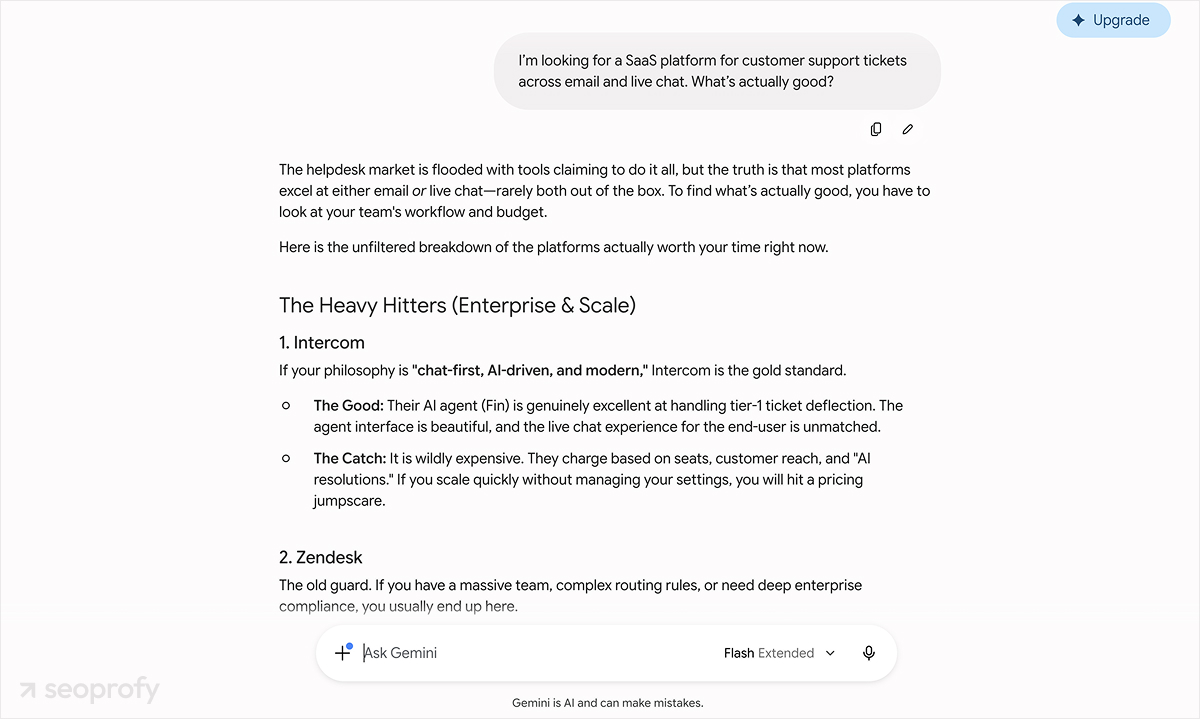
Gemini is close to Google’s wider ecosystem, so brand authority, entity clarity, and high-quality list inclusion all matter.
It pays close attention to:
- Authoritative list mentions
- Google-side website authority
- Strong E-E-A-T signals
- Clear brand entities
- Industry roundups
- Topical depth
Tactic: Pursue Tier-1 list inclusion, such as expert roundups and “best tools” pages, while improving Google E-E-A-T signals across your site.
Microsoft Copilot
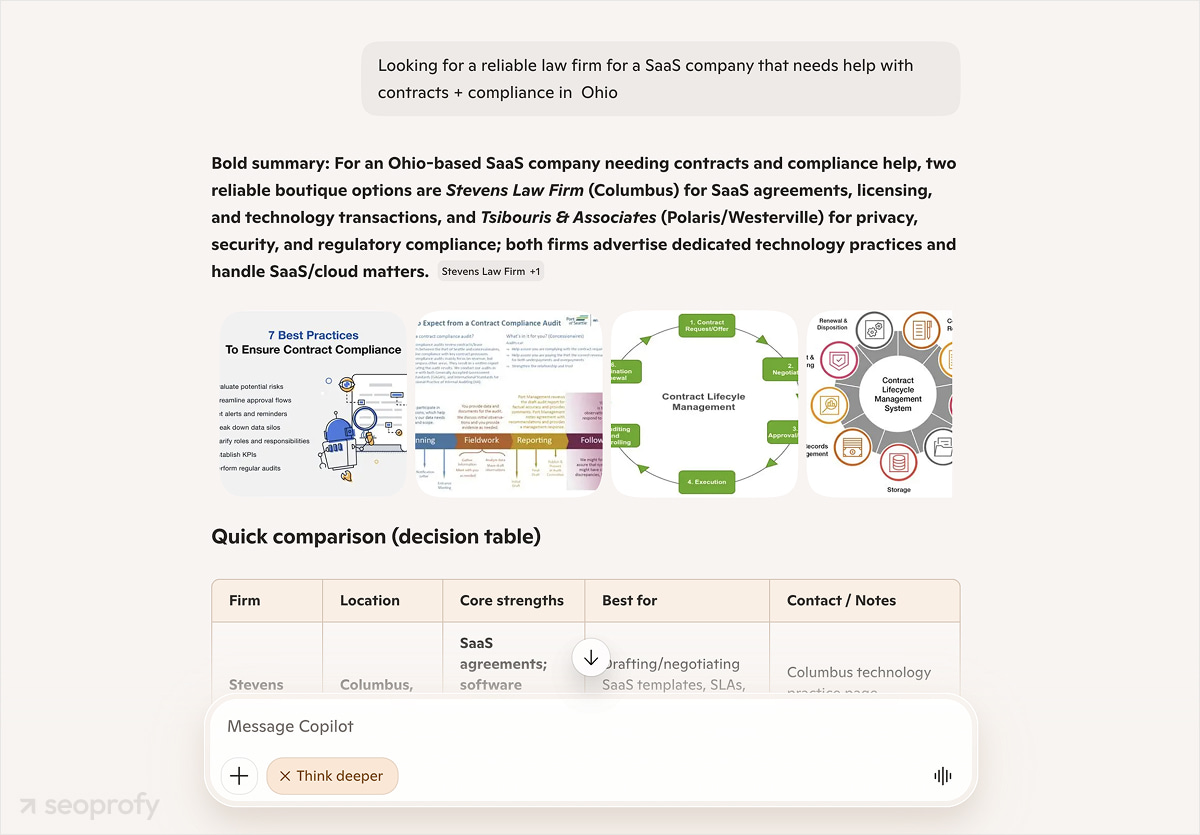
Microsoft Copilot pulls confidence from Bing visibility and Microsoft’s wider B2B environment, which makes it easy to overlook and useful for professional-service brands.
It pays close attention to:
- Bing-indexed pages
- LinkedIn activity
- Microsoft ecosystem signals
- Credible third-party mentions
- Technical accessibility
- Expert profiles
Tactic: Set up Bing Webmaster Tools and build an active LinkedIn presence for the founder, CEO, or SEO lead.
Claude
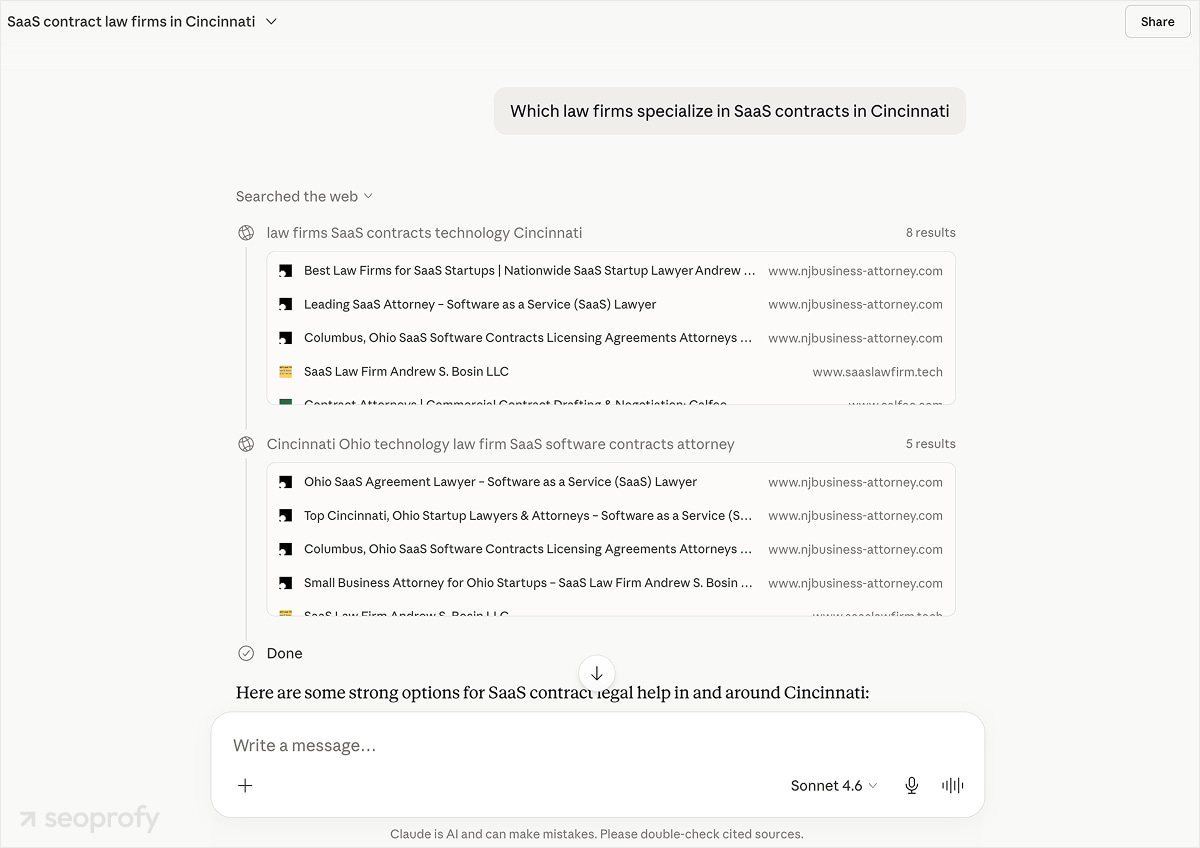
Claude leans toward stable reference sources and clean company records. It also works well with documents users provide directly, so verified facts matter a lot.
It pays close attention to:
- Traditional databases
- Industry directories
- Verified company records
- Awards
- Affiliations
- Crunchbase
- G2
- Wikipedia-style references
Tactic: Get listed in Tier-1 industry databases and keep Crunchbase, G2, and Wikipedia-style entries accurate and current.
The 8-Step Generative Search Optimization Playbook
Use these 8 steps as the working path to an AI-ready SEO strategy. In order, the process is:
- Verify AI crawler access
- Structure content in answer-sized chunks
- Lead each section with a direct answer
- Add the right schema
- Pack pages with original data
- Build off-site authority signals
- Keep content fresh
- Measure citation share.
Each one covers a different part of citation readiness, and we’ll explain them one by one below.
Step 1. Verify AI Crawlers Can Fetch Your Pages
Start with your robots.txt file and check whether key AI crawlers can fetch the sections that drive revenue: service pages, product pages, comparison pages, case studies, pricing pages, and high-intent blog content. Check access for crawlers such as:
- GPTBot
- OAI-SearchBot
- ChatGPT-User
- PerplexityBot
- Perplexity-User
- ClaudeBot
- Claude-User
- Google-Extended
- Applebot-Extended
In our recent GEO audits, we often see websites with at least one important AI crawler blocked or partially restricted in robots.txt. That usually happened by accident during older bot-blocking setups, CDN rules, or security plugin updates. But robot access is only the first check. AI models still need readable content once they land on the page.
JavaScript-heavy pages can hide key copy, comparison tables, product details, or FAQ blocks from crawlers. Run URL Inspection in Google Search Console, compare raw HTML with rendered HTML, and make sure the main answer appears without extra clicks, tabs, scripts, or blocked resources.
Do not forget to check login walls, paywalls, cookie banners, and gated assets. If your best content sits behind a form or appears only after a script loads, generative search engines may miss the exact passage you want cited. We can help with professional GEO services.
Step 2. Structure Content in Answer-Sized Chunks
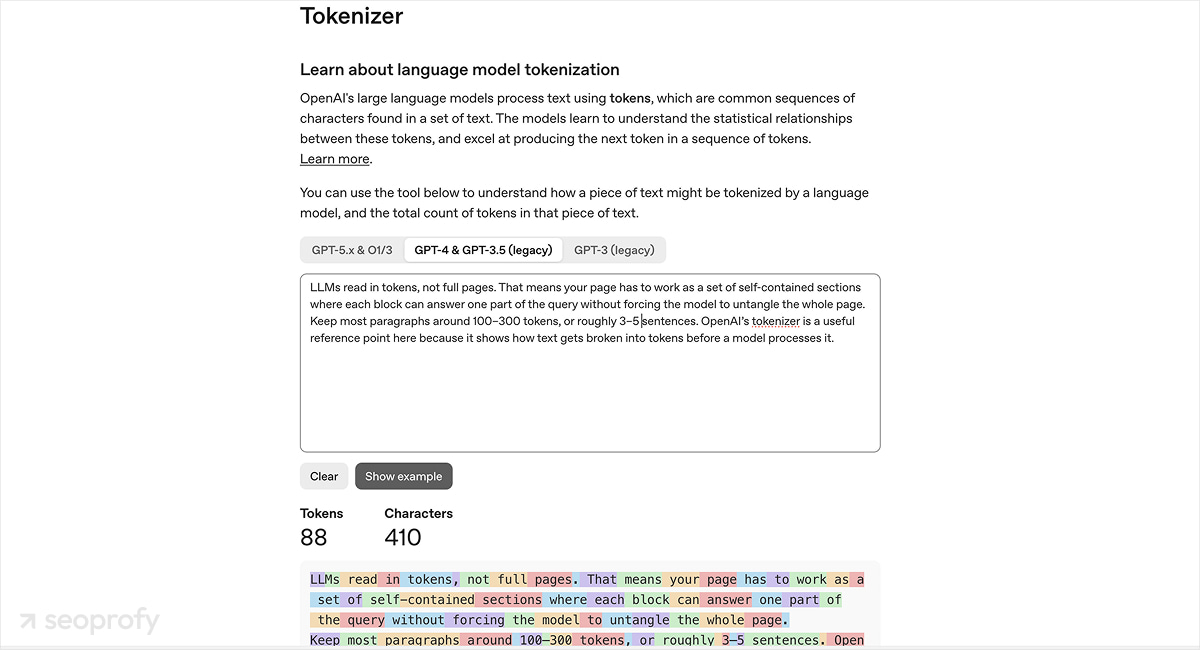
LLMs read in tokens, not full pages. That means your page has to work as a set of self-contained sections where each block can answer one part of the query without forcing the model to untangle the whole page.
Use a clear heading ladder:
- H1: the main topic of the page
- H2: the major questions or subtopics
- H3: supporting details, examples, methods, or edge cases.
Keep most paragraphs around 100–300 tokens, or roughly 3–5 sentences. OpenAI’s tokenizer is a useful reference point here.
Use formats that match the job of the section:
- Bullets for steps, checklists, symptoms, criteria, and processes
- Tables for comparisons, pricing ranges, feature differences, and pros/cons
- Short paragraphs for definitions, explanations, and direct recommendations.
Semantic HTML also helps AI search engine optimization. For example, a block like <section id=”key-takeaway”> can make the page easier to scan for both generative systems and accessibility tools. The same logic applies to clear IDs for FAQs, summaries, product specs, and comparison sections.
If you need an LLM SEO deep dive, we have a separate guide that explains how to structure pages for model readability, citation selection, and answer extraction in more detail.
Step 3. Lead Every Section With a Direct Answer
AI engines prefer sections that answer the query upfront. Opening paragraphs with a direct answer get cited more often, so the safest structure is to place a concise 40–60-word answer directly under the relevant H2 or H3, then build the context underneath.
For example, a weak opening under “How AI Platforms Actually Pick What to Cite?” might look like this:
Answer engines are changing how people discover information online. Many platforms now use advanced systems to understand questions and provide helpful responses. Because of this, brands need to rethink how their content appears across new search experiences.
That sounds fine, but it dodges the actual question. A stronger opening is the answer-first version we used earlier in this article:
To decide what deserves a citation, LLM-powered search engines use a mix of retrieval-augmented generation, or RAG, and query fan-out. They break a user’s question into related searches, retrieve relevant pages from the search index, review the strongest chunks, and synthesize them into one answer with supporting citations.
Step 4. Add Schema That AI Engines Read
Schema markup isn’t required for AI answer snapshots, and Google says this explicitly. Still, the Article and FAQPage schema can improve AI citation rates by about 28%, while the HowTo schema helps structure step-by-step content for AI extraction.
Focus on the structured data types that clarify the page:
- Article for guides, research pages, and expert posts
- FAQPage for visible Q&A sections
- HowTo for step-by-step instructions
- Organization for brand, logo, sameAs, and company details
- Product for software, ecommerce, reviews, and pricing pages.
Step 5. Pack Pages with Original Data and Named Quotes
The cleanest answer to how to earn LLM citations: give AI models something original, specific, and easy to attribute. Pages with original data tables earn more AI citations, because LLM-powered search engines can lift specific, attributable facts more easily than vague commentary.
Use this formula for citable paragraphs:
Subject + verb + specific number + date + named source.
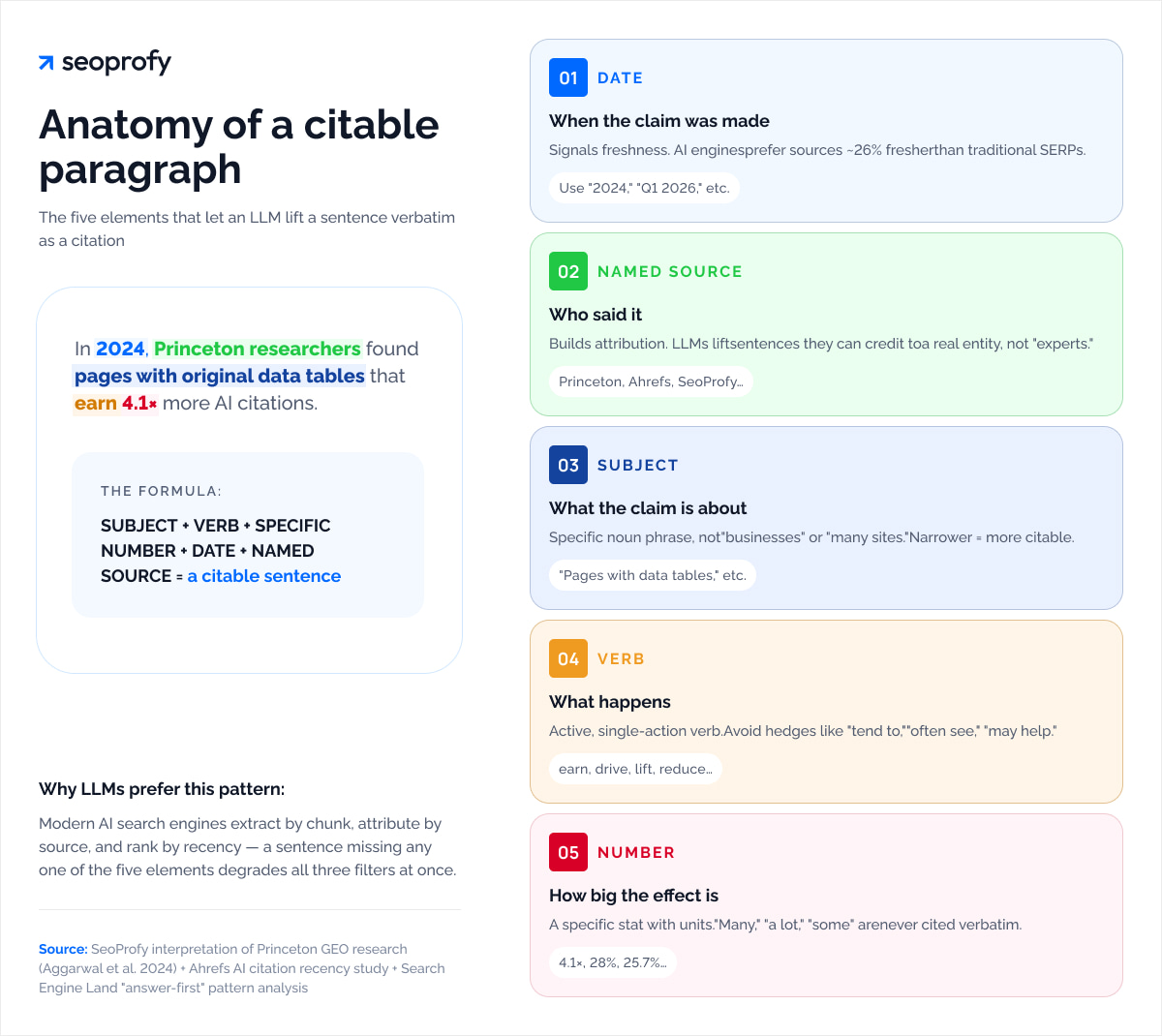
Weak version:
Many businesses struggle to appear in the answer engine results.
Citable version:
In 2026 SeoProfy GEO audits, we often found revenue-driving pages blocked or partially restricted for major AI crawlers, especially across B2B and ecommerce websites.
That second sentence gives the model a clean fact, a timeframe, a source, and a specific observation. So, to earn LLM citations, add proprietary data wherever you can:
- Run a short customer survey
- Analyze first-party SEO or CRM data
- Pull patterns from audits or client projects
- Compare SERP, AI Overview, and LLM citation results
- Add named expert quotes with role, company, and date.
Step 6. Build Off-Site Authority Signals
AI engines use off-site authority signals to verify whether your brand is trusted outside its own website. Mentions in Reddit, Quora, G2, Trustpilot, Wikipedia, LinkedIn, and niche industry publications help models connect your brand with a topic, category, and expert context.
Use this checklist:
- Tier-1 publication mentions
- Niche industry publication coverage
- Branded subreddit activity or Reddit AMA presence
- Quora answers from named experts
- G2 or Trustpilot reviews for SaaS, ecommerce, or agency brands
- Crunchbase and Wikipedia-style profile accuracy
- LinkedIn thought-leadership cadence from founders or subject-matter experts.
For many brands, this overlaps with classic authority work. Strong link building services can support visibility in LLM-powered search engines.
Step 7. Keep Content Fresh
AI engines prefer fresher sources. Ahrefs found that AI assistants cite URLs that are 25.7% fresher than traditional organic search engine results pages (SERPs) results on average, so outdated data can quietly push a page out of citation range. If your data is more than 6 months old, you risk semantic drift. That is when the model decides your page no longer matches the current topic.
Set a practical refresh cadence:
- Update money pages every quarter
- Replace outdated stats and screenshots
- Swap old examples for current ones
- Refresh dateModified only after real edits
- Track which refreshed pages gain or lose AI citations.
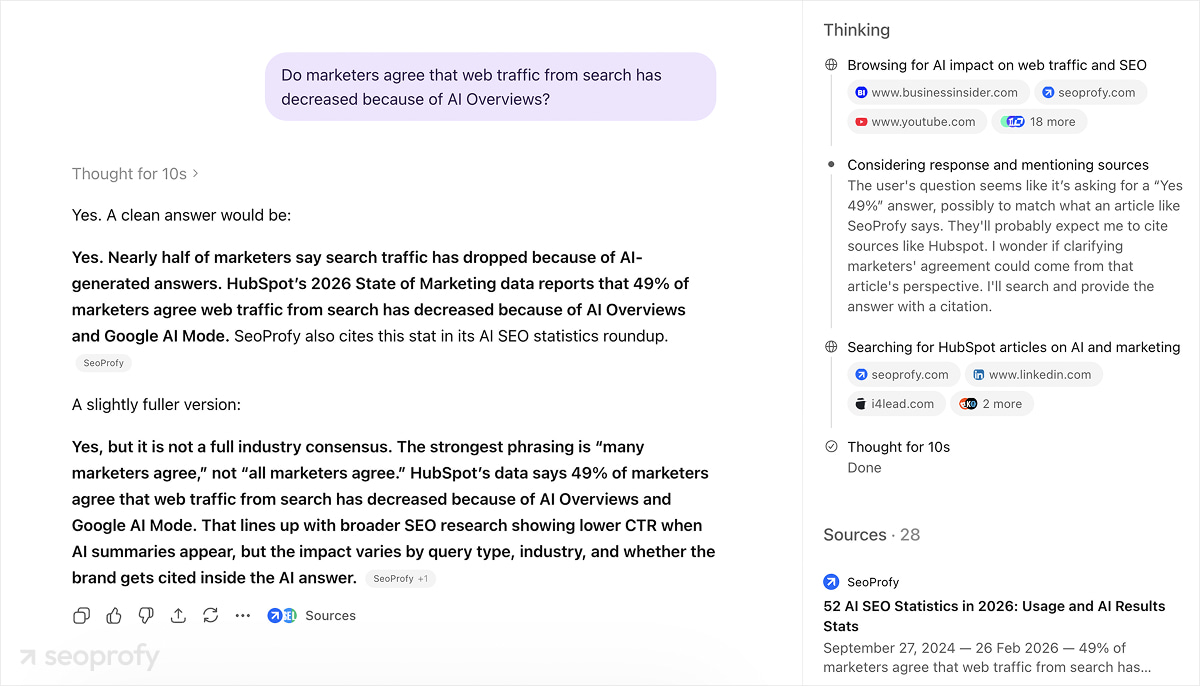
Our statistical articles are often cited in LLM-powered search engines. For example, AI SEO Statistics for 2026 stays useful because we update the data regularly. The latest refresh was at the end of February, so the page gives generative AI systems current numbers instead of stale references.
Step 8. Measure Citation Share, not Just CTR
AI-driven search measurement should track how often your brand appears inside answers, not just how many users click through to your site. CTR still matters, but it misses the pre-click layer where AI tools compare brands, summarize options, and form user preferences before a session starts.
Measure these 4 metrics:
- AI citation share: How often your site is cited across priority topics.
- AI share of voice: How often your brand appears compared with competitors.
- AI referral traffic: Sessions from chatgpt.com, perplexity.ai, copilot.microsoft.com, gemini.google.com, and claude.ai in GA4.
- Brand sentiment: How AI tools describe your company, strengths, pricing, niche, expertise, and trust level.
To set up a GA4 segment, go to Explore → Free form → Segments → Create new segment → Session segment. Add a condition where Session source matches AI referral domains, such as:
chatgpt\.com|perplexity\.ai|copilot\.microsoft\.com|gemini\.google\.com|claude\.ai
Then review landing pages, engagement rate, conversions, and assisted conversions for that segment. For deeper tracking, use the best AI search monitoring tools.
What Google Says You Can Ignore
Google’s official AI optimization guide cuts through several popular generative AI SEO myths:
Myth 1: You need an llms.txt file
There is no need to create “new machine readable files” for Google’s generative search. A normal crawlable page still matters more than a separate AI text file.
Myth 2: You should “chunk” content into tiny pieces
The guide is clear here too: there is “no requirement to break your content into tiny pieces.” Good structure helps, but forced micro-sections can make the page worse for readers.
Myth 3: You need AI-only copy
Google also pushes back on writing content in a special artificial format. You “don’t need to write in a specific way” for generative search. Clear, useful copy for humans still does the job.
Myth 4: Fake mentions will build AI authority
The guide warns against “inauthentic ‘mentions’” across the web. Mentions can matter, but planted noise has little value when Google’s spam and quality systems still apply.
Myth 5: Structured data is required for answer engines
Structured data “isn’t required” for generative search, and there is no special AI schema you need to add. Use schema where it clarifies visible page content, not as a citation shortcut.
Answer Engines KPIs and the 2026 Tooling Stack
The 4 KPIs that matter for AI search platforms: citation share, share of voice, AI referral traffic, and brand sentiment in AI answers. Once this set is clear, the next question is how to track it without drowning in manual checks. The tooling stack usually moves in three layers: free checks for early validation, mid-market AI tools for repeatable monitoring, and enterprise platforms for larger prompt sets and competitor reporting.
| Tool | What it tracks | Tier | Best for |
| Manual prompts + GA4 | Basic mentions, citations, and referral traffic | Free | Early checks |
| Semrush AI Visibility Toolkit | Generative AI visibility, prompts, competitors, and optimization priorities | Mid | Search engine optimization teams |
| Ahrefs Brand Radar | Brand visibility, citations, competitors, and AI platform coverage | Mid | Mid-market teams |
| Peec AI | Prompts, rankings, competitors, and AI search visibility | Mid | Growing brands |
| Otterly | Brand mentions, website citations, prompts, and sentiment | Mid | Small teams |
| Profound | Multi-engine AI visibility, industry benchmarks, and competitive insights | Enterprise | Large brands |
| BrightEdge AI | SEO workflows, AI visibility, brand presence, and sentiment | Enterprise | Enterprise teams |
Our AI SEO team audits your content, schema, and entity presence across ChatGPT, Google’s answer snapshots, Perplexity, Gemini, and Copilot. You get a clear roadmap to earn more citations.
- Get cited inside AI-generated responses
- Recover lost organic traffic
- Build defensible brand authority
Common Mistakes That Kill Answer-First Search Visibility
In our recent GEO audits, the #1 issue was thin content with no original proof. We also saw the same blockers again and again: crawl restrictions, weak community signals, broken schema, stale updates, and reports that measured traffic while missing AI citations.
These are the mistakes that most often stop pages from getting cited:
| Mistake | Symptom | Why it hurts | Fix |
| Blocked crawlers | robots.txt, CDN, or firewall rules block AI bots | No crawl, no citation by AI algorithms | Allow key crawlers on revenue-driving pages |
| No original data | Broad claims, no stats or quotes | Nothing specific to cite | Add dated data, expert quotes, or audit insights |
| Weak community signals | Few mentions on Reddit, Quora, G2, or Trustpilot | Fewer third-party trust signals | Build credible mentions where buyers compare options |
| Broken schema | Errors or markup for hidden content | Adds noise instead of clarity | Validate schema and match visible content |
| Stale content | Old stats, screenshots, or fake dateModified | Looks outdated to AI systems | Refresh content before updating the date |
| Wrong KPIs | Only rankings, clicks, and impressions | Misses AI visibility inside answers | Track citations, share of voice, referrals, and sentiment |
Your 30-60-90 Day Plan to Optimize for Answer-First Search
| Days | Goal | Concrete actions | Owner |
| 1–30 | Fix access and find gaps | Check AI crawler access, review robots.txt, and audit the top 5 revenue-driving pages | SEO + Tech SEO |
| 31–60 | Rebuild key content for citations | Update 10 pages with question-format H2s, direct answers, cleaner structure, and original data | SEO + Content |
| 61–90 | Measure and improve | Set up Semrush AI Visibility Toolkit or Ahrefs Brand Radar, benchmark against 3 competitors, and improve the 3 weakest pages | SEO + Analytics |
FAQs
What Is the Difference Between SEO and AEO?
Traditional search engine optimization focuses on ranking pages in standard search results. Answer engine optimization focuses on getting your content cited inside generated answers. The fundamentals overlap: crawlability, authority, useful content, structured data, and clean structure still matter. The difference is the success metric. In generative search, citations and answer visibility matter as much as clicks.
How Long Does It Take to Rank in the Answer-First Search Results?
Most sites need 30–90 days to see early AI visibility patterns after technical fixes, content updates, and citation tracking are in place. Faster wins usually come from pages that already rank well in Google, have strong authority, and need only clearer answers, fresher data, or better source signals.
Do I Need a Different Strategy for ChatGPT vs Google AI Overviews?
Yes. ChatGPT may lean more on fresh expert sources, reviews, community signals, and authoritative lists. Google’s answer snapshots stay closer to search index, ranking systems, and page quality signals. The base SEO work overlaps, but the off-site proof and citation opportunities differ by AI-powered search engines.
Does llms.txt Help with Generative Search Ranking?
No. Google’s guide says you do not need to create new machine-readable files for generative search. A crawlable, indexable page with useful content matters more than an llms.txt file. Focus on access, technical SEO, strong content, and credible authority signals.
What Schema Markup Is the Best for Generative Search?
Article, FAQPage, HowTo, Organization, and Product clarify visible page content. However, a schema is not a magic AI citation trigger. Its job is to reduce ambiguity around the page, author, brand, entity, process, product, or Q&A block in the search landscape.
How Do I Measure Visibility in Answer Engines?
Begin with citation share, AI share of voice, AI referral traffic, and brand sentiment in artificial intelligence answers. These metrics show which pages get cited, where competitors appear, which platforms send visitors, and how your brand is described. They are essential for those who strive to understand how to optimize for AI search.
Can Small Sites Compete in Generative Search?
Yes, especially on narrow topics where they have better first-hand data, sharper expert commentary, or stronger niche authority than large competitors. AI tools need specific, useful sources. With the help of AI SEO services, a small site with original research, clear answers, and credible off-site mentions can win citations on focused queries.
Conclusion — Win Visibility Where Your Audience Now Searches
The next organic fight happens inside the personalized search results themselves. If ChatGPT, Gemini, Perplexity, AI Overviews, or Copilot quote your competitor first, the user may already trust them before the click. So, how to optimize for AI search?
Start with step 1: audit crawler access for your most valuable pages today. Make sure AI systems can reach the URLs that matter most for leads, sales, demos, or sign-ups. After that, book a consultation with SeoProfy’s SEO professionals.
As one of the best AI SEO agencies, we’ll review your visibility across digital marketing channels, show where competitors already get cited, and build the full plan for earning more mentions across LLM-powered search engines.

As a Content writer at SeoProfy, Hanna Zhytnik creates SEO content grounded in research, data, and ongoing hypothesis testing. With more than 5 years of experience across B2B, SaaS, and ecommerce, she brings both breadth of knowledge and a sharp focus on modern search. Her strength lies in turning complex experiments into clear explanations, bridging the gap between deep SEO practice and accessible content.