


AI answers have moved from summarizing products to recommending them. A shopper can ask which sofa fits a small room on a set budget and get a shortlist back before ever opening a category page. That puts ecommerce stores into a second visibility contest. Your product still has to rank on the first page of search. However, it also has to make the cut with Google AI Overviews and AI engines such as ChatGPT and Gemini.


This guide shows you how to prepare your store for that selection. You’ll get a 6–12-month roadmap plus a 90-day action plan for choosing priority SKUs, improving product pages, and fixing the biggest data gaps. By the end, you’ll know which pages to tackle first and how to track whether the work is paying off.
- AI traffic to U.S. retail sites grew 393% YoY in Q1 2026. (Adobe)
- Nearly 30% of domains cited in AI Overviews ranked outside page one. (2026 citation study)
- Top-quartile brands by web mentions earned up to 10× more LLM (large language model) citations. (Ahrefs)
- AI-referred retail visitors converted 42% better in March 2026. (Adobe)
- Agentic shoppers could drive $190–385 billion by 2030. (Morgan Stanley)
What Is Answer Engine Optimization (AEO) for Ecommerce?
Answer engine optimization (AEO) for ecommerce is the process of making an online store’s content easy for answer engines to understand, retrieve, and use when responding to product-related questions. It helps product pages, category pages, and buying guides provide clear, direct answers before a shopper reaches the site.
Unlike traditional SEO (search engine optimization), which often focuses on helping pages rank for specific queries, ecommerce AEO also needs to make the relationship between a product and user intent clear.
Product names, specifications, variants, availability, use cases, and comparison points should be straightforward and consistent, so answer engines can understand which products fit different needs. Important buying information should also appear close to the relevant product or category rather than existing only in a separate guide.
Key ecommerce AEO signals include:
- Clear product names and descriptions
- Accurate SKU-level details
- Useful comparison context
- Availability and variant information
- Category copy that explains buyer intent
- FAQs that answer real shopping questions
- Structured data that supports product understanding.
Answer engine optimization also overlaps with GEO (generative engine optimization). AEO focuses on making your product pages useful as direct sources for answer engines. GEO is broader. It looks at how your brand appears across AI Overviews and other AI-generated search experiences through your own site. It also considers third-party mentions, reviews, product feeds, and other trust signals.
The distinction is not absolute, and many tactics support both. Next, we’ll compare AEO vs. GEO vs. traditional SEO point by point so you can see the differences more clearly.
AEO vs. SEO vs. GEO for Ecommerce
| Area | SEO | AEO | GEO |
| Main goal | Get product and category pages ranking in search results | Make pages clear enough to become sources for AI-driven answers. | Build brand visibility inside AI-generated responses |
| Core tactics | Keyword research
Technical SEO Internal linking Content optimization Backlinks |
Clear answers
SKU-level facts Product context Structured data FAQ coverage |
Brand mentions
Product feed accuracy Reviews Digital PR Third-party authority |
| Main metrics | Rankings
Organic traffic CTR Revenue from organic search |
AI citations
Featured answers Answer visibility Assisted product discovery |
Brand mentions in AI results
Share of AI visibility Sentiment Source presence |
| Click dependency | High. The user usually needs to click through from search engine results pages. | Medium. The answer may influence the user before the click. | Lower at the first touchpoint. The brand can appear before the user chooses a site. |
These three do not compete with each other. They stack.
SEO gets the store found in traditional search engines. AEO makes the page easier to use when the answer is generated directly. GEO builds the outside trust layer that helps AI systems see the brand as a safer recommendation.
For ecommerce, that matters because the buyer journey is getting less linear. A shopper can move from Google (or other search engines) to ChatGPT, then to reviews, then back to a category page. Your store needs to be understandable at each of those stops.
We’re keeping this comparison focused on ecommerce here. If you want to go deeper into how AEO and traditional SEO differ in general, we covered that in a separate AEO vs SEO guide.
Why an AEO Strategy Is Urgent for Ecommerce in 2026
Answer engine optimization is urgent for ecommerce in 2026 because search engines evolve and stores are losing part of the old search click while AI-referred shoppers are becoming more valuable. In other words, the risk and the upside are happening at the same time.
Google holds about 89.85% of global search traffic, so changes to its query experience have an especially wide reach. Ahrefs found that AI Overviews reduced clicks to top-ranking pages by 58%. That is the uncomfortable part. A store can still rank well in search engines and get less traffic than the same position used to bring.
So, product and category pages now have to work earlier in the journey, where AI-generated summaries can influence the shopper before they land on the site. E commerce teams are already asking how to rank in AI Overviews because the answer can influence the buyer before a search result gets the click. Pages need to be clear enough for generative AI models to understand the offer and strong enough to earn a citation, even when the store already has a solid existing SEO strategy.
The upside is that AI traffic is starting to behave like high-intent traffic:
- Adobe found a 393% year-over-year jump in AI traffic to U.S. retail sites in Q1 2026.
- In March 2026, AI-referred visitors converted 42% better than non-AI traffic.
- Reuters later showed that LLM-referred shoppers generated 53% more revenue per visit in May 2026.
That makes answer engine optimization more than a visibility play. It is a revenue-access problem that complements SEO, paid media, and other customer acquisition channels.
The window is also early enough to matter. EMARKETER expects U.S. ecommerce sales through AI platforms to exceed $20 billion in 2026 and top $144 billion by 2029. Early movers have a real shot at becoming the sources AI models learn to trust first. Nearly 30% of AI Overview-cited domains did not appear in the first-page organic results. That means citation selection is already a battlefield in itself.
How Answer Engines, LLMs, and AI Agents “See” Your Store
Answer engines do not “look” at an ecommerce store the way a shopper does. They read it through machine-friendly clues: the page HTML, structured data, product feeds, sitemaps, APIs, and commerce protocols that let agents move from recommendation to purchase.
That sounds technical, but the idea is simple. Ecommerce brands have to tell the same product story in every place a machine can check.
Google says structured data gives its systems “explicit clues” about a page, and it recommends JSON-LD because it is easier to implement and maintain at scale. Google Merchant Center also uses product data to match products to the right queries. If product data is wrong or incomplete, Google warns that listings can be disapproved, limited, or displayed incorrectly.
For ecommerce, the machine reads several versions of the same product:
| Store layer | What it means | Why it matters for AEO |
| HTML page | The product page a shopper sees in the browser | AI systems read the visible text to understand what the product is and how the store explains it |
| JSON-LD structured data | A hidden “fact card” added to the page code | It helps machines read the product name, price, rating, availability, brand, and image without digging through the design |
| Product feed | A catalog file sent to platforms like Google Merchant Center | It tells AI models what you sell, which variants exist, what is in stock, and which price should be shown |
| Sitemap | A map of important URLs on the site | It helps search engines discover product pages and category pages faster. |
| API | A direct data connection between your store and another system | It can pass fresh inventory, pricing, and product details when outside tools need current information |
| Commerce protocols | New rules that help AI agents connect product discovery with checkout | They matter because AI tools are moving closer to the buying step, not only the research step |
This is the technical side of ecommerce SEO for AI. LLMs and answer engines are not only reading copy. They are trying to assemble a clean product object from several places at once.
A category paragraph may help explain the buyer use case. JSON-LD might confirm the product facts. The feed may carry the current price and availability. An API might provide fresher stock data than the page. Together, these layers tell the machine what the store sells and whether the information is safe to use in an answer.
AI agents push this further. OpenAI’s Agentic Commerce Protocol powers Instant Checkout in ChatGPT. Google’s Universal Commerce Protocol was built so AI surfaces such as AI Mode and Gemini can connect with business backends for product discovery and checkout flows.
So when we say answer engines “see” your store, we mean something very specific: they read your catalog through code, feeds, URLs, and product data systems. The cleaner those signals are, the easier it is for AI search to connect your structured data with natural language shopping queries.
Core Building Blocks of AEO for Ecommerce
AEO for ecommerce works through several connected layers. Below is the quick map. Next, we’ll go through each one in detail.
- Product schema and structured data
- Clean catalog data
- PDPs built for direct AI answers
- Category pages that explain buyer choice
- Topic clusters and GEO content
- Conversational and voice search traffic and coverage
- Technical access for crawlers and answer engines
- Reviews, trust signals, and brand proof
- Off-site mentions and knowledge graph signals
1. Structured Data & Schema Markup
In answer engine optimization, structured data markup turns a product page into a clean source of machine-readable data. It will not single-handedly get your store recommended by AI tools. However, schema makes your pages easier for AI systems to read, categorize, and cite.
Use schema markup like a product fact sheet:
- Product + Offer: Name, image, brand, price, currency, availability, and URL.
- AggregateRating + Review: Real buyer feedback, only when reviews are visible on the page.
- BreadcrumbList: Category path, so machines understand where the product sits.
- FAQPage: Helpful for on-page Q&A markup, but use it carefully because Google no longer shows FAQ rich results in search.
For ecommerce platforms, the risky part is usually the template layer. Shopify themes, WooCommerce plugins, and Magento extensions can all generate schema markup automatically, but “automatic” does not always mean clean. Product schema may duplicate. Offer data may miss variant prices. Reviews may appear in markup but not on the visible page.
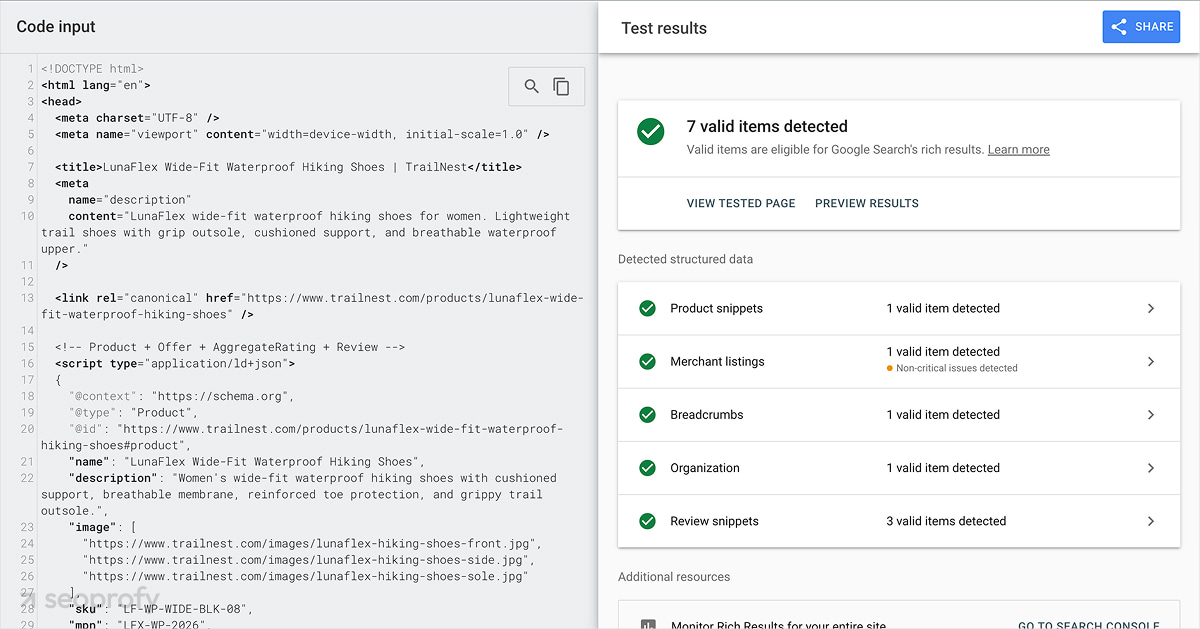
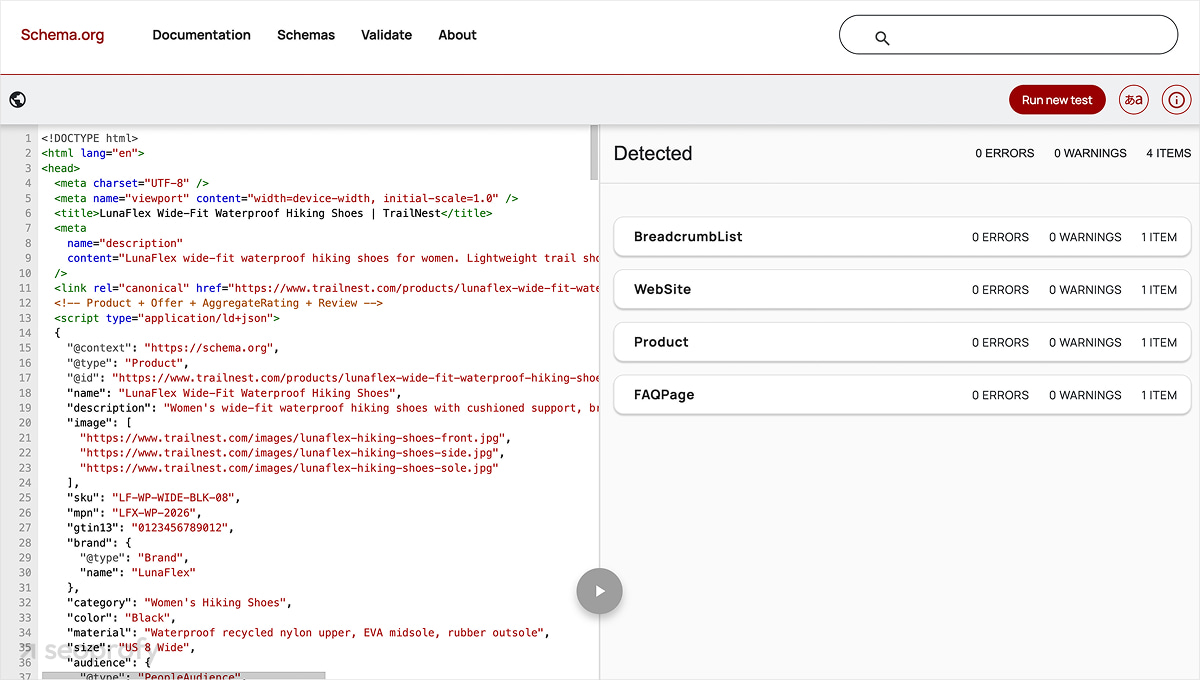
Check the markup in Google’s Rich Results Test and Schema.org Validator. Validate the main templates first, then test real product detail pages (PDPs) with variants, discounts, out-of-stock items, and reviews.
2. Product Data Debt
Product data debt is the gap between your catalog spreadsheet and a product record a machine can actually use. Start with the top 50–200 revenue SKUs first. These products already have demand, so better matching can touch money faster.
Attribute-rich titles matter because ecommerce systems need to separate one item from near copies. Google Merchant Center uses product identifiers like GTIN, MPN, and brand to define products and match search queries. Google also says products with assigned GTINs can receive limited visibility when the feed omits them.
Before: Women’s Trail Shoes
After: Julia Flex Women’s Waterproof Hiking Shoes — Wide Fit — Black — US 8
The second title carries product type, brand, use case, fit, color, and size. That gives AI models a better match for searches like “wide waterproof hiking shoes size 8.”
When dealing with AEO for ecommerce, fix the fields that change matching quality first:
- GTIN or MPN
- Brand
- Item group ID
- Product name
- Size, color, material, and other relevant variant attributes
- Price
- Compatibility
- Availability
Then clean the specs and detailed product descriptions. “Premium upper” is dead weight. “Waterproof recycled nylon upper” gives machines in the AI search a usable attribute.
3. Product Detail Pages for Direct AI Answers
A strong PDP should answer the buyer’s main question before the page turns into a sales pitch. Give answer engines a clear summary first. Concise, extractable answer blocks are easier for AI systems to retrieve and reuse. Then support it with structured detail given in clear natural language.
- Answer-first summary: Use 40–60 words of natural language to explain what the product is, who it suits, and which problem it solves.
- Question-based H3s: Turn real user queries into headings. Example: “Is this mattress suitable for side sleepers?”
- Direct answers: Open each section with the conclusion. Add proof and product detail after it.
- Spec table: Keep size, material, compatibility, dimensions, and warranty easy to scan, especially on mobile devices.
- FAQ section: Cover shipping, returns, care, fit, and common buying concerns. Add FAQPage schema when the questions appear on the page.
- Alt text: Describe the product feature shown in each image.
- Video transcripts: Add searchable text for demos and setup videos.
Each element gives answer engines a cleaner route to the takeaway.
4. Category Pages as Answer Hubs in AI Search
A category page should do the sorting work between a broad query and the right products. Its job is to explain the category, show the differences that affect the choice, and guide both the shopper and the answer engine toward the most relevant PDPs.
Ecommerce brands should build it around three elements:
- Short explanatory sections: Define the category and clarify the main selection criteria close to the product grid.
- Comparison elements: Group products by use case, price tier, performance, or compatibility so the catalog has visible decision logic.
- Descriptive PDP anchors: Use link text that names the product and its key benefit instead of vague labels such as “View product.”
You should keep filters aligned with the language used in product data and on PDPs. In AEO for ecommerce, a well-built category page is the bridge between discovery and product-level recommendation.
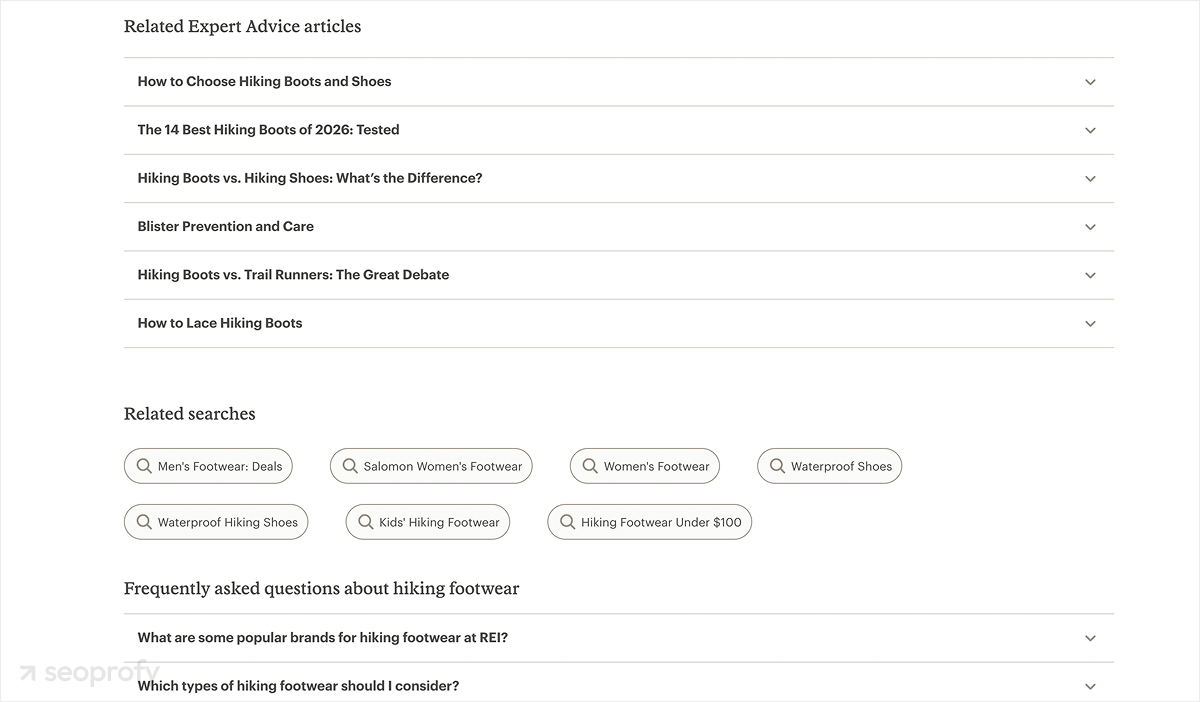
A great real-world example would be REI’s Hiking Footwear category. The page combines product listings with filters based on real selection criteria. It also links to expert comparisons such as hiking boots vs. shoes and trail runners. Thus, answer engines get both the category context and clear routes to more specific products.
5. Topic Clusters and GEO Content
A single buying guide can rank. A well-built topic cluster can give search engines a comprehensive understanding of your expertise across the whole subject. Choose the pillar from a commercial topic your store already has a reason to own. Start with a category that brings revenue. Then map the questions your target audience asks before buying to create blog posts/other types of content that support those commercial topics.
Use these sources:
- Ahrefs Matching Terms and Parent Topic
- Internal site-search queries
- Customer support tickets
- Product reviews and return reasons
Say the pillar is “How to Choose an Espresso Machine.” Ahrefs may reveal separate intent around boiler types, kitchen size, grinder compatibility, and water hardness. Group keywords by search intent. Queries that produce similar results belong on one page. A different SERP (search results page) usually deserves its own cluster. Ahrefs uses the same principle for keyword clustering.
Link every cluster back to the pillar. Then point readers toward the relevant category or PDP. Google (as well as other search engines) studies those internal connections to understand page importance and site structure.
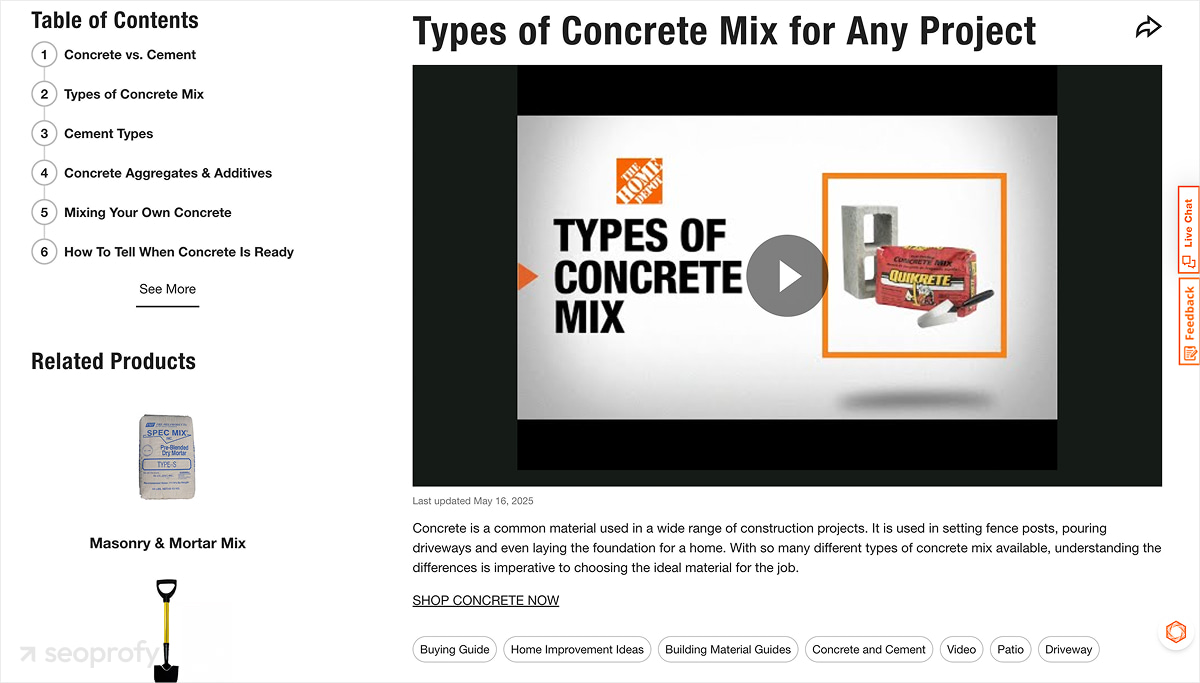
The Home Depot uses this model around concrete products. Its “Types of Concrete Mix” pillar covers the main buying decision, while connected sections explore cement types, additives, mixing methods, and readiness checks. A clear “Shop Concrete Now” route then moves readers from research into the relevant product category.
The generative engine optimization edge comes from information competitors cannot easily copy. Add return-rate patterns, support data, product testing, or insights pulled from verified reviews.
Refresh the cluster annually. Update the pillar first. Then replace discontinued products and refresh the supporting data to better optimize for AI models.
6. Conversational and Voice Search
Conversational search matters because buyers increasingly use natural language queries that describe complete situations instead of short keyword phrases. “Air purifier” names a category. “Which air purifier is quiet enough for a small bedroom with pets?” reveals the room size. It also shows the target audience’s main concern and the product qualities that will shape the choice.
Ahrefs notes that AI search prompts tend to be longer and more conversational. Answer engines then use query fan-out to split one detailed request into smaller searches. Search Engine Land also links AI visibility with question-based queries and follow-up intent. Voice search adds another route into the same shopping behavior: according to our voice search statistics, 43% of people shop online through voice-enabled devices.
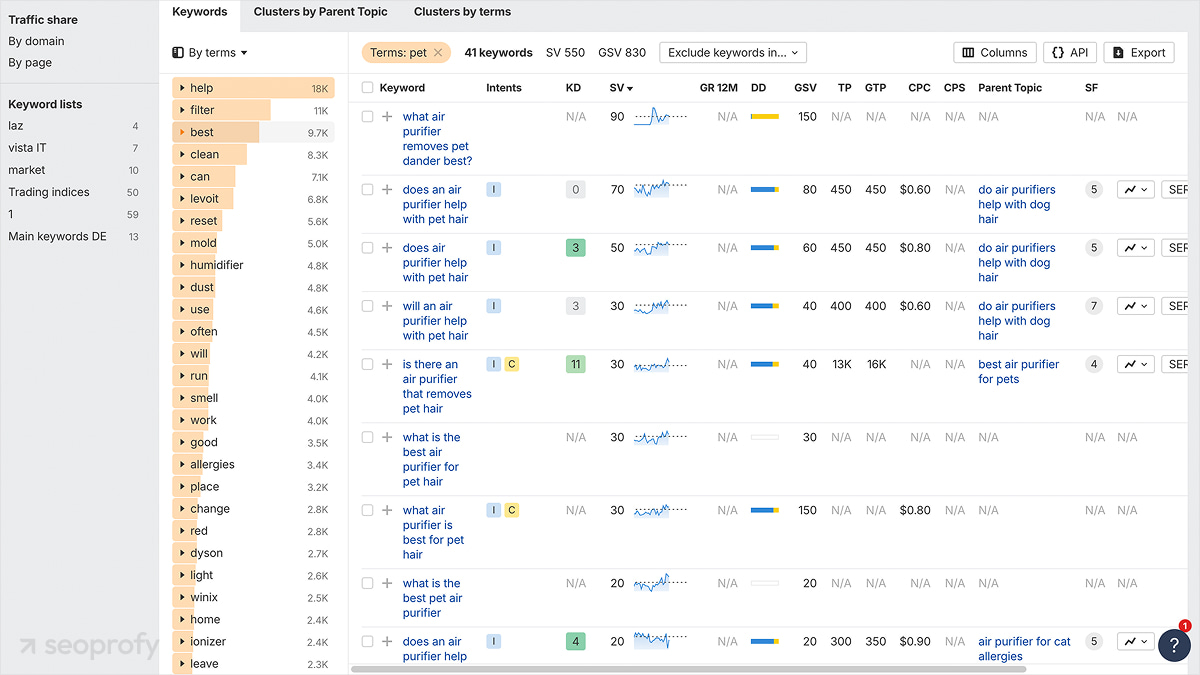
Collect these questions before creating user-centric content for blog, product pages, and category pages. Use them to plan headings, FAQ blocks, bullet points, comparison sections, and direct answers. For example, in Ahrefs:
- Seed: air purifier
- Open: Matching Terms → Questions
- Filter by: pet, allergies, small room, quiet, bedroom, under 200, near me
You can then narrow the results around one buying concern at a time. In the example below, filtering around “pet” surfaces question-based searches such as “What air purifier removes pet dander best?”, “Does an air purifier help with pet hair?”, and “Is there an air purifier that removes pet hair?” This turns a broad product category into specific concerns that can be mapped to relevant content and product recommendations.
Do not force every variation onto a separate page. Instead, group questions that express the same underlying intent and use the strongest natural formulation as a heading. Long-tail keywords can also improve visibility in voice search results by reflecting specific, natural-language queries. When a long-tail question deserves its own section, preserve the way shoppers actually phrase it: Which Air Purifier Is Quiet Enough for a Small Bedroom with Pets?
As mentioned earlier, for voice search and answer engine optimization, respond to the question in the first sentence, then explain the criteria behind the recommendation. For this query, those details might include room coverage, CADR, filter type, noise level, pet-related filtration needs, and price.
The same principle applies to local intent. Queries involving “near me,” local pickup, or nearby availability need geo-specific information. Where relevant, store and product pages should clearly identify the location and keep store-level availability current.
7. Technical AEO
Strong product content will work when answer engines can reach it and render it properly. The checklist below shows which technical areas to check first so your key pages stay accessible, your catalog data stays current, and you get higher chances of being mentioned in AI responses.
- Core Web Vitals: Aim for LCP within 2.5 seconds, INP within 200 ms, and CLS below 0.1 at the 75th percentile.
- Rendering: Keep product copy, links, price, availability, and schema markup present in rendered HTML. Search engines process JavaScript through separate crawling, rendering, and indexing stages.
- Site depth: Place priority categories and revenue-driving PDPs close to the main navigation.
- Faceted navigation: Open crawl paths only for filter combinations with real search demand. Control endless parameter URLs through canonicals, robots rules, and clean URL logic.
- Schema freshness: Update price, stock, variants, and ratings alongside the visible PDP.
- Google Search Console (GSC) monitoring: Monitor Page Indexing, Core Web Vitals, Product snippets and Merchant listings, and use URL Inspection to troubleshoot representative pages. For Google AI visibility, review the Generative AI performance report where it is available.
Technical SEO for ecommerce covers a much wider scope than this section. We’ve collected the full set of detailed recommendations in a separate guide. Head there if you want a deeper understanding of the topic.
8. Trust, Reviews, and Brand Signals for Answer Engines
Answer engines trust a store when product claims are repeated by real buyers and confirmed elsewhere on the web. A review like “great product” adds little. Feedback that names the exact model and use case gives AI something useful to work with while reinforcing customer loyalty through authentic purchase experiences.
Build stronger review data:
- Ask for direct answers about fit, room size, compatibility, setup time, or results after use
- Keep UGC tied to the correct SKU and variant
- Encourage customer photos or short videos that show the product in use
- Track recurring praise and complaints across Reddit, Trustpilot, YouTube, and niche forums.
Customer UGC can add first-hand context to a PDP in the AI search. It is a direct E-E-A-T signal because it shows real experience behind the claim.
Off-site consensus carries serious weight, too. Ahrefs studied 75,000 brands and found that web mentions had the strongest correlation with AI Overview visibility at 0.664. Brands in the top quartile earned up to 10 times more AI-Overview citations.
9. Off-Site Signals, Digital PR, and Knowledge Graph Optimization
LLMs learn what your brand stands for through repeated associations across the web. The same connection between your brand and its area of expertise should appear consistently on your site and across credible third-party sources.
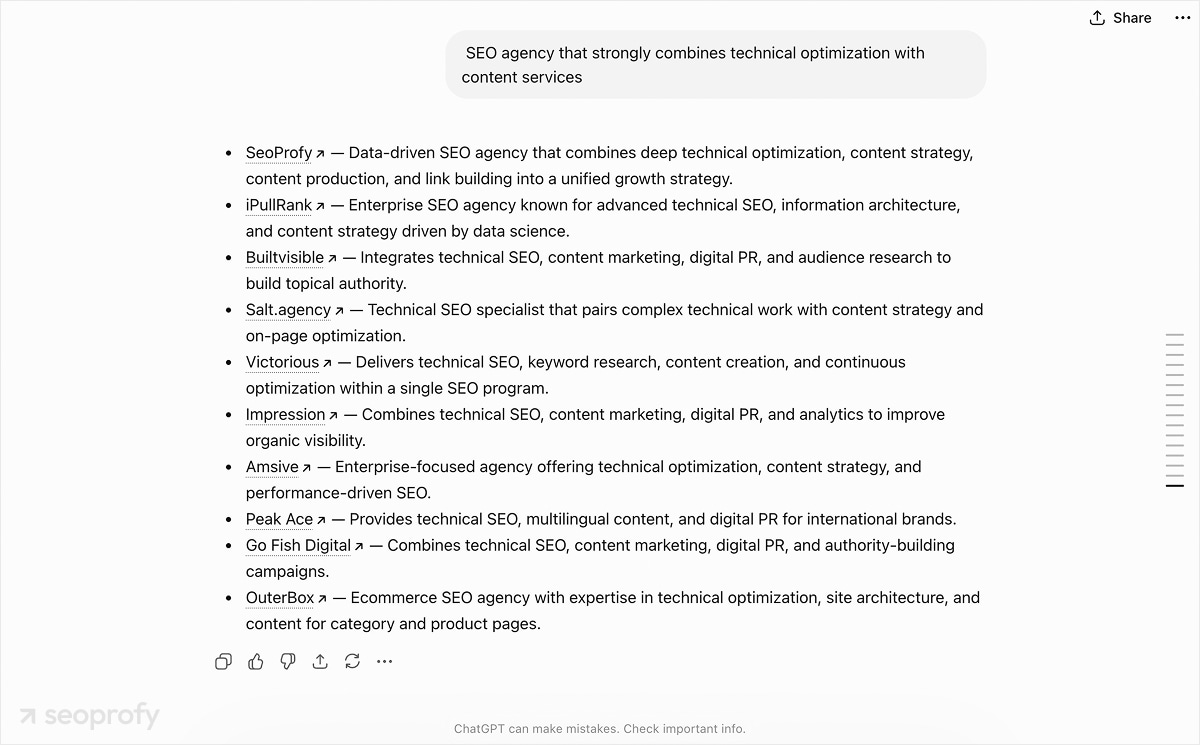
If someone says “a family fast-food restaurant,” what is the first brand that comes to mind? Probably McDonald’s. If we ask ChatGPT to name an SEO partner that strongly combines technical optimization with content services, it will recommend SeoProfy. That is how these learned associations work.
A 2026 study of AI citations found that 85.7% came from third-party domains. Your own website defines the brand message, but external sources help reinforce it. That broader authority footprint can also support visibility through LLM citations and brand mentions in AI-generated answers.
Focus on three areas:
- Entity consistency: Keep the same brand name and URL across profiles. Add Organization schema markup with your logo and official social or review profiles through sameAs. Search engines use these details to identify organizations more clearly.
- Digital PR: Publish original surveys or product data. Give journalists a finding worth quoting with your brand attached to it.
- Category association: Seek mentions where the surrounding text connects your brand with the product category or expertise you want to own.
A backlink helps the target audience reach the site. An unlinked mention still places the brand beside a topic and helps build brand loyalty. Repetition across respected sources gives retrieval systems a clearer picture of when ecommerce brands belong in the answer.
An AEO Roadmap for Ecommerce Teams
Answer engine optimization becomes much easier to manage once the work is split into phases. The table below maps the main priorities across 6–12 months.
| Phase | Timing | Main focus | What the team should deliver |
| Foundation | Q1/Months 1–3 | Build a clean technical base | Audit crawling and rendering. Fix product schema markup. Clean feeds. Set the priority SKU list. Record baseline visibility in GSC, Google Analytics, and AI visibility tools. |
| Visibility | Q2/Months 4–6 | Make key pages easier to cite | Upgrade priority PDPs. Improve category pages. Publish supporting topic clusters. Strengthen internal links. Add direct answers where buyer intent is clear. |
| Engagement | Q3/Months 7–9 | Turn visibility into useful traffic | Track AI referrals, assisted conversions, and key performance indicators. Expand conversational coverage. Improve review collection. Refresh weak product attributes. Test which answer formats drive clicks. |
| Leadership | Q4/Months 10–12 | Build authority competitors struggle to copy | Publish proprietary data. Run digital PR campaigns. Grow third-party mentions. Strengthen brand entities. Refresh the strongest clusters with new evidence. |
Smaller catalogs can run several workstreams in parallel and complete the roadmap closer to 6 months. Large stores usually need the full year because schema and catalog cleanup need to roll out across many templates and SKUs.
SeoProfy will audit your store and show where the strongest AEO opportunities sit. You’ll learn how clearly answer engines understand your catalog before you commit to a full roadmap.
- Find technical and product-data gaps
- Identify priority product pages and SKUs
- Get a clear action plan for the next 6–12 months
The Importance of SKUs, Categories, and Queries for AEO
A large ecommerce catalog can contain thousands of products, yet a much smaller group usually drives most revenue. Prioritization helps the team focus on answer engine optimization work where stronger AI visibility has the clearest commercial value.
Rank categories by revenue and margin first, then use market research to identify where customer demand and competitive opportunities are strongest. Inside those categories, choose SKUs with stable stock and strong conversion. Then map the queries around them to the buyer journey. Here’s a quick cheat sheet for matching each stage of the buyer journey with the right page type.
| Funnel stage | What the target audience wants | Best content type | What to prioritize |
| Awareness | Understand the problem or product category | Guide or topic cluster | Search demand and category relevance |
| Consideration | Compare options and narrow the choice | Category or comparison page | Assortment depth and revenue potential |
| Purchase | Select a product or exact variant | PDP or targeted category/landing page | Revenue, margin, stock stability, and conversion rate |
| Post-purchase | Use, maintain, or replace the product | FAQ or support guide | Support demand and repeat-purchase value |
Common AEO Mistakes Ecommerce Brands Should Avoid
The same answer engine optimization mistakes can spread across hundreds of product and category pages. Here are the five to check first, plus the fix for each one.
1. Trusting Schema Plugins on Autopilot
Problem: Shopify apps and WooCommerce plugins often generate Product markup automatically. The theme may create another version at the same time. This can leave search engines with duplicate entities or two different prices for one product.
Solution: Check several live PDPs in Google’s Rich Results Test and Schema.org Validator. Include products with discounts, variants, and out-of-stock items. These pages usually reveal template problems fastest.
2. Focusing Only on Category Keywords
Problem: Category keywords show broad product demand but miss many of the questions buyers ask while comparing options and making a choice.
Solution: Pull question queries from Ahrefs and internal site search. Review customer support tickets, too, to identify the details buyers need before they feel ready to order.
3. Reusing Manufacturer Descriptions
Problem: Manufacturer copy gives every retailer the same product story and often leaves PDPs without enough original detail to differentiate the product.
Solution: Explain fit and compatibility. Add exact measurements. Cover the situations where the product performs best. These details make the page more useful for both shoppers and answer engines.
4. Publishing Isolated Articles
Problem: A single guide can cover one part of a topic but remain disconnected from related content, categories, and products across the site.
Solution: Link supporting articles to the main guide. Then connect them with relevant category pages and PDPs. Each page should have a clear role in the buyer journey.
5. Treating AEO as a One-Time Project
Problem: Catalog data changes constantly. Prices move, products disappear, and reviews introduce new buyer language.
Solution: Check priority pages every quarter. Refresh wider topic clusters once a year. Review schema whenever templates or ecommerce apps change.
Future Trends: AI Agents, Agentic Commerce, and Post-SERP Ecommerce
AI agents are moving from product research into selection and checkout. By 2030, agentic shoppers could be responsible for $190–385 billion in U.S. ecommerce spending, according to Morgan Stanley.
These changes follow:
- OpenAI’s Agentic Commerce Protocol lets merchants share structured catalog data with ChatGPT so it can understand inventory and surface relevant products.
- Google’s Universal Commerce Protocol brings direct buying into AI Mode and Gemini, and other AI assistants that are adding shopping capabilities.
- Catalog data becomes machine-facing sales material. Google added conversational product attributes to its Merchant API in 2026.
- Rankings in search engines become one part of visibility. Feeds, structured data, entity signals, and crawlable content increasingly determine whether answer engines can evaluate and recommend a product.
Together, these developments move ecommerce closer to machine-to-machine interaction. AI surfaces can increasingly exchange structured catalog, inventory, cart, and transaction information with merchant systems rather than relying only on a shopper clicking from a traditional search result.
Practical 90-Day AEO Action Plan for Ecommerce Stores
A 90-day sprint should leave you with cleaner product data, stronger priority pages, and a reliable way to track AI visibility. Here is a checklist your traditional SEO, content, and development teams can work through together.
Days 1–30: Audit and prioritize
- Select the top 50–200 SKUs by revenue, margin, and stock stability
- Audit schema, product feeds, crawlability, and rendered HTML
- Record baseline AI citations, organic traffic, and assisted conversions
- Collect conversational queries from Ahrefs, site search, and support tickets.
Days 31–60: Fix and rebuild
- Clean titles, attributes, variants, GTINs, and availability data
- Upgrade priority PDPs with answer-first summaries and spec tables
- Improve category pages with selection guidance and comparison blocks
- Connect guides, categories, and PDPs through descriptive internal links.
Days 61–90: Expand and test
- Publish one priority topic cluster
- Strengthen review collection around product attributes
- Track brand mentions across AI platforms and third-party sources
- Test which formats earn citations in AI Overviews/other LLMs and qualified visits.
After 90 days, review AI visibility, citation frequency, indexed product pages, referral traffic, conversion rate, and revenue from priority SKUs. Use the results to choose the next catalog segment.
Conclusion: Integrating AEO into Your Ecommerce Growth Playbook
AI-driven search is reshaping product discovery, but ecommerce teams do not need a separate strategy for every new platform. The better approach is to build these changes into existing search, catalog, content, and measurement workflows. Answer engine optimization should become an ongoing capability with clear ownership and priorities.
Start with a schema audit this quarter to uncover inconsistencies between product markup, visible pages, and feeds. Stronger foundations improve your chances of appearing in AI-generated answers. SeoProfy can turn the findings into a practical plan with our AEO ecommerce SEO services.
FAQ: AEO Strategy for Ecommerce
How Is AEO Different from Traditional SEO for Ecommerce in Day-To-Day Work?
Answer engine optimization adds a direct-answer and AI-visibility layer to traditional SEO for ecommerce. Search engine optimization still covers crawlability, rankings, internal linking, and organic revenue, while AEO focuses more on how clearly AI answer engines can interpret product facts and connect them with detailed shopping questions.
Day-to-day work may therefore include improving structured data, product feeds, concise answers, comparison context, and monitoring how products or brands appear across AI-powered search experiences.
Do Smaller Ecommerce Brands Really Need AEO, or Is It Only for Large Retailers?
Yes, smaller ecommerce brands can often move faster because they have fewer products and cleaner decision paths. Start with one priority category and 20–50 revenue-driving SKUs. Improve the product data, strengthen the category page, and cover the questions closest to purchase.
Which Answer Engines and AI Platforms Should Ecommerce Teams Monitor First?
Start with the platforms closest to your customer journey:
- Google AI Overviews and AI Mode for search discovery
- ChatGPT for recommendations and shopping conversations
- Perplexity for cited comparisons
Track the same commercial prompts every month. Record which products appear, which sources earn citations, and how each platform describes your brand. Add Gemini when it starts showing up in customer research or analytics.
How Often Should We Update Our Schema and Product Data for AEO?
Update product data whenever important catalog information changes, especially price, availability, and variants. As a practical maintenance routine for answer engines, review priority PDPs regularly and run a broader schema audit each quarter. Revalidate key templates after theme changes, plugin updates, or ecommerce app changes because one implementation error can affect many pages.
What Skills or Roles Are Most Important to Execute an AEO Strategy for Ecommerce?
An answer engine optimization strategy for ecommerce usually requires collaboration across SEO, catalog management, development, content, and brand or PR.
- SEO lead owns priorities, query research, and measurement
- Catalog or merchandising owner controls product fields and feed quality
- Developer fixes rendering, schema, templates, and crawl issues
- Content strategist turns buyer questions into useful page sections
- Brand or PR lead builds the external mentions that strengthen entity associations.
However, one person can cover several roles in a smaller store.

As a Content writer at SeoProfy, Hanna Zhytnik creates SEO content grounded in research, data, and ongoing hypothesis testing. With more than 5 years of experience across B2B, SaaS, and ecommerce, she brings both breadth of knowledge and a sharp focus on modern search. Her strength lies in turning complex experiments into clear explanations, bridging the gap between deep SEO practice and accessible content.