


Enterprise SEO (Search Engine Optimization) is the process of optimizing large-scale websites with thousands or millions of web pages using automation, advanced systems, and data-driven strategy — unlike traditional SEO, which focuses on smaller, manually managed sites.


As websites scale, standard SEO tactics break down. Managing thousands of pages means dealing with complex technical setups, constant content production, and coordination across teams. SEO solves this by introducing automation, structured workflows, and scalable systems that maintain performance across the entire site.
It focuses on high-impact areas: technical stability, content quality at scale, internal linking, and targeting competitive, high-volume keywords. Instead of optimizing page by page, enterprise SEO enables site-wide improvements that align with broader business goals like revenue growth and market expansion.
- Huge sites may create way more content in a single day than smaller sites do in a month.
- While smaller enterprise SEO platforms mostly go after specific long-tail keywords, enterprise sites aim for valuable keywords that can draw in millions of visitors.
- As shown by Rotten Tomatoes, pages with proper markup got 25% more clicks.
- If you’re operating sites in different countries, you should properly set up hreflang. But many sites still get this wrong.
- Your enterprise SEO strategy needs to handle not just today’s content but tomorrow’s massive expansion.
What Is Enterprise SEO?
Enterprise search engine optimization is the practice of optimizing large-scale websites with thousands or even millions of pages to improve visibility in search engine results.
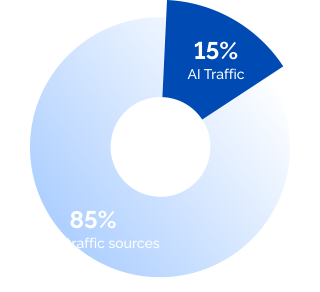
But in 2026, visibility goes beyond rankings. With over 1 billion people using AI systems monthly and search journeys increasingly starting with AI-generated answers, enterprise SEO now influences whether your brand gets surfaced, cited, or skipped entirely across AI-driven platforms — not just traditional SERPs.
Unlike smaller websites, where updates can be handled manually, enterprise sites operate within complex technical infrastructures and continuous content production cycles. This is where working with an experienced enterprise SEO service provider like SeoProfy becomes critical — not just for execution, but for the technical expertise required to manage scale without compromising performance.
Optimization at this level relies on scalable systems, automation, and structured workflows that allow teams to implement changes across thousands of pages efficiently.
That’s why SEO for enterprises is about enabling site-wide impact. This is how global brands like Amazon, Nike, and Walmart consistently dominate search results across markets, categories, and high-volume queries.
Let’s take a closer look at Nike.

Open Google and search for “site:Nike.com.” You’ll find almost a million pages in the search results. Each one needs to be optimized, maintained, and updated.
Number of search results
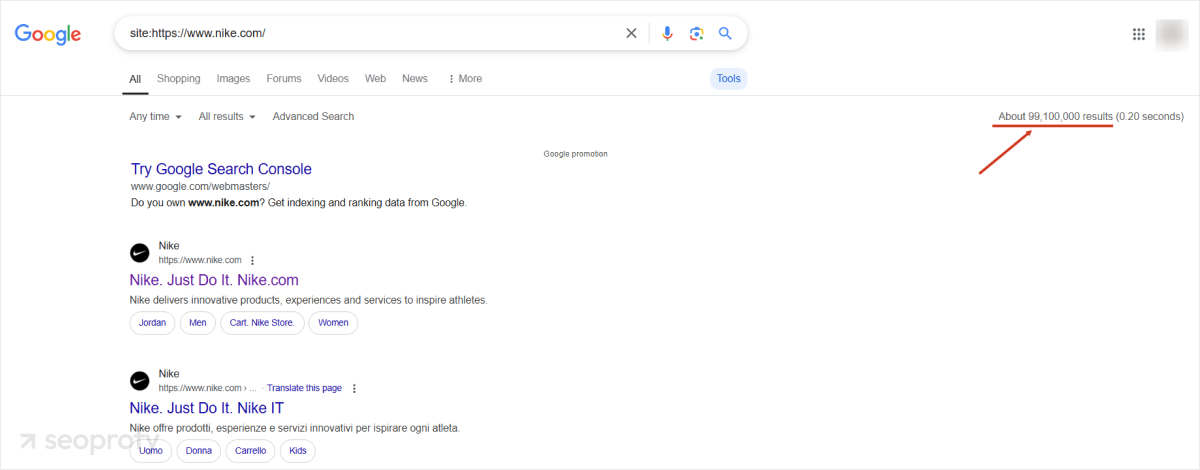
Thanks to Nike’s enterprise SEO, customers can easily find what they want, whether they’re in Paris, Tokyo, or New York.
Enterprise SEO vs. Traditional SEO
Enterprise SEO uses many of the same fundamentals as traditional SEO, but applies them at scale with automation, systems, and cross-team coordination.
|
Category |
Enterprise SEO Approach |
Traditional SEO Approach |
| Content Strategy | Focuses on large-scale issues like page bloat, duplication, and multi-region content. Requires scalable frameworks across languages and markets. | Focuses on optimizing individual pages and smaller content sets, often targeting niche or long-tail keywords. |
| Technical SEO | Relies heavily on automation. Prioritizes crawl budget, indexation, and complex site architecture. | Managed manually or with basic tools. Focuses on core technical setup (speed, indexing, basic structure). |
| Link Building | Leverages brand authority, partnerships, and digital PR to earn high-quality, large-scale backlinks. | Focuses on outreach, guest posting, and niche link-building tactics. |
| SEO Management | Requires cross-team coordination, governance models, and standardized workflows to scale operations. | Typically handled by a small team or individual with simpler workflows. |
| Reporting | Uses advanced analytics platforms with custom dashboards for multiple stakeholders and markets. | Relies on standard tools (GA, GSC) with simpler reporting needs. |
| Risk Management | Proactively manages risks from search engine algorithms and updates, technical failures, and compliance issues at scale. | Reactive approach, with lower risk due to smaller site size and complexity. |
Pillars for an Effective Enterprise SEO
Authority remains a ranking driver. Focus on high-quality backlinks, digital PR, and brand mentions. In 2026, brand visibility also influences AI Overviews and LLM citations, not just traditional rankings.
SEO is not a single channel. It is a system. Performance depends on how well these components work together across teams, markets, and thousands of URLs.

On-page SEO
Every page must align with user intent and drive action. This includes titles, headings, internal links, and content structure. At scale, standardized templates and strict editorial guidelines prevent inconsistency and missed opportunities.
Content Operations
Enterprise growth depends on volume and velocity. You need systems to produce, update, and retire content across thousands of pages. This includes keyword mapping, content refresh cycles, and clear ownership between SEO, product, and editorial teams.
Technical SEO
Crawlability and indexation define your ceiling. Priorities include crawl budget control, structured data, site architecture, and Core Web Vitals. Small technical issues scale into large losses. Continuous monitoring and automation are required. This layer also supports AEO, helping content surface in AI-generated answers.
Off-page SEO
Authority remains a core ranking driver. Within an enterprise SEO strategy, focus on earning high-quality backlinks, digital PR coverage, and consistent brand mentions across trusted sources.
In 2026, these signals don’t just impact rankings — they determine whether you get an LLM citation. Strong brand visibility increases your chances of being referenced in AI Overviews and LLM-generated answers, not just appearing in traditional SERPs.
Local SEO
Critical for multi-location businesses. Optimize Google Business Profiles, local landing pages, and citations. Reviews and proximity signals often drive high-intent traffic with strong conversion rates.
International SEO
Global sites require precise targeting. Hreflang implementation, localized content, and region-specific keyword strategies prevent cannibalization and improve relevance across markets.
UX and Conversion Optimization
Traffic without conversion has no business value. Align SEO with CRO (conversion rate optimization) to improve engagement, reduce friction, and increase revenue per session. This includes page UX, mobile usability, and clear conversion paths.
Data, Analytics, and Attribution
Decisions must be data-driven. Integrate SEO data with GA4, CRM, and revenue attribution models. Track not only rankings and traffic, but MQLs (marketing qualified leads), SQLs (sales qualified leads), and pipeline impact. This is critical in zero-click and AI-influenced journeys where attribution is fragmented.
Automation and Workflows
Manual SEO does not scale. Use automation for audits, internal linking, reporting, and alerts. Clear workflows across SEO, dev, and content teams reduce delays and improve implementation speed.
Brand and Demand Generation
In AI-first search, visibility is not enough. If users remember your competitor’s name from an AI answer, they win the branded search. Strong brand demand increases direct traffic, improves CTR, and supports both SEO and AEO and GEO performance.
Our enterprise SEO team has years of hands-on experience delivering results at scale. Here’s how we help:
- Build a data-driven enterprise SEO strategy;
- Use industry-leading and proprietary tools;
- Continuously track and optimize performance;
- Deliver full-service SEO to support growth;

12 Key Enterprise SEO Strategy Tips
SEO doesn’t fail because teams don’t know the basics. It fails in execution — when decisions don’t scale, systems break, and small issues quietly impact thousands of pages. In 2026, this change also includes how your content is surfaced in AI-driven results, not just traditional rankings.

1. Technical Optimization for Scale
Enterprise SEO strategy starts with a stable technical foundation. At scale, even minor issues can block thousands of pages from ranking. Technical optimization also directly impacts AEO, since AI systems rely on a clean structure and accessible data.
1. Indexation
Ensure only valuable pages are indexed. Control crawl budget with XML sitemaps, robots.txt, and parameter handling. Prevent indexing of duplicates, filters, and low-value pages.
One of our clients, a trading platform with over 120,000 pages, came to us with around 60% of their pages not indexed. You can guess how much website traffic they were missing out on. Making sure their pages got indexed was one of our main goals.
While our SEO campaign included more than indexation but also internal linking, adding missing E-E-A-T elements (we’ll discuss them later), speeding up page load times, and more, our enterprise-level SEO work tripled their organic traffic in just one year!
2. Micro Markup
Implement structured data at scale to enhance SERP appearance and improve eligibility for rich results and AI citations. Keep markup updated as content changes.
3. Hreflangs for the Right Localization
Use `hreflang` to serve the correct language and regional version. Avoid broken, missing, or conflicting tags that confuse search engines and reduce visibility.
4. Website Structure Optimization
Build a clear hierarchy with logical categories and internal links. Ensure pages are accessible within a few clicks. Strong structure improves crawlability, UX, and ranking distribution.
2. Structured Data
Schema is no longer optional if you want visibility beyond blue links. Rich results, product snippets, and AI summaries rely on clean, structured signals. The challenge at scale is keeping markup accurate as data changes. The most effective teams connect structured data directly to backend systems so updates happen automatically.
Here’s an example of micro markup if you search for “Apple AirPods Max ratings”:

Check out the rating part of this search result — you see 7.8/10 with a star rating (⭐⭐⭐⭐). Yes, that’s micro-markup and exactly the information you were looking for.
But when you deal with sites with enormous content libraries, you have to add the right markup to thousands of pages. Furthermore, your markup must stay accurate when, say, products go out of stock, prices change, or content updates. However, with the right micro markup implementation, you can be sure your enterprise SEO efforts will pay off.
3. Hreflang & Localization
International SEO issues are often invisible but costly. Incorrect hreflang or weak localization can split rankings or surface the wrong version in the wrong market.
In 2026, localization is about aligning with regional intent, SERP features, and even AI-generated results that differ by country.
4. Website Structure
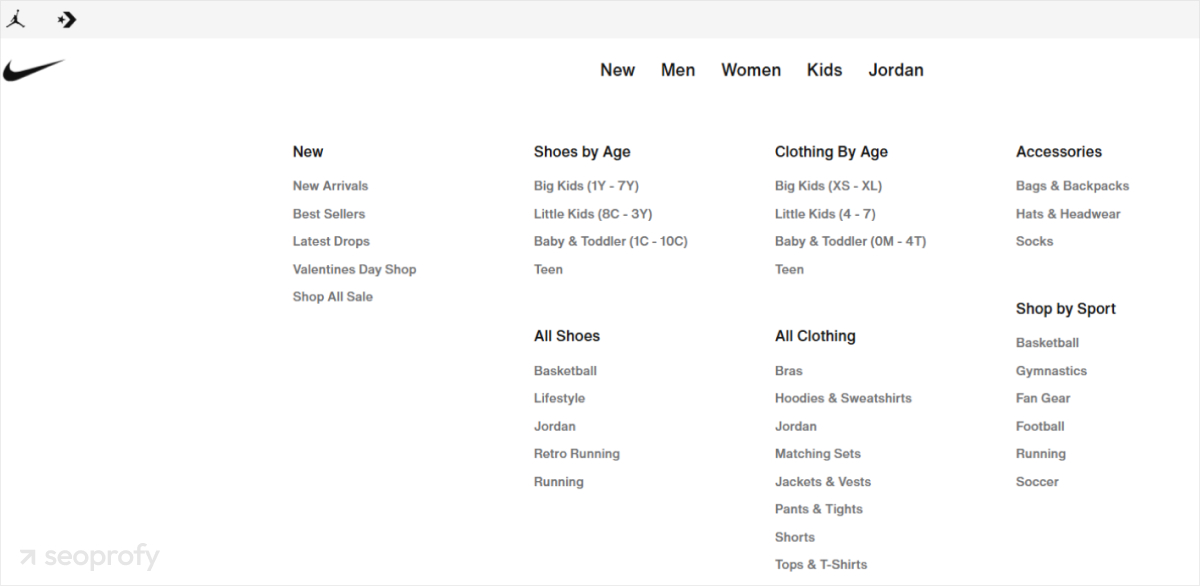
Structure defines how both users and search engines move through your site. At enterprise scale, poor hierarchy leads to orphaned pages, weak internal linking, and inefficient crawling. Strong structures stay logical as the site grows and make it easy to expand categories, markets, and content without constant rework.
For example, Nike’s website structure helps users quickly find what they need, whether they’re shopping for kids’ apparel, performance footwear, or trending collections.
5. Link Building and Digital PR
For enterprise brands, authority is built through both backlinks and brand visibility. Enterprise link building remains a core driver, while digital PR expands its impact by earning placements in trusted media and industry sources.
High-quality links signal trust to search engines. At the same time, brand mentions support AEO, since AI systems prioritize recognizable and frequently cited brands.
Large sites have a built-in advantage. Strong brands are often mentioned naturally across the web. These unlinked mentions create opportunities for enterprise link building, since trusted sources are already familiar with your brand. Converting these mentions into links is typically faster and more effective than cold outreach.
Digital PR, as a part of an enterprise SEO strategy, reinforces this process by placing your brand into relevant conversations through expert commentary, data studies, and media coverage. The result strengthens domain authority, improves rankings, and increases the likelihood of being referenced in AI-generated answers.
6. E-E-A-T Content
Content must demonstrate Experience, Expertise, Authoritativeness, and Trust. This is critical in YMYL niches and increasingly important for AI visibility.
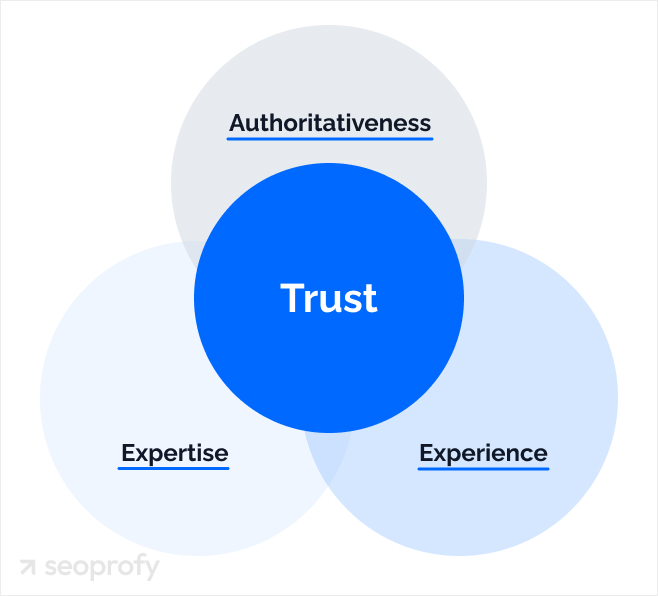
Focus on expert authorship, credible sources, and real-world insights. Support claims with data and keep content updated. Strong E-E-A-T improves rankings and increases the chance of being cited in AI Overviews and LLM responses.

This is McKinsey & Company, one of the world’s most prestigious management consulting firms. They set the gold standard for E-E-A-T content quality since their content is written by industry experts, featuring real case studies and data from their consulting experiences.
7. Content Operations
Consider seasonal content. Smaller sites might just update a few pages when the holidays approach, but you could be freshening up thousands of them. When product details change, you may have to update content across numerous categories, languages, and regions, all while keeping your SEO on point.
Ultimately, all of this requires processes in place to make sure every piece of content is perfect before it goes live. Plus, you must find ways to notice when content starts getting old or isn’t performing anymore (you can do this with the help of Google Analytics, Semrush, Ahrefs, and many other enterprise SEO tools).
Every update has to either protect or boost your search engine rankings. You should always be on the lookout for chances to optimize, whether that’s adjusting featured snippets, securing more links from reputable sources, or filling in content gaps in areas where competitors are ranking instead of you.
8. Competitive Keywords
While smaller sites might chase long-tail terms, enterprise organizations often aim for high-traffic terms in their field. We mean single-word and two-word terms that millions search for monthly (“insurance,” “smartphones,” “running shoes”). These keywords are lucrative but also challenging to rank for (yet totally possible with SEO for enterprise companies!). Suppose you want to rank for “loans.” Here’s what Semrush’s Keyword Magic Tool shows us:
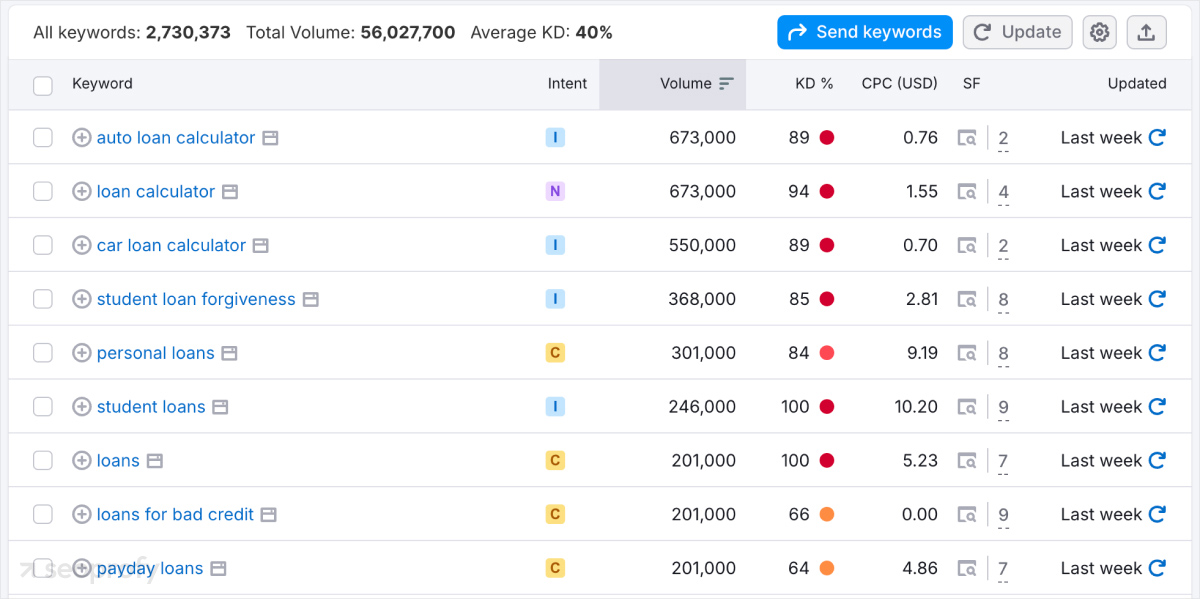
The top terms reflect huge search numbers:
- “Auto loan calculator” and “loan calculator” each pull in 673,000 monthly searches;
- “Car loan calculator” gets 550,000 searches;
- “Student loan forgiveness” sees 368,000 monthly searches;
- “Personal loans” attract 301,000 searches.
Most keywords have keyword difficulty (KD) scores above 85%, while some reach 100%. This means you’re up against some of the strongest sites in the finance industry.
Plus, when you see “student loans” with a $10.20 cost per click (CPC) and “personal loans” at $9.19, this is how else you know these terms are valuable. Advertisers are willing to pay big money for the paid search because these searches usually lead to high conversion rates.
A successful enterprise SEO strategy requires real investment. You need top-tier content that outperforms what’s already ranking, along with a strong technical foundation that can support scale, indexation, and performance.
But the upside matches the effort.
At the enterprise level, even a few high-impact rankings can drive hundreds of thousands of monthly visitors — and turn this strategy into one of the highest SEO ROI growth channels.
9. Scalability
What works at 1,000 pages often fails at 100,000. Internal linking becomes inconsistent, templates break, and updates slow down. Scalability is built into systems from the start — in how pages are structured, how content is created, and how changes are deployed across the site.
10. Data Analysis
At your level, you’re dealing with numbers that can make your head spin. You must understand what’s happening across countless pages, multiple markets, and simply every corner of your business.
Whether you’re doing your SEO in-house or outsourcing, your team should monitor hundreds of keywords, user behavior patterns across different website sections, conversion rates that may vary by market, and technical issues that could pop up anywhere. Finally, you’ll definitely want to know how exactly SEO impacts your bottom line. SEMrush Enterprise or Ahrefs Enterprise can come in handy here.
If you choose to hand off your SEO to SeoProfy, we’ve got your back with weekly plans and reports highlighting wins and ideas for further improvements. (In fact, we’ve got you covered with all the above mentioned since we take a full-on approach to SEO for enterprise.)
11. Competitor Analysis
Knowing your own SEO performance is just half of the battle. In SEO, you’re in a competitive arena, and you need to be aware of your competitors’ digital marketing activities and who actually dominates search results in your field.
Check out some examples of top players in different industries:
- Healthcare: Mayo Clinic, Cleveland Clinic, WebMD;
- Finance: NerdWallet, Bankrate, Credit Karma;
- Legal: FindLaw, Avvo;
- SaaS: HubSpot, Salesforce, Adobe;
- Home services: HomeAdvisor, Houzz, Home Depot.

12. SEO Tools for Enterprise-Level

Automation is great for everything you do online, but it becomes absolutely critical when you’re handling millions of pages. Best SEO practices call for robust tools, preferably powered by artificial intelligence, because of the challenges that would be impossible to manage manually; you should automate your processes.
Technical SEO & Crawling
- Botify,
- Lumar,
- Screaming Frog SEO Spider.
Used for large-scale crawling, log file analysis, indexation control, and identifying technical bottlenecks across thousands (or millions) of pages.
Keyword Research, Tracking & Market Intelligence
- Semrush,
- Ahrefs,
- seoClarity,
- Advanced Web Ranking.
Beyond keywords — these platforms now track SERP features, AI Overviews visibility, and competitor share of voice.
Content Optimization & AEO (Answer Engine Optimization)
- Surfer SEO,
- Clearscope,
- BrightEdge,
Modern content tools focus not only on rankings but also on structuring content for AI answers, featured snippets, and entity-based optimization.
Link Building, Digital PR & Authority Monitoring
- Ahrefs,
- Majestic,
- BuzzStream,
- Pitchbox.
The shift here is from pure link building to authority + brand mentions, which directly impacts both SEO and AI visibility.
Analytics, Attribution & Reporting
- Google Analytics 4,
- Google Analytics 360,
- Adobe Analytics,
- Looker Studio.
Tracking now extends beyond traffic into conversion quality, attribution, and AI-driven sessions.
SeoProfy Proprietary Tools
At SeoProfy, we complement third-party platforms with proprietary tools tailored to enterprise workflows and performance tracking:
- LinkChecker: It is our custom-built backlink monitoring platform. It shows if a link is live, indexed, and still passing value.
- SearchAnalytics: Our proprietary SEO intelligence platform centralizing content, technical, and backlink performance data.
When you work with us, you get access to both the best industry-standard tools and our tailored enterprise SEO solution you won’t find anywhere else on the market. This will definitely give you a competitive edge!
Key Enterprise SEO Challenges
Given these core differences, here are the biggest SEO challenges:
Scaling SEO Across Large Websites
Enterprise websites often include thousands or even millions of pages, which makes maintaining consistent SEO quality a major challenge. Every page needs to meet search engine standards to perform well, and even small issues — like missing metadata, broken internal links, or duplicate content — can scale into significant visibility losses. Teams must rely on prioritization frameworks, templates, and automation to manage updates efficiently while keeping content relevant and optimized.
Technical Complexity at Scale
As enterprise websites grow, so does their technical complexity. Crawl budget waste, indexation issues, slow page speed, and poorly structured architecture can all limit performance. These problems are harder to detect and fix at scale, which is why continuous monitoring, log file analysis, and regular technical audits are essential to maintain search visibility and prevent ranking drops.
Managing Content Quality and Consistency
Scaling content production across multiple teams, markets, and languages often leads to inconsistencies in quality, tone, and optimization. Content can quickly become outdated or misaligned with search intent. Maintaining a centralized enterprise SEO strategy for content, regular updates, and clear SEO guidelines is critical to ensure content remains competitive and valuable.
Complex Infrastructure & International SEO
Enterprise businesses often operate across multiple domains, subdomains, and international versions. Managing hreflang tags, canonicalization, and localized content strategies adds significant complexity. Without a centralized SEO framework, these elements can conflict, leading to duplicate content issues and diluted rankings.
Data, Reporting & Attribution
SEO generates large volumes of data across different markets, product lines, and page types. The challenge lies in turning this data into actionable insights and connecting SEO efforts to real business outcomes like revenue and conversions. Effective reporting requires clear KPIs, segmentation, and automated dashboards to support decision-making at scale.
Cross-Team Alignment and Execution
An enterprise SEO strategy depends on multiple stakeholders, including marketing, development, product, and content teams. Each team influences SEO performance, but misalignment often slows down implementation and creates bottlenecks. Clear processes, defined responsibilities, and ongoing communication are essential to executing SEO initiatives efficiently and delivering results.
Given these differences, SEO introduces a distinct set of challenges that require system-level solutions:
|
Challenge |
Ways to Overcome |
| Content consistency at scale | Maintaining quality, relevance, and brand voice across thousands of pages and multiple regions. |
| Technical stability | Preventing errors that can impact thousands of pages at once while maintaining performance and speed. |
| Scalable implementation | Safely rolling out changes across large sites without breaking existing systems. |
| Localization & compliance | Adapting content for different markets while meeting legal and cultural requirements. |
| Crawl budget optimization | Ensuring search engines prioritize and index the most valuable pages. |
| Internal linking structure | Managing large-scale internal links to support site architecture and authority flow. |
This comparison highlights why SEO requires a fundamentally different approach, where scalability, automation, and cross-team alignment become critical for consistent growth.
Wrapping Up
SEO is not about doing more of the same — it’s about building systems that scale. What works for 100 pages breaks down at 100,000. Without the right structure, automation, and cross-team alignment, even strong and consistent SEO strategies fail in execution.
Success comes from treating SEO as an integrated growth channel, not a set of isolated SEO tasks. Technical stability, content operations, authority building, and data-driven decision-making must work together across the entire organization. The teams that win are the ones that invest in processes, not just tactics.
In 2026, this goes even further. It’s no longer just about rankings — it’s about visibility across search, AI Overviews, and answer engines. If your brand is not part of that layer, you’re losing demand before users even reach your site.
The opportunity, however, is just as large. With the right enterprise SEO strategy, you don’t just increase traffic — you build sustainable visibility, stronger brand demand, and a compounding growth channel that drives real business impact over time.
Do your SEO operations need scale? Let’s make it happen together with SeoProfy, a reputable SEO company that helps enterprise sites dominate high-value search results.

Julia Lubianytska is a Copywriting Team Lead at SeoProfy with over 7 years of experience in copywriting and editing. She works closely with copywriting teams, helping writers craft clear and thoughtful content for SaaS products, IT services, and businesses in the legal and medical fields. Julia enjoys turning complex topics into easy-to-understand, trustworthy content, focusing on structure, clarity, and consistency to ensure the content is genuinely helpful for real people, not just search engines.