
 Add SeoProfy as a preferred source on Google
In 2025, Anthropic posted an operating loss of $8.06 billion. By the second quarter of 2026, the same line showed $974 million of operating income, the company’s first quarterly operating profit.


So, is Anthropic profitable? On an operating basis, yes: it made money in Q2 2026 and told investors it was profitable again on an adjusted basis in Q3. On a net basis, no, because it booked an $80.7 billion net loss in the first half of 2026.
The figures in this review of Anthropic profitability come from the company’s public S-1 filing of October 26, 2026, its own announcements, and major business media. Only the annual Anthropic financials for 2025 and earlier are audited, while the 2026 quarterly numbers are unaudited or preliminary.
Key Anthropic Profitability Statistics for 2026
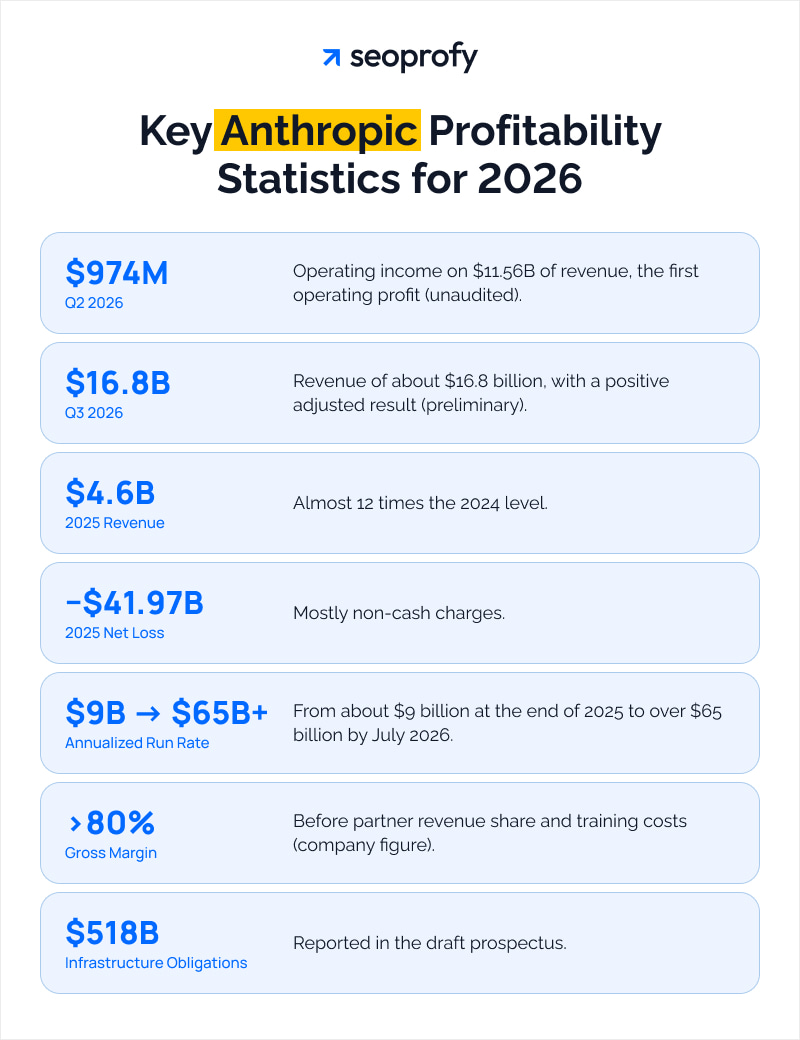
- Q2 2026 operating income: $974 million on $11.56 billion of revenue, the first operating profit (unaudited). (Source)
- Q3 2026 revenue: about $16.8 billion, with a positive adjusted result (preliminary). (Source)
- 2025 revenue: $4.6 billion, almost 12 times the 2024 level. (Source)
- 2025 net loss: $41.97 billion, mostly non-cash charges. (Source)
- Annualized run rate: about $9 billion at the end of 2025, over $65 billion by July 2026. (Source)
- Gross margin: above 80% before partner revenue share and training costs (company figure). (Source)
- Infrastructure obligations: $518 billion (draft prospectus). (Source)
Is Anthropic Profitable in 2026?
Yes at the operating level, not at the net level. Anthropic earned $974 million of operating income in Q2 2026 and reported a second straight adjusted profit in Q3. Yet it lost $80.7 billion in the first half of 2026, mostly because of non-cash accounting charges tied to its rising valuation.
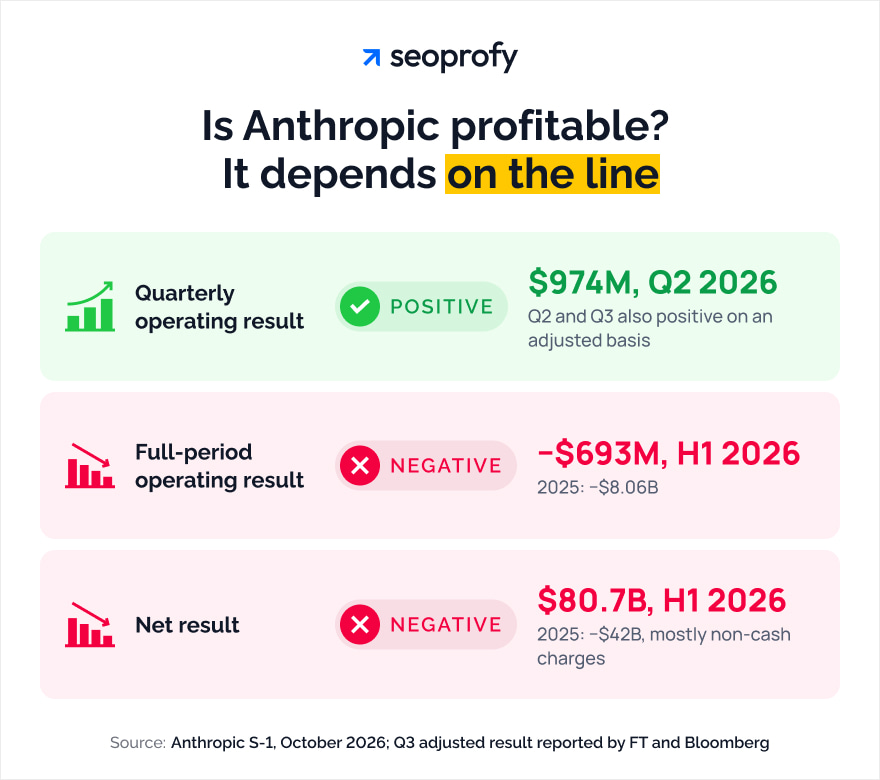
“Profit” can refer to three different lines of the income statement, and the answer depends on which one you check. Here is what each of the three shows:
- Quarterly operating result: positive. Q2 2026 brought $974 million of GAAP operating income, and both Q2 and Q3 showed positive adjusted operating income.
- Full-period operating result: negative. The 2025 operating loss was $8.06 billion, and the first half of 2026 still ended $693 million in the red because Q1 lost about $1.7 billion.
- Net result: negative. The net loss reached $42 billion in 2025 and $80.7 billion in the first half of 2026.
Any headline about Anthropic profitability is therefore true or false depending on the line it quotes. For Q3, Anthropic has given only an adjusted margin, not a dollar amount, and the quarterly section below shows which figures are confirmed and which are still preliminary.
How Anthropic’s Profit Is Measured: Key Financial Terms
Most of the confusion comes from five measures that AI companies and the press quote as if they were interchangeable. But each of them means a different thing:
- Annualized run rate: current sales projected over 12 months; Anthropic’s S-1 defines it as the last 28 days of consumption fees multiplied by 13, plus monthly subscription fees multiplied by 12.
- Recognized revenue: money actually booked in a period under accounting rules, such as the $4.59 billion Anthropic recognized in 2025.
- Gross margin: the share of revenue left after the direct operating costs of serving customers.
- Adjusted operating income: operating profit after the company removes items it treats as non-cash or one-off, which turned an $8.06 billion GAAP operating loss in 2025 into a $4.85 billion adjusted loss.
- Net income or loss: the bottom line after all costs and financing items, which came to a $41.97 billion loss in 2025.
A run rate above $100 billion would not mean $100 billion in revenue booked in 2026, since a run rate is a forward-looking snapshot. The 2025 operating loss also leaves out the fair-value charges on convertible instruments. Those sit below the operating line, so they appear only in the net result, which is why any Anthropic profit figure needs its line named next to it.
Anthropic Losses and Cash Burn
In 2025, Anthropic’s net loss was $42 billion, while the operating loss was $8.06 billion. The gap between those numbers and the cash the company actually spends explains most headlines about Anthropic losses. The two subsections below take each in turn.
Net Loss vs. Operating Loss
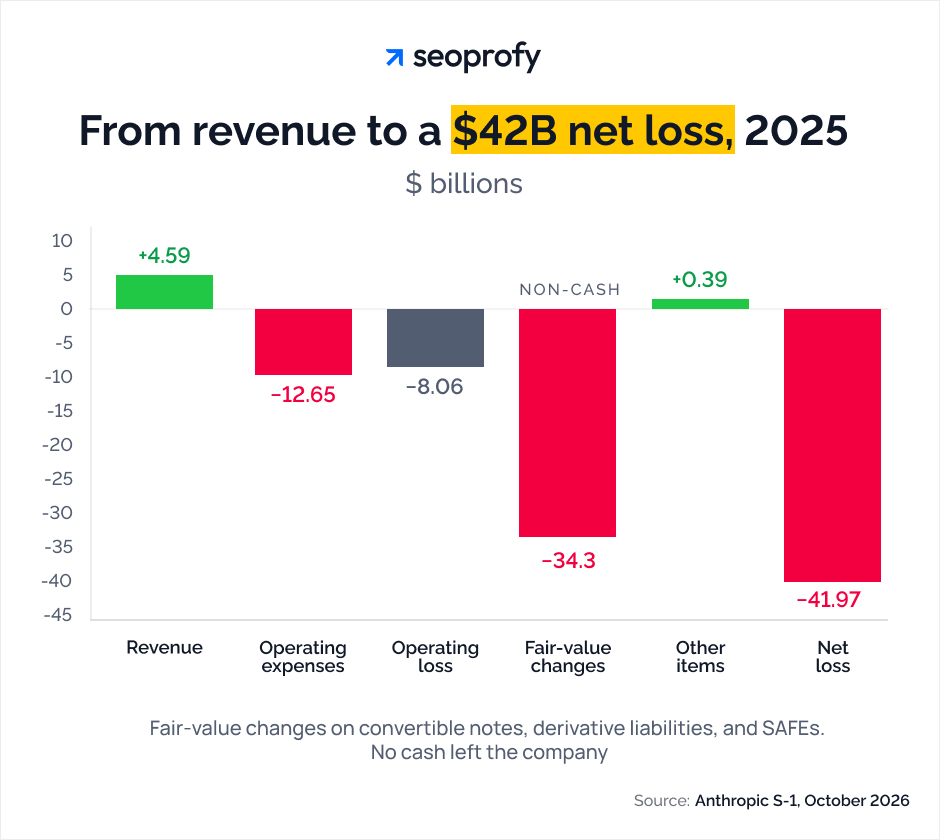
Of the $42 billion net loss in 2025, $34.3 billion came from a change in the fair value of convertible notes, derivative liabilities, and SAFEs (simple agreements for future equity). It was an accounting entry, not money that left the company. Total operating expenses for the year were $12.65 billion, against $4.59 billion of revenue.
The mechanism works like this. Investors who funded Anthropic through instruments that can convert into shares hold claims that grow in value as the company’s valuation rises. Accounting rules require Anthropic to mark those claims at fair value each period, and any increase is booked as an expense. The S-1 says the changes were driven mainly by the higher fair value of Anthropic’s convertible promissory notes as the company’s enterprise valuation went up.
That explains why the net loss is about five times the operating loss. An operating loss of $8.06 billion, plus $34.3 billion in fair-value charges partly offset by other items, adds up to a net loss of $41.97 billion. The same pattern carried into 2026: in the first half, $72.4 billion of the $80.7 billion net loss came from fair-value changes on the same kinds of instruments.
Cash Burn and Spending
Anthropic spent $7.33 billion on compute and infrastructure in 2025, almost three times the $2.52 billion it spent in 2024. It ended 2025 with $20.28 billion in cash, cash equivalents, and short-term investments. By June 30, 2026, that balance stood at $131.7 billion after two funding rounds: $30 billion in Series G and $65 billion in Series H.
Plans from late 2025 put the Anthropic burn rate at about one-third of revenue in 2026 and 9% in 2027. Results so far point lower. The company generated $3.9 billion of operating cash flow in the first half of 2026, its first positive result on that measure, and told investors it was free cash flow positive on an adjusted basis in Q3.
Spending commitments are still rising, which matters for future profits: unlike revenue, which is mostly consumption-based, they are fixed contracts. For example, a compute agreement with SpaceX will cost about $3.1 billion a month once all capacity is delivered.
Anthropic Profitability by Quarter
Four quarters of data show how quickly Anthropic moved from losses to an operating profit.
| Quarter | Revenue | Adjusted operating result | GAAP operating result | Status |
| Q2 2025 | $787 million | Loss | Loss | Shared with investors |
| Q1 2026 | $4.73 billion | Loss | Loss of about $1.7 billion | Unaudited |
| Q2 2026 | $11.56 billion | Positive, quarterly amount not disclosed | $974 million | Unaudited |
| Q3 2026 | About $16.8 billion | Positive, 11% adjusted operating margin | Not disclosed | Preliminary, shared with investors |
Three findings stand out. All of them rest on reported results, not run rate:
- Q2 2026 revenue was about 14.7 times the $787 million of Q2 2025, a 1,368% year-over-year increase.
- Revenue more than doubled from Q1 to Q2 2026, then rose about 45% from Q2 to Q3.
- Q2 2026 was the first quarter with both a GAAP operating profit and positive adjusted operating income.
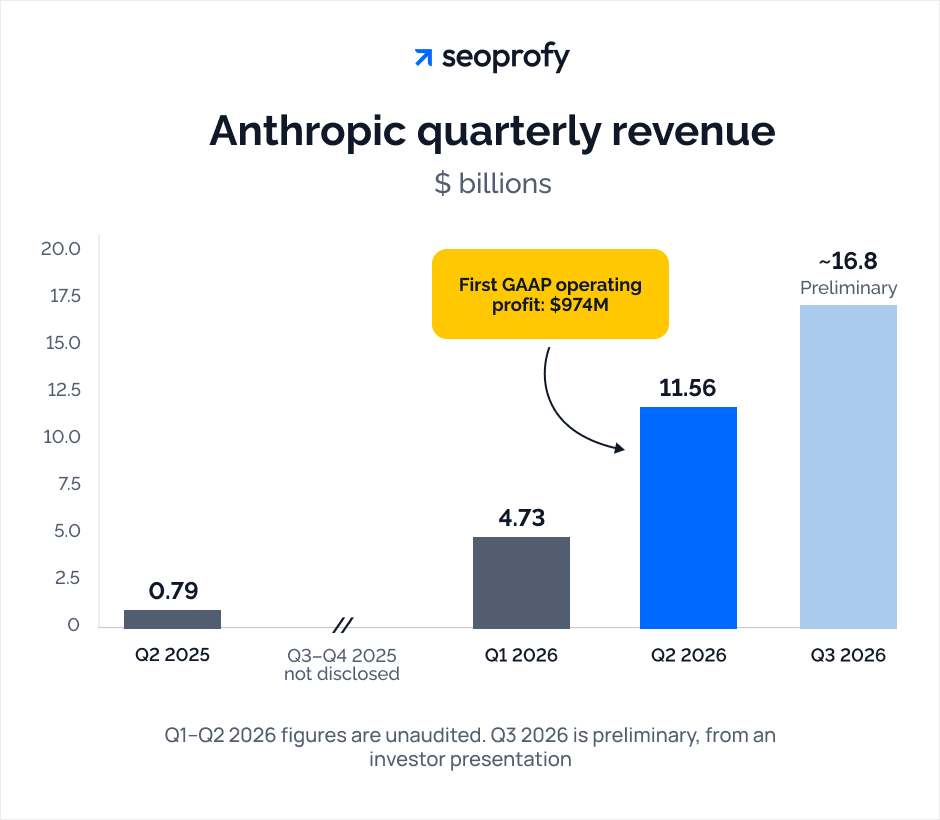
For Q2 2025, the S-1 reports only the first half: a $2.14 billion GAAP operating loss and a $1.85 billion adjusted operating loss. The Q1 and Q2 2026 rows come from unaudited interim statements. Q3 comes from an investor presentation reported by the Financial Times and Bloomberg, and is not yet in the filing, so it could change. Anthropic has also not published adjusted operating income for single quarters: the S-1 gives a first-half 2026 total of $1.62 billion, a 10% adjusted operating margin.
You may still find operating profit figures of $559 million or $570 million for Q2 2026 online. The $559 million number was Anthropic’s own May 2026 projection, made before the quarter ended. The $570 million figure is a third-party estimate from First Page Sage, not a number the company published.
Neither of them is a reported result. The GAAP figure in the S-1 came in at $974 million.
For Q3 2026, Anthropic reported an 11% adjusted operating margin, according to AFP’s summary of the investor presentation, without a GAAP operating result or a net figure. For anyone tracking Anthropic profitability quarter by quarter, the GAAP column matters most, since GAAP results are the ones that eventually go through an audit.
Anthropic Revenue Growth Statistics
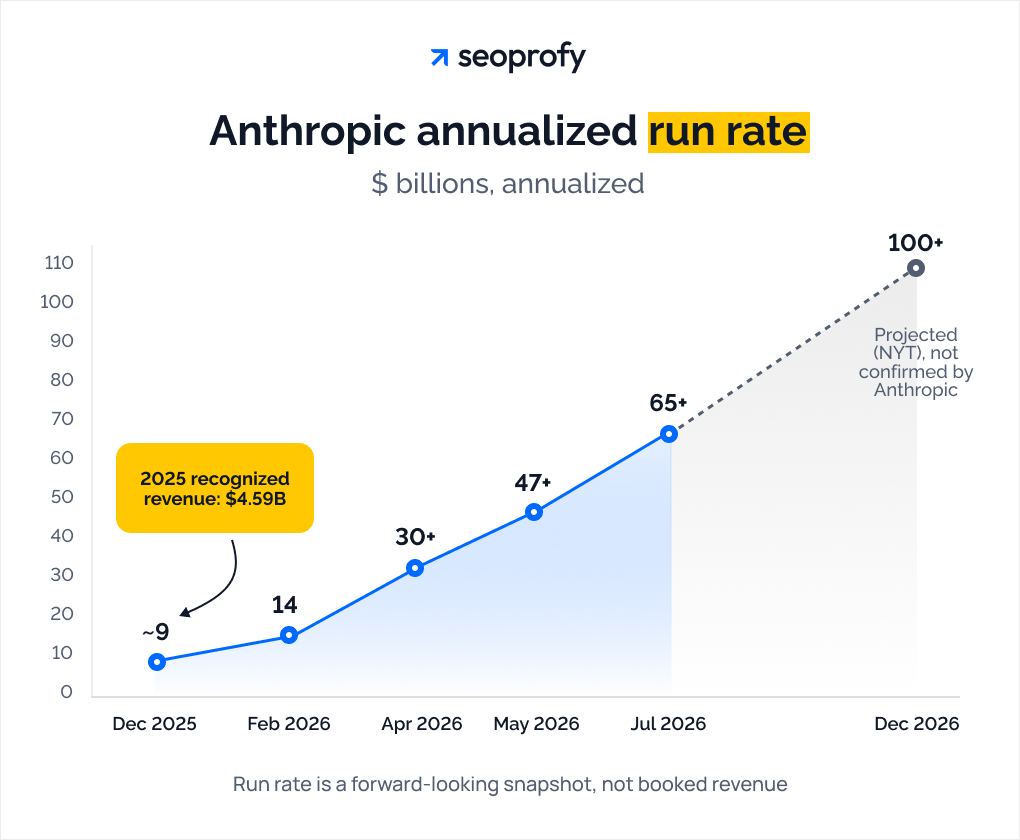
Anthropic’s annualized run rate grew more than sevenfold in seven months, from about $9 billion at the end of 2025 to over $65 billion by the end of July 2026.
| Date | Annualized run rate | Source |
| End of 2025 | About $9 billion | Reuters (via The Star), August 2026 |
| February 2026 | $14 billion | Anthropic Series G announcement (via Ventureburn) |
| April 2026 | Over $30 billion | PYMNTS |
| May 2026 | Over $47 billion | Anthropic Series H announcement |
| End of July 2026 | Over $65 billion | Bloomberg (via Axios) |
| September 2026 | Expected to exceed $100 billion by the end of 2026 | The New York Times (via Gulf News), not confirmed by Anthropic |
The table tracks a pace, not booked sales. A few points put it in context:
- Recognized revenue was $4.59 billion for all of 2025 and $16.29 billion for the first half of 2026, so run rate and revenue are different numbers.
- Between the Series G and Series H announcements, the run rate more than tripled in about three and a half months.
- Enterprise adoption shows in the customer count: more than 1,900 customers paid Anthropic $1 million or more over the 12 months to September 30, 2026. In April, the company had cited more than 1,000 customers paying over $1 million a year.
Booked Anthropic revenue is also growing fast on its own terms. The $16.29 billion recorded in the first half of 2026 was about 14 times the $1.16 billion of the first half of 2025, and more than three times the full-year 2025 total. Growth on this scale depends on how widely people and companies use AI models in their daily work, and our LLM usage statistics track that adoption across AI tools.
Anthropic Gross Margin and Compute Costs
Reported Anthropic gross margin figures range from negative 94% to above 80%. They should not be read as one trend, because each is calculated differently:
- Negative 94% in 2024. This came from company figures reported by The Information in November 2025, for a year when revenue was only $386 million.
- About 50% expected for 2025. The same report projected this before the year closed and before full-year revenue of $4.59 billion was known.
- About 44%. This is an outside estimate from Harrison Rolfes, a senior analyst at PitchBook, published in September 2026 and weighed against Anthropic’s compute commitments.
The spread between these numbers matters for Anthropic profitability. Gross margin determines how much of each revenue dollar remains for research, staff, and sales, so a 44% margin and an 80% margin describe very different businesses.
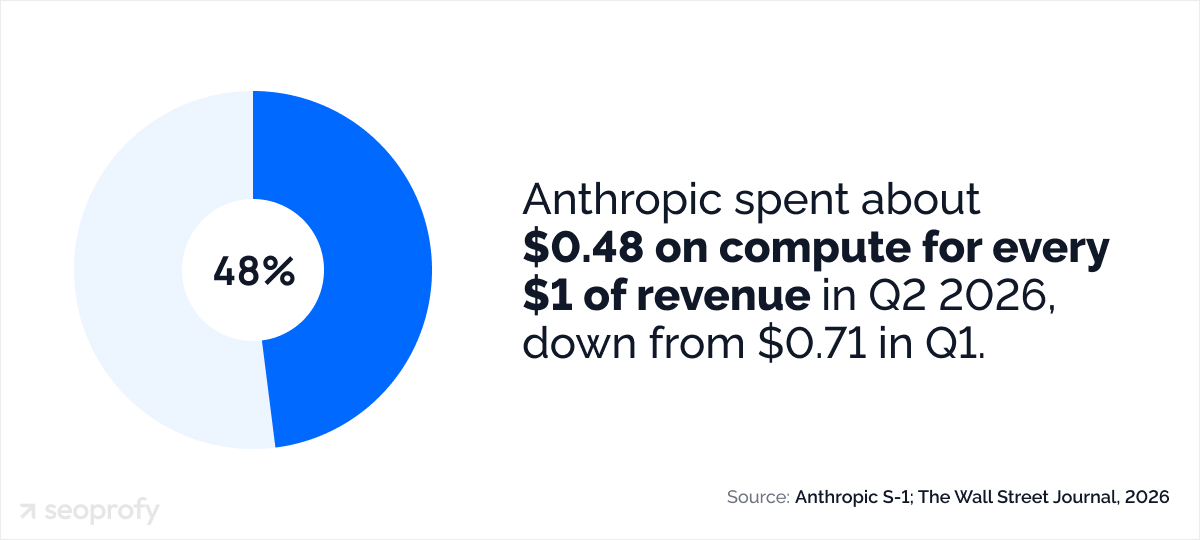
Compute costs per dollar of revenue, the largest expense standing between revenue and profit, have also fallen. In Q1 2026, Anthropic’s compute spend was $0.71 for every $1 of revenue, and it projected $0.56 for Q2. The S-1 puts Q2 compute spending at $5.6 billion against $11.56 billion of revenue, or roughly $0.48 per dollar.
Anthropic’s own margin figure is much higher: the company told investors its gross margin was above 80%. That number excludes two major costs:
- Revenue shared with distribution partners, including Amazon.
- Cost of training its models.
The partner share matters because so much of the business runs through cloud marketplaces. Selling through Amazon and Google accounted for about 47% of Anthropic’s 2025 sales, or roughly $2.16 billion.
The cost side keeps growing as well. Reuters’ review of the draft prospectus found $518 billion in cloud, computing, and infrastructure obligations. PitchBook’s Rolfes argued that to cover commitments of this kind, the gross margin would need to rise to about 70%, the level he cited for Microsoft and ServiceNow.
How Anthropic Makes Money: Revenue Mix
Business customers generate about 80% of Anthropic revenue, according to company projections in November 2025. That is the short answer to “How does Anthropic make money?” Companies pay to use Claude models through the API, enterprise plans, and coding tools, and most of that revenue is consumption-based.
In 2025, the customer base was concentrated, with two unnamed customers each accounting for 12% of revenue. The S-1 also counts more than 11,900 customers spending $100,000 or more a year and about 250 spending $10 million or more. Today, concentration is easing: in the first nine months of 2026, no single customer accounted for more than 10% of revenue, and the top five together made up about 25%.
Much of this revenue goes through Amazon and Google Cloud marketplaces, as the gross margin section describes. That channel widens Anthropic’s reach but also means sharing part of the revenue.
Claude Code shows how quickly one product line can scale. Its run rate was close to $1 billion in November 2025 and passed $2.5 billion by February 2026, with enterprise customers generating more than half of it. Revenue shows what companies pay for Claude, not how many people use it, and our Claude AI statistics cover that side.
Business and API revenue tends to be more profitable than free consumer use because API usage is paid for request by request. Each API call or enterprise seat brings in revenue tied to the compute it uses, while a free user consumes compute and pays nothing.
So is Claude profitable as a product? Anthropic reports profit only for the company as a whole, not for individual products. For marketers, Claude’s spread inside companies has another side: it is becoming a place brands want to be visible, which is why teams study how to rank in Claude or use generative engine optimization services.
Anthropic vs. OpenAI Profitability
Both companies are heading toward public listings, but their paths to profit look very different. Their late-2025 forecasts show the gap clearly.
| Metric | Anthropic | OpenAI |
| Current revenue pace | Over $65 billion run rate (July 2026), expected to top $100 billion by the end of 2026 | Annual recurring revenue approaching $70 billion (September 2026) |
| 2025 cash burn plan | Almost $3 billion on $4.2 billion of revenue | $9 billion on $13 billion of revenue |
| 2026 cash burn plan | About one-third of revenue | 57% of revenue |
| Profitability target | Break even in 2028 | Profitable in 2030 |
The last three rows are forecasts from November 2025, and both 2025 plans equal about 70% of revenue. Since then, Anthropic has booked $4.59 billion of 2025 revenue and reported positive operating cash flow in the first half of 2026. The two companies may also calculate run rate and recurring revenue differently. On those late-2025 plans, the Anthropic burn rate would fall well below OpenAI’s from 2026, and OpenAI is expected to consume roughly 14 times more cash than Anthropic before turning profitable.
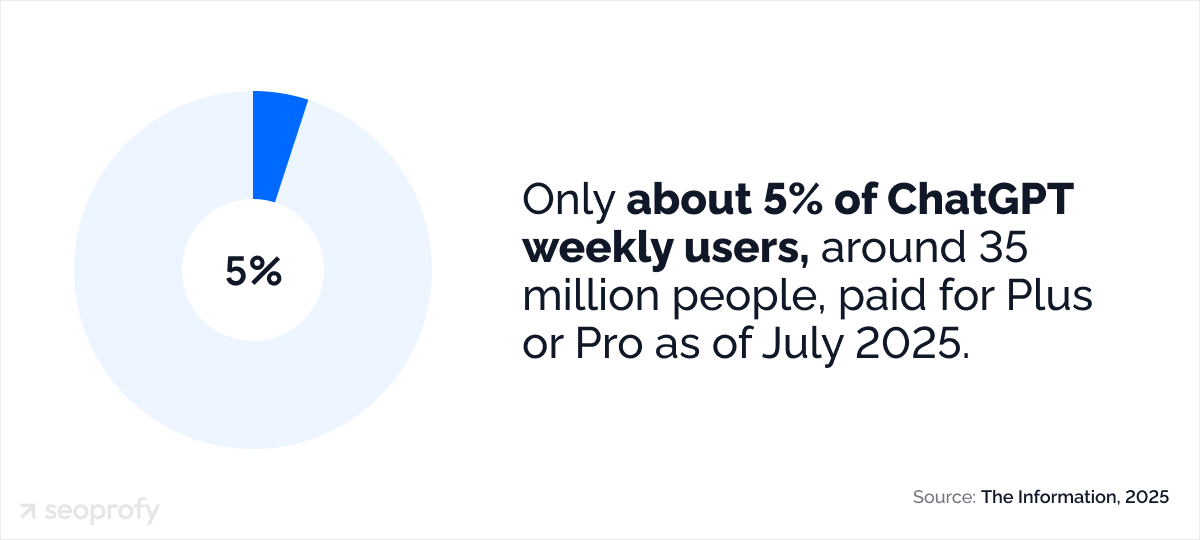
The gap comes down to the business model and who pays. Most Anthropic revenue comes from businesses, as the revenue mix section shows, so usage and income grow together. OpenAI serves a much larger free audience, and only about 5% of ChatGPT weekly active users, or around 35 million people, paid for Plus or Pro as of July 2025. For a closer look at who uses ChatGPT and how, see our ChatGPT user statistics.
What Anthropic’s Profitability Means for Its IPO
The IPO timeline has moved quickly since the spring. Here are the key dates:
- May 28, 2026: Series H of $65 billion at a $965 billion post-money valuation.
- June 1, 2026: Anthropic announces a confidential IPO filing.
- October 26, 2026: public S-1 filed; the company plans to list on the Nasdaq Global Select Market under the ticker ANT.
- Week of November 9, 2026: planned start of IPO marketing, with trading targeted before Thanksgiving on November 26.
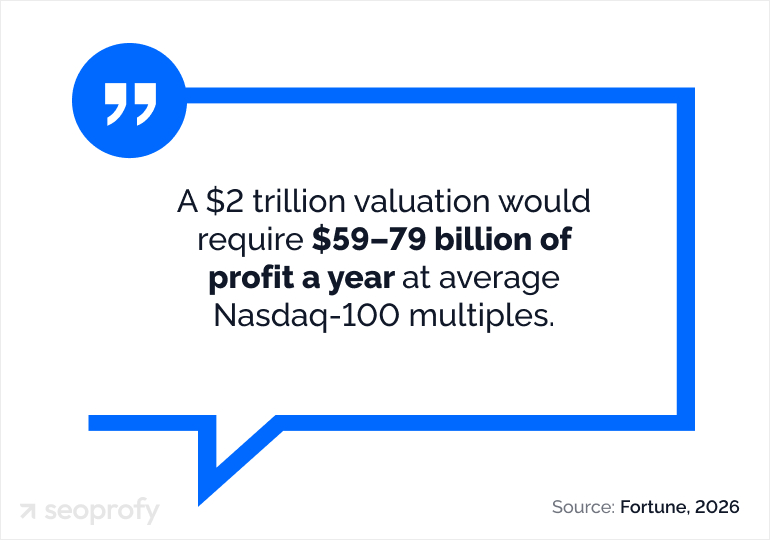
Investors discussed a valuation of $1.8 to $2 trillion in early October 2026. After the Q3 numbers, reports cited valuations as low as $1.5 trillion. At average Nasdaq-100 multiples of about 34 times trailing and 25 times forward earnings, a $2 trillion valuation would require $59 billion to $79 billion of profit a year. For comparison, Anthropic’s adjusted operating income for the whole first half of 2026 was $1.62 billion.
Two structural facts matter as well. Anthropic is a public benefit corporation, so it is a for-profit company whose directors must also weigh a stated public mission. Anthropic also plans to create a Founder LLC for its seven co-founders, and that entity will hold 50.1% of total voting power through a single Class F share.
The S-1 contains audited Anthropic financials only for 2025 and earlier years, and the 2026 interim statements are unaudited. Any view of Anthropic profitability before the listing therefore rests partly on preliminary numbers.
This article is for information only and is not investment advice.
When Will Anthropic Be Profitable on a Full-Year Basis?
Earlier guidance in 2025 did not expect full-year profitability until at least 2028. In late 2025, Anthropic still aimed to break even in 2028 and expected up to $70 billion in revenue, $17 billion in cash flow, and a 77% gross margin that year.
By August 2026, the 2028 revenue forecast had grown to roughly $190–$200 billion. The jump shows how quickly expectations changed. Both are full-year revenue forecasts, not run rates, and both were reported in the media.
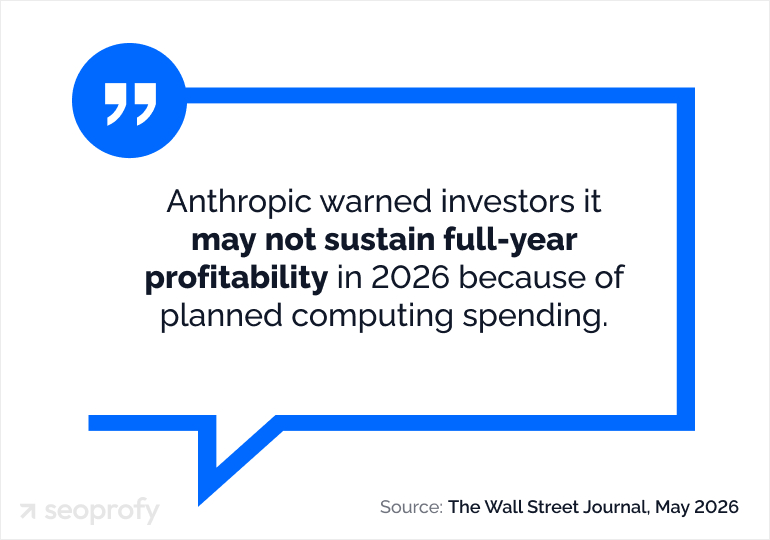
The company has also been careful about 2026. In May, Anthropic warned investors it may not sustain full-year profitability because of planned spending on computing infrastructure. With a $693 million GAAP operating loss for the first half, full-year Anthropic profitability on an operating basis depends on the second half covering that gap. Until second-half results are out, any full-year Anthropic profit figure for 2026 is an estimate, not a reported result.
Three factors will decide the answer:
- The infrastructure obligations described in the gross margin section.
- Price pressure from cheaper open-source models, as industry competition grows and customers become more price-conscious.
- The non-cash accounting charges covered in the losses section.
Anthropic’s Profit Picture: A Milestone With Footnotes
How much weight Anthropic profitability deserves depends on which result you look at. The operating line has turned positive, the adjusted measure has stayed positive for two quarters, and the net line still shows heavy losses driven mostly by accounting for convertible instruments.
The public S-1 settled part of the debate by putting audited annual figures on the record. It did not close the debate entirely, since the 2026 numbers remain unaudited and Q3 sits outside the filing.
Two events will show whether the operating profit holds in future quarters. The first is the final prospectus, which should bring Q3 figures and the offering price. The second is the Q4 and full-year 2026 report, Anthropic’s first annual results as a listed company if the IPO closes as planned. Until then, the most accurate answer to “Is Anthropic profitable?” is a qualified one: it depends on the measure you use.

Julia Lubianytska is a Copywriting Team Lead at SeoProfy with over 7 years of experience in copywriting and editing. She works closely with copywriting teams, helping writers craft clear and thoughtful content for SaaS products, IT services, and businesses in the legal and medical fields. Julia enjoys turning complex topics into easy-to-understand, trustworthy content, focusing on structure, clarity, and consistency to ensure the content is genuinely helpful for real people, not just search engines.