


Even enterprise SaaS companies with thousands of visitors a month may get only a few leads. The issue often begins with keyword selection: teams chase high-volume terms, while ignoring the specific problems, integrations, and comparisons that matter to enterprise buyers. Search engine rankings may improve, but teams still report organic search traffic without showing whether it contributes to pipeline.


This article explains how enterprise SaaS SEO can correct that disconnect. It covers technical foundations for large and complex websites, content aligned with multiple stakeholders and an extended buying journey, authority building, visibility across traditional and AI-powered search, and the governance needed to coordinate execution.
We’ll also show you how to build a 90-day roadmap and evaluate performance through leads, opportunities, pipeline contribution, and revenue.
What Is Enterprise SaaS SEO?
Enterprise SaaS SEO is the process of optimizing a large software company’s organic visibility and linking search demand to qualified leads and revenue. It coordinates technical optimization, content and authority building across complex websites, product lines, markets and the needs of multiple stakeholders involved in a purchase.
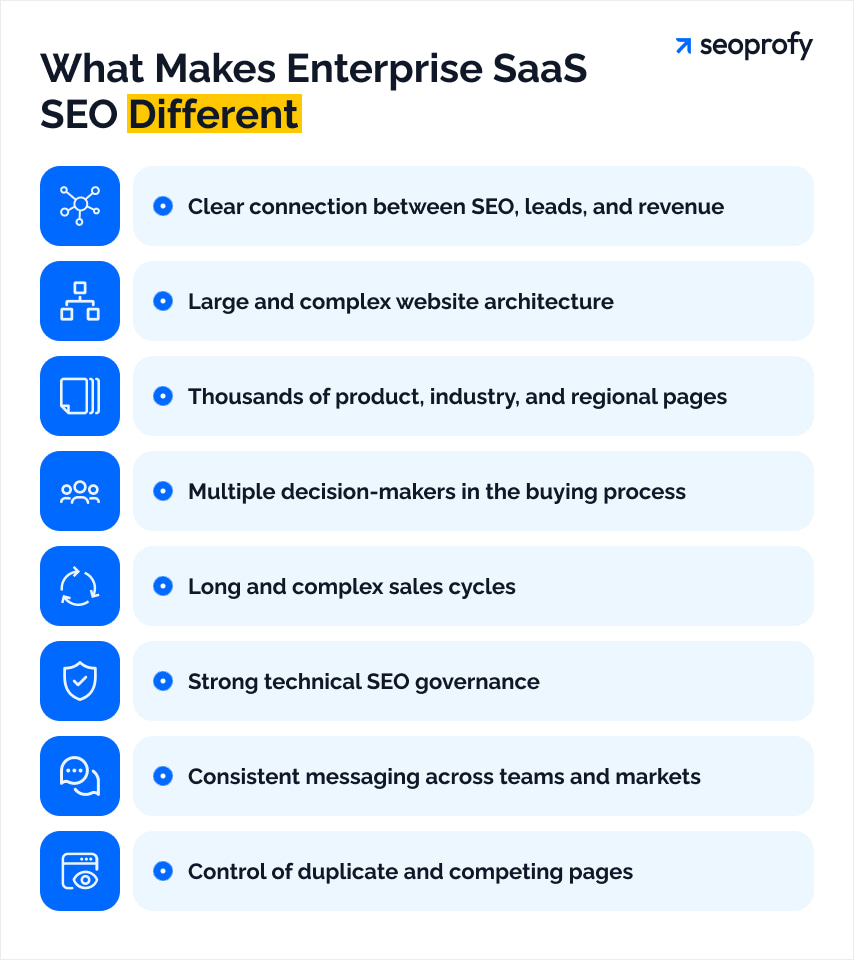
The main differences to regular SaaS SEO are the scale of the buying process and the complexity. A growing software startup might be managing dozens of commercial pages, but focusing on just two or three key personas. An enterprise platform can have thousands of URLs for products, integrations, industries, resources, documentation, regional markets, and more. When you lack clear ownership and governance, managing duplicate content, crawl waste, inconsistent messaging, and competing pages becomes more complex. These demands make SEO for SaaS more complex at enterprise scale.
The sales cycle is longer as well. The user might love the product, but the final say will rest with budget holders, technical teams, security specialists, and legal departments. Each participant looks for different information and assesses different risks. An effective enterprise SaaS SEO strategy needs to serve the entire buying committee, while keeping a large site technically sound, consistent, and aligned to measurable business outcomes.
Why Enterprise SaaS SEO Matters for Sustainable Growth
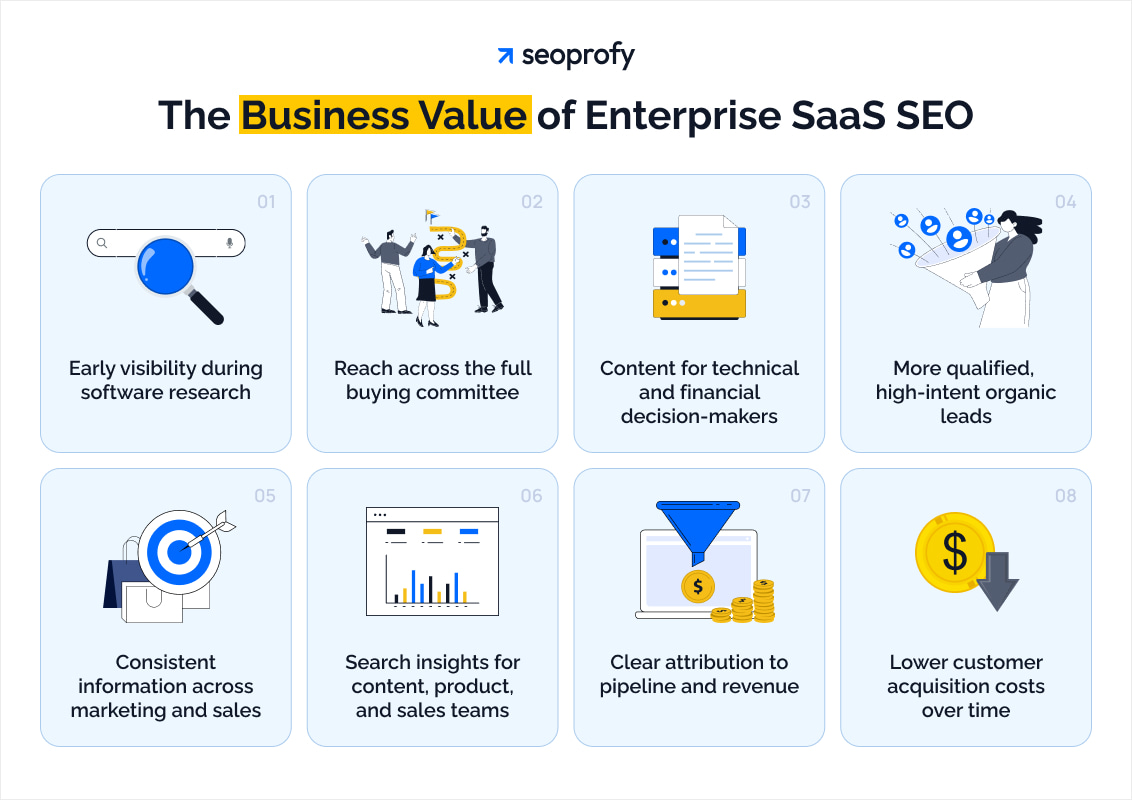
Enterprise SaaS SEO is a way for vendors to get in front of potential buyers who are just beginning to define their problem and compare software solutions. This early search activity is especially useful in markets with long sales cycles, high contract values, and multiple people involved in each purchase.
Organic search also acts as an entry point for the different members of the buying committee. CFOs look at implementation costs and expected ROI. CTOs review technical requirements, security, and integrations. Ranking for these high-intent queries allows a company to address each concern before a prospect even speaks to the sales team. It can also generate more qualified leads than content that targets broad, high-volume keywords.
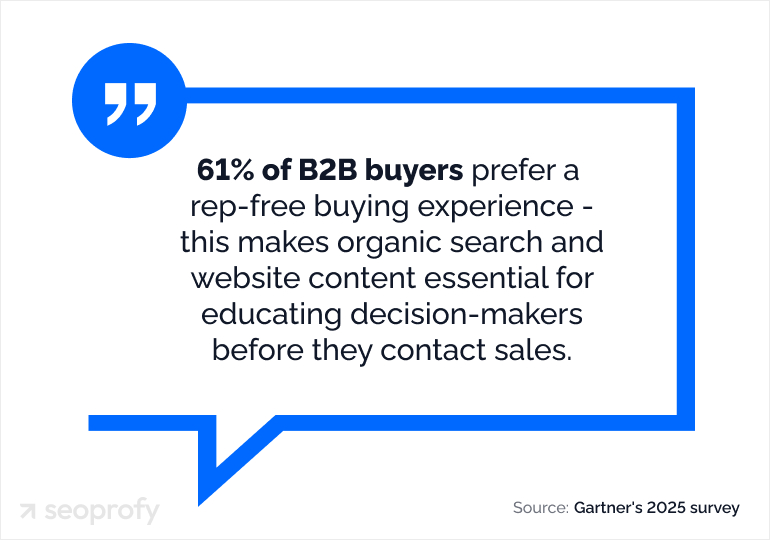
A 2025 survey of 632 B2B buyers by Gartner said 61% would prefer a rep-free buying experience overall. It also found that 69% had encountered inconsistencies between information on a supplier’s website and that provided by its sales representatives. When product content is clear and consistent, trust is established even before a prospect engages with the sales team.
The data you can find by searching can reveal common pain points, questions about your product, how it compares to competitors, and weaknesses in your current messaging. These insights are helpful for enterprise SaaS marketing teams looking to refine their content strategy and overall content marketing plans. They are also useful for product and sales teams as they develop landing pages, demos, and customer conversations.
The measure of SEO performance should be business results. When search and CRM data are joined, companies can measure SEO ROI in terms of conversions, sales-qualified leads, influenced pipeline, and revenue. Over time, SEO can provide a steady stream of high-quality leads at lower costs.
Build a Keyword Architecture Around Enterprise Demand
Successful enterprise SaaS SEO starts with the language buyers use throughout the sales journey. Demand data is available from traditional keyword research tools, but they may miss the specific terminology used in complex software purchases. A practical research process should draw on several sources:
- Get real customer language: You should try to analyze sales calls, customer interviews, support tickets, CRM records, site-search queries, and product feedback. These sources show pain points and technical requirements with potentially low search volume but high commercial relevance.
- Expand the topic set: It is a good idea to identify missing queries from search data and competitor research. Group related keywords together by problem, product category, comparison, integration, use case, purchase intent, etc. This makes it easier to distinguish exploratory queries from searches used to evaluate vendors.
- Concentrate on business potential: Search volume alone should not determine the roadmap. Rate each term for product relevance, potential for generating qualified leads, competitive difficulty, and relevance to revenue. A specific integration or comparison question could be more helpful than a generic term that draws in thousands of poorly matched visitors.
- Map keywords to pages: For each present or future URL, designate a single primary intent. High-value keywords are not necessarily for generic blog posts but could be for product pages, comparison pages, integration pages, or targeted landing pages. A clear keyword-to-page map also shows content gaps.
Before creating new pages, check whether an existing URL already targets the same intent. If multiple pages are competing for a virtually identical need, merge overlapping content, clarify their intent, or tweak internal linking. This prevents keyword cannibalization and gives search engines a clearer signal as to which page should rank.
Map Content to the Enterprise Buying Committee
Enterprise purchases involve multiple decision makers. The initial user may recognize the problem, but technical, financial, security, and operational stakeholders determine whether a product reaches the shortlist. A strong enterprise SEO strategy gives each participant the information needed to support the decision.
| Decision-Maker | Main Concern | Content That Supports the Decision |
| CEO or business leader | Revenue impact, scalability, strategic fit | Business outcome pages, customer stories, ROI guides |
| CFO or finance lead | Total cost, payback period, financial risk | Pricing information, cost comparisons, ROI calculators |
| Procurement or legal team | Contract terms, vendor risk, purchasing requirements | Procurement guides, legal documentation, vendor assessment resources |
| CTO or technical lead | Integrations, implementation, architecture | Integration pages, API documentation, migration guides |
| CISO or security team | Compliance, data protection, access controls | Security pages, compliance documentation, trust centers |
| Department head or end user | Workflow fit, adoption, daily value | Use-case pages, feature guides, product combinations |
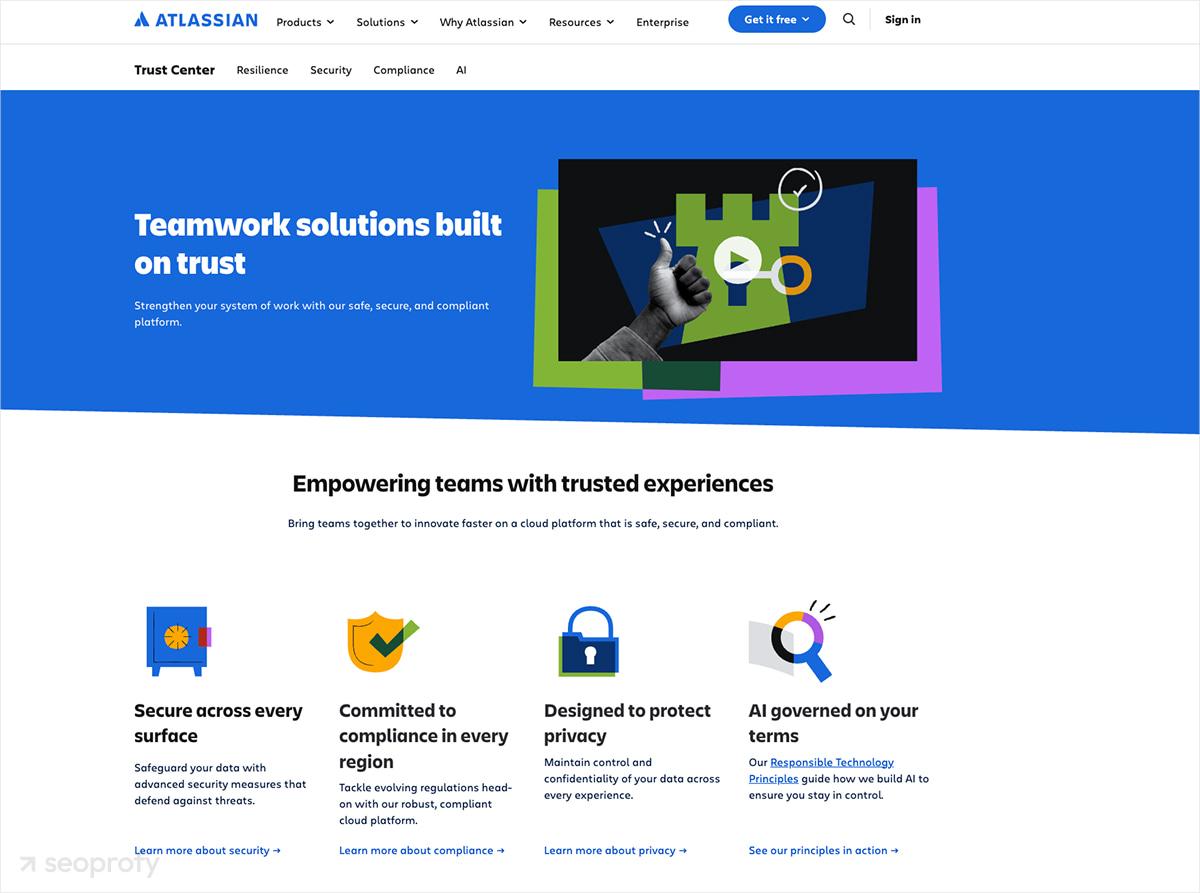
Atlassian’s Trust Center shows how enterprise software vendors can serve security and procurement stakeholders without directing them to a generic product page. The hub separates security, compliance, privacy, and AI governance resources, giving each reviewer a direct path to the evidence required for approval.
Keyword research should reflect these different concerns. Broad category terms can create awareness, while commercial-intent searches reveal stronger buying signals. Comparison pages, integration queries, competitor alternatives, and problem-specific terms often reach prospects who are actively evaluating software.
The content should also connect across the journey. A pain-point article can lead to a relevant use case, which then links to an integration, comparison, or product page. This structure helps buyers move from research to evaluation without forcing every page to address every persona. It also gives the sales team useful resources for follow-up conversations with different members of the account.
Strengthen the Technical Foundation Before Scaling Content
Enterprise SaaS businesses need a technical foundation that can scale without creating performance, crawling, or indexing problems. Fast, stable templates, strong Core Web Vitals, and accurate schema support usability and search visibility. Meanwhile, disciplined crawl management, canonicalization, and URL taxonomy keep growing site sections organized.
Together, these controls form a core part of effective enterprise SaaS SEO.
Site Speed, Core Web Vitals, and Schema
Slow demo and resource pages can kill high-intent sessions before a prospect even sees a form or product explanation. Test reusable templates on mobile and desktop, focusing on Largest Contentful Paint, Interaction to Next Paint, and Cumulative Layout Shift. Compress media, remove unused JavaScript, reserve space for dynamic elements, and load third-party scripts only when needed.
Core Web Vitals should be measured by page type, not by a single sitewide average. A fast homepage can mask poor performance in integration libraries, comparison pages, and gated assets. Use lab testing and field data to identify issues that affect user engagement and conversions.
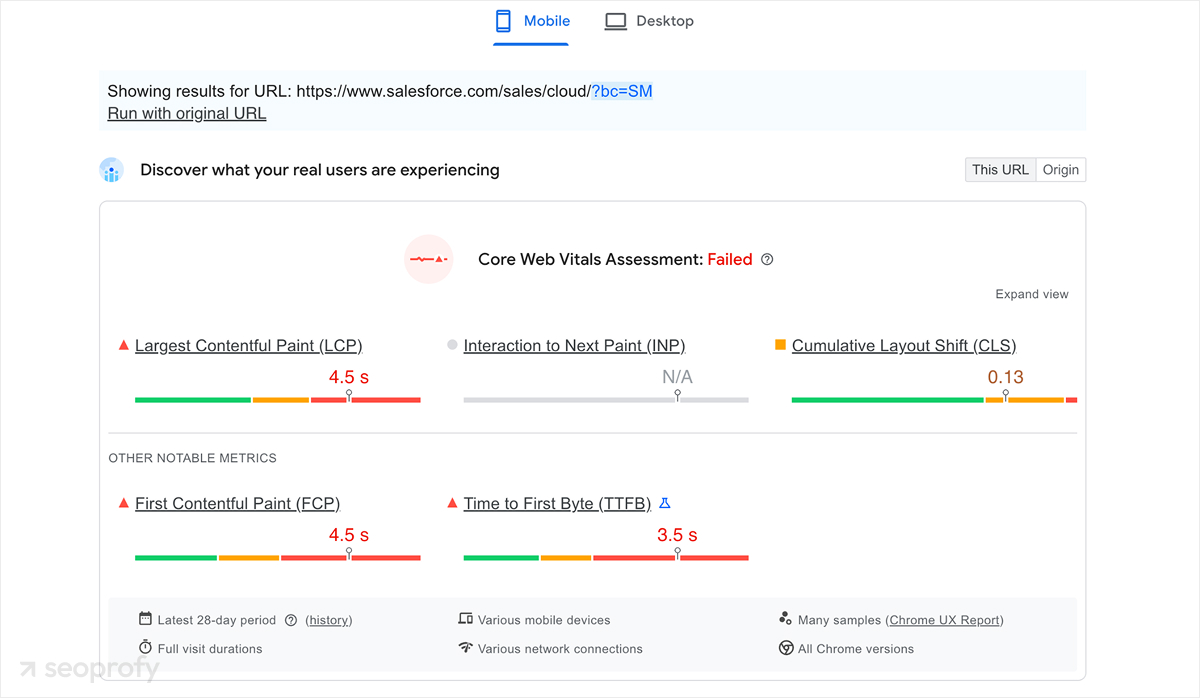
At the time of testing, Salesforce’s Sales Cloud page showed why page-level checks matter at enterprise scale: its latest 28-day mobile field data failed the Core Web Vitals assessment, with a 4.5-second LCP and 0.13 CLS.
Add JSON-LD only if it gives an accurate description of visible page content. Product, Organization, Article, or BreadcrumbList can be used elsewhere, while SoftwareApplication can be used for a product page. If no visible FAQ section, don’t add FAQ markup. Google says structured data can make a page eligible for enhanced results, but it does not guarantee that a page will appear in them.
Test each template using the Rich Results Test and inspect live URLs in Google Search Console.
Crawl Budget, Canonicals, and URL Taxonomy at Scale
Crawl budget becomes a concern when enterprise SaaS sites have very large or rapidly changing URL inventories. One way this problem appears is through duplicate URLs that compete for crawling and indexation. In SeoProfy’s work with Storyboard That, Google Search Console identified 343 duplicate pages without a user-selected canonical, as shown below.
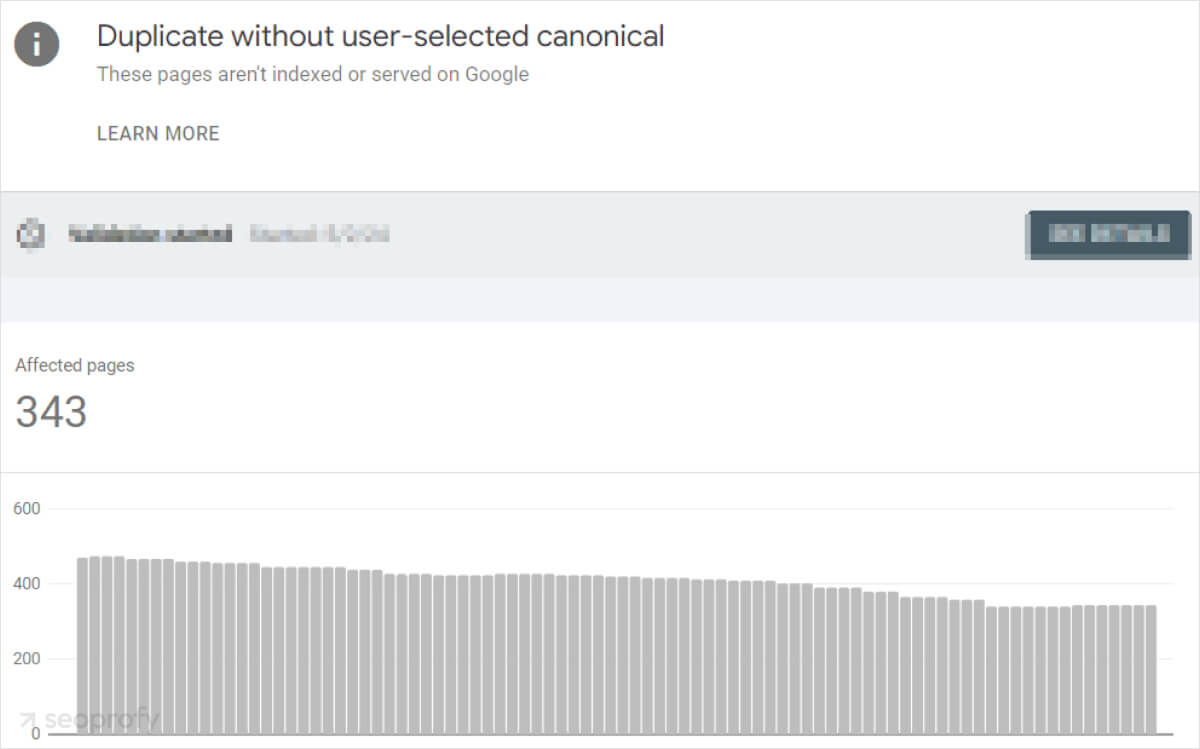
If crawlers spend time on duplicate or low-value pages, updates to important commercial content may be discovered more slowly.
Keep the site under control by three measures:
- Prevent crawl traps: Avoid generating or internally linking to unlimited URL combinations from filters, internal search results, calendars, and session parameters. Use robots.txt when unnecessary URL patterns should not be crawled. Use a crawlable noindex page when exclusion from search is the objective.
- Maintain canonical hygiene: Give each indexable page a consistent canonical destination. Unique product, integration, use-case, and localized pages can use self-referential canonicals. Duplicate or near-duplicate versions should identify the preferred URL, while permanently replaced pages should redirect to the closest relevant destination. Keep canonicals consistent with internal links, sitemaps, redirects, and hreflang annotations.
- Build a taxonomy that can grow: Structure URLs around stable categories, e.g., Products, Solutions, Industries, Integrations, and Resources. Avoid constructions based on ephemeral campaigns or internal product names. Use HTTPS for all pages to enhance user safety and trust.
As the platform grows, review index coverage, server logs, sitemap quality, and orphan pages. A clear hierarchy helps crawlers find priority content and prevents new product lines from creating competing or disconnected sections.
Optimize for AI Overviews and Generative Search
Prospects can now discover a vendor through Google AI Overviews, AI Mode, ChatGPT, Gemini, or Claude before visiting their website. These experiences do not work in the same way: Google’s AI features remain part of search engine results pages, while standalone assistants generate answers using their own models, indexes, and retrieval systems.
For enterprise SaaS SEO, the practical goal is to make important product information easy to find, interpret, and verify:
- Explain integrations, pricing models, implementation, security, and use cases in direct language before adding supporting detail.
- Connect product pages with documentation, comparisons, customer stories, research, and educational resources. This gives search and answer engines more context about the company’s expertise.
- Use named experts, original data, transparent methodology, product documentation, and relevant case studies. Together, these elements demonstrate the experience, expertise, authoritativeness, and trustworthiness associated with E-E-A-T. Keep facts consistent across the website.
- Allow crawling, use descriptive internal links, and keep essential information in readable HTML rather than hiding it inside scripts or gated files.
Google states that no special markup or additional technical requirements are needed for AI Overviews or AI Mode. Traditional SEO fundamentals still apply, including indexability, helpful content, page experience, and structured data that matches visible text.
Create and Scale Content Around the Enterprise Buyer Journey
Enterprise buyers rarely move from one search to a demo request in a straight line. They may begin with a business problem, research a software category, compare vendors, review integrations, check security requirements, and revisit pricing months later. Content must support these shifts without assuming that every visitor is ready to buy.
McKinsey’s 2024 B2B Pulse research found that customers use an average of ten interaction channels during the buying journey, up from five in 2016. Search content must therefore remain consistent with product pages, documentation, sales conversations, and other buyer touchpoints.
Build the journey in four steps:
- Map intent to buying stages: Group queries around problem awareness, category research, solution evaluation, and purchase validation. Assign each group to an appropriate page type rather than forcing every term into blog posts.
- Audit coverage and depth: Identify missing topics, weak pages, and content that does not answer the query as fully as competing results. Consolidate overlapping assets before creating new ones.
- Connect related decisions: Link educational guides to use cases, integrations, comparisons, customer stories, and product pages. Visitors should be able to continue their research without having to return to the search results.
- Plan content creation around business priorities: A content calendar should reflect launches, sales questions, industry demand, and available expertise – rather than search volume alone. SeoProfy’s guide to building an SEO content strategy explains how to coordinate research, planning, creation, optimization, and measurement.
A scalable enterprise SaaS SEO strategy gives each asset a defined audience, purpose, owner, and next step.
Scale Integration Pages and Developer Content
Integration pages and developer resources can attract prospects with specific commercial and technical requirements. Someone searching for “[platform] + [tool] integration” is often evaluating whether a product will fit an existing technology stack. An effective enterprise SaaS SEO program treats this content as part of the buyer journey rather than an isolated documentation library.
- Product data, sales conversations, support requests, marketplace searches, and keyword research should be used to identify the integrations and workflows buyers ask about most often. Prioritize pages tied to valuable use cases rather than publishing every possible tool combination.
- Each integration page should explain what the connection enables, who needs it, which data moves between the platforms, and what is required for setup. Include limitations, permissions, authentication methods, and links to relevant API documentation where appropriate.
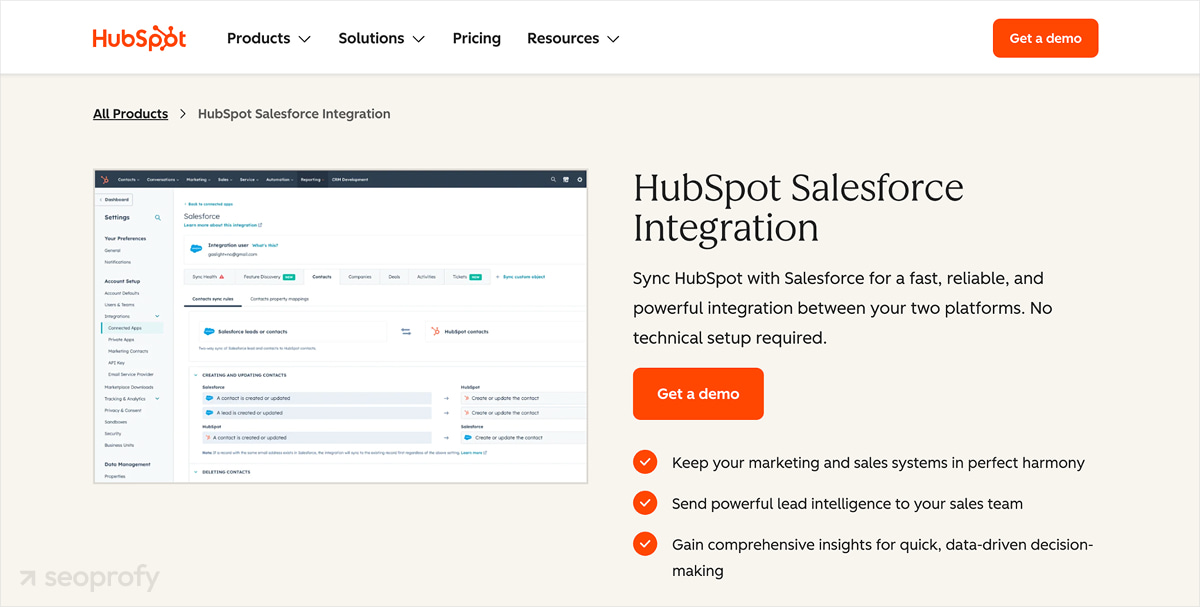
HubSpot’s Salesforce integration page shows what this looks like in practice. The page names both platforms, summarizes the value of connecting their data, and links the integration to lead intelligence and informed decision-making before offering a demo.
- Developer guides and code examples should have crawlable URLs, descriptive titles, clear headings, and contextual copy. Link documentation to relevant product and landing pages, and provide a route back from commercial content to implementation details. This internal linking helps both search engines and technical evaluators understand the relationship between features and workflows.
- Consistent layouts make large integration libraries easier to maintain, but every page still needs unique information. Avoid replacing tool names within otherwise identical copy. You should add platform-specific setup steps, screenshots, supported actions, common errors, and useful code examples.
Review these assets whenever APIs, authentication requirements, or product capabilities change. Accurate developer content builds confidence during technical validation and prevents outdated documentation from undermining the sales process.
Enterprise SaaS growth depends on more than rankings and traffic. SeoProfy connects technical optimization, buyer-led content, and authority building to qualified leads, pipeline, and revenue.
- Remove crawl, indexation, and site architecture barriers at scale
- Reach each buying-committee role with high-intent content
- Connect organic performance to ROI.

Build Authority with Digital PR and Enterprise Link Building
For enterprise SaaS SEO, backlink authority matters more than raw link volume. A relevant editorial link from a respected industry publication may provide more referral value and credibility than dozens of unrelated links. The goal is to earn references that demonstrate the company’s expertise.
Focus on assets that give publishers and specialists a reason to quote the brand:
| Resource type | Examples |
| Original research | Benchmarks, surveys, product data |
| Expert commentary | Insights from industry specialists |
| Technical resources | API docs, guides, SDKs |
| Evergreen resources | Glossaries, calculators, templates |
Digital PR has to get those assets in front of the right journalists, newsletters, podcasts, associations, and niche titles. Outreach needs to explain why the resource is relevant to the audience, rather than using the same pitch across domains.
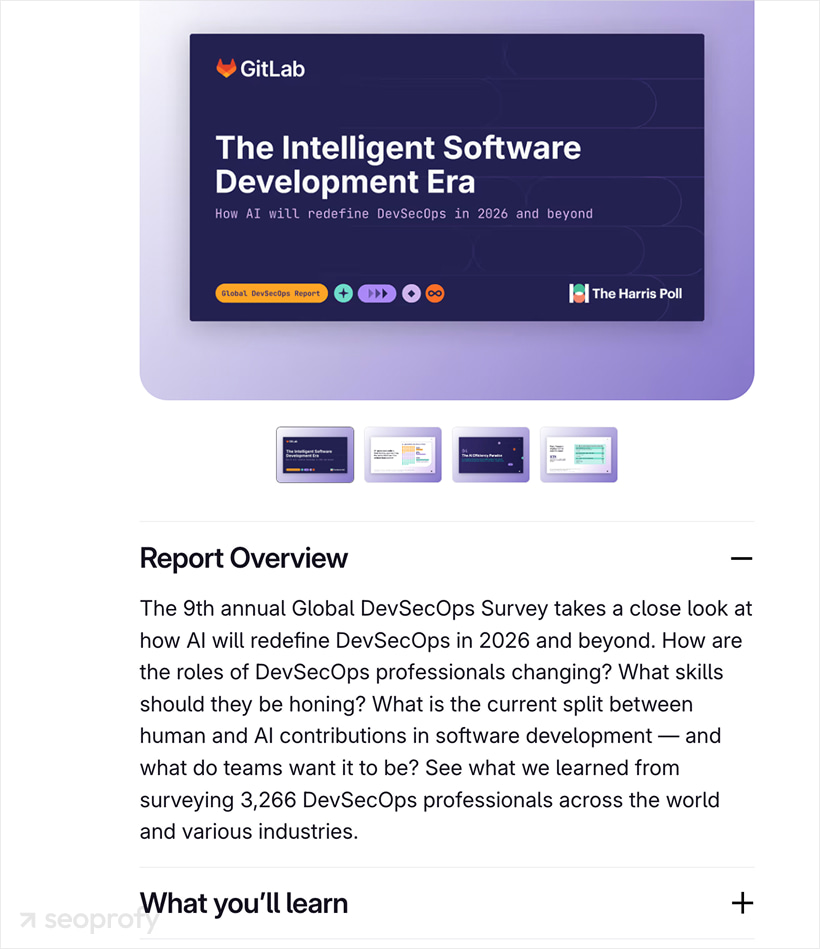
GitLab’s Global DevSecOps Survey shows how proprietary research can become a natural magnet for links. Its 2026 report draws on responses from 3,266 DevSecOps professionals and clearly presents the research scope, making the asset easier for journalists and practitioners to evaluate and cite.
Enterprise SEO teams should evaluate link quality by subject matter, editorial standards, placement, referral potential, and authority of the linking page. Brand mentions are a good way to identify unlinked citations and convert them into backlinks with just one request at the right time.
Tie Organic Performance to Pipeline and Revenue
Traffic and rankings show whether visibility is improving, but they do not establish an enterprise business case for continued investment. Reporting for enterprise SaaS SEO should include tying organic acquisition to qualified opportunities, sales progress, and revenue. It is possible to gain an SEO ROI of approximately 702% for B2B SaaS campaigns, with an average break-even timeline of about seven months.
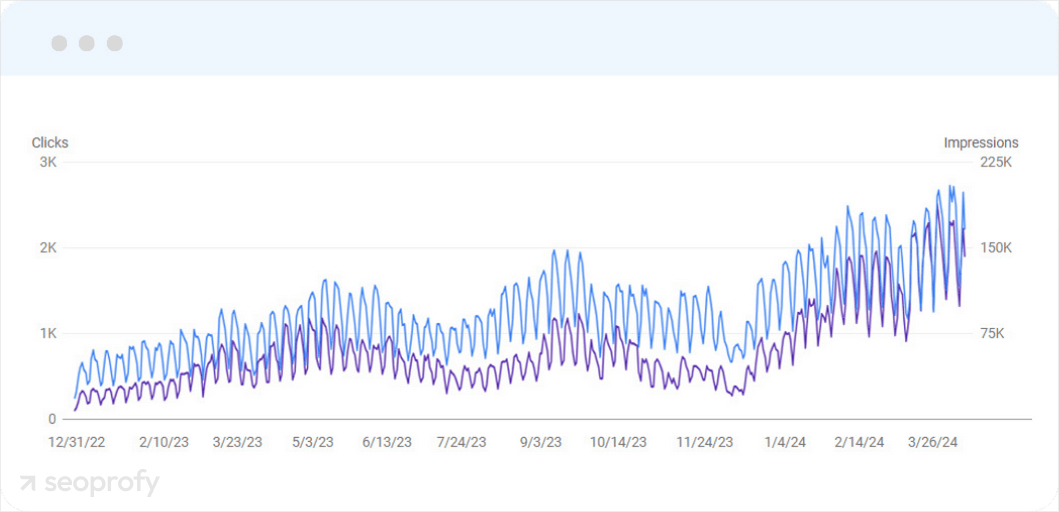
Our SaaS case study for StoryboardThat, a B2B SaaS platform, reports that organic traffic in a priority category grew from 22,000 to 68,000 monthly users in nearly two years, while qualified leads increased by more than 400%. The case shows why traffic gains matter most when the work focuses on pages tied to conversions.
You should build attribution in 4 steps:
- Don’t conflate newsletter signups and content downloads with demo requests, product trials, sales-qualified leads, and closed accounts.
- Push landing-page, campaign, and first-touch data into the CRM. Consistent UTMs, conversion events, and first-party tracking help prevent attribution gaps.
- Correlate organic leads to account status, opportunity value, sales cycle, and closed revenue. Report both sourced & influenced pipeline when search contributes to a journey but is not the final touchpoint.
- Monitor qualified organic leads, conversion rate, cost per acquisition, pipeline value, and annual recurring revenue. CAC should factor in the cost of people, technology, content, and link acquisition to run the program.
Enterprise SaaS SEO Tools and How to Track Success
There is no single place to measure everything in an enterprise SaaS SEO strategy. Big sites need a connected toolset to manage visibility, technical health, content, authority, user behavior, and commercial outcomes.
| Function | What to Measure | Tools | What It Reveals |
| Search performance | Impressions, clicks, rankings, landing-page visibility | Google Search Console, Semrush, Ahrefs | Demand captured by product, solution, and integration pages |
| Technical health | Indexation, crawl errors, duplicate content, broken links, metadata | Screaming Frog, Sitebulb, Lumar | Issues preventing large page sets from ranking |
| Server-log analysis | Bot visits, crawl frequency, status codes, wasted crawl | Oncrawl, JetOctopus, Splunk | Whether bots reach high-value pages or waste resources |
| Content performance | Keyword gaps, intent coverage, content decay, cannibalization | Semrush, Ahrefs, Clearscope | Missing content across use cases, industries, and buyer roles |
| Behavior and attribution | Demos, trials, SQLs, CPA, pipeline, ARR | Google Analytics, Salesforce, HubSpot, Looker Studio | Which organic visits become qualified opportunities and revenue |
| Authority and links | Referring domains, link quality, lost and new links, anchor text | Ahrefs, Semrush, Majestic | Whether priority pages are building authority in their category |
Review these groups together. Rankings without conversions can indicate an intent mismatch, while growing lead volume without revenue may point to poor qualification or weak sales follow-up.
Establish Cross-Team SEO Governance
Enterprise SEO success often depends on governance: organic growth is frequently slowed by unclear responsibilities rather than a lack of ideas. A healthy enterprise SaaS SEO governance model aligns marketing, product, engineering, analytics, legal, and sales around shared objectives and defined ownership.
- Appoint accountable owners: The search lead should own strategy and backlog; content teams own briefs, production, and updates. Technical search engine optimization is managed by engineering; product teams manage launches; analytics manages tracking, and legal reviews claims or compliance-sensitive material. Sales can bring customer questions and commercial insights.
- Keep one common backlog: Log technical fixes, content opportunities, migrations, and reporting tasks all in one system. Each item needs an owner, a deadline, an expected business impact, and dependencies. This prevents requests from getting lost between different departmental workflows.
- Add search reviews for major changes: Enterprise SEO teams need to review redesigns, migrations, product launches, navigation changes, and URL changes before they go live. An early review catches broken redirects, lost internal links, pages that have become blocked, or the accidental deletion of valuable content.
- Create standard documentation and escalation processes: Specify requirements for page templates, metadata, internal linking, redirects, analytics, and approvals. Find out who makes the call when design, legal, or engineering priorities clash with search needs.
- Scale governance to the organization’s size: When enterprise companies operate multiple websites, products, languages, or regions, it’s important to maintain central standards while allowing local execution. Regional teams can customize content for their markets, while a central owner provides technical consistency and eliminates duplicate work.
Governance needs to be revisited regularly as the platform, team, and site structure changes. Clear ownership helps prioritize SEO initiatives and connect day-to-day work to tangible business outcomes.
Build a 90-Day Enterprise SaaS SEO Roadmap
A 90-day roadmap turns an enterprise SaaS SEO strategy into an actionable sequence of activities. It removes the biggest constraints first, assigns clear ownership, and creates measurable progress without attempting a sitewide overhaul.
Days 1-30
- Establish the baseline
- Audit technical health, content performance, search visibility, conversions, and current reporting
- Identify critical issues such as index bloat, crawl traps, broken redirects, duplicate pages, and tracking gaps
- Assign owners for technical fixes, content, analytics, approvals, and cross-team communication
- Establish baseline metrics for qualified leads, priority keyword rankings, organic traffic, and pipeline contribution.
Days 31-60
- Organize demand, prepare execution
- Complete keyword-to-page mapping for product, comparison, integration, use case, and resource pages
- Find content gaps, duplicate URLs, and landing pages with strong commercial intent
- Increase internal linking of educational, product, and developer content
- Prepare briefs for priority pages and document requirements for templates, metadata, schema, conversion tracking, and approvals.
Days 61-90
- Publish, promote, and tie results to revenue
- Launch the highest priority pages and refresh existing assets that already have authority or conversions
- Launch focused link building and digital PR initiatives using your unique data, studies, or technical assets
- Connect analytics and CRM data so reporting can distinguish between traffic, leads, opportunities, and influenced pipeline
- Update stakeholders on progress, blockers, and next priorities.
The roadmap should be flexible. It is important to prioritize tasks by business impact, implementation effort, and dependencies rather than trying to complete a site-wide checklist in sequence. At the end of 90 days, review the results and use them to plan the next quarter.
In-House Team or Enterprise SaaS SEO Agency?
The choice depends on the site’s complexity, internal expertise, hiring capacity, and required implementation speed. Neither model is inherently cheaper or more effective.
An in-house team brings deep product knowledge, direct access to stakeholders, and control over priorities. It suits companies that can hire technical, content, analytics, and authority specialists; no one person can handle all of enterprise SaaS SEO. Costs include salaries, recruitment, training, and tools.
A professional SaaS enterprise SEO agency with a proven track record provides specialist software and a solid team, so you don’t have to build every capability in-house. This model works for migrations, technical backlogs, international expansion, or limited bandwidth. Enterprise clients still need an internal owner to align developers, product experts, and the approval process.
When evaluating in-house or outsourced SEO, it helps to ask:
- Who owns strategy, implementation, reporting, and communication?
- Which specialists will work on the account?
- How will performance connect to qualified leads and pipeline?
- What relevant case studies and references can the agency provide?
- How are recommendations prioritized and communicated?
- What happens when results fall below expectations?
- Which tasks require support from internal teams?
These questions to ask an SEO agency can help shape the evaluation.
Many enterprise SaaS companies use a hybrid model: internal teams retain strategy and product knowledge, while an agency provides specialized execution and capacity.
Conclusion: Making Enterprise SaaS SEO Work at Scale
Enterprise SaaS SEO scales when technical architecture, persona-driven content, AI-search readiness, and revenue attribution reinforce one another. Strong content cannot perform consistently on a poorly controlled website, while greater visibility has limited commercial value when it attracts the wrong audience or cannot be connected to qualified opportunities.
The objective is therefore not to run more isolated SEO activities. It is to build an enterprise SEO strategy that makes complex product information discoverable, supports different stakeholders throughout evaluation, and preserves meaningful performance data from the first search interaction to the CRM outcome. AI-search visibility becomes part of this system rather than a separate campaign.
Companies that lack the internal capacity to coordinate these elements may benefit from specialized enterprise SEO services. The right partner should strengthen the system as a whole, connecting organic visibility with buyer progression and measurable business growth.

Julia Lubianytska is a Copywriting Team Lead at SeoProfy with over 7 years of experience in copywriting and editing. She works closely with copywriting teams, helping writers craft clear and thoughtful content for SaaS products, IT services, and businesses in the legal and medical fields. Julia enjoys turning complex topics into easy-to-understand, trustworthy content, focusing on structure, clarity, and consistency to ensure the content is genuinely helpful for real people, not just search engines.