

AI is already built into budgets. It is changing search, software, customer support, and daily work. These generative AI statistics help teams see where the market is real before they spend money or build a strategy around the wrong signals.


SeoProfy collected fresh 2026 data from market research, enterprise surveys, company reports, and analytics platforms. Use these AI statistics numbers to benchmark your own AI plans and make stronger decisions before the next budget cycle.
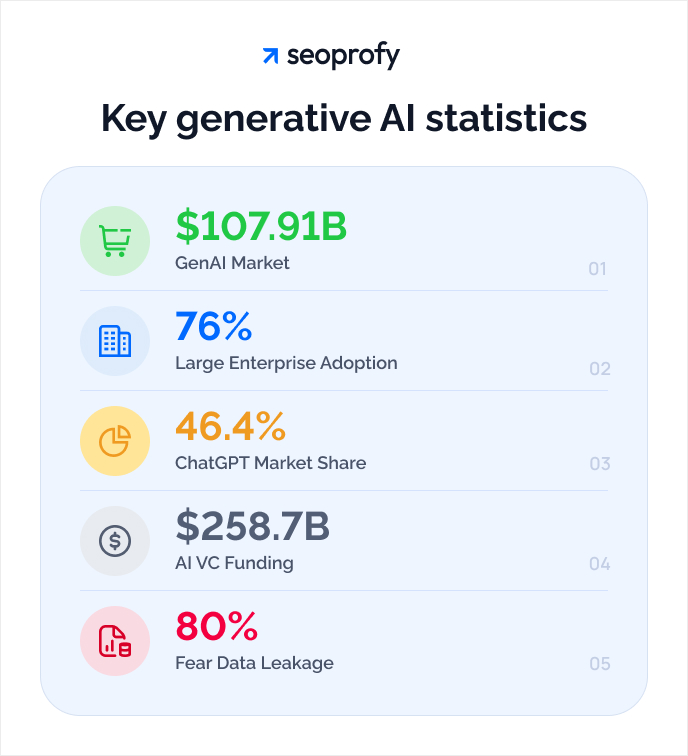
- The global generative AI market reached $107.91 billion in 2026 and is projected to hit $368.12 billion by 2030.
- Enterprise adoption is much higher in large companies, with 76% of organizations above 1,000 employees actively using AI.
- ChatGPT still leads the AI assistant market with 46.4% global share, while Gemini, Claude, DeepSeek, Copilot, and Perplexity are gaining ground.
- Global VC investment in AI firms reached $258.7 billion, with GenAI funding at $35.3 billion.
- Security, governance, and trust remain major blockers, with 80% of organizations worried about data leakage through generative AI solutions.
Our Methodology and Data Sources
SeoProfy reviewed the latest available evidence on generative AI to separate current market signals from outdated data. The report focuses on 2026-relevant AI stats and excludes older sources when fresher information is available.
We checked four main source groups:
- Official reports: AI company updates, public releases, product data.
- Surveys: consumer, workplace, and enterprise adoption studies.
- Market research: revenue, generative AI market growth, forecast benchmarks.
- Analytics platforms: traffic, app usage, audience, demand signals.
Each statistic was reviewed for publication date, methodology, and relevance before inclusion.
Generative AI Market Size and Growth Statistics
Generative Artificial Intelligence (GenAI) is AI that creates new text, code, images, audio, video, or synthetic data from patterns learned during training.
GenAI market growth is tracked in two ways. One view counts direct revenue from models, software, and services. The broader view includes the full spending stack behind GenAI, including servers, devices, cloud infrastructure, and implementation services.
The market grew sharply after 2022 and is still expanding fast in 2026. Market size increased from $20.47 billion in 2023 to $66.89 billion in 2025, and Statista projects it to pass $368 billion by 2030. (Technology Checker)
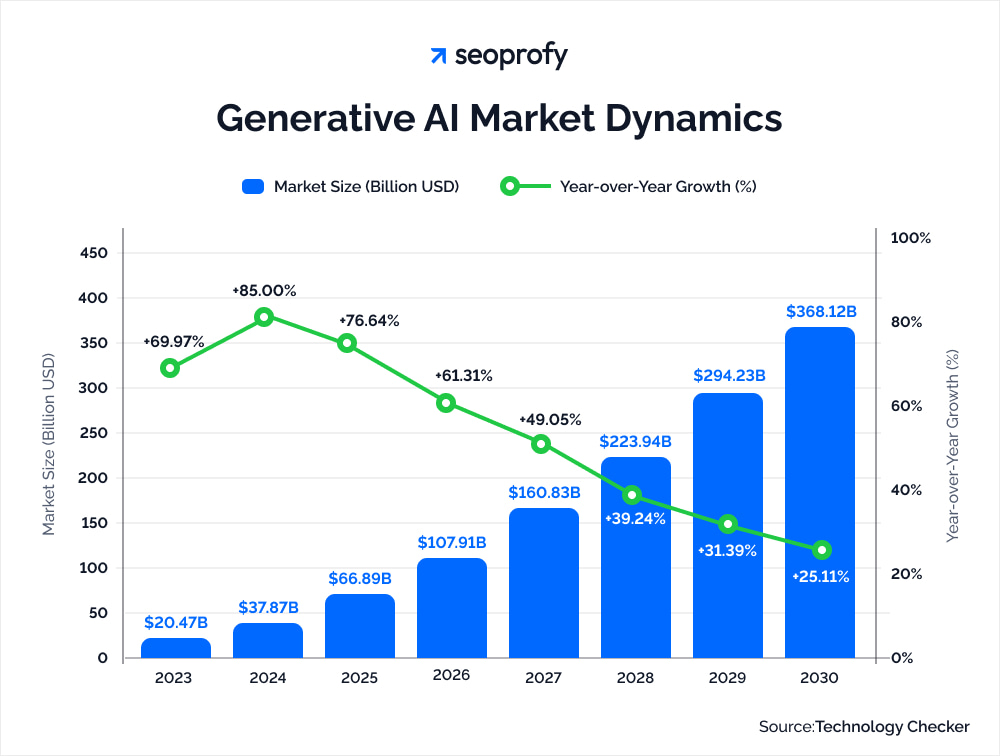
| Year | Market Size | Year-over-Year Growth |
| 2023 | $20.47 billion | +69.97% |
| 2024 | $37.87 billion | +85.00% |
| 2025 | $66.89 billion | +76.64% |
| 2026 | $107.91 billion | +61.31% |
| 2027 | $160.83 billion | +49.05% |
| 2028 | $223.94 billion | +39.24% |
| 2029 | $294.23 billion | +31.39% |
| 2030 | $368.12 billion | +25.11% |
How Big Is the Generative AI Market in 2026?
In our AI statistics, we suggest the AI market be read as a range because analysts count different things. A narrow model counts software and services. A broader model includes AI-enabled devices, servers, infrastructure, implementation, and enterprise spending.
- Narrow revenue models put GenAI much lower because they focus on software, services, and direct market revenue. Grand View Research places the 2026 market at $29.6 billion. (Grand View Research)
- Broader commercial market sizing puts GenAI at $161 billion in 2026 and above $1.2 trillion by 2034. (Fortune Business Insights)
- Total addressable spending is larger. Gartner puts worldwide GenAI spending at $643.86 billion in 2025 because its forecast includes services, software, devices, and servers. (Gartner)
- IDC separates GenAI from the wider AI market. It expects GenAI to reach $202 billion by 2028 and account for 32% of overall AI spending by the end of the forecast period.
The total AI market is not the same as the generative AI market. Total AI includes predictive analytics, machine learning, computer vision, robotics, natural language processing, AI infrastructure, and embedded AI systems. Generative AI is the subset focused on foundation models, content generation, copilots, AI assistants, multimodal tools, and model APIs.
Generative AI Investment and Funding Trends
According to our AI statistics, AI funding became even more concentrated last year. Global VC investment in AI firms reached $258.7 billion, while generative AI VC funding rose to $35.3 billion and represented more than 14% of all AI VC investment. (OECD)
Private AI investment grew 127.5% in 2025, with generative AI growing more than 200% and capturing nearly half of all private AI funding. (Stanford HAI)
| Region / Country | 2025 AI VC Deal Value | Share of Global AI VC Deal Value |
| United States | $194 billion | 75% |
| EU27 | $15.8 billion | 6% |
| China | $13.9 billion | 5% |
| United Kingdom | $13.8 billion | 5% |
The regional split shows how uneven AI funding still is. The U.S. attracts most AI venture capital by a wide margin, while Europe, China, and the U.K. remain far smaller funding markets. This table covers AI VC overall, not GenAI only, but it is the clearest current regional benchmark for where AI capital is flowing in 2025. (OECD)
- Enterprise Generative AI spending reached $37 billion in 2025, up from $11.5 billion in 2024. That shows buyers are moving from pilots into recurring budgets for tools, models, and applications. (Menlo Ventures)
- OpenAI announced a $40 billion funding round in 2025 at a $300 billion valuation. The round shows how frontier model companies now raise capital at an infrastructure scale. (Reuters)
- Anthropic raised $13 billion in Series F funding at a $183 billion post-money valuation. Enterprise demand for Claude and developer-focused AI tools remains a major funding driver. Leaders expect generative AI budgets to keep growing as more companies move from experimentation to recurring software, model, and infrastructure spend. (Anthropic)
- 86% of surveyed organizations expect Gen AI budgets to increase in 2026, and nearly 40% expect an increase of at least 10%. (NVIDIA)
Generative AI Adoption Statistics
Generative AI adoption in 2026 is highest among large enterprises, knowledge-heavy industries, younger workers, and companies already redesigning workflows around AI. Economy-wide business adoption is lower, but enterprise surveys show much faster uptake among larger organizations.
How Many Companies Use Generative AI?
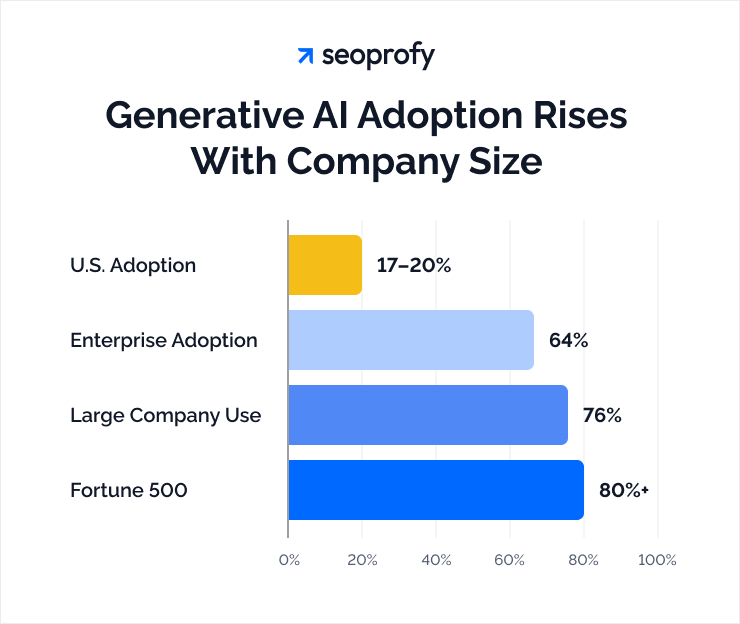
In 2026, AI adoption ranges from 17–20% across all U.S. businesses to 64% among enterprise survey respondents. Large companies are further ahead: 76% of companies with more than 1,000 employees actively use AI, and more than 80% of Fortune 500 companies deploy active AI agents.
| Stage | % of Companies | Characteristics |
| Surface-level AI use | 37% | AI is used with little or no change to existing business processes. |
| Process redesign | 30% | Key processes are being redesigned around AI, while the business model mostly stays the same. |
| Business transformation | 34% | AI is used to create new products, services, core processes, or business models. |
However, the gap between pilots and transformation often comes down to integrating AI into real workflows, not simply giving teams access to tools.
- Company size changes the picture: 37% of U.S. firms with at least 250 employees use AI, compared with 32% of firms with 100–249 employees and less than 20% of firms with four or fewer employees. (U.S. Census Bureau)
- Enterprise adoption is much higher in industry surveys, with 64% of respondents actively using AI, 28% still assessing it, and 8% reporting no plans to use it. (NVIDIA)
- Large enterprises are further ahead, with 76% of companies above 1,000 employees actively using AI and only 2% not using it at all. (NVIDIA)
- The leader-laggard gap is already visible in financial results: 12% of CEOs report both revenue and cost benefits from AI, while 56% report no significant financial benefit yet. (PwC)
Generative AI Adoption by Region
AI adoption is uneven across regions in 2026. Enterprise AI statistics show North America ahead in active use, while population-level GenAI adoption is especially high in Singapore and the UAE.
| Region / Country | 2026 Adoption Data | What It Measures |
| North America | 70% active AI use | Enterprise AI adoption among surveyed organizations. |
| EMEA | 65% active AI use | Enterprise AI adoption among surveyed organizations. |
| APAC | 63% active AI use | Enterprise AI adoption among surveyed organizations. |
| United States | 43% of workers use generative AI for their jobs + 28.3% population adoption | Workplace GenAI adoption and population-level GenAI adoption. |
| Europe, surveyed countries | 26–36% of workers use generative AI for their jobs | Workplace adoption across Germany, the U.K., France, Italy, Sweden, and the Netherlands. |
| Singapore | 61% population adoption | Population-level |
| United Arab Emirates | 54% population adoption | Population-level |
Generative AI Adoption by Industry and Function
Gen AI adoption is strongest in industries where data, software, customer interaction, and operational speed already drive business performance.
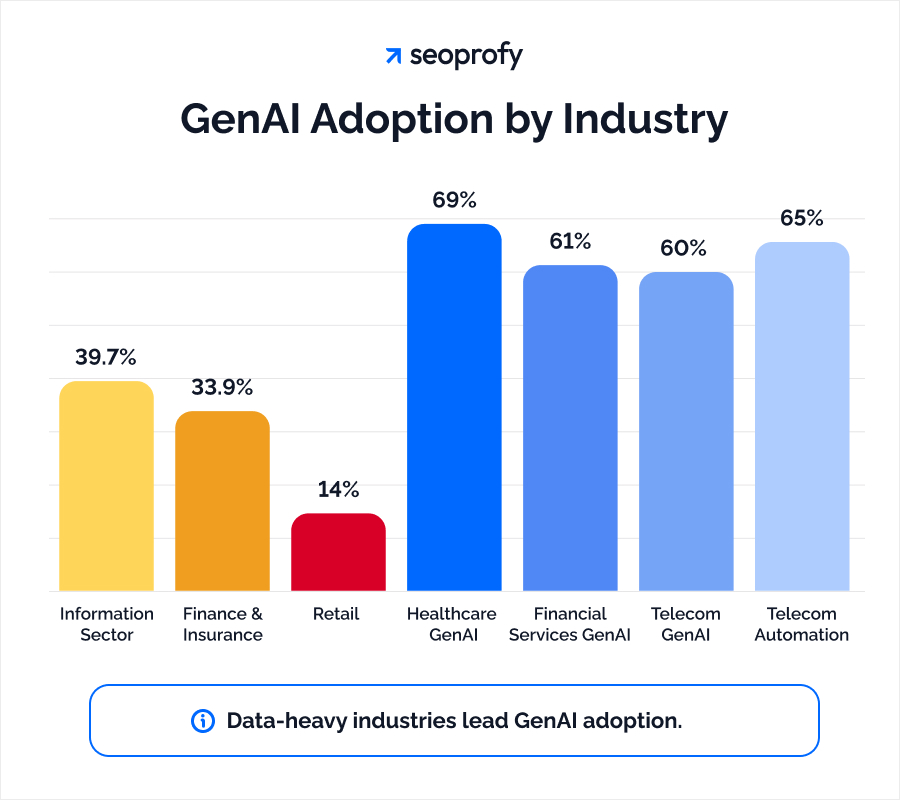
- The Information sector leads U.S. business AI adoption at 39.7%, nearly double the national business average of 19.8%. (U.S. Census Bureau)
- Finance and insurance follow at 33.9%, with about 39% of businesses in the sector expecting to use AI within the next six months. (U.S. Census Bureau)
- Retail is still behind the national average, with around 14% current AI use and about 17% expected use over the next six months. (U.S. Census Bureau)
- Generative AI and large language models are the top AI workload in healthcare and life sciences, used by 69% of respondents. (NVIDIA)
- In financial services, 61% of respondents use or assess generative AI, up 52% year over year. (NVIDIA)
- Telecommunications is moving into generative AI and automation at the same time, with 60% using or assessing generative AI and 65% saying AI drives network automation. (NVIDIA)
Who Is Using Generative AI? Demographics and User Profiles
Generative AI usage is highest among younger workers, students, college-educated employees, workers at larger firms, and employees in ICT-heavy industries.
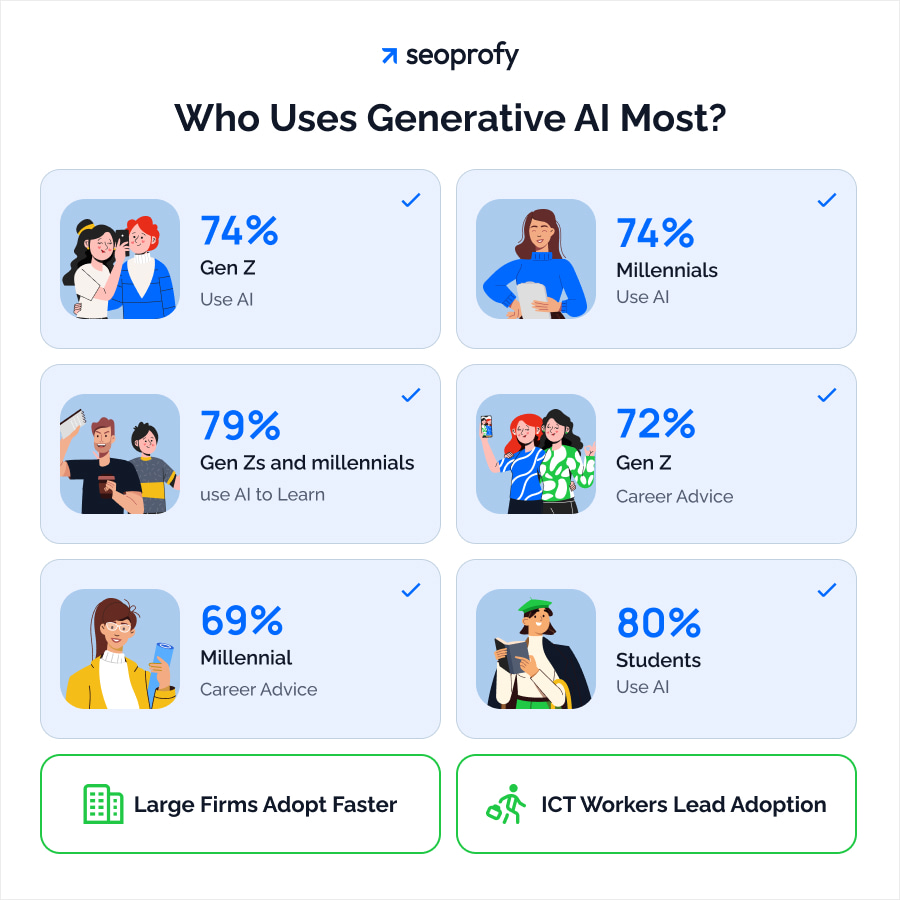
- Gen Z and millennials are now equal in workplace AI use: 74% of both groups say they use AI in their day-to-day work, up from 57% of Gen Zs and 56% of millennials a year earlier. (Deloitte)
- Younger professionals are also using AI beyond basic productivity: 79% of Gen Zs and millennials use AI to identify learning opportunities, while 72% of Gen Zs and 69% of millennials use it for career advice. (Deloitte)
- 67% of Gen Zs and 65% of millennials use AI to cope with work-related stress. (Deloitte)
- Four out of five U.S. high school and college students use AI for schoolwork, most often for research, essay editing, and brainstorming. (Stanford)
- Younger workers, college-educated workers, employees at larger firms, and workers in information and communication technology adopt AI at much higher rates. (St. Louis Fed)
Generative AI Usage Statistics: How People Use GenAI in 2026
Generative AI use in 2026 is shifting from one general chatbot to a multi-tool workflow. People still use ChatGPT for broad tasks, but enterprise users now combine assistants, copilots, search tools, coding agents, image generators, and workflow agents depending on the task.
Most Popular Generative AI Tools in 2026
| Tool | Primary Use Case | User Base Size | Key Strength |
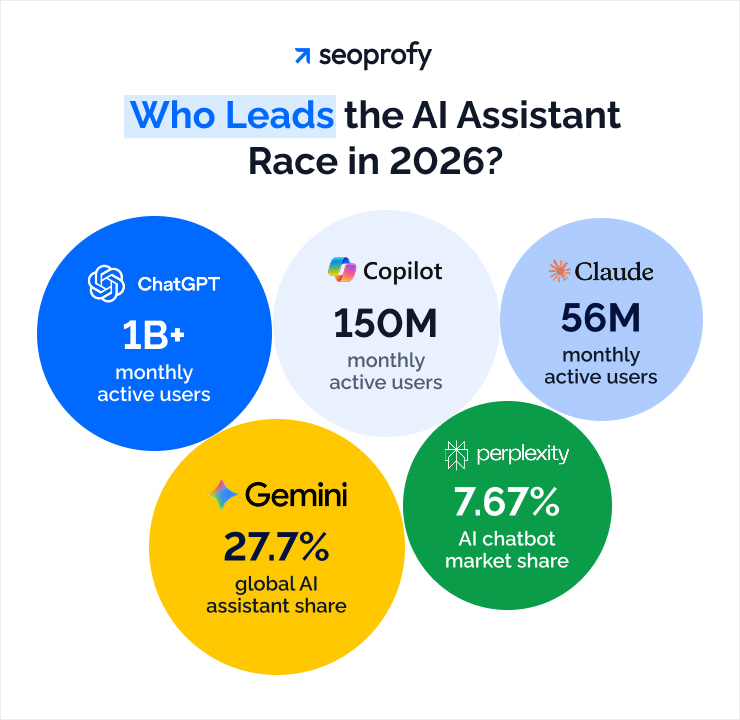
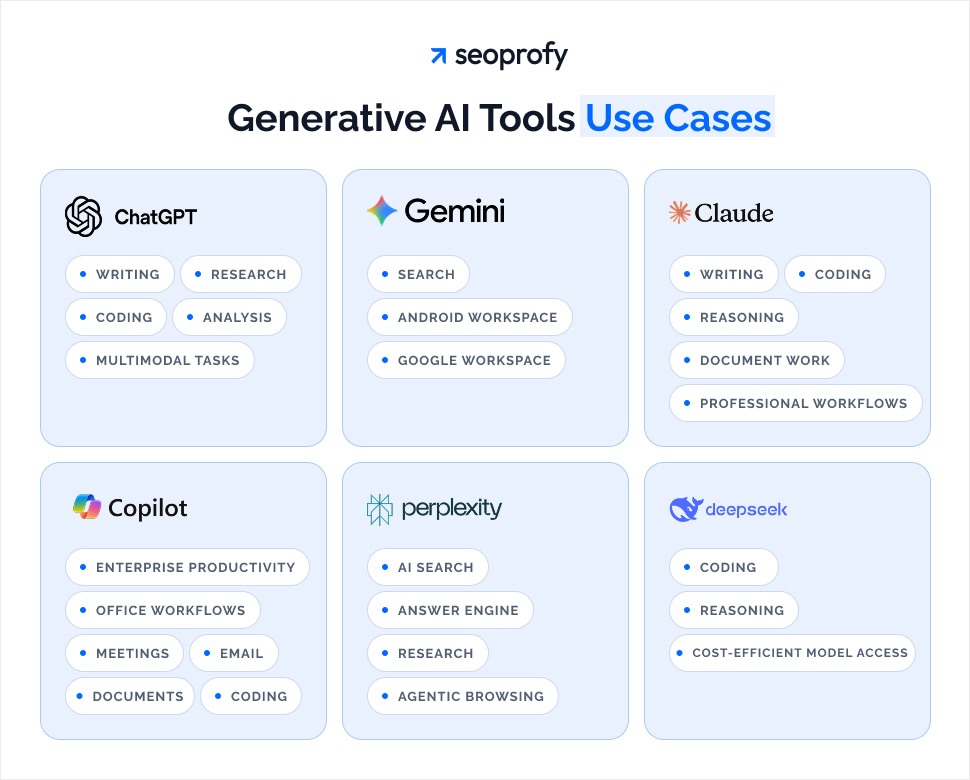
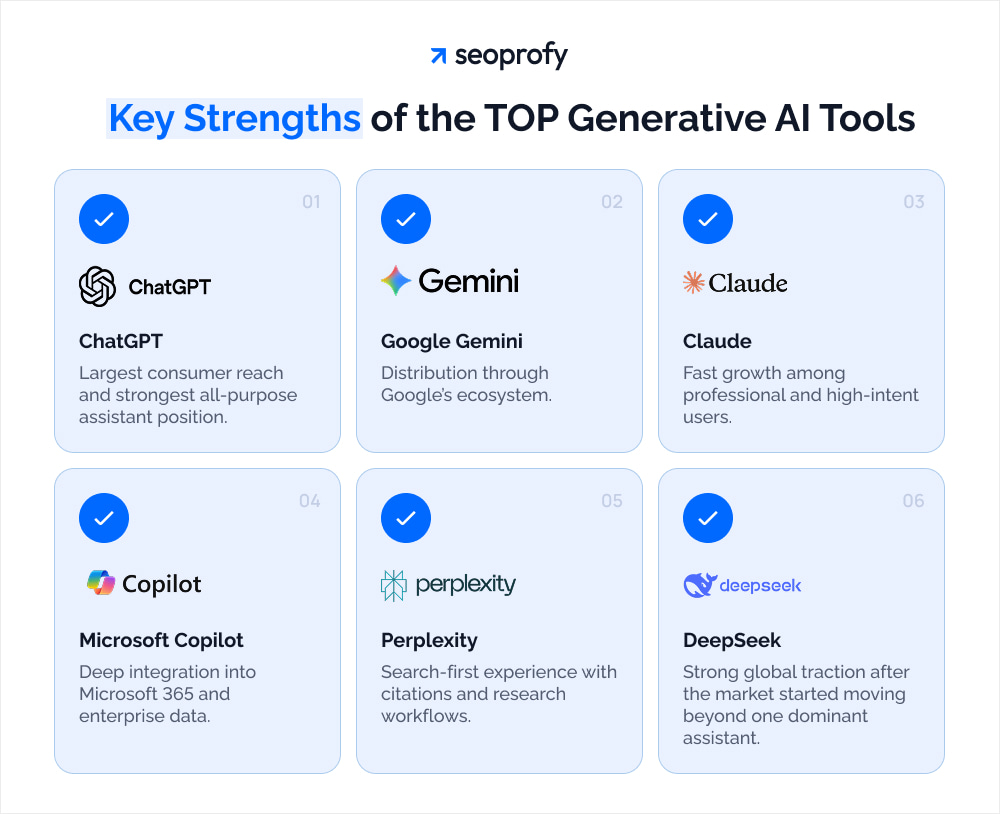
| ChatGPT | General AI assistant for writing, research, coding, analysis, and multimodal tasks | 1B+ monthly active app users; 46.4% global AI assistant true audience share. | Largest consumer reach and strongest all-purpose assistant position. |
| Google Gemini | AI assistant across search, Android, and Google Workspace | 27.7% global AI assistant share. | Distribution through Google’s ecosystem. |
| Claude | Writing, coding, reasoning, document work, and professional workflows | 56M global monthly active generative AI users; 640% YoY MAU growth. | Fast growth among professional and high-intent users. |
| Microsoft Copilot | Enterprise productivity, Office workflows, meetings, email, documents, and coding | 150M monthly active users across first-party Copilots; 20M+ paid Microsoft 365 Copilot seats. | Deep integration into Microsoft 365 and enterprise data. |
| Perplexity | AI search, answer engine, research, and agentic browsing | 7.67% global AI chatbot market share in May 2026. | Search-first experience with citations and research workflows. |
| DeepSeek | General AI assistant, coding, reasoning, and cost-efficient model access | ChatGPT, Gemini, and DeepSeek together account for nearly 90% of total time spent across AI assistant apps. | Strong global traction after the market started moving beyond one dominant assistant. |
The main tool-level trend is diversification. ChatGPT still leads the assistant market, but its share fell below 50% in 2026 as Gemini, Claude, DeepSeek, Perplexity, and enterprise copilots gained usage. (TechCrunch)
Enterprise-grade AI technologies are also becoming more important than standalone consumer apps. Microsoft 365 Copilot has more than 20 million paid seats, and more than 90% of Fortune 500 companies use it. (Microsoft)
Top Generative AI Use Cases Across Business Functions
Generative AI use cases are now split into two groups. Automation use cases replace or execute repetitive tasks, such as order tracking, ticket routing, email drafting, and quote creation. Augmentation use cases help people do higher-value work faster: research, writing, coding, analysis, summarization, and decision support.
Fastest-growing generative AI usage cases in 2026:
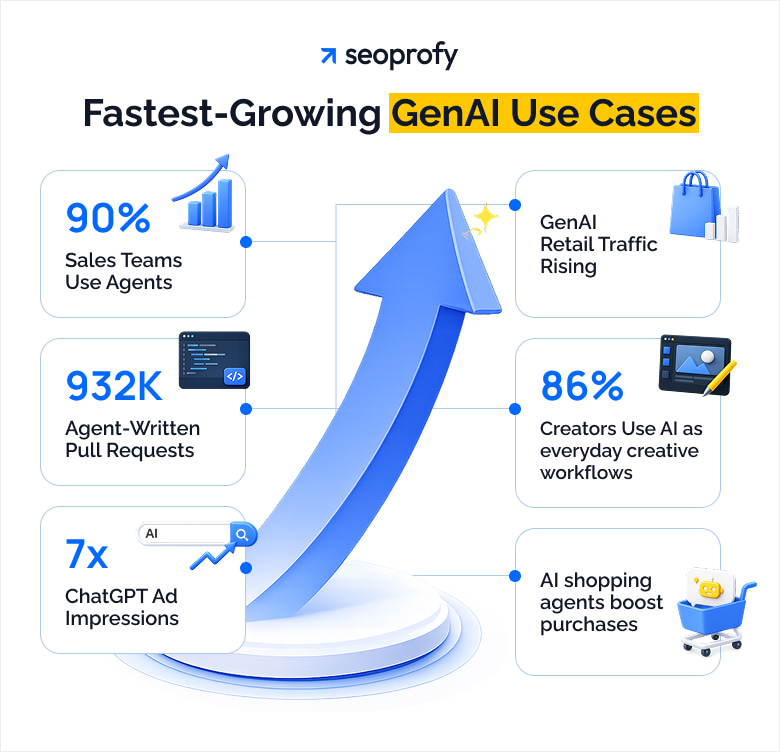
- AI agents are now part of sales workflows: 9 in 10 sales teams use them today or expect to within 2 years. (Salesforce)
- Coding tools are no longer limited to autocomplete. A 2026 GitHub study found 932,791 agent-authored pull requests across 116,211 repositories. (arXiv)
- AI search became a discovery channel: ChatGPT ad impressions increased more than 7x from March to May 2026, while generative AI referral traffic to retail sites rose across major shopping categories. (Sensor Tower)
- AI shopping agents are moving into commerce. Amazon Rufus, the company’s AI shopping assistant that helps users compare products, ask shopping questions, and get recommendations inside Amazon, is already showing commercial impact: Rufus users converted at nearly twice the rate of non-users in Sensor Tower’s retail analysis. (Sensor Tower)
- 86% of creators now use creative AI as part of everyday production workflows. (Adobe)
Generative AI in Business: ROI and Productivity Statistics
Generative AI is delivering the clearest business value in specific workflows: writing, sales support, customer service, coding, knowledge retrieval, security operations, and industry-specific automation. The gap is in scale. Individual workers often see productivity gains before the company can prove full revenue or cost impact.
Generative AI Productivity Statistics
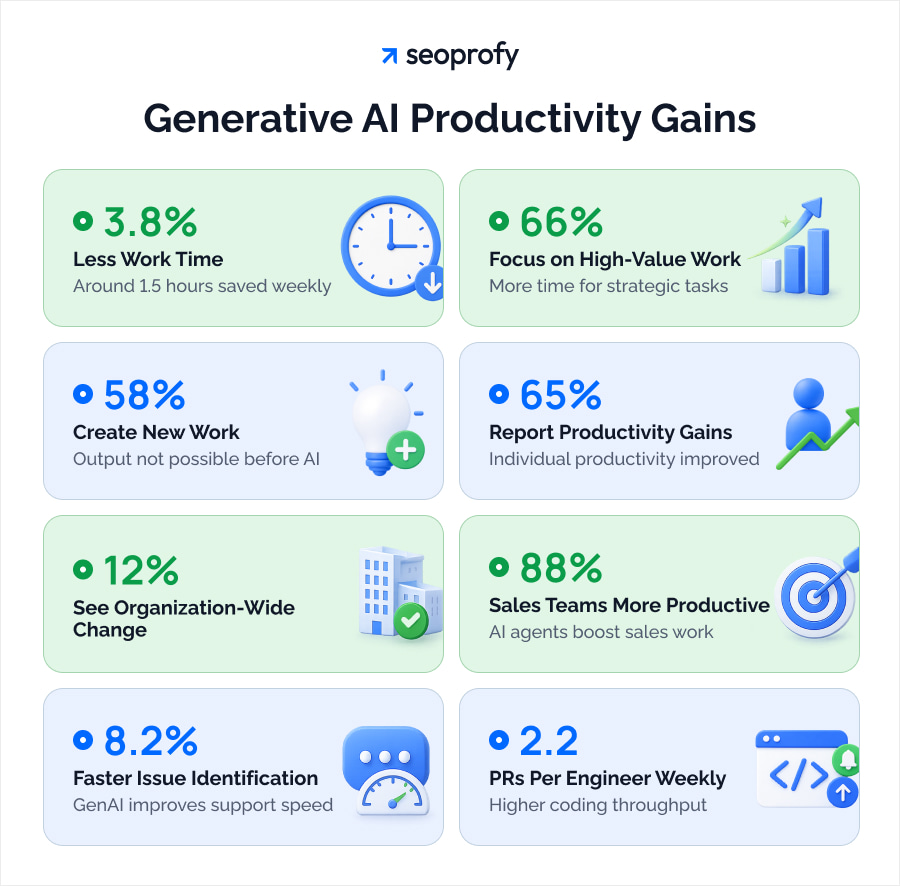
- GenAI users reduced working time by 3.8% in a representative worker survey. In a 40-hour week, that equals about 1.5 hours saved, but the same study found almost no link between time saved and higher output. (arXiv)
- 66% of AI users say AI lets them spend more time on high-value work, and 58% say they now produce work they could not have created a year ago. Among the most advanced AI users, that second figure rises to 80%. (Microsoft Work Trend Index)
- 65% of U.S. workers in AI-adopting organizations say AI has improved their individual productivity, but only 12% strongly agree that AI has changed how work gets done across the organization. (Gallup)
- According to fresh AI statistics, sales teams using AI agents see a clear productivity lift: 88% of sales professionals with agents say AI makes them more productive, and 85% say it frees them to focus on higher-value work. (Salesforce)
- Customer support speed improves when generative AI is embedded into real service workflows. In an Alibaba field experiment, access to a generative AI assistant reduced issue identification time by 8.2% and chat duration by 1.1%; at full usage, the estimated reductions reached 32.3% and 4.2%. (arXiv)
- AI-assisted coding is increasing engineering throughput, but quality control still matters. A benchmark covering 700+ companies, 200,000 engineers, and 20M pull requests found that high-AI-adoption companies averaged 2.2 pull requests per engineer per week, almost double the output of low-adoption companies. (Business Insider)
Generative AI ROI Statistics
The ROI picture is split. Companies with clear use cases, clean data, workflow integration, and executive ownership are seeing gains. Companies stuck in pilots are mostly reporting productivity signals, not full financial returns.
| Industry / Function | ROI Signal | Source | Caveat |
| Enterprise-wide AI | 30% of CEOs saw revenue gains from AI, 26% saw lower costs, and only 12% achieved both. At the same time, 56% saw neither revenue nor cost benefits. | PwC | Real financial ROI is still uneven |
| Enterprise AI benefits | 66% of organizations saw productivity or efficiency gains, 40% reduced costs, and 20% increased revenue. | Deloitte | Productivity comes before revenue. |
| Cross-industry AI adoption | 88% report revenue impact from AI, and 87% report cost reductions. 30% saw revenue increases above 10%, while 25% saw cost reductions above 10%. | NVIDIA | Strongest signal from active AI adopters. |
| Sales | 83% of sales teams using AI saw revenue growth, compared with 66% of teams not using AI. | Salesforce | AI use correlates with stronger sales outcomes. |
| AI investment confidence | AI spending is expected to double in 2026, from 0.8% to 1.7% of revenue, and 94% of companies plan to keep investing even without immediate returns. | BCG | Companies still expect longer-term payoff. |
So, generative AI produces faster visible gains when it augments specific tasks, but financial ROI depends on workflow redesign. Basic pilots can save time. Scaled systems are what start showing up in revenue and operating margin.
Generative AI Statistics by Industry
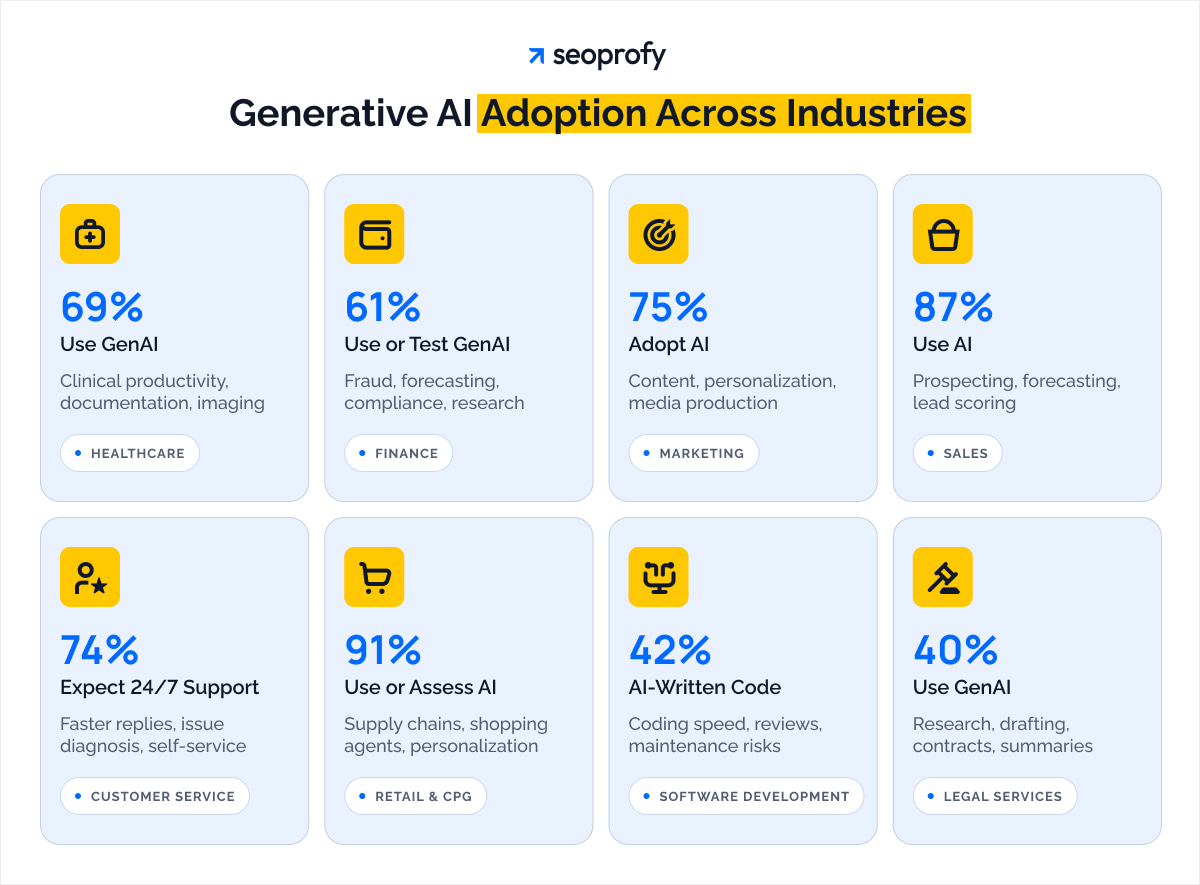
The freshest AI statistics show that adoption is strongest in sectors with heavy knowledge work, large data flows, repetitive documentation, customer-facing workflows, and expensive expert labor. Healthcare, finance, marketing, sales, customer service, retail, software development, and legal services show the clearest 2026 industry-level signals.
Generative AI in Healthcare
- 69% of healthcare and life sciences respondents use generative AI and large language models, making generative AI the top AI workload in the sector. (NVIDIA)
- AI adoption across healthcare and life sciences reached 70%. Digital health is leading at 78%, and medical technology is at 74%. (NVIDIA)
- 50% of healthcare organizations have already implemented GenAI, with clinical productivity emerging as one of the most concrete deployment areas. (McKinsey)
- Among care organizations, 54% have implemented generative AI for clinical productivity, making it the most widely adopted generative AI domain in that group. (McKinsey)
- 78% of health systems are currently involved in AI projects, while 58% plan to implement AI-driven workflow automation or productivity tools within two years. (Guidehouse)
In healthcare, the clearest use cases now sit in documentation, clinical productivity, scheduling, coding, care coordination, imaging, and drug discovery. The harder part is scale, because privacy, safety, bias, and workflow integration still decide whether GenAI becomes useful inside real care settings.
Generative AI in Finance and Banking
- 61% of financial services respondents use or assess generative AI, and 42% use or assess agentic AI. (NVIDIA)
- 89% of financial services respondents say AI increased annual revenue and reduced annual costs. (NVIDIA)
- More than three-quarters of finance organizations use AI in financial planning, reporting, and commercial analysis. (KPMG)
- 71% of finance leaders say AI is meeting or exceeding ROI expectations, while only 23% say it is exceeding expectations. (KPMG)
- Lloyds Banking Group reported a £50 million gain from generative AI in 2025 and expects a £100 million benefit in 2026. (The Guardian)
Finance is one of the cleaner generative AI stories because the use cases are measurable. Banks and finance teams are applying it to fraud detection, forecasting, document processing, risk analysis, customer service, compliance, and investment research.
Generative AI in Marketing
- 75% of marketers have adopted AI, but 84% still say they run generic campaigns. (Salesforce)
- 56% of businesses currently rely on AI in digital marketing. Another 44% are taking a slower approach and watching the technology mature. (SeoProfy SEO stats)
- 81% of marketers would trust AI to respond to customers at scale, but weak or disconnected data keeps many teams from doing it well. (Salesforce)
- 97% of marketing leaders use AI in daily creative work, and 99% plan to increase AI investment in 2026. (Canva)
- 68% of marketing leaders say AI has increased the number of marketing-influenced business decisions. (Canva)
- 80% of marketers use AI for basic content creation, and 75% use it for media production. (HubSpot)
Marketing teams are using generative AI heavily, but the value depends on context. Fast content production alone creates more noise. Better results come from personalization, customer data, campaign analysis, creative testing, media production, and AI search visibility.
Generative AI in Sales
- 87% of sales organizations use AI for work such as prospecting, forecasting, lead scoring, and email drafting. (Futurum)
- Virtual assistants are able to resolve 58% of return and cancellation requests. (SeoProfy)
- 54% of sellers have used AI agents, and nearly 9 in 10 sales teams use agents today or expect to within two years. (Salesforce)
- Sales teams that deeply use AI generate 77% more revenue per representative than teams that do not use it. (Gong)
- Real-time AI support can reduce product-information lookup during live sales calls from 25–65 seconds to 2.8 seconds in benchmark testing. (arXiv)
In sales, generative AI helps with account research, outreach, quote creation, CRM updates, product answers, call prep, and follow-up. Strong teams are using it to remove low-value admin work but not to replace the relationship side of selling.
Generative AI in Customer Service
- 74% of consumers now expect customer service to be available 24/7 because of AI. (Zendesk)
- 88% of customers expect faster response times than they did a year ago, while 76% would choose a company that supports text, images, and video in the same service thread. (Zendesk)
- In an Alibaba field experiment, Generative AI support reduced issue identification time by 8.2% and chat duration by 1.1%. (arXiv)
- Full Generative AI usage in the same experiment reduced issue identification time by 32.3% and chat duration by 4.2%. (arXiv)
- A 2026 Nubank customer-support AI framework delivered a 37-point improvement in AI transactional NPS and a 29-point gain in self-service rate in one card-delivery deployment. (arXiv)
In our generative AI statistics, customer support has some of the clearest GenAI metrics because speed, resolution, deflection, satisfaction, and escalation can all be tracked. The risk is over-automation: AI performs better when it helps agents diagnose problems faster and gives customers clearer answers, not when it blocks access to human help.
Generative AI in Retail and CPG
- 91% of retail and CPG respondents are actively using or assessing AI. (NVIDIA)
- 89% of retail and CPG respondents say AI is increasing annual revenue, and 95% say it is reducing annual costs. (NVIDIA)
- 75% of retail and CPG leaders call AI a top strategic priority, but only 16.5% can quantify ROI. (Deloitte)
- 30% of retailers use AI for supply chain visibility, and that share is expected to reach 41% within the next year. (Deloitte)
- 55% of consumers now start shopping journeys through large language models, pushing CPG brands to make product data more readable for AI agents. (Deloitte)
Analyzing market data, it is easy to notice that retail is splitting into two generative AI tracks. One track improves internal operations through forecasting, inventory, supply chain visibility, and warehouse workflows. The other changes customer discovery through shopping assistants, product data, personalization, and AI-driven search.
Generative AI in Software Development and Tech
- AI accounts for 42% of committed code today, and developers expect that share to reach 65% by 2027. (Sonar)
- 72% of developers who have tried AI coding tools use them every day. (Sonar)
- 96% of developers do not fully trust AI-generated code, and only 48% always verify AI-assisted code before committing it. (Sonar)
- A 2026 study of 201 open-source projects found that agent-authored code had a 15.8-point lower modification rate and 16% lower hazard of modification than human-authored code. (arXiv)
- Code quality depends on prompt design, task specificity, developer expertise, and human-AI interaction, not only the model itself. (arXiv)
Software teams got speed from generative AI, but review work has become the bottleneck. The better question in 2026 is no longer “Can AI write code?” The question is whether teams can verify, secure, and maintain AI-assisted code without creating hidden technical debt.
Generative AI in Legal and Professional Services
- 40% of professional services organizations now use generative AI, and only 19% have no adoption plans. (Thomson Reuters)
- 69% of legal professionals use general-purpose AI tools for work, while 61% say AI saves time each week. (8am)
- More than 80% of current professional-services GenAI users engage with it weekly, and more than 90% expect it to become central to their workflow within five years. (Thomson Reuters)
- Legal AI still needs careful validation: a 2026 benchmark found wide accuracy gaps across legal RAG systems, from 58% to 83% before further ground-truth review. (arXiv)
Legal teams are adopting generative AI, but, as you can see in AI statistics, trust matters more here than in most industries. The strongest use cases are legal research, drafting, summarization, contract review, internal knowledge search, and matter management. For high-risk work, the best setup is human review plus legal-specific tools.
Generative AI Challenges, Risks, and the Trust Gap
Generative AI is already part of daily work, but trust, governance, and security controls are developing at a much slower pace. In 2026, the biggest risk is messy deployment: employees use tools quickly, while companies work to protect data, verify outputs, and meet compliance requirements. So, AI implementation now depends on clear policies and secure data flows.
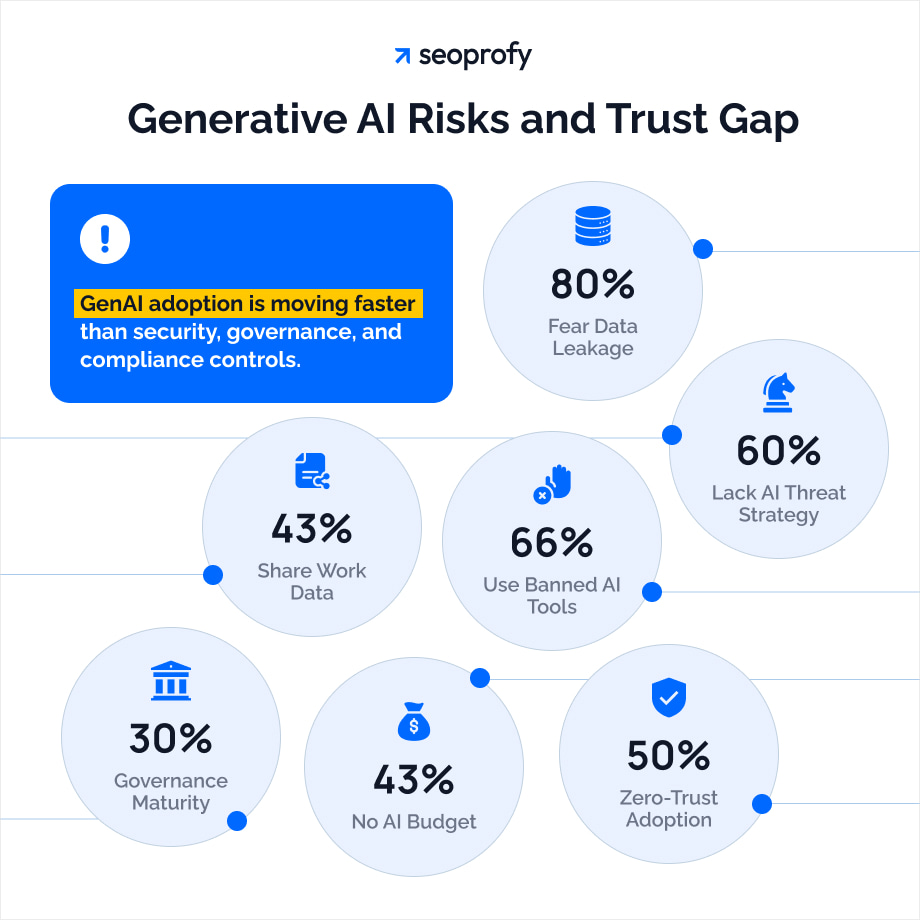
- Sensitive data leakage is a major generative AI security risk: 80% of organizations worry about data leaking through GenAI tools, while 60% still have no specific strategy for AI-driven threats. (MimeCast)
- Shadow AI is already a real workplace behavior. 66% of office professionals have used Gen AI tools for work even when they believed those tools were banned, and 43% entered work-related emails or data into public AI systems. (PagerDuty)
- Only about 30% of organizations have reached level-three maturity or higher in AI strategy, governance, and agentic AI controls. (McKinsey)
- 43% of businesses still have no dedicated AI budget. (SeoProfy)
- By 2028, 50% of organizations are expected to adopt zero-trust data governance because AI-generated content is becoming harder to separate from human-created data. (Gartner)
Generative AI Trends for 2026 and Beyond
Generative AI is entering a more practical phase. The focus is shifting from chat windows to tools that can plan, search, write, analyze, create media, and trigger actions across real workflows. Agentic AI is the biggest change here, while multimodal systems make text, image, audio, video, and data work feel less fragmented.
Gartner’s Hype Cycle places AI agents and AI-ready data near peak market attention, which fits the current moment well: companies are excited, but the real value comes from workflow design, clean data, and human review. According to our generative AI statistics, new roles will grow around AI operations, agent management, governance, and content quality.
For brands, the challenge is visibility inside AI-generated answers. SeoProfy’s AI SEO services help companies adapt content, data, and search strategy for this new discovery layer.

As a Content writer at SeoProfy, Hanna Zhytnik creates SEO content grounded in research, data, and ongoing hypothesis testing. With more than 5 years of experience across B2B, SaaS, and ecommerce, she brings both breadth of knowledge and a sharp focus on modern search. Her strength lies in turning complex experiments into clear explanations, bridging the gap between deep SEO practice and accessible content.