


Claude AI statistics show strong momentum in 2026, with Anthropic reaching a $380 billion valuation after raising $30 billion alongside an estimated $14 billion annualized revenue run rate. Anthropic also reports over 300,000 business customers, highlighting growing enterprise adoption.


For many teams, Claude has become the preferred option when fast answers aren’t enough. It’s widely used for research, documentation, and complex content workflows where clarity, consistency, and depth directly impact the outcome.
Developed by Anthropic, the platform stands out for its ability to handle longer inputs and produce controlled, predictable responses. This makes it especially valuable in environments where vague or inconsistent output creates real risk.
It also competes directly with platforms like OpenAI and Google, which still dominate in overall reach. Claude’s growth, however, comes from a different strength — earning trust in more demanding, high-stakes use cases.
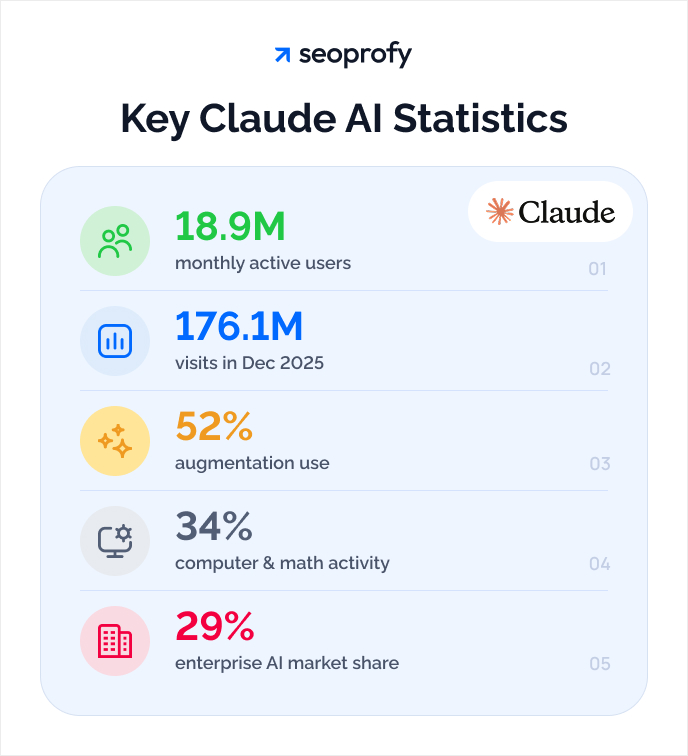
- 18.9 million monthly active users worldwide;
- 176.12 million monthly visits as of December 2025;
- 52% of usage is augmentation-based;
- 34% of activity comes from computer and math tasks;
- 29% share of the enterprise AI assistant market.
Our Methodology
This report combines first-party data, third-party analytics, and industry research to provide a balanced and realistic view of Claude’s usage, growth, and market position in 2026.
Data Sources
We relied on a mix of the following:
- Anthropic reports and disclosures: Including the Anthropic Economic Index (2025–2026) and official company updates for usage patterns, task distribution, and automation vs. augmentation trends.
- Third-party analytics platforms: Tools like Similarweb, Semrush, DemandSage, and AICPB were used to estimate:
- monthly active users (MAU);
- website traffic and visits;
- geographic distribution;
- demographic insights.
- Industry research and benchmarks: External studies and reports were used to validate:
- productivity improvements (e.g., AI coding efficiency);
- enterprise adoption trends;
- developer usage patterns.
- Press reports and market estimates: Financial data such as valuation, funding rounds, and revenue run-rate estimates were cross-referenced with reputable media coverage and analyst projections.
How We Interpret the Data
To avoid misleading conclusions, we applied several principles:
- Separation of metrics: We clearly distinguish between:
- Monthly Active Users (MAU) → unique users
- Visits → total sessions (can include repeat usage)
- Range-based reporting: Where exact figures vary by source, we use ranges or “estimated” labels instead of presenting uncertain numbers as fixed.
- Trend over snapshots: We focus on patterns over time (growth, stabilization, shifts in usage), rather than isolated data points.
- Context-first analysis: Numbers are always paired with explanation — what they mean for real usage, adoption, and business impact.
Attention! Some data points — particularly around:
- enterprise revenue
- exact user counts
- internal usage breakdowns
are not fully disclosed by Anthropic. In these cases, we rely on best-available estimates from multiple sources and clearly present them as such.
How Many People Use Claude AI in 2026?
Recent estimates suggest that Claude has around 18.9 million monthly active users worldwide. This aligns with broader trends, where nearly 40% of U.S. users engage with AI chatbots monthly, reinforcing how quickly adoption is scaling across platforms.
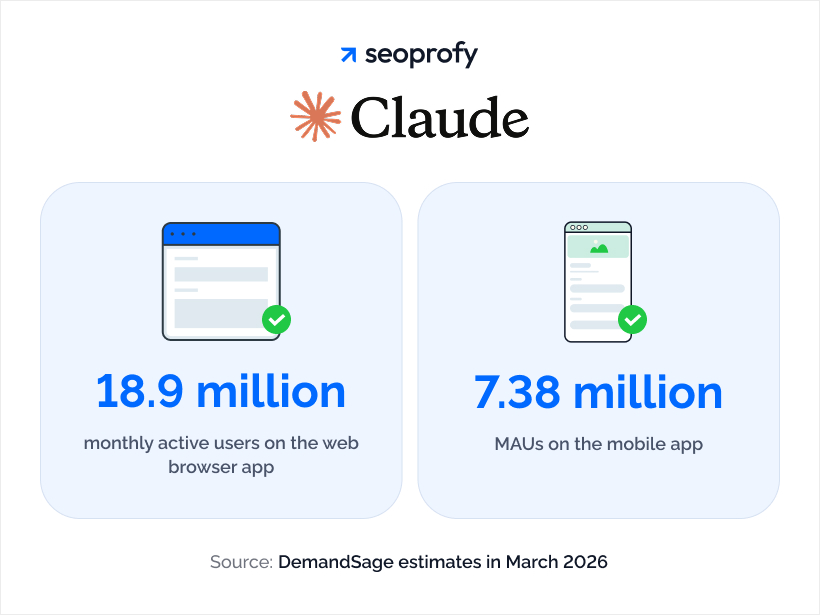
Monthly active users (MAU) refer to people who actively use Claude via the website or mobile app within a given month.
According to AICPB data, approximately 7.38 million of these users come from the mobile app. This implies that more than 11 million users access Claude through the web version.
AICPB also tracks website traffic across AI platforms, offering a broader view of demand. As of December 2025, Claude recorded around 176.12 million visits.
It’s important to distinguish between these metrics: MAU reflects unique users who use Claude AI, while visits represent total sessions, meaning one person can generate multiple visits.
So how does Claude compare to other AI platforms? Below is a side-by-side look at some of the most widely used tools.
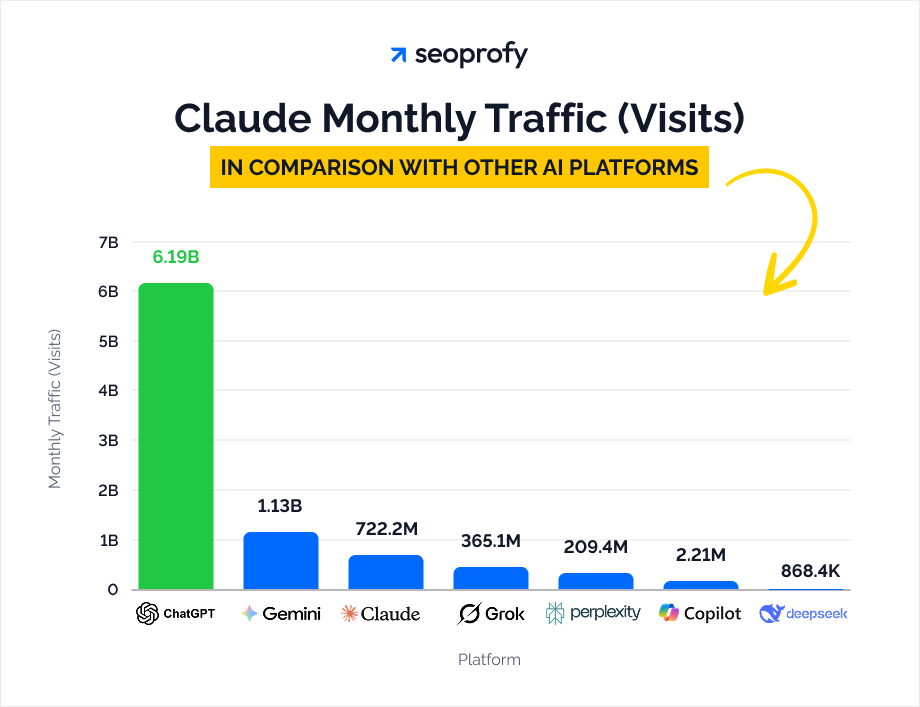
| Platform | Monthly Traffic (Visits) |
| ChatGPT | ~6.19B |
| Gemini | ~1.13B |
| Claude | ~722.2M |
| Grok | ~365.1M |
| Perplexity | ~209.4M |
| Copilot | ~2.21M |
| DeepSeek | ~868.4K |
This table highlights just how top-heavy the AI market has become.
There’s a massive gap between the first two players — OpenAI and Google — and the rest of the field. Everything below them operates in a fundamentally different competitive reality.
Claude sits in a relatively strong position within that second group. It’s not leading, but it’s clearly part of the core set of AI tools that have achieved consistent, large-scale usage — alongside xAI and Perplexity AI.
While it competes with major platforms like OpenAI and Google, which still lead in overall reach, Claude’s growth comes from a different angle — trust and reliability in more demanding use cases. This aligns closely with emerging strategies like Generative Engine Optimization (GEO) and Answer Engine Optimization or AEO, where structured, high-quality content is more likely to be surfaced and cited by AI systems.
Start optimizing your content for AI-driven results.
The Latest Claude Usage Statistics
This section looks at how people actually use Claude in day-to-day tasks, based on data from a January 2026 report by Anthropic.
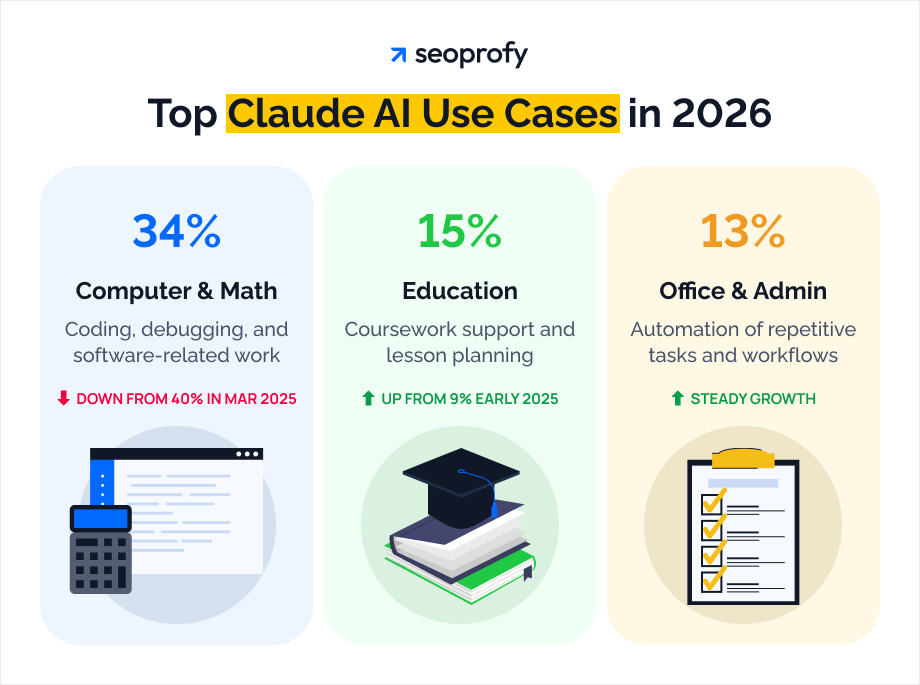
The largest share of activity — 34% — comes from computer and mathematical tasks. That still makes it the dominant use case, even though it’s down from 40% in March 2025. In practice, this mostly means coding, debugging, and working with software.
Education is one of the fastest-growing areas. 15% of Claude’s tasks now fall into educational instruction and library, up from 9% earlier in 2025. More users are turning to it for coursework support, explanations, and lesson planning.
Office and admin tasks account for 13% of usage. Most of these are tied to automation — things like organizing information, handling repetitive tasks, or simplifying workflows.
What’s more fascinating is how people use Claude, not just what they use it for. About 52% of interactions are classified as augmentation, compared to 45% as automation. In simple terms, most users don’t just ask and accept the answer—they iterate, refine, and work alongside the tool.
This shift is critical for workflows like content production and optimization. For example, during an AI SEO audit, teams increasingly use Claude to analyze, structure, and improve content rather than simply generate it.
The report also points to strong productivity gains. Claude completes high school-level tasks about 9 times faster than the average human, and college-level tasks around 12 times faster. The more complex the task, the more noticeable the time savings.
Claude AI Usage Statistics by Key Metrics
Understanding user statistics of Claude AI helps move beyond surface-level adoption and shows how the platform actually scales over time — from early growth spikes to more stable, sustained usage patterns. These metrics highlight both demand and engagement, making it easier to evaluate Claude’s real position in the AI market.
Claude’s Monthly Active Users
Anthropic reported rapid early adoption for Claude, growing from around 4 million monthly active users in December 2023 to approximately 18.8 million by November 2024. Since then, MAU levels have largely plateaued, indicating a period of stabilization after initial growth.
Claude’s Website Traffic and Visits
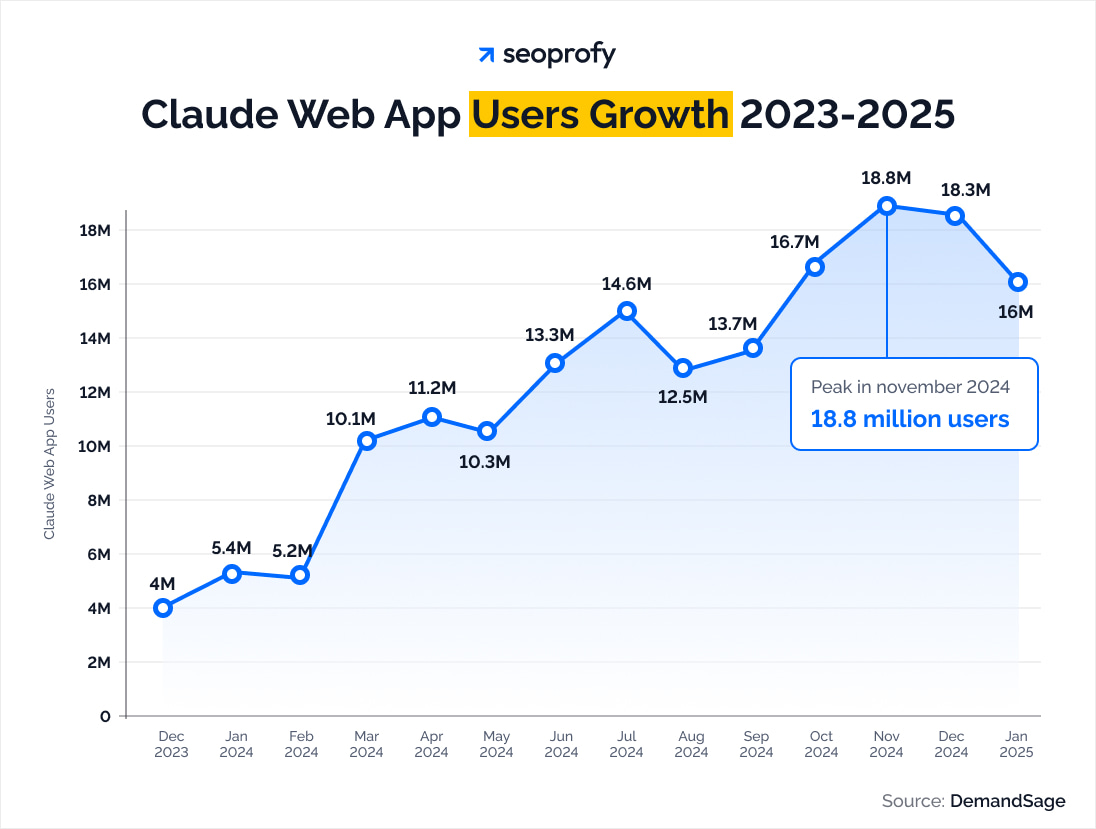
The table below shows how Claude’s web app audience has grown and fluctuated over time:
| Month | Claude Web App Users |
| December 2023 | 4 million |
| January 2024 | 5.4 million |
| February 2024 | 5.2 million |
| March 2024 | 10.1 million |
| April 2024 | 11.2 million |
| May 2024 | 10.3 million |
| June 2024 | 13.3 million |
| July 2024 | 14.6 million |
| August 2024 | 12.5 million |
| September 2024 | 13.7 million |
| October 2024 | 16.7 million |
| November 2024 | 18.8 million |
| December 2024 | 18.3 million |
| January 2025 | 16 million |
Source: DemandSage
Overall, the data shows steady growth throughout 2024, with some mid-year fluctuations, followed by a peak in late 2024 and a slight decline heading into early 2025.
Claude Mobile App Users and Downloads
Claude’s mobile adoption is also reflected in steady download volumes across both the App Store and Google Play.
In January 2025 alone, the app recorded 769.6 thousand downloads globally. Claude app downloads provide another signal of growing adoption, especially on mobile devices where users increasingly access AI tools on the go.
Monthly Download Trend
| Date | Claude App Monthly Downloads |
| August 2024 | 679.8 thousand |
| September 2024 | 582 thousand |
| October 2024 | 705.6 thousand |
| November 2024 | 800.6 thousand |
| December 2024 | 643.3 thousand |
| January 2025 | 769.6 thousand |
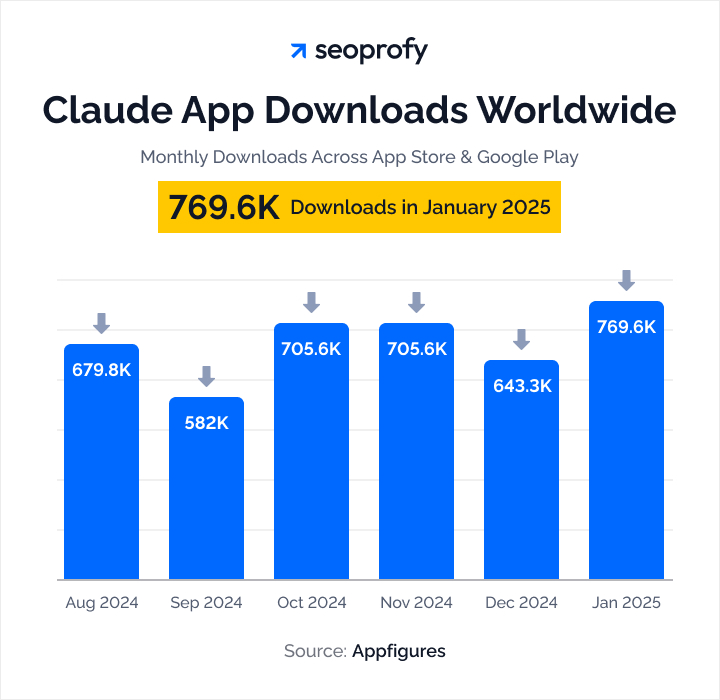
Overall, the data shows consistent demand with periodic spikes, particularly in November 2024 and January 2025, indicating growing user interest following both platform launches.
Claude’s Market Share and Competitive Position
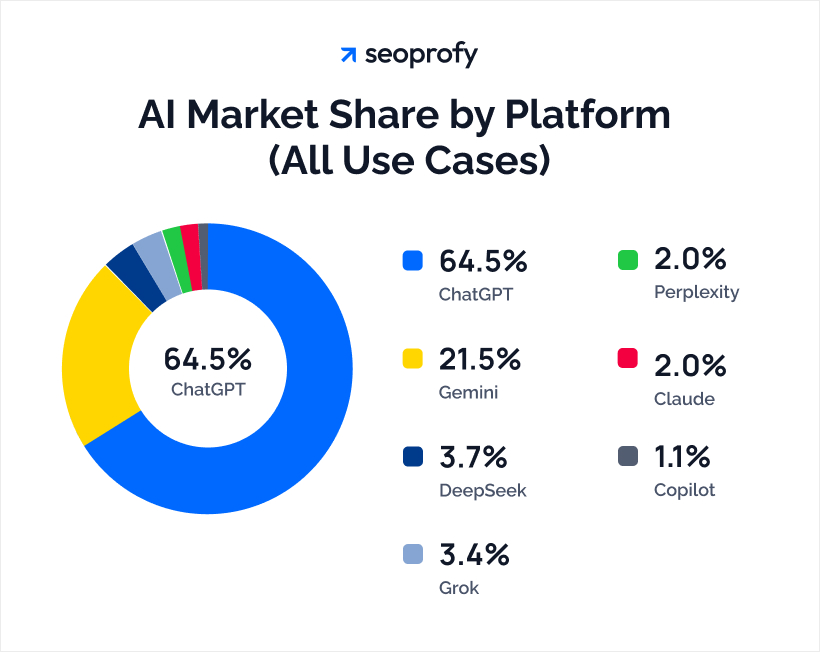
Anthropic’s Claude remains a relatively small but stable player in the broader AI market, holding a 2.0% share as of January 2026.
AI Market Share by Platform (All Use Cases)
| AI Platform | Market Share |
| ChatGPT | 64.5% |
| Gemini | 21.5% |
| DeepSeek | 3.7% |
| Grok | 3.4% |
| Perplexity | 2.0% |
| Claude | 2.0% |
| Copilot | 1.1% |
Despite strong competition, Claude remains within the global top six AI platforms. Notably, its share has stayed largely unchanged throughout 2025, making it one of the few tools to maintain a stable position without significant growth or decline.
Claude’s Share in the AI Chatbot Market
When narrowing the focus to AI chatbots used for customer support and business applications, Claude’s share is smaller — but its growth tells a different story.
| AI Bot Platform | Market Share | Growth Trend (YoY) |
| ChatGPT | 79.76% | 0% |
| Perplexity | 11.09% | +10% |
| Copilot | 4.85% | +8% |
| Gemini | 2.18% | +5% |
| Claude | 1.12% | +14% |
Claude accounts for just 1.12% of the AI chatbot market, but stands out with the highest year-over-year growth rate (+14%) among major platforms.
Another notable signal: Claude users demonstrate deep engagement, with the longest average session duration across AI chatbots — around 18 minutes.
Competitive Standing
Valuation & funding
Following a $30B funding round, Anthropic reached an estimated $380B valuation, placing it among the most highly valued private AI companies. This level of investment reflects strong long-term expectations from investors, especially relative to other AI-first firms.
Enterprise market share
In enterprise environments, Claude holds a more meaningful position. Some estimates suggest it captures around 29% of the enterprise AI assistant market, though figures vary depending on how the category is defined (e.g., internal copilots vs. customer-facing assistants).
Developer ecosystem positioning
Within the developer community, the Stack Overflow ecosystem and similar surveys show that OpenAI’s GPT models still dominate overall usage. However, interest in Claude — particularly models like Claude Sonnet and Claude Code — has been rising among professional developers.
This trend points to a multi-model ecosystem, where teams increasingly rely on multiple AI tools rather than a single platform.
Who Uses Claude?
Claude’s user base is not evenly distributed — it skews toward younger, technical, and male-dominated audiences, with strong adoption among professionals using AI for work-related tasks rather than casual use.
The data shows a clear pattern: Claude is primarily used by Gen Z and early-career professionals, especially in knowledge-heavy and technical roles.
Claude User Demographics
Anthropic’s audience skews heavily toward younger users, with Gen Z forming the largest share of its web app user base.
The 18–24 age group leads by a wide margin, accounting for 8.3 million users, or 51.88% of total users. This makes young adults the core audience driving Claude’s adoption.
Full Age Breakdown
- 18–24: 8.3 million (51.88%)
- 25–34: 4 million (25%)
- 35–44: 1.9 million (11.88%)
- 45–54: 1.3 million (8.13%)
- 55–64: 353 thousand (2.21%)
- 65+: 183 thousand (1.14%)
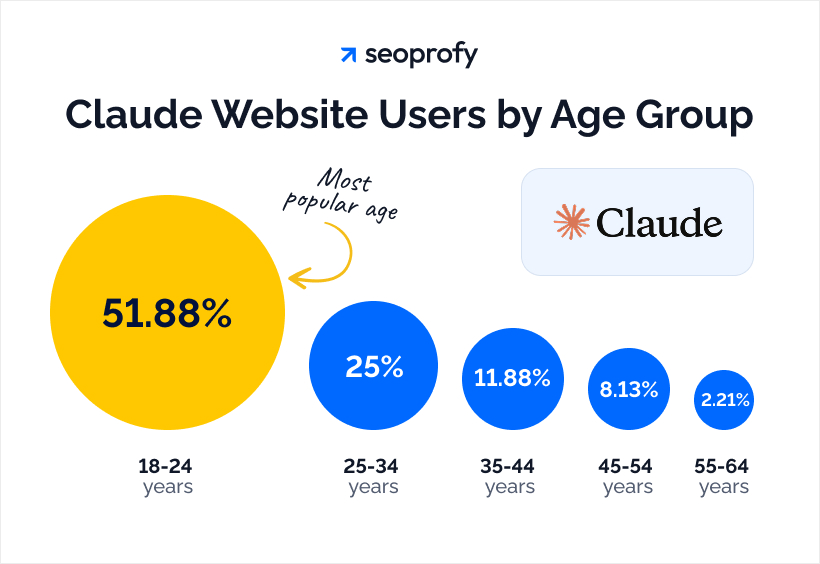
Overall, more than half of Claude’s users are under 25, with usage steadily declining across older age groups. This trend is typical for emerging AI tools, where younger audiences tend to adopt and experiment earlier.
At the same time, the 25–34 segment represents a strong secondary audience, indicating that working professionals are actively using Claude for tasks like writing, coding, and research.
Determining the gender distribution of Claude users is less straightforward, as Anthropic does not publicly release this data. Instead, estimates rely on third-party analytics. According to Similarweb, approximately 60% of Claude users are male, while 40% are female.
Claude Users by Countries and Regions
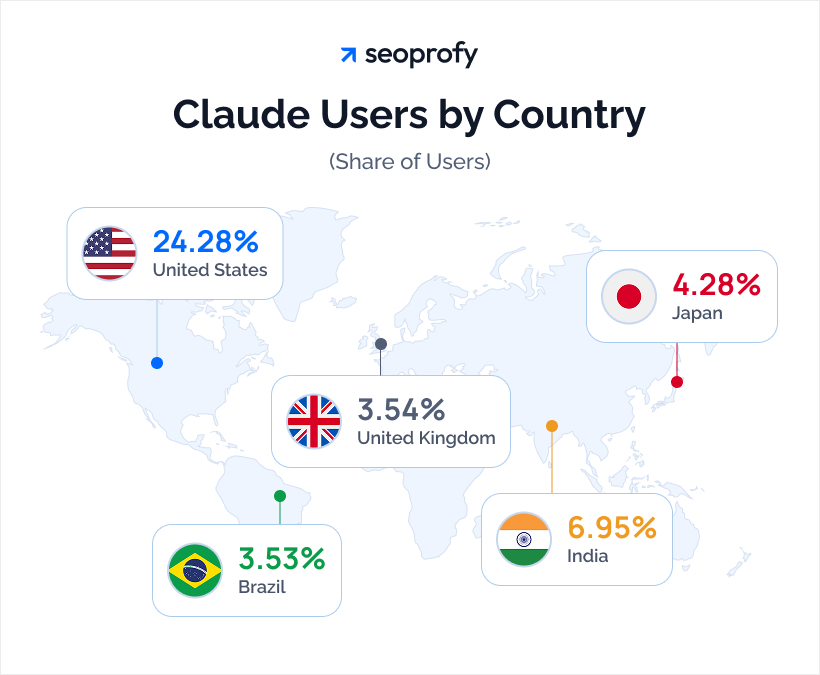
To complete the picture of who uses Claude, it’s useful to look at where its users are located. Data from Semrush shows that the United States accounts for 24.28% of Claude’s total user base, which translates to roughly 43.3 million users as of December 2025.
Claude Users by Country
| Country | Share of Users |
| United States | 24.28% |
| India | 6.95% |
| Japan | 4.28% |
| United Kingdom | 3.54% |
| Brazil | 3.53% |
This distribution highlights a strong concentration in the US, with additional demand coming from major international markets across Asia, Europe, and South America. Much of this demand comes from the working age population, where AI tools like Claude are increasingly used for daily tasks such as research, communication, and productivity workflows.
Claude’s Main Audiences: Consumers, Developers, and Enterprises
Claude serves three core audiences, each using the platform in different ways. Consumers rely on it for everyday tasks like writing, research, and productivity. Developers use Claude and Claude Code to build, test, and automate workflows. Enterprises adopt it at scale to streamline operations, support teams, and integrate AI into existing systems.
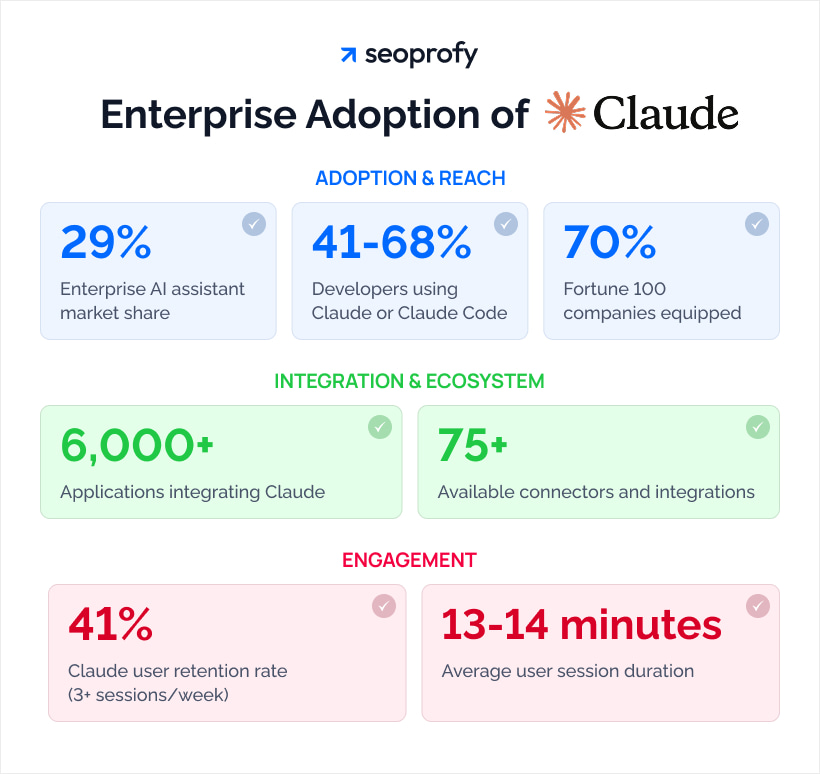
Enterprise Adoption of Claude
| Statistic | Data |
| Enterprise AI assistant market share | 29% |
| Developers using Claude or Claude Code | 41–68% |
| Fortune 100 companies equipped | 70% |
| Applications integrating Claude | 6,000+ |
| Available connectors and integrations | 75+ |
| Claude user retention rate (3+ sessions/week) | 41% |
| Average user session duration | 13–14 minutes |
What These Figures Reveal
✓ Claude adoption is accelerating across large enterprises, with around 70% of Fortune 100 companies already onboard.
✓ A strong ecosystem of integrations — over 6,000 applications and 75+ connectors — makes enterprise-wide implementation faster and more scalable.
✓ Large-scale training initiatives, including 350,000 employees at Cognizant and 30,000 at Accenture, highlight how companies are actively embedding AI into daily workflows.
✓ A 41% retention rate signals that Claude delivers consistent value, becoming a recurring tool in business operations rather than a one-time experiment.
Claude continues to gain traction in enterprise environments, driven by both scalability and real-world use cases. It already captures a significant share of the enterprise AI assistant market, while adoption among developers ranges widely depending on workflows and tooling.
Large organizations are leading this shift. A strong share of Fortune 100 companies have implemented Claude, and thousands of applications now integrate with its ecosystem. With dozens of connectors available, it fits more easily into existing tech stacks.
Developers Are a Key Growth Engine
Developers heavily tie Claude’s momentum to Claude Code.
- Developer-focused tools are driving billions in value, with Claude Code reaching $2.5B+ run-rate revenue.
- Usage data shows increasing task complexity and autonomy, meaning developers are delegating more advanced workflows over time.
What this adds:
→ Growth isn’t just top-down (enterprise) — it’s bottom-up via dev adoption.
Claude Usage Patterns in 2026
In 2026, Claude is used as part of real work, not just quick interactions. Users rely on it across multiple steps — drafting, refining, analyzing, and iterating within the same task.
Sessions are more frequent and more purposeful. Instead of isolated prompts, usage often looks like a continuous workflow where each response builds on the previous one.
At the same time, tasks have become more complex. Claude is used not only to answer questions, but to support entire processes, from research to execution.
Usage Patterns by Task Type
Claude usage stat in 2026 is shaped less by industry and more by what people actually need to get done. Across roles, the same pattern shows up: users rely on Claude to handle structured thinking, speed up execution, and reduce repetitive work.
Most Common Task Types
According to Anthropic, the most frequent use cases reveal where Claude delivers the most immediate value:
- Academic and learning support (5.1%): The top use case. Users rely on Claude to explain concepts, structure assignments, and support multi-discipline learning.
- Technical troubleshooting (3.6%): Debugging software, fixing system issues, and configuring tools remain core workflows, especially for technical users.
- Workplace communication (3.6%): Drafting emails, refining tone, and improving clarity in business communication is a consistent daily use case.
- Software development tasks (3.0%): Writing, reviewing, and managing code across projects and industries.
- Document handling (3.0%): Creating, editing, converting, and formatting documents across formats.
- Health and medical information (2.7%): Users turn to Claude for accessible explanations and general medical insights.
- Business strategy and planning (2.7%): Structuring reports, outlining strategies, and supporting decision-making processes.
- Product research and comparison (2.6%): Evaluating options, summarizing features, and supporting purchase decisions.
- Marketing and SEO content creation (2.4%): Generating campaigns, content drafts, and optimization ideas.
What This Pattern Actually Shows
Instead of being tied to one niche, Claude is used across three core layers of work:
- Execution-heavy tasks (automation): Tasks like document formatting, troubleshooting, and data handling are partially automated. Claude reduces time spent on repetitive or structured work.
- Thinking and structuring (augmentation): For strategy, writing, and learning, Claude acts as a collaborator. It helps users organize ideas, refine outputs, and improve quality — not replace decision-making.
- Knowledge access (acceleration): From academic help to medical and product research, Claude speeds up access to information and makes it easier to understand.
For businesses investing in AI SEO services, tools like Claude are increasingly used to scale content production, research search intent, and improve output consistency.
Usage by Job Category
When grouped by profession, the distribution reinforces the same trend:
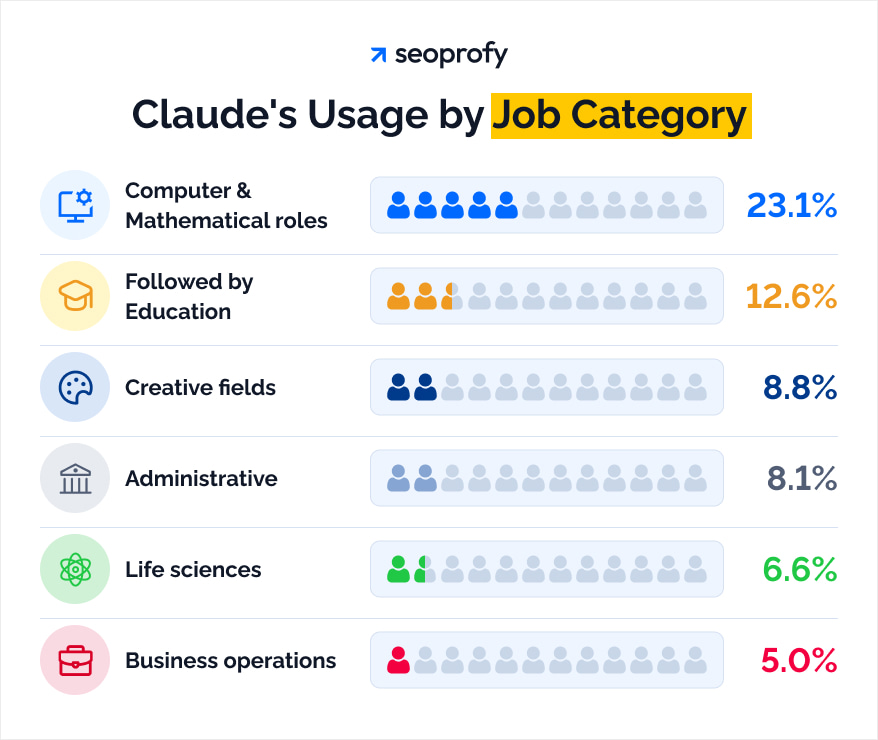
- Computer & Mathematical roles (23.1%) dominate usage;
- Followed by Education (12.6%) and Creative fields (8.8%);
- Then Administrative (8.1%), Life sciences (6.6%), and Business operations (5.0%).
This mix shows that Claude is not just a developer tool — it’s widely used in knowledge-heavy and communication-driven roles.
Claude is not primarily used to fully automate jobs. Instead, it fits into workflows as a productivity layer:
- It automates parts of tasks, not entire roles;
- It augments thinking, especially in writing and strategy;
- It accelerates research and problem-solving.
The result is consistent: Claude becomes part of daily work, not a one-off tool — especially in roles that depend on information, communication, and structured output.
Enterprise vs Consumer Claude Usage
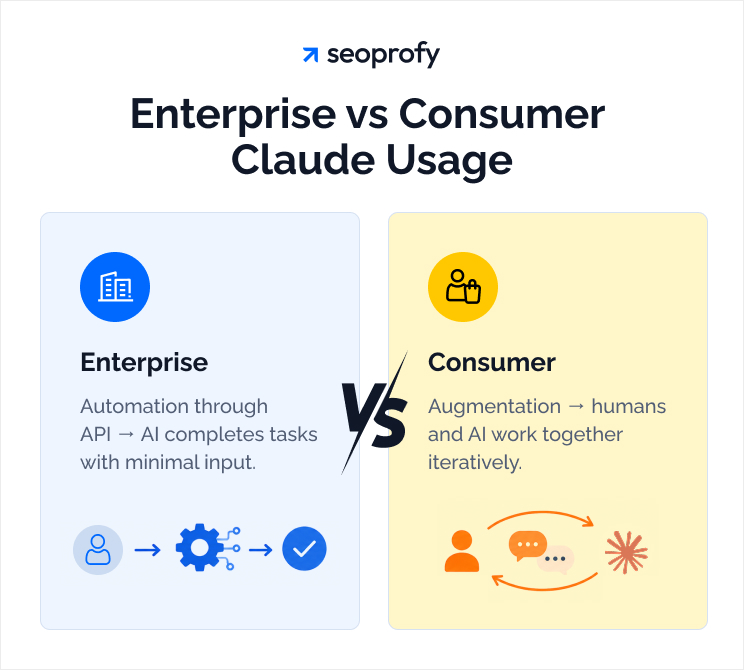
Usage of Claude splits into two clearly different patterns depending on how it’s deployed — and the gap is backed by real data from Anthropic’s Economic Index.
API Usage: Automation at Scale
In business environments, Claude is primarily used through the API — and here, automation dominates.
- Around 77% of API use cases are automation-driven;
- These involve structured, repeatable workflows like:
- content generation pipelines;
- customer support automation;
- data processing and classification;
- internal tools and systems.
In this context, Claude acts less like a “chatbot” and more like infrastructure — embedded into systems to execute tasks with minimal human involvement.
Anthropic’s research explicitly notes that API customers use Claude for more specialized, programmatic automation tasks, reflecting deeper operational integration.
Claude.ai Usage: Augmentation and Collaboration
On the consumer-facing side (Claude.ai), usage shifts toward augmentation — not replacement.
- Around 51.7% of conversations are augmentation-based;
- Augmentation means:
- iterating on ideas;
- refining writing;
- learning and explaining concepts;
- collaborating through back-and-forth prompts.
Anthropic defines this clearly:
- Automation → AI completes tasks with minimal input;
- Augmentation → humans and AI work together iteratively.
What’s important is the trend: after a period of rising automation, Claude.ai usage has shifted back toward collaboration, showing that users increasingly rely on AI as a thinking partner, not just a task executor.
Claude Productivity and Enterprise Adoption
The productivity gains from Claude are not theoretical — they are already measurable in real workflows.
Anthropic reports that users complete tasks significantly faster with Claude, with median task time dropping from hours to minutes in assisted workflows. In some internal benchmarks, this translates into multi-fold speed improvements, not marginal gains.
External research supports this trend. Studies on AI coding tools consistently show 26% to 55% productivity improvements, particularly in structured development tasks. Notably, more experienced developers often see the largest gains, as they use AI to accelerate execution rather than replace decision-making.
Conclusion
Claude AI’s trajectory through 2025 to early 2026 reflects a clear enterprise-led growth model. Company disclosures and press reporting point to strong annualized revenue run rates, alongside a rapidly expanding base of business customers. At the same time, third-party platforms show spikes in hundreds of millions of visits around major product releases, indicating growing market attention and usage.
Developer adoption is widespread across the industry, highlighting a large and still expanding spending opportunity. Anthropic continues to target this demand through enterprise integrations, coding-focused tools like Claude Code, and a growing ecosystem of plugins and connectors.
The company’s recent multi-billion funding round and high valuation signal strong investor confidence. Current estimates place Anthropic’s revenue firmly in the multi-billion-dollar range, driven largely by enterprise API usage and developer-focused products.
For businesses, this shift goes beyond adoption — it changes how visibility works. As AI platforms increasingly control discovery, the focus moves from rankings to inclusion. That’s where strategies designed to get LLM citation become critical, helping brands appear directly in AI-generated answers rather than competing only in traditional search results.

Julia Lubianytska is a Copywriting Team Lead at SeoProfy with over 7 years of experience in copywriting and editing. She works closely with copywriting teams, helping writers craft clear and thoughtful content for SaaS products, IT services, and businesses in the legal and medical fields. Julia enjoys turning complex topics into easy-to-understand, trustworthy content, focusing on structure, clarity, and consistency to ensure the content is genuinely helpful for real people, not just search engines.