

According to extensive observations in 2026, the choice between Perplexity vs. ChatGPT still divides marketing teams and SEOs in half. We keep hearing the same question from clients: “Should we double down on one or keep both?” The honest answer depends on your daily workflow.


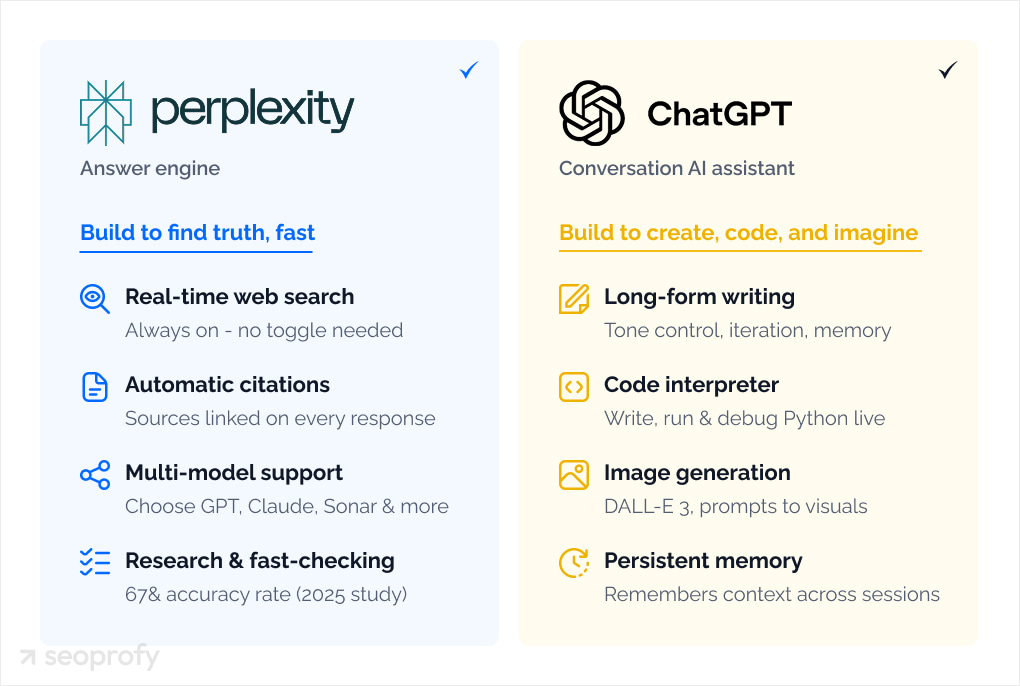
- Perplexity AI serves 22 million+ active users and processes 780 million monthly queries throughout 2025.
- ChatGPT reached 800 million weekly active users and holds 80+ % of the AI chatbots market share.
- Perplexity AI scored 67% matched accuracy in the 2025 Frontiers in Digital Health study, while ChatGPT and similar AI models landed lower on the same benchmark.
Perplexity Pro runs $17 per month. ChatGPT Plus sits at $20 per month. According to the data from AI SEO statistics, most marketers end up using both tools together rather than picking a single winner. Some teams wonder whether Perplexity AI and ChatGPT can truly complement each other or if one should be chosen exclusively.
Perplexity vs. ChatGPT: Quick Comparison Snapshot
We built this table after running the same prompt through both tools side-by-side last month.
| Feature | Perplexity AI | ChatGPT |
| Best for | Research and information gathering | Creative writing and brainstorming |
| AI Model(s) | Multiple AI models (Sonar, GPT-5.2, Claude (Sonnet; Opus 4.6), Gemini 3.1 Pro, Nemotron 3) | GPT-5.3 Instant, GPT-5.4 Thinking, GPT-5.4 Pro, GPT-5.4 mini, GPT-5 / GPT-5.5 Instant |
| Real-time web access | Yes, always on | Available in paid tiers |
| Citations | Automatic with live links | Manual or none |
| Memory | Per Space or conversation | Strong long-term memory |
| Free version | Generous with limits | Generous with limits |
| Paid Plan Price | Pro $17/mo | Plus $20/mo |
| Coding | Documentation lookup only | Full coding assistance and debugging |
| Image Generation | Basic via models | DALL-E 3 and Sora integration |
| Best Use Case | Sourced summaries and market research | Long-form content and custom agents |
Perplexity vs ChatGPT comes down to speed versus depth. ChatGPT vs. Perplexity flips the script when creativity matters more than citations. This AI tool comparison shows neither tool wins every round. Most marketers I talk to keep both open in separate tabs.
- Perplexity shines when you need sources you can trust in seconds.
- ChatGPT wins when you want to iterate on tone or structure without starting from scratch.
- Unlike Perplexity AI, ChatGPT excels at creative drafting and long-form content where originality and tone control matter most.
- Both handle Perplexity AI and ChatGPT strengths differently in real client projects.
What Is Perplexity AI and How Does It Work?
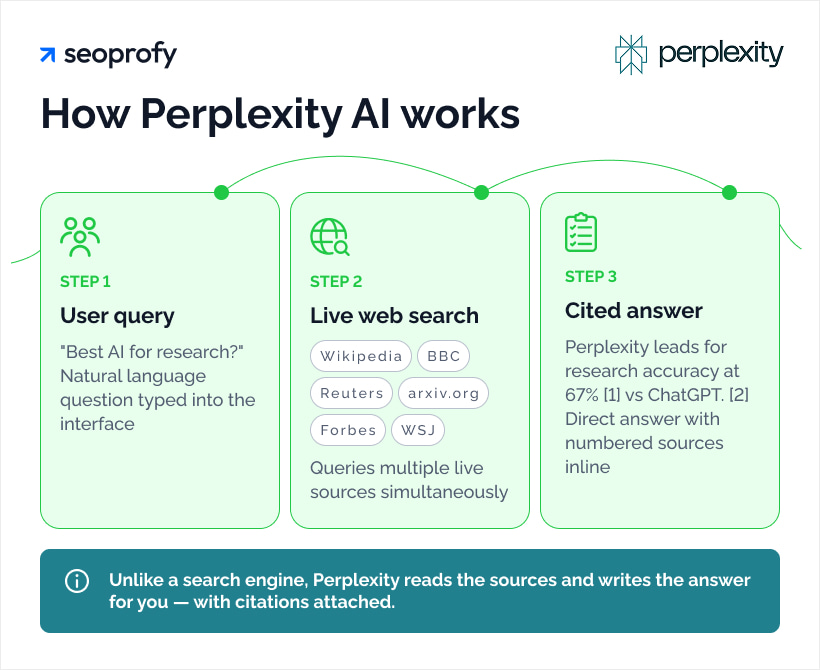
Perplexity AI launched in 2022 as an AI-powered answer engine rather than a traditional search engine. It pulls real-time web search results and synthesizes them into clear, cited paragraphs instead of dumping ten blue links. Think of it as Google plus a smart AI assistant that reads the top results for you.
From what we’ve seen in practice, Perplexity AI feels like the research engine many SEO teams wished existed five years ago. You type a question and get a concise answer with footnotes that link straight back to the source — no more hunting through forums or outdated articles.
Core features include the following:
- Real-time web search that refreshes results with every query.
- Automatic citations on nearly every claim.
- Support for multiple large language models inside one interface.
- Spaces for team collaboration and saved research threads.
- File upload and analysis for PDFs and spreadsheets.
Perplexity AI reported 22 million+ active users and 780 million monthly queries by the end of 2025. That growth did not surprise me. When we tested Perplexity AI against traditional search for a client’s keyword research project, it cut our time in half.
The AI-powered search engine model works because Perplexity AI focuses on one job: to give accurate answers fast. Perplexity vs ChatGPT conversations often start here; people discover Perplexity AI when they get tired of hallucinated facts.
What Are the Key Features of Perplexity AI?
Perplexity AI keeps adding power without cluttering the interface. The Pro Search button lets you dig deeper into any topic and automatically pulls in extra context. Focus modes narrow the scope of the web for general research, academic research papers, or YouTube video transcripts.
We compared Perplexity AI focus modes on the same prompt last week. The academic mode returned cleaner, more relevant citations than the default web mode. That small difference saves hours when you prepare white papers or client reports.
Key capabilities:
- Deep research with Pro Search for longer, more thorough answers.
- Multiple focus modes, including web, academic, and YouTube.
- Custom Spaces that act like private wikis for your team.
- Choice of models (GPT-4o, Claude, or their own Sonar).
- Built-in file data analysis that reads your uploaded documents and answers questions about them.
Perplexity AI also surfaces citation sources at the bottom of every response so you can verify claims instantly. It works as a true research tool for SEO audits and competitive analysis. Perplexity pricing stays simple; Perplexity Pro unlocks unlimited free searches (on quick mode) and higher limits for $17 per month.
When we ran the same prompt through Perplexity AI versus manual searching, accuracy and speed both improved noticeably. The tool never pretends to know something it cannot source.
What Is ChatGPT and What Can It Do in 2026?
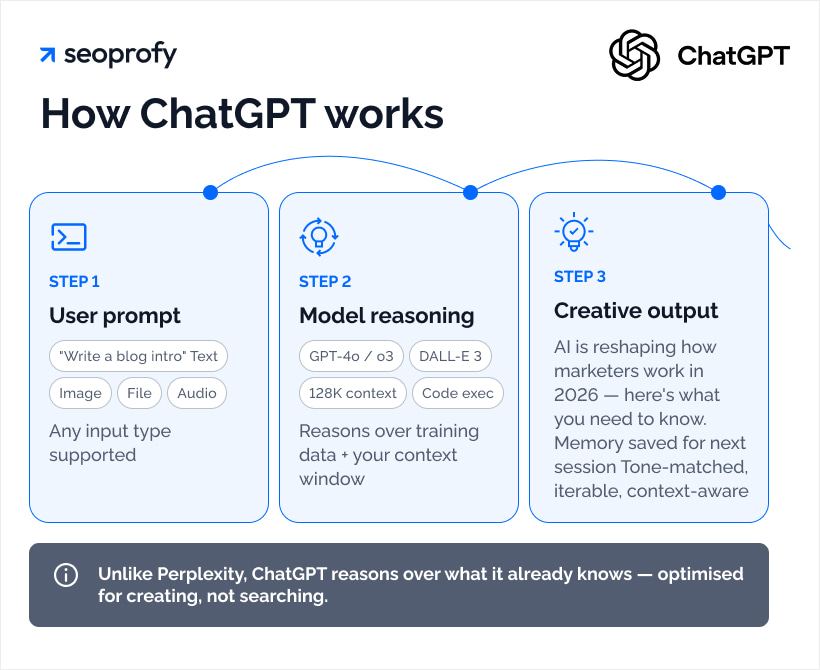
ChatGPT remains the king of conversational chatbots. OpenAI’s model powers human-like conversations that feel closer to working with a talented junior writer than punching commands into a search box.
ChatGPT now handles image, audio, and video generation capabilities. You can upload a screenshot of your website and ask it to suggest headline improvements. Or drop in a podcast clip and get a full transcript plus key insights.
Core strengths I see every week:
- Persistent conversation memory across sessions.
- Multimodal input: text, images, voice, files.
- Built-in code interpreter for running Python directly.
- DALL-E image generation and custom GPTs.
- Web browsing is available in paid plans for accessing fresh data.
Cited in AI platforms, ChatGPT processed conversations with 800 million weekly active users in 2025 and captured more that 80 % of the AI chatbot market. The numbers reflect real behavior. When we need to brainstorm 20 social media post variations for a campaign, ChatGPT delivers them faster than any other tool.
As a general-purpose AI assistant, it excels at leveraging AI for generative tasks. The underlying large language model (or LLM), combined with strong natural language processing, allows it to adapt tone, length, and style on command.
ChatGPT Models and Plans Available in 2026
ChatGPT pricing tiers are tightly connected to model access. You’re not just paying for limits — you’re paying for different levels of intelligence and reasoning.
| Model type | What it does best | Where you get it |
| GPT-5.x (latest flagship) | Best overall performance: writing, coding, analysis | Plus, Pro, Enterprise |
| Reasoning models (o3, o3-pro) | Complex, multi-step thinking, math, deep analysis | Plus (o3), Pro (o3-pro) |
| Mini models (o4-mini, GPT-5 mini) | Faster, cheaper responses for simple tasks | Free, Go, Plus |
| Multimodal models | Voice, image generation, real-time interaction | Free (limited), Plus+ |
| Specialized models | Coding, research, or domain-specific tasks | Higher tiers / Enterprise |
How This Affects Pricing Value
- Free / Go → basic models, faster but less powerful
- Plus ($20) → access to advanced + reasoning models (best value)
- Pro ($100+) → top-tier reasoning + higher limits
- Enterprise → full model access + customization
The key shift in 2026 is the rise of reasoning models (like o3). These are designed to “think longer” and handle complex workflows better than earlier GPT versions.
At the same time, newer GPT-5-level models are becoming the default for high-performance tasks, gradually replacing older models like GPT-4o, and becoming part of ChatGPT pricing.
What Are the Key Differences Between Perplexity and ChatGPT?
ChatGPT vs Perplexity is not a battle of identical tools. They solve different problems. Perplexity AI acts as a research-first search engine. ChatGPT functions as a creative writing assistant and coding partner.
The biggest practical gap appears in how each handles truth and originality. The training data differences between the tools influence how each handles real-time information versus stored knowledge. Perplexity AI cites sources by default. ChatGPT can generate plausible but unverified content unless you prompt it carefully.
Here is a detailed feature-comparison table:
| Aspect | Perplexity AI | ChatGPT |
| Primary Purpose | Answer engine with sources | Conversational creative partner |
| Real-time Search | Native and always active | Add-on in paid plans |
| Citation Quality | Automatic and clickable | Requires specific prompting |
| Memory & Context | Strong within Spaces | Excellent long-term memory |
| Creativity & Tone | Good but more factual | Excellent and highly controllable |
| Coding Ability | Looks up docs only | Executes, debugs, and explains code |
| Multimodal Input | Text + file upload | Text, image, audio, video |
| Speed on Research | Faster for sourced answers | Slower unless you add browsing |
| Hallucination Control | Lower thanks to citations | Higher without strict prompting |
| Collaboration | Spaces for teams | Shared custom GPTs |
| Best Daily Workflow | Quick research sprints | Long-form drafting and iteration |
Perplexity AI wins when accuracy matters most. ChatGPT wins when you need to produce original marketing copy or debug code. This AI tools comparison shows that the tools complement each other.
Is Perplexity More Accurate Than ChatGPT for Research?
Perplexity vs ChatGPT for research usually favors Perplexity AI. The 2025 Frontiers in Digital Health study gave Perplexity AI a 67% matched accuracy rate, noticeably higher than ChatGPT variants. Perplexity excels at delivering sourced, accurate answers quickly, making it ideal for fact-heavy SEO and research tasks.
When does Perplexity AI win?
- Competitive analysis where every claim needs a live source.
- Academic-style literature reviews.
- Newsjacking that requires up-to-the-minute data.
When does ChatGPT still make sense?
- Brainstorming angles before you research them.
- Summarizing documents you already trust.
- Quick hypothesis testing without needing footnotes.
We ran the same 20 research questions through both tools for a client’s industry report. Perplexity AI required almost no fact-checking afterward. ChatGPT needed spot-checks on nearly half the answers.
Perplexity AI functions as a stronger research tool for SEO professionals who live and die by source credibility. Perplexity vs ChatGPT for research ends with Perplexity AI as the default for fact-heavy work.
Which Is Better for Content Creation: Perplexity or ChatGPT?
Perplexity or ChatGPT for content creation depends on the stage of the project. ChatGPT dominates long-form drafting and tone control. Perplexity AI shines when you need fact-checked summaries or sourced outlines.
Use-case table:
| Task | Winner | Reason |
| Blog writing | ChatGPT | Better iteration and style matching |
| Email drafting | ChatGPT | Natural conversational tone |
| Social media | ChatGPT | Creative hooks and variations |
| Research paper | Perplexity AI | Automatic citations and source tracking |
| Creative fiction | ChatGPT | Stronger narrative flow |
Content creation workflows we see most often combine both. Start with Perplexity AI for the research backbone, then hand the outline to ChatGPT as your writing assistant. The generative AI strengths of ChatGPT let you refine voice and pacing in ways Perplexity AI currently cannot.
In practice, our company has found that the hybrid approach cuts total production time by 40% while maintaining high quality.
ChatGPT vs Perplexity for Coding: Which AI Is Better for Developers?
ChatGPT vs Perplexity for coding tilts heavily toward ChatGPT. ChatGPT holds 21% of the enterprise AI coding market and includes a full code interpreter that runs, debugs, and explains Python in real time.
Perplexity AI helps you look up documentation and library references quickly, but it stops short of execution. That limitation matters when you need to test edge cases.
ChatGPT strengths for developers:
- Live code execution inside the chat.
- Step-by-step debugging with explanations.
- Generation of full functions or entire small apps.
Perplexity AI strengths:
- Accurate, cited answers about specific library versions or best practices.
- Fast research on error messages with source links.
We watched a developer switch between the two tools on the same project. ChatGPT handled the heavy lifting. Perplexity AI filled knowledge gaps when the official docs felt unclear.
As a coding assistant, it remains the clear leader. Perplexity AI plays a supporting research role.
Perplexity vs. ChatGPT Pricing: Which Offers Better Value?
At a surface level, ChatGPT and Perplexity look similarly priced. In reality, they target different workflows — which is why “value” depends less on cost and more on how you use them.
Pricing & Value Comparison
| Category | ChatGPT | Perplexity |
| Pricing model | Tiered (usage-based) | Seat-based |
| Entry price | Free / $8 (Go) | ~$17 (Pro) |
| Core plan | $20 (Plus) | ~$17 (Pro) |
| High-end plan | $100+ (Pro) | ~$271/seat (Enterprise Max) |
| What you pay for | Model power, reasoning, usage limits | Search speed, accuracy, sources |
| Best for | Writing, coding, automation, multi-use AI | Research, fact-checking, quick answers |
| Scalability | Individual-focused, upgrades per usage | Team-focused, scales per seat |
| Enterprise focus | Productivity & workflows | Knowledge access & search |
Where Each Tool Wins
ChatGPT delivers more value per user. For $20/month, the Plus plan covers a wide range of tasks — content creation, analysis, coding, and automation. It’s an all-in-one AI assistant.
Perplexity delivers more value per query. Its strength is speed and clarity. If you build your workflow around finding reliable information fast, it often feels more efficient.
Perplexity AI Pricing Plans
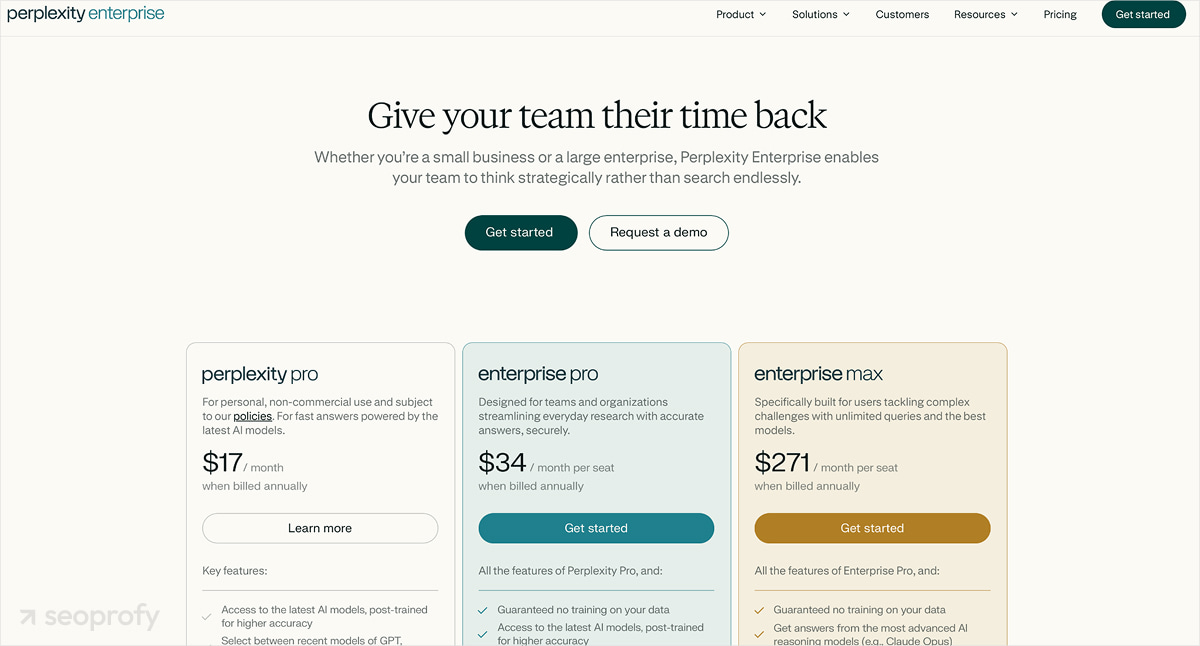
Perplexity offers enterprise-focused plans designed for teams and organizations that need secure, scalable AI research tools. The Perplexity Pro plan (~$17/month billed annually) is intended for individual users, providing access to advanced AI models and research features.
For teams, the Enterprise Pro plan (~$34–$40 per seat/month) adds collaboration tools, admin controls, and strong data privacy with no training on company data. At the top tier, the Enterprise Max plan (~$271–$325 per seat/month) delivers the highest usage limits, access to the most advanced AI models and enterprise-grade security, making it ideal for organizations handling complex research workflows.
In short, Perplexity pricing for enterprise scales from individual use to fully secure, high-performance AI for large teams.
ChatGPT Pricing Plans
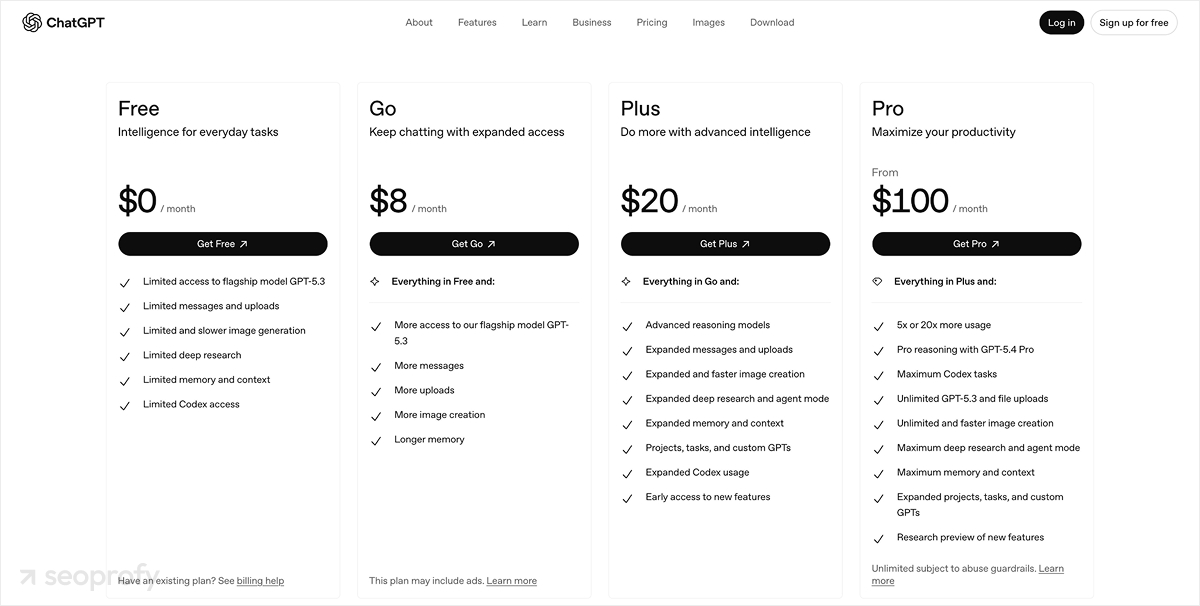
OpenAI offers a flexible range of plans to suit different users, from casual to professional. The Free plan ($0/month) provides basic access with limited messages and features. The Go plan (~$8/month) expands usage and removes ads, acting as a budget-friendly upgrade.
The Plus plan ($20/month) is the most popular, unlocking advanced models, faster responses, and tools like image generation and file analysis. For heavy users, the Pro plan ($200/month) delivers near-unlimited access, top-tier reasoning models, and maximum performance. Businesses can also choose Team and Enterprise plans, which add collaboration, security, and scalable usage.
In short, pricing scales from free everyday use to high-performance AI for power users and organizations.
When Should You Use Perplexity vs. ChatGPT?
Practical guidance beats abstract theory. Here is the Use Case Matrix we give every client:
| Task Type | Best Tool | Why |
| Fact-checking | Perplexity AI | Live citations and low hallucination rate |
| Real-time news | Perplexity AI | Always pulls fresh sources |
| Blog writing | ChatGPT | Superior tone control and iteration |
| Code generation | ChatGPT | Execution and debugging built in |
| Brainstorming | ChatGPT | Creative divergence and idea volume |
| Academic research | Perplexity AI | Structured citations and academic focus |
| Customer support | ChatGPT | Conversational flow and memory |
| Creative writing | ChatGPT | Narrative flair and emotional range |
Perplexity vs ChatGPT rarely ends with one tool winning forever. Most power users treat Perplexity AI as the AI search engine and ChatGPT as the AI chatbot. They switch based on the task.
Perplexity or ChatGPT? The practical answer is both. Use Perplexity AI as your research tool and ChatGPT as your writing assistant and coding assistant. The combination beats either tool alone.
Perplexity vs. ChatGPT: Our Verdict
Neither Perplexity nor ChatGPT delivers a universal winner in 2026. Perplexity AI owns research and accuracy. ChatGPT owns creativity, coding, and multimodal tasks.
From what we’ve seen across dozens of SEO and marketing teams, the smartest workflows blend both. Start research in Perplexity AI and move drafting and iteration to ChatGPT. The result is faster, more accurate, and more original output than either tool could produce alone.
ChatGPT vs Perplexity ultimately comes down to your primary daily pain point. Heavy researchers default to Perplexity AI. Writers and developers lean on ChatGPT.
If you’re looking to leverage AI for your SEO strategy, check out our AI SEO services. The right tool choice compounds when paired with a smart strategy.
FAQ
Is Perplexity AI free to use?
Yes. The free plan delivers unlimited quick searches with automatic citations. Limits only appear on advanced Pro Search features. Most users stay on free until daily volume increases.
Perplexity AI remains generous enough for solo content creators and small marketing teams testing the waters. You can complete several research sessions per day without hitting any paywall, making it easy to evaluate whether the tool fits your workflow before committing to a paid plan.
Does ChatGPT have better memory than Perplexity?
ChatGPT holds a longer conversation history across sessions. Perplexity AI organizes memory inside named Spaces. Choose based on whether you prefer one long thread or organized folders. ChatGPT remembers details from weeks earlier, which helps when refining ongoing campaigns or client projects. Perplexity AI keeps things tidy by letting teams create separate Spaces for different topics, avoiding one massive, cluttered thread.
Which tool is more accurate for SEO keyword research?
Perplexity vs ChatGPT for research favors Perplexity AI. Live sources and a lower hallucination rate make it a safer choice for SERP analysis and competitor data. Perplexity AI pulls fresh ranking data and backlink context directly from the web in real time. IT can brainstorm keyword ideas creatively but often requires manual verification of search volume or difficulty metrics afterward.
Can I use both tools together effectively?
Absolutely. Most marketers I talk to keep both tabs open. Perplexity AI for sourcing, ChatGPT for creation. The workflow feels seamless once you get used to switching. Start your morning research sprint in Perplexity AI to gather accurate data and citations. Then move the raw material into ChatGPT to shape it into polished blog posts, emails, or social campaigns.
How do the pricing plans compare for small teams?
Perplexity’s pricing edges out on pure research value at $17 per month for Pro. ChatGPT cost wins for creative teams at $20 plus or $20 per user Team. Test both with your actual tasks. A three-person SEO team focused on content and link building often finds Perplexity AI Pro more cost-effective for daily research needs. Teams that spend most of their time drafting and editing usually see better returns from ChatGPT team features and shared custom agents.
Which AI handles image generation better?
ChatGPT with DALL-E 3 and Sora integration currently leads. Perplexity AI offers basic generation through its models but lacks the same polish and control. It lets you iterate on prompts with style references and aspect ratio control for consistent branding. Perplexity AI works well for quick illustrative visuals tied to research topics but falls short when you need marketing-ready hero images or complex compositions.
Is Perplexity replacing traditional search engines?
Perplexity AI augments search rather than replacing it. It excels at synthesis and citations. Traditional engines still win for broad browsing and discovery. Many SEO professionals now use Perplexity AI as their first stop for specific questions while keeping Google open for exploratory surfing. The two tools serve different purposes, and combining them often yields the most complete picture for content strategy and keyword mapping.

Bohdan has been an SEO analyst at SeoProfy for more than two years. He began his career in digital marketing in 2019 and has since gained experience helping scale some of the world’s leading brands in industries such as gambling and SaaS. Bohdan specializes in developing effective strategies tailored to specific regions.