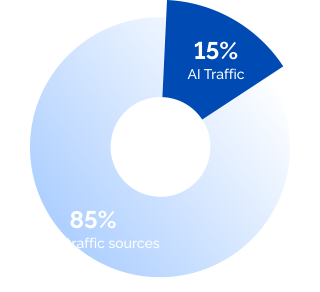



SaaS buyers rarely move from a search query to a vendor page in one clean step. They compare tools on Google, ask ChatGPT or Perplexity to explain trade-offs, scan G2 and Capterra reviews, and use AI-generated summaries before they ever reach a demo page.


That creates a scaling problem for SaaS SEO teams. Manual workflows are too slow when competitors use AI to cluster keywords, audit technical issues, refresh comparison pages, and track where their brand appears in AI answers. And if your positioning is unclear or your content is thin, buyers may see those competitors before they see you.
This guide shows how to use AI SEO for SaaS as part of your workflow to improve organic rankings, strengthen visibility in AI-generated answers, and help buyers compare your product with more confidence.
- SaaS buyers now compare vendors across Google, review platforms, and AI tools before they reach a demo page.
- G2’s 2026 research found that 71% of B2B software buyers rely on AI chatbots for software research.
- AI SEO has two tracks: faster execution through research, audits, clustering, and updates, plus visibility inside AI-generated answers.
- Human editors and strategists still need to choose topics, validate claims, prioritize fixes, and connect content to product positioning.
- Schema markup can clarify entities and page types, but it does not guarantee inclusion in AI Overviews.
- Third-party signals from reviews, comparison pages, communities, and partner directories help AI systems understand where a SaaS product fits.
What Is AI SEO for SaaS?
AI SEO for SaaS is the process of using AI-assisted workflows and AI search optimization to improve how SaaS brands plan content, fix SEO issues, rank in organic search, and appear in AI-generated answers. It combines traditional search fundamentals with visibility across platforms like Google, ChatGPT, and Perplexity.
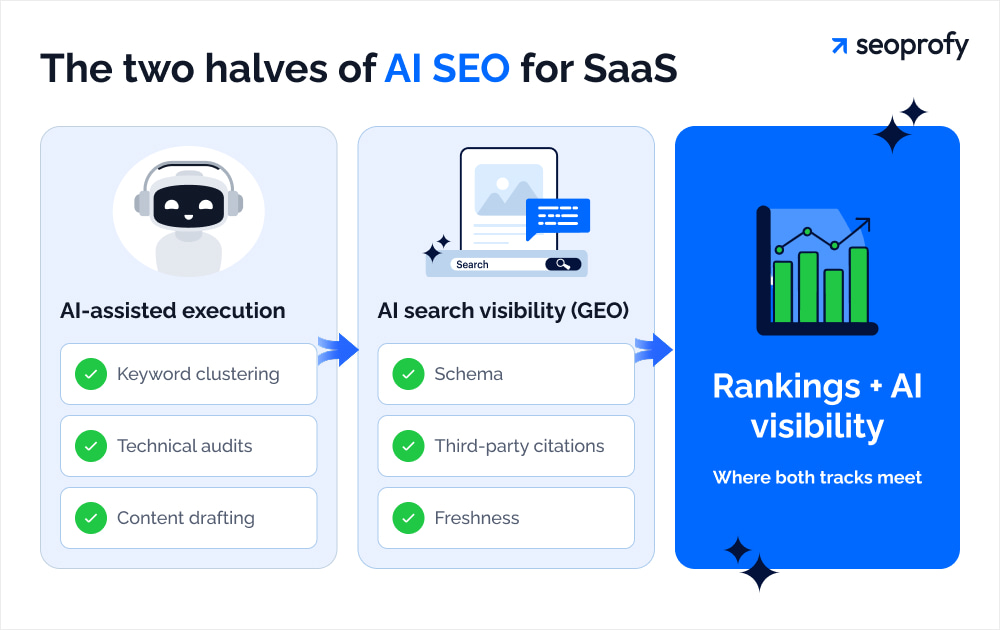
That makes AI SEO for SaaS broader than just generating AI-written drafts or dropping a few prompts into your content workflow. One half is execution: AI tools can cluster keywords, analyze search intent, flag technical issues, summarize performance data, and help teams update existing content faster.
These workflows support the same foundations covered in SaaS SEO, such as crawlability, on-page optimization, strong internal linking, useful content, and conversion-focused landing pages. They also help teams catch pages that need optimizing before they scale up content production.
The second half is AI search visibility, often referred to as generative engine optimization (GEO). Here, SaaS teams need to rank on search engine result pages while also becoming a source that AI systems can recognize, trust, and cite when buyers ask product-related questions.
For a B2B SaaS company, that may involve structured data, clearer product explanations, original research, fresh comparison pages, and third-party proof from review sites or communities. At that point, organic search, brand trust, and demand generation begin to overlap.
A strong SaaS SEO strategy still needs human judgment, product knowledge, technical discipline, and editorial review. Raw AI-published content at scale can weaken that foundation since the final strategy still has to reflect the product, market, ICP, and sales motion — something no model can infer on its own.
Why AI SEO Matters for SaaS Companies Right Now
AI is changing where SaaS buyers build their first shortlist. G2’s 2026 research found that 71% of B2B software buyers rely on AI chatbots for software research, and 51% now start their research in a chatbot more often than in Google.
Responsive’s Inside the Buyer’s Mind report found that nearly two-thirds of B2B buyers use GenAI at least as much as traditional search when evaluating vendors. In the technology and software industry, that share rises to 80%. Together, these AI SEO statistics show that buyers can compare your product before they ever reach your site or talk to sales.
For teams that still measure organic search only by rankings, this creates a blind spot. Google rankings still matter, but a ranking doesn’t tell you whether AI systems mention your brand when buyers ask for recommendations, alternatives, or pricing. A page can win search traffic and still have little influence on AI-assisted vendor research.
SaaS hits that gap faster than many other categories. The buying journey is longer, the comparison process is deeper, and each missed shortlist ripples through to trials, qualified leads, and pipeline quality. A SaaS business that disappears from AI answers gives sharper competitors room to shape the buyer’s options while you’re still invisible.
Building the Foundation: ICP and Content Architecture
Before keyword exports, prompts, or audits, define who the content is meant to help. For a SaaS company, ICP work should map the buyer role, who owns the budget, what triggers the search, the main objections, and the proof it takes to move a deal forward. AI can quickly expand keyword lists, but it cannot decide which queries are worth a page without that context.
Use the ICP to make four practical decisions.
- Choose the buyer segment: An end user and a budget owner don’t search the same way, and they don’t need the same level of detail. Decide who each page is really speaking to before you write it.
- Map the trigger: Identify the problem that pushes the buyer to search now. It may be churn, slow onboarding, duplicate data, or another operational issue. Name that trigger, because it tells you what the page has to resolve.
- Match the page to the decision stage: Awareness pages should explain the problem and available approaches. Comparison pages should help buyers evaluate categories, alternatives, and trade-offs. Decision-stage pages should support vendor selection with pricing explainers, migration guides, integration pages, reviews, and product-specific proof.
- Filter topics by product fit: Keep the keywords tied to real use cases, features, or buying objections. Broad terms can pull traffic, but traffic that never moves toward evaluation isn’t doing much for a SaaS business.
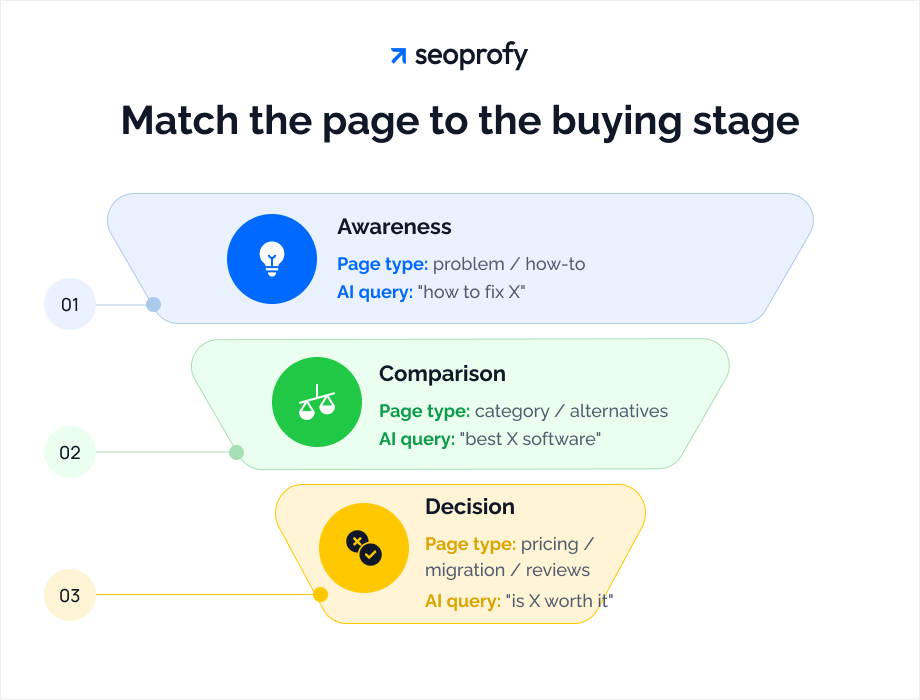
Those four decisions add up to a content architecture. AI tools can help cluster topics and identify gaps, but the buyer journey should drive the final map. A focused SaaS SEO strategy turns SEO into a practical content marketing strategy where each page has a job: attract the right searcher, answer the right intent, and support product evaluation.
Core AI-Assisted SEO Workflows
The strongest AI-assisted workflows do not replace the fundamentals. They reduce the time it takes to collect data, spot patterns, and refresh pages that already have ranking or conversion potential. For SaaS teams, that speed is crucial because product messaging, competitors, integrations, and buyer questions change quickly.
Use AI where it helps the team work through large inputs faster: sorting keyword sets, spotting repeated issues, comparing content gaps, and turning performance data into clearer next steps for a human strategist.
AI-Assisted Keyword Research and Topic Clustering
Keyword research for SaaS often starts with messy inputs from product pages, sales calls, support tickets, integration names, competitor pages, and category terms. AI tools make that list easier to sort, but the team still needs to decide which topics deserve content.
Use the workflow in five steps.
- Collect raw inputs: Pull queries from your usual tools (Google Search Console, Ahrefs, Semrush) alongside softer sources like customer interviews, support tickets, and competitor pages.
- Clean the list: Remove duplicates, merge close variants, and separate branded, informational, commercial, and comparison searches.
- Group by buyer intent: AI users often ask longer, more conversational questions than classic short-tail keywords. A query like “how to reduce user churn after signup” should not sit in the same cluster as “customer onboarding tool alternatives” if the buyer problem is different.
- Check product fit: Separate keywords relevant to product-led pages from broad informational terms that may bring traffic but little buyer intent.
- Assign the next action: Each cluster should lead to a clear content decision. Create a new article, update existing content, build a comparison page, consolidate overlapping pages, or support a product page with internal links.
A strategist should still check search volume, keyword difficulty, SERP overlap, and conversion potential before assigning priorities. Used well, this workflow makes keyword research less manual and ties each cluster to a real business goal.
AI-Powered Technical SEO Checks
AI audit tools are useful when they turn crawl data into a short list of issues the team can act on. For a SaaS site, the first checks should be concrete and easy to verify.
Start with issues that block crawling and indexing or drag down page quality:
- Missing or duplicate H1s
- Weak H2 structure
- 404 pages
- Redirect chains
- Duplicate meta titles or descriptions
- Incorrect canonical tags
- Orphan pages
- Slow templates
- Indexable pages that should be blocked
A traditional technical SEO audit still runs on crawlers like Screaming Frog, PageSpeed Insights, or GTmetrix. AI-assisted tools help after the crawl by grouping similar issues, explaining likely impact, and showing where to start. For example, they can separate a sitewide template issue from a few isolated page errors.
That matters for a SaaS business with hundreds of feature pages, integration pages, and help-center URLs. Treating every warning as equally urgent slows the team down. Grouping issues by URL pattern, template, and business impact makes it easier to turn the audit into developer tasks.
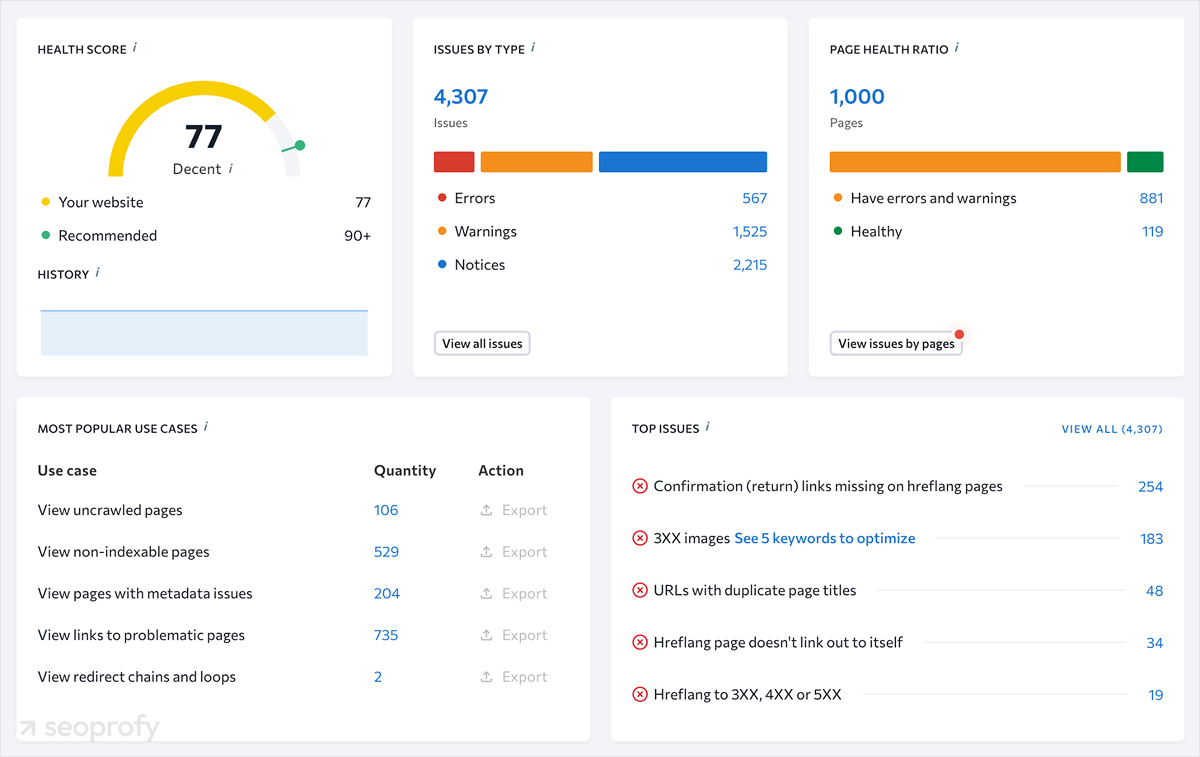
The human job here is proper prioritization. A technical lead should validate the crawl, check affected URL patterns, and focus on the fixes that block discovery or create duplicate signals.
Automation finds problems faster, but it still takes technical judgment to decide which fixes matter first.
AI-Assisted Content Creation (With Mandatory Human Editing)
AI can speed up content creation when the inputs are specific. Before drafting, feed the tool the context it can’t infer, such as a clear brief, ICP notes, the target intent, and your product positioning.
Use AI for tasks that reduce prep time:
- Building outlines
- Drafting section angles
- Summarizing source material
- Turning expert notes into rough copy
- Creating FAQ variants
- Refreshing old sections
- Adapting product notes for integration or use-case pages
Unedited AI content tends to recycle whatever the ranking pages already say, miss product-specific context, and assert things it can’t back up, which erodes trust and organic performance, especially in B2B SaaS where buyers expect specific answers. This is why many AI SEO agencies still rely on human editors and subject-matter experts.
Google’s AI optimization guide also warns against shortcuts such as unnecessary llms.txt files or page chunking created only for AI systems. For SaaS content, aim for non-commodity pages that are accurate, product-specific, and useful for real buyers.
Before publishing, the editor should check whether the page:
- Matches the real search intent
- Removes repeated ideas
- Adds SaaS-specific examples
- Uses accurate sources
- Connects the topic to the product naturally
- Avoids unsupported claims
- Gives buyers enough context to compare options
For a SaaS business, content becomes useful when it helps a real buyer make a clearer decision. AI can reduce drafting time, but editorial judgment is what decides whether the final page is accurate, genuinely differentiated, and strong enough to earn rankings and buyer trust.
Optimizing for AI Search Visibility (GEO)
The second half of AI SEO for SaaS is visibility within AI-generated answers, sometimes also referred to as AEO (Answer Engine Optimization). AI search optimization — often grouped under generative engine optimization (GEO) — focuses on making your brand easier for systems like ChatGPT, Perplexity, Gemini, and Google AI Overviews to recognize and cite.
Organic rankings still matter. The same expertise that helps pages rank should also help AI platforms mention your product when buyers ask about comparisons, use cases, or vendor selection.
Schema Markup and Structured Data
Schema markup helps search engines understand your site structure and how its entities relate. It can support clearer context, but it should not be treated as a shortcut to AI citations.
Google’s guidance states that no special schema.org markup is required to appear in AI Overviews or AI Mode. A SaaS-focused FAQ schema experiment across seven AI platforms also shows why schema should be tested instead of treated as a guaranteed citation lever.
For SaaS pages, use schema where it aligns with the visible content.
- Organization schema can tie together the brand, its site, logo, and linked social profiles.
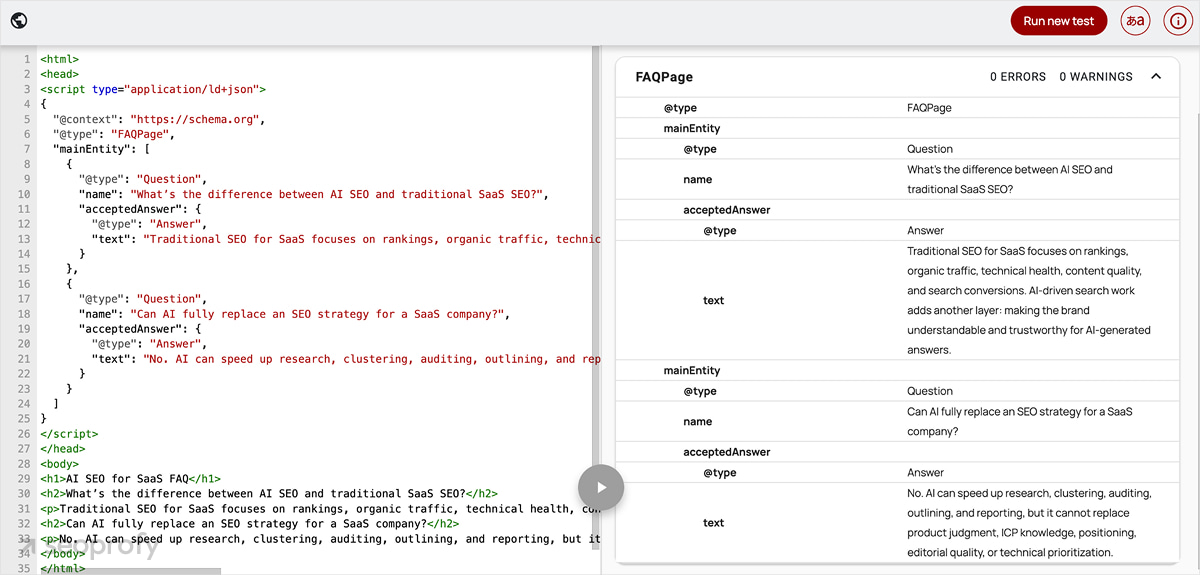
- FAQPage schema works best for real question-and-answer sections on comparison, pricing, migration, or feature pages.
- HowTo schema only makes sense when the page explains a clear process, such as setup, integration, or implementation steps.
Before adding schema, check three things.
- The marked-up content is visible on the page.
- The JSON-LD matches the actual page type.
- The markup does not hide unsupported claims, fake ratings, or questions users cannot see.
A clean schema setup can support crawlability, entity understanding, and eligibility for rich results. It will not, by itself, help a weak page rank in AI Overviews.
Before publishing, validate key templates with a structured data testing tool. For FAQPage markup, Schema.org Validator can confirm whether the schema is technically valid. Google’s Rich Results Test is still useful for supported rich result types. The stronger signal still comes from useful content, clear internal links, and accurate product information.
Earning Third-Party Citations
In GEO, your website is only one trusted source. AI systems may also rely on the sources buyers already use when they compare vendors. For SaaS, that usually means review platforms, comparison sites, analyst pages, partner directories, newsletters, podcasts, and active communities.
Start with the sources closest to buyer research.
- Complete G2 and Capterra profiles.
- Keep product categories and integrations accurate.
- Encourage detailed customer reviews.
- Respond to reviews with useful context.
- Update partner and directory listings.
- Monitor Slack groups, Reddit threads, newsletters, and podcasts where buyers discuss tools and alternatives.
This overlaps with link building, but the goal is broader than backlinks. You need consistent mentions that explain what the product does, who it serves, and why buyers choose it.
Weak profiles give AI systems less context. Strong profiles add category language, use cases, integrations, customer wording, screenshots, and recent reviews. For a SaaS brand, that makes it easier to connect the product with the right buyer problem.
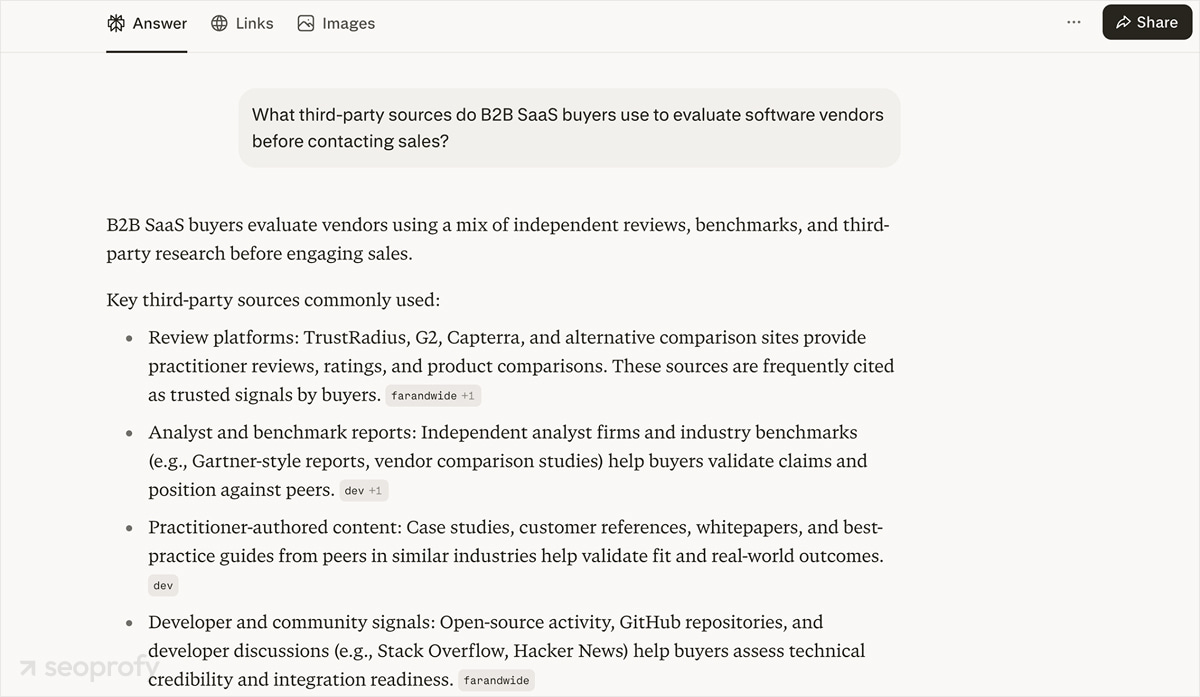
For a SaaS business, this work creates citation signals beyond the company blog. The stronger and more consistent those signals are, the easier it becomes for AI systems to connect the brand with the right category, use case, and buyer problem. SeoProfy’s guide on how to earn LLM citations covers this process in more detail.
Content Freshness and the Citation Window
AI systems need current information to answer buyer questions well. For SaaS, freshness matters most on pages where the answer changes over time.
The citation window is the period when a page is most useful for AI-assisted research because it reflects the current product, pricing context, integrations, market data, and buyer language.
Prioritize updates for:
- Comparison pages
- Alternatives pages
- Pricing-related content
- Review-led pages
- Integration pages
- Articles that mention regulations, platform updates, or market data
A useful refresh should improve the page, not just change the date. Add new product details, remove outdated claims, update old screenshots, refresh statistics, check internal links, and rewrite sections that miss current search intent.
Freshness is especially important when buyers ask AI tools which vendor to choose, what changed, or how one product compares with another. For a SaaS business, updated high-value pages support both organic visitors and AI-assisted research.
Original Research as a Citation Strategy
Original research gives AI systems something specific to cite. It also gives SaaS teams proof that competitors cannot easily copy.
You do not need a large industry report to start. Useful research can come from:
- Short customer surveys
- Anonymized product usage data
- Benchmark studies
- Customer workflow analysis
- Market data collected from public sources
- Internal implementation or adoption patterns
The strongest research connects directly to the product’s market. A project management platform might study how teams plan capacity. A cybersecurity tool might publish anonymized findings about common misconfigurations. A revenue platform might analyze follow-up speed or pipeline quality.
The methodology should be clear, and the claims should stay honest. When the data is useful, up to date, and clearly sourced, it can support organic rankings, PR, sales enablement, and AI-generated references simultaneously.
Optimizing Across AI Platforms
AI platforms usually do not surface information in the same way. Perplexity often shows visible source links. Google AI Overviews are closely tied to search results. Chatbot answers may blend brand mentions, review data, publisher content, and product explanations without giving every source equal weight.
Because of that, AI search optimization should not depend on one platform’s behavior. SeoProfy’s Google AI Overviews analysis shows why this matters beyond rankings. AI Overviews appeared in roughly 20% of analyzed queries, and queries with AI Overviews saw CTR drop from 15% to 8%. Brand visibility inside AI-generated answers becomes more important when more searches end without a traditional click.
Check the same buyer questions across several systems.
- “Best tools for…”
- “Alternatives to…”
- “Software for [use case]”
- “Compare [category] platforms”
- “[Competitor] alternatives”
- “Best [category] software for [team/use case]”
Then compare what the answers show.
- Which brands appear most often?
- Which sources are cited?
- Which product attributes repeat?
- Which competitors appear where your brand is missing?
- Which review sites, directories, or articles shape the answer?
Use those gaps to guide the next actions. Update unclear positioning, refresh old comparison pages, complete review profiles, improve category explanations, and build stronger third-party signals.
Instead of chasing every AI platform separately, SaaS teams should build consistent, well-supported signals that make the brand easier to understand across multiple discovery environments.
SeoProfy audits your technical setup, content, and AI citation readiness, then builds a roadmap to grow organic traffic and an AI-driven pipeline.
- Fix visibility blockers
- Structure pages for AI Overviews
- Strengthen trusted citations
What to Expect: Timeline for AI SEO Results
Results depend on site size, technical condition, content depth, authority, and how competitive the SaaS category is. Still, a realistic timeline helps teams avoid two common mistakes: expecting AI-driven workflows to deliver instant rankings, or waiting too long to measure early signals.
In the first two weeks, the clearest progress usually comes from diagnostics and planning. Teams can audit technical issues, cluster keywords, map existing content to buyer intent, identify outdated pages, and find citation gaps across review platforms and third-party sources.
By six months, stronger signals should be visible if execution is consistent. Updated pages may start gaining impressions, internal links should improve topic coverage, and comparison or use-case content can begin attracting better-qualified visitors. Brand visibility in AI answers may also improve as review profiles, structured pages, and fresh content give systems clearer context about the brand.
After one year, the goal is measurable business impact, like stronger organic search performance, more branded mentions in AI-generated answers, better conversion paths, and clearer attribution from content to pipeline. At that point, the strategy should become a repeatable growth system rather than a one-time experiment.
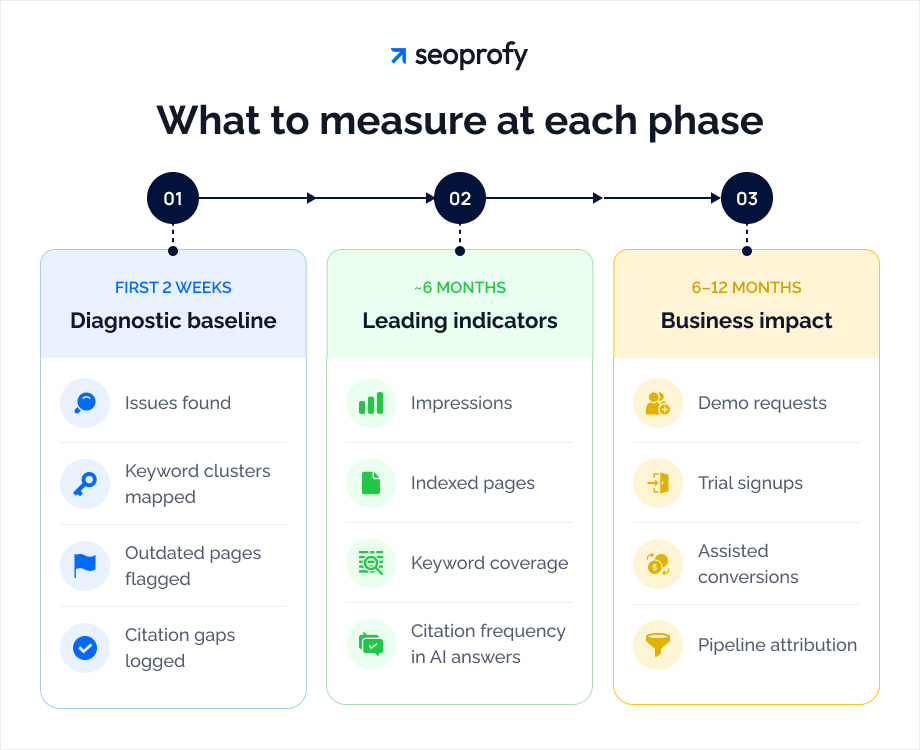
First 90 days checklist:
- Audit technical blockers and indexation issues
- Cluster keywords by intent and funnel stage
- Refresh high-value comparison, pricing, and use-case pages
- Improve third-party profiles and review coverage
Tools for AI-Driven SaaS SEO
SaaS teams should choose tools by workflow, not by a generic “best tools” list. The main categories are keyword and clustering platforms, technical audit tools, and brand mention trackers. Each supports a different part of execution: finding opportunities, fixing site issues, or checking whether the brand appears in AI-generated answers. For a broader breakdown, see SeoProfy’s guide to AI SEO tools.
Keyword and Clustering Tools
Keyword and clustering tools help turn large lists of queries into usable content groups. Platforms such as SurferSEO, Ahrefs, and Semrush can expand seed keywords, group variants, and separate informational from commercial and comparison intent. For SaaS teams, the useful output is a clear map of which topics need new pages, updates, consolidation, or internal links.
Technical Audit Tools
Technical audit tools help SaaS teams find issues that slow crawling, indexing, and page performance. Use crawlers and site audit platforms to detect broken URLs, redirect chains, duplicate metadata, missing headings, canonical errors, orphan pages, slow-loading templates, and mobile usability issues. AI-assisted summaries can then group similar issues and turn the crawl into a prioritized list of fixes for developers, content teams, and SEO owners.
AI Visibility Trackers
These trackers monitor where a SaaS brand appears in AI-generated answers, which sources are cited, and how often competitors are mentioned in response to the same prompts. Tools such as Otterly.ai, Profound, Semrush AI Visibility Toolkit can help track citation frequency, brand mention rate, prompt coverage, and platform-specific gaps across ChatGPT, Perplexity, Gemini, and Google AI Overviews.
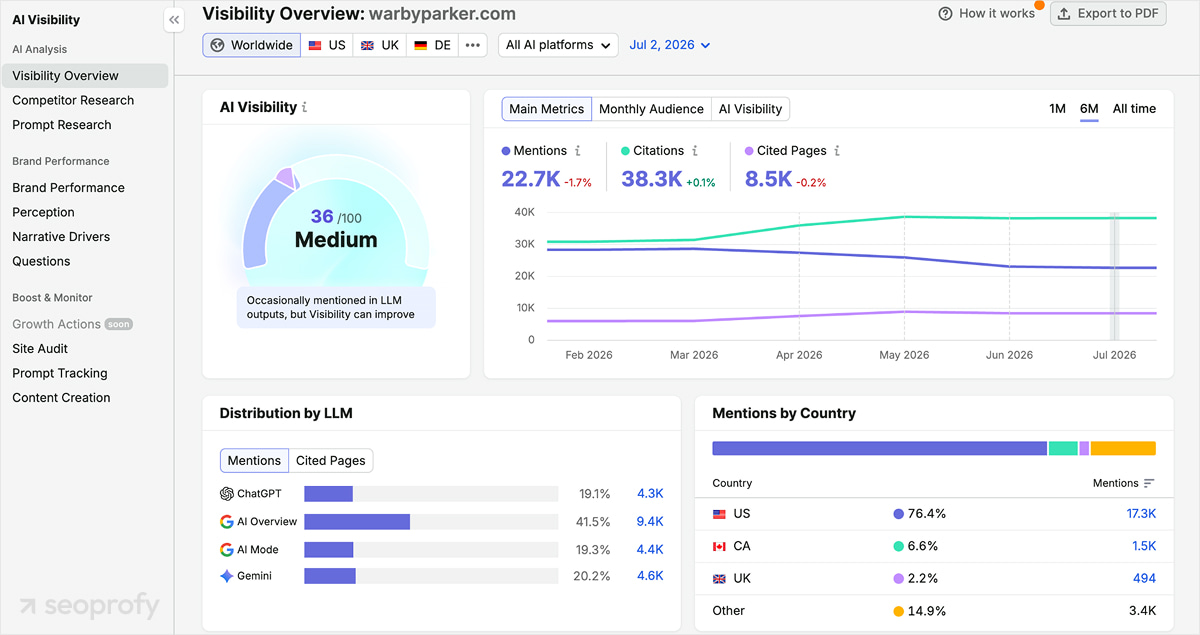
Measuring Results: KPIs for AI SEO Success
Measurement should show whether the strategy improves both SEO performance and brand presence in AI-generated answers. Start with traditional SEO metrics because they still show demand capture. Measure:
- Organic traffic
- Impressions
- Clicks
- CTR
- Keyword rankings
- Indexed pages
- Assisted conversions
- Demo requests
- Trial signups
Google Search Console remains the main source for query, page, impression, click, and CTR data. Google’s AI features documentation also states that clicks and impressions from AI features are included in standard Search Console Performance reports, so teams should not separate AI-related visibility from the rest of search reporting too early. Use Google Analytics or product analytics to connect that traffic with conversion data, including engaged sessions, signups, demo requests, activation events, and revenue opportunities.
Then add AI visibility tracking for AI-search-specific KPIs. Three AI-specific KPIs are worth tracking:
- Citation frequency: How often your brand or content is cited in ChatGPT, Perplexity, or Google AI Overviews for target prompts.
- Brand mention rate: How often the brand comes up even when it isn’t cited as a source.
- Visibility by topic: Where you show up across category, comparison, and alternatives queries.
For SaaS teams, the most useful dashboard connects these signals to buyer intent. A ranking gain for an informational page matters less than improved visibility for “best [category] software,” “[competitor] alternatives,” or “[use case] platform.” Measurement should show whether the brand is becoming easier to find, compare, and trust across the discovery paths buyers already use.
Common Mistakes to Avoid
Treating AI-generated drafts as finished content
A page can be grammatically clean and still be weak if it repeats surface-level advice, misses product context, or makes claims without proof. SaaS buyers compare tools carefully, so every important page needs human editing, examples, source checks, and a clear connection to user intent.
Ignoring technical foundations
AI-assisted workflows cannot compensate for broken internal links, duplicate titles, slow templates, indexation problems, or thin pages competing with each other. If crawlers and users struggle to understand the site, AI systems will have the same problem. Technical cleanup should happen before teams scale content production.
Chasing high-volume keywords with no realistic path
Broad terms can look attractive in a keyword tool, but they may attract the wrong audience or compete with stronger domains. SaaS teams should prioritize queries where the product has a clear use case, the SERP is winnable, and the visitor can move toward evaluation.
Neglecting third-party presence
If review profiles are incomplete, comparison pages are outdated, and communities never mention the brand, AI systems have fewer external signals to work with. Visibility in AI answers depends on the wider market footprint, not only on the company website.
Frequently Asked Questions
What’s the difference between AI SEO and traditional SaaS SEO?
Traditional SEO for SaaS focuses on rankings, organic traffic, technical health, content quality, and search conversions. AI-driven search work adds another layer: making the brand understandable and trustworthy for AI-generated answers.
The goal is to keep organic growth measurable while increasing the frequency of the brand’s appearance in ChatGPT, Perplexity, Gemini, and Google’s AI-generated results.
Can AI fully replace an SEO strategy for a SaaS company?
AI cannot fully replace an SEO strategy for a SaaS company. It can speed up research, clustering, auditing, outlining, and reporting, but people still need to choose the right topics, validate claims, set priorities, and connect content to product positioning.
A SaaS team also needs human judgment for ICP knowledge, technical decisions, editorial quality, and buyer journey logic. AI can support the workflow, but it cannot own the strategy behind it.
How do I get my SaaS content cited by ChatGPT or Perplexity?
To get your SaaS content cited by ChatGPT or Perplexity, you can start with content that gives clear, specific answers and supports claims with reliable evidence. Then strengthen external signals: complete review profiles, earn detailed customer reviews, publish original research, refresh comparison pages, and stay visible in relevant communities.
AI systems are more likely to cite content when it is useful, up to date, and corroborated elsewhere.
Which AI-assisted SEO tasks still need a human?
Humans should own strategy, prioritization, editing, source validation, product messaging, final publishing decisions, and the SEO knowledge needed to connect content work with rankings, visibility, and conversions.
AI can support the workflow, but people need to check whether a page actually answers the search intent, accurately reflects the product, avoids duplicate ideas, and provides buyers with enough context to compare solutions.
How long does it take to see results from AI SEO for SaaS?
Early progress can appear within two weeks through audits, clustering, and content refresh plans. Stronger organic and AI visibility signals usually take several months of execution.
For most SaaS teams, meaningful business impact typically takes six to twelve months, depending on site authority, competition, and content quality.
What This Means for Your SaaS Strategy
AI SEO for SaaS should make the team faster and more selective. Use AI to speed up research, audits, clustering, content updates, and reporting, then let strategists decide what deserves action. The work still depends on buyer intent, product positioning, technical priorities, and clear business goals.
SaaS buyers now use search results, AI answers, review sites, communities, and comparison content together. A SaaS business that wants to stay visible needs strong technical foundations, useful content, structured information, current third-party proof, and a clear way to measure both organic performance and AI mentions.
Winning teams will use AI to work faster while keeping human judgment, editing, and product expertise at the center.
For teams that need a structured plan, SeoProfy’s SaaS SEO services can audit the technical foundation, content architecture, and AI citation readiness, then turn the findings into a prioritized roadmap.

Julia Lubianytska is a Copywriting Team Lead at SeoProfy with over 7 years of experience in copywriting and editing. She works closely with copywriting teams, helping writers craft clear and thoughtful content for SaaS products, IT services, and businesses in the legal and medical fields. Julia enjoys turning complex topics into easy-to-understand, trustworthy content, focusing on structure, clarity, and consistency to ensure the content is genuinely helpful for real people, not just search engines.