

When someone gets hurt, they need legal assistance quickly. The firms that appear at the top of search results when people look for a lawyer usually get the call — and the case. Personal injury law firm SEO can bring your website to the most visible organic spot for the right searches.


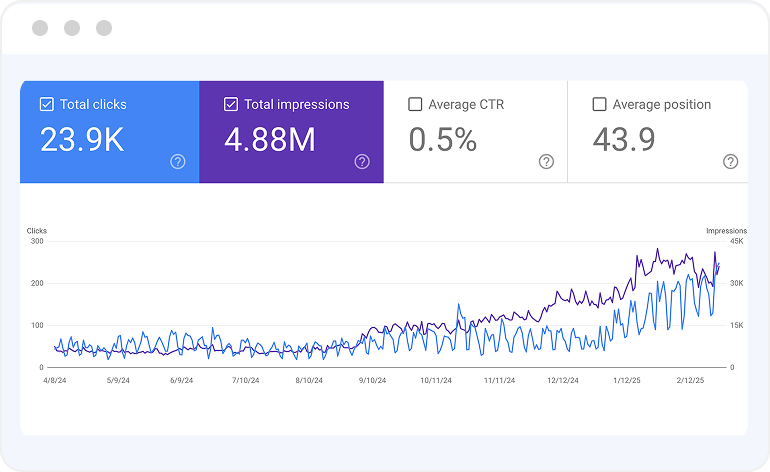
Organic search drives as much as 66% of call conversions in the legal field, which shows that effective SEO is a real revenue driver for law firms. We’ve watched it work up close. When we rebuilt the website and search strategy for a law firm in Boston, qualified leads climbed 1,300% (from roughly 10 to 140–150 a month), organic traffic grew more than sixfold, and the firm went from ranking for 139 to 1,445 keywords in Google’s top 10.
This guide will walk you through the steps of an effective SEO strategy so you can rank for local searches, earn trust before the phone rings, and bring in cases without leaning on ads or referrals. We’ve compiled practical tips and checklists based on our team’s experience in legal marketing as well as industry best practices.
- SEO for personal injury lawyers builds a steady stream of cases from local search, instead of the on-and-off flow you get from ads and referrals.
- Search demand and competition can vary widely by city, so each strategy for lawyer SEO needs to reflect the reality of the local market.
- Firms that appear in both the map pack and organic listings are more likely to receive calls from potential clients. Pages in the local pack get 44% of all clicks from location-specific queries.
- Reviews and AI shape who gets picked in 2026. 45% of consumers use tools like ChatGPT for local recommendations, and your reviews feed those answers.
- AI search features and chatbots are becoming a separate visibility channel that must be included in SEO strategies.
- Backlinks from trusted legal and local sources are still one of the most dependable ways to strengthen rankings and hold them.
What Is Personal Injury Lawyer SEO?
Personal injury lawyer SEO is the process of getting your firm to rank for high-intent legal searches in the areas you serve. In practice, that means showing up in the local map pack, organic listings, and AI-generated answers. It covers everything from your Google Business Profile and service pages to the links pointing at your site.
Why SEO for Personal Injury Lawyers Matters in 2026
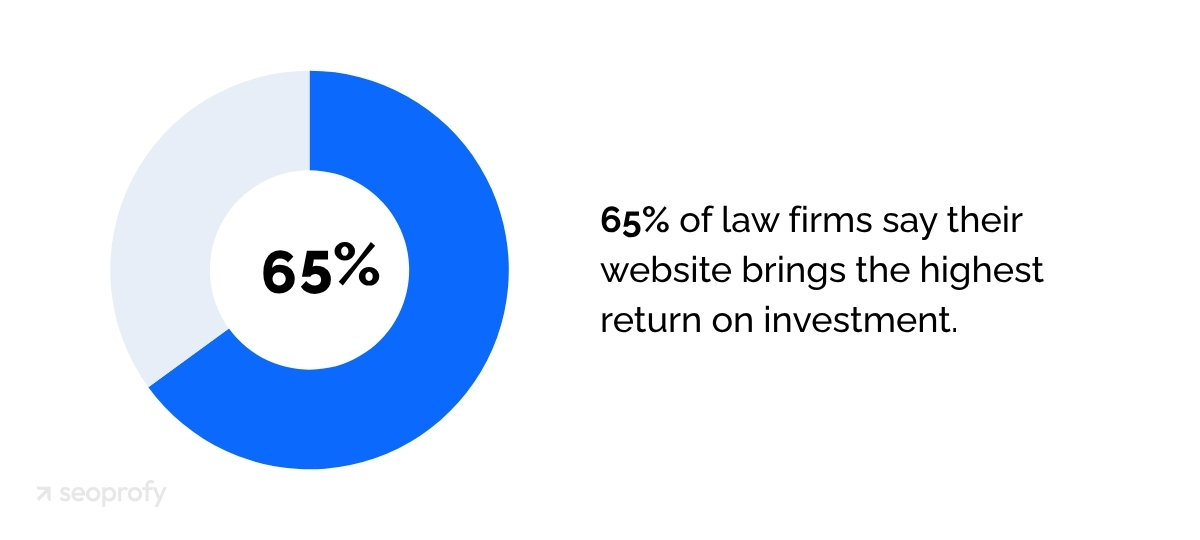
For 65% of law firms, their website returns more than any other marketing channel. That kind of return doesn’t happen by accident. It’s the result of SEO, which helps personal injury law firms keep a steady flow of leads coming in.
Referrals, ads, and word-of-mouth can still work, but they tend to fluctuate. One week you’re fully booked; the next it’s quiet. SEO for lawyers gives you more control and supports your growth in three main ways:
1. Visibility for High-Value Local Searches
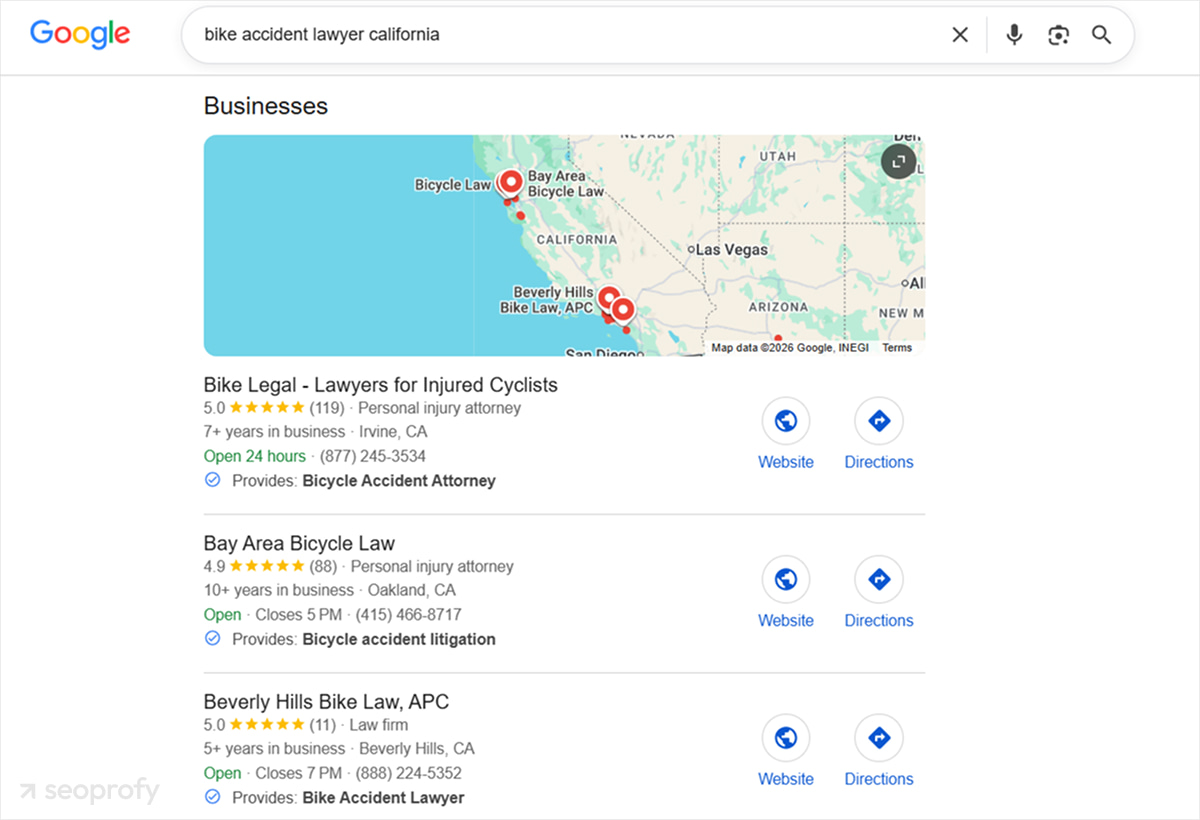
When potential clients type a term like “bike accident lawyer California” into the search bar, the first thing they see is a map with three businesses featured at the top — the local pack, which appears before organic results in 93% of all searches with local intent.
Law firms that rank in this prime spot are more likely to win the case. And if you appear in both the map pack and organic results, you double your visibility.
2. A Steady Flow of Qualified Leads
Personal injury law SEO works by turning your site into an asset that keeps producing. You optimize the pages you already have and build new ones around your practice areas and the cities you cover, each targeting the terms clients actually type.
Once those pages rank, they keep pulling in leads month after month and help you grow your law firm at a steady pace. An ad stops the moment your budget runs out; a ranking page doesn’t. And as qualified lead generation remains a key challenge for 59.6% of law firms, SEO can help you capture leads that are ready to convert (when they are already looking for your services) or nurture potential clients through the right content.
3. Building Trust with Potential Clients
People research before they call a lawyer. They read reviews, check where you’re based, and scan your site for cases like theirs. Before reaching out to an attorney, 75% of consumers visit two to five websites.
What people find about you — your profile, your ratings, the answers on your pages — decides whether they trust you enough to call. BrightLocal’s research shows that 31% of consumers refuse to contact a business rated under 4.5 stars, and 47% won’t consider one with fewer than 20 reviews. SEO pulls those signals together: a complete Google Business Profile, visible reviews, and pages that answer the questions clients already have.
SEO vs. SEM for Personal Injury Lawyers
Both SEO and SEM put your personal injury website in front of people who are searching for legal help. However, they work on different timelines and budgets. Here’s the quick comparison:
| Factor | SEO | SEM (Google Ads / LSA) |
| Goal | Build lasting organic visibility and authority in your market | Buy immediate placement at the top of the page |
| Timeframe | Traction in 3–6 months, then compounds | Leads start the day the campaign goes live |
| Cost | Upfront work on content, links, and fixes; cost per lead drops over time | Pay for every click or lead, every month, with no equity built |
| Best for | Sustainable case flow and lower long-term acquisition costs | Fast results, new locations, or filling gaps while SEO matures |
| Risk | Slower start; needs consistent effort | Leads vanish the moment spend stops; legal clicks are among the priciest anywhere |
The math favors SEO over time. Although paid search eats 58% of all traffic in the legal space, 97% of legal professionals who run PPC say it’s too expensive to hit a solid return. SEO flips that pattern: you invest up front, then your pages keep producing after the spend stops, with no per-click meter running.
That doesn’t mean ignoring paid ads. A balanced personal injury law firm SEO plan treats it as a complement, not a crutch. The firms that grow fastest usually run both: SEO as the foundation that compounds and paid as a booster for speed. Our case study proves the effectiveness of this approach. By using both SEO and paid search engine marketing, we helped the client successfully rebrand, rebuild their website, and grow lead volume by 1,300%.
8 Steps to Build a Strong Personal Injury SEO Strategy
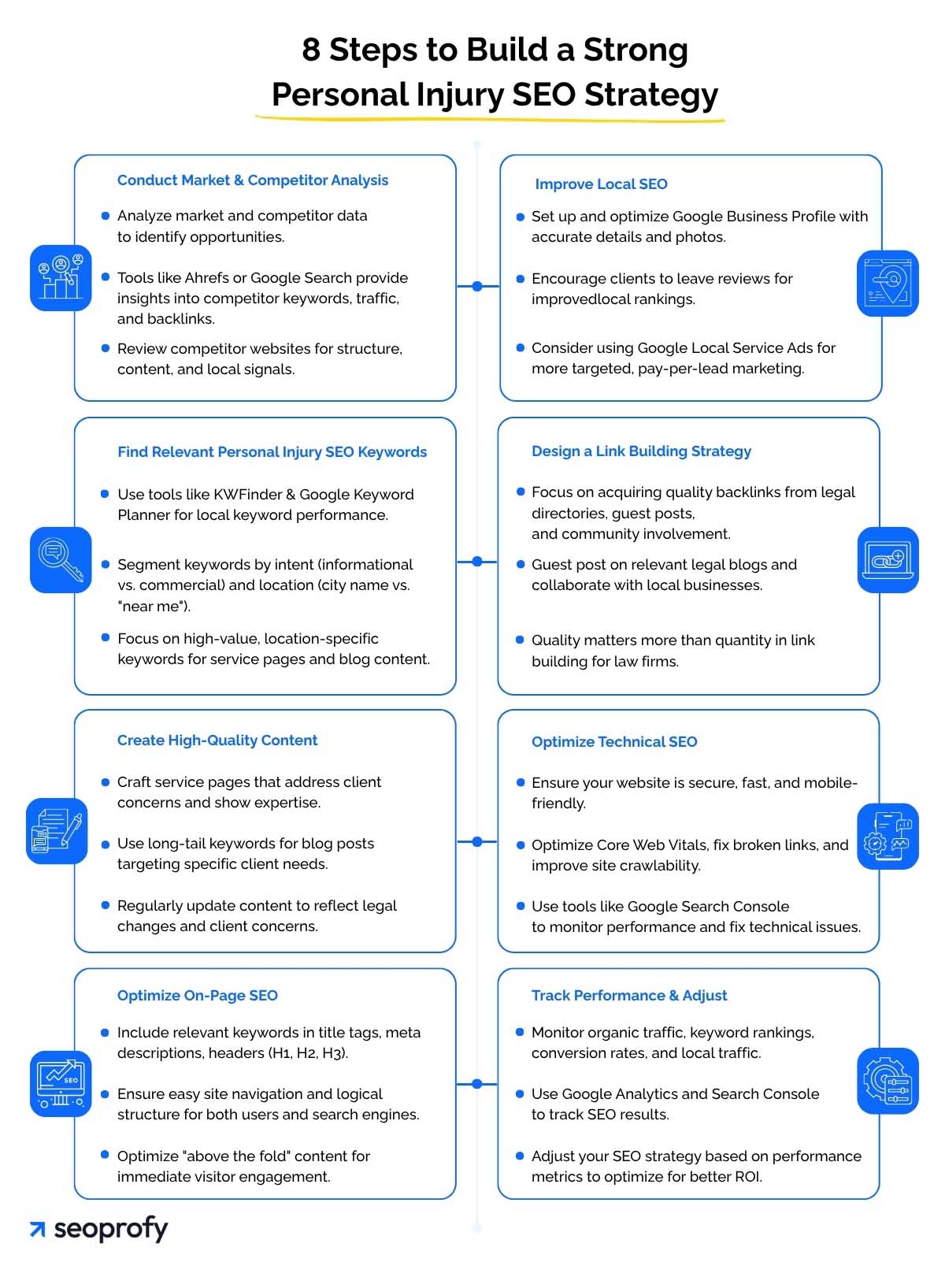
Effective SEO for injury lawyers comes down to eight steps, run in order — research first, content and links next, tracking last. These steps turn SEO from a vague goal into a checklist.
Results don’t land overnight, so here’s a realistic timeline:
| Timeframe | What to expect |
| By month 3 | Technical fixes done, Google Business Profile optimized, keyword map and first service and location pages live. Early movement in the local pack. |
| By month 6 | Content and links start compounding. Mid-difficulty city terms reach page one, reviews grow, and qualified leads pick up. |
| By month 9 | Competitive terms climb toward the top 10, lead flow steadies, and conversion work pulls more cases from the same traffic. |
Most firms break even on SEO around the 14-month mark, but the leads start well before that.
1. A Detailed Market and Competitor Analysis
Before you touch a single page, look at what you’re up against. A proper analysis shows where your firm sits in the local market and hands you real data on the keywords, page structures, and backlinks already winning in your location.
What to Map First
Start with the firms ranking for your target searches. Note the terms they rank for, which pages pull their traffic, and what sites link to them. Patterns show up fast — the content depth Google rewards, the local signals it expects, the directories that keep appearing.
Tools to Use
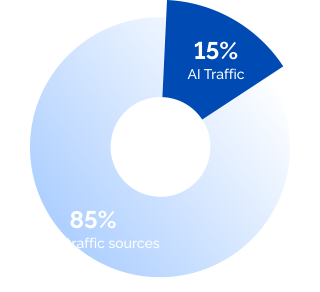
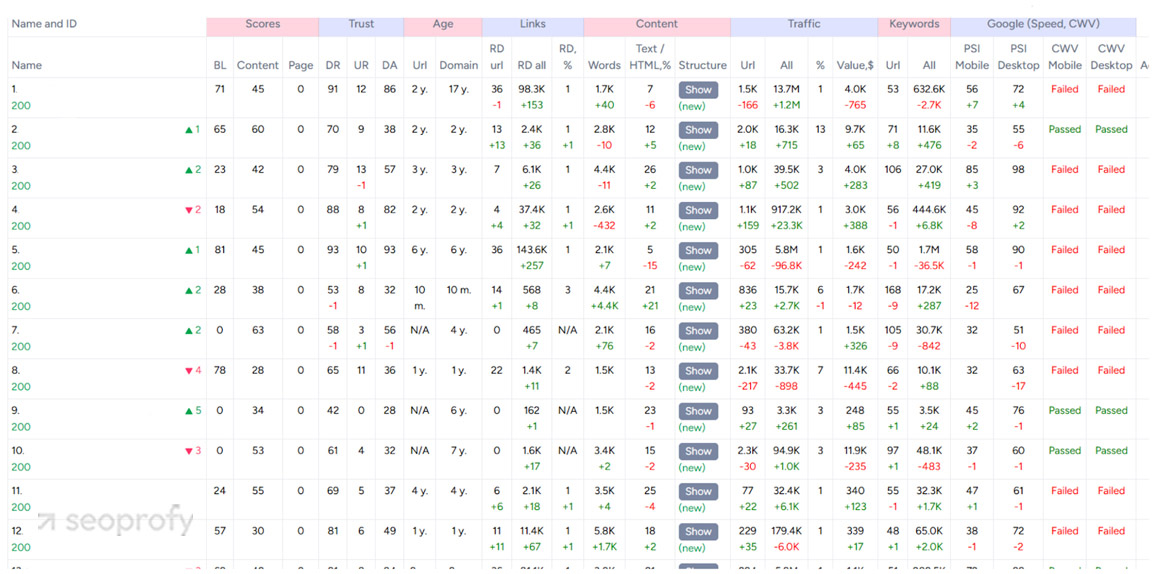
When we take on a new client for our personal injury lawyer SEO services, we run this kind of analysis through SearchAnalytics, our internal tool. It tracks more than 300 data points and breaks competitors down page by page, including a dashboard that shows where each rival’s traffic comes from by channel.
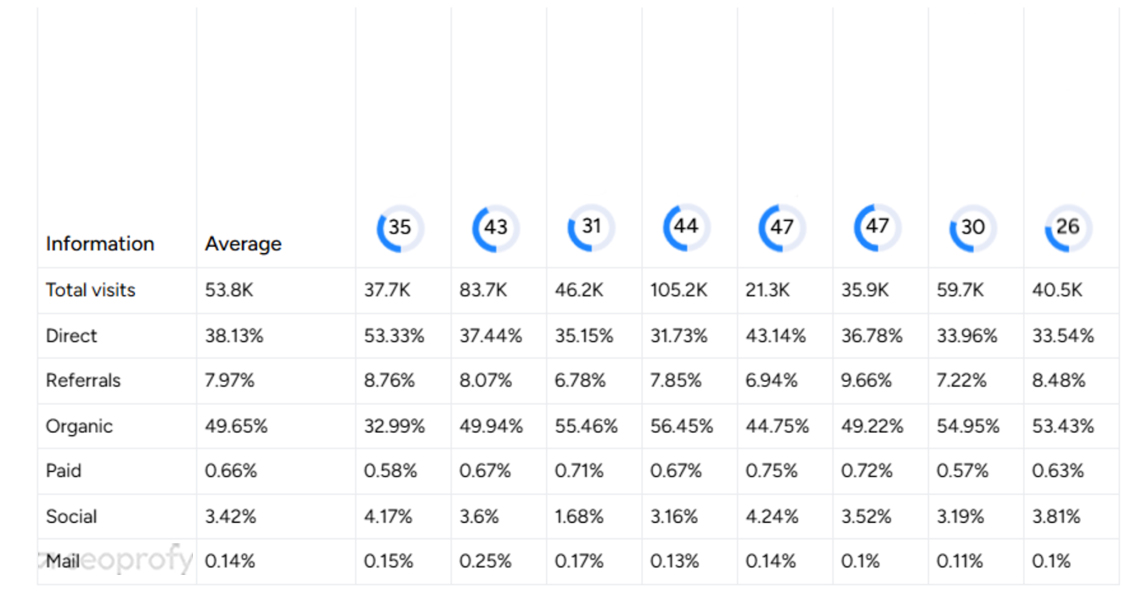
Another helpful feature we use in SearchAnalytics is the competitor dashboard. It shows us the traffic analysis of the competitors, as well as the percentage of how many visitors each marketing channel brings them. This gives us a more rounded overview of their digital marketing efforts.
Of course, you can use Ahrefs or any other SEO tool that you trust to analyze your competition. Add your competitors’ domains and scan their top pages to see what ranks and who links to them.
If you don’t have access to SEO tools, you can still get some data by searching manually. Choose a relevant search term and type it into Google in the incognito tab. Look at the first few firms that appear in both the local pack and organic results, and take the time to study their websites.
Put what you find — target keywords, awards, review counts, page structures — into one document and use it to develop an SEO strategy grounded in your market, not guesswork.
With our internal tools, you get a clear read on your competitors’ performance. You’ll be able to see data on:
- The terms they rank for
- Pages that drive most of their traffic
- Gaps in content and structure

2. Personal Injury SEO Keywords
With competitor data in hand, you can build a keyword strategy. For this step, you can use the same services that you used for competitive analysis, but dedicated keyword research tools with deeper local data, such as KWFinder and Google Keyword Planner, give you a clearer picture, city by city.
Read the Local Numbers
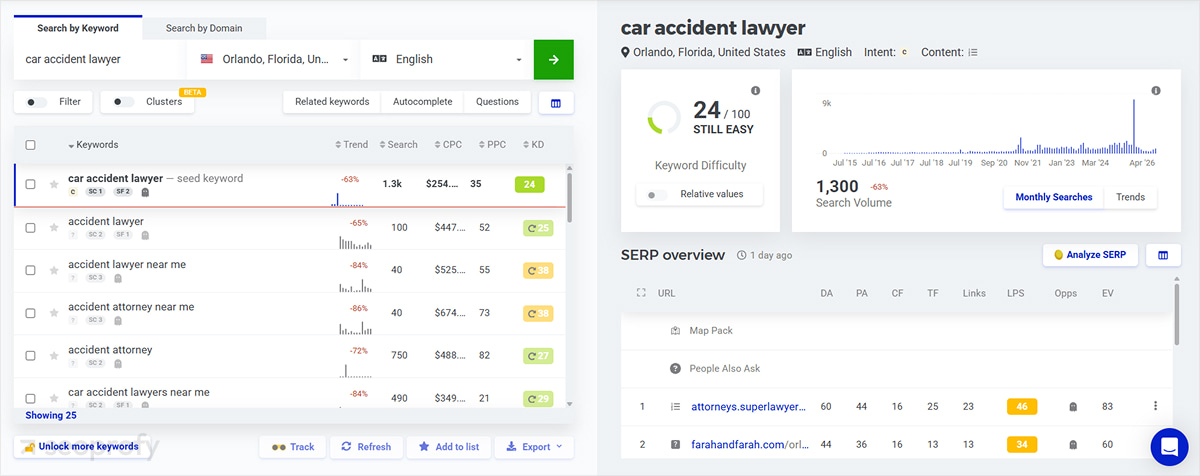
In KWFinder, you can see the local search performance for each of your main terms. This is especially useful if your practice serves multiple locations. Take the term “car accident lawyer” as an example. In Orlando, this query gets around 1,300 searches a month and has a fairly low keyword difficulty of 24 — winnable for a focused firm.
Run the same term for New York City, and it’s a different sport: 4,500 searches and a difficulty of 73.
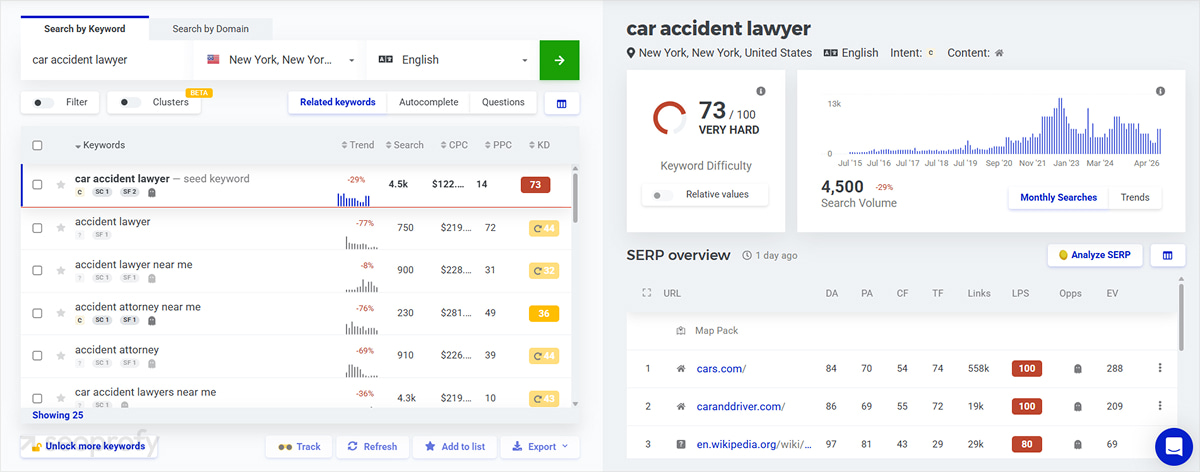
Same keyword, two markets, two completely different levels of effort. That gap is why SEO for personal injury attorneys has to be built around your actual city, not national averages.
Google Keyword Planner adds another angle — related terms and long-tail variations with strong commercial intent that other tools miss. It’s also handy for PI lawyer SEO when you want to watch how a topic trends over time.
50 Personal Injury Keywords for SEO
Not sure where to start your keyword research? Below are some examples of search queries that could be a great starting point for your strategy, based on June 2026 data for the United States from Ahrefs:
| Keyword | Difficulty | Monthly Search Volume |
| personal injury lawyer | 33 | 220,000 |
| car accident lawyer | 23 | 198,000 |
| truck accident lawyer | 1 | 113,000 |
| motorcycle accident lawyer | 2 | 108,000 |
| wrongful death lawyer | 0 | 102,000 |
| accident lawyer | 39 | 95,000 |
| injury lawyer | 28 | 87,000 |
| dog bite lawyer | 1 | 68,000 |
| slip and fall lawyer | 0 | 63,000 |
| personal injury lawyer near me | 39 | 60,000 |
| medical malpractice lawyer | 1 | 58,000 |
| auto accident lawyer | 10 | 56,000 |
| personal injury lawyers | 18 | 55,000 |
| pedestrian accident lawyer | 0 | 54,000 |
| workers compensation lawyer | 5 | 54,000 |
| bicycle accident lawyer | 2 | 54,000 |
| car accident lawyers | 17 | 49,000 |
| birth injury lawyer | 0 | 38,000 |
| car accident lawyer near me | 37 | 37,000 |
| brain injury lawyer | 0 | 35,000 |
| auto accident lawyers | 8 | 34,000 |
| accident lawyers | 55 | 33,000 |
| slip and fall lawyers | 0 | 33,000 |
| uber accident lawyer | 0 | 33,000 |
| truck accident lawyers | 1 | 33,000 |
| injury lawyers | 49 | 30,000 |
| motorcycle accident lawyers | 1 | 29,000 |
| catastrophic injury lawyer | 0 | 29,000 |
| workers comp lawyer | 5 | 24,000 |
| injury lawyer near me | 61 | 23,000 |
| truck accident lawyer near me | 0 | 22,000 |
| workers compensation lawyers | 1 | 21,000 |
| medical malpractice lawyers | 1 | 19,000 |
| lyft accident lawyer | 0 | 19,000 |
| car accident lawyers near me | 8 | 17,000 |
| accident lawyer near me | 35 | 15,000 |
| accident lawyers near me | 58 | 15,000 |
| medical malpractice lawyer near me | 3 | 9,000 |
| slip and fall lawyer near me | 47 | 8,500 |
| auto injury lawyers | 37 | 6,300 |
| work accident lawyer | 2 | 5,600 |
| car accident lawyer houston | 59 | 5,400 |
| best car accident lawyer near me | 29 | 5,300 |
| lawyers for auto accidents | 24 | 5,200 |
| lawyers for car accidents | 13 | 5,100 |
| workers comp lawyer near me | 1 | 4,900 |
| auto accidents lawyers | 22 | 3,400 |
| accident injury lawyers | 49 | 3,300 |
| motorcycle accident lawyers near me | 4 | 3,000 |
| top accident and personal injury lawyers | 12 | 1,000 |
Build a Keyword Map
In our keyword research services, we usually take the data from both tools and add it to a simple keyword mapping sheet similar to the table above, writing down the search volume and KD of each.
Push the list further by sorting terms three ways: intent (informational vs. commercial), location (city name vs. “near me”), and case type. Commercial terms with a city modifier belong on service and location pages. Informational queries like “how long do I have to file a claim?” are blog and FAQ material that builds authority and feeds internal links.
3. High-Quality Content for Lawyers
Your site is where prospects look for answers and a little reassurance. Good legal content writing does three jobs at once: it shows you know the work, builds trust, and moves a reader toward calling. Strong content is also the backbone of SEO for personal injury lawyers — it’s what ranks, what gets cited by AI, and what converts.
Start with Your Service Pages
Service pages are the core. Each should cover a case type you handle — car accidents, slip-and-falls, medical malpractice — and use relevant keywords from the list you mapped. However, the phrases must be used naturally, without forcing them into the content. Keyword stuffing can hurt your SEO efforts because search engines now view this as an attempt to manipulate rankings.
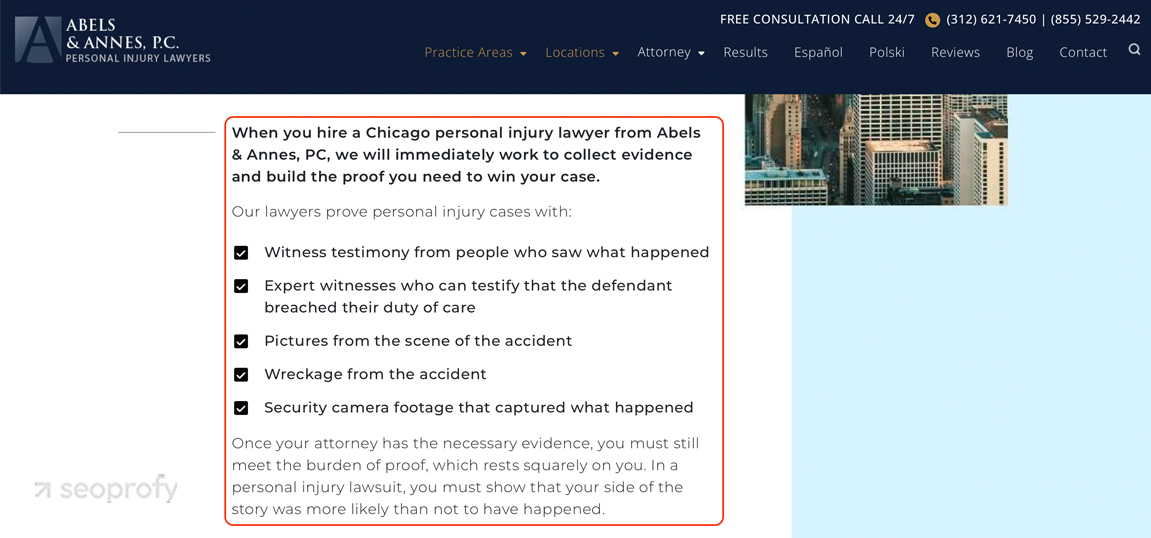
Walk visitors through the process, the timelines, and what working with you looks like. Here’s a good example from Abels & Annes. Their page walks visitors through the kind of evidence they collect and what clients can expect after hiring them.
Checklist: What a Strong PI Service Page Needs
Before a service page goes live, check it against this list:
- A clear H1 with the case type and city, e.g., “Orlando Truck Accident Lawyer”
- A direct opening that answers “can this firm handle my case?” in the first few lines
- What you cover: case types, the claims process, typical timelines
- Proof: results or settlements (within bar rules), reviews, and credentials
- Plain-language answers to the questions clients actually ask
- One obvious next step — a visible phone number and a short contact form
- Internal links to related practice areas and relevant blog posts
- Schema markup (Attorney/LegalService) so search engines and AI can parse the page.
Add Blog Content for Earlier Searches
Service pages catch people ready to hire. Blog posts catch the ones still figuring things out.
Use the informational terms from your map to answer common worries, and lean into long-tail questions — lower competition, higher intent, ideal for blogging content that targets a specific situation. Keep older posts current, too. When the law shifts, or you win a notable case, update the page; search engines favor fresh, accurate content, and so do the AI systems now summarizing it.
If you lean on AI to draft, treat the output as a first pass and add the real examples and judgment that show you understand what a hurt client faces. Many marketers use AI content for SEO, and Google doesn’t punish AI-generated text, but it requires even more attention to quality and value.
4. On-Page SEO for Injury Attorneys
On-page SEO is where your research turns into changes on the actual pages. It helps both Google and the potential personal injury clients it sends you make sense of each page.
On-Page Basics
Without these elements, they simply won’t be able to understand your website:
- Title tags and meta descriptions: Give each page a unique title with its main keyword and a description that sums it up and earns the click.
- Headers (H1, H2, H3, etc.): Use one H1 matching the page topic and target term; H2s and H3s to break up sections and work in related terms. Clean structure helps readers skim and helps AI lift answers straight from your page.
- Site structure and navigation: Every important page should be reachable from the main menu in a click or two. Logical paths help users and the bots crawling you.
Above-the-Fold Content and Location Pages
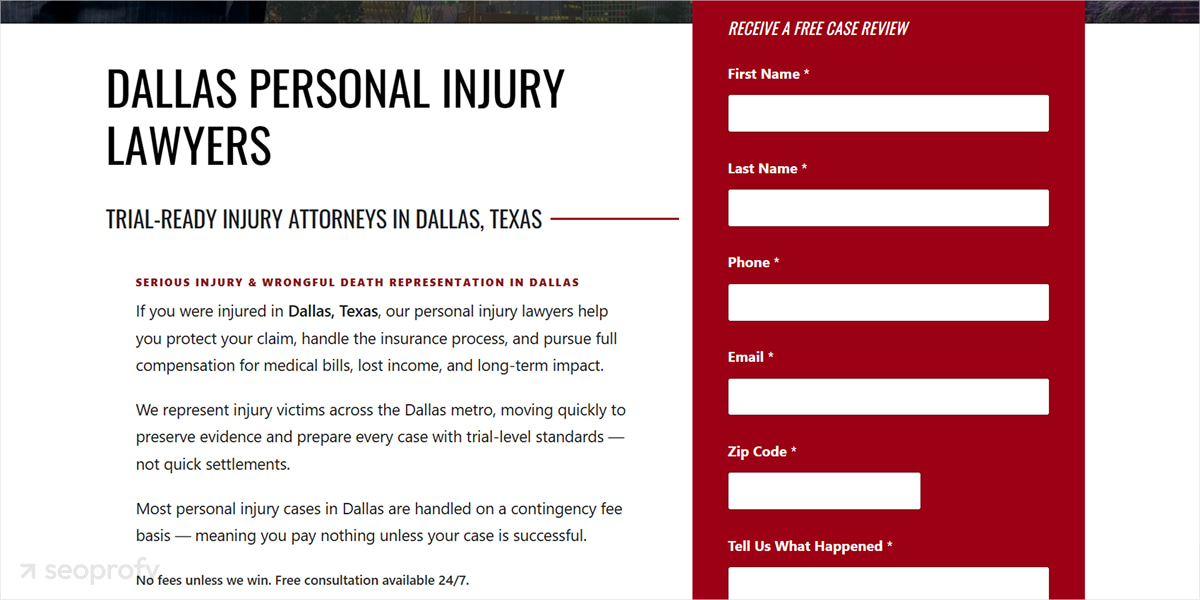
The top of the page decides whether a visitor stays. Lead with a clear headline (main keyword included), a one-line summary of what you do, and an obvious way to make contact — a phone number, a short form, and a few reviews or recognitions, like the layout on Thomson Law. Done right, this is what makes search engine optimization for personal injury lawyers convert, not just rank.
If you have offices in more than one city, give each its own page with local keywords, the address, and a local phone number. Generic “areas we serve” lists don’t rank; dedicated pages do, and they squeeze more ROI out of your personal injury SEO by capturing traffic you’d otherwise miss.
5. Local SEO Tactics for Better Visibility
No personal injury marketing strategy can succeed without local SEO for lawyers. If someone gets hurt in Miami, for example, they don’t search for “personal injury lawyer” — they search “personal injury lawyer near me” or “Miami car accident attorney.”
Local searches are where the commercial intent lives. These are usually high-intent clients who are actively seeking legal assistance and know what they need. Nearly half of consumers add “near me” to their queries, and Google leans into it — the local pack shows up ahead of standard results most of the time on local search engine results pages and takes 44% of the clicks.
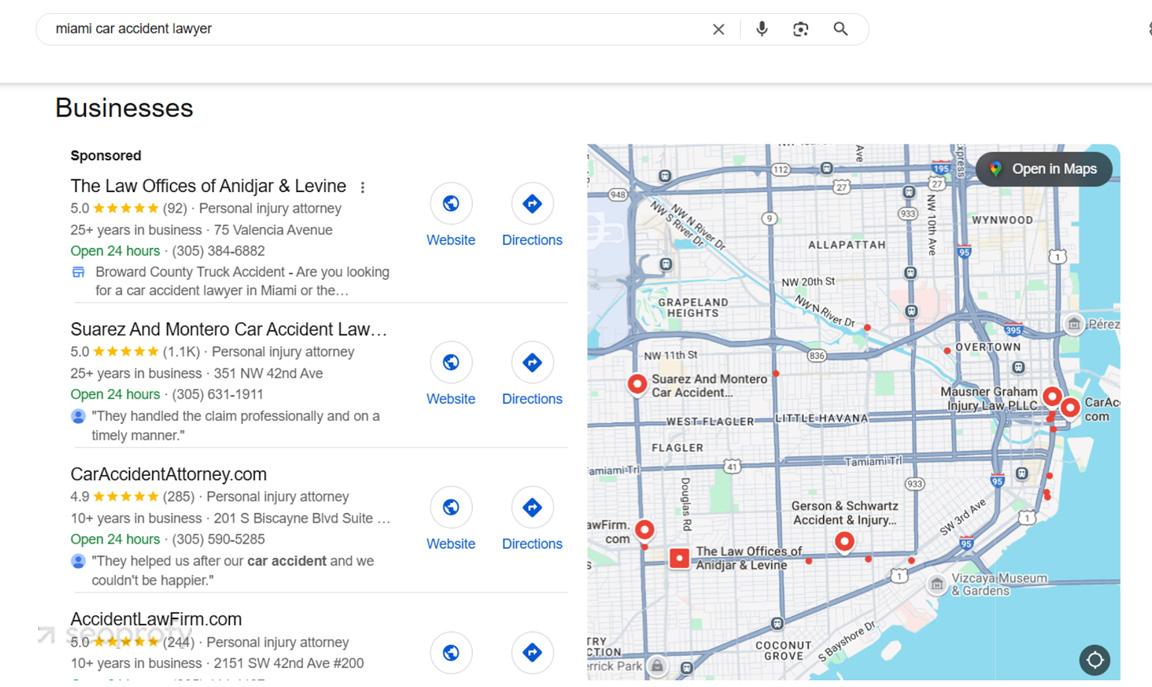
Plus, accident victims tend not to use traditional directories, relying more on local searches and reading reviews to find options faster. Done consistently, local SEO for personal injury lawyers turns map-pack visibility into steady call volume.
Optimize Your Google Business Profile
The main component of local SEO strategies is the Google Business Profile (GBP). This is the first thing potential local clients see, and your job is to give them all the information they need, so they choose you over competitors. Here’s a GBP optimization checklist to cover the basics:
- Fill every field (name, address, phone, hours, website, and services) and keep it accurate
- Set “personal injury attorney” as your primary category; add case-type categories (e.g., wrongful death) as secondary
- Add real photos of your office and team; faces build familiarity before the first call
- Collect reviews continuously and respond to each one — 89% of consumers expect a reply, and recent, consistent reviews carry the most weight
- Post updates and answer questions so the profile looks active
- Keep your name, address, and phone identical across every directory.
Don’t Skip Local Service Ads
In the U.S. and Canada, Google’s Local Service Ads sit above everything else and connect you with people actively looking for a lawyer. They’re pay-per-lead, not pay-per-click, so you only pay for real inquiries — a fast way to get personal injury clients while your organic rankings gain momentum.
You’ll need to pass a background check and submit firm documents to qualify. But they’re worth the setup. LSAs already rank as the second most effective lead channel for 11% of firms.
6. Link Building Strategy for Personal Injury SEO
Link building for lawyers is an important part of every SEO strategy and even more so in the competitive personal injury industry. Google still treats links as a key ranking signal, so the more trustworthy sites point to you, the better your odds in the results. Pull up the SERP for “Miami car accident lawyer,” and the pattern is obvious — most pages ranking on the first page have a strong backlink profile.
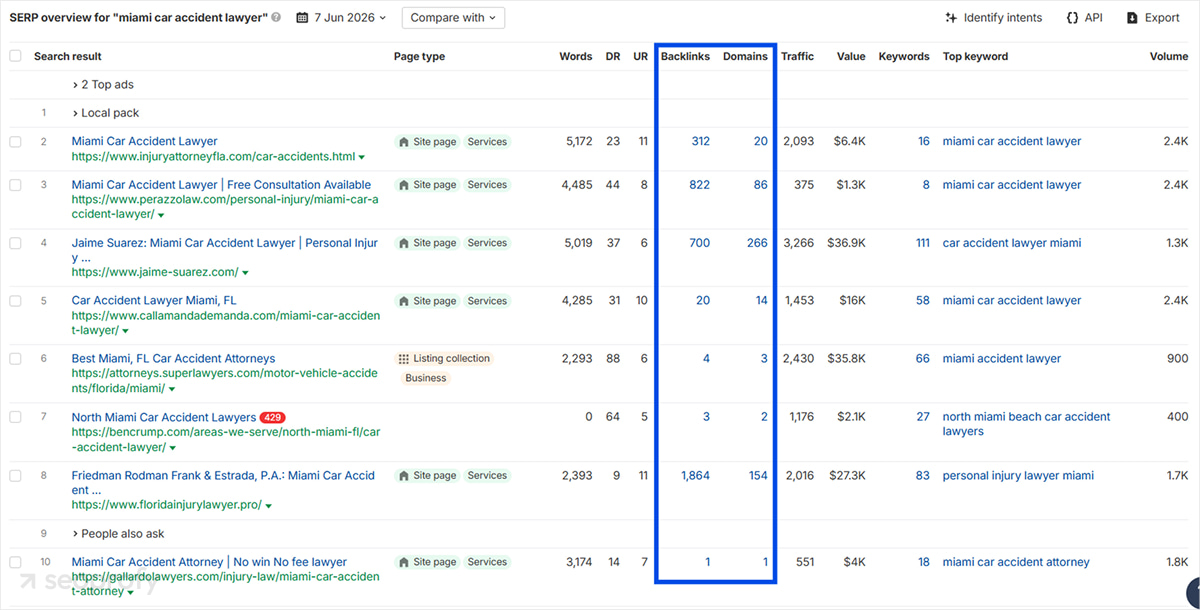
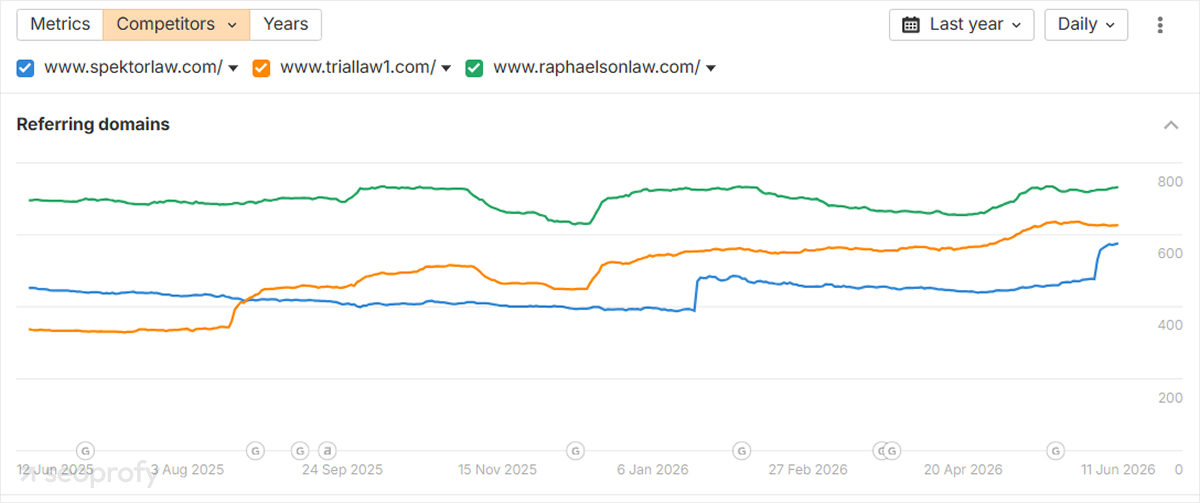
The same pattern shows up in New York. Personal injury law firms in the top three have steady, positive backlink dynamics.
Where the Good Links Come From
A few link building strategies remain consistently reliable in SEO for personal injury law firms:
- Self-publishing in legal directories: Avvo, Justia, FindLaw, and Martindale-Hubbell are trusted by Google and often show up high in search results. Claim your profile and fill it out with the exact business details you use everywhere else.
- Guest posting and collaborations: Articles for respected legal blogs, bar association sites, or local publications reach the right readers and earn quality links. It’s also a common tactic we use in our link building services for lawyers.
- Digital PR and data: Pitch reporters local injury or safety data — crash counts at a dangerous intersection, seasonal accident trends. Newsworthy angles earn links from high-authority news sites and increasingly get pulled into AI answers.
- Community involvement: Sponsor local events or support nonprofits; these organizations often list and link to the firms that back them.
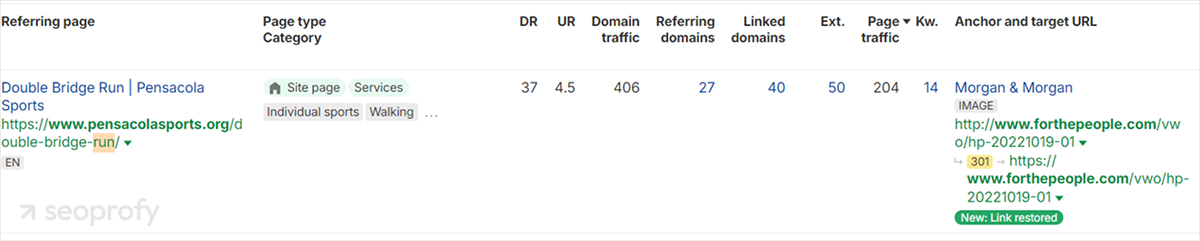
The last one deserves special attention in local SEO efforts. For example, this local running event was sponsored by Morgan & Morgan, listing them in the sponsor section on the event’s web page:
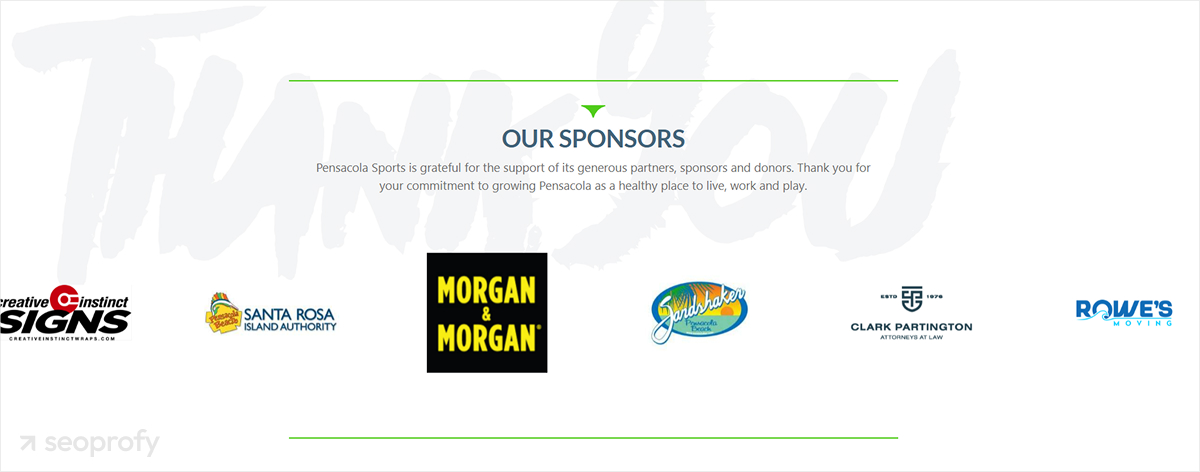
As a result, the law firm got a valuable backlink:
Checklist: Your First 10 Quality PI Links
Starting close to scratch? Aim for these ten first:
- Google Business Profile, claimed and complete
- Avvo profile
- Justia profile
- FindLaw or Martindale-Hubbell listing
- Your state bar association directory
- Local bar association or chamber of commerce
- A “best lawyers in [city]” or local business roundup
- A sponsorship or nonprofit you support locally
- A guest article on a respected legal or local site
- A university or alumni listing, if you guest-lecture or mentor
The most important link building advice: Chase relevance, not volume. The links that move search engine rankings are the ones that make sense for your practice and your city — directory listings, bar mentions, local features. Build those steadily, and your authority climbs and stays put.
7. Technical SEO for Law Firm Websites
The visibility and performance of a personal injury attorney website also depend on how technically sound it is. Site speed, mobile usability, and how Google crawls and indexes your pages are the technical foundations of any successful SEO strategy.
Technical SEO Essentials
First of all, fix broken links, redirect chains, duplicate titles, and missing meta descriptions. Once the basics are covered, keep these areas in good shape:
- Site security (HTTPS): A valid SSL certificate must be present on every page.
- Core Web Vitals: Make sure loading times, interactivity, and visual stability are within Google’s thresholds.
- Mobile usability: Most injury searches happen on phones, so the mobile version is the real version.
- Crawlability and indexing: Create and submit a clean sitemap; no blocked resources, no orphan pages.
- Structured data: Add the Attorney, LegalService, and FAQ schema so search engines and AI tools can read your pages.
How to Audit and Optimize Your Site’s Technical Health
There are multiple tools that can help you optimize your personal injury lawyer website and find potential issues. PageSpeed Insights shows what’s slowing you down. Screaming Frog (free up to 500 URLs) flags broken links, missing titles, and redirect chains. Google Search Console reports what’s indexed and surfaces crawl errors.
This is the piece most firms hand to a specialist — if no one on your team can fix it, a law firm SEO audit pinpoints the issues and hands you a fix-it list in order.
8. Performance Tracking and Strategy Adjustment
Launching the strategy isn’t the finish line. Track how it performs and adjust based on what the numbers say. Which metrics you watch depends on your SEO goals, but these are the ones we monitor for legal clients:
- Organic traffic: Check how many users visit your site from unpaid search results and which pages tend to attract the most leads. Healthy website traffic graphs should climb month after month, not be a flat line.
- Keyword rankings: Monitor how many keywords your pages rank for, with special attention to local search rankings. A realistic goal is ranking among the top 10 results for 3–5 or more commercial terms.
- Conversion rate: Measure how many people take action after landing on your site, such as submitting a consultation form. Effective SEO strategies show higher conversion rates than PPC.
- Local traffic from GBP: Track review clicks, calls, and direction requests that come from your GBP listing. These should outpace referrals as your main source of new leads.
Our personal injury SEO company pulls these metrics from Google Analytics, Search Console, and our internal dashboards. These numbers show us which pages attract visitors and, more importantly, what kind of SEO ROI you get from your efforts.
In 2026, it also makes sense to analyze your AI visibility. As about 40% of consumers trust AI to learn about local businesses, and Google’s AI Overviews reach more than 2 billion people, you need an AI-ready SEO strategy that includes monitoring that takes generative responses and AI services into account.
Still, there’s an aspect of traditional search that must also be monitored: Google algorithm updates. There are regular reviews of the search engine’s ranking systems that can cause significant SERP changes, impacting your website traffic and search rankings. Take this into account when monitoring your site’s performance.
Tools like Ahrefs highlight Google events in their graphs to help you analyze whether a shift in traffic or rankings is connected to a core or spam update. It’s also helpful to check the Google Search Status Dashboard if you notice something unusual in your reports.
SEO Ethics for Personal Injury Law Firms
Lawyer advertising is regulated, and SEO is advertising, even if it’s not the same as traditional paid promotion. Most state bars follow the spirit of the ABA Model Rules: your marketing can’t be false or misleading, and how you present results, reviews, and specialization is fair game for scrutiny. Rules vary by state, so treat the examples below as a starting point and check your own bar’s guidance.
What Counts as Ethical SEO
Most good “white-hat SEO” is also compliant SEO:
- Accurate, truthful content that describes your services and experience honestly, with the disclaimers your state requires
- Real reviews from real clients, never bought or invented
- Honest framing of “specialist” or “expert” claims, matched to what your bar actually allows
- Credentials, case results, and awards you can back up
- Links earned on merit: directories, bar listings, genuine features.
Truthful, well-structured pages are exactly what rank and bring long-term results.
What Can Get You in Trouble
The shortcuts that cause problems:
- Fake or incentivized reviews
- Misleading superlatives like “#1 injury lawyer” or “best in the state,” where your bar prohibits unverifiable claims
- Undisclosed paid endorsements or testimonials dressed up as organic
- Claiming a specialization or certification you don’t hold
- Buying spammy links or running link schemes that violate Google’s guidelines and can sink the whole site, which also qualifies as “black-hat SEO.”
When in doubt, ask your bar before you publish.
Amplify Your Personal Injury Lawyer SEO with SeoProfy
The personal injury market is crowded, expensive, and brutal if you’re invisible in search. To compete, work with a law firm SEO agency that has both the expertise and the results to show for it.
SeoProfy has achieved real outcomes for legal websites, such as a 1,300% growth in qualified leads and a 940% increase in top 10 keyword rankings in this case study. We know what your clients search for and what it takes to rank in competitive markets.
If you’re serious about growing your caseload, get in touch. We build sustainable and predictable SEO for personal injury lawyers around how legal prospects actually behave online, so you get more qualified leads and booked consultations.
FAQ About Personal Injury Lawyer SEO
How Long Does SEO for a Personal Injury Law Firm Take?
Expect early traction in 3–6 months and meaningful lead flow by 6–9 months. Most firms break even on their SEO investments around month 14, though leads start sooner.
How Much Does Personal Injury SEO Cost in 2026?
The cost of SEO starts from $1,000 for simpler packages for small firms and can reach $10,000 for full-scope SEO for large companies. See our guide to law firm SEO cost for more details on what impacts the pricing and the average budgets.
Is Google Business Profile Optimization Enough?
No. A strong profile is essential, but on its own, it won’t rank your service pages, win competitive keywords, or feed AI answers. Treat it as one piece alongside content, on-page work, and links.
Should I Choose SEO or Local Service Ads and Paid Ads?
Both, if you can. LSAs and PPC bring leads now; SEO builds the cheaper, compounding flow that lasts.
Do I Need Separate Location Pages?
Yes, if you provide legal services in more than one city. Give each office a dedicated page with local keywords, address, and phone, and write genuinely different content for each.
Can AI Optimization Actually Bring in Personal Injury Clients?
It can. Today, 45% of consumers use tools like ChatGPT for local recommendations, and AI Overviews answer a growing share of searches. Optimizing your pages for AI visibility increases your chances of earning LLM citations.

Andrew Shum is the Head of SEO at SeoProfy with 10+ years of experience in SEO and digital marketing. He has been part of the company for over 6 years and has led the SEO department for the past 3.5 years, managing a team of 15+ specialists. He works with competitive and international multi-language projects across eCommerce, SaaS, and enterprise niches, focusing on practical SEO strategies that deliver measurable results.