


AI SEO for law firms works when it removes slow manual steps without weakening legal accuracy. A firm can use AI to cluster keywords, outline pages, rewrite unclear copy, sort site issues, and monitor search visibility. It cannot verify a statute, protect client data, judge bar rules, or decide which cases the firm should pursue.


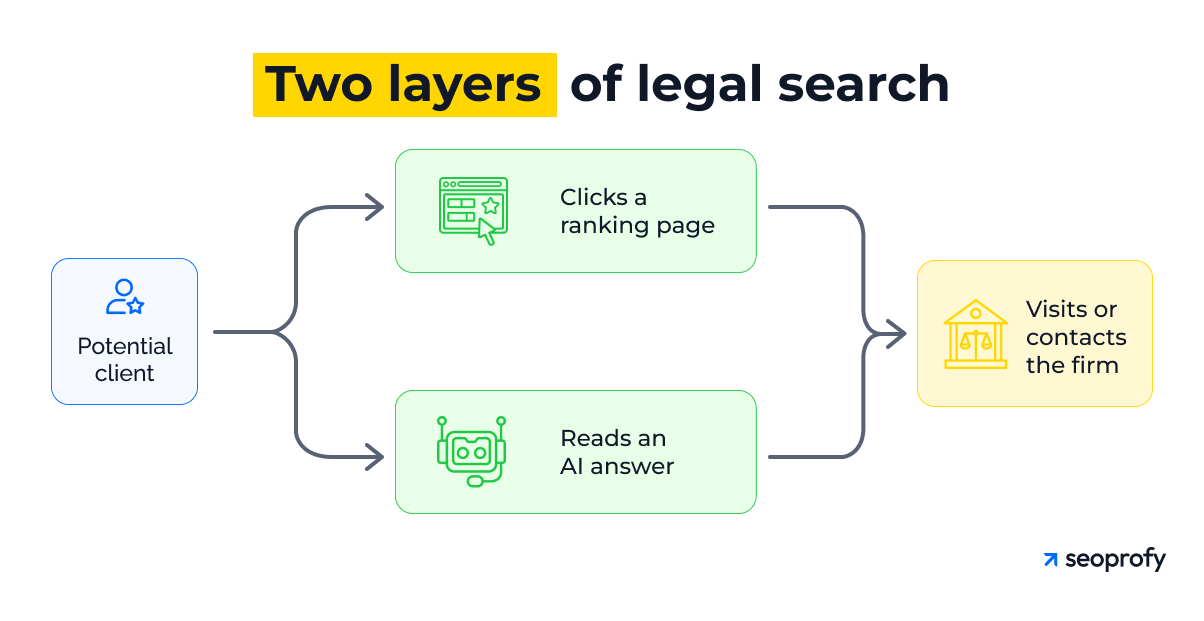
Legal search now has two layers. Your potential client may still click a ranking page, but they may also read an AI answer or compare firms inside ChatGPT or Perplexity before visiting any website. In this guide, we focus on the working process, including prompts, review rules, practical checks, and places where human judgment must stay in control.
- AI can cluster keywords, draft copy, and sort technical issues, but it can’t verify a statute, protect client data, or judge bar rules.
- An AI Overview presence correlates with a 58% lower average CTR for top-ranking pages, so citations now matter as much as rankings.
- Every AI prompt used for law firm SEO should force the model to flag uncertainty instead of inventing volume, difficulty, or facts.
- Measure AI SEO monthly across Search Console performance, AI visibility in ChatGPT and Perplexity, and referral traffic together.
- AI works best as an operations layer, while attorneys and editors stay responsible for claims, compliance, and client trust.
Where AI Actually Fits in the Law Firm SEO Workflow
AI is more useful when it comes to middle work. In law firm SEO, that means turning a messy keyword export into page groups, a crawl report into priorities, or a dense attorney draft into language a client can understand.
It’s important to remember that it should not become the source of truth. SEO for lawyers allows a firm to turn legal expertise into searchable pages, but the expertise still has to come from the firm. AI can organize the material, but the attorney and SEO team should decide what is correct, compliant, and commercially useful.
| AI Search vs. Traditional SEO | Primary Goal | Focus | Measurement |
| Traditional SEO | Rank and earn clicks | Pages, links, site health, local authority | Rankings, CTR, traffic, leads |
| AI Search | Be cited or recommended | Direct answers, trusted entities, source-backed facts | Citations, mentions, AI referrals, assisted leads |
Ahrefs found in 2026 that AI Overviews correlated with a 58% lower average CTR for top-ranking pages, based on 300,000 keywords compared across Dec. 2023 and Dec. 2025.
Google also confirms there is no need for llms.txt, special schema.org markup, or forced content chunking to appear in generative AI search. Good generative engine optimization and overall search engine optimization start with crawlable, useful pages, not tricks.
Think of GEO for law firms as an added visibility layer. The same pages still need strong structure, clear legal explanations, technical access, law firm local SEO, and trustworthy authority.
AI-Assisted Keyword & Content Research Prompts
Most law firms already have plenty of keyword data. You can find dozens of content opportunities through Search Console queries, SEO tool exports, call transcripts, live chat logs, and consultation notes, but manually sorting them takes time.
The two prompts below are designed to speed up the law firm SEO process. The first helps organize keywords into pages that match search intent, and the second uncovers the questions potential clients ask before they contact a lawyer and highlights content gaps competitors may already be covering.
Both prompts work best when you give the AI real inputs from your firm instead of asking it to generate ideas from scratch.
The AI Prompt for Clustering Keywords by Intent
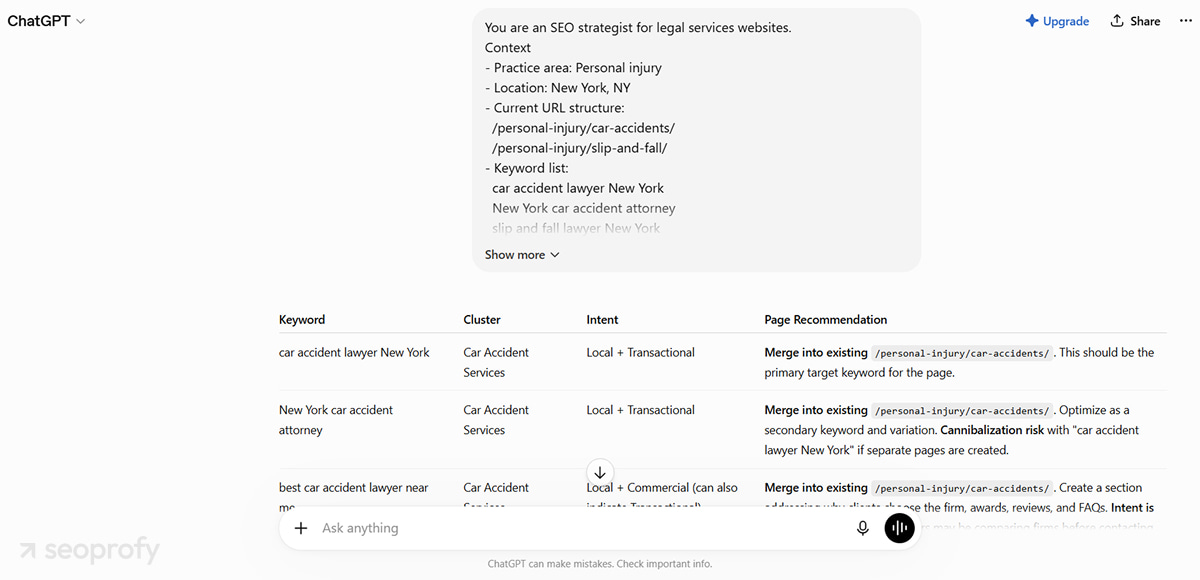
Before using the prompt, add the firm’s location, services, existing URLs, and preferred case types. Tell AI not to invent search volume or difficulty. It should classify intent and flag uncertainty. This keeps the output useful for a law firm SEO strategy, not fake data.
Then, developing a dedicated LLM SEO strategy for that specific project will help refine the existing pages so they are easier for search engines and AI systems to understand.
Example
You are an SEO strategist for legal services websites.
Context
Practice area: [PRACTICE AREA]
Location: [CITY, STATE]
Current URL structure: [PASTE]
Keyword list: [PASTE]
Task
Cluster the keywords by intent: informational, commercial, transactional, or local. Recommend whether each cluster needs a new page or should be merged into an existing page. Flag cannibalization risks and keywords with unclear intent. Do not invent search volume, difficulty, or traffic estimates.
Output as a table
Keyword | Cluster | Intent | Page Recommendation
AI Prompts for PAA Questions and Competitor Analysis
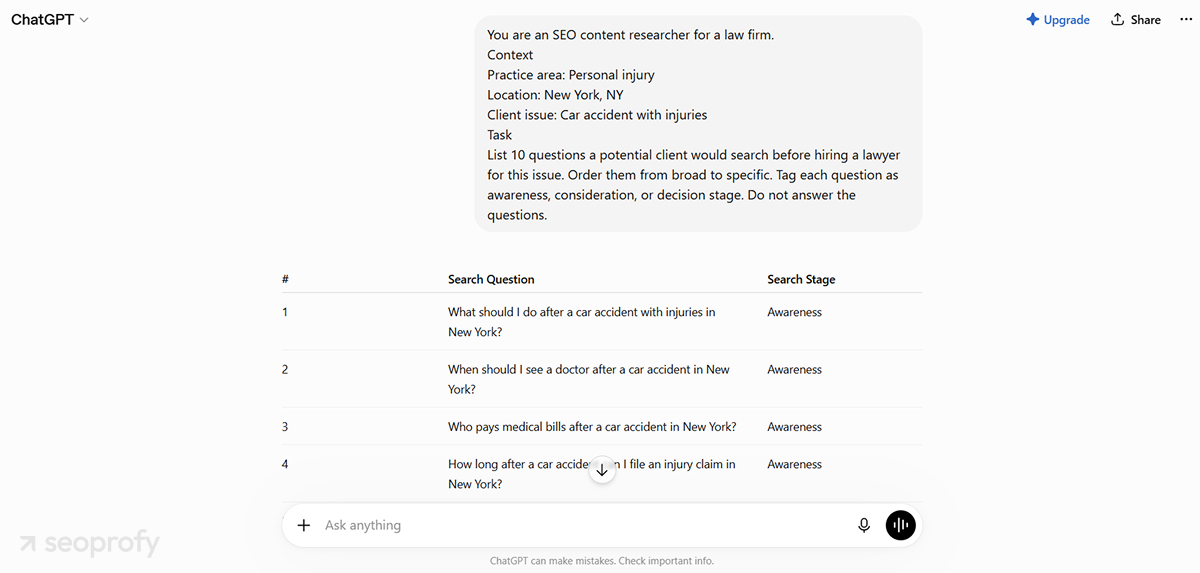
Clients don’t search like lawyers write. Instead, they search things like “can my employer fire me while pregnant,” not “pregnancy discrimination legal remedies.” AI can help translate legal topics into client language, but the output still needs to be checked against real SERPs, intake calls, and the firm’s actual services. These law firm SEO tactics are useful at the research stage because they help separate early education questions from hiring-intent questions before the team writes the brief.
Example 1
You are an SEO content researcher for a law firm.
Context
Practice area: [PRACTICE AREA]
Location: [CITY, STATE]
Client issue: [ISSUE]
Task
List 10 questions a potential client would search before hiring a lawyer for this issue. Order them from broad to specific. Tag each question as awareness, consideration, or decision stage. Do not answer the questions.
Example 2
You are reviewing competitors for a legal SEO brief.
Context
Keyword: [KEYWORD]
Top 5 ranking titles and meta descriptions: [PASTE]
Task
Infer what subtopics these pages likely cover. Separate what is certain from what is inferred. Do not invent laws, statistics, cases, or competitor claims.
Output
Likely Subtopic | Certain or Inferred | Needs Manual Check
The second prompt is only a planning shortcut. Someone still has to open the pages, check the facts, and decide where the firm can add stronger legal experience.
Drafting Practice-Area Content and FAQs Without Losing Your Voice
AI drafts often fail because they explain the topic, but they do not sound like someone who has handled calls from anxious clients. That is a problem in law firm SEO because the page has to rank and make the visitor feel understood. It also matters for law firm search engine optimisation, because a page can be technically optimized and still feel empty if it does not answer the client’s real concerns.
A strong practice-area page should quickly answer what is happening, what can go wrong, and when to speak to a lawyer. Here’s how to do it:
- Start with an attorney-approved outline, not a blank prompt.
- Give AI the target reader, practice area, and page goal.
- Ask it to simplify the language without changing legal meaning.
- Require short sentences and plain-English explanations of legal terms.
- Have an editor check whether every factual and legal claim stayed intact.
Example
You are editing legal marketing copy for a law firm.
Task
Rewrite the text so it sounds like an experienced paralegal calmly explaining the situation to a worried client on the phone.
Rules
- Keep sentences under 20 words.
- Explain legal terms in plain language in the same sentence.
- Remove stiff or generic marketing phrases.
- Keep all factual and legal claims unchanged.
- Do not add laws, cases, deadlines, or promises.
Text to rewrite: [PASTE]
AI Ethics & Compliance Checklist for Legal Marketing Content
Legal content needs a stricter AI review process. Staff should not paste client names, case files, medical records, police reports, settlement details, or privileged communications into public AI tools. AI-assisted copy should also have one clear owner who approves it before publication.
In Mata v. Avianca, attorneys submitted fake AI-generated case citations. The court imposed a $5,000 sanction and required disclosure letters to the client and affected judges. For AI SEO for law firms, compliance is a crucial part of the workflow that should never be overlooked.
Before publishing, check that:
- No client-identifying data was entered.
- Cases, statutes, deadlines, fees, and quotes were verified.
- State-specific claims were reviewed by a qualified person.
- The copy avoids guarantees and unsupported “best” claims.
- Bar advertising rules were followed.
AI for Predictive Client Acquisition and On-Site Personalization
Predictive work should start with patterns the firm can responsibly act on. GEO for law firms can connect local patterns with useful pages and intake paths.
As part of search engine optimization for attorneys, AI can help spot which topics need updates before demand peaks, based on search queries, intake notes, and local events.
On the site, AI chat can route visitors faster. Someone asking about license suspension should see the right DUI FAQ, attorney bio, and consultation path.
That is the difference in generative engine optimization vs traditional SEO. Strong generative engine optimization tools help a page rank, get summarized, and guide the next step without pretending AI is legal counsel.
AI Workflows for Technical SEO and Schema Audits
AI is strong at sorting technical exports, but quite weak at knowing business impact unless you tell it what matters. Give it a crawl file, Search Console notes, page type, and conversion priority. Then ask it to sort issues by likely ranking impact.
Example 1
You are a technical SEO auditor for a law firm website.
Task
Sort this crawl-issues export into three categories: fix this week, 30 days, and 90 days. Prioritize by likely ranking impact and lead value, not ease of fix.
Output as: Issue | Bucket | Justification | Pages affected
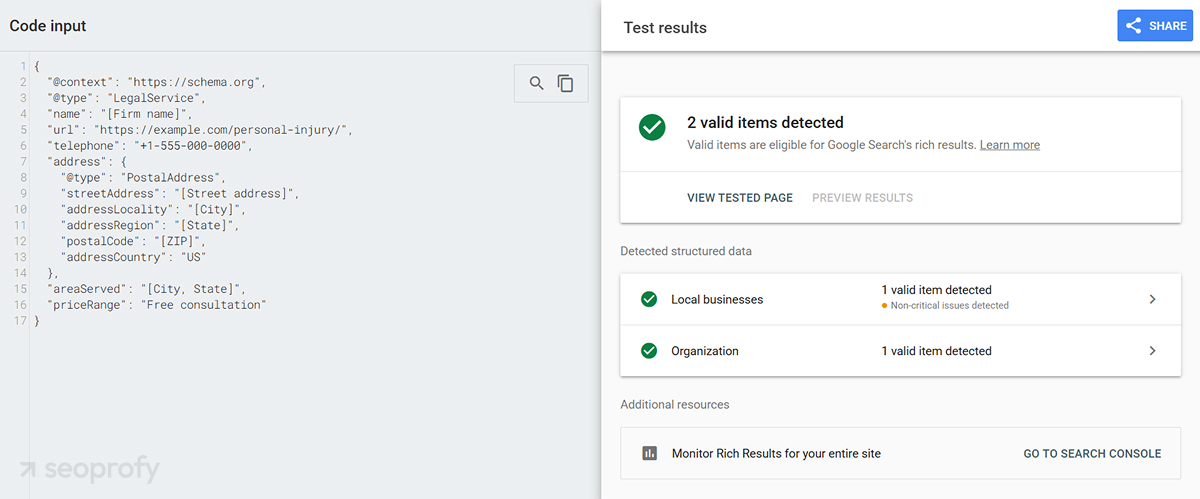
AI can draft JSON-LD, but never publish it unchecked. Google says structured data should match visible page content, and there is no special schema markup required for AI features. Validate output with Google’s Rich Results Test before it goes live.
Example 2
You are a technical SEO auditor for a law firm website.
Task
Generate JSON-LD schema using LegalService and FAQPage for this page: [DETAILS]. Use only schema.org vocabulary. Do not invent values for fields I have not provided. Mark missing information as NEEDS HUMAN INPUT.
AI-Assisted Link Prospecting for Law Firms
AI can support link prospecting, but it should not be asked to invent websites. Start with a backlink gap analysis from real competitors, clean the list, and use AI to group opportunities by source type, relevance, and outreach angle.
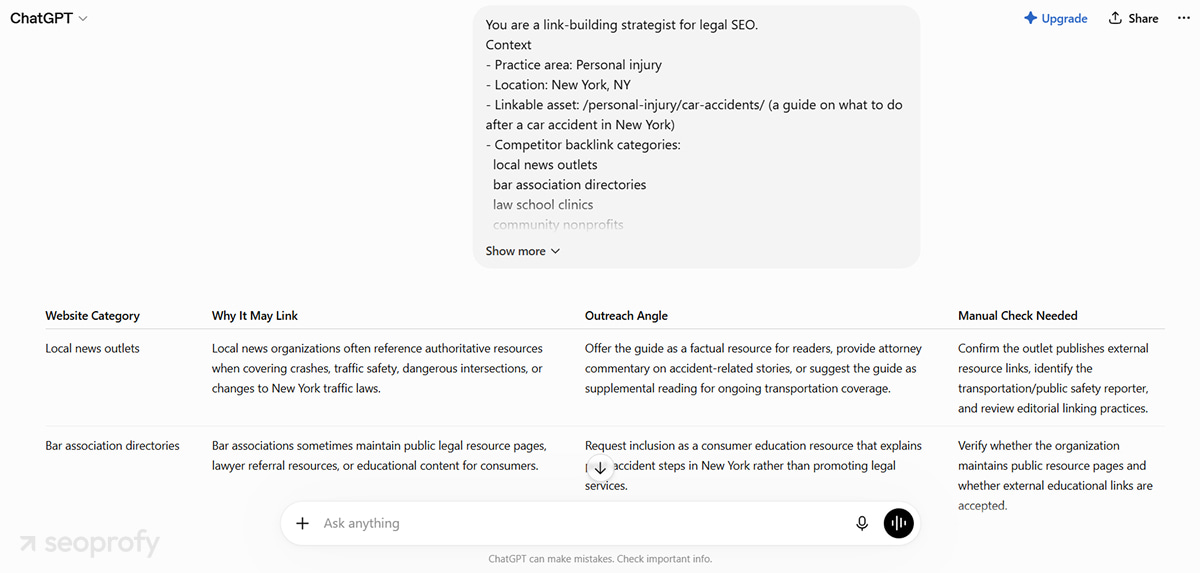
A good prompt needs the firm’s practice area, location, and the asset you want links to. That asset could be a legal checklist, local data page, FAQ guide, scholarship page, or practical resource. Ask for categories and outreach angles first, then verify every real prospect manually.
- Export competitor referring domains.
- Remove spam, scraper sites, and weak directories.
- Group useful domains by type: local press, universities, nonprofits, bar associations, legal blogs, or podcasts.
- Give AI the cleaned categories and linkable assets.
- Ask it for realistic outreach angles, not a final list of domains.
Example
You are a link-building strategist for legal SEO.
Context
Practice area: [PRACTICE AREA]
Location: [CITY, STATE]
Linkable asset: [TOPIC OR URL]
Competitor backlink categories: [PASTE]
Task
Suggest realistic link prospecting angles. Do not invent domains. For each category, explain why it may link, what outreach angle could work, and what needs manual verification.
Output
Website Category | Why It May Link | Outreach Angle | Manual Check Needed
SeoProfy is an experienced law firm SEO company that can audit your firm’s content, site health, and AI citation readiness to build a roadmap for rankings and qualified case inquiries.

Measuring Whether Your AI SEO for Law Firms Is Working
Measure the workflow monthly, not after every small content change. Google confirms that traffic from AI features appears in the standard Search Console Performance report under the Web search type, so there is no separate AI Overview report to depend on. Here’s how to measure if your AI SEO is working:
- Check Search Console in week one: Review priority pages for impressions, clicks, average position, queries gained, and queries lost.
- Test AI visibility in week two: Run 10-20 priority prompts in ChatGPT, Perplexity, and Google. Record whether the firm appears, which competitors show up, and which URLs get cited.
- Review referral data in week three: In GA4, check traffic from sources like chatgpt.com and perplexity.ai. Look at landing pages, engagement, and conversions.
- Make updates in week four: Refresh one page, strengthen one internal link path, and improve one third-party profile or citation source.
You can use AI SEO statistics for market context, but judge your own results by qualified consultations, signed cases, and stronger lead generation for lawyers. A solo marketer can handle basic checks, briefs, and FAQ updates. A law firm SEO agency becomes more useful when the work involves site architecture, attorney review workflows, local competition, link acquisition, or multi-location strategy.
Frequently Asked Questions
Can I use ChatGPT to write my law firm’s website content?
Yes, but use it for drafts, outlines, FAQs, and tone edits, not final legal guidance. An attorney or trained editor should verify every claim, deadline, case reference, jurisdiction note, and advertising statement before publishing. For AI SEO for law firms, review is one of the most important parts of the workflow.
How much of law firm SEO can realistically be automated with AI?
AI can speed up keyword clustering, briefs, content edits, crawl-report sorting, schema drafts, and reporting summaries. It should not automate legal judgment, client confidentiality decisions, final strategy, or outreach approval. Strong law firm SEO still keeps humans in charge of risk.
Is it risky for a law firm to rely on AI SEO tools?
It is risky when the firm treats AI output as verified. The safer approach is to use generative engine optimization tools for organization and acceleration, then require human checks for law, facts, tone, compliance, and privacy. The tool can assist, but the firm owns the result.
Do I still need an SEO agency if I use AI workflows myself?
You may need law firm SEO services for audits, local search problems, link building, content strategy, tracking, and competitive markets. AI lowers production time, but it does not replace experience with legal SERPs.
How long before an AI SEO workflow shows results?
Early gains can show in 30-60 days if the site already has authority and the fixes target pages close to visibility in search results. Bigger gains take longer because law firm SEO still depends on content quality, links, local trust, site access, and conversion tracking.
Making AI SEO Workflows Work for Your Firm
AI SEO for law firms only works when the firm treats AI as an operations layer, not a strategist. Use it to organize research, expose gaps, tighten structure, and make reporting clearer. Keep attorneys and editors responsible for claims, compliance, and client trust.
The firms that benefit most will build a repeatable system around real inputs, specific prompts, careful review, and monthly updates. That is how AI SEO for law firms supports answer engine optimization, stronger visibility, and better paths for prospective clients without turning into another marketing experiment.

Julia Lubianytska is a Copywriting Team Lead at SeoProfy with over 7 years of experience in copywriting and editing. She works closely with copywriting teams, helping writers craft clear and thoughtful content for SaaS products, IT services, and businesses in the legal and medical fields. Julia enjoys turning complex topics into easy-to-understand, trustworthy content, focusing on structure, clarity, and consistency to ensure the content is genuinely helpful for real people, not just search engines.