


96% of people turn to search engines first when seeking legal services. And if your law firm isn’t ranking on page one, you’re missing most of them — the top organic result captures 27.6% of all clicks. That number is shifting as AI Overviews reshape the SERP, but one thing stays the same: visibility at the moment of intent is everything.


That’s what SEO for lawyers comes down to. Not brand awareness, not social media reach — showing up when a potential client types “personal injury lawyer near me” or “divorce attorney in Chicago” and needs help today.
In this guide, you’ll find everything you need to build that visibility: how law firm SEO works in 2026, which ranking factors matter most, and step-by-step tactics for local search, Google Business Profile (GBP), content, backlinks, and AI search optimization.
- 96% of people searching for legal advice start with a search engine
- Law firms that invest in SEO see an average ROI of 526% over 3 years
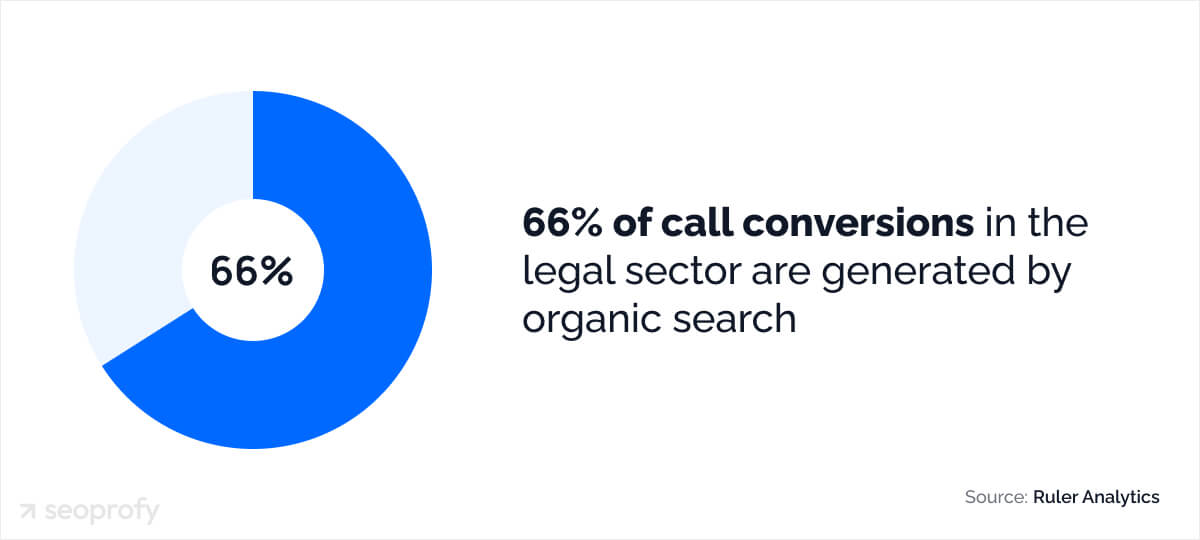
- Organic search drives up to 66% of call conversions in the legal sector — more than any other digital channel
- Competitive legal keywords can cost $300+ per click in paid search, making a strong organic presence significantly more cost-efficient in the long term
- 94% of law firms name search engines as their top channel for new client acquisition
- SEO budgets typically range from $2,500–$5,000/month for small firms and $10,000–$20,000 for large ones. The right investment depends on your market, the level of competition, and your practice area.
What Is Law Firm SEO?
Law firm SEO is the process of optimizing a law firm’s website to rank higher in search engine results for relevant keywords. These terms may be generally related to your niche (e.g., “attorney” or “law firm”) or be more specific for a particular location or niche (e.g., “family lawyer Chicago” or “NYC injury attorney”). With the help of an efficient SEO strategy, you ensure that a person will see your website when they enter this or that keyword in Google or other search engines.
However, attorney search engine optimization doesn’t stop at driving more traffic. With high-quality content, keyword targeting, and technical website optimization, time-tested SEO practices can help you convert visitors into loyal clients.
In addition, SEO isn’t limited solely to your website. When someone searches for a lawyer, they might also check out a law firm’s listings on directory sites and review platforms to see what others say. Optimizing and updating your company’s Google Business Profile is another aspect of law firm SEO practices.
With all the different pieces that go into a full-fledged SEO campaign for law firms, the potential advantages are extensive. But what specifically makes search engine optimization so valuable for lawyers looking to grow their practices?
Why Is SEO so Important for Lawyers in 2026?
SEO gives attorneys a sustainable way to build visibility and attract clients who are actively looking for legal help. But the landscape has shifted — and understanding that shift is what makes SEO strategy in 2026 different from what it was even two years ago.
AI Overviews now appear in 25% of all Google searches. For informational legal queries like “what to do after a car accident,” users increasingly get a direct summary without visiting any website. According to Ahrefs, this has reduced click-through rates for top-ranking pages by up to 58%. That’s a real change in how informational content performs.
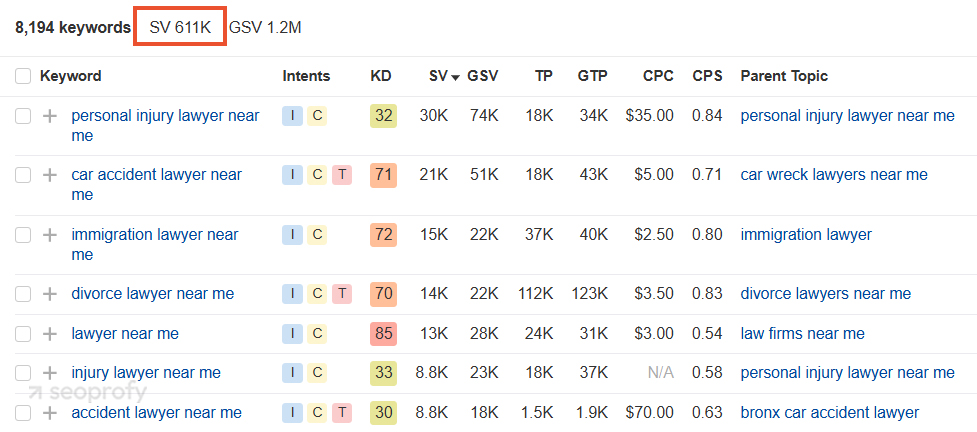
What it doesn’t change is the value of high-intent search. When someone types “personal injury lawyer near me” or “divorce attorney in Chicago,” they need a real person — not an AI summary. Transactional and local-intent queries are far less affected by zero-click behavior, and they’re the ones that drive consultations and retained cases. The “lawyer near me” keyword cluster alone generates over 600,000 monthly searches. Ranking position for these terms still directly translates to calls and cases.
Beyond traditional search, platforms like ChatGPT and Perplexity are now actively citing sources when answering legal questions. This is where AEO and GEO come in — optimization approaches that extend traditional SEO rather than replace it. Law firms with authoritative content, strong backlinks, and a credible online presence are better positioned to appear in these AI citations. The foundation is the same; the opportunity is new.
The business case remains strong across all of this. According to our legal marketing statistics, organic search drives up to 66% of call conversions in the legal sector — more than any other digital channel. 94% of law firms name search engines as their top channel for new client acquisition, ahead of referrals, social media, and paid advertising combined. Firms that invest consistently in SEO report an average 526% ROI over three years, with some seeing a 266% increase in cases within the first year.
Unlike paid ads, which stop the moment budgets pause, SEO builds compounding visibility over time — reaching people who are already looking for legal services, at the exact moment they’re ready to act.
SEO vs. Paid Ads for Lawyers
Both paid advertising and SEO have their merits. The first one offers instant results. With platforms like Google Ads, you can bid on keywords and have your firm’s ads displayed at the top of search engine results pages.
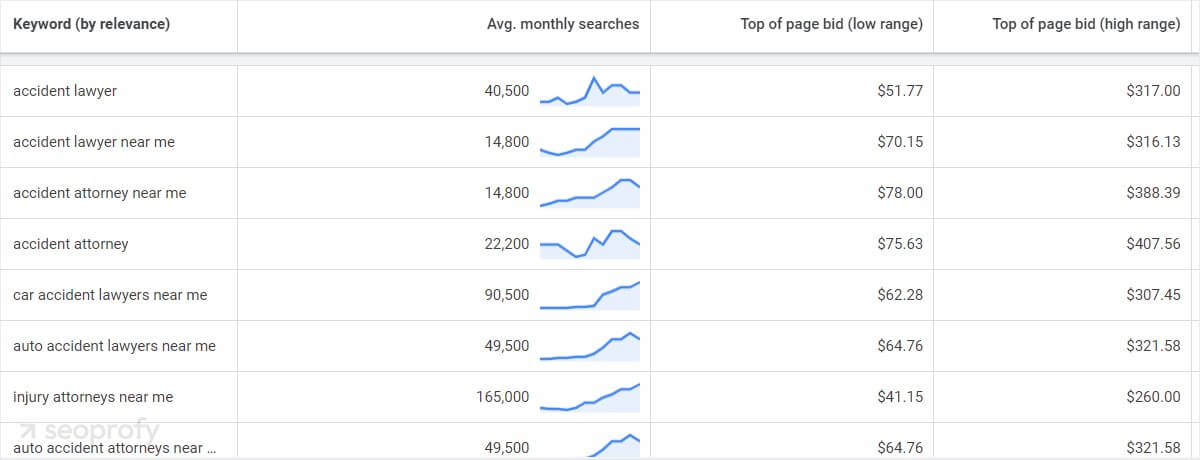
However, you also have to pay when someone clicks on your ad. Further, the more competitive the keywords, the pricier the clicks get. In fact, for some competitive legal keywords, the cost per click can reach $300.
What’s more, as soon as you stop paying, your traffic immediately disappears.
On the other hand, the fruits of your legal SEO efforts compound over time. Once you’ve earned a coveted spot on the first page for your target keywords, you’ll continue to reap the benefits of organic traffic and lead generation with minimal maintenance.
Recent benchmark data shows that SEO continues to outperform paid search in legal marketing. In Legal Services, the average conversion rate is 4.4%, compared to 2.2% for Google Ads, meaning organic search converts at roughly 2x the rate of paid search.
More broadly, cross-industry benchmarks show that average conversion rates by marketing source vary significantly by channel. Ruler Analytics reports average conversion rates of 3.3% for direct traffic, 2.9% for referral, 2.7% for organic search, 2.6% for email, 1.5% for social media, and 3.2% for paid search across fourteen industries. It does not replace the legal-specific benchmark above, but it helps show why channel mix and intent matter so much when evaluating performance.
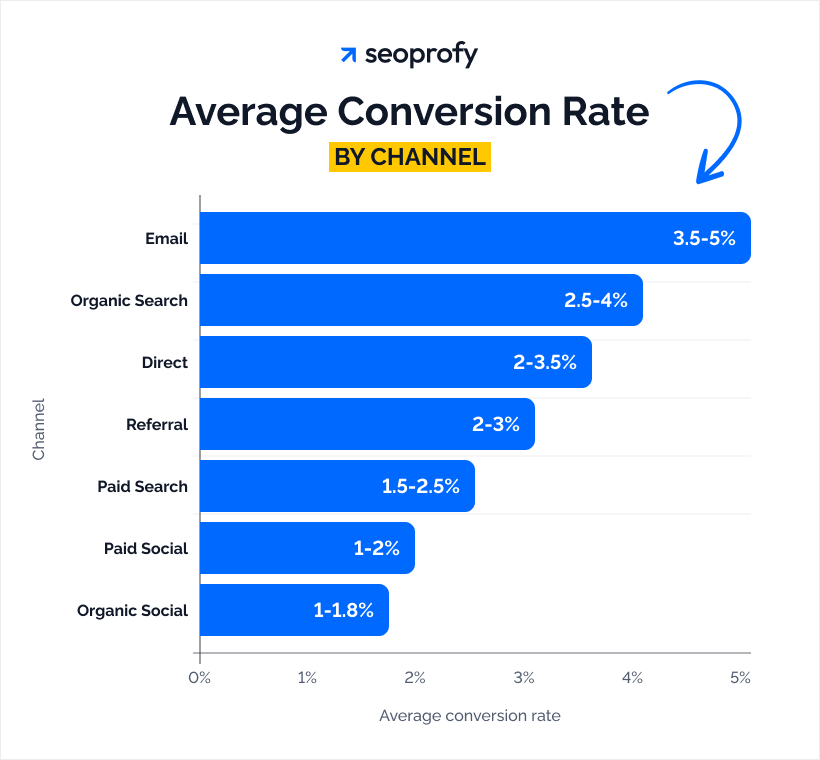
Now that you understand the difference between these channels and their possible impact on your revenue, let’s summarize the pros and cons of each for your law firm:
|
Benefits of SEO |
Drawbacks of SEO |
|
|
|
Benefits of PPC |
Drawbacks of PPC |
|
|
While paid ads certainly have their place in marketing, relying solely on this approach for a high-cost industry like legal services can drain your budget. Building a strong local search presence through law firm SEO may yield better long-term results.
Look for ways to balance SEO and PPC marketing tactics. You might begin with a stronger focus on PPC, increase your SEO efforts over time, and then reduce your PPC spending as your organic reach grows.
If you’ve decided to focus on SEO as your main digital marketing strategy, let’s look at the major factors that impact your search engine rankings.
Lawyer SEO Ranking Factors
Search engines like Google use complex ranking algorithms that evaluate hundreds of different factors. However, some factors carry much more weight than others on law firm websites. Here are the major ones to focus on:
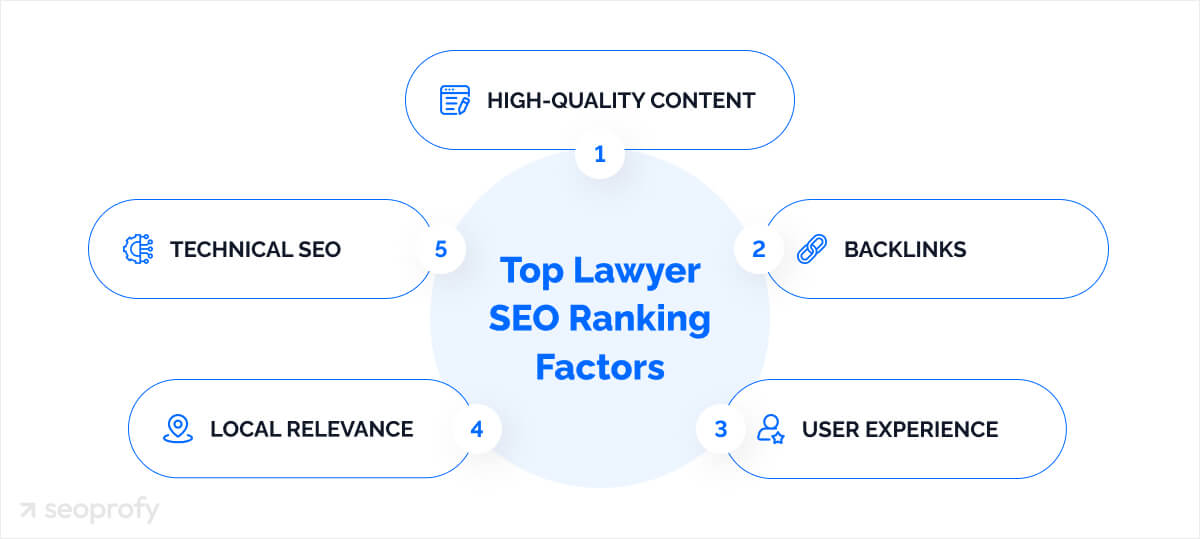
High-Quality Content
Effective attorney SEO starts with a great content marketing strategy. Google pays close attention to quality when choosing which websites to rank highly. So, whenever you implement a law firm SEO campaign, ensure that all texts on your service pages and blog posts offer accurate, relevant, and helpful information.
First, get acquainted with our ultimate tips that can help you with content writing for law firms. Also, don’t forget to use our checklist every time you want to create another SEO-friendly piece:
- Review existing content to identify gaps and opportunities for updates
- Identify relevant keywords and create diverse content types
- Show expertise, experience, authoritativeness, and trustworthiness (E-E-A-T) with credible sources and attorney qualifications
- Adhere to legal marketing regulations and focus on user experience
- Track content performance and adjust your strategy accordingly
When it comes to the content types for law firms, you could be focusing on:
- Blog posts: Articles exploring various legal concepts.
- Frequently asked questions: Dedicated FAQ pages answering common questions about legal processes, law services, the firm’s fees, etc.
- Case studies and firm updates: Content highlighting successful cases, firm news and updates, community involvement, and more.
- Legal guides and ebooks: Long-form downloadable content that provides a thorough analysis of legal topics.
In addition, the performance of this content in Google search results depends on how well it is optimized with keywords.
Backlinks
Your digital marketing campaign will never bring the desired results without proper link building for lawyers. This process involves the implementation of different practices focused on improving your site’s backlink profile, which is an important SEO ranking factor for attorneys. It includes links from other sites that point to your website (so-called backlinks). They inform Google about the reliability of your content. The more reputable and relevant sites that link to your web pages, the higher your pages are likely to rank.
Let’s take a look at the search engine results page for the query “Los Angeles personal injury lawyer.” The websites that take the first positions have high domain rankings (DR) and powerful backlink profiles.
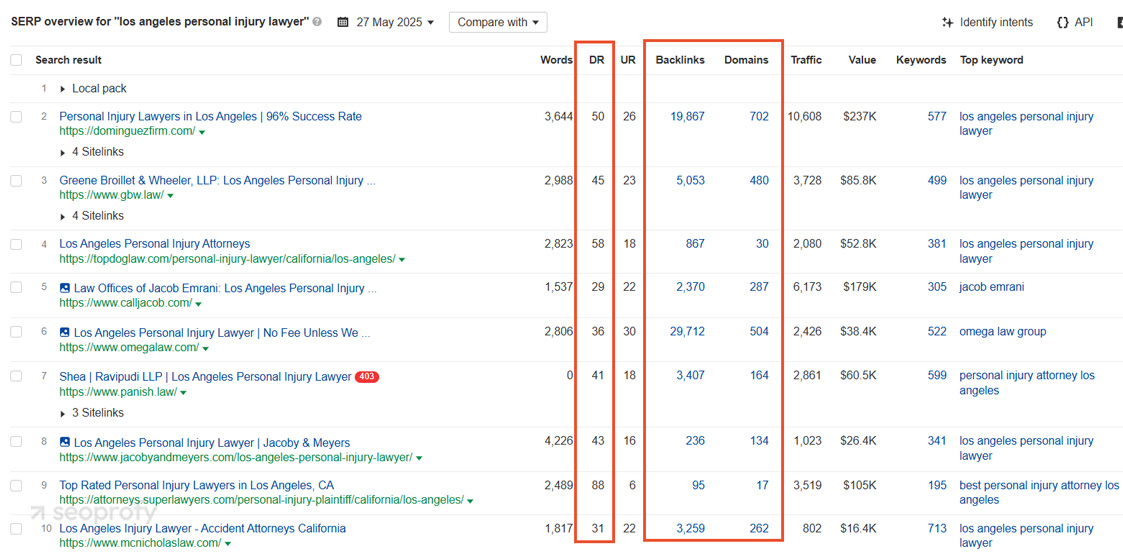
To have a chance of competing with such sites, you would have to reach the same results at least. It makes link building especially important for newly launched websites that haven’t yet established their authority.
User Experience
The user-friendliness of a website plays a crucial role in the success of SEO marketing for lawyers. Moreover, a lot of attorneys neglect this fact, so if you optimize all your site’s elements, you’ll get a strong chance of standing out from the crowd and gaining the desired keyword rankings.
While performing SEO for a law firm, ensure that all pages on your website load quickly, work well on all devices, and have clear navigation. A perfect user experience, combined with valuable and exciting content, can drive traffic growth and, eventually, revenue.
In addition, focus on visual elements. Consider that most lawyers’ websites have almost identical designs. It means they won’t stand out to users who might be browsing different sites and considering several options.
If your legal website loads slowly or is hard to use, your visitors will most likely quickly return to the search results, increasing your bounce rate and lowering your rankings. If they stay on your page a bit longer, poor usability might discourage them from performing a necessary action (booking a consultation, filling out a form, etc.).
Local Relevance
If you’re looking for prospective clients in a specific city or region, the implementation of efficient local SEO for lawyers is a must. That is also how most people search online for legal services in their area. First, ensure your firm’s information is complete and consistent across listings and local directories. It’ll help Google know where your practice is located and who your target audience is. Plus, getting positive reviews from local clients is critical, as many users check them before deciding whether to opt for your legal services.
Obtaining links from local websites is also a part of local SEO for law firms. It’s also important to make sure that location keywords and the cities or neighborhoods you serve are included in your website’s content, titles, and location landing pages.
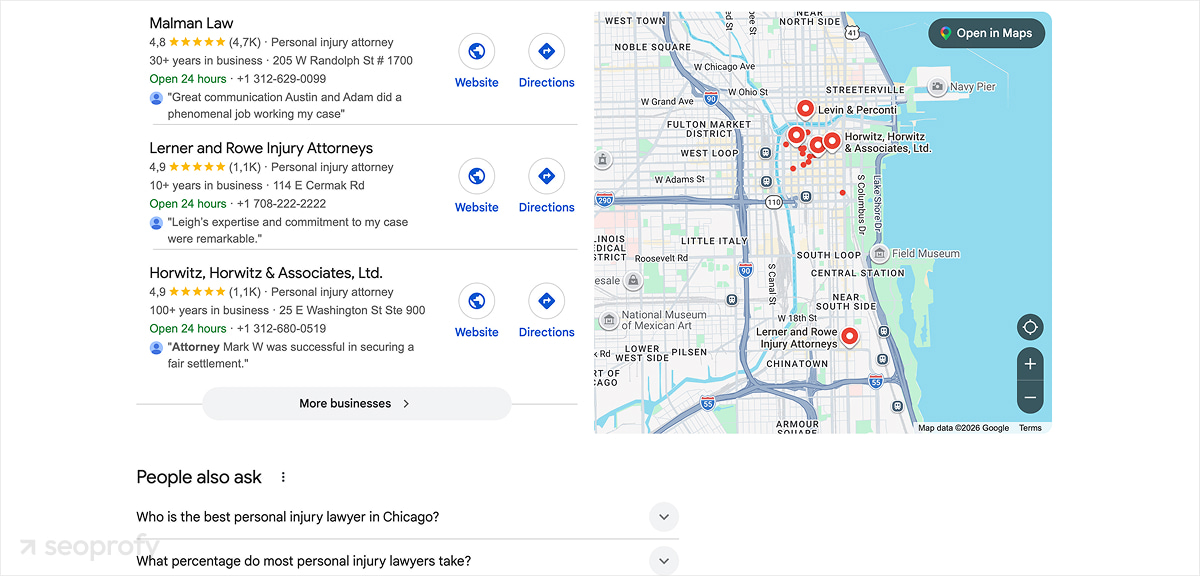
However, Google Maps and Google Business Profile are the most critical things to optimize for regional relevance. In local search results, Google often shows users a Local Pack, a special section that shows relevant businesses on Google Maps. For example, here’s what the SERP for the “personal injury lawyer Boston” query looks like:
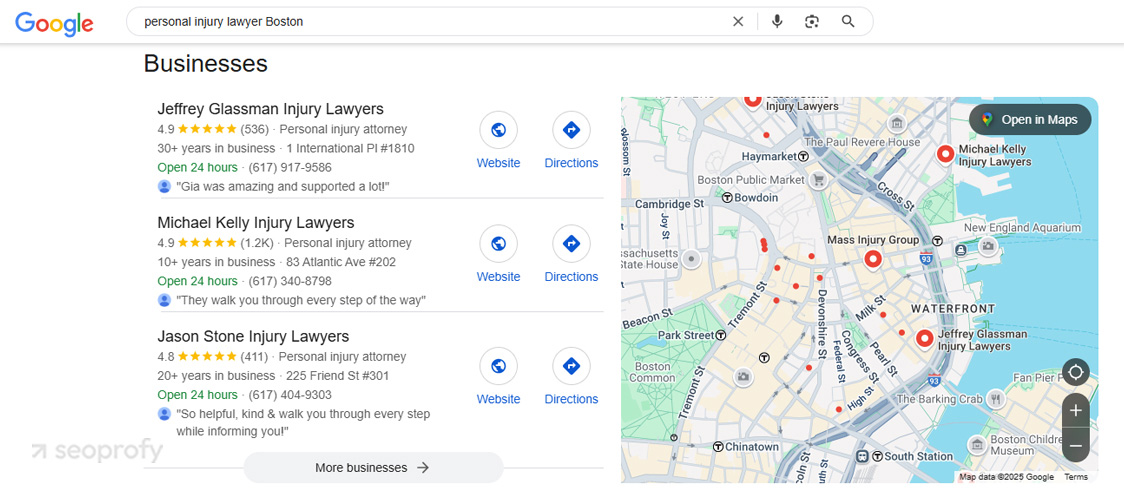
An optimized, frequently updated GBP listing is a key factor in ranking in local results and on Google Maps.
Technical SEO
All our SEO case studies show that improving your site’s technical foundation is as important as building a backlink profile and writing interesting content.
Sometimes, even a minor issue with the website’s security, architecture, or URL structure can prevent it from reaching the top of search results. Thus, we always strongly recommend our clients perform an efficient audit and provide them with valuable recommendations to solve these technical SEO problems:
- Duplicate content
- Keyword cannibalization
- Broken pages and redirects
- Issues with Core Web Vitals (LCP, FID, CLS) thresholds
- Problems with indexing and crawling
- Missing, duplicated, or unoptimized meta tags
There are many SEO best practices to follow that can help you improve your website’s performance in all these areas.
Schema Markup
Schema markup is a key part of technical SEO that many law firms overlook. It is structured data that gives search engines explicit, machine-readable context about your content — labeling each element. Hence, algorithms know this is a law firm, this attorney handles personal injury cases, and these are verified client reviews. Without it, Google can still read your pages, but with it, your content is processed and displayed correctly. And increasingly, schema is what helps your firm appear in AI-generated answers.
For law firms, four schema types matter most:
LegalService schema identifies your firm as a legal services provider. It tells search engines your practice places, service area, address, and contact details in a format machines can read directly. It is helpful for local rankings and appearing in AI-generated answers.
Attorney schema marks up individual lawyer profiles with credentials, bar admissions, specializations, and years of experience. Google’s quality guidelines place heavy emphasis on expertise and authoritativeness for legal content, and the attorney schema can provide the structured evidence search engines need.
The FAQ schema makes your Q&A content more extractable by AI Overviews and tools like ChatGPT and Perplexity. When someone asks, “How long does a personal injury case take?“, the FAQ schema increases the likelihood that your firm’s answer will be cited. Build FAQ sections from real questions your clients ask during intake calls and from Google’s People Also Ask results.
Review schema helps surface star ratings and client testimonials directly in search results. Law firms with visible review data can get higher click-through rates, and those ratings also feed into the trust signals search engines use when ranking local results.
Remember to validate all schemas with Google’s Rich Results Test before publishing. Search engines ignore markup errors entirely.
Our law firm SEO company offers fully customized strategies to help you reach your business goals:
- Increased revenue and steady flow of loyal clients
- Boosted authority in the local communities
- Enhanced client retention

How to Improve Your Law Firm SEO
Search engine optimization can provide a consistent flow of leads from organic local search traffic, but only if done right. Here are the steps you should take to ensure your SEO efforts are successful:
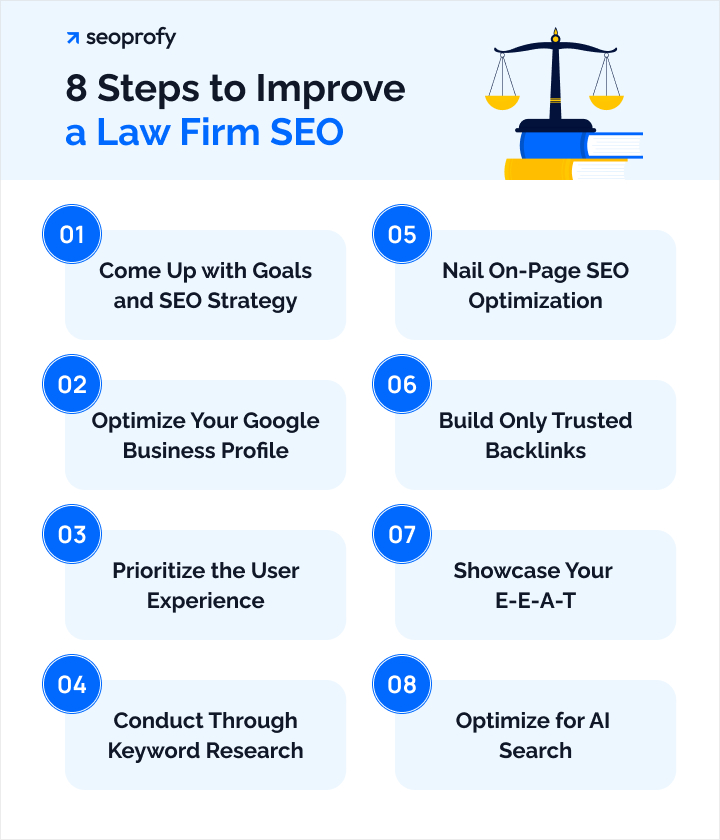
Come Up with Goals and SEO Strategy
A clearly defined lawyer SEO strategy gives you a roadmap for what to prioritize, how to measure progress, and when to adjust course. Your law firm SEO strategy should reflect your business goals, practice area, and target audience. There is no one-size-fits-all approach that works for every attorney.
Thus, you should start by setting the main tasks for your SEO campaign. For example, are you trying to increase organic traffic, improve search engine rankings, or generate more client inquiries?
Once you’ve done with the first step, it’s time to estimate the current condition of your website and pay attention to how your local competitors execute SEO. Using the best marketing tools for law firms like Google Analytics, Google Search Console, Ahrefs, and Semrush, you can easily perform comprehensive research, including:
- Exploring your site: You need to define the core strengths and weaknesses of your website in terms of search engine optimization efforts. Evaluate how many relevant keywords are covered by the content on your landing pages and blog posts. Also, check the condition of your backlink profile to ensure there are no broken links or those obtained from unreliable sources. Finally, check your site’s performance, focusing on page load speed, mobile optimization, and other key metrics.
- Analyzing competitors: Exploring your opponents can provide valuable insights. Find out whether their blogs cover the topics that are missing on your website. It’s a good idea to use these ideas in your own content to add more value for potential readers. Also, you should focus on their backlink profiles, as they’re a great way to discover authoritative websites and online directories that may provide your site with valuable backlinks.
In addition, ensure that your strategy aligns with the search intent and behavior patterns of your potential clients. Knowing your audience’s pain points and interests is essential for crafting content that not only attracts their attention but also inspires them to opt for your legal services.
At the same time, you should set clear expectations and goals for your SEO campaign. It’ll help you effectively track your progress and estimate ROI. Some common KPIs for law companies include:
- The amount of organic search traffic: Remember to separate website traffic going to your main landing pages from traffic going to informational content pages. Getting visits to your service pages is ultimately more valuable for lead generation.
- Positions on targeted search queries: The ideal scenario is for your law firm’s website to appear on the first page of organic search results for phrases related to your practice. If you don’t currently rank on the first page, continue tracking the improvements. Moving up even a few spots each month indicates that your law firm SEO strategy is working.
- The number of leads: This is arguably the most meaningful SEO metric for your law firm to watch closely. How many form fills, phone calls, or other signals of prospective client interest do you get each month from organic search? This metric directly shows the return on your SEO investment.
Use the tools mentioned above to track these metrics and adjust your strategy based on the data.
Optimize Your Google Business Profile
GBP is a free listing that lets businesses manage their online presence across Google Search and Google Maps. For law firms, it is one of the most direct ways to reach local clients — and one of the most underoptimized assets in legal SEO.
Once you claim and verify ownership of the listing, be sure to fill it out with all key business details, such as:
- Your official name, address, phone number, and website
- The specific cities and areas you serve
- Your hours of operation
- The payment options you accept
- Other relevant information about your firm and services
Encourage satisfied clients to leave feedback on your listing. For example, you can create a link for them to write reviews and send it after providing your services. Also, don’t forget to respond to clients’ reviews to keep your GBP active. An optimized, frequently updated Google Business Profile packed with positive customer reviews lets potential clients see you’re a legitimate option before they even visit your website.
Beyond completing your profile and keeping it active, there are a few optimization tactics that can further improve local visibility. To get the most out of your profile, focus on three areas:
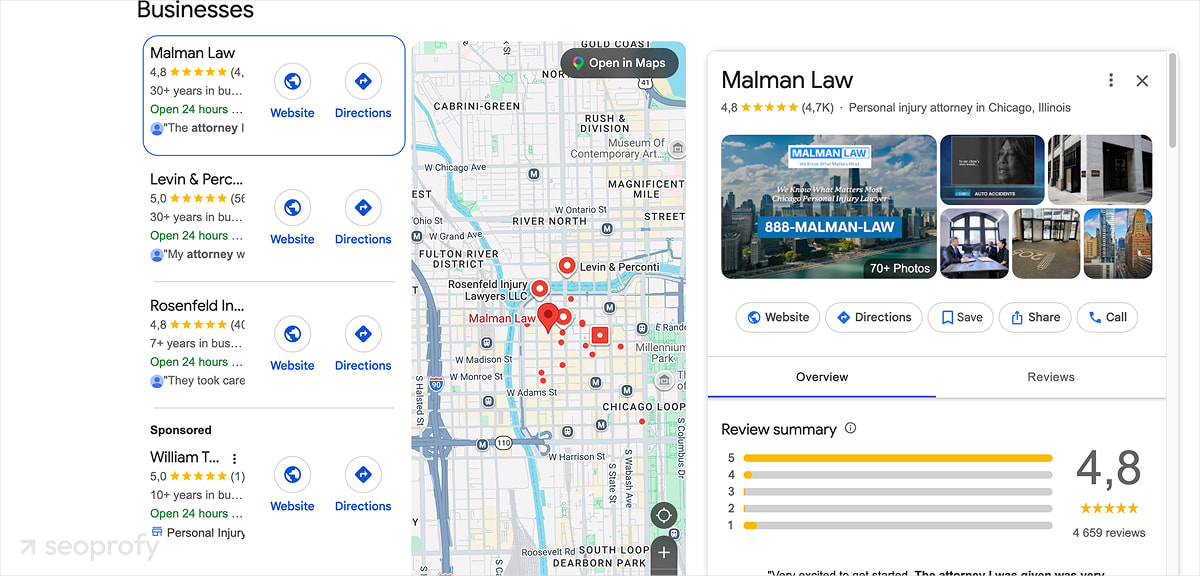
- Choose the right primary category: Your GBP primary category carries more weight than most firms realize. “Personal Injury Attorney” will outperform “Lawyer” or “Legal Services” for personal injury queries every time. Google uses your primary category as a key signal for which searches to show your listing. Use secondary categories for additional practice areas, but keep your primary tightly focused on your main service. Here’s how that looks in practice:
- Build review velocity, not just review count: Five new reviews per month over a year outperforms 50 reviews posted at once, followed by silence. Google’s local ranking algorithm favors consistent feedback activity — it signals that your firm is active and clients keep coming back. Set up a simple system: send a review request link to every satisfied client within a week of closing their case.
- Get reviews that mention specific services: A review that says “great lawyer” does less SEO work than one that says “helped me with my DUI case in Cook County.” Encourage clients to mention the type of case, the outcome, and the location. These service-specific mentions strengthen your relevance for practice area keywords in local search.
Prioritize the User Experience
The mobile factor is hard to ignore: 3 in 4 smartphone owners turn to search first when they need legal help, and “near me” searches for attorneys have grown by 500% in recent years. If your site loads slowly or breaks on smaller screens, you’re losing those clients before they ever see your content.
While law firms certainly don’t need flashy, bright websites, a clean, modern, professional look instantly elevates the user experience. In addition to a polished presentation, pay attention to the following:
- Keep your law firm website fully responsive on both mobile and desktop, and ensure it adapts to different screen sizes.
- Test your load times using various tools like Google PageSpeed Insights. Compressing your images will help improve your speed.
- Organize your website so visitors can easily find the information they need. Use clear menus, visible contact buttons, and a simple structure to guide users.
- Check if your CTA is clear (e.g., “Book a consultation”) and your contact info is visible. Your hero section should immediately tell visitors what to do next.
Conducting a UX audit is one of the unobvious law firm SEO tips that can significantly boost both ratings and conversion rates. Estimate how easy it is for your visitors to use your site by taking the following steps:
- Check your website’s structure: Can a user reach the services, contact, or FAQ page in three clicks?
- Review the copy on your site: Is it concise, informative, and easy to skim? Do headings guide users well?
- Pay attention to details that matter: Is your contact information, pricing, and the list easy to find?
Conduct Thorough Keyword Research
Identifying the right keywords is foundational to SEO for lawyers. When performing keyword research, take into account the following factors:
- Practice areas: List the specific legal practice areas your firm handles. For example, personal injury lawyer SEO requires a very different keyword strategy than family law or criminal defense.
- Location: Since most law firms serve specific geographic areas, location-based keywords are critical. Think about the cities or regions your firm covers, and how potential clients search for them using geographic terms.
- Search intent: People’s search intent falls into two main categories: legal information and attorney services. A person searching for “best divorce lawyers in Chicago” is more likely to hire an attorney than someone who is just looking for “divorce laws in Illinois.”
- Search volume: Use keyword research tools like Ahrefs or Semrush to evaluate the monthly search volume for different terms. Higher volumes mean more potential website traffic targeting popular queries.
- Competition: Keyword research tools can also show how competitive certain terms are based on how many other sites target them. A personal injury law firm, for instance, will face significantly higher keyword competition than a family law or estate planning practice — and budgeting your SEO efforts accordingly makes a real difference.
- Long-tail keywords: Also consider long-tail options that add more specificity, like “Chicago personal injury car accident lawyers.” These usually have lower difficulty scores and can drive the right visitors to your practice. Keep in mind that if you’ve just launched a new website for your legal company, focusing on these specific keywords is a great option, as they have lower competition and higher conversion rates.
- Related terms: Subsets of your main practice areas may uncover more relevant queries to target as well. For example, “medical malpractice lawyer” under personal injury.
Relevant and properly targeted keywords organically woven into your content will make it easier for potential clients to find your website.
Nail On-Page SEO Optimization
Once your keyword list is finalized, it’s time to make each web page on your site as relevant as possible for these terms. It covers both the visible content elements and the technical SEO factors behind the scenes. Here’s how to approach it:
- Title tags and meta descriptions: These are the first things your potential clients see in local search results, so optimize them with your primary keyword to improve click-through rates. If your firm is focused, say, on estate planning, then use “estate planning attorney” in your meta tags and description.
- Content optimization: Include your target search terms naturally within your header, body text, image descriptions, and other content elements. Avoid keyword stuffing, as it can worsen readability and lead to a penalty from Google.
- Internal linking: Link to other relevant pages within your website to guide visitors. It will help enhance user experiences and spread page authority. Moreover, if you efficiently put references to your money pages in your blog posts, it’ll also boost your revenue.
- Technical SEO: To ensure the efficiency of SEO for legal firms, you need to improve page load speed, use HTTPS for security, and make your site more mobile-friendly. Also, define a proper URL structure. That way, search algorithms will consider your website reliable and user-friendly. Remember that regular technical audits help ensure your law firm site stays crawlable, fast, and free of issues that could hurt rankings.
Build Only Trusted Backlinks
Even with stellar on-page optimization, your law firm’s website will not rank well if other authoritative sites don’t link to it. However, don’t aim solely for a high number of backlinks. The quality and relevance of the references are way more important for successful legal SEO.
Backlinks from spammy, low-quality sites can hurt your search engine ranking if search engine bots detect link buying or other manipulative tactics. The links need to come from legitimate, respected sources related to the legal industry.
As our experience shows, most law firm sites that rank highly for different keywords don’t use aggressive link building strategies or black-hat techniques. If you want to achieve lasting results and remain competitive for a long time, you should focus on these approaches instead:
- Getting listed in trusted local directories
- Pursuing featured content or guest posting on other reputable legal blogs/publications
- Publishing research (studies, surveys, statistics, etc.) relevant to your field, which will attract backlinks naturally
- Earning media mentions and links from authoritative news outlets when showcasing the firm’s expertise
- Having location/practice area resources linked by relevant local/regional websites
Mentions from high-quality sources can also drive referral traffic as people discover and click through to your website. Participating in legal forums and collaborating with local businesses are additional ways to earn quality backlinks.
For a full breakdown of ethical tactics, see our guide on link building for lawyers.
Showcase Your E-E-A-T
Google’s algorithms put a big emphasis on expertise, experience, authoritativeness, and trustworthiness. These factors are especially crucial for attorneys — people want to trust the lawyers they hire to handle important, often life-changing, legal matters.
So, how can you demonstrate strong E-E-A-T signals in your SEO for lawyers strategy? Some of them will be improved if you implement the tips we mentioned earlier. Important factors are valuable content, high-quality backlinks, client testimonials, and overall website experience.
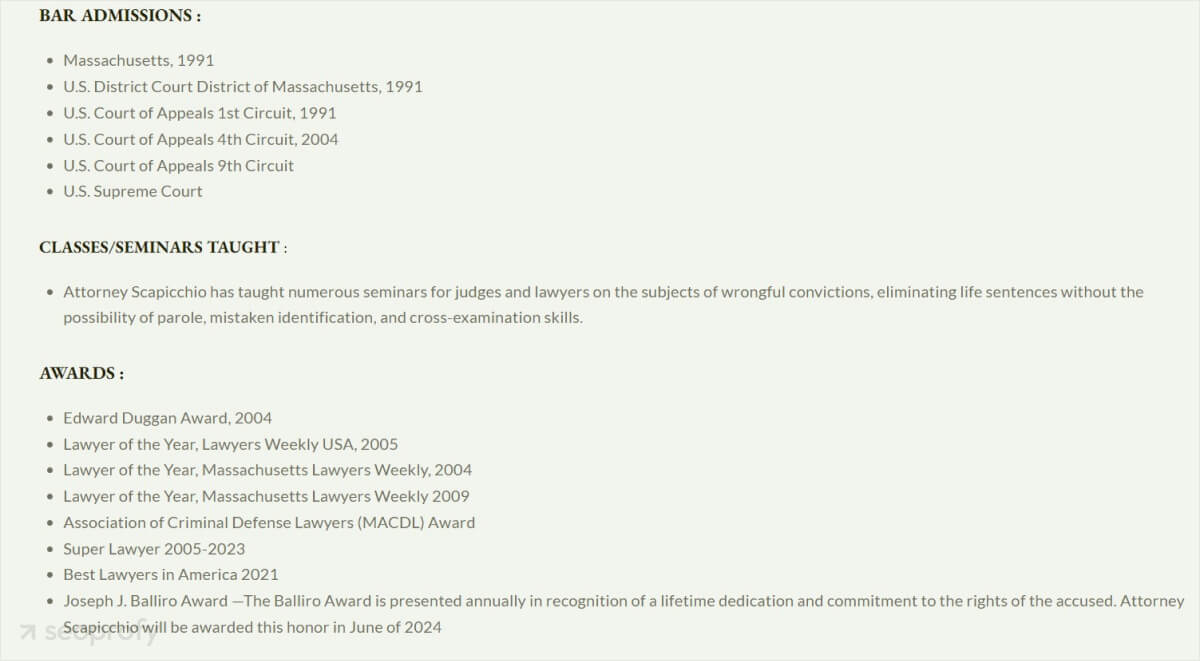
A detailed About Us page with extensive information about your organization is one of the best ways to improve your E-E-A-T. Attorney profiles are some of the most clicked pages of law firms’ websites, so they are the perfect place to show your credentials, like education, years of experience, awards, and recognition in your field. If you or your company’s lawyers are members of prestigious legal associations, be sure to highlight these memberships on your website, too.
Here is an attorney profile from scapicchiolaw.com that demonstrates the expertise of the firm’s criminal defense attorney:
Law Firm SEO in the Age of AI
A law firm can still rank well in search while losing visibility. Google AI Overviews, ChatGPT, and Perplexity increasingly answer legal questions before a user ever clicks through to a website.
Search has changed more in the past year than in the previous decade. Google, ChatGPT, and Perplexity don’t just point users to websites anymore — they synthesize answers directly, often citing specific sources by name. For law firms, this creates both a challenge and an opportunity: effective SEO for lawyers now means competing not just for rankings, but also for citations in AI-generated answers that shape a law firm’s website visibility.
From SEO to AEO and GEO — How Legal Search Is Changing
A few years ago, ranking on page one was the goal. Today, that’s still true — but it’s no longer the whole picture. Legal search now operates on three levels.
The first is traditional SEO: getting your pages to rank in Google’s organic results. The second is AEO — Answer Engine Optimization — which is about structuring your content so AI systems can extract and use it directly when answering questions. The third is GEO — Generative Engine Optimization — which means building enough authority across the web that AI platforms recognize and cite your firm as a credible source. Together, these layers expand your law firm’s SEO beyond traditional rankings alone.
None of these replaces the others. A firm that ranks well but has poorly structured content is less likely to get cited. A firm with strong content but little external authority may still struggle to be recognized. All three work together.
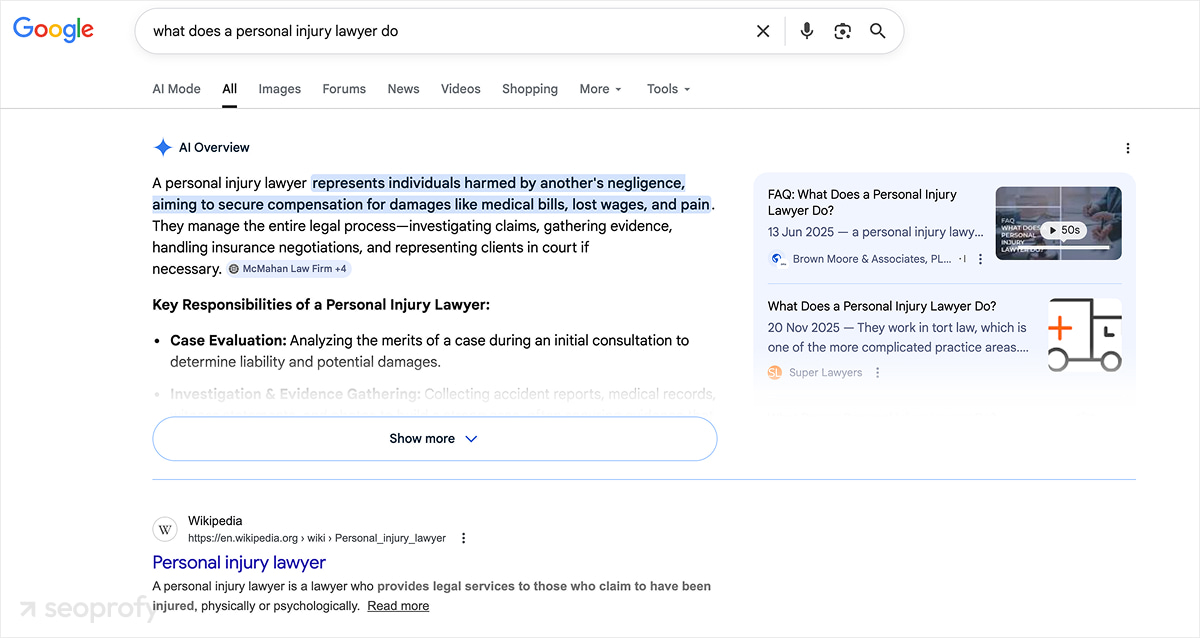
The practical implication is clear: informational queries like “what does a personal injury lawyer do?” are increasingly handled by AI before the user ever visits a website. Here’s an example of what that looks like:
What Should You Do?
Publish Attorney-Led Content
In legal search, content tied to real attorneys carries stronger expertise and trust signals than anonymous law firm copy. Generic blog posts published without clear authorship are less likely to stand out on high-stakes legal topics than content connected to a named attorney with relevant credentials and experience.
Every practice area page and key blog post should include a byline with the attorney’s name, photo, bar admissions, and relevant experience. Add a short author bio with a link to the attorney’s profile page, along with any relevant media mentions or speaking engagements. This helps create the entity and trust signals that both search engines and AI systems use to decide which content to surface.
Structure Content for AI Extraction
AI systems read in chunks. They extract answers from clearly structured content, not from dense paragraphs. Every key page should open with a direct answer to the main question, followed by organized sections that address follow-up queries.
FAQ sections are especially effective. A personal injury page that answers “How long do I have to file a claim?“, “What is the average settlement amount?“, and “Do I need a lawyer for a minor accident?” gives AI systems ready-made answers to pull.
Build these from real client questions — check Google’s People Also Ask and your own intake calls. You should try to keep each answer concise enough so that AI systems can extract it cleanly. Structured data (such as FAQ or LocalBusiness schema) can reinforce the process further.
Build Brand Authority Beyond Your Website
Your website is one signal among many. AI platforms and search engines also look at what the broader web says about your firm — directory listings, bar association profiles, local press coverage, third-party reviews. Consistent, accurate information across these sources strengthens how your firm is perceived and interpreted.
Keep your listings up to date on Avvo, Justia, FindLaw, and your state bar’s directory. Encourage clients to leave reviews that mention specific practice areas and outcomes where appropriate. When your attorneys comment on cases or legal trends in local publications, those mentions add up. Each one acts as a small signal that your firm is active, credible, and worth citing.
Track Your AI Visibility
Google Search Console tracks rankings, not AI citations. To understand whether your firm appears in ChatGPT or Perplexity responses, you need a different approach.
Start manually: run your most important practice-area queries through ChatGPT, Perplexity, and Google AI Overviews once a month and note which firms come up. For more systematic tracking, tools like Semrush AI Toolkit and Authoritas are building out AI visibility features — still early, but worth monitoring alongside your work to rank in AI Overviews.
Useful signals to track alongside traditional rankings include which pages appear in AI Overviews, whether your firm’s name surfaces in AI responses, schema markup validity, and review growth over time. None of these gives a complete picture on its own, but together they help you understand where you stand.
AI visibility is still evolving in 2026. No tactic guarantees inclusion. But firms that invest now in structured content, clear authorship, and broader authority will be better positioned as these systems mature.
DIY SEO vs. Hiring a Lawyer SEO Expert
Taking on SEO yourself can seem appealing at first. You avoid extra marketing costs and maintain full control over the process. However, are you truly ready to face the possible challenges? You’ll need to perform keyword research, create search-friendly content, do link building, analyze data, and keep up with Google’s frequent algorithm changes. For many legal professionals, it quickly becomes a full-time job on top of their existing casework.
So, how do you decide between DIY SEO and outsourcing? Let’s break down the pros and cons to help you make an informed choice:
|
DIY SEO |
Hiring an SEO Professional |
|
| Pros |
|
|
| Cons |
|
|
Not all agencies are equal. Look for a law firm SEO agency that specializes in the legal industry, understands compliance requirements, and has verifiable case studies from firms in your practice area.
If you’re leaning toward outsourcing, it helps to know what to look for. See how the top law firm SEO companies structure their services before making a decision.
Now that you know these differences, you can decide whether to opt for law firm SEO services. In case you decide to delegate, our law firm SEO agency can be your strategic partner, focused on driving more leads and cases through search traffic. Meanwhile, you can keep delivering exceptional legal services.
Hiring an SEO expert comes at a cost. It leads to another question — how much do companies typically invest in SEO for law firm websites?
How Much Do Law Firms Spend on SEO?
The variety of factors has an influence on the law firm SEO cost, including:
- Your business size and practice area: Some areas, like personal injury and corporate law, can be more competitive, and therefore, the price can also be higher.
- Your site’s current condition: If you’ve just started with a brand-new website, you’ll likely need to budget more for upfront SEO work.
- Local competition: The broader and more competitive your market, the more you’ll need to invest.
- Your goals: If you plan to rank for highly competitive keywords, you might need a larger SEO budget.
- Extra services: If you need additional tactics such as link building and content creation, the cost of your SEO campaign may increase significantly.
Understanding your law firm SEO cost upfront helps set realistic expectations and avoid budget surprises down the road.
Here’s an overview of the typical price ranges for SEO for lawyers, depending on their size, competition, and regional influence:
|
Firm Size |
Competition Level |
Target Location |
Average Monthly Budget |
| Small (up to 5 attorneys) | Low | Small towns or neighborhoods | $2.5–5K |
| Mid-size (up to 20 attorneys) | Medium | Cities or regions with a population of up to 500K residents | $5–9.5K |
| Large (more than 20 attorneys) | High | Big cities and entire states | $10–20K |
Bottom Line: Things to Keep in Mind about SEO for Lawyers
Ranking on page one takes consistent work across multiple fronts — technical health, content, backlinks, local presence, and increasingly, visibility in AI-generated answers. Furthermore, Google updates its algorithm regularly, and your competitors are investing in the same channels.
Before you move forward, run through this checklist:
- Claim and fully optimize your Google Business Profile, including primary category, service areas, and photos
- Implement LegalService, Attorney, FAQ, and Review schema on key pages
- Publish attorney-bylined content for every major practice area, with credentials and bar information visible
- Build review velocity — aim for at least 5 new reviews per month with specific service mentions
- Conduct keyword research focused on local, high-intent queries for each practice area
- Audit your technical SEO — Core Web Vitals, mobile performance, HTTPS, and site structure
- Track your presence in AI Overviews and citations in AI chatbots like ChatGPT and Perplexity alongside traditional rankings.
If you’re not sure where to start or don’t have the bandwidth to manage all of this in-house, working with a specialist makes sense. Consider SeoProfy, an experienced law firm SEO company that specializes in digital marketing for legal firms. We know all the latest SEO best practices and can help you move toward SEO success.
Book a free strategy call with one of the top law firm SEO companies to talk through what your firm specifically needs.

Andrew Shum is the Head of SEO at SeoProfy with 10+ years of experience in SEO and digital marketing. He has been part of the company for over 6 years and has led the SEO department for the past 3.5 years, managing a team of 15+ specialists. He works with competitive and international multi-language projects across eCommerce, SaaS, and enterprise niches, focusing on practical SEO strategies that deliver measurable results.