

Most marketers and SMB owners don’t know whether their CTR is good or bad — because they’re comparing across the wrong dimensions. A “good” CTR always depends on what you compare it against. A 2% CTR can be strong for display ads, normal for email, weak for paid search, and far too low for a position-one organic result.


This guide breaks down CTR benchmarks by industry across organic search, Google Ads, email, and social media. It also shows how AI Overviews, SERP features, and user intent change what a good CTR means in 2026.
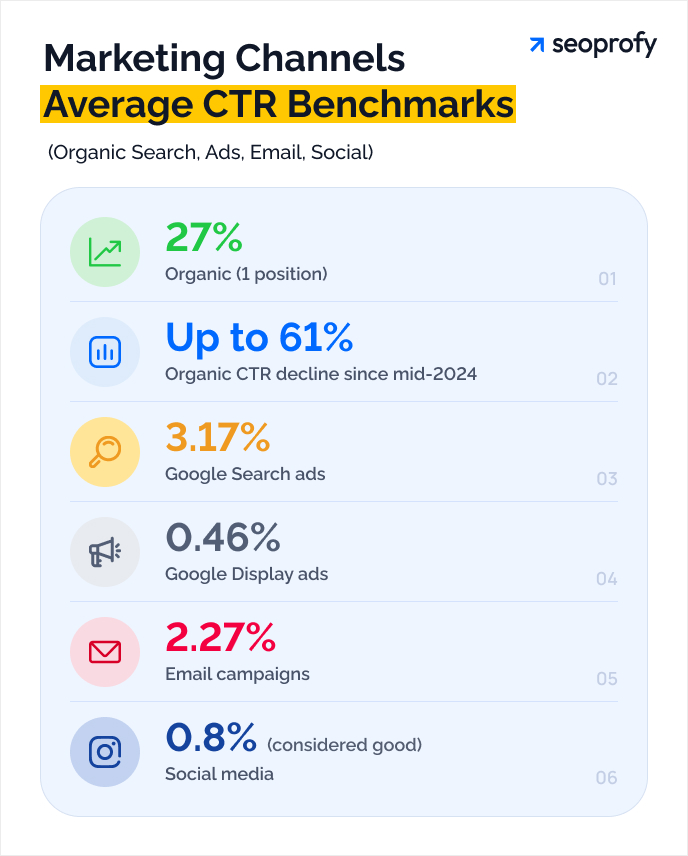
- Organic average click-through rate (CTR) is 27 for position 1.
- For searches that include AI Overviews, organic click-through rates have fallen by as much as 61% since mid-2024.
- Google Search ads average 3.17% CTR, while Display Network ads average 0.46%.
- Email campaigns average 2.27% CTR, but CTOR is better for diagnosing email body performance.
- For Facebook and Instagram, a CTR of 0.8% is considered good.
- For B2B companies, a LinkedIn CTR of 0.44% can generate better-qualified leads than a Facebook Ads CTR of 0.9%.
- Social CTR is lower than search, so judge it by platform and audience quality, not clicks alone.
What Is Click-Through Rate (CTR)?
Click-through rate shows how often people click after seeing a result, ad, email, or post. The click-through rate formula is:
CTR = clicks ÷ impressions × 100
CTR appears in four main contexts: organic search results, paid ads, email marketing, and social media. Each one has different benchmarks because user intent is different. Search clicks usually come from active demand, while email and social clicks depend more on timing, trust, and creative. CTR matters because it signals relevance, supports paid Quality Scores, helps organic performance, and affects revenue. Strong CTR optimization turns visibility into website traffic.
Organic Search CTR Benchmarks by Industry
Ranking position is still the main driver of organic CTR. Across six CTR studies, the average organic click-through rate is 27% for position 1, 15.6% for position 2, and 10.4% for position 3.
Industry benchmarks tell a different story. Ahrefs’ May 2026 data shows median organic CTR across 17,039 websites, grouped by industry. These numbers are lower because they reflect broader site performance, not only top-three rankings.
| Industry | Good Organic CTA |
| Adult | 7.53% |
| Online Communities | 3.51% |
| Arts & Entertainment | 2.25% |
| Games | 2.03% |
| Internet & Telecom | 1.88% |
| News | 1.63% |
| Computers & Electronics | 1.60% |
| Autos & Vehicles | 1.58% |
| Sports | 1.56% |
| People & Society | 1.53% |
| Finance | 1.50% |
| Food & Drink | 1.45% |
| Real Estate | 1.44% |
| Books & Literature | 1.37% |
| Shopping | 1.36% |
| Science | 1.36% |
| Travel & Transportation | 1.25% |
| Hobbies & Leisure | 1.23% |
| Jobs & Education | 1.17% |
| Health | 1.12% |
| Beauty & Fitness | 0.96% |
| Home & Garden | 0.91% |
| Law & Government | 0.90% |
| Business & Industrial | 0.85% |
| Pets & Animals | 0.80% |
A good average CTR depends on the market. Online Communities can reach a median CTR of 3.51%, while Business & Industrial sits at 0.85%. That does not automatically mean one site is better optimized than the other. Some SERPs have more ads, AI answers, image packs, shopping results, or comparison blocks.
Use the industry average CTR as a starting point, then check your own Google Search Console data. An SEO audit can show whether low CTR comes from weak titles, poor rankings, missing schema, or SERP features pushing organic results down.
How AI Overviews Are Affecting Organic CTR
For years, organic CTR benchmarks were mostly tied to ranking position. If a page ranked first, it was expected to take the largest share of clicks. If it ranked second or third, the number dropped, but the pattern was still fairly predictable. In 2026, however, it’s no longer as straightforward.
AI Overviews now sit above many traditional organic results. AI SEO data we’ve collected shows that they appear in roughly 13–15% of searches, with much higher exposure in informational industries.
The negative impact on CTR is already visible. On queries with AI Overviews, organic CTR has dropped by up to 61% since mid-2024. For affected keywords, position #1 CTR fell from about 7.3% to 1.6%.
Another problem is that the decline is not limited to AI results. Queries without AI Overviews have also seen CTR fall, which suggests that users are getting used to quick answers, snippets, panels, and other SERP features. Zero-click behavior is now common, with many searches ending before a website visit.
Thus, CTR benchmarks in 2026 should not be judged by position alone. Check whether the query triggers an AI Overview, what else appears above your result, and whether your industry has high AI coverage.
Google Ads CTR Benchmarks by Industry
Paid CTR usually sits below the CTR of a top organic result on a clean SERP. Ads are labeled, and some users skip sponsored results by habit. That said, paid search gives marketers more control. You can change the keyword set, rewrite the offer, test headlines, add assets, exclude weak queries, and improve the landing page without waiting for rankings to move.
This is where the SEO vs. paid search question often appears. SEO may earn cheaper clicks over time, but paid campaigns give you faster feedback. A weak paid search CTR often shows up within days, while an organic CTR problem can stay hidden behind rankings, SERP features, or AI Overviews.
The table below shows how Google Ads CTR differs between Search Network and Display Network campaigns.
| Industry | Search Network CTR | Display Network CTR |
| Auto | 4.00% | 0.60% |
| B2B | 2.41% | 0.46% |
| Consumer Services | 2.41% | 0.51% |
| Dating & Personals | 6.05% | 0.72% |
| eCommerce | 2.69% | 0.51% |
| Education | 3.78% | 0.53% |
| Finance & Insurance | 2.91% | 0.52% |
| Health & Medical | 3.27% | 0.59% |
| Home Goods | 2.44% | 0.49% |
| Industrial Services | 2.61% | 0.50% |
| Legal | 2.93% | 0.59% |
| Real Estate | 3.71% | 1.08% |
| Technology | 2.09% | 0.39% |
| Travel & Hospitality | 4.68% | 0.47% |
The gap between search and display is the first thing to notice. Search CTR is almost seven times higher on average because the user is already looking for an answer, product, quote, or provider. Display ads reach people earlier.
Real Estate is the display outlier at 1.08%, the highest rate in the table. That makes sense because property decisions are visual, so a good image, location cue, or price range can make a user stop browsing and click, even outside a direct search.
Email Marketing CTR Benchmarks by Industry
Email remains one of the strongest ROI channels in 2026. In search, the user is already looking for something, while in email, the click comes after a few smaller steps. The message has to land in the inbox, the subject line has to earn the open, and the email body has to make the next step worth taking.
That is why open rate and CTR should not be read as the same signal. Open rate shows how many delivered emails were opened. Email marketing CTR shows how many delivered emails received a click. CTOR, or click-to-open rate, helps to narrow the question further — of the people who opened the email, how many clicked?
| Industry | Avg. Open Rate | Avg. Email CTR | Approx. CTOR |
| eCommerce | 15.5% | 2.15% | ~13.9% |
| Retail | 16.67% | 2.31% | ~13.9% |
| Healthcare & Wellness | 19.47% | 2.06% | ~10.6% |
| Real Estate & Property Management | 20.32% | 2.32% | ~11.4% |
| Technology / SaaS | 20.68% | 1.88% | ~9.1% |
| Media & Publishing | 21.29% | 3.01% | ~14.1% |
| Banking & Financial Services | 21.30% | 1.87% | ~8.8% |
| Education | 22.25% | 2.38% | ~10.7% |
| Nonprofit & NGO | 27.03% | 3.10% | ~11.5% |
| Government & Public Administration | 34.19% | 3.53% | ~10.03% |
Similar to Government and Nonprofit fields, Media & Publishing CTR stands out because subscribers usually opt in for the content itself. They expect links, articles, reports, guides, or updates. In that case, a click is not a bonus action. It is often the main reason the email was opened.
Ecommerce is quite different. Its CTR is not terrible, but the open rate is lower than the overall average. Even interested buyers start ignoring messages when every brand uses the same urgency.
A good CTR for email is usually around the 2–3% range for standard campaigns. Above 3% is strong, but the better diagnostic metric is often CTOR. If open rate is low, check the subject line, sender name, preview text, and send timing. If CTOR is low, the problem is inside the email.
Social Media CTR Benchmarks by Platform
Social media CTR is usually lower than search CTR because users are not actively looking for a solution. They are scrolling, watching, or reading updates, so the ad has to earn attention in a passive feed.
That is why social media CTR should be judged by platform, not against paid search. A 0.8% CTR may be solid on Facebook or Instagram, but weak for a high-intent Google Search campaign.
| Platform | Average Ad CTR | Best-Performing Format |
| Google Display | 0.46% | Responsive display ads |
| Facebook / Meta | ~0.9% | Video, carousel |
| ~0.8-2.8% | Stories, reels | |
| X (Twitter) | ~1.0–2.0% | Promoted tweets |
| ~0.44–0.65% | Sponsored content | |
| TikTok | ~0.84% | In-feed video |
Social is still central to B2B distribution. Nearly nine in ten B2B marketers use organic social platforms to share content, so paid campaigns often work best when they support the wider content strategy.
X often shows a higher CTR than LinkedIn because promoted tweets blend into the feed and can catch users during live conversations or trending topics. LinkedIn’s CTR is lower, but click quality is often stronger. For B2B companies, a LinkedIn CTR of 0.44% can generate better-qualified leads than a Facebook Ads CTR of 0.9%.
Average CTR by industry depends on the goal. If impressions are high but clicks stay flat, the first things to review are the hook, creative format, and audience match.
Factors That Affect CTR Performance
CTR usually depends on how visible the result is, how well it matches the query, and how much trust the user already has in the brand. Before you try to improve CTR, check which factor is actually limiting clicks:
- Ranking position: Average click-through rate falls from 39.6% in position 1 to 10.1% in position 3, so moving from position 3 to position 1 can nearly quadruple clicks without increasing impressions. That kind of lift can improve SEO ROI faster than small snippet edits.
- Title tag and meta description quality: If rankings are stable but CTR is weak, review the search snippet. Put the main keyword near the start of the title, add a clear benefit, and use the meta description to show what the reader will get after clicking.
- Brand recognition: Known brands often win clicks from lower positions because users already trust them. Smaller brands can compete by adding proof points, numbers, reviews, or a stronger value statement in the snippet.
- Search intent match: A “buy now” search needs a product, pricing, demo, or quote page. A “how to” search needs guidance, examples, or comparison points.
- Ad format and extensions: In paid search, sitelinks, callouts, structured snippets, prices, reviews, and lead forms give the ad more space and more reasons to click.
- Industry competition: Ads, Shopping results, comparison blocks, local packs, and AI Overviews can push organic listings down, so compare performance against the SERP type, not only a generic average.
How to Improve Your Click-Through Rate
CTR improvement depends on the channel. Organic search, paid ads, email, and social media each need a different fix.
Organic CTR
- Optimize title tags: Put the primary keyword near the start, add the year or a strong modifier, and keep the title under 60 characters where possible.
- Write useful meta descriptions: Show what the reader will get: data, examples, steps, or comparisons. Add a light CTA such as “See the data” or “Compare benchmarks.”
- Use schema markup: FAQ, how-to, article, product, and review schema can help results take up more SERP space.
- Improve rankings: The simplest CTR lift often comes from moving from position 5 to position 3, or from position 3 to position 1.
- Build better supporting content: A strong SEO content strategy helps pages rank for the right intent, not just more keywords.
Paid Search CTR
- A/B test ad copy: Compare urgency-led, benefit-led, and question-led headlines.
- Use all relevant extensions: Add sitelinks, callouts, structured snippets, prices, and lead forms where they fit.
- Separate branded and non-branded campaigns: Branded keywords usually have much higher CTR, so mixing them can distort benchmarks.
- Match the query closely: Specific ads beat generic copy. A search for “enterprise SEO audit” should not land on a broad “digital marketing services” ad.
Email CTR
- Test subject lines and CTA text separately: Subject lines affect open rate. CTA text and email layout affect CTOR.
- Segment beyond first name: Use behavior, past purchases, lifecycle stage, product interest, or engagement level.
- Reduce frequency for cold subscribers: Sending fewer emails to disengaged users can protect sender reputation and improve long-term performance.
Social Media CTR
- Use native-looking creative: Ads that feel like normal feed content usually beat banner-style designs.
- Narrow the audience: Smaller, more relevant segments often bring higher CTR and better platform signals.
- Test video against static: Video often performs better for CTR on Facebook and Instagram, especially when the first seconds make the offer clear.
- Connect social clicks to stronger landing pages: This is especially important for ecommerce brands. Ecommerce product pages should load fast, show clear pricing, and support the click with trust signals.
SeoProfy builds SEO strategies around your niche and real CTR potential, not generic averages.
- Niche-specific SEO planning
- CTR and SERP analysis
- Traffic and lead growth
Key Takeaways
- Organic position 1 still beats paid CTR, but AI Overviews are reducing clicks in informational SERPs.
- There is no single “good CTR.” Benchmarks change by channel, industry, intent, and SERP layout.
- Search CTR is much higher than display CTR because users are already looking for a solution.
- Email CTR is best judged with CTOR, not open rate alone.
- To improve CTR, start with ranking position, then refine titles, snippets, ad copy, CTAs, and audience match.
- Use Google Search Console to compare your CTR against your own SEO ROI goals.

Julia Lubianytska is a Copywriting Team Lead at SeoProfy with over 7 years of experience in copywriting and editing. She works closely with copywriting teams, helping writers craft clear and thoughtful content for SaaS products, IT services, and businesses in the legal and medical fields. Julia enjoys turning complex topics into easy-to-understand, trustworthy content, focusing on structure, clarity, and consistency to ensure the content is genuinely helpful for real people, not just search engines.