


According to Grand View Research, the global marketing automation market was valued at $6.65B in 2024 and is projected to reach $15.58B by 2030. But market growth alone does not indicate which tools, workflows, and channels actually improve performance.


With growth like this, modern marketing teams face a practical question: which workflows actually improve leads, revenue, and customer experience, and which ones simply add another marketing automation platform to an already crowded stack?
This guide collects the latest marketing automation stats and broader marketing statistics on market size, adoption, AI, ROI, lead generation, channels, B2B vs. B2C use, implementation barriers, and fully automated customer journeys. Use the data to see how many companies use automation, which workflows deserve a budget first, which process gaps to fix, and which automation platforms can support those workflows at scale.
- The global market was valued at $6.65B in 2024 and may reach $15.58B by 2030, reflecting mid-teens market growth.
- 76% of businesses use marketing automation, and about 96% of marketers plan to use a marketing automation platform or have already used one.
- Marketing automation users report up to 451% more qualified leads, while Salesforce reports a 14.5% productivity lift for sales teams.
- Only 9% of marketers run fully automated customer journeys; 59% still use partial automation, which leaves room for better journey orchestration in 2026.
- Data quality (52%) and technology/data integration (40%) remain the biggest barriers on the way to automation.
- 92% of marketers use AI in some form within automated workflows, and 77% use AI for personalized content creation.
Right vs. Wrong Expectations About Marketing Automation
| Right Expectation | Wrong Expectation |
| It improves marketing processes that already have clear triggers, goals, and ownership | It fixes unclear strategy, messy data, or broken handoffs on its own |
| It helps teams scale personalization across email, CRM, ads, and customer journeys | It makes marketing campaigns feel personal simply because a marketing automation platform is in place |
| It can improve ROI when teams measure revenue, lead quality, and conversion impact | It guarantees ROI without attribution, testing, or workflow optimization |
| It uses automation tools to reduce repetitive work and allows marketers to focus on strategy and creative decisions | It removes the need for human review, judgment, and customer understanding |
| It works best when marketing, sales, RevOps, and data teams share the same process | It works as a standalone marketing automation software disconnected from CRM and customer profiles |
Overview: Why Do Marketing Automation Statistics Matter in 2026?
Marketing automation statistics matter because the industry now affects budgets, lead quality, sales handoffs, audience data, and campaign performance across modern marketing operations. For CMOs and RevOps teams, the numbers show where automation platforms create measurable gains and where they simply add complexity.
Use this data as a state-of-marketing snapshot alongside broader digital marketing statistics to understand how automation intersects with SEO, content, PPC, social, e-commerce, advertising, and customer journey performance. Forecasts show market direction, adoption figures show usage, and ROI numbers show where workflow design, CRM integration, data quality, and source recency affect the outcome.
Our guide covers nine areas: market size, adoption, AI, ROI, lead generation, channels, B2B vs. B2C use, barriers, and fully automated customer journeys. For more benchmark-led articles by topic, see SeoProfy’s digital marketing statistics hub.
What this means for you: Use the data to decide which workflows deserve a budget first and which process gaps to fix before implementing marketing automation at scale.
Global Marketing Automation Market Size and Growth
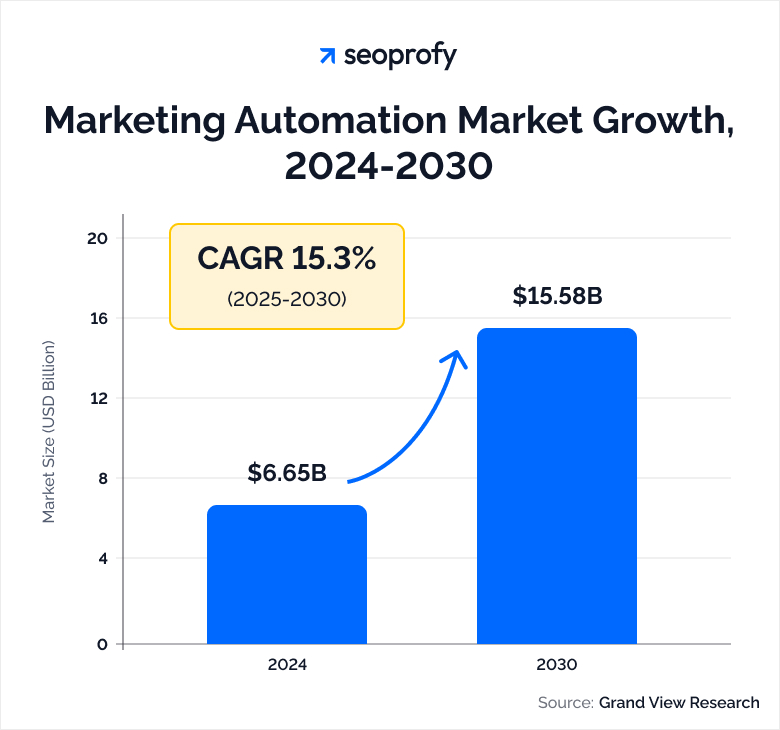
The global marketing automation market was valued at $6.65B in 2024 and is projected to reach $15.58B by 2030, growing at a 15.3% CAGR from 2025 to 2030. (Grand View Research)
Market-size estimates vary across the industry because research firms define the category differently. Some reports focus only on marketing automation software, while others include broader martech solutions, services, analytics, lead generation, and campaign management tools.
| Source | Figure | Year | Status | CAGR/Share | What it shows |
| Grand View Research | $6.65B | 2024 | Actual | — | Base-year value for the marketing automation market |
| Grand View Research | $15.58B | 2030 | Projected | 15.3% CAGR, 2025–2030 | Core forecast used for this article |
| Fortune Business Insights | $20.12B | 2034 | Projected | 12.0% CAGR, 2026–2034 | The long-range software market forecast exceeds $20B |
| P&S Intelligence | $17.5B | 2032 | Projected | 12.5% CAGR, 2025–2032 | Supports a double-digit growth outlook through 2032 |
| Market Research Future | $16.0B | 2035 | Projected | 9.96% CAGR, 2025–2035 | More conservative long-term software forecast |
Additional Market Context
Market-size forecasts show total category growth, but regional and company-size data explain where adoption is concentrated.
North America accounted for 43.6% of the automation market’s revenue in 2024. (Grand View Research)
In 2024, North America accounted for 38% of the marketing automation solutions market. (MarketGrowth Reports)
Large enterprises accounted for $2.81B in marketing automation software market revenue in 2024, with this segment projected to reach $8B by 2035. (Market Research Future)
Small enterprises accounted for $1.13B in marketing automation software market revenue in 2024 and are projected to reach $3.2B by 2035. (Market Research Future)
SMEs also represented 62.88% of deployments in 2025, with adoption expected to grow at a 13.33% CAGR through 2031. (Mordor Intelligence)
Stat callout: Market forecasts are not interchangeable. Use the Grand View Research forecast as the core market-size benchmark, and treat broader $20B+ projections as adjacent software or martech views rather than the same market definition.
The takeaway: Forecasts point the same way, but the scope sets the size of the number. A software-only view keeps the estimate narrow, while broader forecasts, those that include services, analytics, marketing automation solutions, and adjacent martech categories, push the totals higher.
What this means for you: Match automation investment to data maturity, CRM integration, journey design, and campaign workflows.
Marketing Automation Adoption and Usage Patterns
When it comes to automation, most marketing teams start with measurable use cases: email campaigns, lead capture, segmentation, lead scoring, CRM-triggered follow-ups, and lifecycle messaging. Mature automation programs expand into multi-channel journeys across email, paid media, social, website personalization, and sales handoffs.
Approximately 76% of businesses use some form of automation technology. (RevenueMemo)
96% of marketers have used or plan to use a marketing automation platform. (DemandSage)
In 2024, the most common areas of marketing automation use were email marketing, social media management, content management, and paid ads. SMS marketing, campaign tracking, live chat, and SEO efforts also increased in use compared with the previous year. (Ascend2)
In 2024, 54% of marketers reported an increase in their automation budgets. (Ascend2)
Stats takeaway: Adoption in the sector is already high, but usage patterns show that most teams still begin with practical, channel-level workflows before moving into more advanced customer journeys. This means automation success depends not only on adopting marketing automation but also on data quality, workflow maturity, channel integration, and whether automation platforms improve lead management, customer experience, and revenue reporting.
What this means for you: Adoption alone is not a benchmark. Before you increase automation investment in additional marketing automation solutions, assess which workflows are already automated, how well your channels are connected, and whether your marketing efforts can turn automation efforts into measurable performance improvements.
AI-Powered Automation and Personalization Trends
AI use in marketing automation now covers audience targeting, content creation, segmentation, campaign planning, analytics, customer engagement, and journey optimization. Marketing teams use it to segment the target audience, recommend next-best actions, create personalized content, score leads, and identify customer behavior patterns that manual analysis can miss.
AI is already part of automation workflows: 92% of marketers use AI in some form within automated workflows. (SQ Magazine)
77% of marketers use AI for personalized content creation. (SQ Magazine)
Deloitte predicts that 25% of large businesses using GenAI will deploy AI agents in 2025, rising to 50% by 2027. (Deloitte)
Salesforce reports that 75% of marketing organizations use AI in at least one form, but only 13% currently use self-directed AI agents. (Salesforce)
Salesforce also found that 83% of marketers say customers now expect two-way conversations, while 69% struggle to respond promptly due to a lack of necessary context. (Salesforce)
McKinsey found that only 21% of organizations using GenAI have fundamentally redesigned at least some workflows. (McKinsey)
SeoProfy’s practical observation: AI marketing statistics indicate that the workflows work better when teams document trigger logic, approval rules, and data ownership before connecting agents to live campaigns.
Stats takeaway: Personalization still depends on content quality and workflow logic. This is where content marketing statistics matter: teams need the right content for each segment before AI can adapt messages at scale.
What this means for you: Use AI first where inputs, approvals, and success metrics are clear — segmentation, content adaptation, lead routing, and campaign testing. Remember that weak customer data, unclear goals, and poor approval rules can amplify mistakes in AI-assisted workflows.
ROI, Revenue Growth, and Sales Productivity
The fastest payback usually comes when marketing leaders plan automation around workflows tied directly to revenue: lead nurturing, cart recovery, lifecycle emails, lead routing, and sales follow-ups. These are the touchpoints where automation does measurable work of moving a contact toward a purchase, recovering a sale that was about to slip, or handing sales a lead at the right moment, so the impact shows up in the numbers fast.
Time-to-ROI
ROI from implementing marketing automation depends on how quickly a team connects automated workflows to measurable outcomes. The useful benchmark is not “Did we buy a platform?” but “Which workflows already reduce manual work, improve conversion, or shorten the sales cycle?”
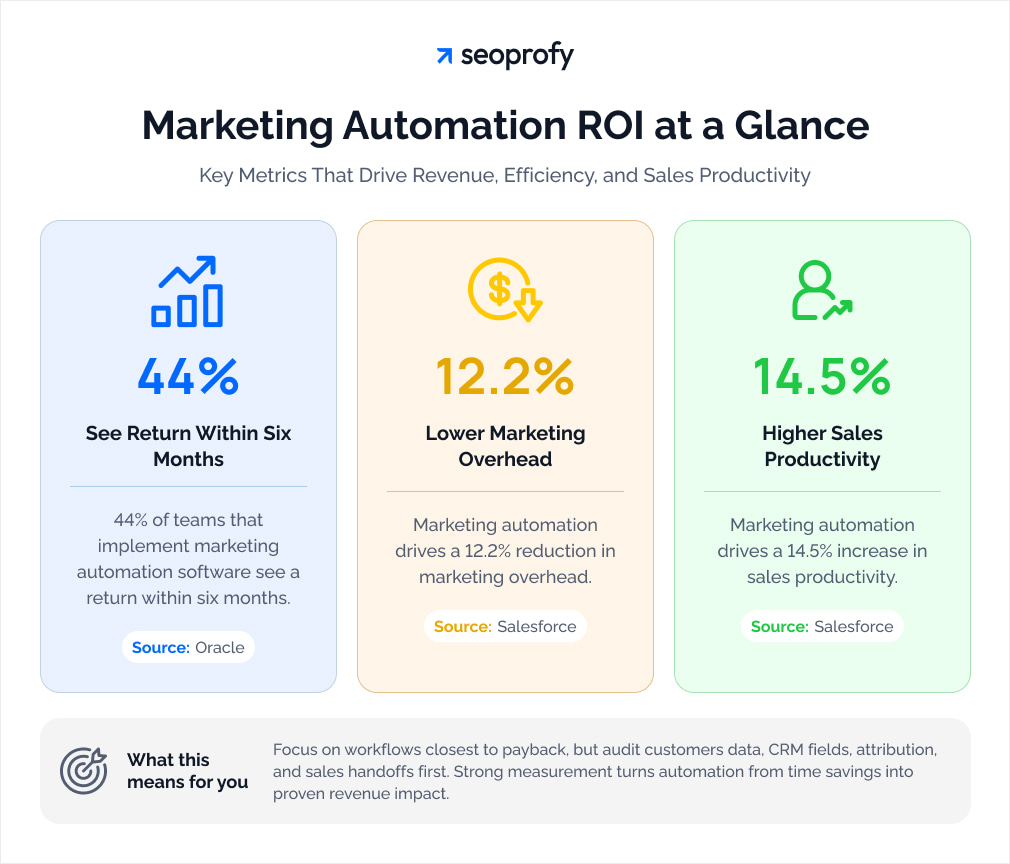
63% of teams that implement marketing automation software expect to see benefits within six months, while 44% report seeing a return within that period. At the same time, 31% still struggle to prove marketing attribution and ROI. (Oracle)
Revenue Lift
Revenue lift should be measured by workflow, not by the automation platform as a whole. Nurture, cart recovery, reactivation, and lead scoring each contribute differently, and a platform-level number averages them into a single figure, obscuring which workflows actually drive gains and which cost.
Companies report a 10%+ revenue boost within 6–9 months when using marketing automation, driven by improved lead management. (Comosoft).
The most mature users achieve 32% greater revenue than the average company. (Adobe for Business)
Marketing Overhead Reduction
Automated workflows reduce repetitive tasks, manual handoffs, and campaign execution time, especially when teams integrate approvals, segmentation, and reporting into a single process. For marketing teams, this matters because lower overhead can free time for digital marketing strategy, content creation, testing, and customer experience improvements.
Marketing automation improves efficiency. Salesforce cites research showing a 12.2% reduction in marketing overhead from automation. (Salesforce)
Cost reduction is also one of the main reasons teams optimize automation programs: 39% of marketers named decreasing costs as a primary goal for improving marketing automation in the year ahead. (Ascend2)
Sales Productivity
Sales teams benefit when automation handles lead scoring, routing, and timely follow-ups. With those tasks off their plate, reps stop chasing low-intent contacts and put their time into the qualified, sales-ready opportunities instead.
A 14.5% increase in sales productivity, which makes sense when reps spend less time sorting low-intent leads and more time working qualified opportunities. (Salesforce)
Stat callout: The strongest ROI case combines speed, efficiency, and measurement: 44% see a return within six months, marketing overhead declines by 12.2%, and sales productivity rises by 14.5%.
What this means for you: Start ROI planning with workflows closest to payback, but audit customer data, CRM fields, attribution, and sales handoffs first. In SeoProfy’s audit work, automation often saves time before it proves revenue impact, especially when measurement is weak.
Lead Generation, Lead Management, and Conversion Outcomes
Lead generation remains one of the strongest B2B use cases for marketing automation because long buying cycles depend on lead capture, segmentation, scoring, nurturing, CRM history, and timely sales handoffs. For B2B teams, lead management turns scattered actions into a single lead profile.
Automation users report up to a 451% increase in qualified leads. (Oracle)
Companies using marketing automation report an 80% lift in their ability to generate leads. (Oracle)
Marketers using automation can see up to a 77% increase in conversion rates, especially when campaigns respond to behavior rather than fixed batch schedules. (LeadsBridge)
Automated (triggered) campaigns can generate up to 75% of email revenue. (LeadsBridge)
Automated emails can produce 320% more revenue than non-automated sends. (Campaign Monitor)
Stats callout: Lead scoring models, routing rules, nurture sequences, and sales alerts work together to separate early-stage contacts from qualified leads that sales teams can prioritize. It’s why B2B marketing statistics tend to favor nurture, attribution, and sales alignment over raw lead volume when measuring revenue impact. The lift comes from timing and relevance — cart recovery, welcome flows, reactivation emails, product reminders, and nurture sequences all reach users while intent is still active.
What this means for you: Do not measure marketing automation by lead volume alone. Track whether your workflows create better-fit leads, faster handoffs, higher conversion rates, and more revenue per campaign.
Channel-Level Marketing Automation Statistics: Email, Voice, and Beyond
Channel-level marketing automation statistics show how teams use email, SMS, push notifications, chat, mobile advertising, display advertising, and social media in automated campaigns. The real advantage comes when these touchpoints are coordinated across multiple channels, all based on the same customer data foundation.
Email marketing automation is the top tactic used by marketers, at 58%. (Ascend2)
About 62% of B2B teams use automation for email campaigns. (Insightly)
Email marketing returns about $36 for every $1 spent. (Litmus)
Email Marketing
Email marketing remains the baseline automation channel for triggers, segmentation, nurturing, testing, and revenue attribution.
In B2B, the use of automation for email marketing increased from 53% in 2022 to 62% in 2023. (Insightly)
In e-commerce digital marketing, welcome flows, cart recovery, renewal reminders, reactivation campaigns, and lead-nurture sequences work better when messages respond to user behavior rather than to a fixed send calendar.
SMS and Push Notifications
Push notifications and SMS work best for time-sensitive moments. The most suitable use cases for them are order updates, event reminders, limited offers, app engagement, and cart recovery. Personalized push campaigns can also support app engagement when messages are triggered by timing, behavior, and user intent.
SMS is often cited for open rates as high as 98%, while push notifications give teams another measurable channel for timely, behavior-based engagement. (Infobip)
Push notification CTR is around 7.8% across all app categories, with performance depending on timing, behavior, and user intent. (NVECTA)
Chatbots and In-App Messaging
Chatbots and in-app messages help teams engage customers through lower-friction interactions such as FAQs, onboarding prompts, demo routing, support triage, and upgrade nudges. They work best when connected to CRM, product usage, and account data because chat and in-app signals can reveal intent before a sales form is filled out.
Social Media and Paid Media
Automation in digital marketing helps teams coordinate audiences, timing, budgets, and follow-ups across social media and paid advertising channels. It can sync CRM segments with ad platforms, trigger retargeting flows, update audiences, and connect ad engagement with email, SMS, or sales workflows.
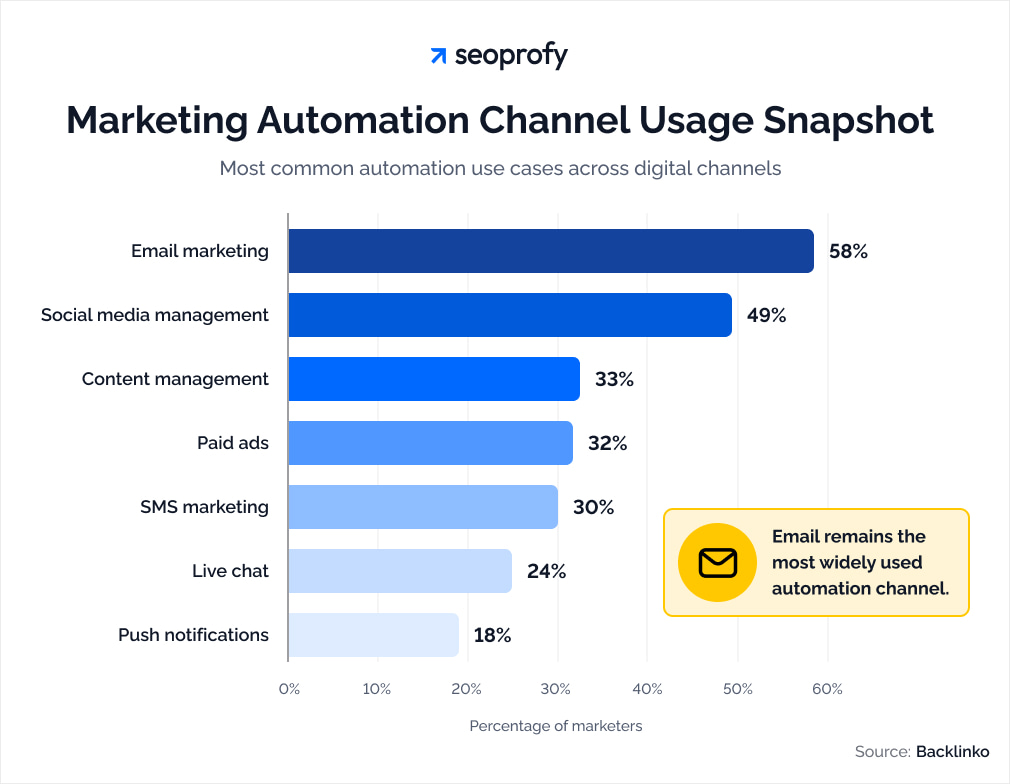
Marketers report using automated workflows for email marketing (58%), social media management (49%), content management (33%), paid ads (32%), SMS marketing (30%), live chat (24%), and push notifications (18%). (Backlinko)
In 2023, automated content management grew from 30% to 40% among B2B teams. (Insightly)
What this means for you: Do not automate every post or ad decision; connect campaign signals with email, CRM, lead scoring, and customer journey automation so each channel informs the next step.
Common Barriers to Implementing Marketing Automation
Most roadblocks come from data quality, ownership, integrations, unclear strategy, and platform adoption, not from the marketing automation software itself. These issues often appear when automation initiatives scale before teams define data ownership, workflow logic, and reporting rules.
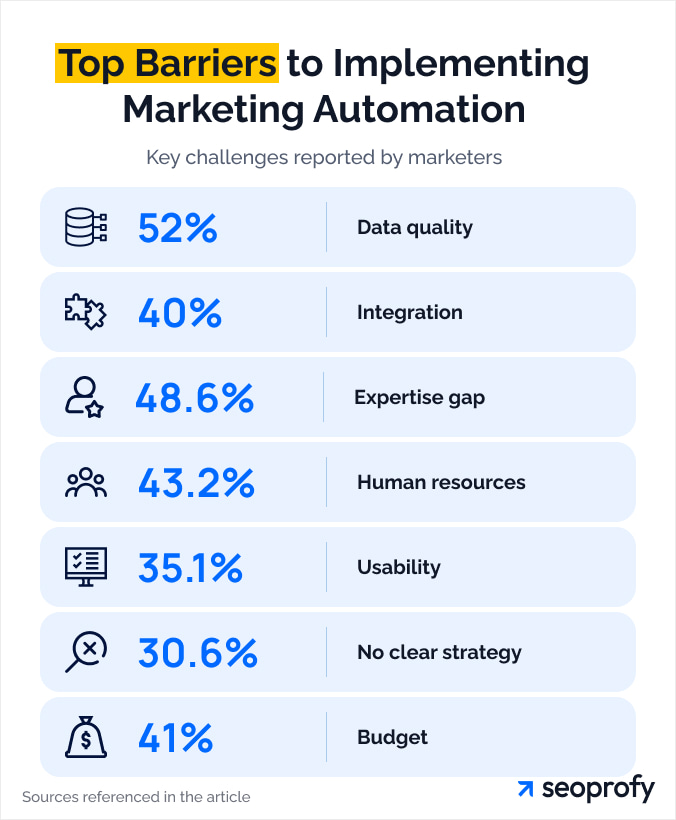
| Barrier | Share | Why It Blocks Results / How to Fix It |
| Data quality | 52% (Ascend2) | Weak customer data hurts segmentation, scoring, and attribution. Clean CRM fields, remove duplicates, and define required data points before setting up segmentation, lead scoring, or attribution workflows. |
| Integration gaps | 40% (Ascend2) | Disconnected tools break reporting and handoffs. Map CRM, analytics, email, ads, and customer data platform connections before scaling |
| Expertise gap | 48.6% (Cropink) | Teams may own marketing automation software but lack workflow, scoring, and reporting skills. Assign owners and document trigger logic |
| Resourcing limits | 43.2% (Cropink) | Automation still needs planning, QA, and maintenance. Start with fewer workflows the team can actually manage |
| Usability issues | 35.1% (Cropink) | Complex processes and automation platforms push teams back to manual processes. Choose tools around real use cases, templates, and repeatable QA |
| No clear strategy | 30.6% (Cropink) | Implementing marketing automation without a clear strategy can create more messages rather than better results. Define the outcome first: leads, revenue, retention, or lower overhead |
| Budget | 41% (Ascend2) | Limited budget affects setup, integrations, content, and marketing analytics. Prioritize workflows closest to payback |
SeoProfy’s practical observation: Automation quickly exposes weak processes. If data, ownership, content, or measurement is unclear, scaling usually amplifies those gaps rather than fixing them.
What this means for you: Use these barriers as criteria for selecting automation software during platform selection, and address data quality, integrations, ownership, and strategy before adding more solutions.
Future Outlook: Automated Journeys and AI Agents
Most teams are still far from full journey automation: about 59% of marketers report partially automated customer journeys, 32% report mostly automated journeys, and only 9% report fully automated ones. (Ascend2)
This gap shows where marketing automation is heading next: from isolated workflows to connected, consent-aware customer journeys. AI agents may monitor performance, update segments, suggest tests, route leads, and trigger follow-ups based on real-time behavior, but they still need clean data and clear system connections to work correctly.
Deeper CRM and CDP integration remains a core requirement. A customer data platform can consolidate website behavior, email engagement, paid campaigns, chat, product usage, and sales activity into a single profile, giving marketing automation software the context it needs to personalize journeys without disrupting attribution, consent rules, or handoffs.
Without a connected data foundation, even advanced marketing automation software works with fragmented signals. Privacy and consent also shape next-gen automation across SMS, push notifications, in-app messaging, chat, and AI-driven personalization, because every automated touchpoint requires accurate customer context and permission data.
Emerging channels will matter, but orchestration matters more. AI search visibility, voice search optimization, mobile devices, chat interfaces, and in-app experiences are becoming part of the broader customer journey, so teams need connected data, clear consent rules, and AI-assisted workflows that adapt without losing human control.
What to benchmark: Your setup with the future state — connected data, clear consent, AI-assisted workflows, and journeys that adapt without losing human control.
Turning statistics into growth takes more than collecting numbers. SeoProfy helps marketing teams translate automation data into data-driven SEO content strategies, search-driven briefs, and measurable content systems built around audience intent, rankings, and revenue.
Conclusion
The latest marketing automation statistics show a market moving from broad adoption to measurable maturity. The global market reached $6.65B in 2024, 76% of businesses already use automation, and 44% of teams see ROI within six months.
The maturity gap is still clear: adoption is high, but few teams have fully connected journeys across data, channels, consent, analytics, and sales handoffs. For 2026, competitive advantage will not come from simply using marketing automation. Industry leaders will build workflows that connect customer data, campaign execution, personalization, and revenue reporting.
For teams turning these numbers into a search-led growth plan, SeoProfy’s SEO content writing services can help connect data, strategy, and content execution. Contact us today to get your tailored SEO solution!

Julia Lubianytska is a Copywriting Team Lead at SeoProfy with over 7 years of experience in copywriting and editing. She works closely with copywriting teams, helping writers craft clear and thoughtful content for SaaS products, IT services, and businesses in the legal and medical fields. Julia enjoys turning complex topics into easy-to-understand, trustworthy content, focusing on structure, clarity, and consistency to ensure the content is genuinely helpful for real people, not just search engines.