
Most customers start looking for products with a Google search, and if your store isn’t visible in search results, they’ll buy from someone else. Retail SEO (search engine optimization) is a set of strategies aimed at increasing your visibility in those results.


Retail SEO covers everything that influences how your site ranks in search engine results pages (SERPs): product page structure, content quality, technical performance, and the links pointing to your domain. Done well, it brings in shoppers who are already in buying mode, without you having to depend entirely on paid advertising.
However, retail businesses face a serious challenge in SEO: the scale of their websites. They often have hundreds or even thousands of product pages, and each one needs proper optimization. We’ve prepared a set of useful SEO tips for retail sites to help you boost your online presence, outperform your competitors, and expand your customer base.
- 88% of customers are less likely to return to the online store after a bad experience.
- 76% of shoppers use mobile devices to make purchases — mobile optimization is a baseline requirement, not an optional extra.
- 89% of buyers prefer businesses that respond to all customer reviews.
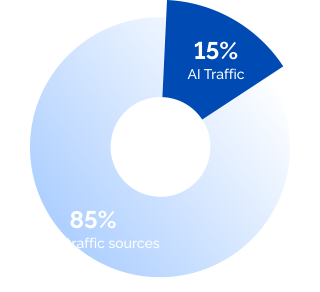
- AI Overviews and chatbots have become a part of the buyer’s journey, so optimizing for AI-generated search results is a key part of every serious retail SEO plan.
- A strong SEO strategy for retailers combines mobile-friendly UX, clear site architecture, quality content, strong calls to action, and a solid backlink profile.
Why Does Your Retail Business Need SEO?
If you sell goods online, you’ll never reach your customers without proper SEO for retailers. It’s not enough just to launch a website and wait for purchase-ready visitors. You need to regularly update your pages, optimize them, and craft valuable content. SEO for online shops encompasses all these techniques, as well as numerous other processes aimed at enhancing your business performance.
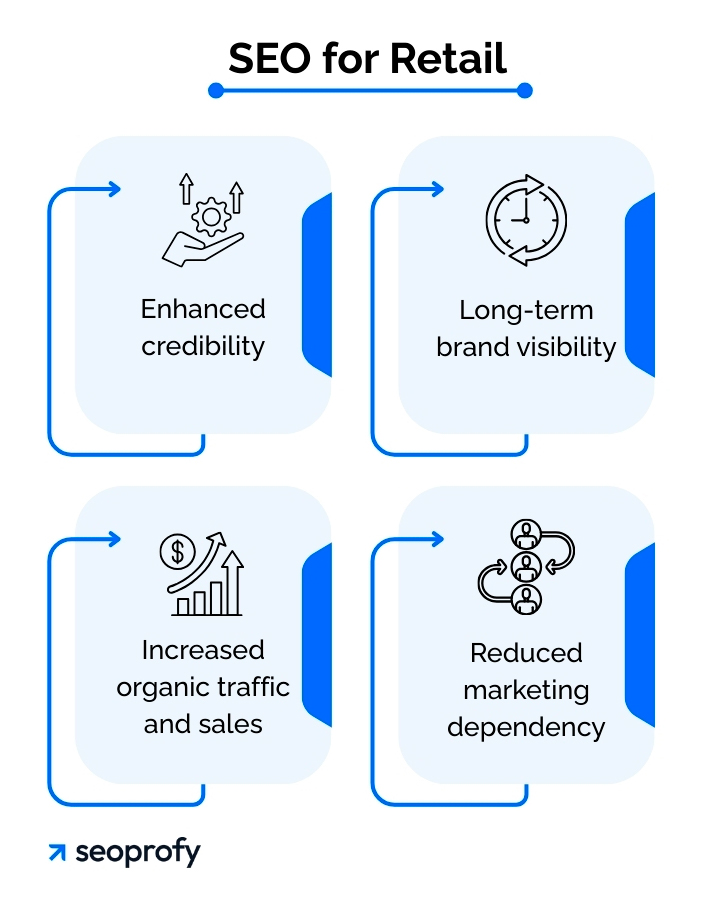
It takes time and effort, but the SEO benefits are undeniable. Here’s what a well-executed SEO strategy built on solid keyword research and tailored to specific goals delivers for retail businesses:
- Enhanced credibility: Search engine algorithms consider a variety of factors while ranking websites. They opt for sites with high-quality content, a strong backlink profile, and a well-optimized technical background. The right SEO strategy will help your website meet those standards and improve its search engine rankings.
- Long-term brand visibility: According to our ecommerce marketing statistics, 88% of customers are less likely to return to a site after a bad experience. An online shop with unique content, intuitive navigation, and positive reviews can help you establish a brand that continues to grow year after year.
- Increased organic traffic and sales: The harsh truth is that only 9% of buyers scroll down to the bottom of the first page of Google. If you’re not ranking at the top for your target keywords, you’re losing thousands of potential customers to competitors who are.
- Reduced paid ads dependency: You can significantly lower ad spend by building organic search visibility. When comparing SEO and PPC, the former doesn’t work as fast as paid search, but it’ll bring your business more advantages in the long run. Typically, optimization for retail stores takes at least 4 months, while the budget depends on your goals, the site’s condition, and competition. On average, SEO delivers an ROI of 8x, while the typical return for PPC is 4x. After optimization, you’ll mainly need to monitor performance and periodically adapt your approach.
Do you want to gain all the mentioned benefits without making costly mistakes? Opt for our professional ecommerce SEO agency, and our team will take care of your online visibility!
On-Site SEO Basics for Retail Websites
Website optimization for retail stores focuses not only on the quality of content but also on technical elements such as the website’s structure and mobile-friendliness. Do your customers leave your online store frustrated because pages load too slowly or because finding a desired product is harder than it should be? Then these on-page tips are a good starting point.

Optimize Product and Category Pages
Product page optimization is where successful SEO strategies for retailers begin. Strong product descriptions, clear calls to action (CTAs), and proper metadata all contribute to better visibility and higher conversion rates. Here’s what retailers should pay attention to:
- Product descriptions: Conduct thorough keyword research using SEO tools like Ahrefs and Semrush to identify relevant keywords and naturally incorporate them into the content on your category and product pages. Avoid using the same descriptions for similar products — duplicate content can hurt your rankings. You can also leverage Google Shopping SEO to get your products visible in shopping results alongside organic listings.
- Images: High-quality photos are an important factor for 67% of online shoppers. Use top-quality images that reveal the product’s benefits and help customers visualize its design. However, without proper optimization, large image files may slow your website down. Compress them to reduce page load times. Write descriptive alt text with target keywords for all your images. It’ll help search engine algorithms determine what is depicted in a photo, which will positively impact your rankings.
- CTA buttons: Strong CTA buttons directly affect conversion rates. Make sure your pages include multiple CTAs with clear, encouraging text.
- URLs: Keyword-optimized URLs receive 45% more clicks. Check whether URLs include relevant keywords, as they are also among the factors that help search bots understand page content.
- Meta tags: Well-written meta descriptions improve click-through rates from search engine results pages. Write them to match search intent and include your primary keywords.
- Page structure elements: Implement the terms and phrases you’ve discovered during keyword research into your pages’ headings (H1, H2, etc.). These HTML elements help search engines analyze the content on your pages, while visitors can use them to quickly scan through the text and determine whether it’s the right match for their intent. Plus, well-optimized headings can increase your AI visibility. AI systems tend to analyze page fragments for relevance, so having clear keywords for your content sections helps you get LLM citations.
- Reviews and testimonials: To convert organic traffic, your webpages should include testimonials from real buyers that highlight the advantages of the products you’re selling. About 83% of online shoppers use Google to check reviews before making a purchase, and other customers’ opinions are among the key factors in most buyers’ decision-making. Providing the audience with strong social proof is an integral part of SEO for retail shops.
Improve Website Structure for Easy Navigation and Crawling
A clear and logical site architecture helps search engines crawl your site efficiently, leading to better search rankings and improved indexing. It also reduces bounce rates — structured pages are simply easier to use.
When optimizing retail stores, pay attention to the so-called “breadcrumb trail.” It can be implemented using HTML and CSS within your website’s CMS. This important element creates a clear navigation path from your homepage to other pages, helping users and search bots understand each page’s position within the overall site architecture. Thus, visitors can explore your website more effectively:

Finally, you need to carefully weave internal links into your content. This is a great way to connect your blog posts with your “money” pages. For example, if you run a store that sells shoes, it may be a great idea to write an article titled “Top 10 Sneakers for Runners” with links to relevant products.

When you run an online store with hundreds of pages, keeping your architecture clean takes real effort. Our affordable SEO services can help keep things manageable.
Technical SEO for Online Retail
Strong technical SEO for ecommerce and retail is the foundation on which everything else is built. Even the best content and keyword strategy won’t perform well if your site has crawl issues, broken links, or indexing problems. For retail businesses with large product catalogs, technical optimizations are especially worth the investment.
Here are the technical SEO areas that matter most for retail stores:
- XML sitemaps: Submit XML sitemaps to Google Search Console to help search engines discover and index all your product and category pages.
- Broken links: Broken links frustrate customers and waste crawl budget. Audit your site regularly and fix or redirect them.
- Canonical tags: Large retail sites often produce duplicate or near-duplicate URLs through filters, sorting, and pagination. Use canonical tags to tell search engines which version of a page to index and assign ranking power to.
Make Your Pages Mobile-Friendly and Fast
A mobile-optimized website isn’t optional — it’s table stakes for retail, as 76% of online customers make purchases on mobile devices. Plus, Google’s mobile-first indexing means its algorithms prioritize a site’s mobile version when ranking it.
Responsive design is an integral part of any mobile-friendly website. It arranges all elements on webpages to fit any type of screen. Both desktop and mobile versions should be easy to navigate and visually clean.
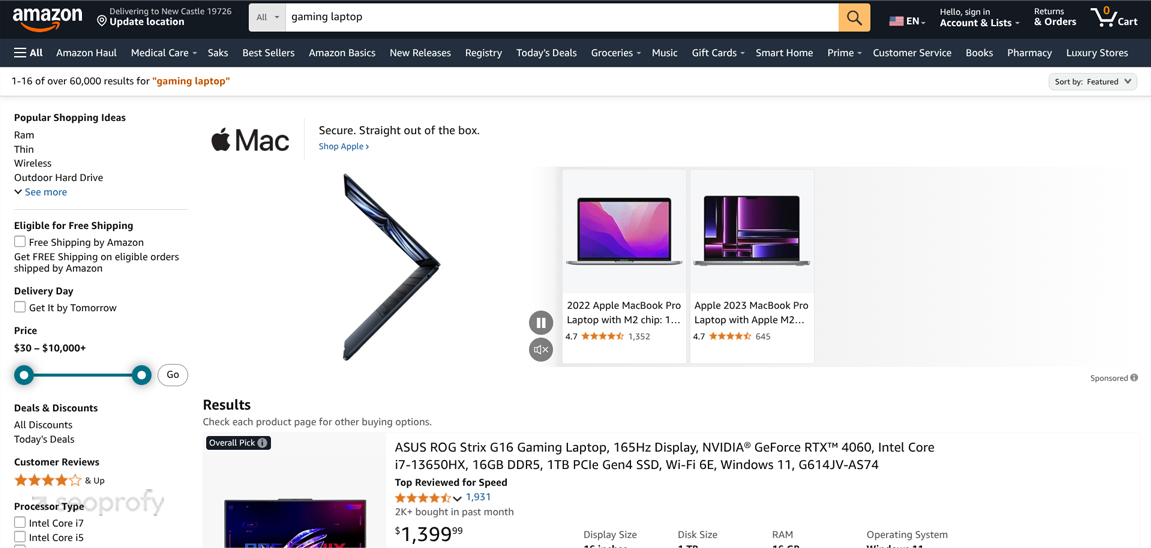

Here are a few more mobile optimization tips that directly affect user experience and search engine rankings:
- Make checkout processes as simple as possible by reducing the number of steps to complete the form.
- Opt for a minimalistic UX design to avoid overwhelming your customers with unnecessary elements.
- Remove pop-ups for mobile users for smoother navigation on the site.
For local businesses, making phone numbers clickable on mobile is also a smart move. It’s a small local SEO detail that can noticeably improve user experience for nearby customers.
The loading speed of your webpages is another essential factor to consider if you want to reach your business and SEO goals. Google recommends using its Lighthouse for estimating your website’s performance on desktop and mobile devices:

This tool will analyze your site, considering different factors, including the loading speed. After that, it’ll provide improvement suggestions, which may include compressing images, optimizing CSS performance, etc.
Site speed has a direct impact on conversion rates and bounce rates: more than 88% of users report leaving a website due to slow loading, and for 73%, poor mobile optimization was a major issue. Having your pages load at least one second faster can increase your conversion rates by about 17%. Check your performance regularly and fix issues before they compound into bigger problems.
Leverage Structured Data and Rich Snippets
Search engines use structured data, also known as schema markup, to understand your content. This specific HTML code organizes data on your webpages, making it readable for machines. It’s based on specific vocabulary such as schema.org. Product schema with pricing, availability, and reviews is particularly valuable for retail businesses.
Retail SEO strategies involve leveraging structured data, as it increases click-through rates (CTR) by about 25%, improves visibility in organic search, and boosts the chances of a page appearing in rich snippets. These are the Google Search results with some additional information displayed:

As you can see, rich snippets may include various elements, such as star ratings, prices, and even images. They make your pages more attractive and informative for the target audience, encouraging them to click on your website.
Use Best Practices for Voice and Visual Search Optimization
The rapid development of AI technology has significantly boosted the popularity of voice assistants. Nearly 42% of U.S. residents use them to search for information online. At the same time, many of them opt for voice search to look for products offered by local and online retail businesses.
The best way to make your pages appear in voice search is to optimize their content with long-tail keywords. Voice queries tend to be more conversational, so content that answers specific questions in plain language performs best. Incorporating long-tail keywords into product pages and blog posts also brings in shoppers who are closer to making a purchase.
Visual search is another channel worth optimizing for — Google recorded 100 billion visual searches in 2025. Here’s how to make your product images discoverable:
- Change image names: Before uploading the product photo to your website, make sure that its filename includes relevant keywords. For example, instead of “image1.jpeg,” opt for the more descriptive “black-running-shoes-adidas-man.jpeg.” Also, don’t forget to include the keywords in the alt text.
- Use high-quality images: Whether you’re implementing SEO for luxury brands or your homemade products, focus on the quality of your photos. Consider using image formats like JPEG or WebP. They offer an ideal balance between image size and quality.
- Create image sitemaps: You should create and submit special XML files (image sitemaps) to help search engine algorithms discover and index the photos on your pages more efficiently.
Content and Off-Page SEO for Retail Businesses
A solid technical foundation matters, but it won’t carry you to the top on its own. Content and backlinks are what separate retail businesses that rank higher. Here’s how to approach each.

Blogging and Content Marketing
Unique, engaging content is essential for retailers. A strong content strategy built around your customers’ needs can improve E-E-A-T signals (experience, expertise, authoritativeness, and trustworthiness), drive relevant traffic, and attract shoppers who are actively looking to buy. And real data proves this: websites that publish blog posts attract 55% more visitors than those that don’t.
How can you create content that ranks higher in search and resonates with your audience? A few practical tips:
- Use the right keywords: Focus on long-tail, localized, and intent-driven keywords when creating content for your blog posts and product pages. Long-tail keywords are usually easier to rank for due to lower competition. Additionally, these keywords attract more qualified traffic to your site. They are often used by searchers who are ready to make a specific purchase, making it easier to convert them into your clients.
- Know search intent: Understand your customers’ common questions before you write. Analyze competitor blogs and popular search queries for your main keywords to identify customer pain points and the topics your audience cares about.
- Provide unique insights: If you want people to share your content, you need to provide extra value. For example, you can conduct research, create attractive infographics, or use other types of visual content that attract references like a magnet.
- Opt for social media: Although social media doesn’t have a direct impact on your rankings, it still drives traffic to your website. Make sure that your content is easy to share by adding widgets and “Share” buttons. For effective social media marketing, create profiles on platforms popular with your target audience to enhance your business’s online presence.
Finally, if you want your ecommerce content strategy to yield the maximum outcomes for your business, consider adding Q&A sections to your product pages. They strengthen E-E-A-T signals, grow your overall credibility, address customer confusion before it kills a sale, and improve customer satisfaction — turning one-time visitors into satisfied customers.
Does your business have both a physical store and an online presence? Focus on content relevant to your local audience. For instance, if your city holds a yearly marathon or festival, you may come up with an article highlighting the best items for these events. A similar logic works for multi-location SEO — create content that reflects the interests of customers from every retail location where you operate.
AI Visibility Optimization
AI-generated results are quickly becoming a new frontier for retail brands’ visibility. Google’s AI Overviews appear at the top of many product-related queries, and generative AI tools like ChatGPT are increasingly used for product discovery and online shopping recommendations.
Here’s how you can adapt your ecommerce SEO for AI and start appearing in LLMs:
- Write structured, factual product descriptions that directly answer common buyer questions.
- Apply schema markup for products, including reviews, prices, and availability.
- Build topical authority in your niche through thorough content on related subjects.
- Keep your Google Business Profile up to date — local signals feed into AI search results too.
Beyond general AI visibility, online retailers should consider optimizing specifically for ChatGPT shopping and similar emerging features.
User-Generated Content and Reviews
Accumulating positive reviews is a cornerstone of customer engagement and credibility. But careful reaction to negative feedback also matters. According to our local SEO statistics, 89% of buyers are more likely to choose a business that responds to both positive and negative online reviews.
Additionally, by leaving feedback and posting product photos on your pages, users keep the information on them up to date, which is a positive signal to search engines. The algorithms will see that people spend more time on your website, which will eventually increase its authority.
If you run brick-and-mortar retail stores, you should focus on the development of your Google Business Profile (GBP) and visibility in local search. Local SEO can drive foot traffic to your physical locations. Keep the information about your shop in GBP fresh, add high-quality pictures of your products, and respond to customers’ reviews.
You may also opt for other local SEO strategies to enhance both your online and offline business processes. Local SEO increases visibility in local search results — the searches that include phrases like “near me” or a specific city — and attracts people to your retail location.
Link Building and Local Partnerships
Many retail stores operate only in certain locations and aren’t as well-known as popular brands, which makes it difficult for them to rank for high-volume keywords. That’s where link building comes into play.
Earning high-quality backlinks is an integral part of successful SEO for small businesses, as earning backlinks helps you grow your domain authority. The higher it is, the stronger your chances of reaching the top in competitive searches. For a full breakdown of link acquisition tactics, our guide on ecommerce link building is worth reading.
Although it may be tempting to buy a few backlinks, this is considered a black-hat technique that can negatively impact your search rankings. Focus instead on creating genuinely useful content — incorporate local keywords, share valuable insights, and use high-quality visuals. That’s what earns organic backlinks from relevant sites and gives you a competitive edge without risking penalties.
Another great way to enhance your backlink profile and reach new clients is to get mentioned in business listings. These are popular websites that include directories of businesses organized by category. They are an invaluable resource for your local SEO strategy.
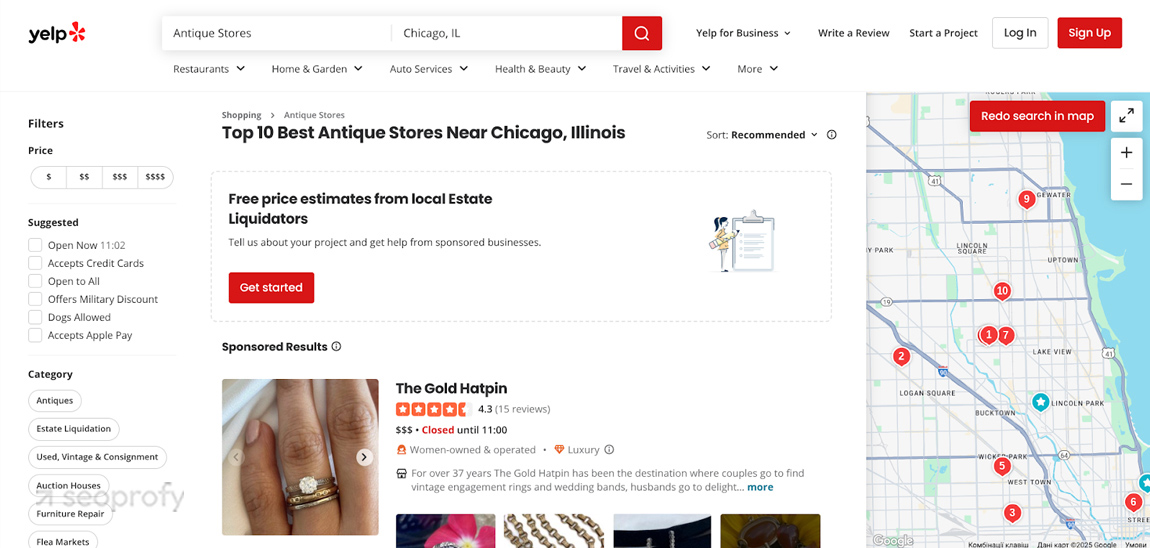
For example, if you run a beauty salon in Chicago, you need to get mentioned by popular local listings such as Yelp, Fresha, and Byrdie. Such a specific niche also calls for specific health and beauty SEO techniques, taking into account the demands of the field.
Develop your business with our custom SEO solutions for retail businesses. SeoProfy is here to help you reach your goals:
- Increase search rankings and revenue
- Grow your brand awareness
- Create an extensive base of loyal customers

Measure and Scale Your SEO Results
Even with a strong SEO strategy for retail, you need to track the performance of your online store using tools like Google Analytics and Search Console. Algorithm changes happen regularly, and your strategies need to adapt with them. It’s also important to keep your approach aligned with how consumer behavior and online shopping habits shift over time.
Through regular audits, you can identify technical issues and pinpoint content that needs to be updated. Remember that it’s easier to fix a problem when it has just occurred rather than waiting until it leads to Google penalties or significant ranking drops.
Unfortunately, online shops often struggle after the algorithms’ updates. In this case, you’ll need powerful SEO tools and deep expertise to recover. Instead of wasting your resources and time trying to figure out what works for your site, it’s better to opt for professional help. Take a look at our ecommerce SEO pricing guide and book a free consultation to discuss your project with our experts.
Get More Traffic and Sales with Retail SEO
SEO is a long-term investment that can drive more sales through better visibility in search results, open new business opportunities, and enhance your authority. Retail businesses that combine a solid technical setup with quality content, local SEO, and a strong backlink profile consistently outrank those that don’t.
If you need a partner to help build or scale an effective SEO strategy, SeoProfy is here. We’ll help you develop an approach that works for your specific market and customers and grows with your business.

Andrew Shum is the Head of SEO at SeoProfy with 10+ years of experience in SEO and digital marketing. He has been part of the company for over 6 years and has led the SEO department for the past 3.5 years, managing a team of 15+ specialists. He works with competitive and international multi-language projects across eCommerce, SaaS, and enterprise niches, focusing on practical SEO strategies that deliver measurable results.