


AI marketing statistics in 2026 make the industry look busy, uneven, and far more mature than it was a year ago. AI has moved into content work, campaign planning, SEO, analytics, and customer communication, but the gains depend on the team behind the tools.


Below, we collected the latest numbers to show where marketing professionals already benefit from AI and where the work still gets messy. The data covers adoption, use cases, ROI, marketing automation, personalization, customer experience, and trust.
- 88% of marketers use AI in their day-to-day roles.
- 80% of marketers use AI for content creation, and 75% use it for media production.
- 86.5% of pages ranking in Google’s top 20 include some AI-generated or AI-assisted content.
- In one survey of 1,000+ GTM professionals, two-thirds of businesses using AI said their revenue growth rate increased by 25% or more.
- Marketing AI users report 44% higher productivity and save about 11 hours per week.
AI Adoption in Marketing: How Widely Is It Used?
AI adoption in marketing is already widespread in 2026. About 88% of marketers use AI in their day-to-day roles. Canva’s 2025 State of Marketing & AI Report found that 78% of marketing leaders consider AI critical to their long-term strategy, while McKinsey reports that 88% of organizations use AI in at least one business function. Moreover, SeoProfy’s stats show that 82% of the world’s top companies use GenAI at least once a week, and 46% use it every day.
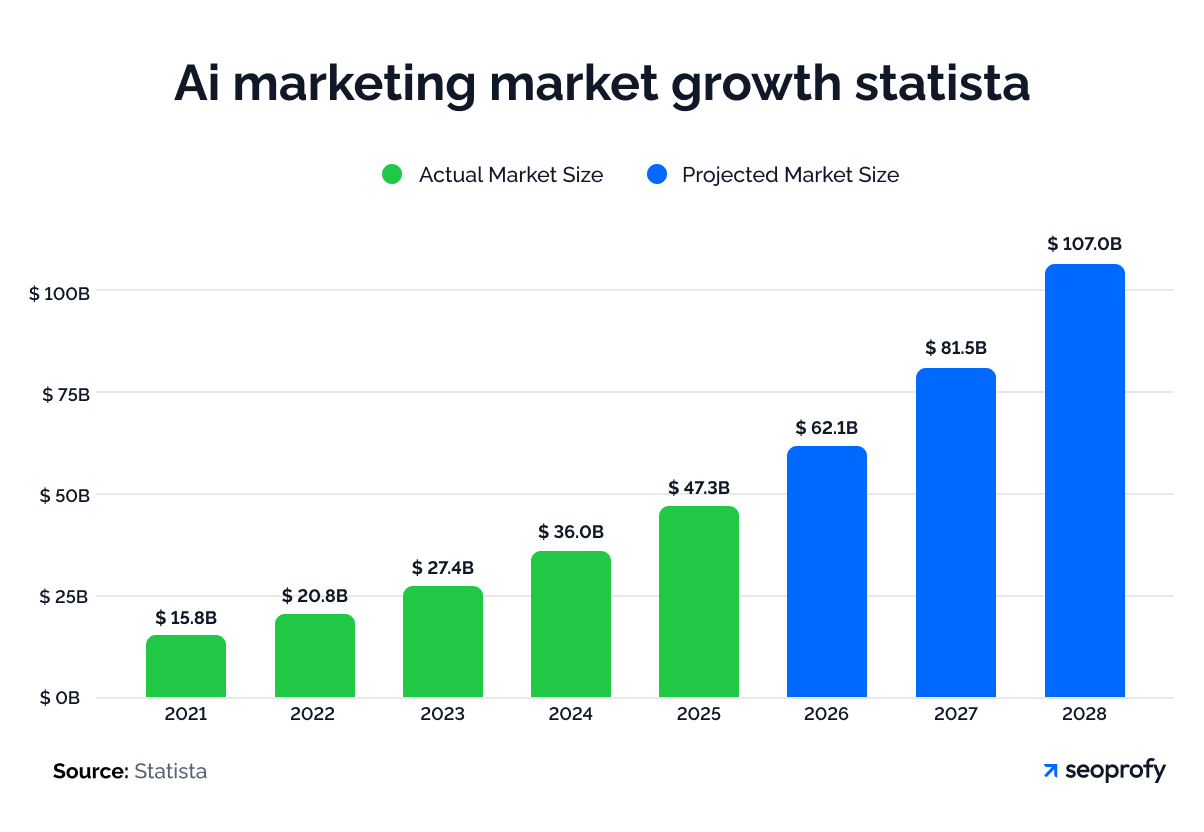
Still, full integration is less common. Around a third of organizations have already built AI into their operations, while many teams are still testing it across channels and repetitive tasks. The money is growing too: the AI marketing sector reached $47 billion in 2025, with forecasts pointing to $107 billion by 2028.
Usage Rates Across Marketing Teams
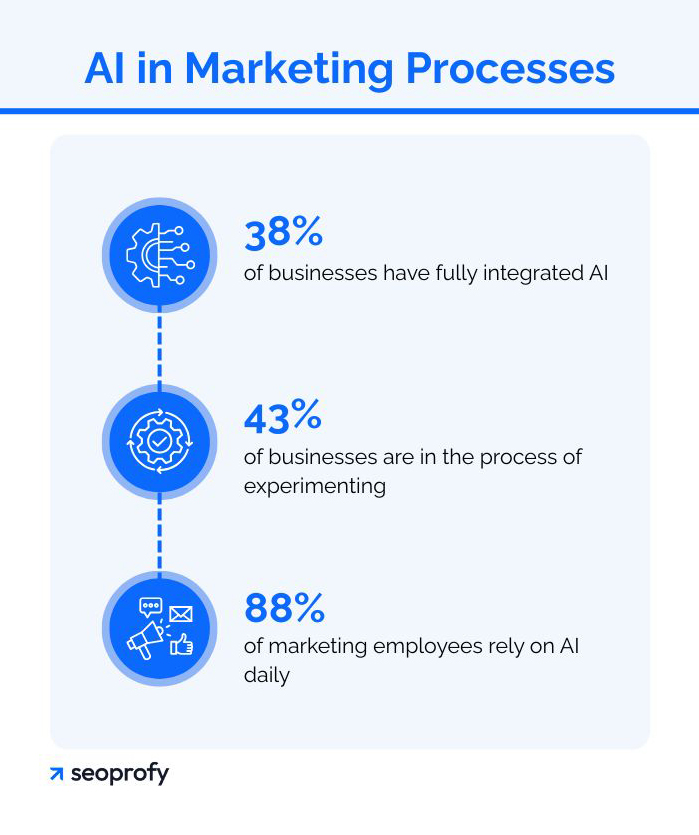
AI is widely used in marketing, but most teams are still working out how deeply it should fit into their processes. Almost all marketing organizations use it for planning or execution, 38% have fully integrated it, and 43% are still experimenting.
88% of individuals in the marketing niche rely on AI in their day-to-day operations, even if their companies haven’t fully implemented it. (SurveyMonkey)
80% of marketers use AI for basic content creation, and 75% use it for media production. (HubSpot 2026)
AI agents are moving into production, but full integration is still limited: only 23.3% of companies have AI agents fully integrated into their marketing stack in production. (Averi)
Still, only 29% of adopters consider their AI use advanced. This signifies the gap between adoption and operational readiness. (Jasper.ai)
Industry and Business Size Breakdown
AI integration is now expanding rapidly across various industries in marketing. U.S. SMBs are catching up fast: small-business marketing AI adoption rose from 26% in 2023 to 87% by April 2026. Enterprise teams are further ahead in production maturity: 25% of companies already have at least 40% of AI experiments in production, and 54% expect to reach that level within six months.
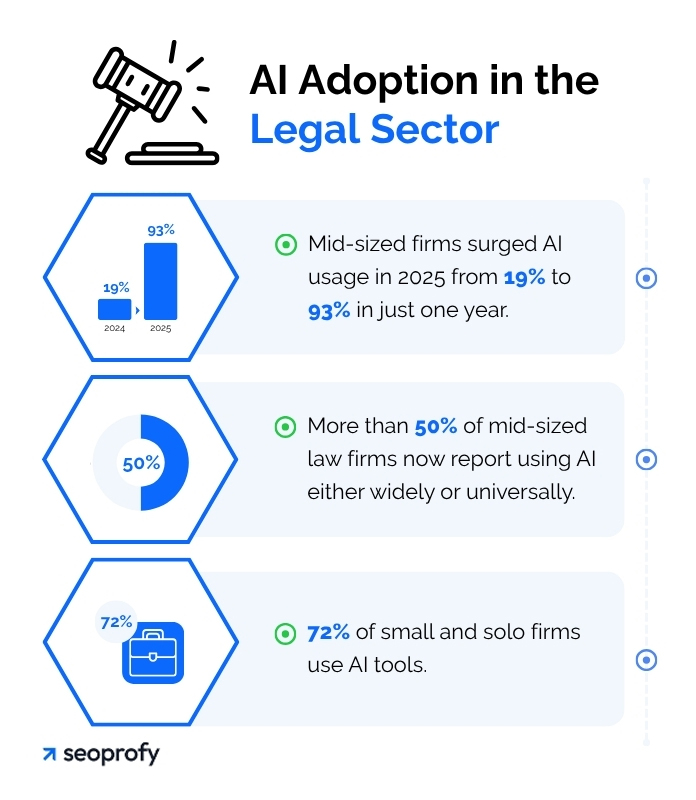
In the legal sector, mid-sized firms demonstrate broad AI usage. In 2025, the share increased from 19% to 93% in one year. (Law Times)
Across small and solo firms, 72% adopt AI tools, while only 10% use them extensively. (Law Times)
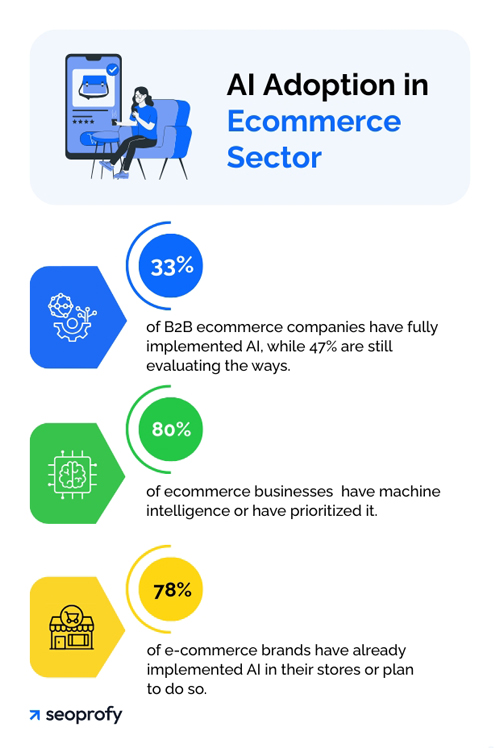
33% of the B2B ecommerce companies have fully implemented AI, while 47% are evaluating the ways. (Gauss)
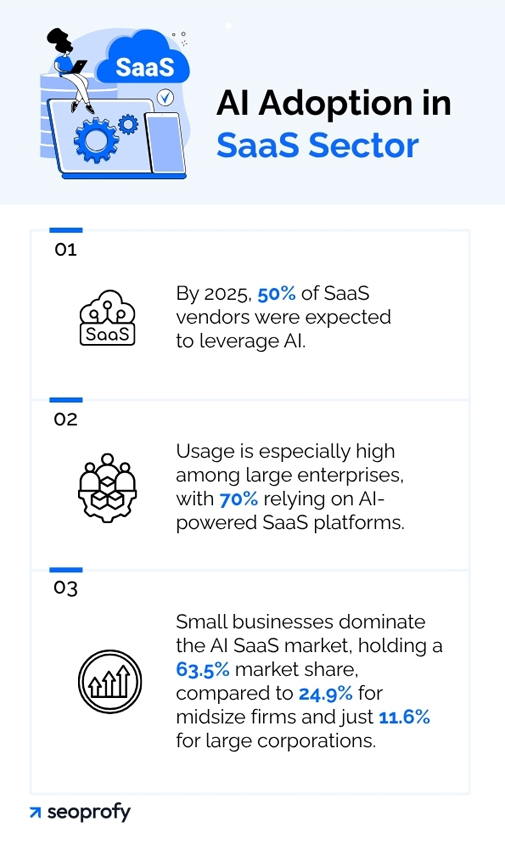
Small businesses dominate the AI SaaS market, holding a 63.5% market share, compared to 24.9% for midsize firms and just 11.6% for large corporations. (Consainsights)
AI-Powered Tools for Marketers
Marketers use generative AI tools across content, visuals, customer communication, productivity, and audio workflows. By category, AI chatbots and conversational tools lead at 69.2%, followed by visual AI tools at 59%, text generation tools at 41%, productivity assistants at 28.2%, and audio or voice AI tools at 17.9%.
Generative AI
Generative AI is growing fast in the marketing industry. Teams use it to write, test, personalize outreach, and support customer interactions.
For example, around 78% of companies have adopted generative tools into at least one core business process. (SQmagazine)
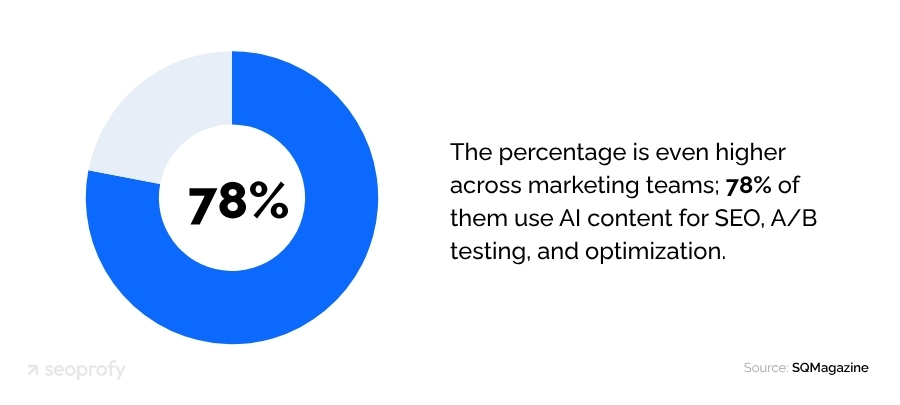
About 78% of marketing teams use AI content for SEO, A/B testing, and optimization. (SQMagazine)
Across the AI platforms marketers use, the most popular are: ChatGPT holds the largest AI chatbot share at 79.08%, followed by Perplexity at 7.67%, Google Gemini at 7.03%, Microsoft Copilot at 3.23%, and Claude at 2.98%. (Statcounter)
AI use cases among marketers: copywriting/written content — 79%, visuals/graphics — 57%, video/motion — 31%. (Typeform 2026 Trends in Generative AI and the Marketer)
These content creation tools are integrated into marketing workflows to speed up delivery, boost engagement, and support SEO strategy through features like keyword optimization, metadata generation, and enhanced personalization.
Predictive Analytics
Predictive analytics helps marketers forecast campaign results and personalize outreach with current data. It is already common in the industry, with 74% of organizations using AI for it. The key functions of the usage include:
- Audience segmentation;
- Consumer behavior forecasting;
- Customer insights;
- Data-driven decision-making;
- Marketing outcomes of campaigns.
With adoption so high, AI’s impact on long-term strategies is evident. It helps teams improve targeting, messaging, and timing. In particular, 91% of execs agree that new technologies improve decision-making.
Automation
AI automation is moving from task-level support to connected campaign workflows: marketers use it for email personalization, social scheduling, lead scoring, segmentation, reporting, and campaign testing.
Around 25% of marketing tasks are automated, with expectations to rise to 30% by 2026. (9CV9)
More than 40% of agentic AI projects are expected to be canceled by the end of 2027, largely because autonomous AI agents are more complex than standard automation and often come with higher costs, unclear business value, and weaker risk controls. (Gartner, cited by Reuters)
50% of marketers say AI helps them bring work to market faster, and 45% say it has lowered operating costs. (Jasper State of AI in Marketing 2026)
There is a 20% average lift in conversion rates through personalization with AI tools. (9CV9)
Where AI Makes the Biggest Impact
The use of AI in marketing can help teams plan faster, handle routine tasks, and track results more clearly. For many companies, it also becomes a way to stay competitive as digital marketing keeps changing.
Top Use Cases of AI in Marketing: Content, SEO, Personalization
AI SEO tools power some of the most critical aspects of marketing. For instance, tools like ChatGPT and Jasper generate blogs, scripts, and social media marketing, freeing SEO experts to develop strategy and brainstorm ideas.
In addition, these tools can help with AI SEO implementation success and search visibility. Platforms like SurferSEO or SearchAnalytics automate keyword planning, technical aspects, and relevant structure for texts.
Marketers who use AI publish 42% more content each month, with an average of 17 articles compared with 12 from teams that do not use AI. (Ahrefs)
About 74% of all new online content is now produced with the help of generative AI. (SEO statistics for 2026, SeoProfy)
86.5% of pages ranking in Google’s top 20 include some AI-generated or AI-assisted content. (Ahrefs)
Still, AI-generated content can drive:
- 47% longer time on page;
- 39% deeper scroll depth;
- 58% increase in shares across social platforms (Numberanalytics)
The other important aspect in marketing strategies is personalization. AI SEO stats show that tailored content can ensure more leads and higher revenue.
AI-driven personalization can raise customer satisfaction by 15–20%, increase revenue by 5–8%, and cut service costs by up to 30%. (McKinsey)
Productivity and ROI Gains
Beyond strategy, artificial intelligence also affects the business side of marketing. In a survey of 1,000+ GTM professionals, two-thirds of businesses using AI said their revenue growth rate increased by 25% or more. Marketing AI users also report 44% higher productivity and save about 11 hours per week. For teams working with AI content for SEO, this supports faster publishing, more testing, and a stronger link between content output and revenue.
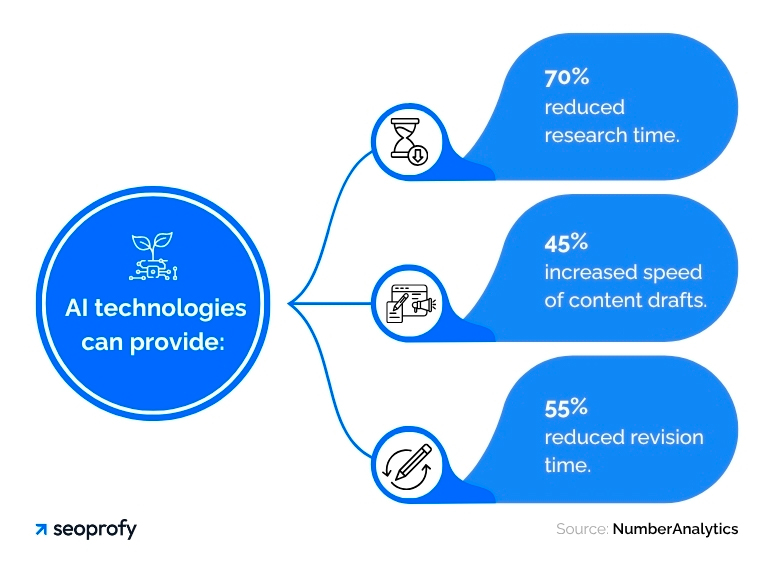
For instance, AI technologies can provide:
- 70% reduced research time;
- 45% increased speed of content drafts;
- 55% reduced revision time. (NumberAnalytics)
The other important factors are production expenses and ROI efficiency.
40% of marketers report a 6–10% revenue increase after using AI SEO, while 75% say their AI initiatives deliver a clear ROI. (SeoProfy)
Companies that use generative AI to improve customer experience can see 25% higher revenue over five years than companies that use it only for productivity. (SeoProfy)
Meanwhile, some brands report a 200-450% increase in their ROI. (Market Pulse)
Marketers’ Sentiment Toward AI
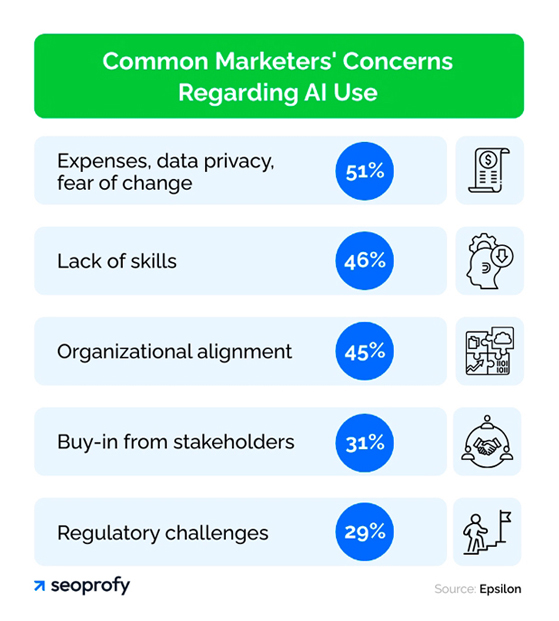
Despite the benefits, marketers still have concerns about AI. Many teams use it often, but questions around accuracy, trust, data privacy, and brand voice still slow wider adoption.
Optimism vs. Caution
Nowadays, marketers rely on artificial intelligence as a part of their daily workflows.
While the majority (69%) recognize the power of AI technology to transform business operations and boost performance, only 17% admit to mixed emotions, still reviewing real-world integration and long-term impact on their roles and jobs. (SurveyMonkey)
One of the most common fears is that machine intelligence might replace their jobs; it’s admitted by 60%, a jump from 36% the year prior. (Influencer Marketing Hub)
The other barriers include lack of skills (46%), organizational alignment (45%), buy-in from stakeholders (31%), and regulatory challenges (29%). (Epsilon)
Job Impact and Upskilling
As AI adoption accelerates across the industry, marketing leaders face growing pressure to keep up.
Over 75% of marketers see AI skills as a gap in their professional development. (Marketing week)
About 68% of marketers say they have received no AI training from their company, and only around 17% have had full job-specific training. (State of marketing)
Since 68% receive no formal Gen AI training, many rely on self-learning or external programs. (Complete AI Training)
Only 47% understand how to use these technologies strategically. Thus, integration requires better support and clearer direction. (Hubspot)
Barriers and Challenges to AI Adoption
Artificial intelligence adoption still has clear barriers. Privacy concerns, budget limits, technical complexity, accuracy issues, and customer trust all affect how far companies are ready to take it.
Data Privacy and Ethical Concerns
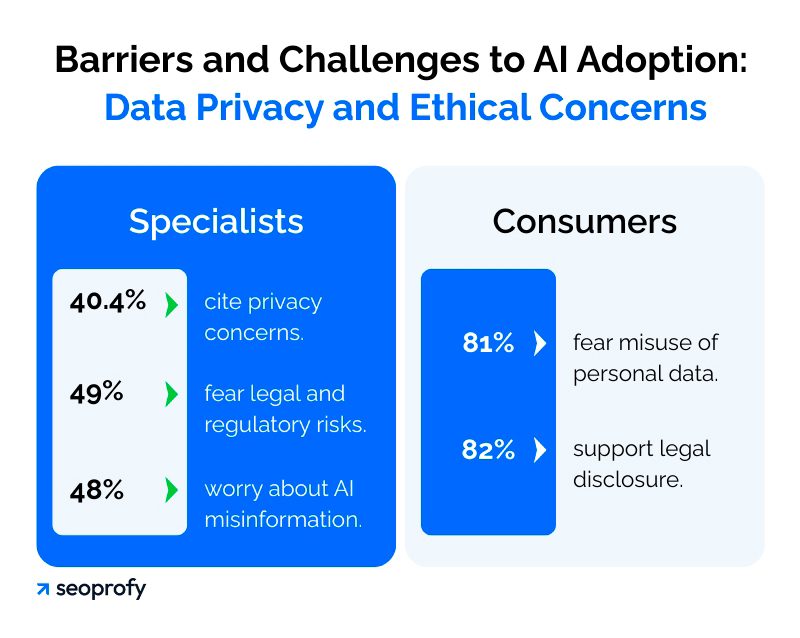
AI marketing stats show data privacy concerns as the most cited barriers among professionals and consumers. For example, many specialists worry that data bias in machine learning models can lead to skewed insights and harm audience targeting accuracy.
40.4% of teams note that privacy is a top reason they hesitate to fully adopt these tools in their marketing campaigns. (CoSchedule)
90% of organizations say AI has expanded the scope of their privacy programs, and 93% plan to invest more in privacy and data governance over the next two years. (Cisco)
AI governance is still underdeveloped in many companies. Only 12% describe their committees as mature and proactive, while 23% have yet to create a dedicated group to oversee AI use. (Cisco)
As for consumers, their concerns are even more highlighted. Thus, companies must be careful and respectful when integrating artificial intelligence to ensure trust and transparency for their clients.
Only 46% of people say they are willing to trust AI systems, while 70% believe AI needs regulation. (KPMG)
Consumers are cautious about sharing personal data with AI tools. Among generative AI users, 84% worry that the information they enter could become public. (Forbes)
82% support legal disclosure of robotics participation in customer interactions. (New York Post)
Technical and Budget Constraints
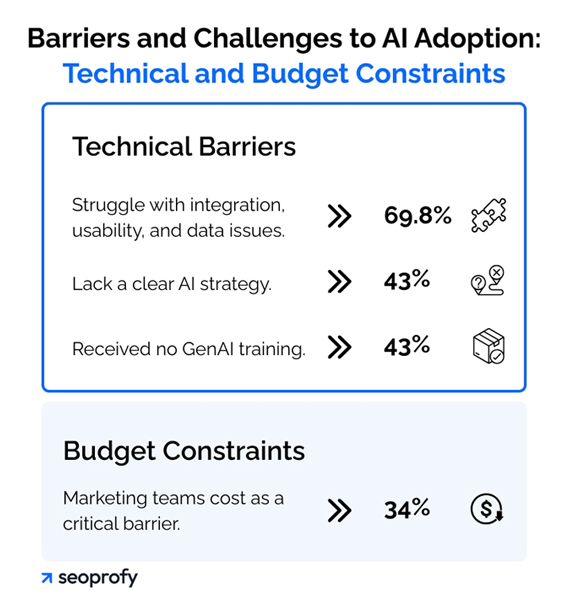
Technical barriers also slow AI integration. Companies often struggle with implementation, limited in-house skills, and the budget needed to make the tools work properly.
69.8% of marketers struggle with tool integration, poor usability, and data compatibility issues. (Influencer Marketing Hub)
In 2026, only 25% of companies have moved at least 40% of their AI experiments into production, which shows how hard scaling still is even after adoption starts. (Deloitte)
More than 34% of marketing teams identify cost as a critical barrier. This is especially challenging for small companies. (Influencer Marketing Hub)
Still, JPMorganChase found that entry costs for small-business AI services fell from about $50/month in 2019 to $20–30/month in 2025, helping newer adopters enter at lower spending levels. (JPMorganChase)
43% cite the lack of a clear artificial intelligence strategy as a major problem. (Marketing Profs)
43% of specialists admit their companies didn’t provide Gen AI training, leaving them unprepared for integration. (LinkedIn)
Without unified SEO goals, marketing organizations often fall short in aligning AI with broader business success or in using it for smarter audience segmentation and content creation.
Consumer Perception of AI in Marketing
When implementing AI tools into your processes, it’s necessary to understand what consumers think about these changes. With all innovations, we should remember that customer trust is a key factor in engagement. At the same time, demand for AI-powered content is high among Gen Z and millennials.
Trust and Preferences
As for today, consumers are cautiously optimistic about the impact of the AI marketing trend. These customer preferences should be noted by marketers.
Around 59% of consumers feel positive toward companies that use artificial intelligence. (Optimove)
57% of consumers trust human-generated content more than AI-generated content. (Averi)
People correctly identify AI-generated images 62% of the time. (How good are humans at detecting AI-generated images?)
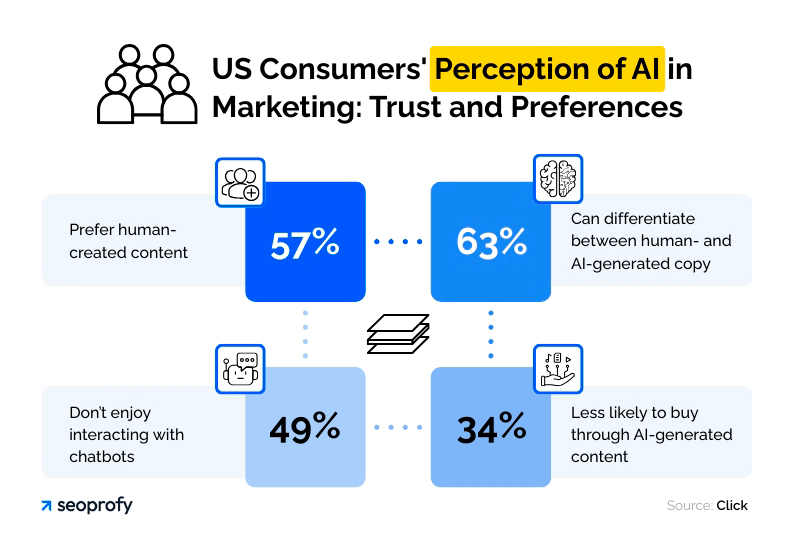
The chatbot aspect also reflects these trust patterns, underlining the need for smoother and more transparent AI integration.
Chatbot adoption is high, but consumer acceptance remains weak: 42% of organizations were using generative AI text-based chatbots with customers in 2023, with adoption expected to reach 84% by the end of 2025, while only 16% of consumers said they often used chatbots. (Forrester)
56% of people have negative feelings about companies using AI as part of their customer experience, and 79% of Americans strongly prefer interacting with a human over an AI agent. (SurveyMonkey)
Moreover, 50% of U.S. consumers say they would rather buy from brands that avoid using GenAI in customer-facing messages, ads, or content. (Klaviyo)
Personalization Expectations
While there still are trust issues, demand for AI-driven personalization is rising.
Most consumers find personalized marketing appealing, and 72% expect it from brands. (SmarterHQ)
In 2026, 93% of shoppers are likely to keep buying from a brand that provides personalized experiences. (Attentive)
Besides, more than 75% of shoppers want AI-generated product recommendations. (Capgemini)
These facts about AI in marketing statistics shows a tricky outlook: consumers embrace artificial intelligence in marketing when it’s used to enhance relevance, but they expect ethical data use and transparent communication.
AI Marketing Trends in 2026 and Beyond
AI marketing statistics show rapid expansion of use cases. As we define, they can provide not only automation but also personalization, creativity, and real-time insights useful to develop a successful SEO strategy. Brands that harness agentic tools, transparency-first personalization, and platform-aware advertising will have a competitive advantage as AI marketing trends in 2026 push the industry toward more automated and adaptive campaigns.
In 2026, AI, especially generative engine optimization services, will be a co-creator, and this usage will grow fast over the next few years. Tools like ChatGPT or Synthesia can work alongside marketers, developing ideas, generating brand-aligned campaigns, and providing insights that fuel creativity.
Predictive tools also have a wide range of uses. Big brands like Delta are using digital twins and forecasting models to improve sales and plan campaigns. Moreover, such tools can help teams build an AI-ready SEO strategy to expand their reach. This includes ranking in Google AI Overviews and generated answers from other LLMs, which can bring part of today’s search traffic.
Some of the biggest AI marketing trends include:
- AI influencers: Virtual brand ambassadors who chat with followers, react to emotions, and are available 24/7.
- Multimodal AI: Tools that combine text, images, and audio to build content that adapts to each platform.
- Dynamic personalization: Ads, websites, and emails that instantly change based on user behavior.
At the same time, there are concerns. Many marketers worry about bias in artificial intelligence models and a lack of in-house skills to manage these tools. With more ads showing up in chat-based platforms like Copilot, staying ethical and transparent is more important than ever.
Looking to future-proof your marketing? Connect with SeoProfy, a reliable data-driven SEO company, for a custom roadmap to smarter decisions.

As a Content writer at SeoProfy, Hanna Zhytnik creates SEO content grounded in research, data, and ongoing hypothesis testing. With more than 5 years of experience across B2B, SaaS, and ecommerce, she brings both breadth of knowledge and a sharp focus on modern search. Her strength lies in turning complex experiments into clear explanations, bridging the gap between deep SEO practice and accessible content.