
 Add SeoProfy as a preferred source on Google
Effective SEO for gambling sites helps online casino, sports betting, and affiliate platforms improve their visibility in organic search. It is similar to regular SEO in that it includes technical and on-page optimization and link building, but iGaming sites require more attention to trust and compliance signals.


Gambling content can fall into YMYL territory because it may affect users’ financial well-being, which makes accuracy, transparency, and trust especially important. Without first building solid trust and compliance, even solid SEO practices may not improve organic search visibility. It also means that standards for accuracy, transparency, and trust for such sites are higher than for other domains.
This guide explains how to build a practical gambling SEO strategy in the right order. It is intended for operators, affiliates, marketers, and website owners who want to improve their sites’ organic visibility.
- Build trust and compliance before investing heavily in content or backlinks.
- Fix technical and indexing issues so search engines can properly access and understand priority pages.
- Match keywords to search intent and create useful, market-specific content instead of relying on repetitive templates.
- Treat link building and SEO measurement as ongoing processes, focusing on qualified traffic, conversions, and sustainable growth.
Why SEO Matters for Gambling and Casino Sites
Many gambling businesses rely on paid acquisition, which can be an effective traffic channel, but it is less accessible than in other domains. Because of how sensitive the niche is, it is subject to more regulations from the platforms, which limits campaign reach and slows expansion into new markets.
Google’s gambling advertising policy requires certification, approved-country targeting, responsible-gambling information, and compliance with local laws. The same applies to Meta — its policy also requires prior written permission for ads that promote online gambling.
Organic search helps operators and affiliates reduce their dependence on paid ads and find another way to reach qualified traffic. However, it does not necessarily replace traditional advertising — more often than not, SEO is used to support paid acquisition over the long term. Strong visibility can also reduce reliance on one advertising platform when policies or approvals change.
Gambling SEO is the process of improving a casino, sportsbook, or affiliate website so search engines can crawl it, understand its relevance, and present it for suitable queries. What it includes:
- Compliance-aware content
- Technical SEO
- Keyword research
- On-page SEO
- Link building
- Multi-market localization
An effective SEO strategy starts with understanding how search engines find and rank your pages. See our guide on What Is SEO to learn more about how it works and how you can start and measure it on your website.
Define Your Starting Point and Goals
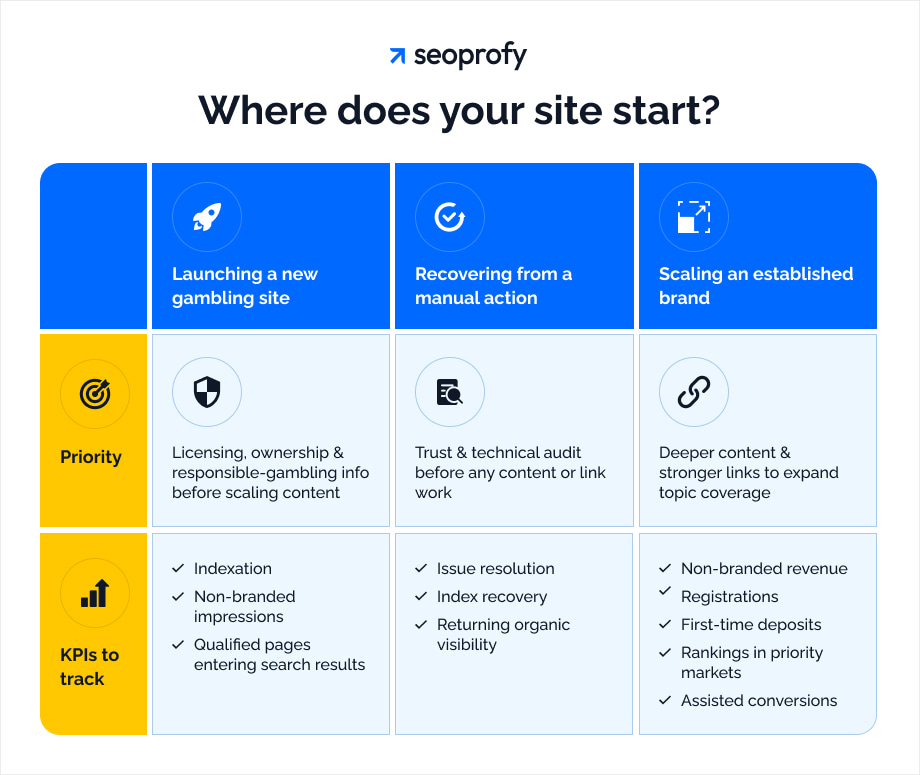
Before planning your iGaming SEO strategy, assess the current state of the site and your business goals to better define what success looks like. Your priorities will depend on the site’s condition:
Launching a new gambling site: For a new gambling site, establish licensing, ownership, and responsible-gambling information before scaling content production. To build this foundation, ensure that the site has accurate licensing, ownership details, terms, age restrictions, and responsible-gambling information. The key KPIs here are indexation, non-branded impressions, and the number of qualified pages entering search results.
Recovering from a manual action or severe decline: The priority is a trust and technical audit before any content or link work. To reveal the cause of restrictions or decline, review the Search Console, crawlability, security, ownership details, licensing information, and the manual action notice. The main KPIs are issue resolution, index recovery, and returning organic visibility.
Scaling an established brand: The focus here is deeper content and stronger links. These sites usually already have a working technical base and existing authority, so growth comes from expanding topic coverage and earning better mentions. The key KPIs are non-branded revenue, registrations, first-time deposits, rankings in priority markets, and assisted conversions.
The Gambling SEO Strategy Framework: Why This Order Matters
Begin with trust and compliance because users and search engines need clear evidence that the business is legitimate and its content is dependable. Even when the rest is done correctly, a site’s performance can suffer because of weak or missing ownership details, unclear licensing, or misleading, unsupported claims.
Next, fix technical problems that may stop important pages from showing in search. New content and backlinks will bring little value if the site loads slowly, appears more than once, cannot be crawled, or does not work well on mobile.
After that, research keywords and improve the content on each page. Build links only when those pages are ready, since link building costs more and carries greater risk.
This order is especially important in SEO for gambling because mistakes may be more expensive and harder to recover from. These sites operate in a regulated YMYL niche, where weak licensing or trust signals can affect the entire domain even if it has good technical state and relevant keywords. It can also undermine the effectiveness of paid links, which tend to be costly to acquire.
Step 1: Build Trust and Compliance First (E-E-A-T for a YMYL Niche)
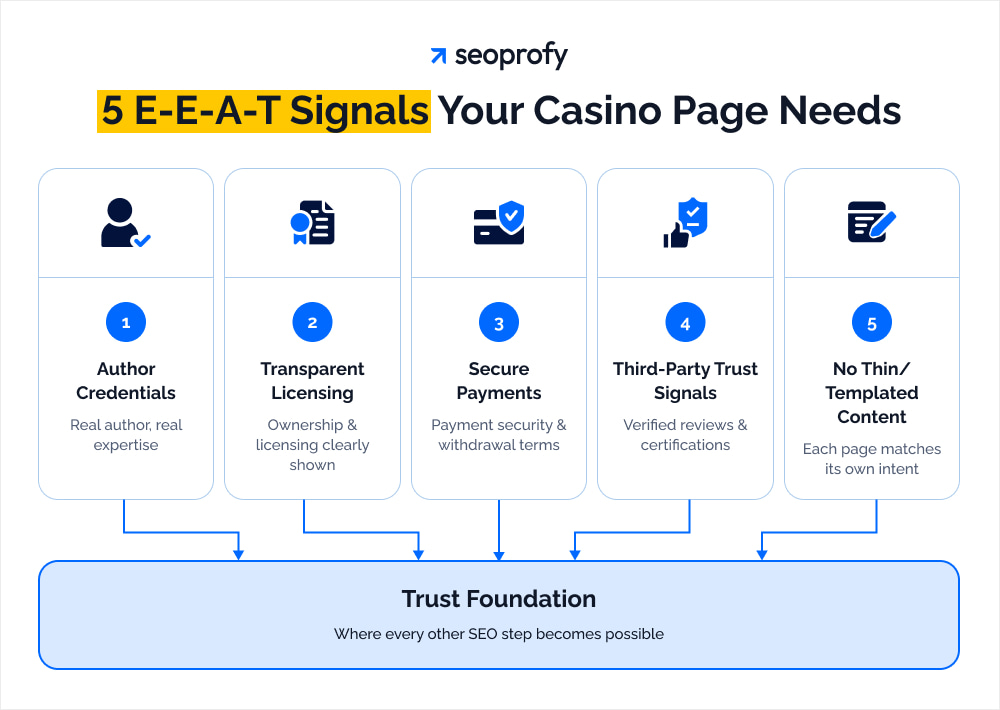
E-E-A-T (Experience, Expertise, Authoritativeness, Trustworthiness) is a key aspect in SEO, as it shows Google how reliable your website is for users. The concept is especially relevant for gambling, as strong trust signals are the foundation for any platform in the industry.
E-E-A-T Signals to Show
Name the company behind the website and provide information about contacts, ownership, and editorial process. Add author profiles to expert content, including relevant experience and how pages are reviewed.
The same applies to financial condition. Explain payment security, withdrawal rules, bonus conditions, and complaint procedures clearly so users can verify all the terms before signing up.
Use independent reviews or certifications only when verified. Avoid using thin templates that repeat claims across game or location pages. Each page should match its specific purpose and search intent.
Compliance and Responsible-Gambling Signals
The compliance details you put out should match the visitor’s jurisdiction. This normally includes showing the relevant license, age requirements, terms & conditions, privacy information, and access to help or self-exclusion services. Display licensing information accurately and link to the relevant regulator’s register where appropriate.
For better compliance, place responsible gambling tools where users can find them. These may include limits, account controls, support resources, and market-specific self-exclusion options such as GAMSTOP or BetStop.
Step 2: Fix the Technical Foundation
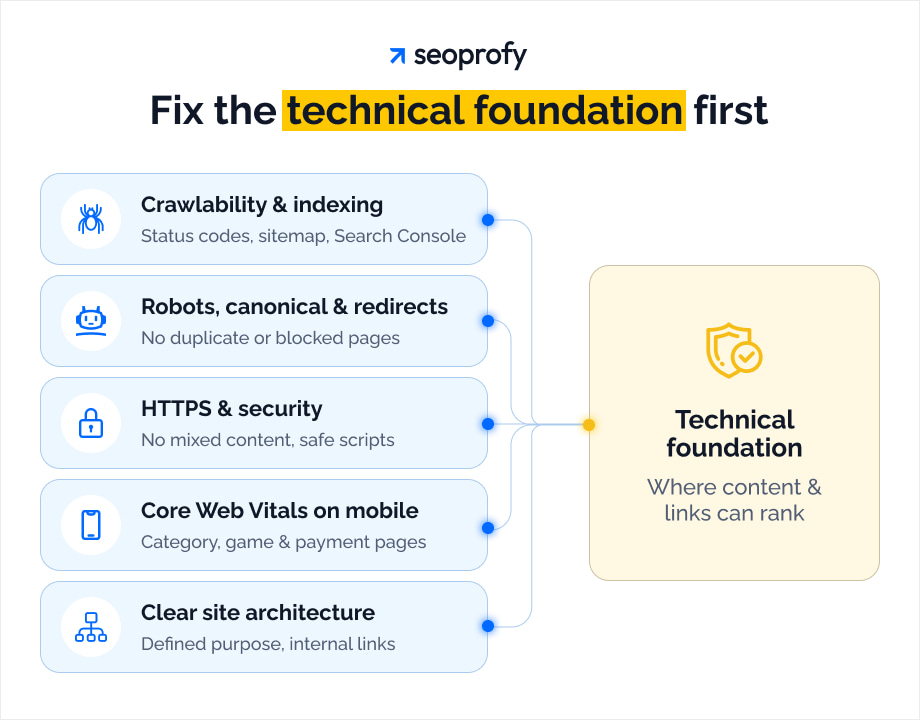
Strong E-E-A-T signals have limited value if important pages are slow, insecure, or not properly indexed. Resolve security, performance, rendering, and architecture issues before investing in new content or links.
Core Technical Checklist
Confirm that priority URLs return the correct status codes, are crawlable, and appear in the XML sitemap. Compare the URLs you intend to index with actual indexing and crawl data from Search Console and server logs.
Review robots.txt, canonical tags, redirects, pagination, and faceted navigation. Make sure they do not create duplicate pages, block important URLs, or waste crawl paths.
Serve the site through HTTPS and check for mixed content or unsafe third-party scripts. Gambling websites often use embedded games, tracking tools, and payment integrations, so security issues can affect trust and performance.
Improve Core Web Vitals and test key page templates on mobile devices. Check category pages, game pages, registration flows, payment steps, pop-ups, and banners rather than relying on the homepage.
Keep the site architecture clear. Category, game, bonus, review, guide, and location pages should have a defined purpose and relevant internal links.
Multi-Market Considerations
Create separate localized URLs for different markets. Use country-specific hreflang annotations between equivalent pages, maintain self-referencing canonicals, and avoid redirecting users solely by IP.
It’s also important to localize currencies, payment methods, legal text, and terminology. Don’t just translate one universal page word for word.
Google recommends using separate locale URL configurations and annotating them with rel=”alternate” hreflang annotations.
Step 3: Research Keywords and Plan Content
Content planning becomes worthwhile once the site has a reliable trust and technical foundation. At this stage, search engines can access the right pages, and new content has a better chance of ranking instead of being held back by crawl, indexing, or credibility issues.
Before you plan content, it is important to understand how to choose keywords for SEO that meet real search demand and support the right business goals. Group keywords by topic, such as games, betting options, payment methods, bonuses, comparisons, questions, and locations. Then separate them by intent, since informational and commercial searches usually require different page types.
In your keyword strategy, combine competitive head terms and more specific long-tail or localized queries. Broad terms can support major commercial pages, while narrower searches often reveal a clearer need, such as a country, game type, payment method, or licensing concern.
Do not ignore terms simply because they may have a low reported volume. Much of SEO for gambling sites relies on keywords with low search volume and clear commercial intent. The main keyword for this article, for example, has around 70 monthly searches and a KD of 4.
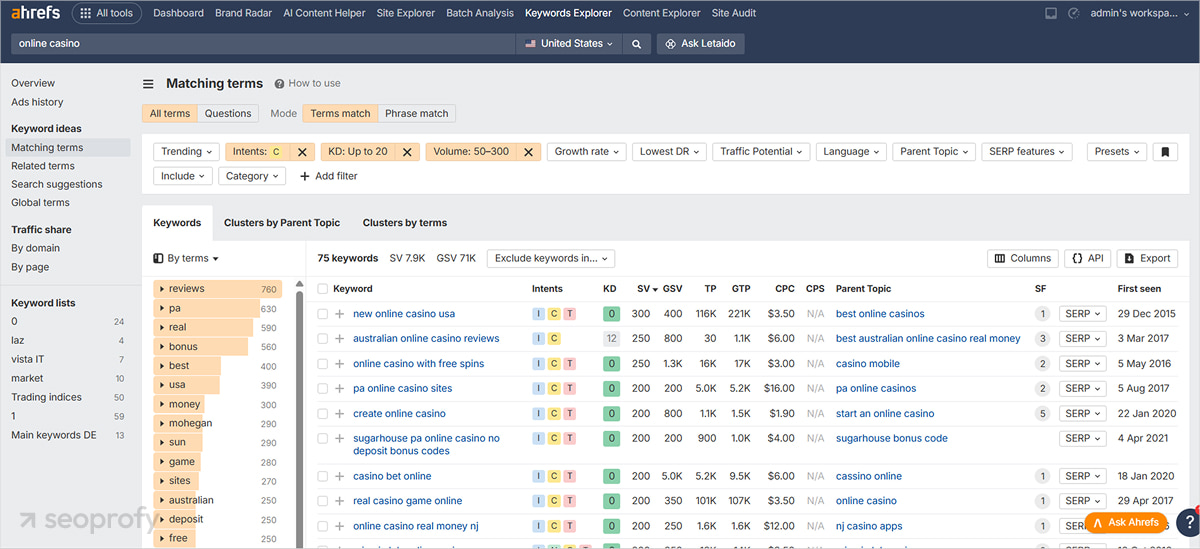
Once you have collected your terms, build a keyword map that will be the foundation for your content plan. This way, you can create pages and articles around the questions that visitors actually want answered.
Step 4: Optimize On-Page Content
Once you have selected the right keywords, use them to create pages and blog posts that answer the related queries. Give each important page a unique title and meta description, keep the URL easy to read, and do not change it unless there is a valid reason.
Use the main keyword in the H1, but avoid repeating the exact phrase in every heading. The introduction should quickly show what the page is about, while the main text should answer the reader’s questions and provide useful information.
Write each page around the needs behind its search query, and avoid thin pages based on the same template. A game review should describe the game and what makes it different. A market page should explain the local offer, rules, and payment methods. Do not change only the game or country name.
Use internal links to connect related guides, category pages, reviews, and commercial pages. Choose anchor text that describes the linked page without repeating the same keyword every time.
Use tables when they make options easier to compare. For claims about payments, withdrawals, bonuses, or account access, link to the operator, provider, regulator, or official policy page and note when the information was checked.
Place important conditions near the offer and explain bonus terms clearly. Calls to action should not hide compliance information.
For mobile compatibility, test menus, expandable sections, registration forms, and embedded games separately. This way, you can be sure that users can find information and complete actions easily.
Step 5: Earn Authority Through Link Building
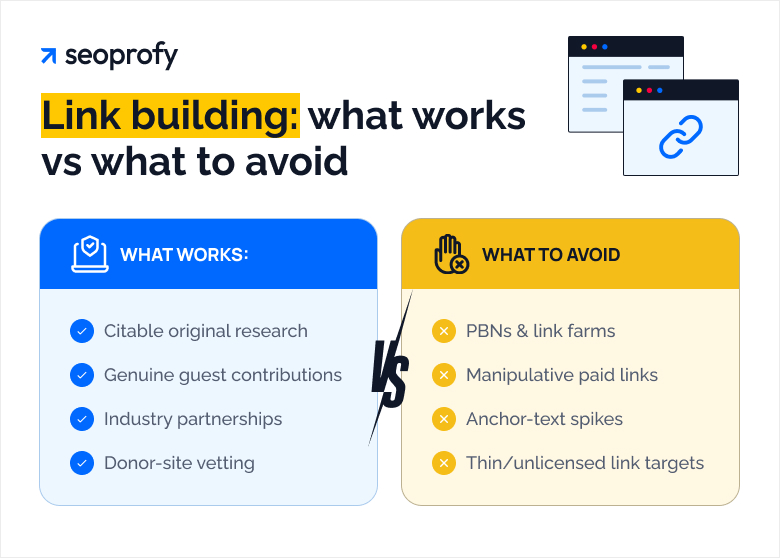
Link acquisition comes after the site and target pages are ready. In this niche, placements can be costly, and publisher standards vary, so each opportunity should be reviewed for relevance, quality, and policy risk.
What Actually Works
Create content that reputable publishers can cite, such as original market analysis, technical studies, expert commentary, or useful tool roundups. These give outreach a clear reason beyond asking for a link.
You can also consider guest posts, but only when they are genuinely useful to the host’s audience and not produced only for links. Partnerships with suppliers, associations, payment providers, and event organizers may also lead to relevant mentions. Remember to mark sponsored or user-generated links with the appropriate Google link attributes.
Before getting a backlink, check whether the website has real readers, publishes relevant content, and receives organic traffic. Look at who owns it, what it has published recently, and which other sites it links to. Avoid buying many links from unrelated or low-quality websites.
Use the same approach when choosing a gambling SEO agency. Ask how it selects websites, whether it tells you about paid placements, and what it does if a link is removed or no longer meets its standards.
What to Avoid
Avoid private blog networks, link farms, hacked pages, automated directories, and paid links created mainly to influence rankings. Paid links intended to manipulate rankings may violate Google’s spam policies and can result in links being ignored or, in more serious cases, ranking-related actions against the site.
Also, be cautious with websites that publish casino content alongside many unrelated topics and show no evidence of a real audience. Avoid sudden increases in exact-match anchors. Do not build links to pages with thin content, unclear licensing, or unresolved technical problems.
Get a free consultation focused on your target markets, current online visibility, technical constraints, compliance needs, and growth priorities. Talk to an expert iGaming SEO specialist today!
Step 6: Measure, Iterate, and Decide What’s Next
When measuring the effectiveness of an SEO campaign, track search results against business outcomes. Qualified traffic must come with registrations, first-time deposits, assisted conversions, and revenue.
Use Search Console to track impressions, clicks, queries, and indexation, then combine it with Google Analytics, rank tracking, backlink monitoring, and technical crawls. Track branded and non-branded traffic separately so brand awareness does not hide poor growth for general keywords.
A new site may need three to six months before it shows stable improvements, especially in competitive markets. How long SEO takes depends on several factors, including existing content and its quality, the website’s technical state, competition, and backlink profile.
For recovery, confirm that the underlying violation or quality issue is fixed before investing in new content or links. If dealing with a manual action, follow Google Search Console instructions and request review only after resolving the problem.
For a growing, established site, identify pages already ranking high and improve them with supporting articles, stronger internal links, and relevant backlinks. Prioritize markets that already bring registrations, deposits, or other valuable actions rather than spreading resources evenly across every country.
Review the strategy monthly, but allow more time before judging major content updates or link-building campaigns. Since SEO for gambling cannot guarantee rankings, traffic, or revenue, evaluate progress using longer-term trends, completed work, and current market conditions.
Frequently Asked Questions
How do you promote gambling sites?
To promote a gambling site, use a mix of organic search, paid advertising, partnerships, affiliates, email, and other channels allowed in the target jurisdiction. Check promotion rules separately for every market, product, audience, and platform before launching any marketing campaign.
For organic growth, begin with licensing and trust information, then improve the site’s technical state, content, on-page relevance, and links.
What is SEO in gambling?
Gambling SEO means improving the visibility of a casino, sportsbook, gambling affiliate, or other iGaming business in organic search.
It covers technical accessibility, useful content, keyword targeting, page optimization, authority, and localization.
How long does gambling SEO take to show results?
Online gambling sites usually see the first SEO results within 9 to 12 months, but campaigns in competitive markets can take longer to produce traffic or revenue.
The timeline depends on domain history, current problems, competition, content quality, links, implementation speed, and target markets. No online casino SEO partner can guarantee specific search engine rankings, traffic levels, or fixed commercial results.
Is link building for casino sites different from other industries?
The core principles in link building for gambling sites are similar to other niches, but fewer publishers accept such content, and placements are typically more expensive.
Campaigns usually require stricter prospect checks, market relevance, stronger assets, and careful anchor control. Links must follow Google’s spam policies, use appropriate sponsored or user-generated attributes, and meet any disclosure requirements that apply to the placement.
Build a Compliant, Sustainable SEO Strategy for Your Gambling Site
Sustainable SEO for gambling sites must follow a clear order. Establish verifiable trust and market compliance, fix the technical foundation, map demand to suitable pages, improve on-page content, and then invest in authority. This sequence reduces wasted work and makes each later step more useful.
The details differ between operators, affiliates, and domains. Some gambling sites need indexation fixes, while others need deeper content, better localization, or stronger third-party recognition. The right plan starts with the constraint that currently limits qualified organic growth.
Keep regulatory information current, review important claims against primary sources, and monitor performance by market and page type. Revisit priorities as the site gains visibility and new constraints appear. SEO in gambling works best as an ongoing process with clear ownership, documented changes, realistic expectations, and decisions tied to business outcomes.

Andrew Shum is the Head of SEO at SeoProfy with 10+ years of experience in SEO and digital marketing. He has been part of the company for over 6 years and has led the SEO department for the past 3.5 years, managing a team of 15+ specialists. He works with competitive and international multi-language projects across eCommerce, SaaS, and enterprise niches, focusing on practical SEO strategies that deliver measurable results.