


Selecting a raw SEO API allows developers to bypass expensive software interface fees. When developers build custom dashboards, they often overlook how specific endpoint rate limits affect raw daily scraping operations. A localized SEO ranking API must pinpoint coordinates down to the city level.


Data quality varies significantly between scraping utilities and established search databases. Scrapers extract live HTML directly from search engines at query time, transforming public layouts into structured JSON payloads. Established databases pool historically crawled records, offering metric scores like domain trust or search volume trends. We checked 10 options to find the best SEO data API for AI agent pipelines.
- Established search platforms lock programmatic access behind premium subscription packages ranging from $549 to $1,499 per month.
- Stands-only scraping tools and database utilities offer pay-as-you-go models starting at $50 deposits.
- Loaded credits remain active on DataForSEO and SE Ranking accounts indefinitely until consumed.
- Extra Ahrefs credits are discarded after three billing months.
- Semrush strictly limits response data caching to a maximum of thirty days, whereas scraping utilities allow developers to save raw HTML output indefinitely.
- SE Ranking offers prebuilt Model Context Protocol configurations, allowing AI agents to query keyword volumes and audit code structures natively using plain English.
Why the Right SEO Data API Matters
4 reasons why the right SEO data API matters:
- Clean formatting of data. A structured SEO data API parses featured snippets and ads into clean JSON. Managed endpoints handle blocking challenges at the proxy layer, ensuring high connection reliability.
- Data retention and historical analysis. Different SEO data API providers restrict data retention in their terms. Enterprise databases like Semrush enforce strict rules against caching response files for more than thirty days, limiting historical analysis. Scraping endpoints let developers archive raw search HTML indefinitely, enabling custom temporal trend tracking.
- Efficient approach. Many developer-focused API SEO tools use credit-based pricing models. The best SEO data API must handle anti-bot walls automatically without failing. Selecting the right configuration depends on whether your pipeline requires real-time scraped HTML or historically pooled competitor metrics.
- Geographic accuracy. Search results shift significantly based on geographic locality. A search query executed in New York returns entirely different organic links, local map packs, and shopping listings than the same query executed in London. Programmatic providers bypass regional limitations by routing requests through localized proxy networks, mimicking real users down to specific ZIP code boundaries.
Building private web scrapers is a losing game for growing engineering teams. Search engines block automated queries using Cloudflare Turnstile human checks, CAPTCHA, and IP fingerprinting. Managing rotating residential proxy networks and debugging headless browser fingerprint leaks diverts valuable engineering hours.
Yes, Python automation libraries like Camoufox run custom Firefox builds to bypass blocks. SeleniumBase UC can handle human check boxes. However, these libraries struggle with high-concurrency enterprise pipelines.
Quick Comparison: Best SEO Data APIs at a Glance
| Tool Name | Primary Use Case | Best For | Starting Price with API Acess |
| SE Ranking | Local rank tracking and AI prompt runs. | Standalone developer projects with native MCP capabilities. | $50 minimum deposit |
| Majestic | Link graph building and Flow Metric checks. | Domain checking platforms and large-scale link auditing. | $399.99 per month. |
| Zenserp | High-speed real-time SERP scraping. | Localized coordinate-level position monitoring. | $49.99 per month. |
| DataForSEO | Broad programmatic metrics across endpoints. | SaaS platforms requiring zero subscription commitments. | $50.00 minimum deposit. |
| Semrush | Deep domain traffic databases and PPC metrics. | Enterprise competitive benchmarking and marketing dashboards. | $549.00 per month. |
| Authoritas | Competitor page layout analysis and SEO audits. | Custom technical content editor creation. | $399.00 per month. |
| Bright Data SERP API | High-volume multi-engine scraping. | Enterprise parallel crawling and AI-agent RAG setups. | $1.50 per 1,000 successful results. |
| SerpAPI | Visual search debugging and no-code setups. | Low-volume scripts and academic search parsing. | $25.00 per month. |
| Serpstat | Multi-functional programmatic database auditing. | Mid-market agencies creating white-label software. | $129.00 per month. |
| Ahrefs | High-end Site Explorer backlink checks. | Major software applications requiring authority scores. | $1499.00 per month. |
How We Evaluated These Tools
Evaluating various programmatic options requires looking beyond standard pricing tiers to understand the structural layout of each platform. Our evaluation process measured 5 criteria:
- Proxy and anti-bot automation. How cleanly the managed endpoint handles Cloudflare blocks and rotating residential proxy pools.
- Regional coverage. The platform’s ability to pull highly localized organic search layouts down to specific coordinates.
- Latency and parallel speed limits. The average response time for successful live queries and parallel request ceilings.
- HTML parsing completeness. How reliably the system extracts complex rich elements like Featured Snippets, local map packs, and Shopping blocks into clean JSON arrays.
- Credit expiration schemes. Whether purchased credits roll over monthly or remain active forever.
Based on our experience, successful SEO API automation requires reliable batch endpoint processing.
The 10 Best SEO Data API Options
Below, you’ll discover 10 options to help you select the best SEO data API tool for your company. We’ll start with the most advanced SEO data API for everyone’s needs and go down the list, reviewing other options you can also consider for specific needs.
SE Ranking
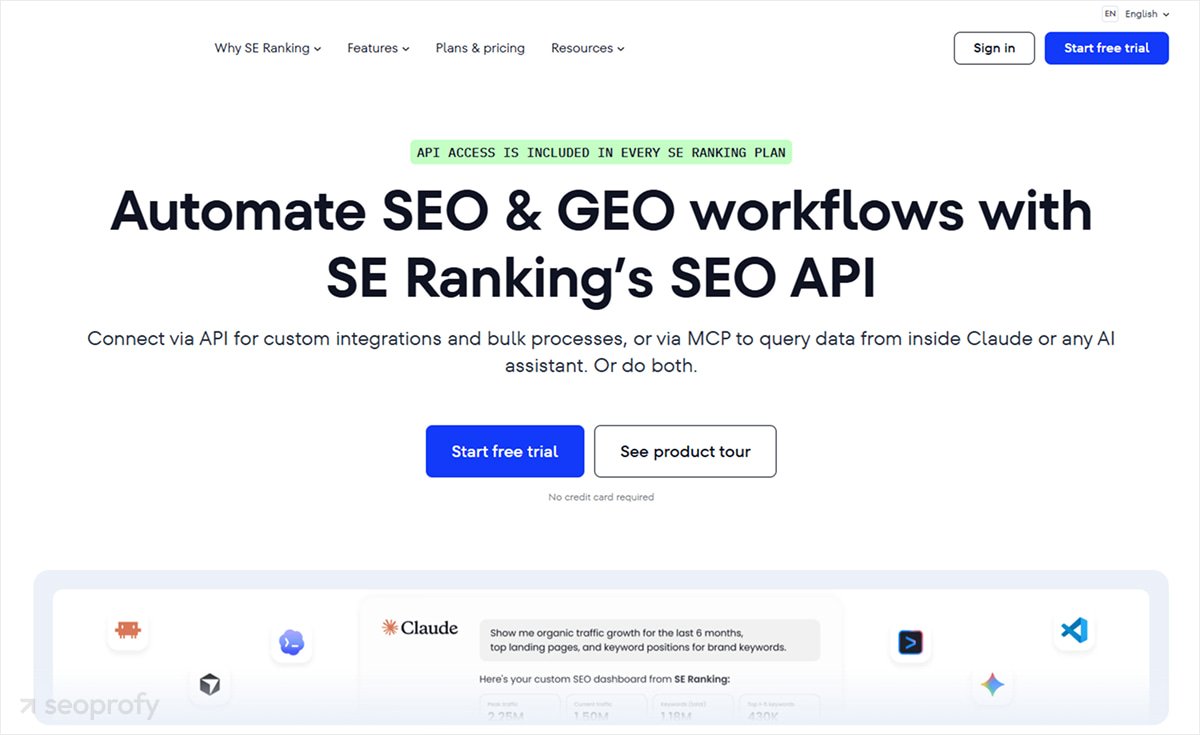
SE Ranking operates a massive programmatic backend that connects developers to its global keyword, search, and audit databases. This standalone database functions as an advanced SEO ranking API, divided into Data API and Project API.
The Data API is divided into several functional areas that cover the most common SEO intelligence and reporting workflows:
- Domain Analysis. The Domain Analysis endpoint provides aggregated SEO metrics for any website, including estimated organic traffic, keyword visibility, and ranking distribution across position ranges. This data is particularly useful for competitor research, market analysis, and building client-facing reporting dashboards.
- Keyword Research. The Keyword Research module helps uncover new ranking opportunities by generating keyword suggestions, related search terms, and query variations. Teams commonly use this data for content gap analysis, topic clustering, and large-scale keyword opportunity modeling.
- Backlink Analysis. Backlink endpoints provide visibility into referring domains and inbound links, along with authority and quality metrics that help evaluate link profiles. The data can be used to identify link-building opportunities, monitor backlink growth, and detect potentially harmful links.
- Website Audit. The Website Audit API crawls websites and surfaces technical SEO issues that may impact search performance. Alongside an overall site health score, it provides detailed diagnostics covering broken links, indexing problems, crawlability issues, and on-page optimization gaps, making it easier to prioritize technical improvements.
- AI Search API. The AI Search API is the most distinctive component of SE Ranking’s offering. Rather than focusing solely on traditional search engines, it measures brand visibility across AI-powered discovery platforms. Coverage includes ChatGPT, Gemini, Perplexity, Google AI Overviews, and AI Mode.
The Project API extends beyond data retrieval by enabling direct automation of SEO operations within SE Ranking. Through the API, users can:
- Create and manage projects, keywords, and search engine configurations
- Access ranking data and historical performance trends
- Organize keyword groups, project structures, and competitor tracking
- Manage sub-accounts and client permissions
- Launch, monitor, and review website audits throughout their lifecycle
- Retrieve traffic and performance insights, including Google Search Console data
- Manage backlink workflows, including imports, categorization, and disavow processes
For agencies and enterprise teams, these automation capabilities make it possible to integrate SEO management directly into internal reporting systems, dashboards, and operational workflows.
Pricing
- The pay-as-you-go tier requires a $50.00 minimum deposit for 250,000 credits.
- Core Plan ($129/month or $103.20 billed annually): 10 projects & 1 seat, 2,000 keywords + 100 prompts daily, 5 GEO domains, 250k audit pages/month, 25k API credits with MCP access, rank tracking, unlimited keyword/backlink research, site audit, and integrations (GA, GSC, Looker Studio, Matomo).
- Growth Plan ($279/month or $223.20 billed annually): 30 projects & 3 seats, 5,000 keywords + 250 prompts daily, 15 GEO domains, 2M audit pages/month, 100k API credits with MCP access, all Core features plus historical data, collaboration tools, page monitoring, and dedicated support.
- Agency Pack (+$69/month, annual): add-on with 30 projects, 30 client seats, full white-label platform & reports, unlimited scheduled reports with AI summaries, agency catalog placement, and lead generator.
- AI Search Add-on ($89/month or $71.20 annually): 200 prompts, tracking across AI platforms (ChatGPT, Perplexity, AI Overviews), unlimited competitor research, SE Visible dashboard, and automated reporting.
- API Add-on ($149/month, annual): 12M credits, access to backlinks, domain analysis, keyword research, AI search, and website audit APIs for automation.
- SMM Platform (from $33/month): social media scheduling, collaboration workflows, content planning, analytics, and asset management.
- SEO Data API (from $179/month): standalone API with scalable volume, access to backlinks, domains, AI search queries, MCP integration, and automation via tools like Looker Studio, n8n, and Make.
- 24M Credits Plan ($318/month effective): 24M credits/year (billed $3,816/year upfront), suitable for large-scale API usage and automation workflows.
Best For
Technical marketing agencies and AI developers requiring standalone programmatic search databases with native Claude Desktop MCP connections.
Pros
- Backlinks, keyword research, domain analysis, website audit, AI Search, and Project Management API run from a single credit balance under one subscription.
- 188 countries, 420M domains, 6B pages crawled daily.
- Prebuilt MCP server lets AI agents query rankings and run audit commands using natural language.
- Standalone credits never expire, minimizing wasted monthly budget.
- Pay-as-you-go pricing for low-volume workloads, volume-based discounts for recurring workflows.
- Precise geolocation tracking down to ZIP-code boundaries on mobile and desktop search layouts.
- Automated crawler endpoints tracking technical code issues up to 250,000 pages monthly.
- Prebuilt developer connectors supporting direct syncing with Google Sheets, n8n, and Looker Studio.
- Free 14-day trial with 100K API credits and full endpoint access from day one.
Cons
- Endpoints consume variable credits based on returned record length, which complicates monthly cost calculations.
- Integration relies on a Postman collection and REST reference rather than native client libraries.
Majestic
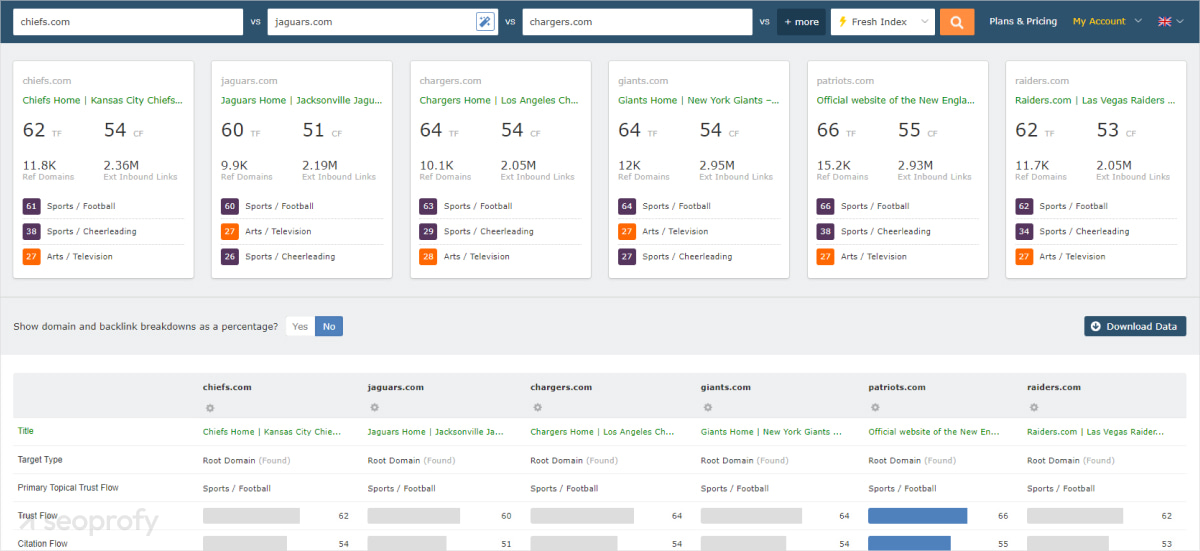
Majestic focuses entirely on backlink intelligence, presenting a highly detailed map of the web’s link architecture. The database is split into the Fresh Index (updated daily with recently crawled links) and the Historic Index (records dating back to 2006). The system provides proprietary metrics like Citation Flow (measuring link volume) and Trust Flow (measuring link quality). Developers use these metrics to calculate domain value and audit link graphs.
- Global link index split into Fresh Index and Historic Index.
- Citation Flow and Trust Flow profiling metrics to calculate link volume and authority.
- Custom Link Graph tools visually graphing backlink networks.
- Direct endpoints to query bulk domains simultaneously for authority validation.
- Standalone OpenApps creation allowing programmatic setups for other Majestic users.
Pricing
- Lite Plan ($49.99/month): 1 million analysis units, 1 user, access to Fresh Index, Site Explorer, Link Graph, Trust Flow metrics, backlink tools, keyword checker, bulk backlink checker, PDF reports, and core website tools.
- Pro Plan ($99.99/month): 20 million analysis units, 1 user, everything in Lite plus Historic Index, raw data exports, custom reports, site comparison, backlink history, Search Explorer, email alerts, and extended analytics tools.
- API Plan ($399.99/month): 100 million analysis units, 5 users, everything in Pro plus full API access, scalable data volumes (up to 1B units), and custom data integration capabilities for agencies and developers.
Majestic is highly cost-effective for backlink checks, costing roughly $0.036 per 1,000 backlinks, compared to $2.00 on Semrush. A single query to GetBackLinkData costs 5,000 units.
Best For
Large link-building teams, domain checkers, and database managers who need historic link graph data at massive volumes.
Pros
- Massive, historically verified backlink index dating back to 2006.
- Extremely cost-effective for pulling bulk backlinks at high scale.
- Five concurrent users are allowed under the entry API tier.
Cons
- Completely lacks search metrics, keyword data, and on-page auditing endpoints.
- Complex developer setup process relying on legacy OpenApps keys.
Zenserp
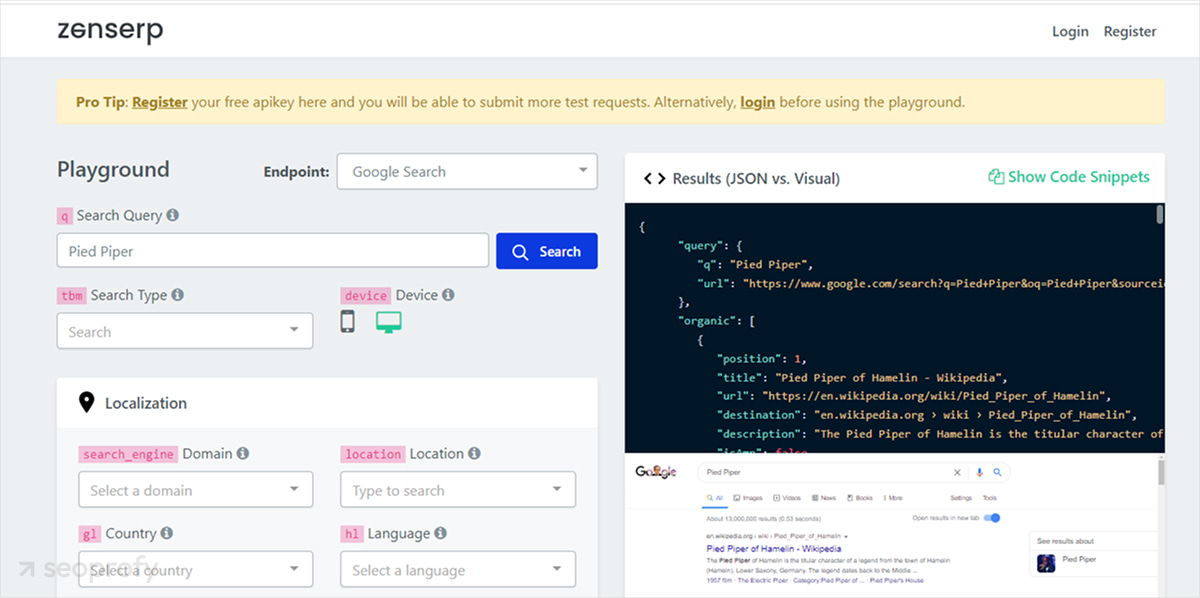
Zenserp is engineered for high-speed, localized search results scraping, returning clean structured JSON responses within seconds. Zenserp operates as a high-speed SEO rank API returning structured results. The system abstracts proxy configuration and browser emulation, handling rotation, IP blocks, and CAPTCHA bypasses automatically. Zenserp parses all primary Google search results types, including organic listings, Shopping, News, Maps, and Images. It also provides precise geolocation parameters, matching requests to localized coordinates globally.
- Real-time search engine scraping handling proxy rotation, browser fingerprints, and IP blocks automatically.
- Comprehensive SERP category coverage including standard Organic search, Shopping, News, Maps, and Images.
- Precise geolocation targeting based on local coordinates globally.
- Batch endpoints supporting high-volume parallel scraping requests.
- Structured JSON and raw HTML output parameters.
Pricing
- Free Plan ($0/month): 50 searches, basic access for getting started.
- Small Plan ($49.99/month): 25,000 searches, access to all SERP types.
- Medium Plan ($149.99/month): 100,000 searches, all SERP types, batch endpoint, keyword search volume & CPC data, bulk index checker, onboarding, SLA, and personal support.
- Large Plan ($299.99/month): 250,000 searches, all Medium features with higher limits.
- Premium Plan ($499.99/month): 500,000 searches, all Premium SEO/API features plus custom queue support.
- Enterprise Plan ($899.99/month): 1,000,000 searches, all Premium features with maximum scale and enterprise-level capacity.
Best For
Developers and startups requiring localized search engine scraping with low latency and clean JSON outputs.
Pros
- Straightforward documentation with simple copy-pasteable script templates.
- No concurrent request limits on paid plans, allowing parallel queue processing.
- Interactive visual dashboard for rapid testing of parameters.
Cons
- Completely lacks organic databases, backlink histories, or technical on-page checkers.
- Pricing scales poorly for extremely large enterprise data pipelines compared to raw credit providers.
DataForSEO
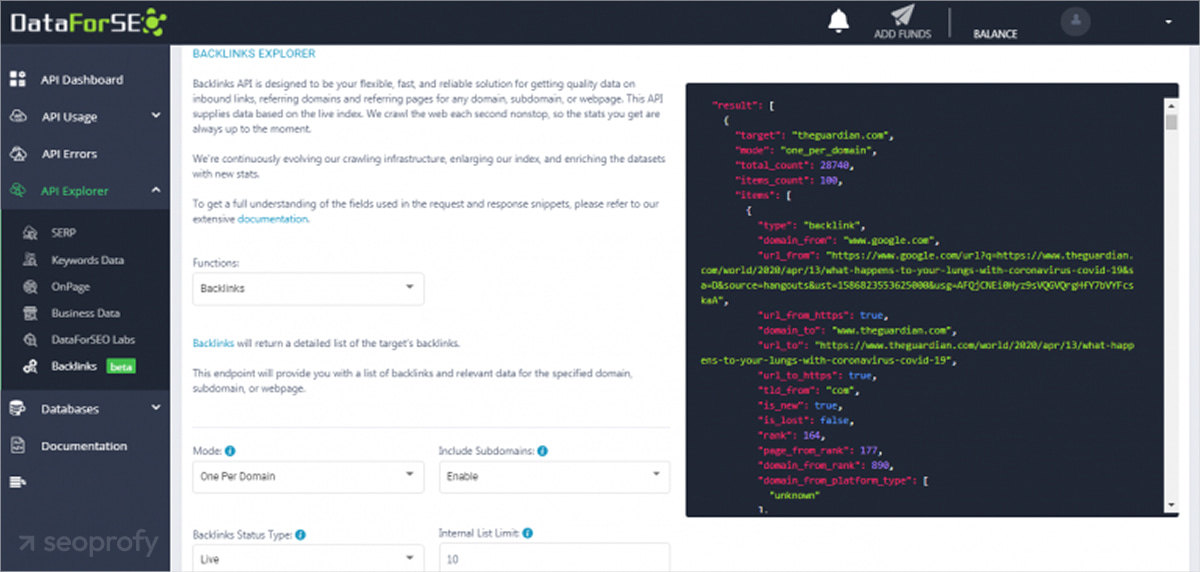
DataForSEO is a highly popular option in the developer community, offering a massive ecosystem of over 15 distinct, specialized endpoints. The platform provides programmatic access to search results, keyword databases, backlink indexes, merchant listings, on-page diagnostics, and social metrics. DataForSEO supports multiple search engines, including Google, Bing, Yahoo, YouTube, Baidu, and Seznam. It offers extreme flexibility, allowing developers to choose between real-time Priority Mode (results in under 2 seconds) or Standard Queue Mode (highly cost-effective processing).
- Comprehensive selection of 15+ programmatic endpoints, including SERPs, Keywords, Backlinks, and Merchant details.
- Multi-engine flexibility parsing Google, Bing, Yahoo, YouTube, Baidu, and Seznam results.
- Dual processing options: Standard Queue (highly cost-effective) and Priority Mode (under 2 seconds).
- Mass submissions allowing up to 100 scraping tasks per programmatic request.
- Automated cost controls including daily budget limits and crawl page boundaries.
Pricing
Pure pay-as-you-go model with a $50.00 minimum deposit. Loaded credits never expire. Standard SERP queue is priced at $0.60 per 1,000 queries, while Priority live queries cost $2.00 per 1,000. The Backlinks API requires a $100.00 monthly minimum (though credits can be used on any endpoint) and charges $0.02 per request plus $0.00003 per returned data row. Deposits over $5,000.00 yield 1,750 credits per dollar, dropping standard query costs to $0.00057.
Best For
SaaS startups and enterprise software platforms requiring a diverse, multi-endpoint database with highly scalable, non-expiring credit pricing.
Pros
- Pay-as-you-go credits remain active indefinitely without recurring subscription fees.
- Supports dynamic parameters for fine-tuning budget allocations and request depths.
- Rate limits support up to 2,000 requests per minute with 30 simultaneous queries.
Cons
- The wide range of endpoints and parameters requires significant integration effort.
- High-volume applications can drain loaded credit balances rapidly if cost limits are not configured.
Semrush
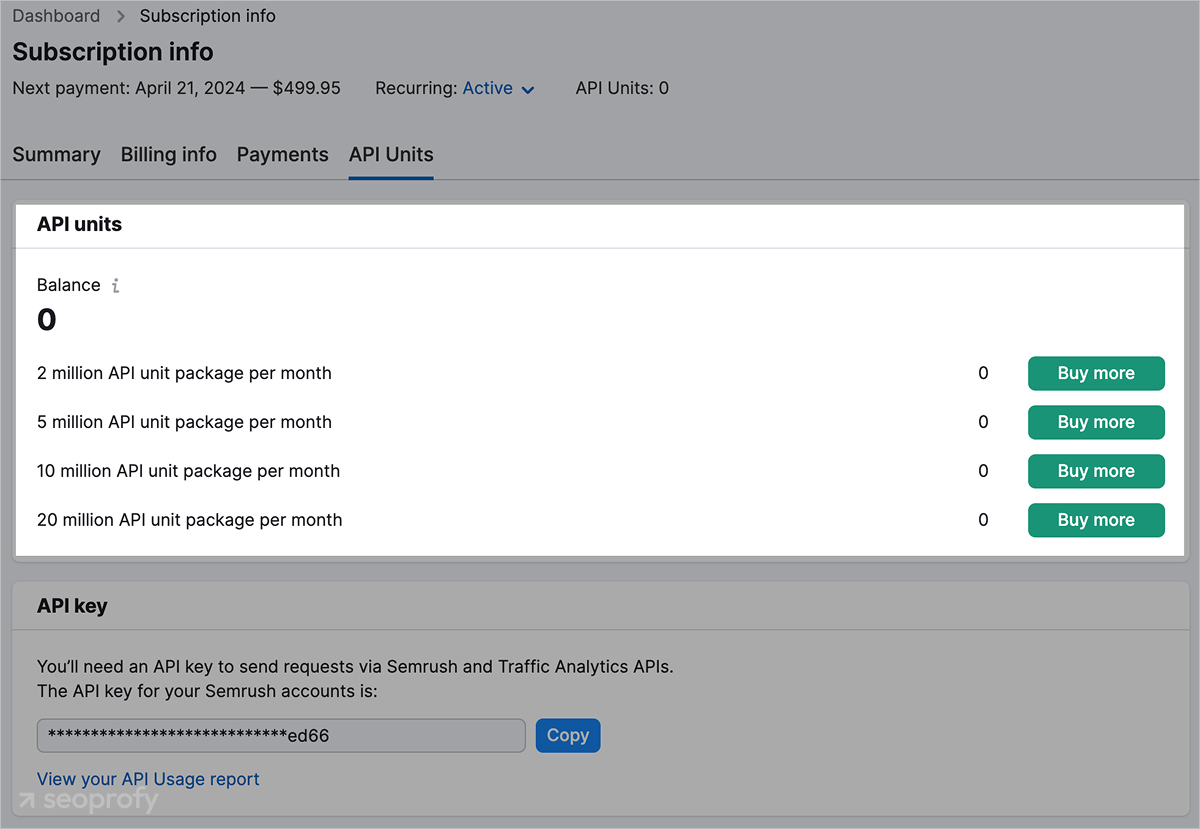
Semrush is an enterprise player in the search intelligence market, providing massive programmatic databases to developers. Its domain database provides the best SEO data API output for competitive PPC intelligence. Semrush offers an advanced SEO integration API for large enterprise platforms. The platform’s standard endpoints connect engineers directly to global domain histories, keyword trends, and localized ranking charts. Semrush supports both legacy API v3 formats and a modern, OAuth 2.0-enabled API v4 configuration.
- Global competitive database containing historical traffic estimates, search positions, and domain analytics.
- Direct endpoints parsing competitor advertising budgets, social campaigns, and display ad placements.
- Advanced API v4 configurations relying on OAuth 2.0 protocols for enterprise security.
- Standard speed limits are capped at 10 requests per second and 10 concurrent requests.
- Independent Trends API and Listing Management options that do not consume standard unit limits.
Pricing
Enforces a massive price barrier, requiring the Business subscription priced at $499.95 per month (or $416.66 per month on annual billing). Standard subscriptions include zero programmatic units. Developers must purchase separate pay-as-you-go unit packages, which start at $50.00 for 1,000,000 API units. Live reports charge 10 units per data row, while historical records charge 50 units per row. Under this structure, a request pulling 1,000 organic keywords for 100 domains costs 1,000,000 live units or 5,000,000 historical units.
Best For
Large enterprises and corporate marketing platforms requiring historically validated traffic estimates and PPC competitor intelligence.
Pros
- Gold-standard competitive intelligence and advertising databases.
- Excellent enterprise compliance backed by robust OAuth 2.0 security.
- Listing Management and Map Rank Tracker endpoints do not exhaust standard unit pools.
Cons
- Extremely expensive, locking access behind a $500.00 monthly subscription threshold.
- Terms of service strictly ban caching response data for more than 30 days.
Authoritas
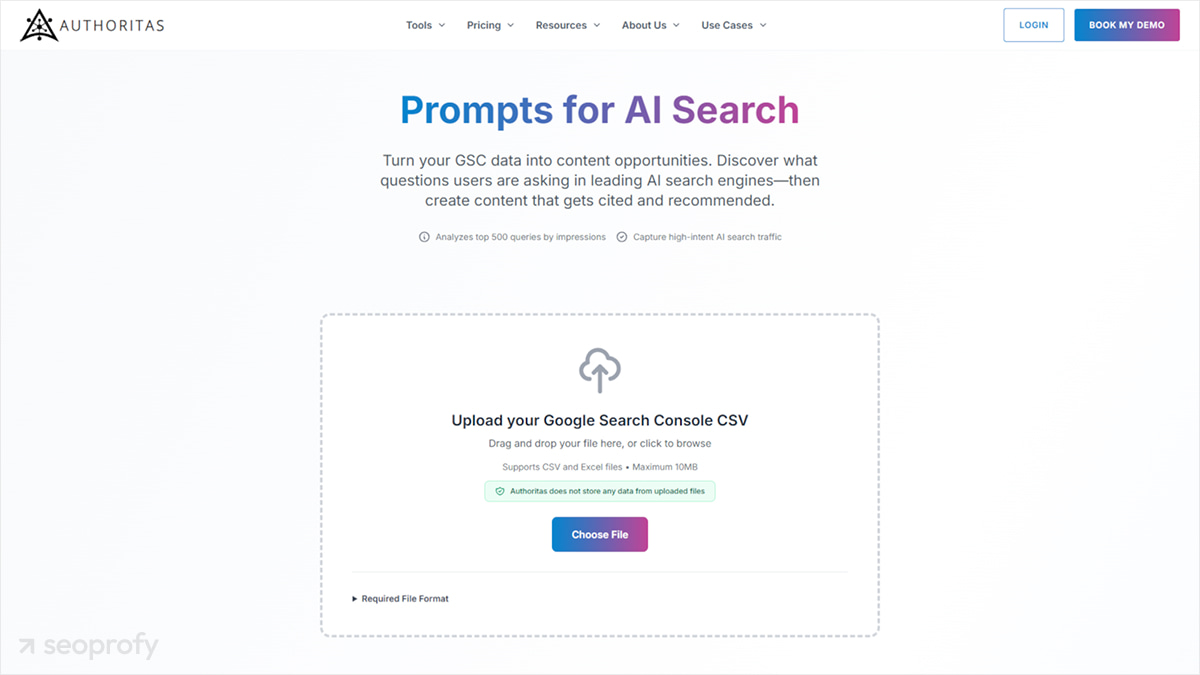
Authoritas provides 3 specialized programmatic paths:
- Keyword Ranking API (SERPs API)
- Page Structure Content API
- Platform API
Authoritas provides a specialized API SEO path for technical engineers. The platform delivers a flexible SEO integration API that connects page structure data to local databases. The Page Structure endpoint retrieves structural page-level HTML data, allowing developers to analyze exact content structures, layouts, and page elements favored by search engines. The system manages proxy rotation and bot prevention automatically, delivering JSON payloads cleanly.
- Keyword Ranking API programmatically harvesting search results at scale.
- Page Structure API parsing HTML layout designs of top organic competitors.
- Platform API automating project management, site audits, and competitor checks.
- Ready-made developer libraries provided in PHP, Python, and Java.
- Compliant web crawler strictly accessing publicly available data on the open web.
Pricing
- Free Tier: 1,000 queries at no cost, includes free API key access.
- 100K Queries Plan ($399): $0.00399 per query, CPM $3.990.
- 250K Queries Plan ($949): $0.00379 per query, CPM $3.791.
- 500K Queries Plan ($1,809): $0.00360 per query, CPM $3.601.
- 1M Queries Plan ($3,429): $0.00342 per query, CPM $3.421.
- Custom Enterprise Plan (1M+ queries): custom pricing for large-scale API usage.
Best For
Technical SEO engineers and software developers seeking competitor page structure details to build proprietary editing tools.
Pros
- Page Structure API parses code layouts of competitors, a feature missing elsewhere.
- Fully managed proxies remove scraper development headaches.
- Uptime guarantee of 99.9% ensures high connection reliability.
Cons
- Standard software platform interface feels dated.
- Higher-tier endpoints require technical coding skill to implement successfully.
Bright Data SERP API
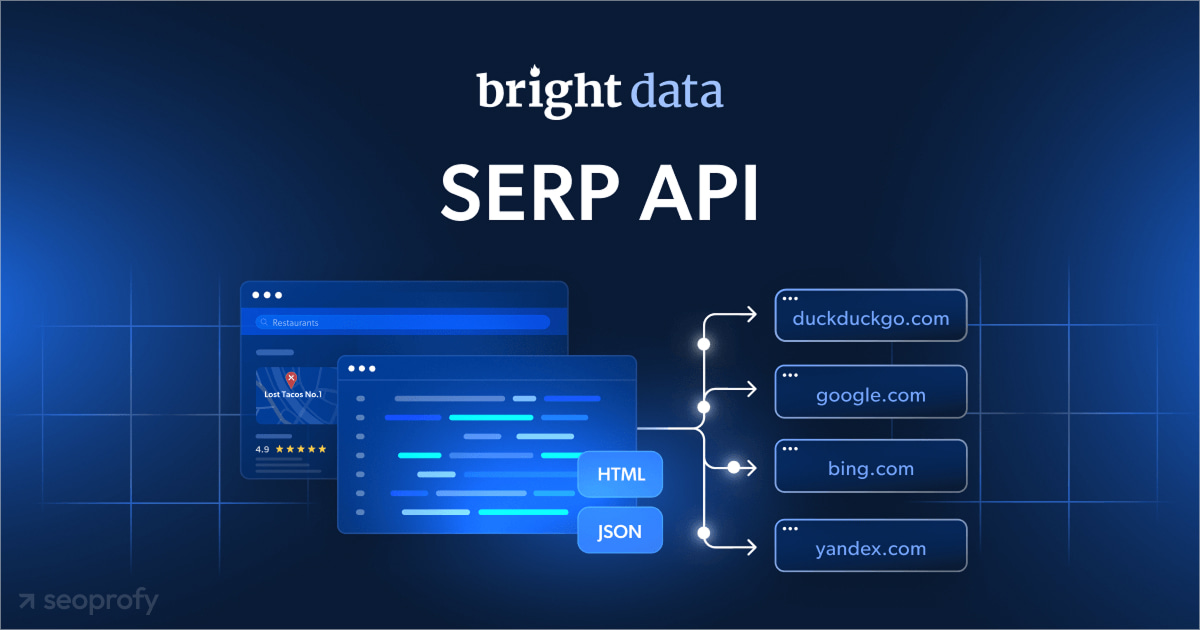
Bright Data is a global leader in web scraping infrastructure, and its SERP API provides unblocked access to 7 major search engines across 195 countries. Its high-volume scraping capabilities make it the best SEO data API for parallel RAG pipelines. Its unblocked headless browser features make it a top choice for SEO API automation at high volume.
Supported by a massive proxy network of over 400 million residential IPs, it handles CAPTCHA solving, IP rotation, and bot blockers like Cloudflare automatically using browser fingerprint emulation. Bright Data returns search results in structured JSON, raw HTML, or AI-ready Markdown. It includes a free Model Context Protocol (MCP) server for direct connections to AI agent frameworks.
- Real-time scraping across 7 major search engines including Google, Bing, Yandex, Baidu, Naver, Yahoo, and DuckDuckGo.
- Complete Web Unlocker bypassing Cloudflare Turnstile blocks, CAPTCHAs, and anti-bot scripts automatically.
- Rotating residential proxy network of over 400 million IPs ensuring zero connection blocks.
- Built-in JS rendering engine handling complex browser fingerprints, resolution, screen memory, and cookies behind the scenes.
- Native Model Context Protocol (MCP) server providing 5,000 free requests monthly.
Pricing
- Pay-as-you-go ($1.5 per 1K results): no monthly commitment, flexible usage, ideal for small or occasional needs.
- 380K Results Plan ($499/month): $1.3 per 1K results, designed for teams scaling their operations.
- 900K Results Plan ($999/month): $1.1 per 1K results, suited for large teams with higher data demands.
- 2M Results Plan ($1,999/month): $1 per 1K results, built for enterprise-level usage with advanced support and features.
Best For
Enterprise software engineers and developers of high-concurrency AI-agent pipelines requiring unblocked parallel scrapers.
Pros
- Zero limits on concurrent requests, supporting high-speed parallel crawling.
- Outputs search results in clean JSON, raw HTML, or AI-ready Markdown.
- Managed proxy backend handles bot challenges automatically, saving massive engineering time.
Cons
- Focuses strictly on page scraping, completely lacking prebuilt search volume databases or keyword research metrics.
- Highly technical platform dashboard can be intimidating for beginners.
SerpAPI
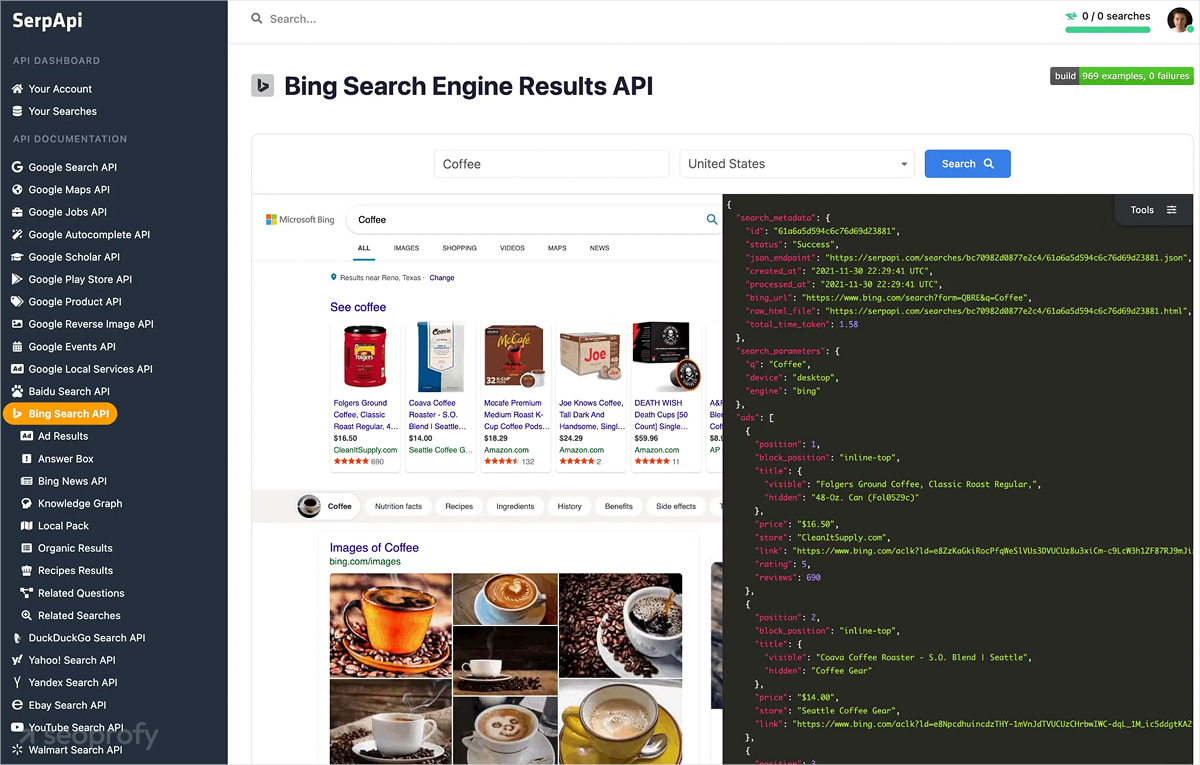
SerpAPI is a widely used scraper that parses organic listings, featured snippets, local packs, and ads into structured JSON. SerpAPI functions as a reliable search engine rankings API with a legal shield. The platform supports multiple search engines and provides GPS-level localized targeting globally. SerpAPI includes a robust visual playground that lets developers test parameters, view structured JSON results side-by-side with raw HTML, and export request scripts in Python, Go, Node.js, and Java.
- Specialized scraping of major search engines with structured JSON parsing of rich result types.
- Precise geolocation targeting down to specific coordinates globally.
- Interactive visual playground displaying JSON outputs side-by-side with raw HTML.
- Built-in legal shield protecting developers from compliance disputes.
- Direct connections with no-code tools like Make, n8n, and Zapier.
Pricing
- Starter Plan ($25/month): 1,000 searches/month, 200 throughput/hour, includes U.S. Legal Shield.
- Developer Plan ($75/month): 5,000 searches/month, 1,000 throughput/hour, includes U.S. Legal Shield.
- Production Plan ($150/month): 15,000 searches/month, 3,000 throughput/hour, includes U.S. Legal Shield.
- Big Data Plan ($275/month): 30,000 searches/month, 6,000 throughput/hour, includes U.S. Legal Shield.
No rollover of reserved credits is allowed.
Best For
Developers, small startups, and academic researchers seeking precise coordinates targeting and a visual debugging interface.
Pros
- Visual playground and auto-generated code libraries speed up initial integrations.
- Highly rich data parsing, returning maps, local packs, and featured snippets cleanly.
- Legal compliance shield covers scraping risks.
- Only charges for successful searches.
Cons
- Extremely expensive per query ($7.50 to $25.00 per 1,000) compared to raw scrapers.
- No standard pay-as-you-go billing; queries fail if monthly limits are reached.
Serpstat
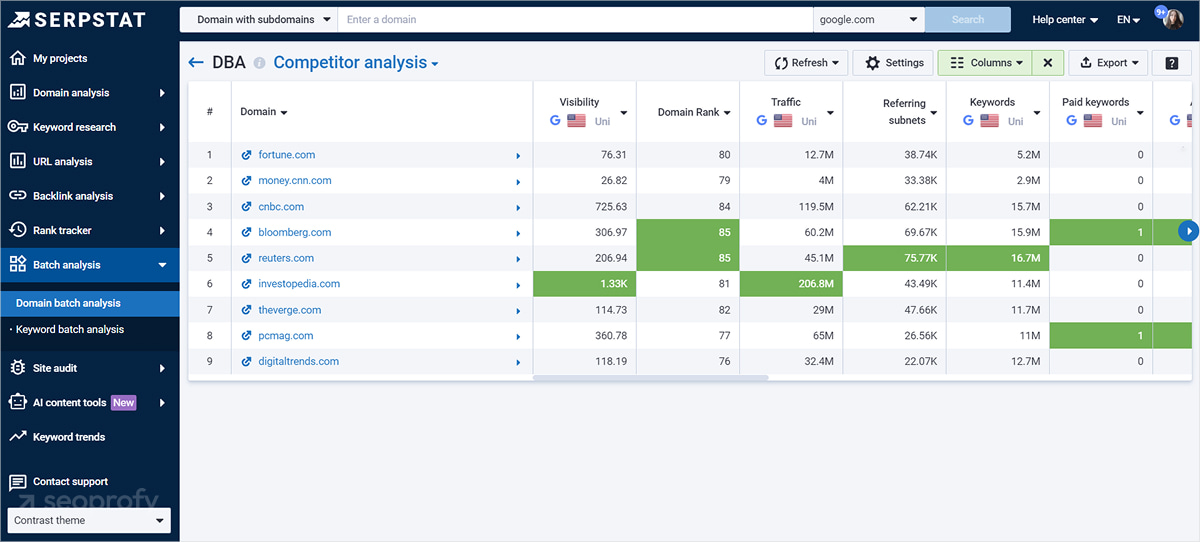
Serpstat is a multi-functional SEO platform that provides programmatic database access alongside its web application. This programmatic suite operates as an exhaustive SEO data API for mid-market clients. Serpstat excels in bulk parsing, making it ideal for SEO API automation. The platform’s standard endpoints connect engineers directly to global domain histories, keyword trends, and localized ranking charts. Serpstat exposes a robust search engine rankings API for bulk analysis.
- Access to a massive database of over 7 billion keywords and 1 trillion backlink records.
- Bulk domain analysis parsing multiple target domains in a single programmatic request.
- White-label report generation allowing agencies to resell data with custom styling.
- Built-in site health diagnostics and audit crawls programmatically triggered.
- Unused programmatic credits roll over to the subsequent billing month.
Pricing
- Individual Plan ($69/month): 5 projects, 100 daily searches (sites, keywords, backlinks), 10k rank checks, 30k audit pages, 50k export rows, core SEO tools including keyword research, site analysis, rank tracking, site audit, and backlink analysis.
- Team Plan ($129/month): unlimited projects, 500 daily searches, 50k rank checks, 150k audit pages, 250k export rows, all Individual features plus API access, ChatGPT & Claude integration (MCP), collaboration tools, AI features, batch analysis, scheduled reports, and invoicing tools.
- Agency Plan ($499/month): unlimited projects, 5,000 daily searches, 500k rank checks, 1.5M audit pages/month, 2.5M export rows/month, all Team features plus white-label reports, data engineer consulting, and phone support.
Free trials are available but require a temporary $1.00 authorization charge for identity verification.
Best For
Growing mid-market marketing agencies requiring white-label report creation, bulk analysis, and rollover credit terms.
Pros
- Permissive licensing allows white-labeling and reselling of raw data.
- Unused credits roll over monthly, minimizing wasted budget.
- Standard Team plan includes API access without extra fees.
Cons
- The speed limit is capped at 10 requests per second for standard users.
- Search database coverage in smaller regional search engine domains can be thin.
Ahrefs
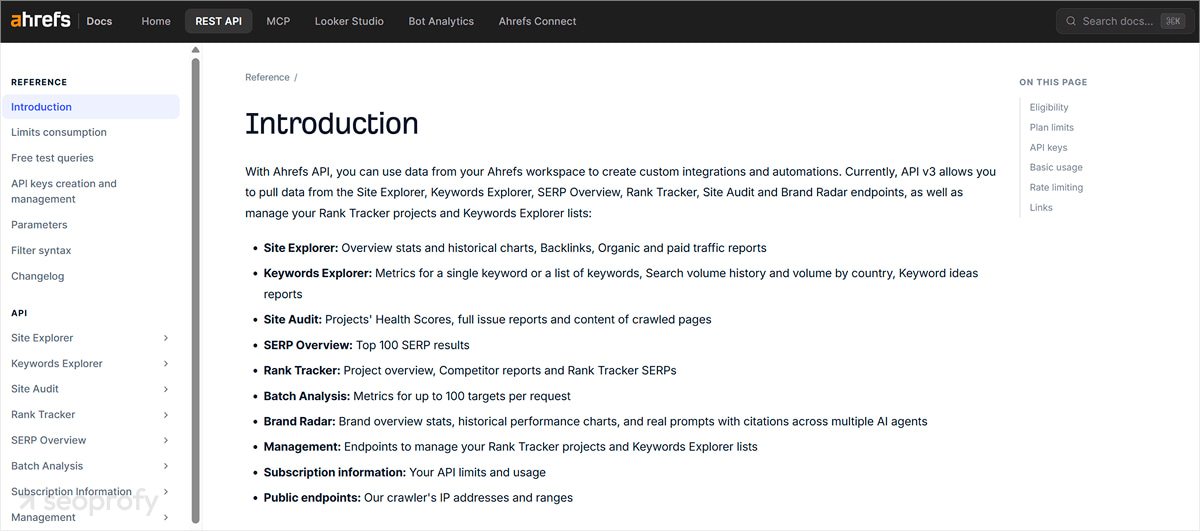
Ahrefs is widely regarded as having the industry’s most authoritative, exhaustive backlink database, and its programmatic API v3 brings this machine-readable power to developers. Ahrefs remains one of the largest SEO data API providers for backlink intelligence. Ahrefs integrates a stable search engine rankings API alongside its Site Explorer metrics. It allows software systems to pull referring domains, anchor texts, organic keyword histories, and page-level metrics.
- Access to one of the largest active link databases on the web.
- Direct machine-readable endpoints for lead scoring and domain enrichment.
- Deep temporal search tracking covering years of domain organic performance.
- Advanced parameters filtering results by device, search engine, and layout.
- Free Ahrefs Webmaster Tools (AWT) programmatic keys for verified site owners.
Pricing
- Lite Plan ($129/month): 5 projects, 6 months historical data, 750 tracked keywords, 5 tracked prompts, 100k crawl credits, 1,000 credits per user, 1 user (+2 at $40/mo), core tools (Site Explorer, Keywords Explorer, Rank Tracker, Site Audit, Competitive Analysis, API & MCP access, reports, dashboards).
- Standard Plan ($249/month): 20 projects, 2 years historical data, 2,000 tracked keywords, 10 tracked prompts, 500k crawl credits, unlimited credits per user, 1 user (+5 at $60/mo), all Lite features plus Content Explorer, batch analysis, SERP comparison, keyword clusters, AI suggestions, deeper analytics & reporting.
- Advanced Plan ($449/month): 50 projects, 5 years historical data, 5,000 tracked keywords, 20 tracked prompts, 1.5M crawl credits, unlimited credits per user, 1 user (+10 at $80/mo), all Standard features plus Looker Studio integration, advanced site audit options, segmentation, and extended data insights.
- Enterprise Plan ($1,499/month): all Advanced features plus unlimited API access, SSO & enterprise-grade security, access management & audit logs, unlimited historical data, custom limits & exports, and forecasting & trend analysis (annual commitment required).
Extra credits expire after three billing months.
Best For
Enterprise software developers, high-end analytics engines, and corporate finance groups who need verified domain authority metrics.
Pros
- Unmatched backlink index quality and link authority metrics.
- The Ahrefs MCP server is available for all paid plans.
- Uptime and connection stability are highly reliable for enterprise production platforms.
Cons
- Extremely high entry cost locks out independent developers and small startups.
- Extra pay-as-you-go credits expire after three billing months if unused.
FAQ
What is the main difference between a dedicated SEO ranking API and a raw search page scraper?
A dedicated SEO ranking API focuses strictly on tracking search positions. These systems parse organic listings, featured snippets, and local pack maps automatically, returning structured data points inside clean JSON structures. Conversely, a raw search page scraper retrieves the entire raw HTML payload of a query, forcing developers to build and maintain custom parsers to extract search layout structures manually. Choosing an SEO rank API is ideal for real-time local checks.
How does an SEO integration API handle local search targets compared to standard global databases?
An SEO integration API allows developers to sync search metrics with external CRMs. When handling local targets, these endpoints query search engines through rotating residential proxies located near specific coordinates. This ensures the returned search layouts reflect local search results exactly. Standard global databases usually cache search layout records at country or state levels, making them less accurate for city-level or ZIP-code local tracking. Setting up a custom API SEO setup requires an active developer key.
Which factors should technical developers prioritize when choosing among the best SEO API providers?
The best API for SEO has a high uptime SLA and comprehensive documentation. Choosing among the best SEO API providers requires looking closely at credit expiration mechanics and parallel connection rate limits. Developers must evaluate whether credits roll over monthly or expire immediately, as well as check if the database terms allow long-term caching of search results. Determining the best SEO API depends on the balance of features and limits.
Conclusion
Programmatic search data extraction represents a major architectural cornerstone for modern software engineers, technical marketing groups, and AI developers. Choosing the right interface depends heavily on whether your custom database requires real-time scraped layouts or historically parsed domain authority metrics. So, top SEO data APIs:
- SE Ranking provides standout programmatic values for agencies, especially with its prebuilt MCP server that connects search data directly to LLMs for AI workflows.
- Scrapers like Bright Data and DataForSEO remove standard subscription traps entirely, offering unblocked proxy networks and flexible pay-as-you-go billing with non-expiring credits.
- Technical teams requiring historical backlinks, domain traffic estimations, and validated brand parameters can justify the higher subscription costs of Majestic, Semrush, or Ahrefs.
Remember: testing endpoint response formats, debugging parallel request latency, and auditing caching terms will ensure a highly stable programmatic search pipeline.

Andrew Shum is the Head of SEO at SeoProfy with 10+ years of experience in SEO and digital marketing. He has been part of the company for over 6 years and has led the SEO department for the past 3.5 years, managing a team of 15+ specialists. He works with competitive and international multi-language projects across eCommerce, SaaS, and enterprise niches, focusing on practical SEO strategies that deliver measurable results.