

 Add SeoProfy as a preferred source on Google
SEO for financial services involves digital marketing methods aimed at improving website rankings for relevant keywords, such as “wealth manager near me” or “best insurance company.” It blends high-quality content, technical work, link building, and a compliance layer most industries don’t face.


This guide covers the essential SEO strategies for financial services that brands like Bankrate and NerdWallet use to build authority in the space.
- YMYL and EEAT standards shape every piece of financial content.
- Security is one of the most important concerns in on-page SEO for financial institutions.
- Financial brands can see up to 1,031% ROI from SEO.
- Keywords with medium difficulty and volume give you a way to compete without a massive budget.
What Is Special About the SEO Approach for Financial Websites
If you want your digital marketing campaign to succeed, choose an SEO agency with experience in the financial services industry. A generic playbook won’t hold up, and small missteps in search engine optimization — a missed disclaimer, an unverified claim — create compliance risk fast.
Differences show up across every part of the strategy:
|
Traditional SEO |
SEO for Financial Companies |
|
| Key goals | Drive organic traffic and increase online rankings. | Build trust, attract interested clients, and ensure compliance. |
| Keyword strategy | Primary aims for high-volume keywords. | Balances between keywords with high search volume and specific long-tail queries to drive conversions. |
| Content strategy | Prioritizes blog posts that increase user engagement. | Involves creating verifiable educational content to help clients understand complex financial topics. |
| Technical SEO | Mainly focuses on site speed, indexing, and crawlability. | Adds enhanced security measures such as HSTS and CSP to protect sensitive user data. |
| Regulation and compliance | Not a primary concern. | Content must align with SEC, FINRA, and FCA rules, plus Google’s YMYL guidelines. |
| Metrics | Organic traffic, rankings, and conversions. | Adds trust signals — reviews, brand mentions, and author authority. |
Main Challenges of SEO for Financial Services Companies
Strong SEO strategies for financial services help you work around the obstacles specific to this industry. These are the ones we see most often:
- Strict compliance reviews: Content about financial topics has to be accurate, well-sourced, and, at the same time, readable for someone without a finance background. That adds fact-checking and plain-language editing that most marketing teams aren’t set up for.
- YMYL and EEAT standards: Google holds financial content to a higher standard. Since it can impact people’s financial stability, it’s categorized as “Your Money or Your Life” (YMYL) content. This raises the bar for experience, expertise, authoritativeness, and trustworthiness (EEAT). A missing author bio or thin sources can drag down a whole section.
- Competition: Fintech platforms, affiliate review sites, and banks often compete for the same results pages. Knowing where to start requires thorough analysis — usually prioritizing sub-topics or locations where opposition is weaker. Otherwise, the competition can be too serious.
- AI-friendly content: People ask ChatGPT, Perplexity, and Google’s AI Overviews for recommendations. To get cited, your pages need structured answers, FAQ sections, and one-sentence definitions that language models can extract cleanly. Vague prose doesn’t get pulled into AI answers. A focused LLM SEO program is how you show up there.
- Digital-first customer expectations: Most people now compare loans, check rates, and open accounts from their phones. And this trend grows across generations: 63% of Gen Z, 67% of Millennials, and 56% of Generation X users prefer to access their financial accounts on mobile. Slow sites or broken mobile menus send potential customers elsewhere. Mobile page experience is one of the ranking factors Google values most for finance queries.
Organizational Silos & Legal Bottlenecks
What many financial service providers overlook is how internal processes affect the company’s SEO efforts. Marketing writes a post, legal flags a claim, and compliance asks for a rewrite. Weeks pass while one article sits in review, and by the time it ships, the topic has cooled.
To fix such issues, teams often need to reconsider their coordination. Compliance reviewers might need to get involved in SEO content processes, a company-wide glossary could be created to ensure consistency, and a shared editorial calendar could make creating content and managing all review steps easier. But most often, the best solution is to hire an SEO agency to reduce internal load.
Why SEO Makes Sense for Financial Websites
According to our SEO ROI statistics, the financial services sector sees the second-highest return on investment (1,031%) from search engine optimization. Financial services SEO can help you:
- Attract higher-intent visitors who convert better than paid traffic
- Build brand recognition in local markets and national search engine rankings
- Stand out when potential customers research and compare different providers
Finance SEO focuses on trustworthy content and a clean user experience. When someone lands on your mortgage calculator or savings account explainer, the path to sign-up should be obvious. Thanks to this optimization, organic search keeps paying after the campaign ends — unlike paid ads.
How to Do SEO for Financial Services: Essential Strategies
What works in financial services SEO depends on your business goals, target audience, and competitors. The techniques below cover the core of what moves the needle on most financial websites.
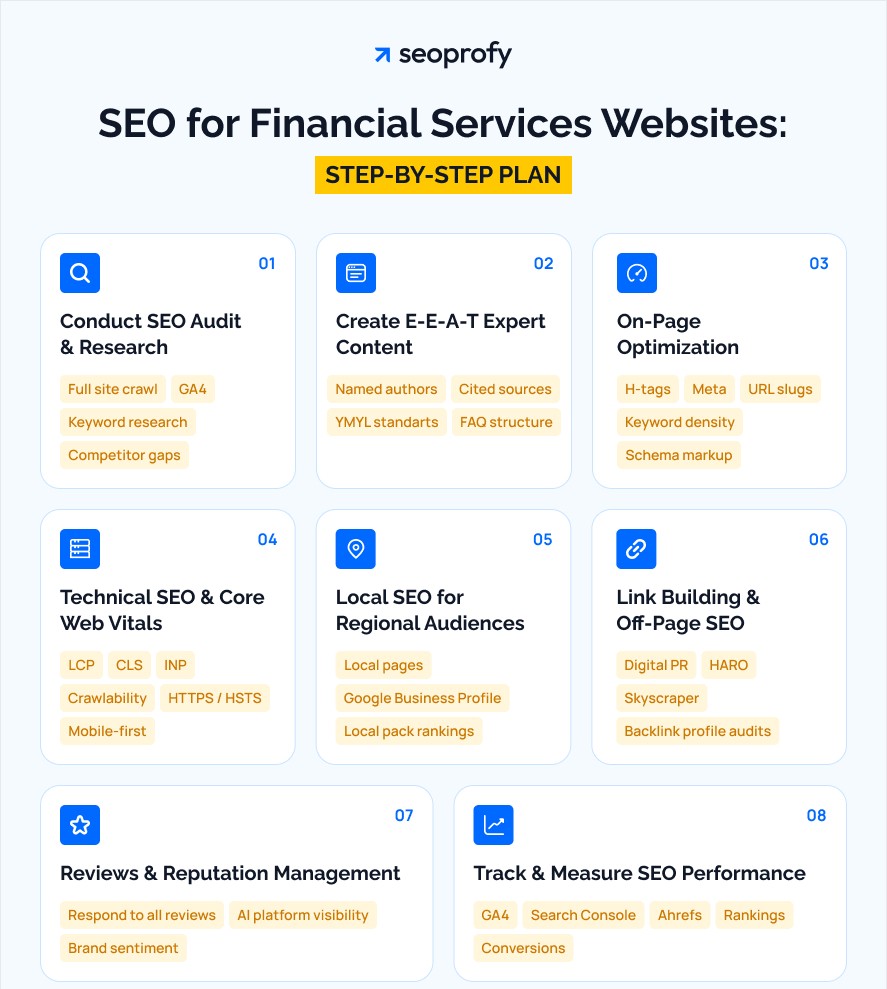
SEO Strategy Foundation: Audit & Research
The development of an efficient financial website SEO strategy starts with a full SEO audit — a snapshot of what’s working, what’s broken, and where the biggest gains sit. Here’s what to check first:
- Current condition: Crawl the site with Screaming Frog, pull data from GA4 (Google Analytics), and check Google Search Console for insights on how your pages perform in search engine results pages (SERPs). Watch dwell time, scroll depth, and which pages attract the most organic search traffic.
- Target audience: You can’t develop an effective strategy for financial SEO without considering your potential clients’ pain points and preferences. Review support tickets, call transcripts, and FAQ submissions to see what to base your keyword research on.
- Competitors: Pull the top five sites for your priority keywords and compare content depth, rankings, and backlink profiles. Look for gaps in their content that you could cover.
Keyword research sits at the center of this phase. Build a core list tied to real search intent: transactional for product pages, informational for the blog, navigational for brand terms. Mapping relevant keywords to intent keeps the content plan focused.
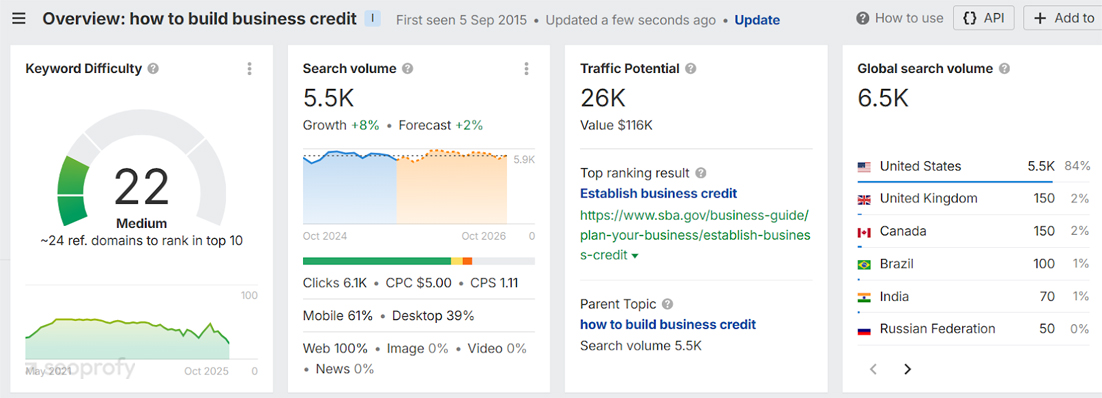
Use Semrush, Ahrefs, or Google Keyword Planner for keyword research at scale, then group the output by keyword difficulty (KD). The query “business credit cards,” for example, has strong volume but a KD of 53 — tough for a newer financial website.
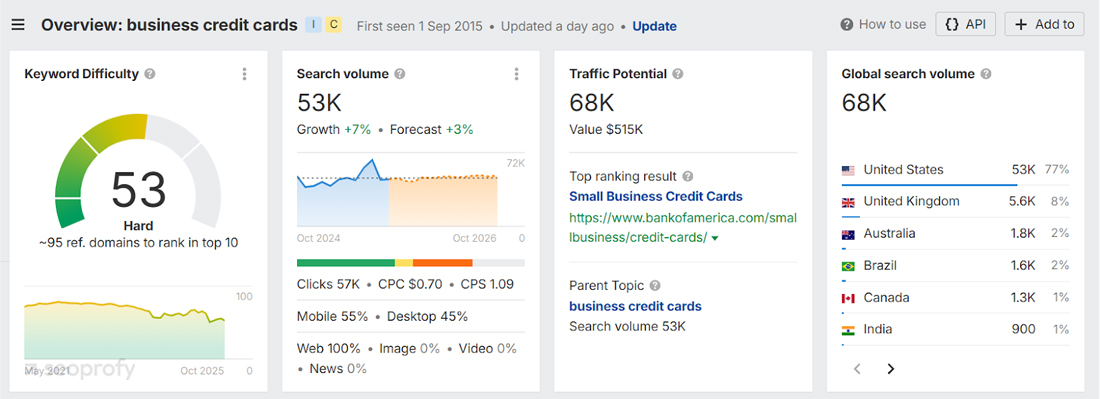
Start with long-tail variations that carry realistic KD scores, decent volume, and clearer search intent. “How to build business credit,” for example, is an easier query to rank for.
Crafting High-Quality, Compliant Content
To rank higher and establish strong brand authority, you need to create high-quality content that addresses your clients’ pain points. In finance, the bar sits higher than most industries:
- Pull quotes from named experts and cite sources like the Federal Reserve, FINRA, or peer-reviewed journals. Keep citations under two years old when possible.
- Use relevant internal links to other helpful articles and to your service pages. Show readers the path from question to solution without making it feel like a pitch.
- Keep each article focused on one core question with one clear answer. Covering every tangent waters down the value and confuses search engines.
Review every article against EEAT principles. The table below shows how each principle translates into content decisions in the finance industry.
|
EEAT principle |
Explanation |
Examples |
| Experience | Demonstrate hands-on experience with the financial products or services and knowledge gained from working on real projects. |
|
| Expertise | Show in-depth knowledge of specific financial topics, backed by credentials and data from related research. |
|
| Authoritativeness | Build your reputation in the financial industry by consistently publishing high-quality content referenced by other authoritative sources. |
|
| Trustworthiness | Ensure that your content is accurate, transparent, and honest. |
|
Proper financial services SEO also involves regular monitoring of your content performance. Watch bounce rate, scroll depth, and conversions — if numbers soften, the page needs a refresh.
On-Page Optimization
On-page work makes each page more user- and search engine-friendly. Your task is to strategically incorporate the target keywords not only into your content but also into:
- Headings: H1, H2, and H3 tags will help you structure your content, making it easier for algorithms and visitors to understand its context.
- URL slug: A properly optimized URL slug helps users understand what your page is about and provides search bots with context, improving its rankings and visibility. Here’s a good example from NerdWallet, which ranks #1 for “best investment platforms for beginners”: https://www.nerdwallet.com/investing/best/online-brokers-for-beginners.

- Alt text: Image optimization starts here. Every visual needs a short description that ties back to the page’s topic and explains where it fits.
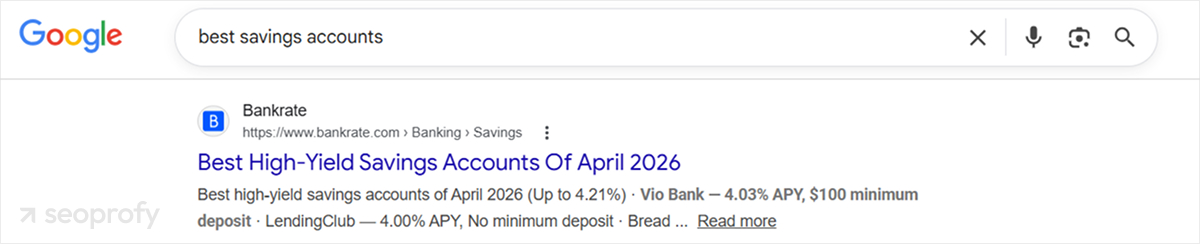
- Metadata: Meta descriptions and titles show first in SERPs. Keep descriptions near 150 characters, include the target keyword, and give searchers a reason to click. Here’s an example from Bankrate:
Placement matters, but so does keyword density — jamming the same term into every paragraph reads unnaturally and can pull rankings down. Aim for a density of roughly 1-3%, and let synonyms carry the rest.
Beyond keywords, on-page SEO in financial services also involves more advanced techniques:
- Improvement of internal links: Broken links hurt crawl paths and user experience. Audit them every quarter.
- Schema markup optimization: FinancialProduct, FAQPage, and Article schema help search engines categorize your pages and raise the odds of rich results.
- Security enhancement: HTTPS is a basic requirement. HSTS and CSP headers add more protection — important when people fill out loan or account forms on your site.
Technical SEO
Technical SEO carries extra weight for financial sites because trust signals decrease with every second a page takes to load. Core Web Vitals — LCP, CLS, and INP (which replaced FID as an official ranking signal in March 2024) — are confirmed ranking factors that also shape how users perceive your brand.
- Page speed: Aim for LCP under 2.5 seconds, INP under 200 ms, and CLS under 0.1. Run your site through PageSpeed Insights or Lighthouse to find bottlenecks. On finance sites, the usual culprits are bloated third-party scripts and unoptimized hero images.
- Mobile optimization: Google uses the mobile version of your site for ranking, so design mobile-first. Test forms, calculators, and comparison tables on mobile before the desktop.
- Crawlability: Clean XML sitemaps, sensible robots.txt rules, and logical internal linking help bots find every page that matters. Regular Screaming Frog crawls catch orphaned pages, redirect chains, and duplicate content.
- Structured data: Mark up rates, fees, and product details so search engines surface them cleanly — and so AI systems can pull them into answers.
Grow your credibility and client list with our SEO for financial services:
- Custom strategies
- ROI-oriented solutions
- Data-driven approach
- Regular monitoring

Local SEO
If you have a physical office, targeted SEO is how you win over your local customers. Covering multiple locations? Build a separate page for each — stuffing ten cities onto one page rarely helps you rank for any of them.
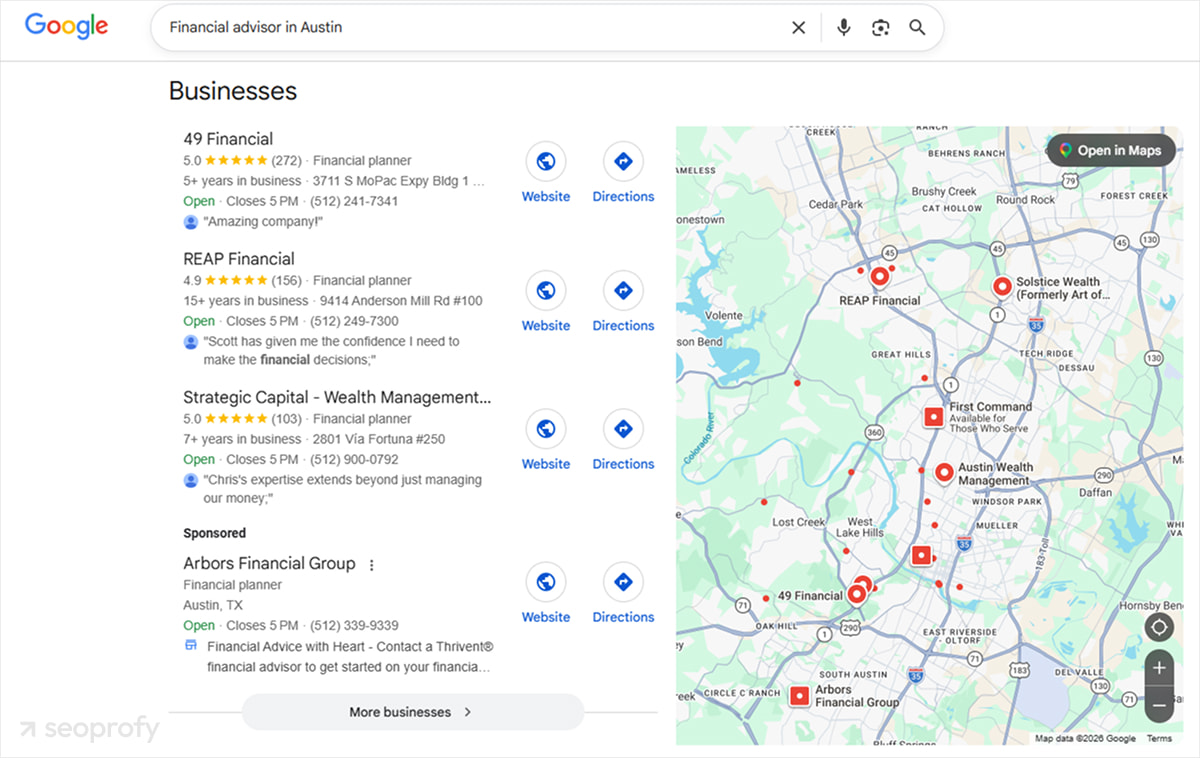
Use location-specific keywords on those pages. “Financial advisor in Austin” and “certified financial planner Austin Texas” both carry intent, and each variation opens a different door. Working them into your content helps you increase organic traffic and climb rankings in specific regions.
Local financial services SEO also means keeping each Google Business Profile accurate. Check addresses, hours, and service descriptions. Respond to every review — the algorithms notice. Combined with strong Google Maps ratings, this boosts your odds of landing in Google’s local pack.
Link Building and Off-Page SEO
Link building belongs inside your core SEO strategy. References from reputable and relevant websites, such as news outlets, financial magazines, and local listings, do more for your search rankings than almost any other off-page move.
Skip black-hat tactics unless you want to meet Google’s penalty queue. Focus on actually earning citations through link building and SEO best practices:
- Link baiting: Build content others want to cite — interactive calculators, original research, regional rate surveys.
- Skyscraper technique: Find the top-ranking article on a topic you want to own, then publish something better — more depth, more recent data, cleaner structure.
- Unlinked mentions: Watch for brand mentions that don’t include a link, then email the writer and ask for one.
You should also regularly check your backlink profile using tools like Ahrefs or LinkChecker.PRO to make sure that you don’t lose your valuable backlinks and that no spammy links ruin your profile.
Digital PR for Financial Brands
Platforms like HARO (which is operational in 2026, despite a history of rebranding as Connectively, then shutting down and changing ownership), Qwoted, and Prowly connect you with reporters on finance stories. Writers at Business Insider, Forbes, and Bloomberg need expert quotes fast — a sharp response within hours often gets cited.
Finance companies tend to underinvest here. Brands that pitch a few times a week thoughtfully earn links from outlets they’d never reach through cold outreach at a fraction of paid-campaign cost.
Using Reviews and Reputation Management
Review management for financial services websites is among the factors that have the greatest impact on consumer trust and your website’s authority. Reviews carry real weight with consumers and algorithms alike.
- Always respond to both negative and positive reviews politely and quickly.
- Invite clients to leave feedback through a business link or QR code.
- Avoid buying fake reviews, as this violates Google’s rules.
A solid online reputation matters because most clients research hard before choosing a financial provider. At the same time, the way they search for financial information has changed: nearly half of consumers have used AI tools for financial guidance.
If you want your financial business to rank on ChatGPT and other AI-powered platforms, remember that your online reputation feeds directly into what they recommend. Their models weigh brand mentions, review sentiment, topical authority, and content freshness.
Tracking & Measuring SEO Performance
Financial services SEO is a long-term commitment. Results aren’t quick to show, but the landscape changes frequently. Algorithms shift, new search features appear, and teams that spot changes early adapt faster. Track these metrics regularly to monitor your site’s health and SEO success:
- Keyword rankings
- Organic search traffic
- Conversions and engagement
- Backlink count and quality
- Local listing performance
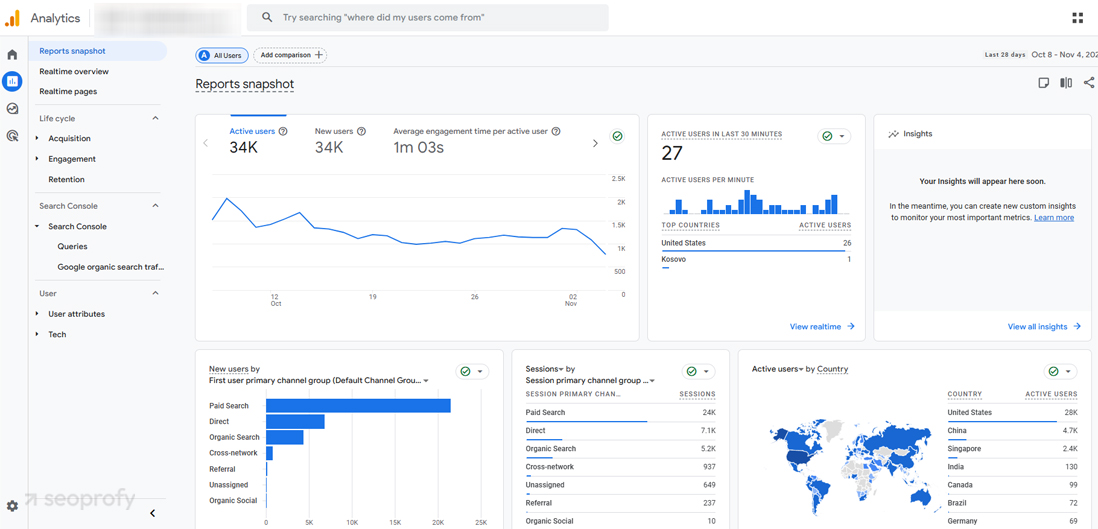
You need the right SEO tools for this task. GA4 and Google Search Console cover conversion data, query-level click-through rates, and pages that are slipping. Use Ahrefs and Semrush for deeper analysis, rank tracking, and competitive monitoring.
Overcoming Implementation Challenges
Strict YMYL and EEAT standards and tough competition are the core challenges in SEO for financial services. Other common roadblocks:
- Lack of in-house expertise: Your team might lack the knowledge and experience to implement a comprehensive SEO and content marketing strategy.
- Outdated technologies: Missing tools, slow CMS platforms, and legacy systems create a rough user experience that content alone can’t fix.
- Poor collaboration: Writers need real access to your financial experts. Without it, articles slip into generic territory fast.
Our case studies show what happens when those gaps close. A specialist finance SEO company handles SEO audits, technical work, and ongoing optimization so your team can focus on the business. Search engine optimization for financial institutions works best as a dedicated workstream — you save on subscriptions, skip beginner mistakes, and protect your brand’s reputation.
Financial SEO Trends: 2026 and Beyond
Search is moving fast. These are the trends shaping SEO for the financial sector:
- AI-driven searches: According to ChatGPT statistics, this AI chatbot is the fifth most-visited website worldwide. Users routinely ask AI platforms for guidance and product recommendations. LLMs mention real brands and provide links to relevant pages, making AI search visibility an important trend — and one worth implementing in your strategy.
- Voice search optimization: Voice assistants pull users toward natural, spoken queries. “What’s the best savings account for an emergency fund?” reads differently than a typed search — long-tail keywords are a must to capture both.
- Answer engine optimization: AEO techniques earn you placement in AI Overviews and answer boxes. It’s a more specific subset of AI visibility optimization that requires more targeted improvements.
- Omni-channel digital presence: Modern financial businesses can’t stop at Google search results. Around 30% of Americans search for finance-related advice on social media, and a presence there feeds your SEO work downstream.
Financial SEO Strategy that Works
SEO for financial services can make brands recognizable nationwide or increase a company’s impact on a local level. The right SEO strategy combines technical cleanup, EEAT content, local SEO, link building, and review management. Skip any one of them, and the others lose leverage.
Handling all of it while still running the business gets heavy fast. SeoProfy helps you rank in AI Overviews, dominate local search results, and grow organic traffic that compounds year over year. Together, we’ll get you in front of the right audiences at the right moment.

Bohdan has been an SEO analyst at SeoProfy for more than two years. He began his career in digital marketing in 2019 and has since gained experience helping scale some of the world’s leading brands in industries such as gambling and SaaS. Bohdan specializes in developing effective strategies tailored to specific regions.