


A SaaS content audit is a structured review of all website content that evaluates traffic, search performance, and alignment with user intent across the customer journey. It covers blog posts, landing pages, and product documentation, with clear actions: keep high-performing pages, update underperforming content, merge overlaps, and remove low-value content.


Our team at SeoProfy has run hundreds of content audits for SaaS and built streamlined content systems that support conversions and improve ROI. In this guide, we break down how to conduct a SaaS content audit, share a clear checklist, and pass along practical tips from real projects.
- A successful content audit for a SaaS website evaluates how each page contributes to conversions, pipeline, and overall business impact.
- Clear goals, defined evaluation criteria, and proper content segmentation set the foundation for strong results before any analysis even starts.
- Most of the impact comes from gaps you find across the strategy, not pages: missing clusters, weak funnel coverage, and intent mismatches.
- Each page needs a clear decision during execution: update, merge, delete, or reposition based on its role and business impact.
What is a SaaS Content Audit?
A successful SaaS content audit is a process that includes technical analysis, existing content asset quality evaluation, and SEO (search engine optimization) performance review across all key pages. Based on audit results, you can build effective content strategies and make decisions to:
- Merge pages,
- Improve structure,
- Update outdated pages,
- Remove weak assets, etc.
This way, you can influence overall site performance: improve search engine rankings and LLM SEO metrics, attract higher-quality traffic, influence conversions by guiding users through the funnel with more relevant and high-quality content, and, as a result, improve ROI.
But why stay in theory? Let’s look at a real example.
With this approach, in one of our SaaS cases with a productivity and workspace SaaS platform, we achieved +26% organic traffic: from 60.1K to 75.5K clicks (+15,352). Top-3 keywords increased by +31%: from 523 to 687.
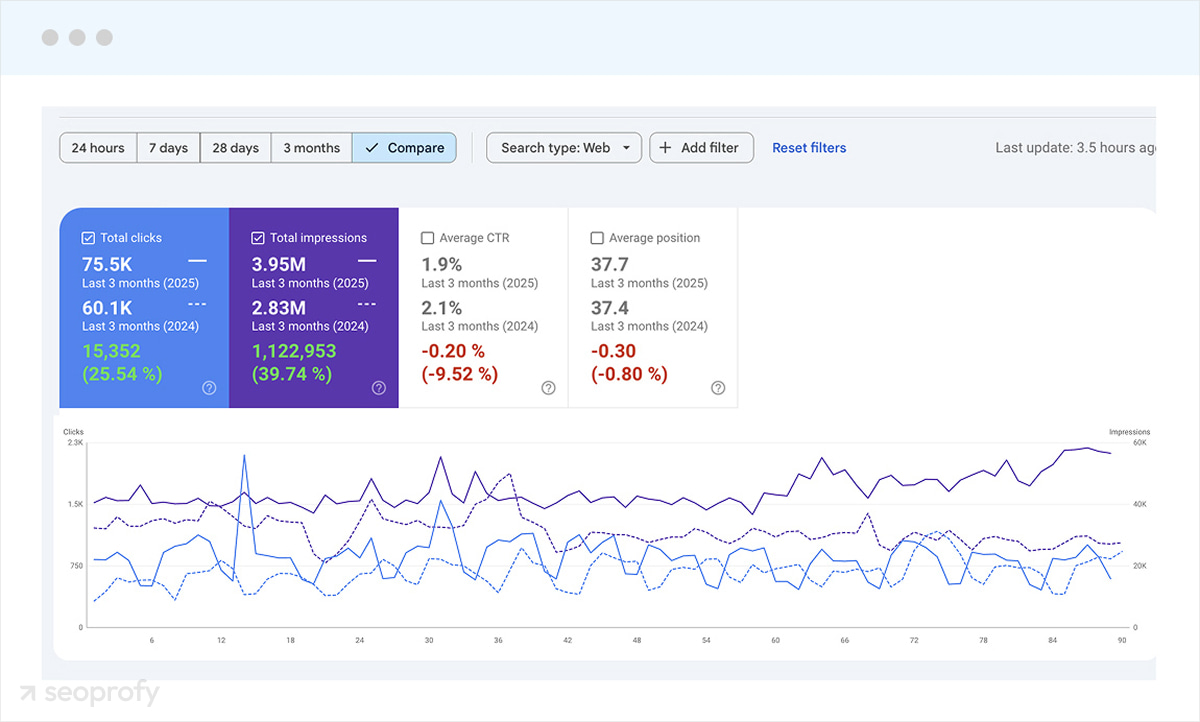
To reach these results, SEO specialists at SeoProfy conducted a deep SaaS content audit: we identified key issues, then the team replaced a score-based approach with intent-driven SEO briefs, reworked content and layout, and more. At the same time, we worked on technical SEO, structural optimization, and links, but content changes made a strong contribution to the outcome.
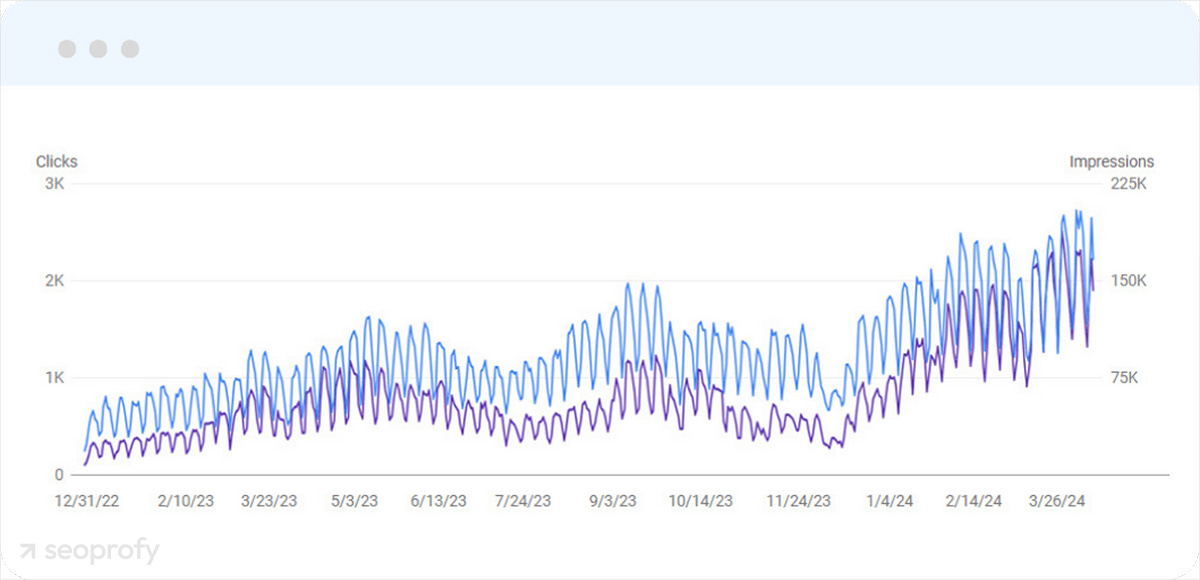
In another SaaS case, after identifying issues through the same approach, our team improved UX and category hierarchy, moderated UGC, and kept high-quality pages indexed. Results: 22K → 68K users/month (209% in ~2 years), traffic doubled in 12 months, +140% mid-season clicks, and a 4x increase in qualified leads.
But what makes a content audit for SaaS different from general audits? Let’s see:
| Aspect | SaaS Content Audit | General Content Audit |
| Content audit goal | Find gaps across the funnel and fix content that blocks conversions or product understanding | Identify underperforming pages and improve traffic and rankings |
| Evaluation criteria | Traffic, rankings, intent match, funnel stage fit, product relevance, conversion role | Traffic, rankings, keyword targeting, and user engagement metrics |
| Content gaps | Missing pages across funnel stages (use cases, comparisons, integrations, BOFU pages) | Missing keywords or topics with search demand |
| Technical checks | Checks technical issues like crawl depth, internal paths to BOFU pages, and indexation of revenue-driving content | Checks indexation, crawlability, and overall site structure across all pages |
| Internal linking | Evaluated as part of funnel flow and conversion paths | Evaluated for SEO structure and authority distribution |
Why Do SaaS Businesses Need Content Audit?
So, our SaaS content audit guide focuses on this approach because it is an important part of SEO since it directly impacts performance and helps improve key metrics. What specific benefits does it bring? Here’s a quick breakdown:
- Improves search rankings and helps earn LLM citations;
- Uncovers content gaps across the funnel;
- Helps fix pages that block conversions;
- Aligns content with user intent and product value;
- Strengthens internal linking and site structure, and eliminates broken links;
- Increases quality traffic and conversion rates;
- Supports better ROI from existing content.
When Should You Conduct a SaaS Content Audit?
How do you understand when it’s time to audit your SaaS content strategy? We prepared a checklist to help you determine it clearly.
What Signals Show You Need a Content Audit for Saas?
For SaaS startups, a content audit has limited value, since you need to build the strategy from scratch. However, if your product already runs and content exists, these signals show it’s time for it:
- Organic traffic declines or stalls over time
- Conversions stay low despite consistent traffic
- Content cannibalization across similar pages
- Rankings fluctuate or drop for key pages
- Content no longer matches current product or user intent
How Often Should You Run Content Audits?
SaaS content audits should run based on the company stage, overall SEO campaign setup, content volume, and release velocity. The more pages, features, and updates you have, the more often you need to revisit content so that you can keep it aligned with search and product changes.
| Frequency | Company Stage | When It Makes Sense |
| Quarterly | Growing B2B SaaS companies | Active SEO, new pages, frequent product updates |
| Yearly | Mature SaaS companies | Stable rankings, slower content changes |
| Ongoing | Enterprise SaaS / high-scale platforms | Large sites, constant updates, focus on GEO/AEO, and AI visibility |
SaaS Content Audit: Step-by-Step Process Guide
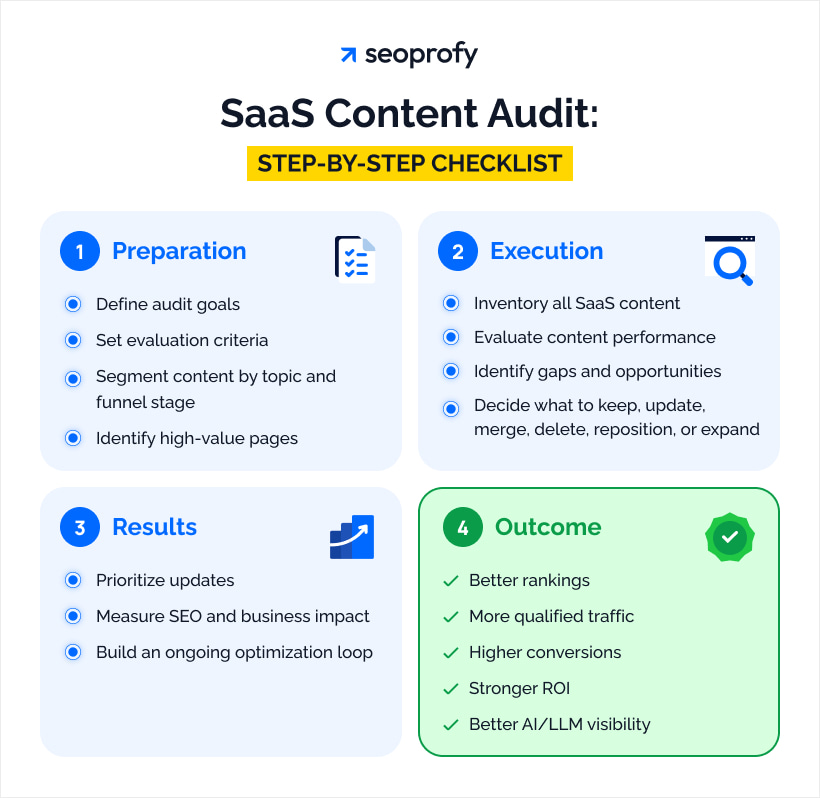
And now we’ve reached the practical part on how to run this process. Here, you’ll find tips from our experienced team at SeoProfy, detailed content audit checklists, and clear steps to follow at each stage.
Preparation Phase
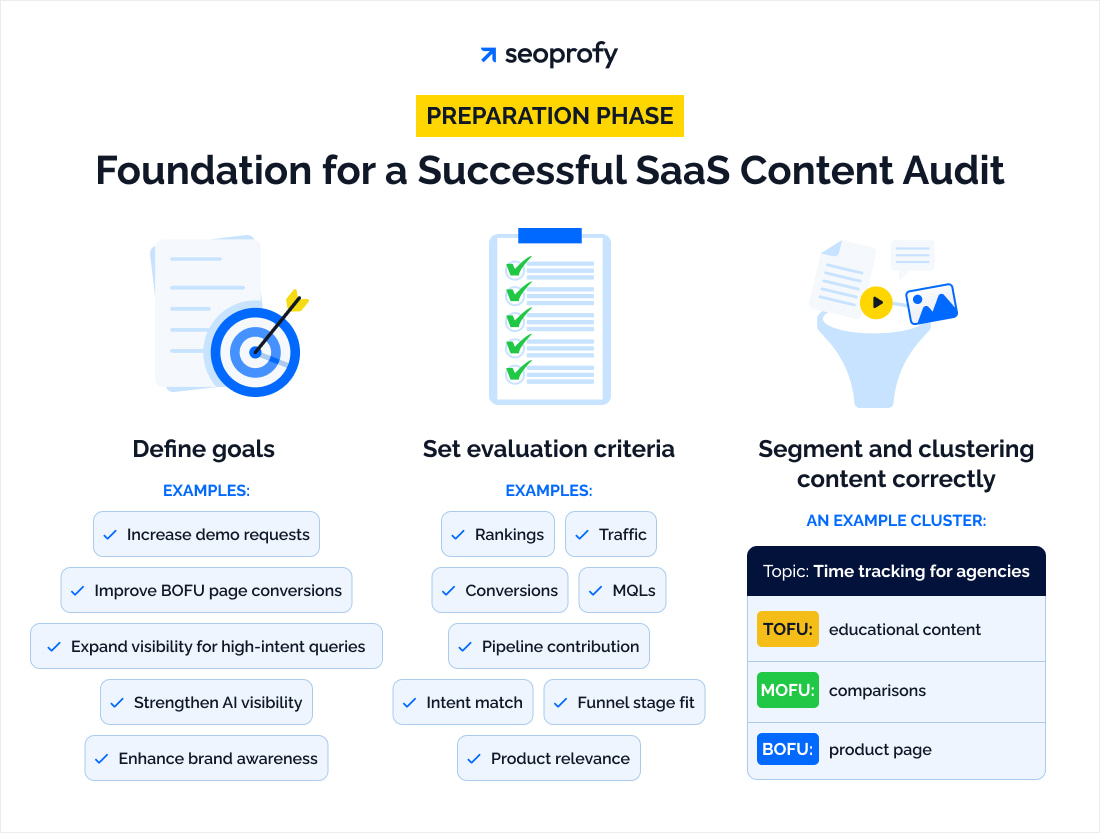
This stage is the foundation of the entire process, and we would not recommend underestimating or skipping it. At the core, the first step is defining goals and criteria for evaluating your pages’ visibility and business impact.
In SaaS, goals need to tie directly to business outcomes:
- Increase demo requests
- Improve conversion rates on BOFU pages
- Expand visibility for high-intent queries and enhance brand awareness
- Strengthen AI visibility
The audit can cover multiple goals, but each page should have its own role in the strategy.
Next, you need to define evaluation criteria for pages. Judging by traffic alone = having a distorted view of your future content strategy. A page can bring thousands of visits and zero conversions, while another with lower traffic drives demos. So, in SaaS SEO, you always look at a combination:
- Rankings,
- Conversions (trials, demos, sign-ups),
- MQLs and pipeline contribution.
And when this is ready, the most important part of preparation begins. This is segmentation before the audit. Experienced content marketers usually do not review pages one by one, because patterns get missed, cannibalization stays hidden, gaps are not visible, and the user path becomes unclear. To spot these, you need to cluster first. And here’s the question: group by funnel or by topic?
- If you group only by topic, you understand coverage but miss conversion logic.
- If you group only by funnel, you understand flow but miss topical depth.
For SaaS SEO, we recommend combining both. A proper cluster always connects:
- One topic
- Multiple funnel stages
- Clear path toward conversion
For example, the cluster is “Time tracking for agencies”:
- TOFU: educational content pages;
- MOFU: industry-specific comparisons;
- BOFU: dedicated product page.
Next, identify high-value pages. Do not read this as “top traffic pages,” since these can be pages with declining traffic that need optimization, but they sit close to conversion or influence it directly and therefore matter for you:
- Product and feature pages
- Use case and industry pages
- Comparison and alternative pages
- Integration pages
- High-intent blog pages that lead to product actions
After this, you have a base you can analyze and move to the execution phase, where the main work will happen. Next, we will provide a practical content audit checklist with specific factors, key metrics, and recommended actions.
Execution phase
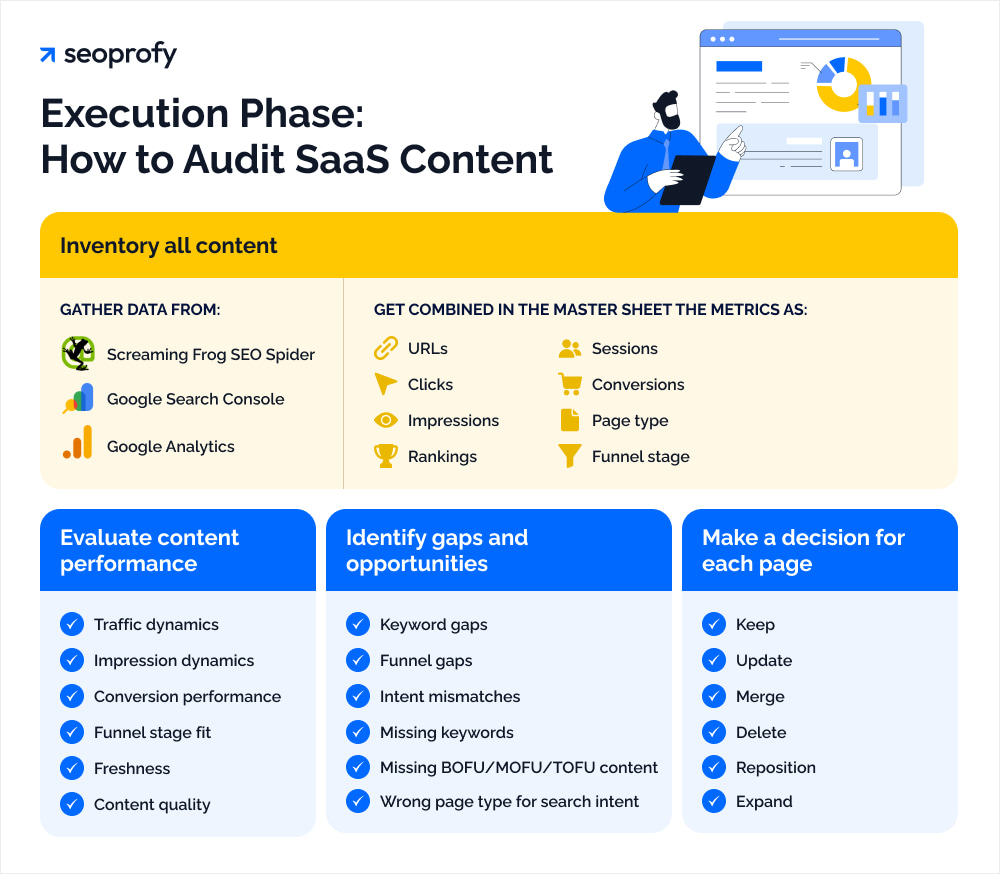
At this stage, we will cover how to inventory all SaaS content, evaluate performance using a clear content audit checklist, uncover opportunities across keywords and funnel stages, identify content gaps, and decide what to update, merge, or remove.
Inventory All SaaS Content
For starters, you need a complete list of all pages that exist and bring any value. You collect it from three sources and merge them into one dataset.
Start with a crawl. Use Screaming Frog SEO Spider
- Enter your domain and run a full crawl
- Filter by HTML pages only
- Check indexability (indexable vs non-indexable)
- Export all indexable URLs
This gives you the base list of pages.
Then, you open the Google Search Console. Go to search results, switch to pages, set a normal working range like the last 3–6 months, and hit Export in the top right. This file shows which pages actually appear in search, with clicks, impressions, and positions.
Very often, you’ll notice pages here that your crawl didn’t surface properly, especially older or weakly linked ones.
After that, you go into Google Analytics. Export landing pages with sessions and conversions. For that, go to Reports → Engagement → Landing page → set the same date range → click Share → Download file (CSV).
Now you combine everything into one sheet. Use URL as the key, remove duplicate pages, and keep one row per page. Add columns for clicks, impressions, keyword rankings, sessions, and conversions.
Before moving further, assign labels: page type (blog, feature, integration, landing) and funnel stage. Now you have a structured dataset ready for analysis!
Evaluate Content Performance
Now you move to performance. Each page needs to be evaluated through rankings, engagement, and conversions to understand what drives results and what needs to be fixed. The table below shows what to check for each page, how to read the signals, and what to do next:
| Factor | Metric / Source | Sign | Recommended Action |
| Traffic dynamic | GSC clicks / GA sessions | Declining or flat traffic | Update content, improve intent match |
| Impression dynamic | GSC impressions | High impressions, low clicks | Improve titles, meta, positioning |
| Conversion | GA / CRM data | Traffic without conversions | Rework CTA, align with funnel stage |
| Marketing funnel stage | Page type + intent | Mismatch with intent | Adjust content angle or reposition page |
| Freshness | Last update / publish date | Outdated content | Refresh data, update structure |
| Content quality | Manual review | Thin, generic, weak structure | Rewrite or merge with stronger pages |
Identify Gaps and Opportunities
Now we move from checking pages to auditing the whole system. You look for missing keywords, missing funnel stages, and mismatches between intent and content.
Let’s find keyword gaps first. Use SEO tools like Ahrefs or Semrush. Open Content Gap / Keyword Gap and:
- Add your domain,
- Add 2–3 main competitors,
- Filter for keywords where competitors rank, and you don’t.
After export, you go through the list and focus on queries with clear search intent, especially commercial ones like “best,” “vs,” “alternative,” and “pricing.” This is one of the best SaaS keyword research strategies, since you get a list of missing queries that already bring traffic to competitors, which means they can potentially bring traffic to you once you cover this gap.
Then check funnel gaps. Take your clustered content (from the previous step) and map it:
- Each topic should have TOFU, MOFU, and BOFU coverage;
- If a cluster has only blog content, you miss conversions;
- If it has only BOFU pages, you miss traffic.
Next, validate intent with Google Search Console. Go to Search results → Pages → open a page → switch to queries. Compare query intent with the page role. If informational queries dominate a BOFU page; users read and leave. If commercial queries land on a blog page, clicks exist but conversions lag. This way, you see where intent and page type conflict.
So, that’s how you audit SaaS marketing strategies, not just pages. Around 70% of online marketing specialists believe that SEO generates more sales than PPC, so every missed keyword cluster or broken funnel path directly limits the pipeline.
Decide What to Update, Delete, or Keep
It’s finally time to turn this whole analysis into decisions! Every page should earn its place based on how it supports your SaaS product, business priorities, conversions, and, of course, ROI.
Here’s a simple scoring logic. Each page gets evaluated across:
- Performance (rankings, traffic),
- Business impact (conversions, MQLs, pipeline),
- Content relevance (intent match, funnel role, product fit),
- Quality (depth, structure, E-E-A-T signals).
E-E-A-T matters more in SaaS than most teams expect. Weak expertise, generic content, or unclear authorship often explain why pages ruin customer retention or do not convert even when they rank.
Also, account for how content gets used in modern search. If your pages answer search queries clearly, use structured sections, and cover topics in depth, they have higher chances to be cited in LLM outputs and bring more value to a smaller but highly targeted audience. This should be considered as part of your AI SEO strategy.
After all the analysis you’ve done, you can now use the content audit checklist below to make decisions and assign actions.
| Action | When to Use | What It Means |
| Keep | High-performing content: stable rankings, consistent traffic, strong conversions, clear role in funnel | Protect rankings, monitor performance, scale internal linking |
| Update | Traffic or impressions exist but low conversions, outdated content, weak intent match | Rework structure, improve intent alignment, strengthen CTAs, update data |
| Merge | Cannibalization (multiple pages rank for the same keywords), overlapping topics, and no clear primary page | Consolidate into one page, redirect weaker URLs, and rebuild internal linking |
| Delete | No traffic, no impressions, no conversions, no backlinks, no role in SEO strategy | Remove page, return 410/404, or redirect if needed |
| Reposition | Page ranks but for the wrong intent (informational vs commercial mismatch) | Change angle, adjust content type, align with the correct funnel stage |
| Expand | Page brings some conversions but has limited keyword coverage or depth | Add sections, target more queries, strengthen cluster coverage |
Results
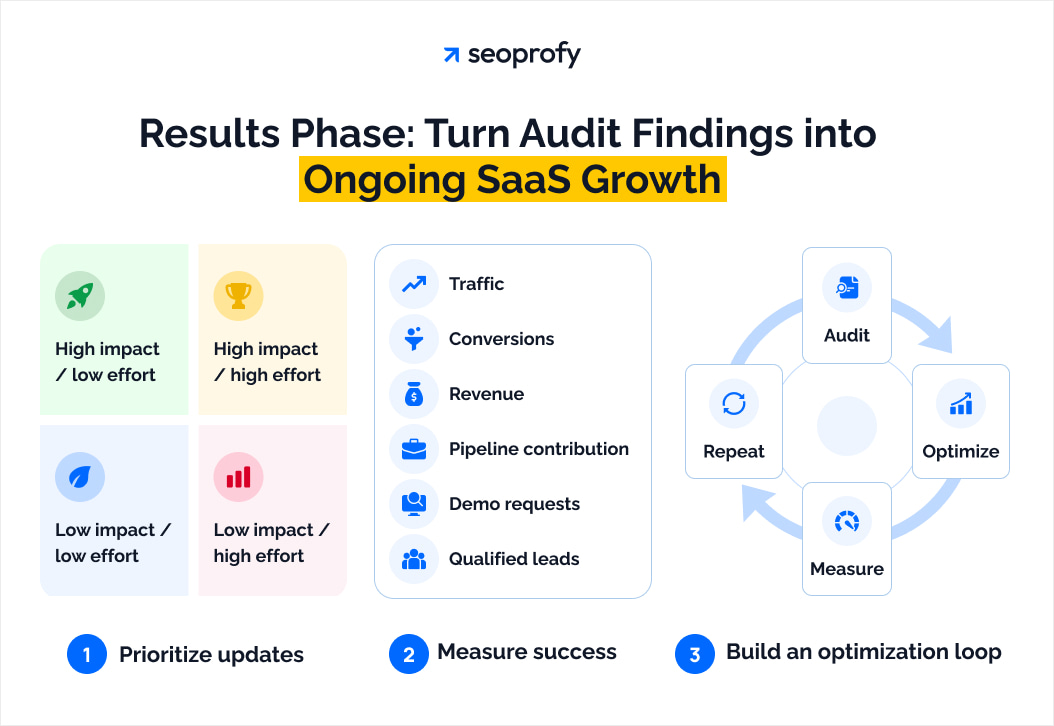
After the audit, the main work comes down to how you prioritize and measure what you change. Below are a few practical tips from the SeoProfy team in a question–and–answer format for your convenience.
How do you prioritize updates after the audit?
Split actions into quick wins and long-term work. Quick wins come from pages that already have a digital presence but underperform:
- High impressions + low CTR: fix titles, meta, positioning;
- Traffic + low conversions: adjust intent, improve CTAs;
- Ranking in positions 4–10: small updates can push into the top 3.
Long-term work includes:
- Creating missing BOFU pages;
- Rebuilding clusters with weak funnel coverage;
- Merging cannibalized content into stronger assets.
Use a simple prioritization matrix:
| Impact \ Effort | Low Effort | High Effort |
| High Impact | Fix CTR and update high-ranking pages | Build new BOFU pages, restructure clusters |
| Low Impact | Minor content tweaks | Deprioritize |
How do you measure success after a content audit?
Track all KPIs that connect SEO to business:
- Traffic,
- Conversions,
- Revenue and pipeline contribution.
We have seen multiple cases where looking at the full picture gives a more accurate view of performance. For example, one SaaS project improved a set of BOFU and comparison pages. Traffic grew moderately, but demo requests increased significantly because intent matched better and conversion paths became clearer. So it’s important to evaluate all KPIs together.
How do you build an ongoing optimization loop?
Comprehensive content audits are not one-time work. You run them as a cycle: Audit → Optimize → Measure → Repeat.
To keep results, conduct regular content audits:
- Revisit key web pages every 3–6 months;
- Track clusters, not just individual URLs;
- Monitor queries in Search Console for intent shifts;
- Expand pages that convert well;
- Fix new cannibalization early.
Get a thorough content audit built around how your buyers search, compare, and choose. SeoProfy specialists analyze your content, uncover gaps, and turn it into a system that brings revenue, not just vanity metrics.
- Higher organic traffic,
- More qualified leads,
- Clear conversion paths.

Which Tools Help Audit SaaS Content Strategy?
As a data-driven agency, SeoProfy works with data every day, so the role of proper analysis here is obvious. Doing this manually across dozens or hundreds of pages quickly is unrealistic, so tools handle most of the heavy lifting. Below are the key tools for checking performance metrics, keyword research, technical aspects, and more, including how to use them in a content audit for SaaS.
| Tool | Use Case |
| Google Search Console | Analyze queries, clicks, and impressions, and identify intent mismatches across the buyer’s journey |
| Google Analytics 4 | Track sessions, conversions, and user behavior |
| Ahrefs | Keyword gaps, competitor analysis, backlink data |
| Semrush | Keyword research, content gaps, visibility tracking |
| Screaming Frog SEO Spider | Crawl site, export URLs, check indexation and structure |
| Search Analytics | Deeper search, data analysis, and segmentation |
| SeoCrawl | Track SEO performance over time and segment data by pages and queries |
What are the Common Mistakes in a SaaS Content Audit?
In a process this large and complex, mistakes happen easily. Review the key ones below to avoid them:
- No clear goals or prioritization in the current marketing strategy;
- Treating all pages equally without a business impact focus;
- Focusing only on traffic and ignoring lead generation and conversions;
- Ignoring funnel stages and intent alignment;
- Missing content cannibalization across similar pages;
- Making decisions without full data (GSC, GA, CRM).
Make Your Content Convert on Your SaaS Product Sales
The results of a content audit process depend on how well all parts of your strategy work together. When goals are clear, clusters are structured, intent is aligned, and decisions are based on data, you get a SaaS content marketing strategy that consistently supports search visibility and conversions instead of random page-level improvements.
This process is complex, and the safest way to avoid costly mistakes in your future content marketing efforts is to delegate it to a professional SaaS SEO agency. At SeoProfy, the team works with data and understands how content connects to product logic and conversion paths. Book a call with our team, and we will show you where your current setup holds you back and what to fix first.

As a Content writer at SeoProfy, Hanna Zhytnik creates SEO content grounded in research, data, and ongoing hypothesis testing. With more than 5 years of experience across B2B, SaaS, and ecommerce, she brings both breadth of knowledge and a sharp focus on modern search. Her strength lies in turning complex experiments into clear explanations, bridging the gap between deep SEO practice and accessible content.