


In 2026, assisted living SEO matters most when families begin comparing care options under pressure, often long before they make a call or schedule a tour. If your community is not showing up in local search results, you risk losing attention at the very moment trust is still being formed.


That search rarely begins with the future resident alone. Adult children and other family decision-makers are often the ones turning to Google when they need answers quickly. And the scale of that audience is significant: 63 million Americans — nearly one in four adults — now serve as family caregivers.
Also, families are no longer relying only on standard search results. AI-generated answers and search overviews now shape part of the early research process, often before a family clicks through to a website.
This guide explains what assisted living SEO entails, why local visibility matters so much, how long results typically take, and which tactics have the greatest impact on direct resident inquiries.
- 63 million Americans — nearly 1 in 4 adults — currently serve as family caregivers
- 88% of families say they need more guidance navigating senior care options
- Adult children and other family decision-makers often start the search, not the future resident
- The national median assisted living cost in 2026 is $5,419 per month, making referral-dependent acquisition expensive over time
- Local SEO and Google Business Profile optimization are often the fastest levers for improving visibility in senior care search
- SEO results usually begin to show early movement within 3 to 6 months, while stronger gains often take 6 to 12 months.
What Is Assisted Living SEO?
Assisted living optimization is the process of improving a senior care facility’s local search visibility so families can find it more easily in search results when looking for care in a specific area. It includes your website structure, GBP, local citations, published content, and authority signals from reputable websites linking back to you.
What makes it different from general search engine optimization is the nature of the search itself. Choosing a hotel or a coffee shop is usually a low-stakes decision. Selecting an assisted living facility is not. Families often begin that search during a stressful transition, when an older adult needs more support, and the decision cannot be delayed for long. That creates a very different kind of search behavior — one shaped by urgency, emotional pressure, and the need for reassurance.
Senior living SEO is also highly local. Most families are not comparing communities across the country. They are looking for options in a specific city, neighborhood, or driving radius that make regular visits realistic. That is exactly why this niche requires a more targeted, confidence-focused approach than standard SEO in other industries.
Why Does Senior Living SEO Matter?
Visibility at the right moment is everything in senior living. Families searching online are already in decision mode — and communities that don’t show up early rarely get a second chance to make the list.
Demand Is Growing, and Search Starts Early
According to the Population Reference Bureau, the number of Americans age 65 and older is projected to rise from 58 million in 2022 to 82 million by 2050. And as A Place for Mom’s Senior Care Search Trends report shows, 88% of families often need more guidance when navigating care options, making early visibility in the search results far more important.
For assisted living providers, that changes what a strong online presence looks like. Content now needs to be clear, credible, well-structured, and specific enough to earn trust in both traditional search results and AI-generated search experiences.
The Referral Platform Trap – High Cost, Low Control
Many assisted living operators still rely heavily on referral platforms such as A Place for Mom and Caring.com to generate move-ins. The appeal is obvious: these sites already rank well, attract high-intent traffic, and can quickly send inquiries. But that convenience comes at a real cost.
On A Place for Mom’s methodology page, the company states that when a senior moves into a referred community, the community pays a percentage of the resident’s first month of rent and care fees. With the national median assisted living cost at $5,419 per month in 2026, a referral model tied to first-month rent and care fees can quickly become an expensive way to acquire residents.
The bigger issue is control. Aggregators place your community alongside many others and shape much of the discovery experience. When your website and Google Business Profile rank in local search results, families can engage with your brand directly. You control the message, the first impression, and the next step.
The difference becomes clearer when you compare referral-based lead generation with long-term organic visibility:
|
Aspect |
Lead Aggregators (A Place for Mom, Caring.com) |
Organic SEO |
| Cost per move-in | High acquisition cost tied to each placement | Lower ongoing cost after the initial investment |
| Lead ownership | The platform controls much of the lead flow | You own the relationship from the first visit |
| Brand visibility | Your listing competes with many other providers | Your website and GBP can rank directly |
| Long-term value | Stops when you stop paying | Compounds over time |
| Trust signal | Families first engage with a referral platform | Families land directly on your website or GBP |
Paid search can also generate immediate visibility, but like referral platforms, it depends on continuous spending. Once campaigns stop, so does the traffic — unlike optimization, which continues to deliver over time.
Senior living SEO creates long-term value. When a community ranks in local search, maintains a well-optimized Google Business Profile, and publishes useful content that answers real family questions, it has a much better chance of turning visibility into qualified leads. In that sense, SEO for assisted living is not just a visibility play. It is a way to build organic traffic, strengthen brand control, and create a more sustainable pipeline of direct resident inquiries over time.
What Does Assisted Living SEO Include?
Assisted living optimization includes several connected disciplines that work together to improve how a community appears in search results, how families experience its website, and how credible the community appears before anyone schedules a tour or makes a call. In practice, that usually means local optimization, keyword research, content strategy, technical improvements, authority building, and review management.
Local SEO for Assisted Living
If there is one area where facilities can see results faster than almost anywhere else, it is local discoverability. When a family searches for phrases like “assisted living in Phoenix, AZ” or “memory care near me,” the first listings they usually see are regional search results tied to Google’s local index. Those rankings depend heavily on your Google Business Profile, your business information across the web, and the strength of your location signals.
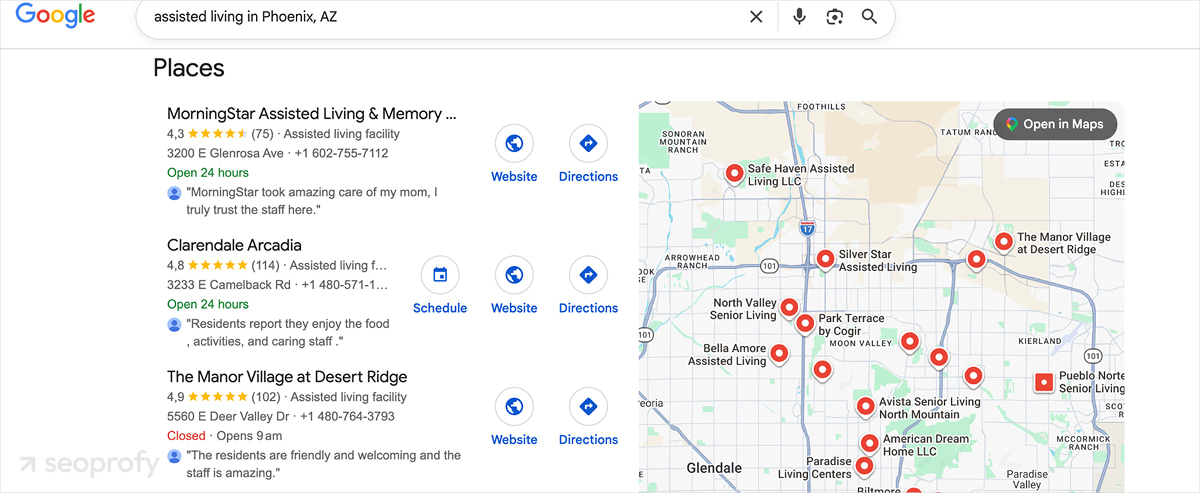
Overall, your GBP is often the most visible digital asset your community has. It shapes what families see before they ever visit your website: your name, address, phone number, hours, photos, services, and, just as importantly, your reviews.
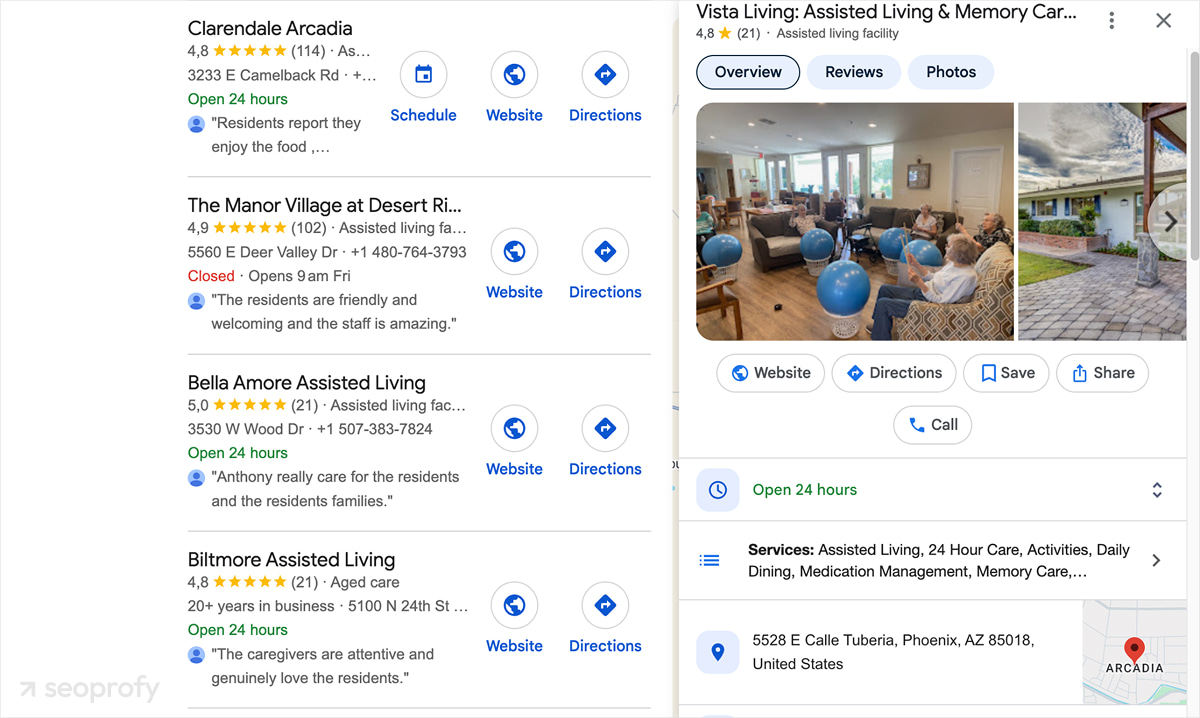
A complete, accurate, and actively managed profile improves your chances of appearing in Google’s local pack — the three-business block that dominates many location-based searches.
To improve local visibility, your profile needs more than a basic setup. Important steps include:
- Choosing the most accurate primary and secondary categories
- Writing a business description that reflects your services and location naturally
- Uploading high-quality photos of your community, common areas, rooms, and outdoor spaces
- Publishing regular Google Business Profile posts about events, updates, or community life
- Responding to every review, both positive and negative, with professionalism and empathy
- Keeping your name, address, and phone number consistent everywhere they appear online.
That last point matters more than many operators expect. Search engines compare your business information across local directories, review platforms, citation sources, and your own website. If your address or phone number appears differently on Yelp, Caring.com, SeniorAdvisor, and your site, those inconsistencies can weaken trust signals and create confusion. Thus, cleaning up and standardizing local citations is one of the most important steps in any local SEO strategy for senior care communities.
Industry-specific directories also carry real value. Listings on platforms like Caring.com, SeniorAdvisor, and AgingCare can serve as both referral sources and citation signals that strengthen placement in local results. When your information is accurate and aligned across those profiles, it strengthens your authority in the local market. This, in turn, makes it easier for prospective residents and their relatives to find reliable details about your community.
Keyword Research for Senior Care Facilities
Many assisted living operators make the same mistake with SEO: they optimize for the language they use internally instead of the words people type into search engines when they need help. Good keyword research closes that gap.
The most useful terms usually fall into three groups:
- Location-based keywords such as “assisted living in New York” or “memory care in Palisades.” These reflect strong local intent and help communities compete in crowded regional markets
- Service-based keywords such as “assisted living with memory care” or “senior living with medication management.” These attract people who already understand the kind of support they need
- Intent-based keywords such as “how to know when a parent needs assisted living” or “what does assisted living include.” These searches happen earlier in the decision process and help facilities stay visible before families are ready to call.
Keyword research tools like Google Keyword Planner, Semrush, or Ahrefs can help uncover search volume, related terms, and ranking opportunities. But the goal is not to chase the biggest numbers. It is to build a keyword strategy around relevant keywords that match real intent and give an assisted living site a realistic chance of appearing in search results.
Long-tail phrases are especially valuable because they are more specific, less competitive, and more likely to attract qualified organic traffic. For many providers, such word combinations offer the most realistic path to better search engine rankings and more relevant visits.
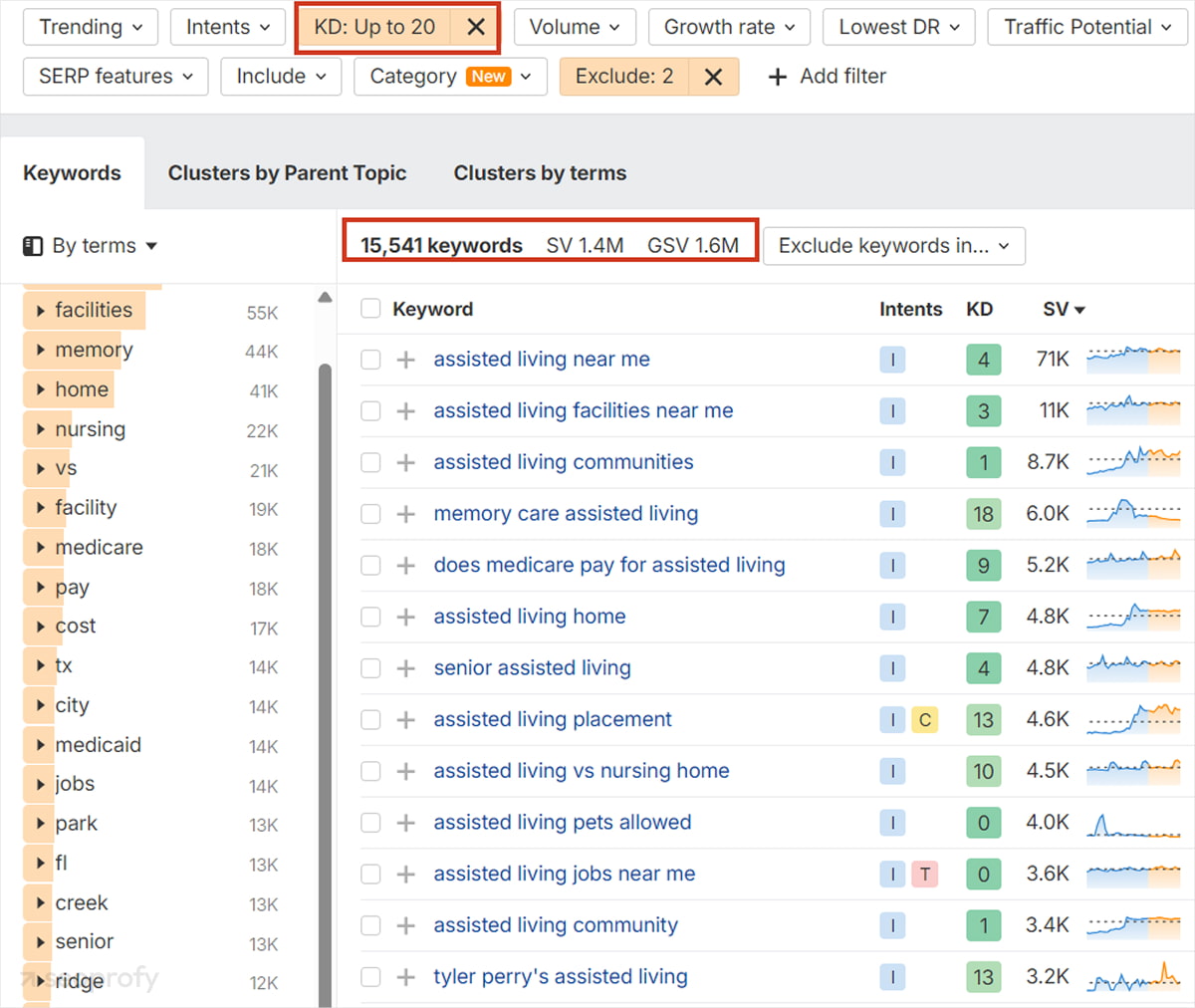
Strong keyword optimization is an ongoing part of senior living SEO. Search behavior changes, priorities shift, and the language families use evolves. Communities that revisit their keyword strategy regularly are better positioned to attract prospective residents and their families.
Content Strategy for Assisted Living Websites
A common mistake in content planning for senior living websites is assuming that more pages automatically lead to better rankings. In reality, volume only helps when the content is genuinely useful. For assisted living providers, that means building website content around the real questions families bring to Google and answering them clearly, honestly, and with enough depth to be helpful. That is also what makes an SEO strategy more effective over time.
In this niche, content marketing works best when it answers real family questions and builds trust at every stage of the decision-making process.
The most important content types usually include:
- Service and location pages for assisted living, memory care, respite care, and other core offerings. These pages should explain what the community provides, who it is right for, and what families can expect
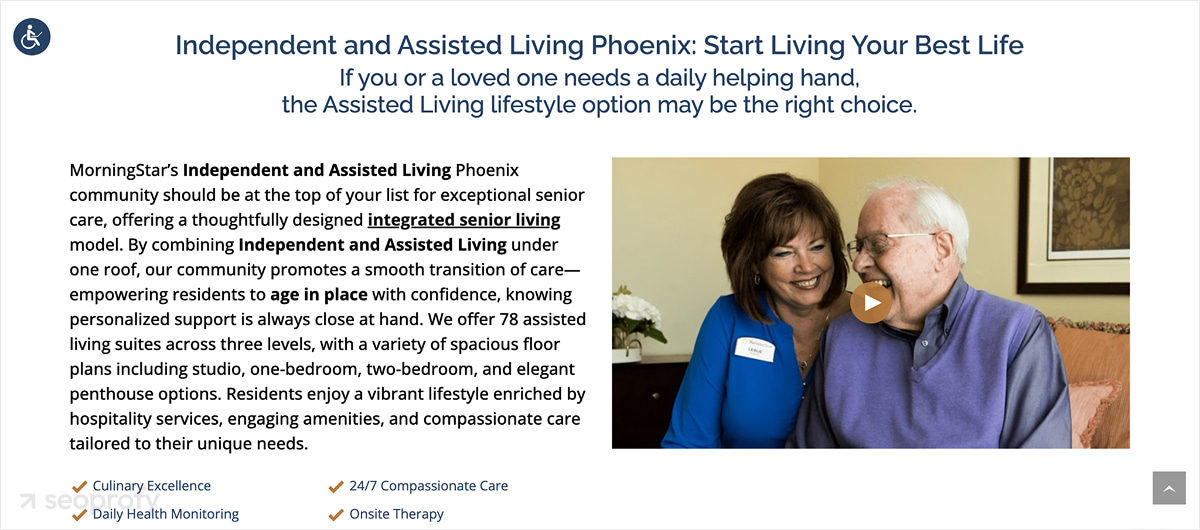
- Blog posts and FAQ pages that address the questions families ask earlier in the process, such as how to talk to a parent about assisted living or what to look for during a tour
- Testimonials and resident stories that add social proof and show what the experience feels like in real life.
In a sensitive category like senior care, E-E-A-T matters. High-quality content should reflect real operational knowledge, use credible sources where appropriate, and sound specific enough to match what families searching for care actually need.
The strongest content does not rely on generic marketing language. It uses real details, real programs, and real community context — the kind of substance that supports both credibility and search performance. It also reinforces generative engine optimization and AI search visibility, as AI-generated answers and search overviews increasingly favor content that clearly, credibly, and naturally responds to real questions.
Technical SEO for Assisted Living Facilities
Technical SEO covers the behind-the-scenes elements that affect whether a website can be crawled, indexed, and ranked properly. For senior care operators, this part of SEO can feel complex and difficult to navigate, since even minor technical issues can affect visibility, usability, and trust. The good news is that, with qualified support, these issues can be identified and fixed systematically before they start limiting performance.
A few technical optimization factors have the biggest impact on usability and search visibility for assisted living sites:
|
Factor |
Why it matters |
Main impact |
| Mobile-friendly website | Many families research senior care on their phones, and a poor mobile experience can drive them away early. | Better engagement and lower bounce risk |
| Site speed and Core Web Vitals | Slow-loading pages frustrate users and can weaken visibility in search. Faster pages create a smoother first impression. | Usability and rankings |
| Schema markup | It helps search engines better interpret your location, services, and business details. | Clearer search visibility |
| HTTPS | A secure site supports trust and shows that privacy and data protection are taken seriously. | Credibility and security |
Most of these issues can be uncovered during a technical audit, but it is not a one-time task. Websites evolve, content grows, plugins and integrations change, and performance can shift over time. Ongoing monitoring and qualified support help prevent technical problems from quietly undermining visibility, usability, and trust.
Link Building and Online Authority
Search engines treat backlinks as signals of trust. When credible, relevant websites link to your community, those links help strengthen authority over time. For senior care providers competing against large aggregator platforms with years of accumulated visibility, link building is one of the most practical ways to narrow that gap.
Relevance matters more than volume. A link from a recognized healthcare directory is far more valuable than a generic mention on an unrelated blog. In this niche, the strongest backlinks usually come from a fairly specific set of sources. These include the following:
Healthcare and senior care directories are a natural starting point. Listings on platforms such as the American Health Care Association, Argentum, and state-level senior care associations can support both referral traffic and authority signals. These sources matter not only because search engines recognize them as authoritative, but also because families may recognize them as credible organizations.
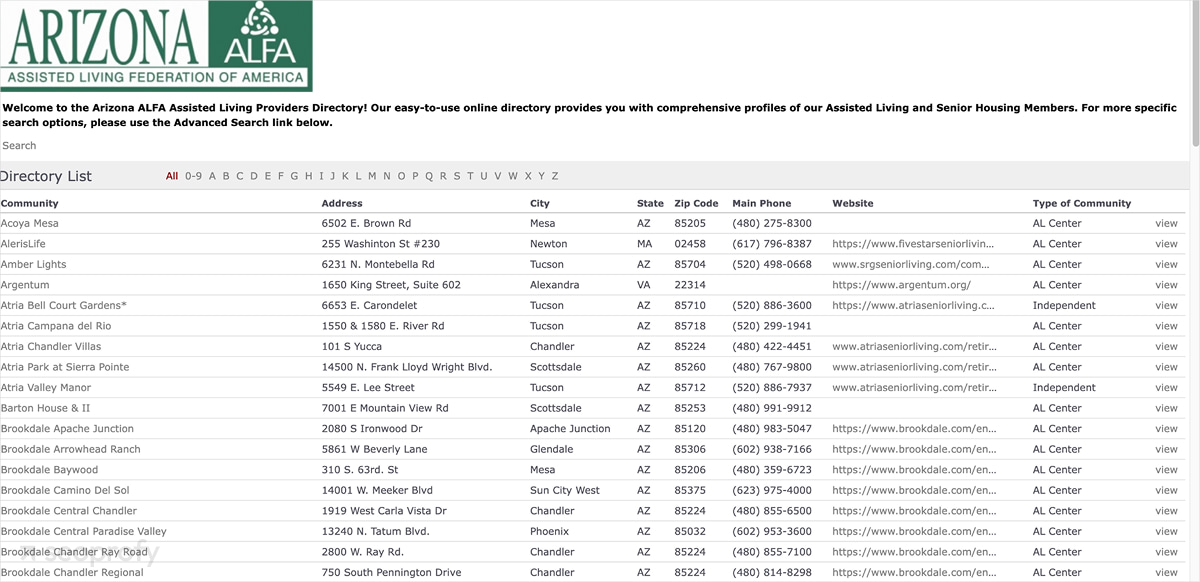
Local news outlets and community publications offer another valuable path. Coverage of a community event, a staff recognition story, or commentary from your leadership team on an aging-related issue can generate local backlinks that strengthen visibility in the local market. These mentions also help reinforce the idea that your community is active, established, and connected to the area it serves.
Industry associations and professional organizations are worth developing relationships with beyond basic directory listings. Groups such as Argentum and state-assisted living associations often publish member directories, educational resources, and local references that can lead to meaningful editorial mentions.
Healthcare partners can also be strong sources of authority. Hospitals, rehabilitation centers, home health agencies, and similar organizations often refer families to senior care providers. When those relationships are reflected online through resource pages or partner listings, they create links that signal both authority and local relevance.
What matters just as much is knowing what to avoid. Low-quality directories, paid link schemes, and unrelated websites can weaken trust rather than build it. In a sensitive category like senior care, a smaller number of relevant links from reputable sources will outperform a high-volume approach built on shortcuts.
For providers managing assisted living facility SEO without a large internal marketing team, the most practical place to start is usually a mix of trusted directory listings, a few local outreach opportunities, and existing referral relationships that can be reflected online.
Online Reputation Management and Reviews
In senior care, online reviews shape both credibility and local visibility. A community with a steady flow of recent, positive feedback often has an advantage over one with fewer reviews, especially when other ranking signals are similar.
Star ratings also affect click behavior. When families compare communities in Google’s local pack, the ratings are often among the first things they notice. A stronger rating and steady review volume can make a listing more likely to earn clicks and inquiries.
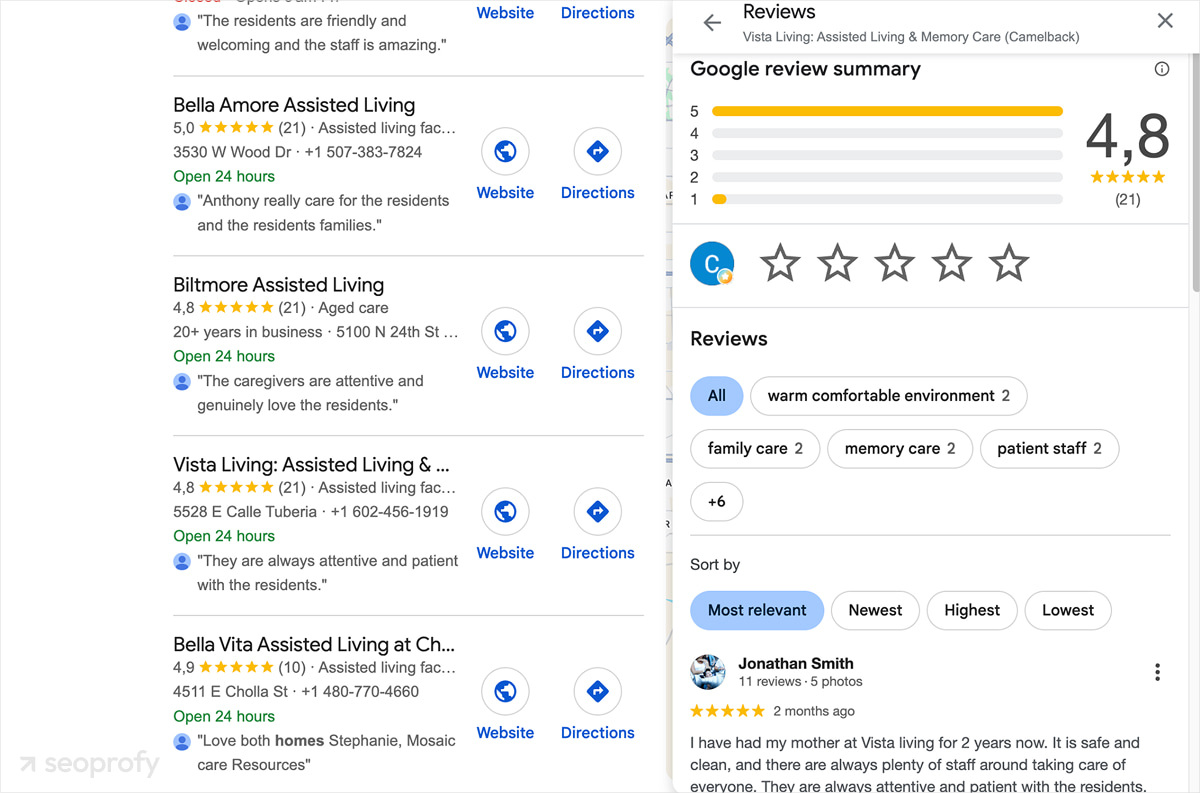
That is why review management cannot be passive. Communities that build momentum usually do so by consistently asking for feedback after a successful move-in, a positive family interaction, or a well-run community event. Many families are willing to leave positive reviews — they just need the right prompt at the right time.
Responding to reviews matters just as much. Replies to positive feedback reinforce warmth and attentiveness, while responses to criticism show professionalism and accountability.
When handling negative feedback, a few principles matter most:
- Acknowledge the concern without becoming defensive
- Thank the reviewer for sharing their experience
- Move detailed follow-up offline rather than arguing in public
- Keep the response brief, empathetic, and focused on resolution.
Google should be the priority, but it is not the only platform that matters. Reviews on Caring.com, SeniorAdvisor, and Yelp also shape how families evaluate a community. Structured data can further support visibility by making search listings more informative when implemented correctly.
How Long Does Assisted Living SEO Take to Show Results?
Most assisted living communities begin to see early SEO movement within 3 to 6 months, while more meaningful gains usually take 6 to 12 months. Senior living SEO is a compounding channel, so results depend on your local competition, your website’s starting point, and how consistently the strategy is executed. In most cases, the process follows a similar pattern:
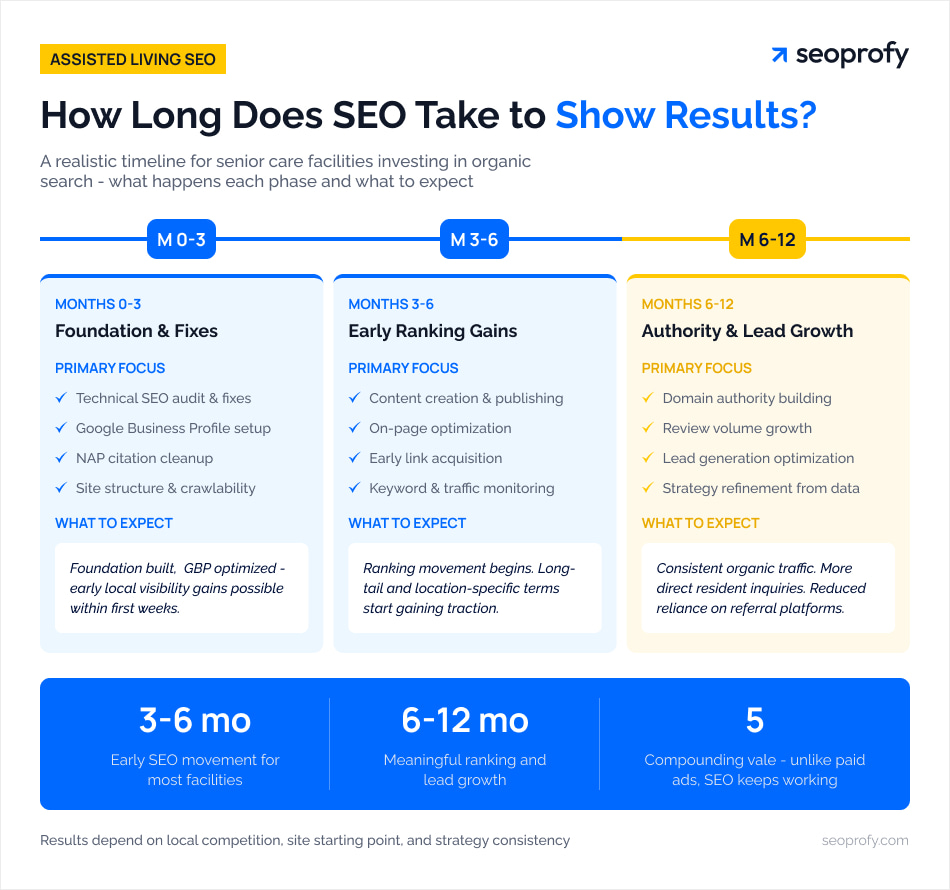
Months 0–3: Foundation and Fixes
The first phase is rarely the most exciting, but it is the one that makes everything else possible. This is when technical issues are resolved, your Google Business Profile is fully optimized, local citations are cleaned up for NAP consistency, and the site is structured so search engines can crawl and index it properly.
If an assisted living website has serious issues such as slow load times, duplicate content, missing meta descriptions, or weak mobile performance, those problems can seriously limit visibility and user experience. Getting the technical foundation right is what allows later SEO work to perform.
Even at this early stage, results are possible — a fully optimized Google Business Profile can start producing local visibility gains within the first few weeks.
Months 3–6: Early Ranking Gains
Once the foundation is in place, the focus usually shifts toward content creation, on-page optimization, and the early stages of link acquisition. During this period, target pages may begin to move up in search rankings, especially for long-tail searches and less competitive location-specific terms.
Organic traffic often grows gradually here, and local search results begin to reflect the work completed. It is also when useful patterns start to emerge: which keywords are gaining traction, which pages need improvement, and where the site may be losing conversions.
A strong SEO partner uses that data to refine the strategy instead of following the original plan too rigidly.
Months 6–12: Sustained Authority and Lead Growth
By the second half of the year, a well-executed approach usually begins to produce more consistent organic traffic, stronger search engine rankings for key terms, and, most importantly, more direct resident inquiries.
It is also when the community begins to build a stronger local authority. Citations, reviews, and backlinks begin reinforcing each other. Sites that were previously stuck on page two may start moving onto page one. The community becomes easier to find in local results for the terms people actually use when comparing care options.
This is where the compounding value of SEO becomes easier to see. Unlike paid ads or referral platforms, which stop delivering once spending stops, the visibility and authority built through SEO can continue to work over time when the strategy is maintained.
A realistic summary looks like this:
|
Timeline |
Primary Focus |
What to Expect |
| Months 0–3 | Technical SEO, GBP, citations | Foundation built, early local visibility gains |
| Months 3–6 | Content, on-page optimization, and links | Ranking movement, gradual traffic growth |
| Months 6–12 | Authority building, lead generation | More consistent organic traffic and direct resident inquiries |
Setting realistic expectations is a sign of a trustworthy partner. Any agency promising dramatic results within 30 days of launching SEO for assisted living communities is either oversimplifying how search works or relying on tactics that may create short-term gains at the expense of long-term stability.
What Actually Matters When Choosing a Senior Living SEO Agency
Not every SEO agency is equipped to handle the realities of senior care marketing. Assisted living search engine optimization sits at the intersection of hyperlocal strategy, trust-sensitive content, and highly emotional decision-making. That combination requires more than general digital marketing experience.
Here is what to look for when evaluating a potential partner that provides SEO services:
- Niche experience matters more than agency size. A team that has worked with senior living facilities understands how family decision-makers search, which tactics matter most in this category, and how to create content that speaks to the right target audience. A generalist agency can learn the niche, but that learning curve comes at a cost in time and budget.
- Local expertise is essential. For most communities, local search drives the most qualified traffic. An agency should be able to explain exactly how it approaches Google Business Profile optimization, citations, and local SEO for assisted living in competitive markets.
- A data-driven process is another strong signal. Senior living search engine optimization should involve keyword tracking, content analysis, technical audits, and ongoing strategy adjustments based on data.
- Monthly reports full of vanity metrics and vague deliverables are warning signs. Transparent reporting must be a baseline expectation. You should be able to see which keywords are moving, how organic traffic is trending, where lead generation is coming from, and how performance connects to real business outcomes. If an agency cannot explain its work in plain language, that is a problem.
It is also worth asking whether the agency has experience in adjacent categories, including SEO for nursing homes, independent living, or other senior care verticals. That broader familiarity often leads to stronger strategic judgment.
|
Green Flags |
Red Flags |
| Demonstrated experience with senior care or healthcare SEO | No relevant niche experience |
| Clear local SEO services with GBP as a priority | Vague approach to local search |
| Transparent reporting tied to leads and performance | Reports full of disconnected metrics |
| Data-driven process with regular refinements | Rigid deliverables with no optimization |
| Realistic timeline expectations | Promises of fast results or guaranteed rankings |
| Content strategy built around caregiver search intent | Generic content with no niche relevance |
| Profound link building services and citation strategy | A vague backlink strategy or low-quality sources |
| Technical SEO is built into the strategy | Technical SEO is ignored or treated as an afterthought |
The goal is not to find the largest or cheapest agency. It is to find an SEO partner with the right mix of niche knowledge, local expertise, and measurable execution. In this market, long-term success depends on whether the agency understands both search behavior and the people behind it.
Grow Your Senior Care Facility with SeoProfy
Families are searching for senior care communities right now — on Google, on their phones, and in moments of urgency and uncertainty. Whether they find your facility or a competitor depends largely on the SEO decisions you make today.
The fundamentals covered in this guide — local discoverability, keyword strategy, content built around real family intent, technical health, authority, and reputation — are not separate projects. They work as a system. When that system is built correctly and maintained consistently, it becomes one of the most reliable sources of direct resident inquiries a senior care community can have.
SeoProfy is a data-driven SEO agency with experience across senior care verticals, including assisted living, nursing home SEO, and adjacent categories. Our approach combines niche knowledge, transparent reporting, and a process built around outcomes that actually affect occupancy rates.
If you are ready to reduce dependence on referral platforms, improve how easily your community is found in local search, and strengthen visibility in both traditional and AI search, our SEO services are designed to help you get there.

Bohdan has been an SEO analyst at SeoProfy for more than two years. He began his career in digital marketing in 2019 and has since gained experience helping scale some of the world’s leading brands in industries such as gambling and SaaS. Bohdan specializes in developing effective strategies tailored to specific regions.