

We’ve seen numerous new websites or smaller players in very competitive fields struggle with achieving high rankings for popular keywords. But you can actually start ranking and attracting traffic if you know how to find low-competition keywords and incorporate them into your strategy.


SEO keywords with less competition, such as long-tail, niche-specific, and question-based queries, can be the stepping stones for your journey to the top of more popular search engine results pages (SERPs). But a thorough keyword research process is a must. This guide gives you useful ways to find keywords with little competition, as well as advice on how to analyze and prioritize them once you have a list.
- Longer search phrases (10-15 words) get 1.76 times more clicks than single-word queries.
- A good low-competition keyword balances decent search volume with low keyword difficulty.
- Search intent, ranking difficulty, and business relevance are the three most important factors when selecting SEO keywords with low competition.
- Keyword research tools like Semrush, Ahrefs, and Google Keyword Planner make the research process faster and more efficient.
- AI tools can surface keyword ideas, but always validate results in a proper keyword tool before building SEO content around them.
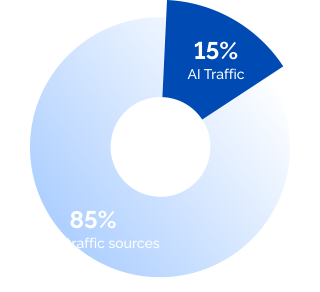
- To achieve AI visibility, it is even more important to target longer keywords with clear, specific intent.
What Is a Low-Competition Keyword?
Low-competition keywords are terms that few websites compete for in Google results. They usually get less traffic but are easier to rank for, which makes them ideal for small or new sites.
For instance, ranking for a popular keyword like “lawyer services” is extremely challenging because thousands, if not millions, of attorneys try to target it. At the same time, a more precise, longer phrase like “personal injury lawyer in East Bay” will have fewer websites competing for it, so it’s easier to rank for.
You can use various tools to estimate the keyword competition level. As a rule, this metric is represented by a keyword difficulty (KD) score. For instance, here you can see the KD for the phrase “lawyer services” estimated by Semrush:
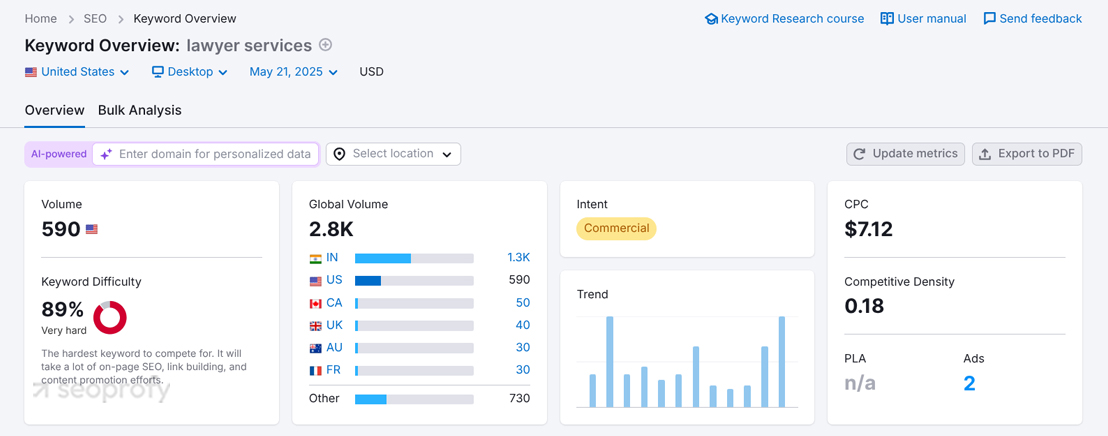
Considering that it scores 89 out of 100, it’s truly hard to rank for such a search phrase. Thus, if you want to promote your law services online, it’s better to look for options with a lower KD.
Why Do You Need Low-Competition Keywords for SEO?
Despite attracting less traffic, search terms with lower ranking difficulty can give your site several real advantages:
- First victories: When you start a new website, it’s better to avoid high-competition keywords — you won’t be able to compete with sites that are more authoritative in the eyes of search engines. This doesn’t mean you have to fully ignore them. But prioritizing low-competition queries can help you see real results faster.
- More targeted traffic and conversions: People who use longer, more precise search terms usually know what they want. They’re closer to making a decision or a purchase than someone searching for a broad term.
- Growth in competitive industries: In saturated markets like ecommerce, healthcare, or legal services, established players with massive budgets and years of authority dominate high-volume keywords. For newer businesses, targeting low-competition keywords is a more realistic keyword strategy to gain visibility and attract traffic — you’re not wasting budget or time chasing terms you’re unlikely to win.
- Credibility: The more of your pages rank for low-competition keywords, the more Google trusts your site. This credibility helps you eventually go after higher-volume terms.
Types of Low-Competition Keywords
Being outranked by more authoritative competitors is one of the most common reasons for poor search performance. Low-barrier ranking terms can become a solid foundation for your site. Here’s a quick look at the most common types that have low keyword difficulty but can still increase your organic traffic.
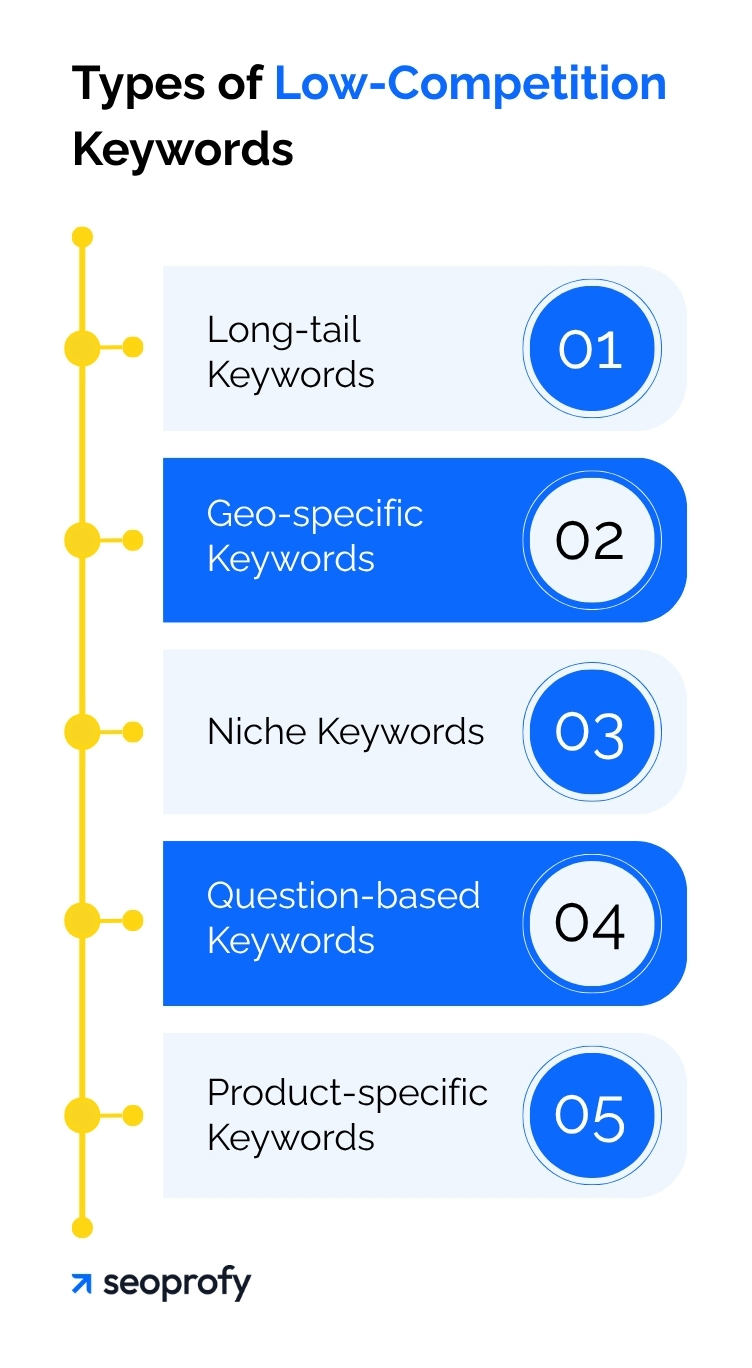
Long-Tail Keywords
Long-tail keywords are specific phrases that usually include three or more words. According to our SEO statistics, searches with longer queries result in 1.76 times more clicks than single-word queries.
The best approach to find suitable long-tail keywords that reach your potential clients is to take your core industry terms and make them more specific. For example, if you run an online store that sells sporting goods, you can opt for the low-competition long-tail keyword “buy rubber hex dumbbells for home gym” instead of the ordinary “buy dumbbells.”
Local Keywords
If you want to identify profitable keywords with low competition, you should also pay attention to the terms related to the location where your company operates. This works well for local companies or enterprises with multiple locations.
For instance, if you run a legal services company in Brooklyn, you can opt for a local query like “best law firm in Brooklyn, NY” instead of high-competition keywords like “best law firm”. Such an approach allows you to narrow your audience and make your pages more relevant in the local search. To get the most out of a local SEO strategy, it’s also important to have a strong Google Business Profile.
Niche Keywords
Industry-specific keywords allow you to reach people looking for distinct services or products within your market or industry. Such terms usually represent a unique angle of your services, a use case scenario, a product feature, or other distinguishing attributes.
If you own a cloud storage platform, targeting “cloud storage services” means competing with dozens of major brands. A more focused term like “secure cloud storage services for medical records” cuts through that noise. Build out as many ideas as possible to expand your keyword list. You’ll end up with a solid collection of terms that drive traffic from a smaller but highly engaged audience.
Question-Based Queries
People don’t always search with a simple phrase. Question-based queries are increasingly more common, especially in voice search. They typically feature question terms (such as “what” or “how”) and simple descriptors (like “best” or “easiest”) — these structures make up almost 20% of all voice searches. For instance, instead of “running shoes,” a blog post could target “What are the best running shoes for beginners?”
Question-based keywords also work well in FAQs. Accurate, valuable answers boost your site’s authority and increase your chances of ranking. Plus, they increase the chances of your pages appearing in AI-powered search results, such as AI Overviews or AI chatbots with search functions (Perplexity, ChatGPT, Claude, etc.). LLM citations often feature pages with clear definitions and direct answers as their sources.
Product-Specific Keywords
If you need SEO that brings leads to your website, product- or service-specific keywords are a must. However, you need to prioritize terms that are really precise and relevant to your business.
For example, instead of a difficult keyword like “personal injury lawyer,” you can opt for “dog bite injury lawyer for children” or “burn injury lawyer for fair compensation.” Phrases with more detailed specifications have lower ranking difficulty and can attract more qualified leads who are ready to take action.
How to Find Low-Competition Keywords with High Traffic Potential
We’ve prepared six keyword research tips that include powerful SEO tools and time-tested practices that you can use to find real golden nuggets among the numerous terms and phrases.
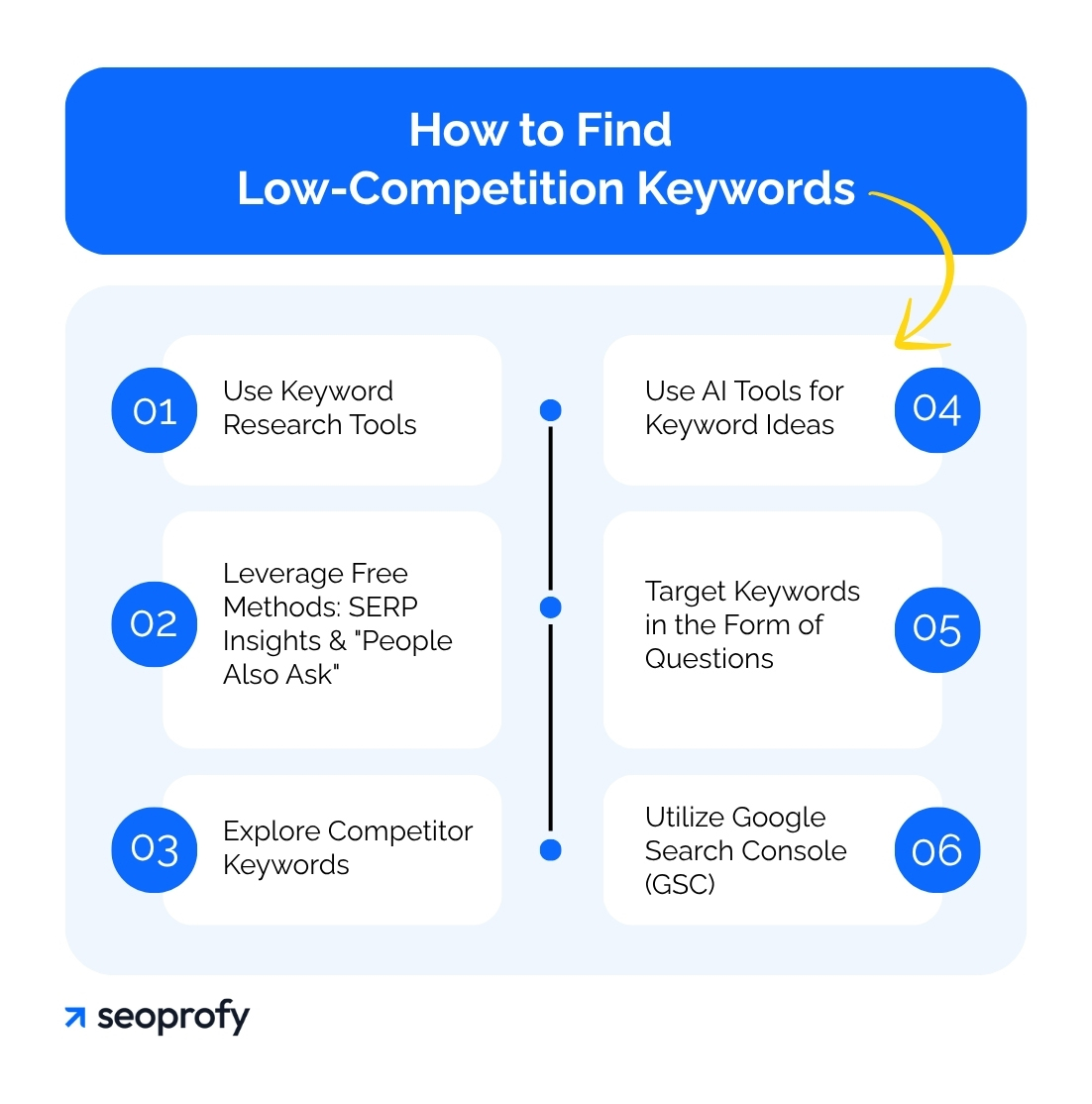
1. Start with SERPs
You can use Google itself to identify low-competition keywords absolutely for free. Search engine results pages frequently contain additional suggestions based on your search query:
- People Also Ask: This feature includes a set of related questions and answers to them. Analyzing them allows you to find out what other topics your potential clients are interested in.
- Related Searches: Unlike People Also Ask, Related Searches are located at the bottom of the search results. Usually, this block includes other phrases your audience uses to search for the services or products you provide or related offers.
- Google Autocomplete: When you type a query, Google tries to predict it in real time based on the terms and phrases used by people who were looking for similar services, products, or information.
Use these suggestions to generate more long-tail keyword ideas and collect them in a document or spreadsheet to keep an organized list.
2. Use AI Tools for Keyword Ideas
There are many AI tools for SEO, such as ChatGPT or Jasper. They can find underserved phrases without spending a lot of time and resources. Nonetheless, it’s important to write correct prompts for them to ensure they’ll find the right keywords.
The more details you provide to the chatbot, the better. Describe your target audience, the types of products or services you offer, the recent trends in your industry, your competitors’ SEO strategies — whatever data may be available and relevant to your request. Then, request a specific output format or outline our expectations.
Here are a few examples of prompts for low-competition keyword research:
- “Act as an SEO specialist to help me discover low-competition keywords. My business operates in [your industry] and offers [your products or services]. I need you to give me a list of long-tail keywords that my potential clients are likely to use in search. All the phrases and terms should have clear search intent (commercial, informational, etc.).”
- “Suggest low-competition keywords that a site in [your industry] with low domain authority could realistically target. Prioritize long-tail phrases, specific problems, and keywords with lower competition. Explain why each term may be easier to rank for.”
- “Create a list of low-competition keyword clusters for a website about [topic]. Group them by topic and include pillar topics plus supporting long-tail terms.”
- “Generate 50 long-tail keyword ideas for a website that sells [product]/offers [service type]. Prioritize phrases with clear search intent, lower competition, and realistic ranking potential.”
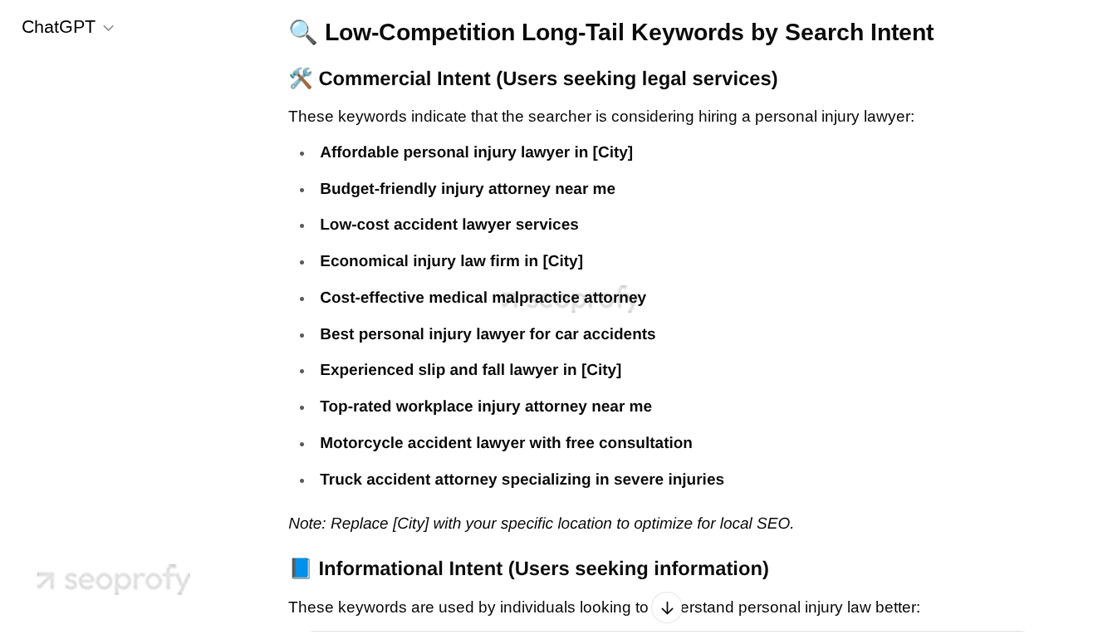
For example, the first prompt used in ChatGPT can provide this list for a personal injury law firm:
3. Use Keyword Research Tools
Once you have a list of queries, you can use various SEO platforms and dedicated keyword tools to analyze their difficulty and look for more ideas. For example:
- Google Keyword Planner discovers the terms related to your industry, estimates how many searches they may receive, and determines the cost of ranking them. It’s a free tool for finding low-competition keywords.
- Ahrefs has an advanced keyword research tool that allows you to discover SEO queries that are more attainable.
- Ubersuggest can help you find keyword ideas according to what your business and target audience need. It provides data on keyword difficulty and search volume.
- Semrush: You can opt for Semrush’s keyword difficulty metric to indicate the options that offer easy ranking opportunities. This platform can also help you form a list of seed keywords.
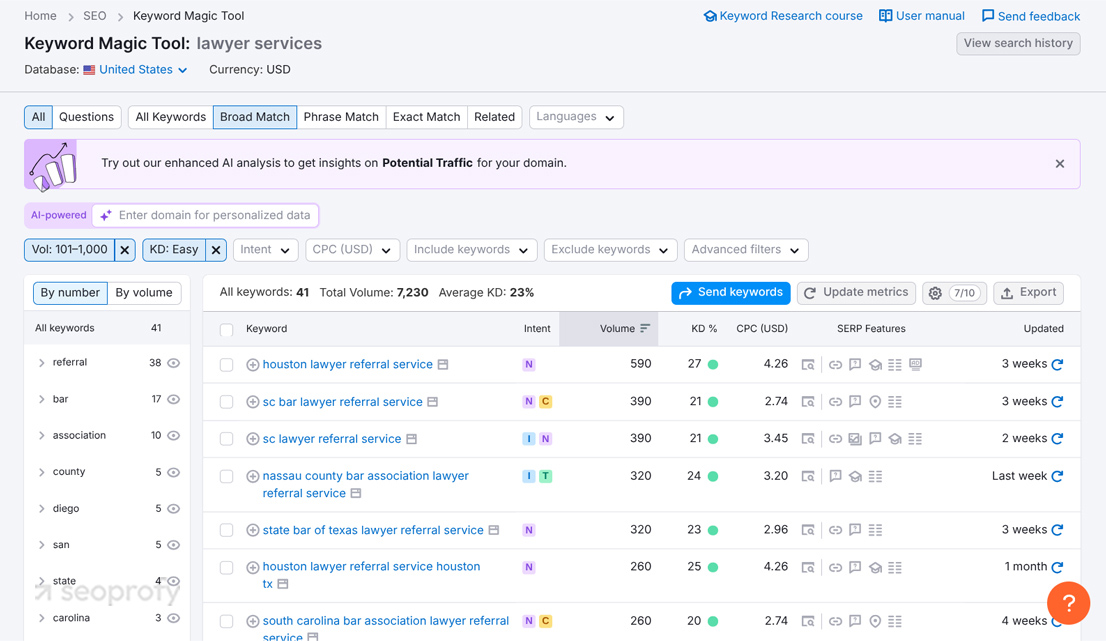
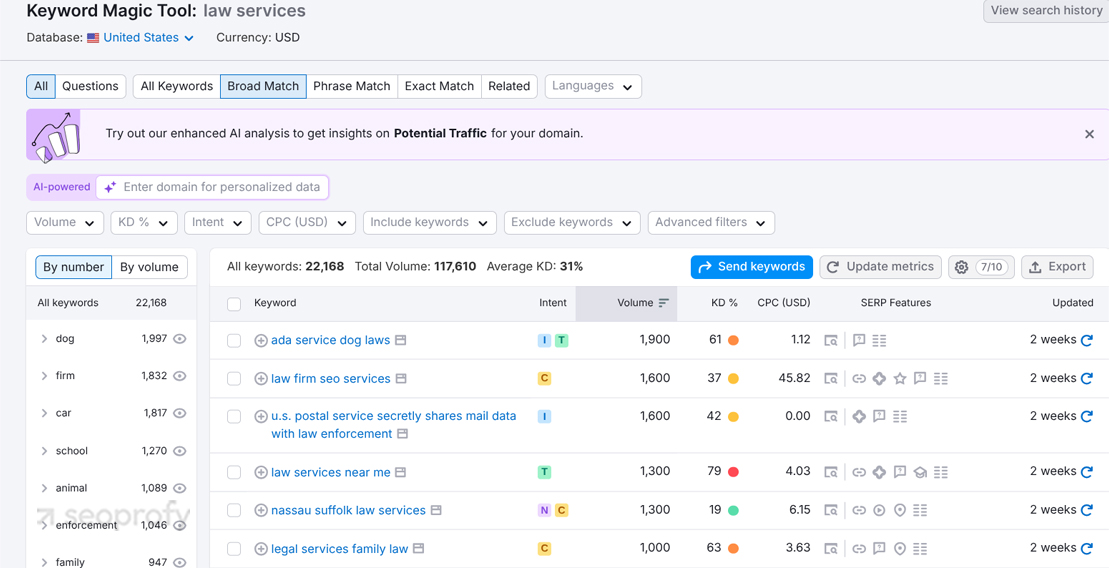
All of these tools have filters that you can use to identify low-competition keywords with relatively high organic search volume faster. In addition, you can explore related and long-tail phrases within their interfaces. For instance, Semrush allows you to enter the focus phrases (e.g., “lawyer services”) and use KD and volume filters to discover the terms that will perfectly match your potential clients’ search intents (we’ll explain these metrics in more detail below):
4. Explore Competitor Keywords
Your competitors’ websites are a great source of ideas for low-competition keywords. With platforms like Ahrefs and Semrush, you can analyze all aspects of your opponents’ SEO techniques.
For instance, you can use Semrush to discover the terms for which your competitors rank. Here you can see how this platform analyzes the difference between the two legal sites:
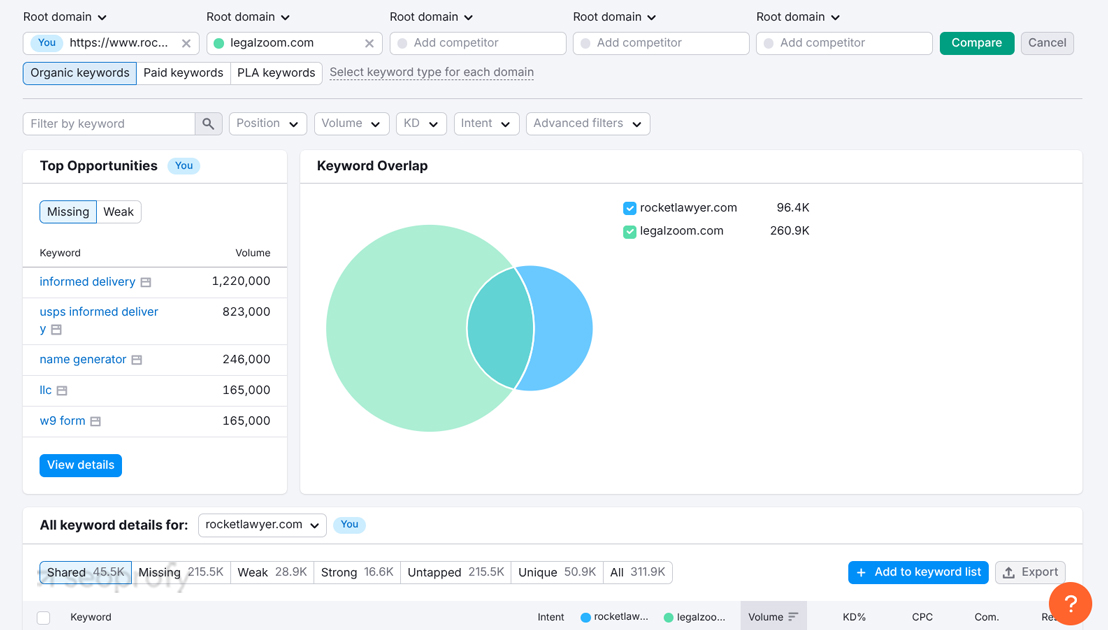
Semrush has several filters to compare keywords between your site and a competitor’s domain. Using them, you can highlight high-volume keywords with low difficulty. It’s also possible to sort them by intent and position in SERPs if you need a more detailed analysis. Then, you just need to think of ways to use these phrases to boost your page’s rank and traffic.
It might be tempting to just copy your competitors, but be careful. Prioritize natural and relevant keywords, not just the ones used by a competing site. Don’t try to force as many terms as possible onto a page. This may be viewed as keyword stuffing, which often leads to Google penalties.
5. Target Keywords in the Form of Questions
Accurate and valuable answers to question-based keywords can improve your search visibility, attract potential customers, and grow your authority. As a rule, these SEO-friendly phrases are used in the FAQs or question-led content (e.g., an article titled “What Services Does a Personal Injury Lawyer Provide?”).
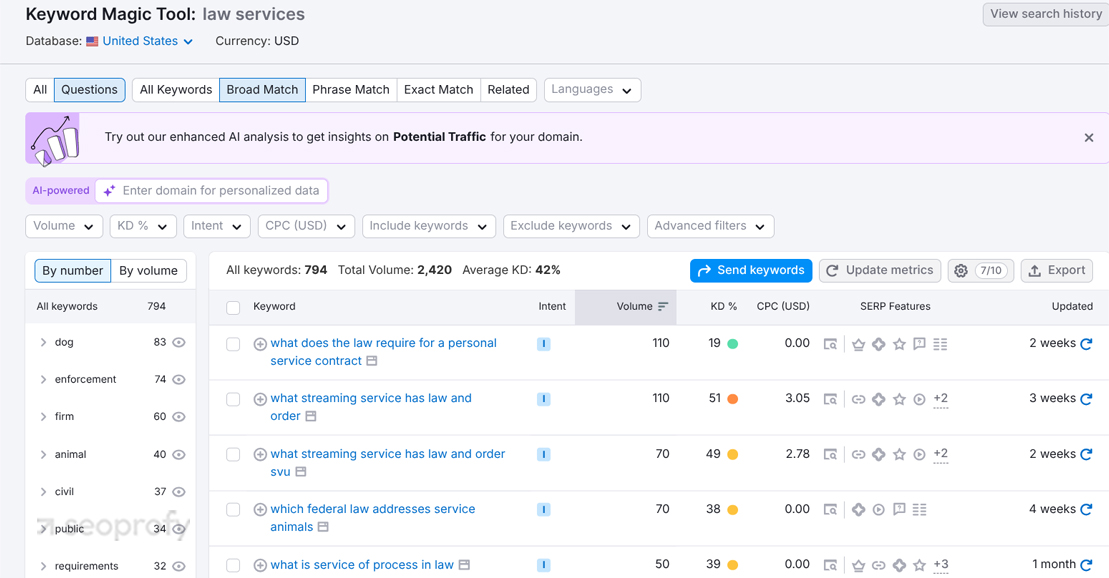
You can discover them using free methods such as Google’s People Also Ask feature and ChatGPT. Plus, you may opt for Semrush’s Keyword Magic Tool (apply the “Questions” filter):
Another great way to discover keyword ideas based on questions is to visit popular online communities, such as Reddit and Quora. There, you can find the clients’ issues overlooked by your competitors. Here are some questions discovered on Reddit that a loan company may cover in its blog:

6. Utilize Google Search Console (GSC)
Google Search Console is a powerful tool that allows you to analyze your website’s performance in SERPs. Many think of it as a basic website owner’s dashboard, but it can also be used for a more advanced SEO strategy and to find prospective low-competition terms.
For instance, you may discover the related keywords your site already ranks for, but there is still no dedicated content. Navigate to the “Queries” section in the “Performance” report to reveal all the terms leading to your site. Each of them will include the information about clicks and impressions, just like on the screen below:
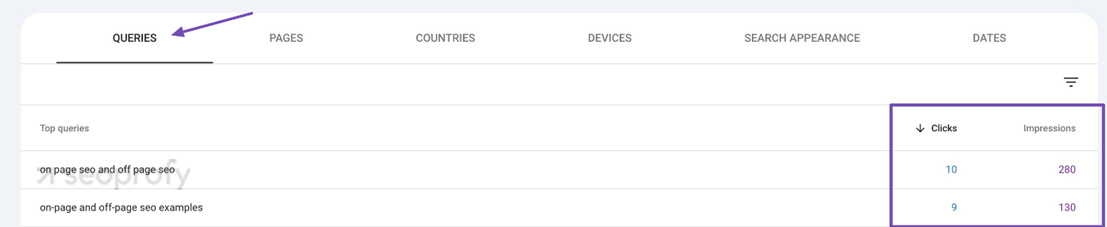
Look through the list and highlight long-tail keywords with high impressions but low clicks. It means that users see your pages in organic search results, but they don’t click on them. In this case, you may need to create a more compelling website URL, update the metadata, or build a new page.
Does searching for low-competition keywords feel overwhelming? SeoProfy can help with top-quality services:
- Professional keyword research and optimization
- Custom SEO strategies focused on ROI
- Comprehensive website analysis

How to Analyze Low-Competition Keywords
If you want to select queries that will not just have low keyword difficulty but also bring value to your website, you need to analyze certain metrics in your keyword research process. They will also be important for measuring SEO results. Here’s what you need to prioritize:
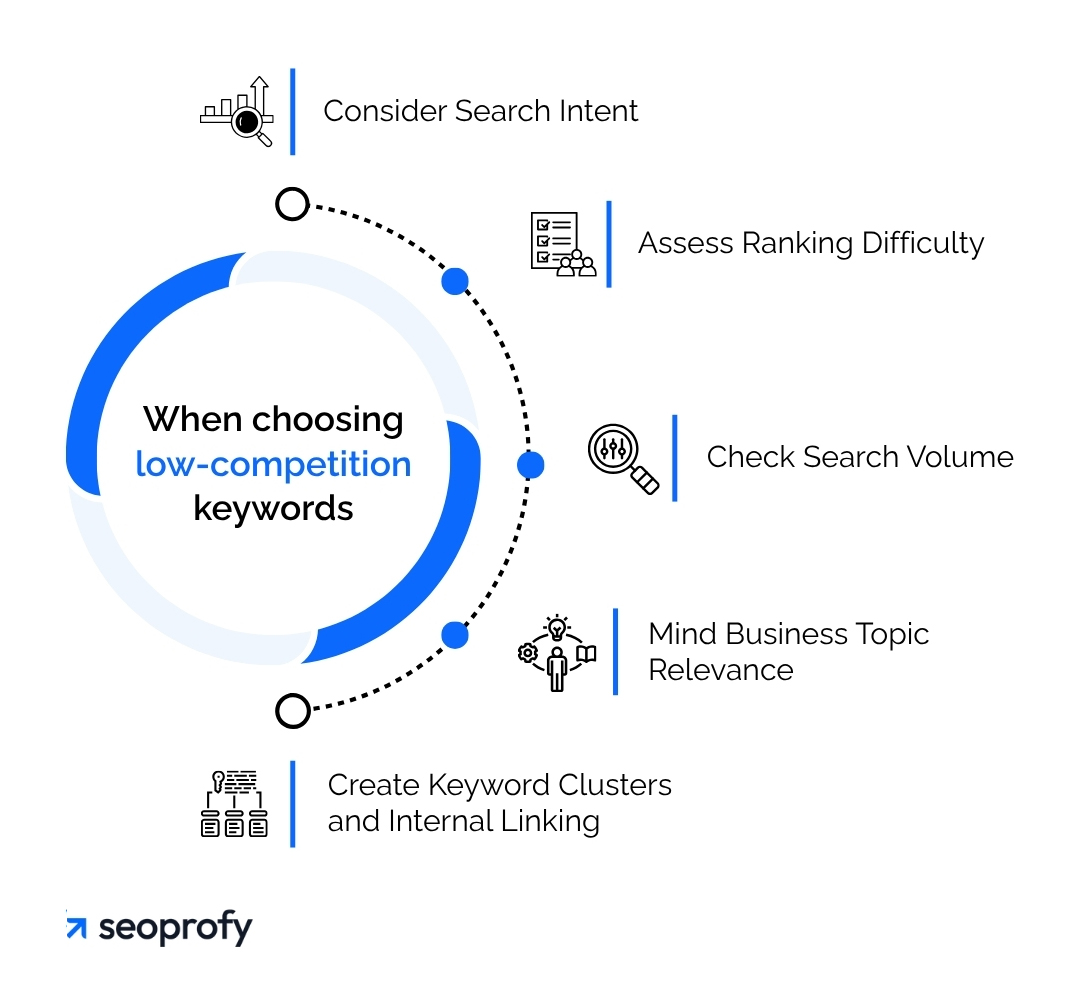
Search Intent
There are four types of intent to consider when choosing keywords and creating content:
- Informational: A person wants to learn something.
- Commercial: A potential buyer searches for purchase options.
- Navigational: A user looks for a particular page or site.
- Transactional: The goal is to take a specific action (e.g., complete a purchase).
Why is this important? Using queries with a specific intent in content that doesn’t match it confuses both search engines and visitors. Search engine algorithms won’t consider it relevant to the search, which may lead to your website not showing up on Google. Users will likely leave the pages quickly if they don’t contain what they were actually looking for.
What complicates the analysis, though, is the possibility of a term combining several types of intent at once or having a very vague goal. Tools like Semrush can identify the main intent behind a query and show you in what contexts the keyword is used:
Ranking Difficulty
SEO tools like Moz, Semrush, and Ahrefs have tailored indicators that evaluate how difficult it might be to rank for a given query. But finding less competitive keywords is not just about the metrics of a specific phrase. The SEO performance of the pages that rank for it matters, too. Here’s what to look for:
- Domain authority: How likely a website is to rank in search results based on its overall link profile.
- Page authority: The individual authority of the highest-ranking pages for a specific term.
- Backlinks: The number and quality of links pointing to top-ranking pages.
If you see that your website or pages don’t have enough authority score or backlinks to compete, it’s better to look for another term with lower keyword difficulty.
Search Volume
You are more likely to rank in a competitive field if you manage to find high search volume terms with low competition. SEO tools allow you to choose a minimum search volume when analyzing keywords. We recommend setting at least 500+ searches/month to ensure the low-competition term will actually bring in traffic to your pages.
Business Topic Relevance
The terms you choose must align with your industry, location, and potential customers’ preferences. To create content that provides truly valuable information and leads to higher engagement and rankings, you need to target highly relevant phrases and topics.
If you want to ensure the topic’s relevance, you need to analyze your target audience’s needs and search intent, your main competitors’ keywords, and trends in your niche. All this information will help you better understand what terms you should use to keep your rankings growing.
Keyword Clusters and Internal Linking
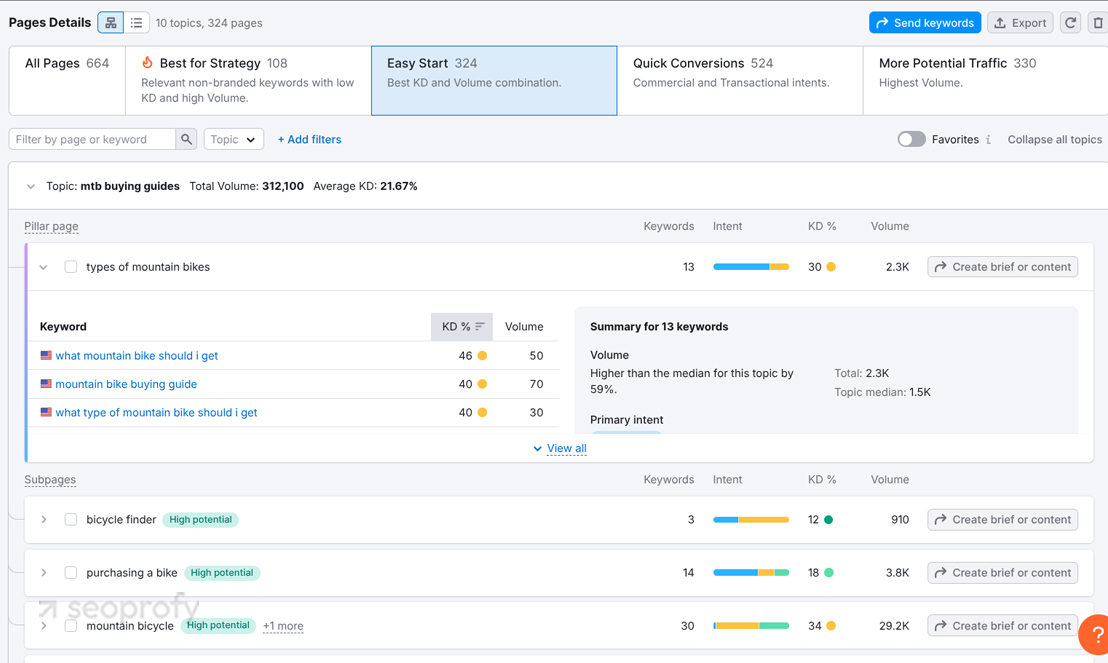
Grouping multiple keywords into clusters means organizing them by topic for use on related pages. Clusters are very useful in SEO content strategy — they can help you develop a comprehensive content map, improve your website’s structure, and simplify internal linking. Such an approach is ideal for targeting low-competition topics, as it signals that your content has covered a subject comprehensively. This also helps guide visitors to different pages on your site, which can boost engagement.
Semrush’s Keyword Strategy Builder is a perfect option for creating these clusters. In the “Easy Start” section, you can find search terms with the best KD and volume balance for your list. Here is an example of research for an online shop that sells bikes:
Boost Your Rankings with Low-Competition Keywords
If you have a new website or are struggling to rank in a highly competitive industry, keywords with low competition should be a part of your SEO strategy. They are like a low-hanging fruit in the SEO world, but finding them and optimizing your content properly might not be that easy.
Don’t feel like doing the research yourself? SeoProfy provides keyword research services that uncover hidden opportunities in any niche. Our team is ready to help your website start ranking for relevant organic keywords with higher search volume and KD.

Andrew Shum is the Head of SEO at SeoProfy with 10+ years of experience in SEO and digital marketing. He has been part of the company for over 6 years and has led the SEO department for the past 3.5 years, managing a team of 15+ specialists. He works with competitive and international multi-language projects across eCommerce, SaaS, and enterprise niches, focusing on practical SEO strategies that deliver measurable results.