
Current artificial intelligence systems statistics show how quickly conversational AI has moved from experimentation to mainstream business adoption. From customer support to sales and content workflows, chatbots now influence how users search, interact, and convert online. For businesses and marketers, they are no longer just support tools but a driving force behind user experience, automation strategies, and measurable performance metrics.


In this article, we’ve compiled global chatbot statistics, sourced from reputable industry reports. Instead of raw data alone, our team focuses on what these numbers actually mean for businesses: where smart assistants are growing fastest, how people use them, which platforms dominate traffic, where real ROI is being created, and what the future trends are.
- In 2034, the global chatbot revenue is expected to reach $113.35
- Nearly 40% of US citizens use AI chatbots once per month
- Virtual assistants can handle 58% of return and cancellation cases
- 58% of B2B companies have already integrated chatbots into their sites
- In 2026, the cost of chatbot development ranges from $5,000 to over $1 million
Global Chatbot Market Size Statistics
A chatbot is a software app designed to simulate human conversation with users through text or voice messages. They range from simple ones based on specific algorithms to advanced assistants that use large language models (LLMs) to regularly analyze and understand complex queries. Thus, they can provide more accurate and relevant answers.
Many LLMs are open-sourced and enable enthusiasts to build their own AI-powered virtual assistants, contributing to the growth of the global chatbot market. Nonetheless, despite the variety of platforms featuring artificial intelligence, only a few have gained popularity. For instance, according to our ChatGPT statistics, OpenAI’s product holds the largest AI chatbots market share. And if you want to find out more about the condition of this industry in the world, here is some useful information based on AI chatbot market data.
In this dataset, “market share” refers to the percentage of global AI chatbot traffic, based on usage activity rather than revenue or total registered users.
- Over 3,200 LLMs are driving the development of machine learning algorithms. (Source)
- Over 1 billion people use AI every month. (Source)
- As of early 2026, ChatGPT holds 79.79% of the global AI chatbot market share. (Source)
At the same time, other popular virtual assistants contribute to the industry’s development. The statistics below show that OpenAI’s product still dominates the market, but companies like Google and Microsoft are actively developing their own AI systems, which may shift their positions in the future.
| Chatbot Name | Market Share % |
| Perplexity | 10.85% |
| Google Gemini | 4.68% |
| Microsoft Copilot | 3.58% |
| Claude | 1.07% |
| DeepSeek | 0.02% |
- In the European region, the situation is slightly different, but ChatGPT still holds 80.02% of the market share. (Source)
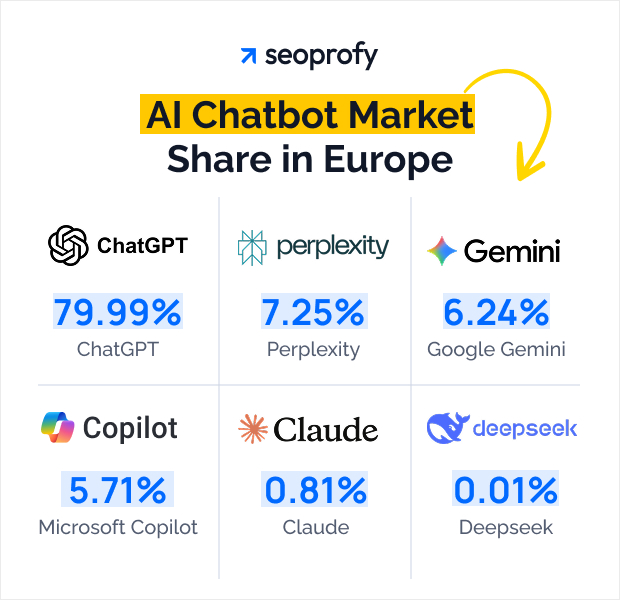
Below, you can see how the influence is divided between other popular chatbots:
| Chatbot Name | Market Share % |
| Perplexity | 8.71% |
| Microsoft Copilot | 6.36% |
| Google Gemini | 4.1% |
| Claude | 0.8% |
| DeepSeek | 0.01% |
- In North America (the USA and Canada), ChatGPT’s influence is slightly lower than in Europe, with 77.08% market share. (Source)
Finally, let’s review how the chatbot market is divided in this region between other popular AI products:
| Chatbot Name | Market Share % |
| Microsoft Copilot | 8.7% |
| Perplexity | 7.1% |
| Google Gemini | 5.86% |
| Claude | 1.22% |
| DeepSeek | 0.03% |
Chatbot Growth Trends and Forecasts: 2026–2034 Outlook
The market review shows that chatbot technology is only gaining momentum. AI assistants have already changed every industry, making it necessary to implement LLM SEO solutions alongside traditional optimization methods. So, what should we expect from AI in the near future? Here are some interesting insights:
- By the end of 2025, the global AI chatbot market reached $9.9 billion. (Source)
- The global chatbot market revenue is projected to reach nearly $113.35 billion by 2034. (Source)
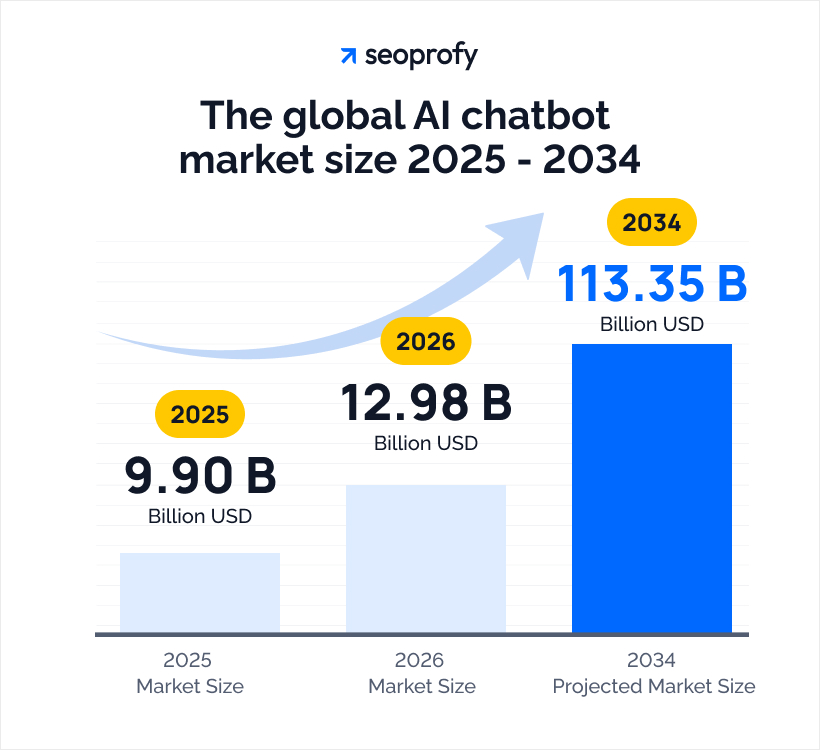
- The chatbot market is expected to grow at a Compound Annual Growth Rate (CAGR) of 31.11% from 2026 to 2034. (Source)
Using this data and formula Markett=Marketbase×(1+CAGR)(t−base year), we can predict the approximate market value growth year by year:
| 2026 | $12.98 billion |
| 2027 | $17.02 billion |
| 2028 | $22.32 billion |
| 2029 | $29.28 billion |
| 2030 | $38.43 billion |
| 2031 | $50.47 billion |
| 2032 | $66.26 billion |
| 2033 | $87.01 billion |
| 2034 | $113.99 billion |
Estimates are based on CAGR projections and do not represent actual reported revenue.
- A massive push for customer service improvement, cost reduction, and a 30% reduction in support agent workloads is the key driver influencing the market. (Source)
Chatbot Adoption and Usage Statistics
Modern chatbot use cases vary. But what matters to us is that many people use it to compare products and services. This leads more and more modern businesses to opt for generative engine optimization (GEO) in addition to traditional SEO. The chatbot usage statistics below show how people and companies use AI, the platforms they prefer, and their satisfaction with them.
Top Chatbot Statistics by Active Users
The numbers in this part show which sources drive the most users to AI platforms. Further, we’ve also analyzed their behavior and further actions after using virtual assistants:
- 48.7% of the users aged 16+ worldwide are excited about artificial intelligence. (Source, p. 130)
- 96% of respondents think that businesses that use chatbots take good care of their customers. (Source)
- Nearly 40% of the USA citizens use an AI chatbot at least once per month. (Source)
- Overall, there are 813 million ChatGPT active users with a 4% quarterly growth, making it the most popular AI chatbot as of 2026. (Source)
Although other platforms are still far from such results, they actively grow their audience due to regular updates and the introduction of new features:
| Chatbot Name | Active users per month |
| Google Gemini | Over 650M |
| Perplexity | Over 22M |
| Claude | Over 18.9M |
Most Used AI Chatbots by Traffic
Here, you can discover general information about the monthly AI chatbot traffic statistics on different platforms. If you want to learn more about a particular artificial intelligence assistance system, you are welcome to explore our dedicated reviews, such as our comprehensive Perplexity AI stats.
- ChatGPT dominates the number of monthly visits with over 489 million visits (Source, p. 134)
If you look at the statistics for other chatbots, you’ll definitely see a significant gap between them and OpenAI’s chatbot. This is a clear sign that its dominance is expected to continue in the near future:
| Chatbot Name | Monthly Visits |
| Google Gemini | 122M |
| DeepSeek | 45.2M |
| Grok | 26.3M |
| Perplexity | 24.8M |
| Microsoft Copilot | 19.7M |
| Claude | 16.8M |
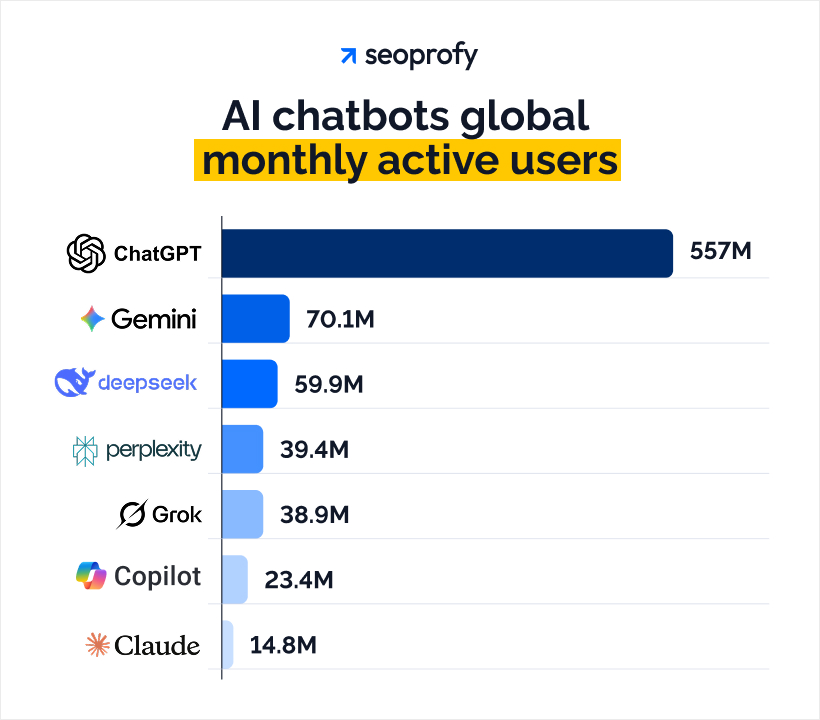
- The situation with monthly active mobile users is almost identical, where ChatGPT also leads. (Source, p. 135)
The analysis of the mobile user statistics proves that most people prefer using chatbots on their portable devices. It’s also interesting that Perplexity outpaces Grok in this category:
| Chatbot Name | Mobile Monthly Visits |
| ChatGPT | 557M |
| Google Gemini | 70.1M |
| DeepSeek | 59.9M |
| Perplexity | 39.4M |
| Grok | 38.9M |
| Microsoft Copilot | 23.4M |
| Claude | 14.8M |
Most Popular Chatbot Use Cases
How do the majority of people use different chatbots? Is there any solid reason for your business to enter LLM citations? The following statistics can help you answer these questions:
- Therapy and companionship are the most popular use cases of generative AI tools and AI assistants. (Source, p. 132)
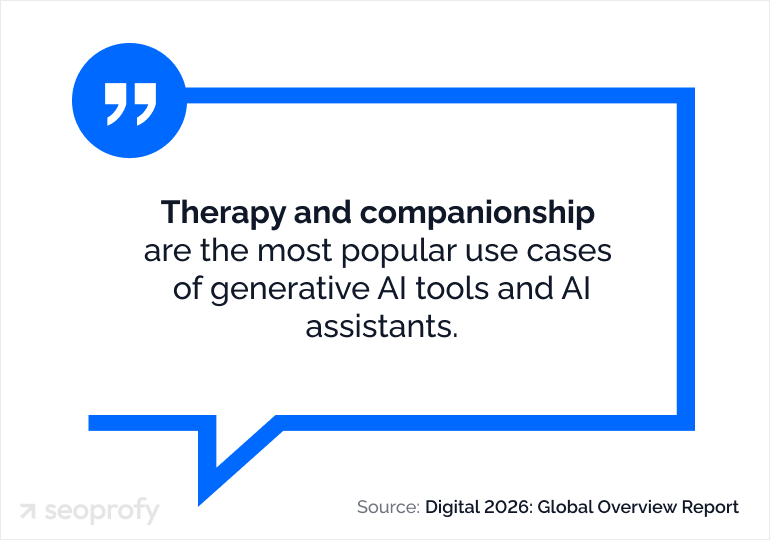
There are other activities popular with users, including life organization, purpose search, enhanced learning, coding, and idea generation.
- 50% of businesses using AI chatbots expect them to deliver fast, round-the-clock responses. (Source)
The other two popular problems that companies want them to solve include:
| Customer service interactions automation | 44% |
| Processing similar customer questions | 28% |
- 29% of customers expect chatbots to provide help 24/7. (Source)
Here are other important expectations of clients from a virtual assistant:
| Receiving a fast reply | 24% |
| Possibility to reach a human agent if a user wants to | 17% |
| Asking questions using natural language | 11% |
| Avoiding customer interactions with other people | 11% |
| Getting personalized messages | 8% |
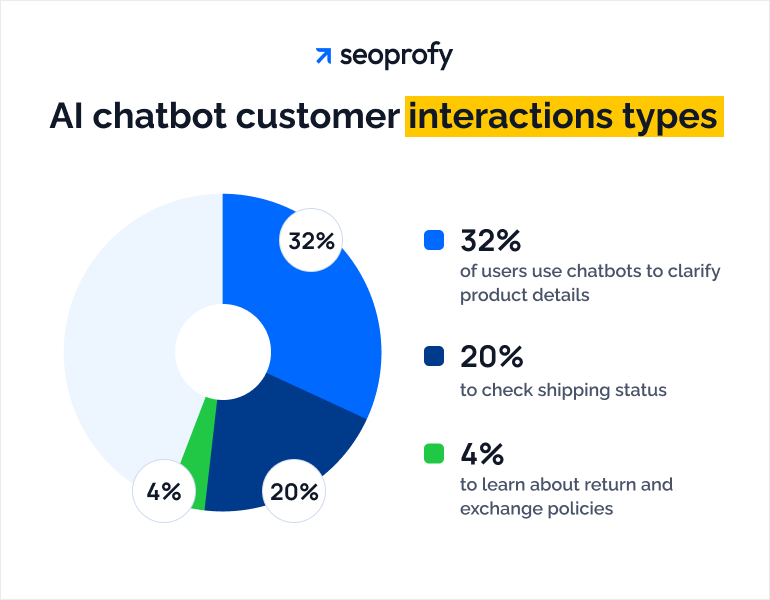
- 32% of users use chatbots to clarify product details, 20% to check shipping status, and 4% to learn about return and exchange policies. (Source)
Chatbot Business Statistics by Function
Do you wonder whether artificial intelligence can help you run a business? If you plan to use it for brand promotion, you surely need to check our AI marketing statistics out. Also, the following chatbot adoption statistics show how different companies use virtual assistants to handle a variety of tasks:
- 78% of global companies rely on AI chatbots to handle at least one business process. (Source)
- Marketing accounts for 17% of the market share and is the third most common application for chatbots. (Source)
- 71% of businesses now use GenAI for content creation, marketing tasks, and coding. (Source)
Chatbot Customer Support Statistics
Delivering an excellent customer experience is important for almost any business, as it directly influences revenue. Implementing AI to automate this process can save you $327,500 per year, which is why more and more brands are opting for this technology. Further, other statistics are proving that virtual assistants can level up your customer support service:
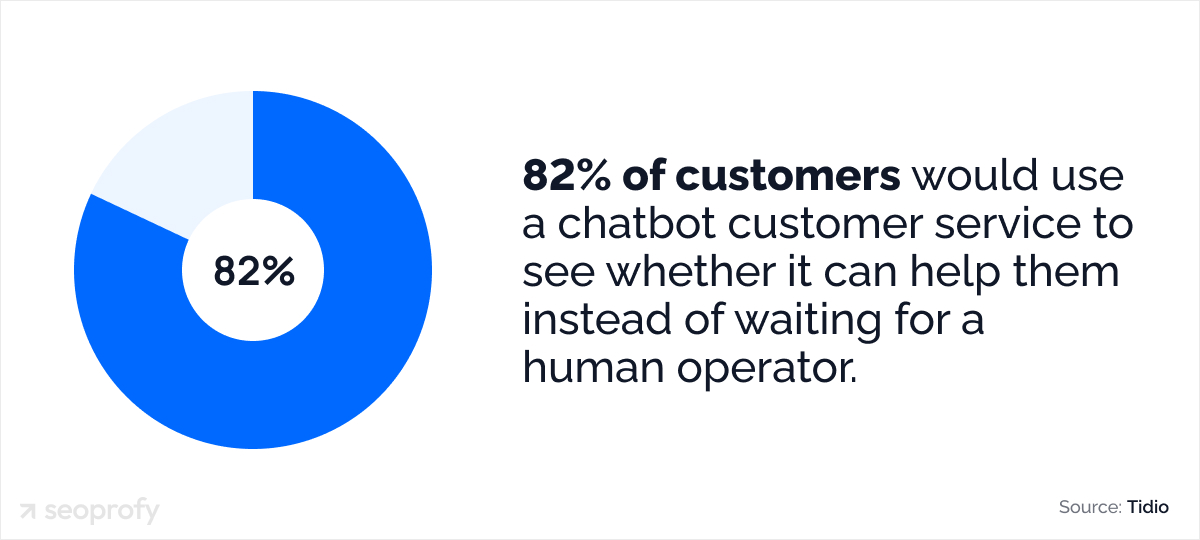
- 82% of customers would use a chatbot customer service to see whether it can help them instead of waiting for a human operator. (Source)
- 36% of users say that chatbot recommendations influence their buying decisions. (Source)
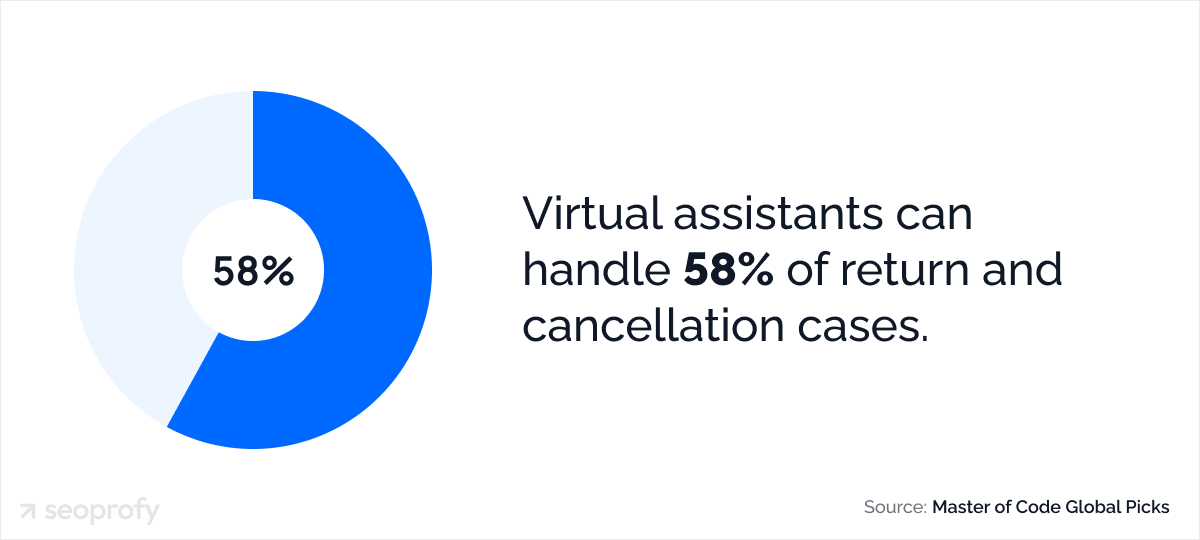
- Virtual assistants can handle 58% of return and cancellation cases. (Source)
- AI interaction costs range from $0.03-$0.25 per minute, while the similar time for human agents ranges from $3-$6.50. (Source)
- 51% of customers prefer to use chatbots instead of live agents when they need immediate support. (Source)
Chatbot Stats Landscape by Industry
While some industries now depend entirely on AI, others have only begun implementing it. The statistics below break down the usage of artificial intelligence between different sectors:
- 58% of B2B companies have already integrated chatbots, compared with only 42% in B2C. (Source)
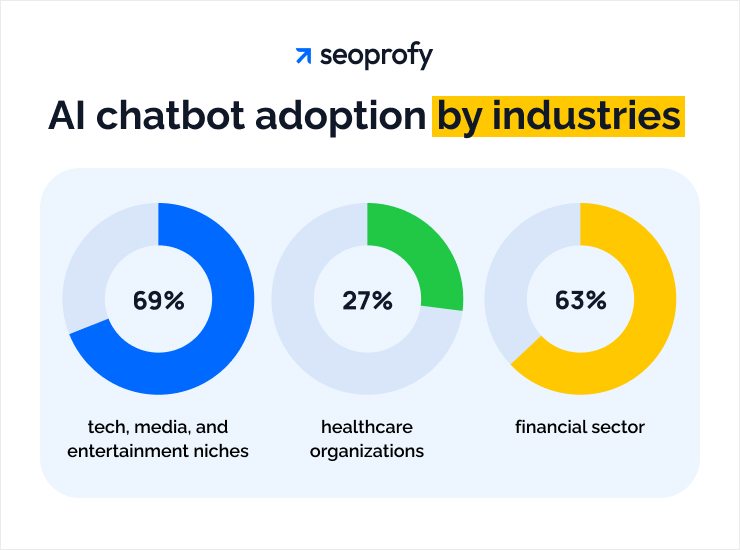
- The highest adoption (69%) of AI chatbots is in the tech, media, and entertainment niches, where companies use them to create content. (Source)
- Healthcare organizations now deploy AI at more than twice the rate (2.2x), making the adoption rate in this niche jump to 27%. Also, in the financial sector, the adoption rate of virtual assistants is 63%, and they’re mainly used for high-stakes tasks. (Source)
- The size of the financial industry chatbot market is expected to reach $7 billion by 2030. (Source)
- Over 18% of online learning platforms have implemented chatbots to simplify the processing of student queries, scheduling, and feedback collection. (Source)
- Career sites get 95% more leads by using chatbots to engage with job seekers. (Source)
Chatbot Cost Statistics: Build, Run, and Maintain
Development and maintenance of chatbots are among the core factors that influence the prices of their subscription plans. In this section, we’ll review how much it takes to build a virtual assistant and how the resources spent influence platform features and capabilities.
Cost to Develop and Implement a Chatbot
Building an AI chatbot requires selecting an appropriate technology stack, designing conversation flows, and preparing data for model training. Of course, handling these complex processes requires significant resources, as shown in the statistics below:
- In 2026, Chatbot development prices range from $5,000 to over $1 million, since the final costs depend on its functionality. (Source)
The table below can help you better understand the price ranges and expectations from each tier of chatbots:
| Chatbot Type | Price Range | Short Description of Functions |
| Rule-based Chatbots | $5K-$30K | Delivery of simple tasks, such as serving as an FAQ or order tracking |
| AI-powered Chatbots | $75K-$500K+ | Sentiment analysis, integrations, and advanced natural language processing |
| Enterprise AI Chatbots | $200K-$1M+ | Comprehensive analysis for complex niches like banking and healthcare while following strict compliance requirements |
- An ongoing maintenance of an AI chatbot usually costs 15-25% of the original development spend annually. (Source)
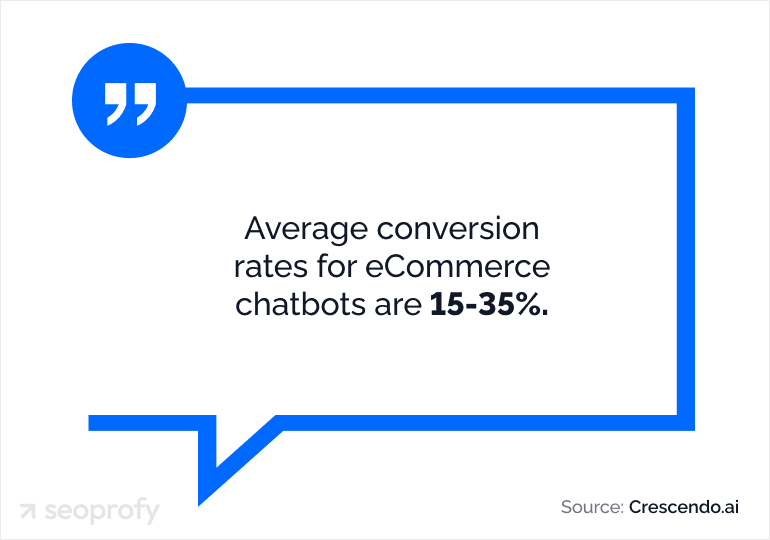
- Average conversion rates for eCommerce chatbots are 15-35%. (Source)
Cost by Industry and Compliance Needs
Each chatbot may be good at performing particular tasks, such as coding or eCommerce AI SEO planning, but struggle with others, such as academic research, for example. The following table is based on data from Anglara and shows how the price tiers differ among various industries and users’ compliance:
| Industry | Price Range |
| Healthcare | $120,000–$10,000,000+ |
| Travel and tourism | $30,000 |
| Finance | $100,000–$400,000 |
| Real estate | $5,000–$220,000 |
| Marketing and retail | $5,000–$500,000+ |
| Law firms | $20,000–$200,000+ |
Chatbot Statistics by Region: Global + Local Differences
If you want to promote your business with AI, you must know whether prospective customers from your region use it. Below, you can review which countries people use chatbots and which LLMs are most popular there. And if you notice that your target audience often opts for artificial intelligence, it’ll be a good idea to opt for an AI SEO audit to make your web pages attractive for virtual assistants.
- In 2025, North America contributed the most to the chatbot market size — 38.72%. (Source)
The USA and Canada hold the top spots, as companies in these countries were the first to adopt LLMs to reduce labor costs and automate business processes. Nevertheless, in terms of CAGR (Compound Annual Growth Rate), they are overpaced by the countries from the Asia Pacific region:
| Country | CAGR % |
| India | 32.9% |
| China | 27.5% |
| The UK | 22.8% |
| The USA | 22.2% |
| Germany | 20.5% |
| Japan | 17.2% |
The CAGR gap may be explained by differences in key growth drivers. The table below explains them for each specific global region:
| North America |
|
| Asia Pacific |
|
| Europe |
|
| Latin America |
|
| Middle East and Africa |
|
- India has the highest daily ChatGPT usage rate (36%), which is more than twice the global average (17%). (Source)
- In the UAE and Singapore, 60% of the working-age population uses AI-powered chatbots. At the same time, this rate is lower than 50% in all other countries (Source)
Chatbot Business Benefits Statistics
Chatbots can help you boost your AI content performance, brainstorm ideas, and develop efficient business strategies. Moreover, there are other significant benefits for your company from the usage of artificial intelligence:
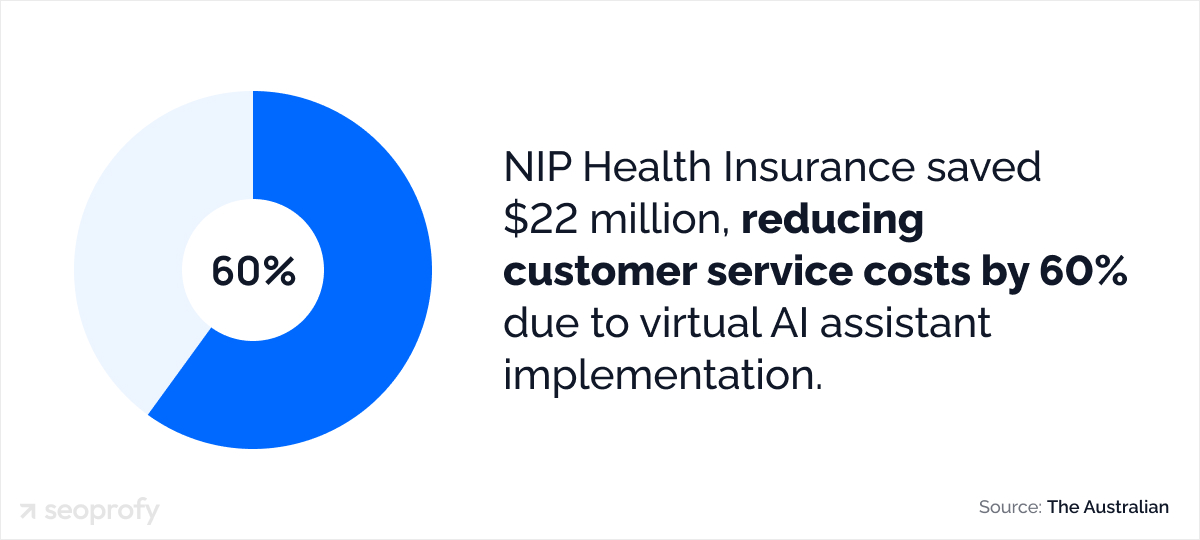
- NIP Health Insurance saved $22 million, reducing customer service costs by 60% due to virtual AI assistant implementation. (Source)
- The average ROI for companies using chatbots for GenAI tasks is $3.7x, but in some cases it may even reach $10.3x. (Source)
- Chatbot implementation helped businesses achieve a 45% reduction in average response times and a 22% increase in customer satisfaction. (Source)
- Deploying chatbots for first-tier support can help a company reach 25%–30% cost savings. (Source)
Voice Assistants and Multimodal Bots
The rapid development of conversational AI also contributed to the growth of voice assistants, prompting more businesses to adopt answer engine optimization to make their content more relevant to their algorithms. Ignoring these bots may be one of the biggest mistakes, especially considering their rising popularity with modern users:
- The number of people opting for voice assistants in the USA is expected to reach 157.1 million in 2026. (Source)
- 38% of smartphone owners use voice assistants daily. (Source)
- The global speech and voice recognition market is expected to reach $83 billion by 2032. (Source)
- There are over 4.2 billion active voice assistants used by individuals worldwide. (Source)
The most popular use cases include:
| Information search | 52% |
| Home automation | 44% |
| Shopping | 38% |
Latest Trend: From Chatbots to AI Agents
The latest chatbot statistics show that artificial intelligence isn’t just a “computer dummy” used to provide answers to simple questions like an ordinary FAQ section. Its complex algorithms and machine learning technologies enable virtual assistants to complete tasks even when human specialists are operating in specific fields.
Further, according to the Elementor Blog, we should expect the introduction of agentic AI, the next evolution of modern virtual assistants. These will be autonomous systems powered by AI, capable of creating complex plans and executing them to reach high-level goals.
At the same time, such an impressive development causes several concerns:
- 40% of people believe that AI can replace them in the workplace. (Source)
- By 2027, improper cross-border use of generative AI (GenAI) will cause more than 40% of AI-related data breaches. (Source)
- 93% of respondents say human issues, such as culture and change management, are the main challenges to AI adoption. (Source)
However, we at SeoProfy consider artificial intelligence a powerful tool that, in the hands of a skilled expert, can skyrocket your business. With our AI SEO services, you’ll boost your online visibility across both traditional and AI search engines, reaching more people and increasing your conversion rates.

Andrew Shum is the Head of SEO at SeoProfy with 10+ years of experience in SEO and digital marketing. He has been part of the company for over 6 years and has led the SEO department for the past 3.5 years, managing a team of 15+ specialists. He works with competitive and international multi-language projects across eCommerce, SaaS, and enterprise niches, focusing on practical SEO strategies that deliver measurable results.