

Grok is a generative AI chatbot built by xAI, Elon Musk’s AI company. It was introduced in early November 2023 and rolled out through X subscriptions during its early access phase. Our Grok AI usage statistics help you see how fast this chatbot has moved from a feature inside X into a product people actively visit and use.


What makes Grok different from ChatGPT and similar assistants is its close tie to the X ecosystem. It leans on live context from public posts plus web search, which changes how people use it day to day.
With that context in mind, on this page, you’ll find data on estimated monthly Grok users, engagement signals like time on site, rank country traffic share, and audience breakdowns to help you see how Grok compares to other models and where it sits in the wider AI market.
Grok AI Statistics: SeoProfy’s Top Picks
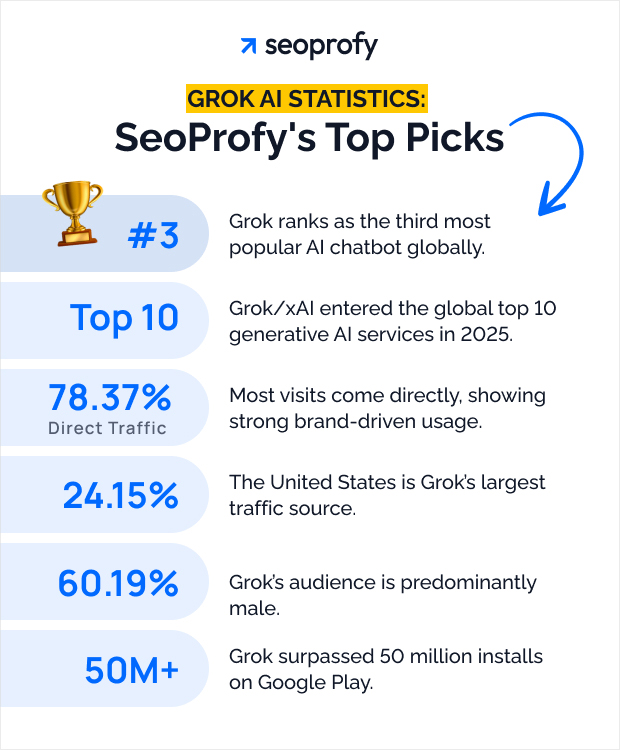
- Grok ranks 3rd in the category of AI Chatbots and Tools.
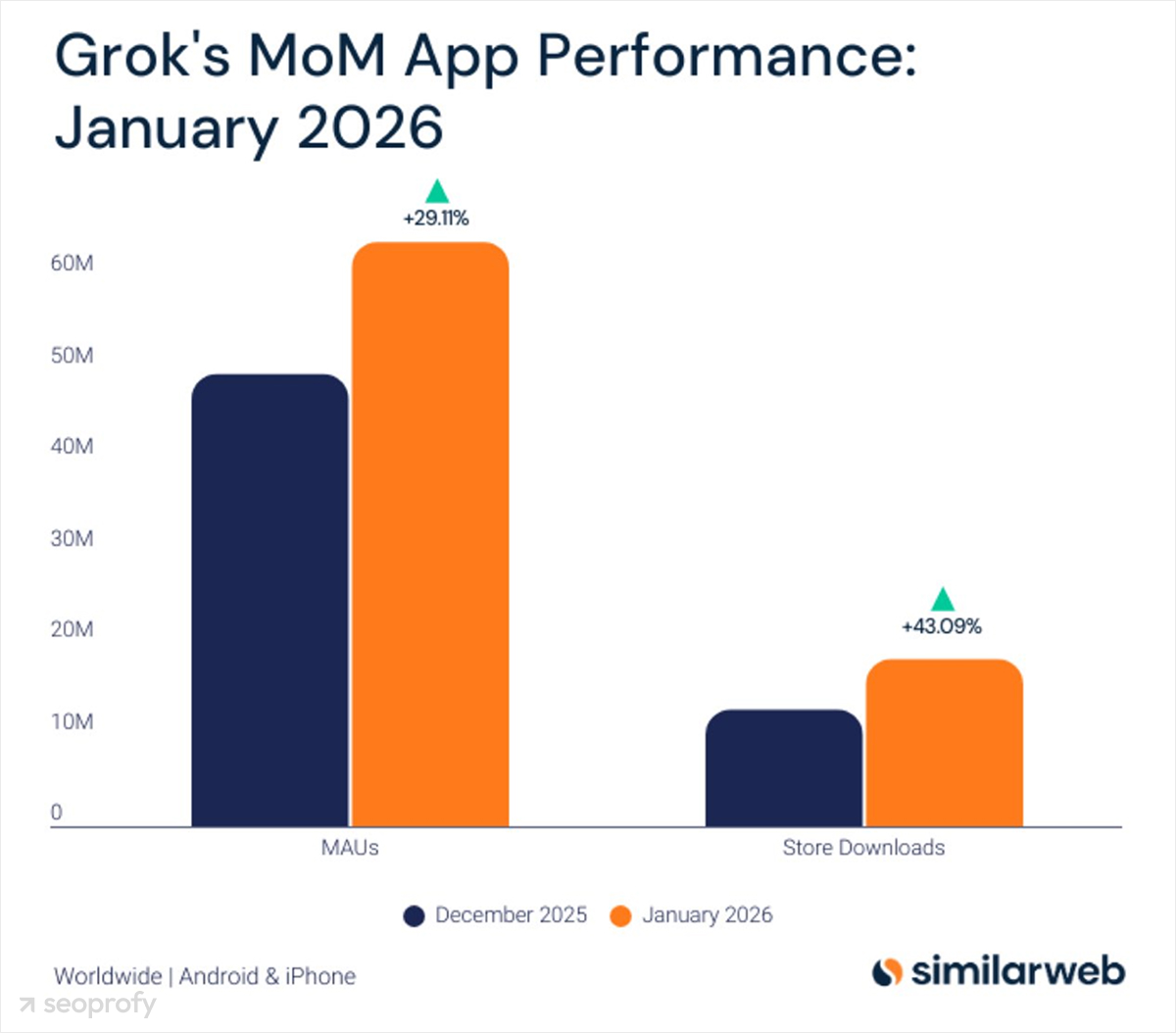
- In January 2026, the Grok’s app had around 60 million monthly active users.
- Grok/xAI was listed as a new entry in the global top 10 generative AI services for 2025.
- 78.37% of visits to Grok’s website came through direct traffic, with Google at 10.33% as the next biggest source.
- The United States drove 24.15% of Grok’s desktop traffic, followed by India at 8.76%, Vietnam at 4.09%, and Brazil at 4.01%.
- Grok has more than 50M+ Android downloads on Google Play.
- Daily iOS downloads of the app rose 279% to 197,000 by July 11, up from 52,000 right before Grok 4 launched.
- Male users made up 60.19% of Grok’s visitors, while female users accounted for 38.71%.
- The top personas using Grok are crypto traders, gamblers, and peer‑to‑peer payers, among others.
- Grok made about $88 million in Q3 2025 and projects close to $300 million for the full year 2025.
Grok Usage Statistics
Let’s start with the traffic first. Current data indicates that Grok has turned into one of the bigger destinations in the AI chatbot category. Similarweb’s data shows that Grok had an impressive 314.0 million visits in January 2026.
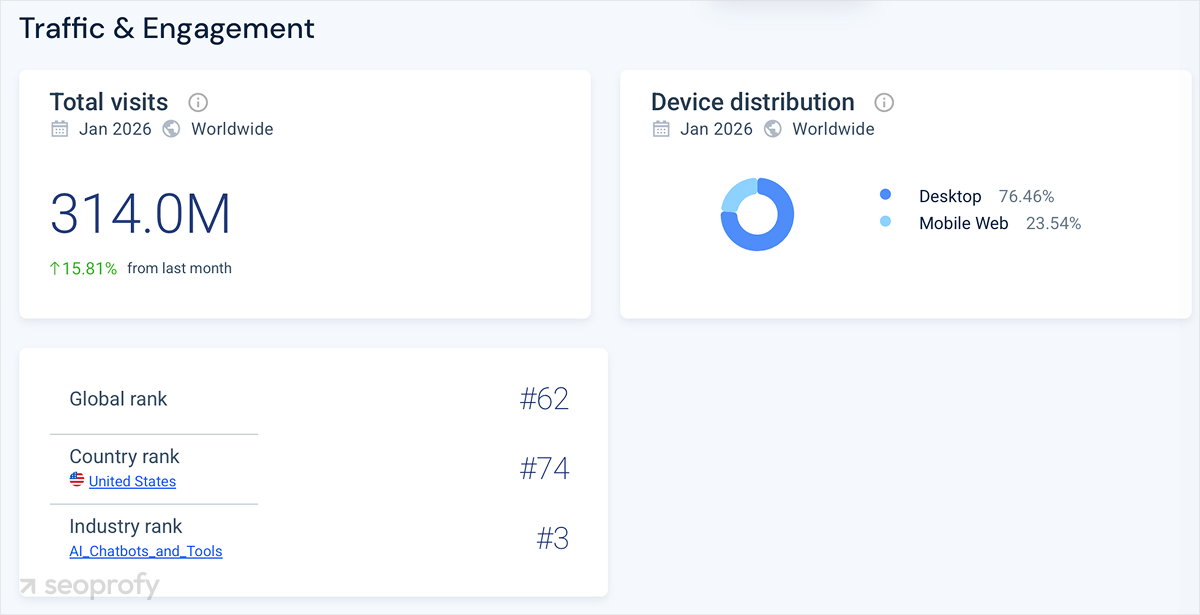
That jump lines up with the fact that the model kept expanding access through X and shipping new releases, so more people could try it, and more searches led straight to the site. Here are traffic and engagement stats from Similarweb and Semrush that support it:
- Grok grew 14.7% month over month and reached its highest recorded monthly visit total on Similarweb’s preliminary November read. (Similarweb)
- 78.37% of visits to Grok’s website came through direct traffic, with Google at 10.33% as the next biggest source. (Semrush)
- The average visitor on Grok.com viewed 6.72 pages per visit. (Similarweb)
- Grok ranks 3rd in the category of AI Chatbots and Tools. (Similarweb)
- Across visits, Grok’s bounce rate came in at 42.06%. (Semrush)
- The average visit duration was 7 minutes 44 seconds. (Similarweb)
How Many People Use Grok AI?
Usage gets a little tricky to pin down because Grok lives in a few places at once. People can use it inside X, and they can also use the standalone experience on grok.com and the mobile apps. With that context, the stats below give you a better read on how big the audience looks right now and how usage has been changing.
- Grok has reached 30 million active users through both X and its own app. (Business of Apps)
- After Grok 3 shipped, global daily active users climbed 5x week over week, and in the U.S., daily user growth increased by more than 260%. (TechCrunch)
- Grok became available to X Premium+ subscribers in 2023, then expanded to all X Premium users in 2024, and later rolled out broadly to X users. (Wikipedia)
Grok User Demographics Statistics
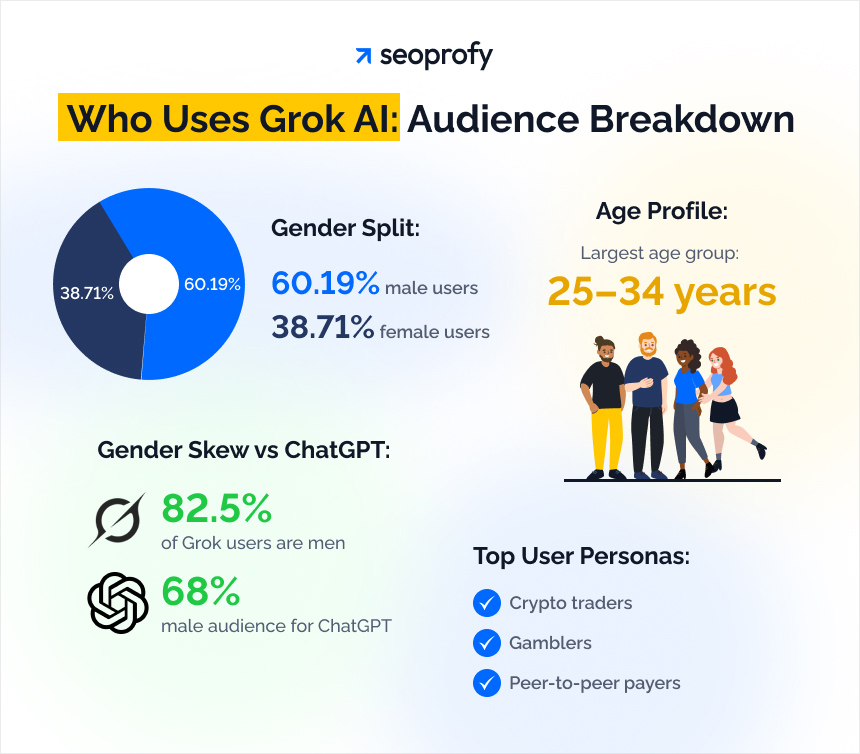
As data from Similarweb shows, Grok’s daily active users on the web skew young and lean male. The biggest age band sits in the 25–34 range, and the interests point to a crowd that spends a lot of time around software and digital tools. Let’s look at the stats that show this:
- 60.19% of Grok AI users were male users, while 38.71% were female. (Semrush)
- The largest age group visiting the website was 25–34. (Similarweb)
- Grok is by far the most male-skewed of the leading AI apps, with about 82.5% of its users being men, compared with 68% for ChatGPT. (SensorTower)
- The top personas using Grok are crypto traders, gamblers, and peer‑to‑peer payers, among others. (Sensor Tower)
Grok AI Usage Statistics By Country 2026
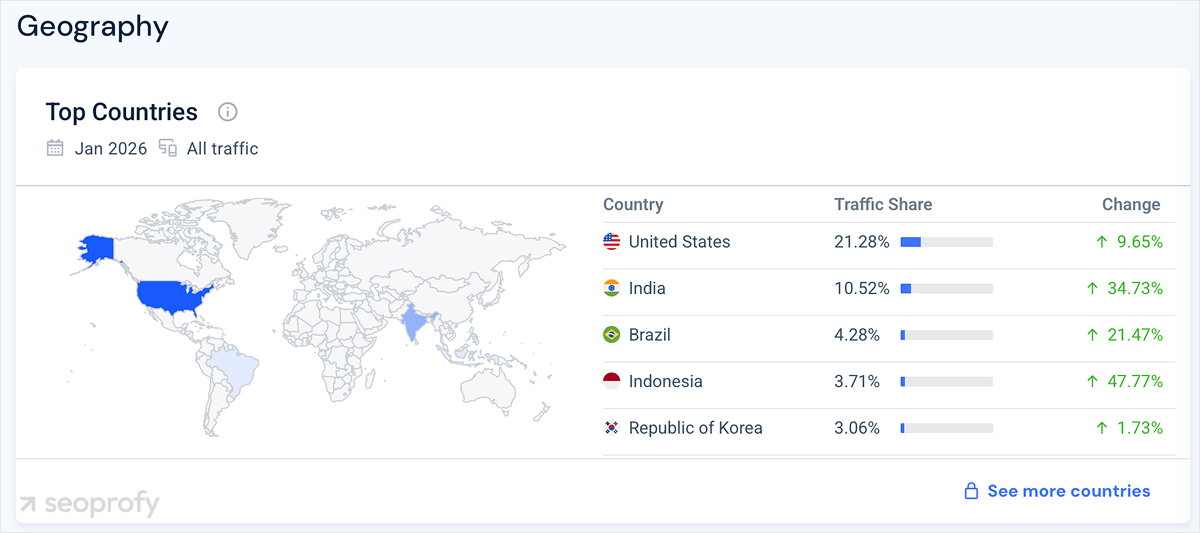
To see where Grok demand concentrates, the country split is the best place to look next. As you review the stats below, remember that Similarweb’s country split is shown for desktop traffic, while Semrush reports traffic share and estimated visits for the site as a whole. So even though the percentages don’t match line for line, both tend to point to the same takeaway.
- In January 2026, the United States represented 21.28% of Grok’s visits, while India accounted for 10.52%, and Brazil reached 4.28%. (Similarweb)
Market Share of Grok vs Other AI Models
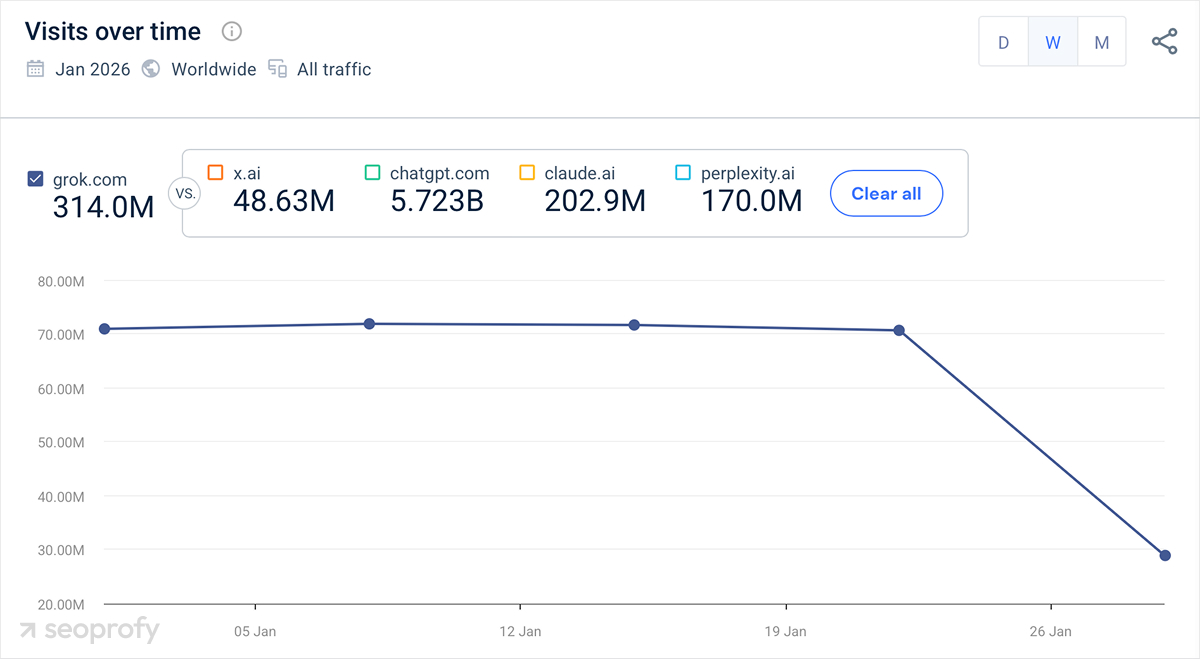
In the usage stats, you already saw that Grok is attracting millions of visits to its website. So how does that compare to other AI tools like ChatGPT, Perplexity, and Claude? Let’s look at the numbers below:
- ChatGPT sits in first place when it comes to AI traffic share, with volume at 5.844 billion visits. After that, Grok comes in ahead of Claude and Perplexity, with 234.4 million visits versus 189.0 million for Perplexity and 180.3 million for Claude. (Similarweb)
For a broader market presence signal beyond web visits, Cloudflare Radar’s 2025 Year in Review listed Grok/xAI as a new entry in the global top 10 generative AI services for 2025. It ranked 9th on their list, while ChatGPT ranked 1st.
Voice, Mobile & Real-Time Usage Statistics
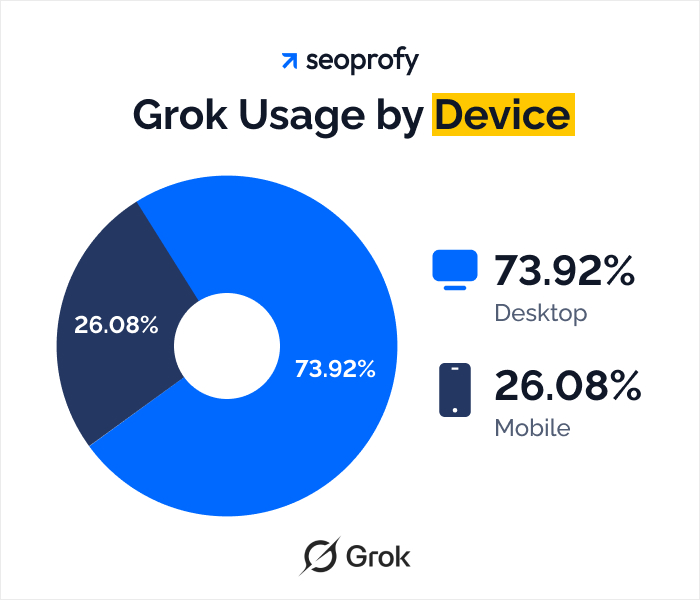
A lot of Grok usage still happens on desktop, which suggests many users still prefer a computer for longer sessions and deeper use cases. At the same time, Grok has an advantage on freshness because it can pull from public posts on X and use live web search when a query calls for it. Here are the exact numbers that show what mobile usage and real-time access look like in practice:
- Desktop traffic accounted for 73.92% of Grok’s visits, whereas mobile traffic was 26.08%. (Semrush)
- Grok can decide to search public X posts and run real-time web search while answering user queries through text or voice input. (Grok Help Center)
Grok AI App Statistics
Grok’s mobile rollout began in early 2025, and growth followed quickly. It gained around 8.1 million users in just a few months — about 2,600% growth. According to our stats, only ChatGPT grew faster during that stretch. It hit 100 million users in roughly three months. That said, let’s look at the data that shows Grok’s traction:
- There are 50M+ mobile app downloads listed for the Grok app on Google Play. (Google Play)
- Grok’s app has a 4.9 rating on Google Play, based on 1.86M reviews. (Google Play)
- Daily iOS downloads rose 279% to 197,000 by July 11, up from 52,000 right before Grok 4 launched. (TechCrunch)
- Grok’s app placed 4th among the top free iPhone apps and 12th for iPad in the US. (SensorTower)
- In January 2026, the Grok’s app had around 60 million monthly active users. (Tesla Owners on X)
Subscription Pricing & Business Statistics of xAI
Like most AI assistants, Grok comes with both free and paid access. The free option comes with rate-limited usage over a set period. For higher limits and the ability to use Grok directly inside X, a paid subscription through X or the Grok app is needed. Here are the stats that show this in more detail:
- SuperGrok is priced at $30 per month. (Grok)
- Grok 4 fast-reasoning API has a 2M context window. Text input costs $0.20 per 1M tokens, and output costs $0.50 per 1M tokens for requests. (xAI)
- SuperGrok Heavy is priced at $300 per month. (Grok)
- Grok made about $88 million in Q3 2025 and projects close to $300 million for the full year 2025. (Business of Apps)
Future Predictions: Where Grok AI Is Heading Next
Grok’s popularity and growth show no signs of slowing down. The biggest reason? It’s uniquely positioned to succeed at acquisition thanks to its integration with X (formerly Twitter). This means Grok has a built-in audience and a much smoother path to getting new users than its competitors.
And as Elon Musk continues to improve the product, it’s pretty clear that usage will only keep growing. Here’s why that’s more than just speculation:
- xAI already shipped a Grok Voice Agent API, and it positions voice as a core surface for Grok rather than a side feature. That sets up more voice-first workflows on mobile and in products that embed Grok through the API. (xAI)
- Elon Musk keeps talking publicly about scaling compute via Colossus and future expansions. Bigger compute tends to show up in the product as higher limits and more model variants that target different workloads. (Tom’s Hardware)
Final Thoughts on Grok AI in 2026
We went through a lot of data and it all points in the same direction. Grok picked up users quickly through 2025, both on the web and on mobile, and it has already secured a visible place in the AI space. A big reason for this lies in the distribution. Being built into X removes friction and puts the tool in front of people who already spend time there.
Looking ahead through 2026, we expect Grok to only grow as its features expand. It is moving away from being just a chatbot and becoming more of a “live engine” that handles video and audio in real-time while taking on more complex tasks as a smart assistant.
For anyone tracking how AI tools gain traction, our numbers help explain why Grok moved faster than most new entrants. And if you’re interested in how AI changes search and marketing more broadly, we also have reports with the latest AI SEO and AI marketing statistics that add context around how businesses and platforms adapt to this new shift.

Khrystyna Dzhumaryk is a content writer at SeoProfy with four years of experience in SEO and content strategy. At the company’s main blog, she writes in-depth articles and guides to help businesses improve their online visibility through proven tactics. Her work brings together hands-on SEO experience with ongoing research into algorithm updates, search trends, and the growing impact of AI on content and optimization.