

AI Overview in 2026 has become one of the most noticeable changes in Google Search. Many queries now show an AI-generated answer before the traditional list of results. Users read a short explanation, see a few cited sources, and often get the information they need right away.


This changes how search works. Visibility is no longer limited to rankings on the first page. Websites now compete to appear inside the AI answer itself. If your content becomes a source in that summary, your brand stays visible even when users do not click through immediately.
In this article, we analyze the latest Google’s AI overviews statistics and industry data to explain how this feature impacts search behavior, traffic, and SEO strategy in 2026.
- AI Overviews appear in ~20% of Google searches, reaching up to 37.2% in some countries, making them a core part of modern SERPs.
- Health-related queries trigger AI Overviews in 60.7% of cases, showing how strongly informational industries dominate visibility.
- AI Overview presence grew rapidly from 6.49% to 24.61% of queries in 2025, then stabilized around 15–16%, indicating a fast rollout followed by normalization.
- Organic CTR drops significantly, with top-ranking pages losing up to 34.5%–64.4% of clicks when AI Overviews appear.
- User behavior is shifting to zero-click search, with only ~8% clicking results and ~26% ending sessions immediately after seeing an AI Overview.
Study Methodology
To compile this Google AI overviews statistics research, we analyzed a combination of large-scale industry studies and proprietary datasets on AI search behavior. Our approach focused on identifying consistent patterns across multiple sources rather than relying on a single report.
We reviewed data from leading SEO platforms and research providers, including analyses of 10M+ to 146M+ keywords, 30M+ SERPs, and 100M+ AI-generated citations. These datasets helped us understand how often most AI Overviews appear, which queries trigger them, and how visibility differs across industries and regions.
We compared findings across multiple studies to validate trends related to:
- query intent and keyword structure;
- industry-level adoption and exposure;
- user behavior and click patterns;
- domain-level citation trends across AI platforms.
All statistics included in this article were selected based on relevance, recency, and source credibility. Where possible, we prioritized data from 2025–2026 studies to reflect the current state of AI-driven search.
Why Should You Care about AI Overviews?
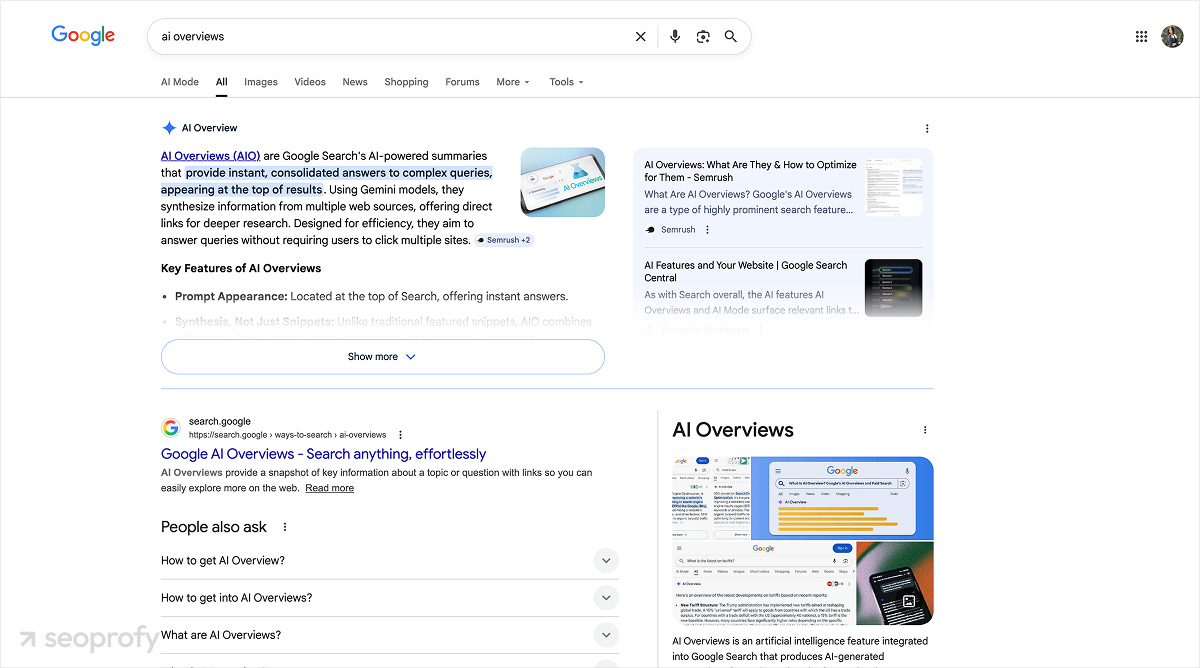
AI Overviews are AI-generated summaries that appear above the traditional organic listings. Instead of opening multiple websites, users can read a short explanation directly on the results page. Answers appear above the traditional organic listings. Instead of opening multiple websites, users can read a short explanation directly on the results page.
This reduces the need to click through to external pages. As a result, publishers, ecommerce sites, affiliates, and content-driven businesses may see less traffic from certain queries.
AI Overviews rely on Google’s generative AI models. The system analyzes several relevant pages and creates a single summary that combines information from multiple sources.
This is different from featured snippets. A featured snippet usually pulls a short passage from one page. Overviews gather information from many sources and present a broader answer.
In simple terms, Google is moving beyond showing links. It is increasingly acting as both a search engine and an answer engine.
AI Overviews Appear in About 20% of Google Searches
AI overview coverage varies by country. In some markets, the feature appears in more than one-third of search results, while in others it appears less often. Language support, search behavior, and rollout stages influence these differences.
An analysis of 108 million AI overview queries from the Brand Radar dataset shows where the feature appears most frequently. Indonesia leads with 37.2% of keywords triggering AI overviews. The Philippines and Mexico come next with 29.1%, India with 26.8%, and Nigeria with 26.4%.
The United States ranks lower, with AI Overviews appearing for 20.5% of queries, placing it 13th. Canada and the United Kingdom follow with 19.2% and 19.1%.
Countries with the highest AI overview coverage:
| Rank | Country | Keywords (M) | AI Overviews | AI Overview Coverage |
| 1 | Indonesia | 11 | 4,096,000 | 37.2% |
| 2 | Philippines | 6.4 | 1,865,000 | 29.1% |
| 3 | Mexico | 12 | 3,496,000 | 29.1% |
| 4 | India | 30 | 8,026,000 | 26.8% |
| 5 | Nigeria | 1.6 | 423,000 | 26.4% |
| 6 | Brazil | 21 | 5,303,000 | 25.2% |
| 7 | Peru | 2.8 | 696,000 | 24.9% |
| 8 | Japan | 18 | 4,468,000 | 24.8% |
| 9 | Ecuador | 1.3 | 322,000 | 24.77% |
| 10 | Colombia | 6.5 | 1,573,000 | 24.2% |
| 11 | Argentina | 5.4 | 1,237,000 | 22.9% |
| 12 | Chile | 3.1 | 669,000 | 21.6% |
| 13 | United States | 43 | 8,815,000 | 20.5% |
In comparison, large English-speaking markets show lower but still significant coverage.
| Country | AI Overview Coverage |
| United States | 20.5% |
| Canada | 19.2% |
| United Kingdom | 19.1% |
These numbers show that AIO appears in roughly one-fifth to one-third of Google search results, depending on the country.
Desktop and Mobile Show Different AI Overview Patterns in Search
AI Overviews appear on both desktop and mobile search results, but their frequency and behavior differ across devices. Several industry studies show that desktop still dominates in overall AI overview presence, while mobile shows faster growth.
| Metric | Desktop | Mobile |
| Share of AI Overviews by device | 59 percent of AI Overviews appear on desktop | About 39 percent appear on smartphones |
| Frequency of AI Overviews in US searches | About 30 percent of desktop keywords trigger AI Overviews | Rapid expansion, still slightly below desktop |
| Growth trend | Stable growth across 2025 | About a 474.9 percent increase year over year in AI Overview presence |
| Impact on organic clicks | AI Overviews can reduce clicks by about 50 percent on desktop | About a 30 percent decline in clicks on mobile |
For SEO teams, this means AIO influence visibility across both device types, but the impact may be stronger on mobile because AI summaries take up more screen space and push traditional organic results further down the page.
AI Overview: Adoption Across Industries and Search Queries
AI overviews do not appear evenly across all industries. Some sectors trigger AI summaries far more often than others, especially those that rely on informational content and research-based queries.
A large analysis of eight million search queries across thirty-eight countries shows that health, home improvement, and transportation-related searches generate Overviews most frequently. In contrast, industries that depend more on local or transactional intent, such as real estate or local services, show much lower adoption.
Adoption by Industry
| Industry | Share of Searches With AI Overview |
| Health | 60.7% |
| Home and Garden | 50.4% |
| Transportation | 31.4% |
| Animal and Pet | 30.9% |
| Food and Beverage | 24.9% |
| Professional Services | 23.8% |
| Retail | 23.2% |
| Finance | 22.9% |
| Legal | 21.5% |
| Insurance | 19.0% |
| Apparel and Fashion | 18.3% |
| Technology | 17.4% |
| Energy and Utilities | 17.4% |
| Education | 15.5% |
| Entertainment | 14.6% |
| Travel and Hospitality | 11.3% |
| Sports | 7.1% |
| Automotive | 5.8% |
| Real Estate | 5.2% |
| Local Services | 2.2% |
Source: NP Digital’s analysis of eight million search queries across thirty-eight countries using Ubersuggest and Data for SEO datasets.
What the Data Shows
Two patterns stand out. First, informational queries dominate AI overview visibility. Topics like health and home improvement frequently trigger AI summaries because users are looking for explanations, advice, and step-by-step guidance.
Second, transactional and location-based queries appear far less often in AI overviews. Queries related to real estate, automotive, and local services are less likely to trigger summaries because users typically search for specific businesses, products, or providers rather than general information.
For ecommerce brands, this creates a new challenge. You need to align SEO with AI-driven search behavior. See how to approach this in ecommerce SEO for AI.
How Does Google AI Overview Adoption Differ by Query Type?
A large Semrush study analyzing well over ten million keywords shows that the feature appeared for about 6.49 percent of queries in January 2025, grew to 24.61 percent in July, and later stabilized at around 15.69 percent of queries by November 2025.
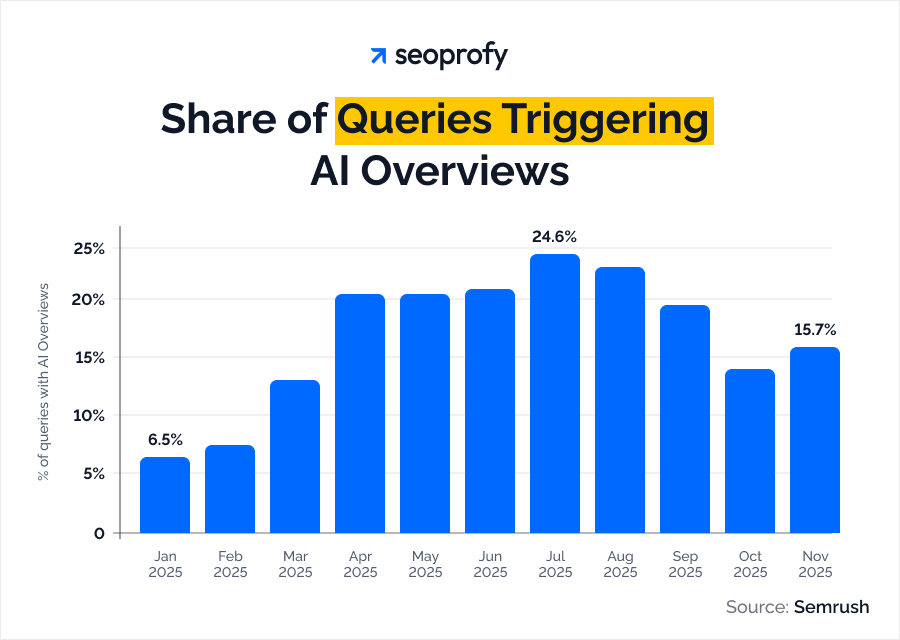
The data shows that AIO initially appeared mostly for informational searches but are gradually expanding into commercial and transactional queries.
| Search Intent | Share of Queries Triggering AI Overviews |
| Informational | 91.3 percent in early 2025, later dropping to 57.1 percent |
| Commercial | 18.57 percent |
| Transactional | 13.94 percent |
| Navigational | 10.33 percent |
These numbers show that informational queries still dominate AI Overview results, but Google is steadily expanding the feature into mid-funnel and lower-funnel searches, including branded and product-related queries.
What Kinds of Queries Are Triggering AI Overviews?
99% of AI overviews appear on informational queries. Keyword intent remains the strongest trigger.
- Informational queries dominate
- Transactional queries rarely trigger AI
- Navigational queries are almost unaffected
| Keyword Intent | AI Overview Rate |
| Informational | 21.4% |
| Commercial | 4.3% |
| Transactional | 2.1% |
| Navigational | 0.9% |
This confirms a key principle of AEO. If your content answers questions, it competes directly with AI. Learn more about how to structure content for answer-based search.
Long-Tail Queries Trigger AI Overviews More Often
Query length strongly influences AI visibility.
| Query Length | AI Overview Rate |
| 1 word | 9.5% |
| 3 words | 14.0% |
| 5 words | 27.6% |
| 7+ words | 46.4% |
Longer queries signal intent clarity. Google can confidently generate summaries. For agencies, this creates a trade-off:
- Long-tail keywords = higher conversion intent
- But also higher AI competition
This is especially important for brands trying to boost visibility in AI platforms, as AI-generated answers often replace traditional clicks and determine which sources users trust and engage with.
What Types of Queries Appear the Least in the AI Overview?
Transactional queries appear the least in AI Overviews.
Even with recent growth, they still have the lowest share compared to other intent types. At the start of the period, transactional queries accounted for just ~2% of AI Overview triggers. By late 2025, they increased to ~14% but still lag behind all other categories.
Why are transactional queries limited in AI Overviews?
- High risk of wrong answers: Purchase decisions require accuracy. Google avoids summarizing when errors could impact money or trust.
- Strong monetization layer (ads): These queries often drive paid search revenue. AI Overviews compete with ads, so rollout is more cautious.
- Preference for direct sources: Users searching with the intent to buy want product pages, pricing, and comparisons, not summaries.
- Lack of clear consensus: Unlike informational queries, transactional searches rarely have one “correct” answer to summarize.
Overviews still prioritize informational intent, but transactional queries are the last frontier, and they are already growing fast.
How Do AI Overviews Choose Which Pages to Cite?
Google does not disclose the exact logic, but clear patterns show what gets cited. AI Overviews prioritize trusted, relevant, and easy-to-extract content.
1. Authority and Trust (E-E-A-T)
- Strong backlinks and brand credibility
- Consistent expertise in your niche
- Clear author and site trust signals.
2. Direct Match to Search Intent
- Answers the query clearly and early
- Focus on informational, question-based queries
- No unnecessary fluff before the answer.
3. Structured, Scannable Content
- Clear headings (H2–H3)
- Short paragraphs
- Lists, tables, summaries.
4. Depth and Coverage
- Covers the topic fully
- Addresses related questions
- Includes examples or comparisons.
5. Freshness
- Updated, relevant content performs better
- Critical for YMYL and fast-changing topics.
6. Unique Value
- Original data, research, or case studies
- Insights are not repeated across dozens of pages.
7. Multi-Source Selection
- Google pulls from multiple sites
- You compete for inclusion, not just rank.
8. Technical Accessibility
- Fast, mobile-friendly pages
- Clean structure and proper indexing.
What This Means Strategically
AI Overviews do not reward traditional SEO alone. They reward extractable expertise. To get cited consistently, you need to:
- Answer questions directly
- Structure content for AI parsing
- Build topical authority, not just rank for keywords
- Publish original insights, not recycled content.
Top Cited Domains Across LLMs
| Rank | Domain | Share of LLM responses with a citation |
| 1 | reddit.com | 9.7% |
| 2 | linkedin.com | 8.9% |
| 3 | wikipedia.org | 7.6% |
| 4 | medium.com | 4.8% |
| 5 | youtube.com | 4.2% |
| 6 | google.com | 4.1% |
| 7 | nih.gov | 4.1% |
| 8 | forbes.com | 3.4% |
| 9 | amazon.com | 2.6% |
| 10 | microsoft.com | 2.4% |
This information is based on a Semrush study of 230k prompts as of October 2025.
Google AI Overviews Usage Statistics
Google AI overviews are changing how people use search. Users scan quickly, click less, and rely more on the summary itself. Here are the key numbers that explain this shift:
- 7 out of 10 users read only the first lines of an AI overview.
- 88% of users click “show more,” but often do not read the full answer.
- 70 percent of users report some level of trust in AI-generated search results.
- Only about 8% of users click a result when an AI overview is present, compared to 15% without it.
- About 1 percent of users click links inside AI Overviews.
- Around 26% of users end their search session after seeing an AI overview.
- Organic click-through rates can decline by more than 60% when overviews appear.
- When a page is cited inside an AI overview, CTR can increase from 0.6 percent to about 1.08 percent.
What does this mean? Most users scan instead of reading in depth. Many searches now end without a click. But being cited inside overviews still brings visibility and some traffic.
How AI Overviews Reshape User Behavior in Search
Search used to be simple. You typed a query, scanned a few links, and clicked one. Now the answer often shows up before you even decide where to go. AI overviews change that flow. Users spend less time comparing results and more time reading the summary at the top. The decision to click happens faster, or not at all.
Key behavior changes backed by data:
- Users read less and skim more: Most users only scroll through about 30 percent of an AI overview, which means they focus on the top part of the answer.
- Overall, CTR declines across markets: Studies show an average 34.5% drop in organic CTR when AI overviews are present.
- Zero-click behavior continues to rise: Around 58% of Google searches now end without a click, with AI summaries contributing to this trend. However, commercial queries remain less affected, creating a temporary safe zone for transactional intent.
- Mobile behavior dominates AI interaction: About 81 percent of AI overview queries occur on mobile devices, reinforcing mobile-first search behavior.
- The desktop still shows a stronger visibility impact: Desktop click-through rates can drop by half, while mobile clicks fall by about one third.
Impact Across the US, UK, and Europe
- United States: The strongest data comes from US studies. AI overviews reduce clicks by nearly half and increase session abandonment rates.
- United Kingdom: Publishers report traffic drops between 40 and 60% when AI overviews appear.
- European markets: News publishers across Europe report sharp declines in referral traffic and rising zero-click behavior, prompting regulatory concerns.
At the same time, search usage is increasing. Google reports that users run more follow-up searches when AI overviews appear, especially in large markets like the US. So the behavior shift is not just about fewer clicks. It is about longer sessions inside Google and less reliance on external websites.
How Do Google AI Overviews Impact Clicks?
Google’s AI Overviews are not just another SERP feature. They fundamentally change how users interact with search results, especially for informational queries.
Instead of clicking through multiple blue links, users increasingly get answers directly in the SERP. This shift leads to fewer clicks, lower visibility for traditional rankings, and a measurable decline in CTR even for top positions.
Key Data on CTR Impact
- -34.5% CTR drop for position #1 when AI Overviews are present (Ahrefs, 300K keywords)
- -15.49% average CTR decline across industries (Amsive, 700K keywords).
- Up to -37.04% CTR loss when AI overviews and featured snippets overlap.
- -19.98% CTR decline for non-branded queries (Amsive).
- -27.04% CTR drop for keywords outside Top 3 positions.
- +18.68% CTR increase for branded queries (rare but high intent).
CTR Comparison: AI Overview vs. Traditional SERPs
According to a 2025 study by Ahrefs, based on the analysis of 300,000 keywords using Google Search Console data, the introduction of Google AI Overviews is strongly associated with a significant decline in click-through rates for top-ranking organic results—particularly for informational queries.
The table below summarizes how CTR has changed before and after the rollout of AI Overviews, including the estimated impact compared to expected performance without AI-generated results.
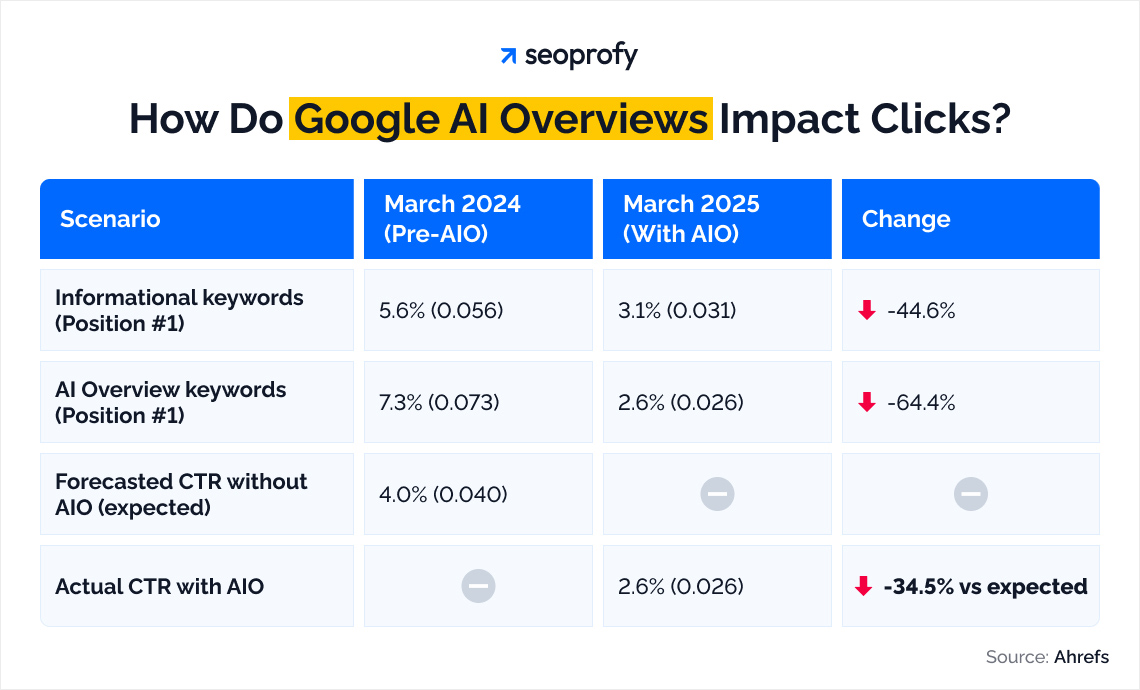
| Scenario | March 2024 (Pre-AIO) | March 2025 (With AIO) | Change |
| Informational keywords (Position #1) | 5.6% (0.056) | 3.1% (0.031) | ↓ -44.6% |
| AI Overview keywords (Position #1) | 7.3% (0.073) | 2.6% (0.026) | ↓ -64.4% |
| Forecasted CTR without AIO (expected) | 4.0% (0.040) | — | — |
| Actual CTR with AIO | — | 2.6% (0.026) | ↓ -34.5% vs expected |
Some More Google AIO Stats and Facts You Should Know
Beyond the main trends, several less obvious insights show how AI overviews actually work under the hood. These details help explain how Google selects sources, where AI pulls information from, and what signals still matter.
Interesting AI Overview Statistics
- Reddit and Wikipedia remained two of ChatGPT’s most cited domains, even after a sharp decline in September 2025. Before mid-September, ChatGPT cited Reddit in close to 60% of prompt responses and Wikipedia in roughly 55%.
- LinkedIn and Forbes gained ground after the September adjustment. LinkedIn showed a steady rise across platforms. Forbes also increased, and in ChatGPT, its citation frequency roughly doubled after the September shift.
- Around 88–91 percent of queries triggering AI overviews are informational, but this share is declining as Google expands into commercial intent.
- AI Overviews stabilized at around 15 to 16% of queries. After peaking near 25 percent in mid-2025, AI Overview’s presence settled at 15.69% of all queries by November 2025.
- AI Overviews appear mostly on low-volume keywords. Over 68% of keywords triggering answers have 100 or fewer monthly searches.
- AI Overviews were heavily concentrated in specific countries:
- US: 254,778 SERPs with AI Overviews
- UK: 44,818
- South Africa: 7,995
- Nepal: 2,555
- Nigeria: 1,007
- → Strong early dominance of US and UK markets
- Question-based keywords were the main trigger. About 25% of AIO-triggering keywords were interrogative (how, what, why, etc.)
- 65% of businesses report better SEO results with AI, and 68% of marketers confirm higher ROI. AI-driven strategies can increase revenue and efficiency while reducing manual workload. Winning in AI overview responses is now directly tied to revenue, not just visibility.
Key AI Mode Statistics
- Google AI Mode reached 75 million users by December 2025, growing 4× since launch.
- Over 100 million monthly active users across the US and India.
- AI Mode usage grew from 0.25% to over 1% of all searches within 2 months.
- AI Mode processes over 1 billion queries per month.
- Google AI Overviews now reach 2 billion monthly users globally. More Google users now rely on instant answers instead of browsing multiple pages.
How to Make AI Overviews Cite Your Page?
Start with the right queries. Focus on informational, long-tail, and question-based searches. These are the ones most likely to trigger AI Overviews.
Write to answer, not just to rank. Lead with a clear, direct response, then expand. Structure your content with logical headings, short paragraphs, and lists so both users and AI can quickly extract value.
Add something original. Unique insights, real examples, or proprietary data increase your chances of being cited. Generic content rarely makes it into AI summaries.
Build trust into every page. Show expertise, reference credible sources, and keep your content fresh. Authority remains a key signal for selection.
Get the technical basics right. Ensure fast load speed, mobile usability, and clean internal linking so your content is easy to crawl and understand.
Finally, track and iterate. Monitor which queries trigger AI Overviews, check if your content is cited, and refine your pages over time.
What Google AI Overviews Mean for Your SEO Strategy
The data shows one clear trend: search is shifting from clicks to answers. Google AI Overviews are changing how users interact with SERPs. Instead of comparing multiple results, users increasingly get what they need directly on the page. That means traditional rankings alone are no longer enough to drive traffic.
For your business, this creates both a risk and an opportunity:
- Less reliance on blue links: Even high-ranking pages can lose visibility and clicks
- Higher competition for attention: More SERP features reduce available space
- New visibility layer: Being ranked in AI Overviews becomes as important as ranking
To stay competitive, you need to adapt your strategy:
- Focus on topical authority, not just individual keywords
- Structure content for clear, extractable answers
- Strengthen E-E-A-T signals to increase trust and citation likelihood
- Monitor AI visibility, not just rankings and traffic
Search is no longer just about ranking higher. It’s about being selected as the answer.

Julia Lubianytska is a Copywriting Team Lead at SeoProfy with over 7 years of experience in copywriting and editing. She works closely with copywriting teams, helping writers craft clear and thoughtful content for SaaS products, IT services, and businesses in the legal and medical fields. Julia enjoys turning complex topics into easy-to-understand, trustworthy content, focusing on structure, clarity, and consistency to ensure the content is genuinely helpful for real people, not just search engines.