

In 2026, we must build SaaS marketing strategies around intent, trust, and measurable impact, as competition intensifies and buying cycles lengthen. Buyers now research extensively before engaging with sales, comparing features, pricing models, integrations, and real-world use cases across multiple channels. This shift makes fragmented tactics ineffective.


High-performing SaaS companies rely on integrated marketing systems that connect SEO, content, paid acquisition, CRO, and lifecycle marketing into a single growth engine. The goal of SaaS marketing strategies is not just acquisition but qualified demand, faster activation, and higher lifetime value. Data-driven execution plays a central role — guiding channel prioritization, messaging, and optimization at every stage of the funnel.
- Focus on high-intent demand, not raw traffic
- Align SEO and content with buyer stages
- Build trust early with use-case–driven content
- Reduce CAC through data-led channel prioritization
- Connect acquisition, activation, and retention
- Support longer sales cycles with educational assets
- Treat marketing as a scalable system, not isolated tactics
What Makes SaaS Marketing Different from Traditional Marketing?
In the SaaS industry, companies market their products fundamentally differently from traditional product-based or offline businesses, especially in how they use effective SEO services to drive scalable growth. The focus is not on one-time conversion. Instead, it is on generating recurring revenue during the customer journey, which lasts a very long time.
Unlike traditional models, SaaS businesses must focus on how prospective customers become users, how users activate, and how they eventually turn into paying customers. This makes lifecycle thinking essential. Marketing efforts continue long after the first conversion and are tightly connected to customer success.
Because subscription revenue compounds over time, monthly recurring revenue becomes the central outcome that connects marketing, product, and the customer success team. Retention and expansion often matter more than how many new customers are acquired in a given period.
SaaS marketing strategies also lend themselves to product-led growth, where the focus shifts to the product itself to drive sales through free trials, a freemium approach, and demos. Marketing SaaS companies shift from persuading existing customers to showing them the value through guided product education and structured onboarding.
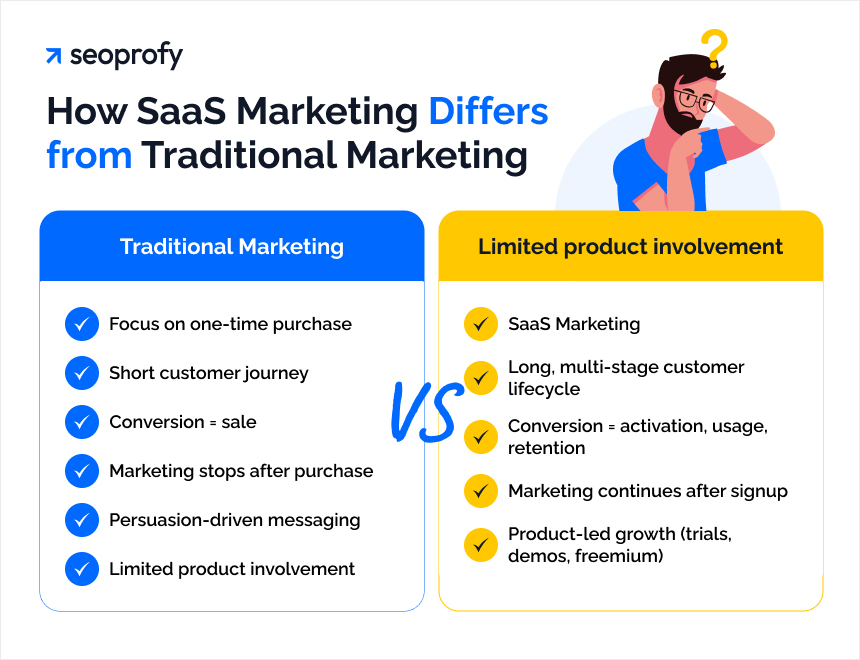
As a result, SaaS marketing places greater emphasis on:
- Long-term customer relationships
- Lifecycle and retention metrics
- Education-driven content and SEO
- Cross-team alignment between marketing, product, and sales
This lifecycle-first approach is what separates SaaS marketing from traditional marketing frameworks.
How SaaS Marketing Is Evolving in 2026
In a modern SaaS world, buyers rarely convert after a single interaction. Potential customers encounter brands through search, content, communities, review sites, and social media marketing platforms long before they take action.
Predictive performance modeling, content personalization and conversion optimization, and forecasting buyer journey intent are often supported by AI in mature SaaS organizations. However, these gains are only achievable when the underlying data foundation and strategic framework are sound — an area where an experienced SEO agency for SaaS companies plays a critical role.
At the same time, trust has become a decisive and important factor in SaaS marketing strategies. Clear onboarding, intuitive UX, transparent pricing, and credible proof points influence both conversion and retention, especially as existing customers and target customers evaluate competing tools.
The Most Effective SaaS Marketing Strategies in 2026
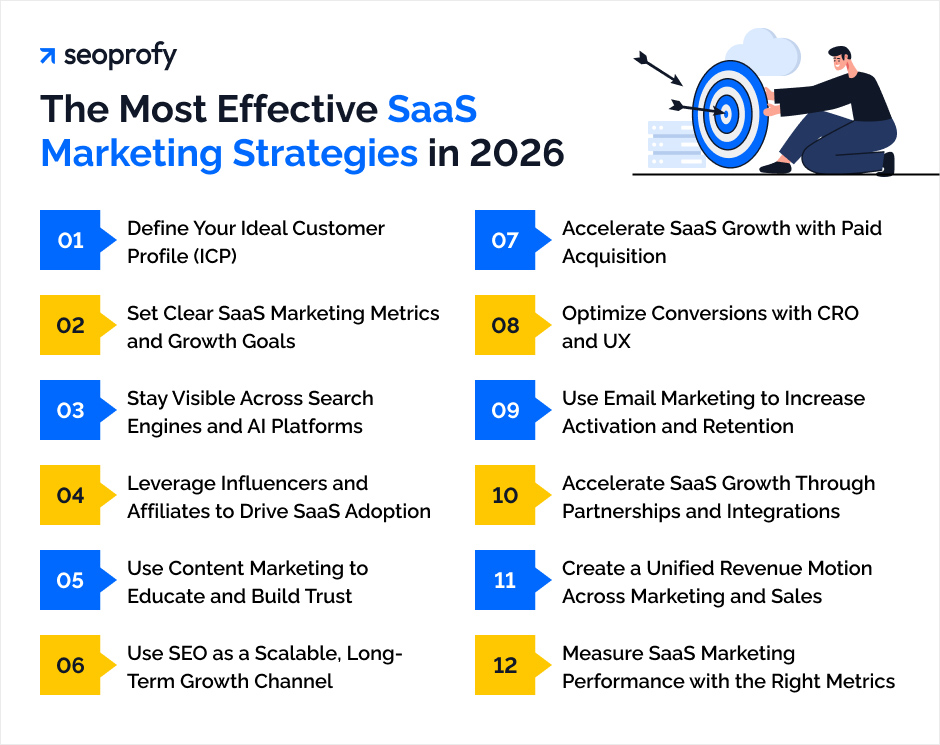
Marketing is shifting from “channel tactics” from SaaS marketers to full-funnel systems built for longer evaluation cycles, stricter data realities, and higher buyer skepticism. Most teams should be adapting to five structural changes:
- Longer, more complex buying journeys: Many B2B SaaS deals are influenced well before the first sales touch — often over months, not weeks.
- AI is becoming operational, not experimental: AI is increasingly used for segmentation, personalization, forecasting, and workflow automation — when paired with clean data and tight governance.
- First-party data is now the growth lever: As tracking gets less reliable, product usage, CRM, and owned audience signals drive targeting and lifecycle decisions.
- UX directly impacts revenue: Activation, onboarding, and time-to-value are not “product-only” concerns — they determine conversion and retention.
- Brand trust is a deciding factor: Buyers shortlist early and look for credibility signals that reduce perceived risk.
Below are proven, current SaaS marketing strategies that companies are actively using to grow in 2026 — optimized for acquisition and retention, not just awareness.
1. Define Your Ideal Customer Profile (ICP)
A clearly defined ICP ensures that marketing communications reach the right target market instead of attracting broad, low-intent audiences. Without this clarity, even strong campaigns struggle to convert.
Effective SaaS strategies go beyond firmographics. They incorporate behavior, pain points, buying triggers, and product fit. This allows teams to prioritize the channels where qualified buyers are most active and invest in content that addresses real evaluation criteria, not generic awareness topics. This is why many fast-growing brands partner with top SaaS SEO companies that build strategies around buyer intent rather than traffic volume alone.
When ICPs are well defined in your SaaS marketing strategies, content marketing strategy, paid ads, account-based marketing, and other marketing channels become more efficient — reducing waste and improving conversion quality.
Audience segmentation further sharpens execution. By separating users by role, maturity stage, use case, or intent level, SaaS companies can tailor messaging across SEO, paid media, email, and product touchpoints. The result is higher relevance, better engagement, and more efficient CAC.
In practice, a well-defined ICP helps teams:
- Focus marketing spend on high-LTV segments
- Align content with real buyer objections
- Improve conversion across the entire sales funnel
It also creates alignment between marketing, product, and sales — ensuring that every growth initiative is built around the same definition of an ideal customer.
2. Set Clear SaaS Marketing Metrics and Growth Goals
SaaS growth is driven by efficiency, not volume. The most effective teams align marketing and product around a small set of metrics that reflect long-term revenue impact, not short-term wins.
The core metrics that matter:
- Customer Acquisition Cost (CAC): Track CAC by channel and ICP segment. For example, SEO CAC often decreases over time, while paid CAC rises as competition increases—this should directly influence SaaS marketing budget allocation.
- Lifetime Value (LTV): LTV must be tied to real retention and expansion data. If a segment churns within 6–9 months, scaling acquisition for it rarely makes sense.
- Churn Rate: High churn signals issues in onboarding, product fit, or expectations set by marketing. Growth stalls when churn is ignored.
- Activation Rate: Measure how quickly users reach their first “aha” moment. Faster activation shortens payback and improves trial-to-paid conversion.
- Payback Period: In 2026, many SaaS companies aim to recover CAC within 6–12 months to maintain cash efficiency.
Clear goals based on these metrics help SaaS marketing teams prioritize scalable channels, refine messaging, and make data-backed growth decisions.
3. Stay Visible Across Search Engines and AI Platforms
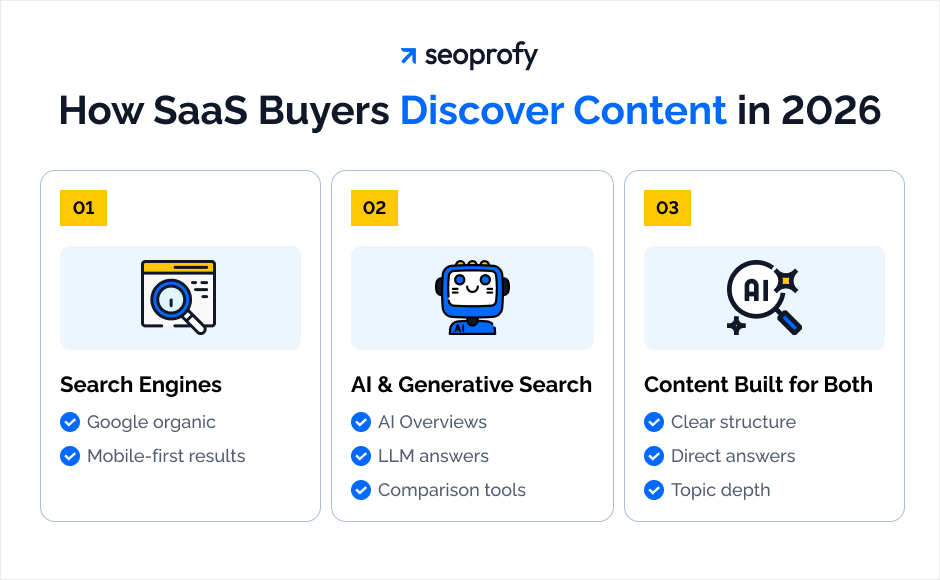
In 2026, “search visibility” for SaaS isn’t limited to traditional organic rankings. Buyers increasingly begin their research with AI assistants, generative search summaries, and LLM-powered comparison tools — not just standard search engine results pages. To capture demand early in the funnel, companies must optimize content for both classic search engine optimization and AI discovery.
Structure Content for AI Discovery
AI platforms favor content that’s:
- Well-organized with clear headings (H1–H3)
- Rich in concise definitions and direct answers
- Supported by factual data and authoritative sources
Instead of a long narrative about “what product-led growth is,” include a concise definition followed by bullet points describing key actions and outcomes. This increases the chances of being featured in AI Overviews and LLM snippets.
Target Question-Driven Queries & Conversational Phrases
AI assistants surface answers to natural language prompts. Optimize pages for queries like:
- “What are the best retention strategies for SaaS?”
- “How does product-led growth improve LTV?”
- “Compare inbound vs. outbound B2B SaaS marketing.”
Use H2/H3 questions and concise paragraph answers to improve visibility across both Google Search and AI platforms.
Build Semantic Topical Authority
AI systems model context and topical relationships across content and entities. As a part of SaaS marketing strategies, create content clusters around core themes (e.g., onboarding, lifecycle metrics, and churn reduction). Internally link these pages to help AI models connect concepts and your brand.
A pillar page linking to subpages like “Improving Activation Rate” and “Reducing CAC” strengthens authority and increases the likelihood of generating AI citations.
Use Rich Media & Structured Data
AI platforms utilize structured data to interpret content better. Implement schema markup (FAQ, HowTo, Product, Review) to enhance understanding by crawling systems and AI models.
Visuals like comparison tables, metric dashboards, and quick definitions also help AI extract structured insights.
Leverage AI-Focused SEO Tactics
AI-focused SEO goes beyond traditional keyword targeting. SaaS companies need to optimize how their content is understood, interpreted, and reused by search engines and large language models.
SeoProfy’s AI SEO services address this shift with practical, data-driven optimizations:
- AI-framed topic modeling: Instead of building content around isolated keywords, AI models analyze how topics, subtopics, and entities are connected. This helps SaaS brands cover subjects in the way AI systems expect, improving visibility in AI Overviews and generative answers.
- Predicting semantic relevance: AI models help evaluate which pages are more likely to answer complex questions based on intent, context, and topical coverage. With this, content can rank for a wider variety of queries without having to repeat keywords that are highly searched for.
- Going beyond just using relevant keywords: SEO that uses AI to improve how content is organized, written, and detailed will match AI ranking signals to assess how clear, in-depth, and knowledgeable the content is. These are the defining factors that determine whether content will get AI summarization, citations, and recommendations
These SaaS marketing strategies help companies remain visible as search shifts from keyword retrieval to AI-driven answer generation.
4. Leverage Influencers and Affiliates to Drive SaaS Adoption
Influencers and affiliates serve different roles in SaaS growth marketing and should be treated as separate, strategic channels — not variations of the same tactic.
Use Niche Influencers to Build Credibility and Reduce Risk
In SaaS, buyers trust practitioners more than brands. Niche influencers, such as operators, consultants, or technical specialists, shape opinions long before a purchase decision. Their value lies in experience-based validation, not promotion.
Effective formats include:
- In-depth product walkthroughs tied to real workflows
- Honest comparisons against alternative tools
- Long-form tutorials showing how the product solves a specific problem
These assets influence mid-funnel and late-funnel buyers who are actively evaluating solutions and looking for reassurance before committing.
Use Affiliates to Capture High-Intent Demand
Affiliates work best at the bottom of the funnel. Review sites, comparison blogs, and vertical-specific publishers convert users who are already searching for solutions.
Strong SaaS affiliate programs:
- Incentivize qualified sign-ups or paid conversions
- Focus on ICP-aligned publishers, not traffic volume
- Track performance by LTV, not just cost per lead
When separated and optimized correctly, influencers build trust, while affiliates turn demand into revenue.
5. Use Content Marketing to Educate and Build Trust
Content marketing is not a nice-to-have — it’s a core SaaS growth strategy that explains complex products, reduces perceived purchase risk, and guides buyers through longer evaluation cycles. High-quality content helps prospects understand their problems, compare solutions, and justify purchase decisions internally.
To perform at this level, SaaS brands increasingly rely on professional SEO content writing services that combine subject-matter expertise, search intent analysis, and conversion-focused structure.
Effective SaaS content aligns with the buyer journey through a structured TOFU, MOFU, and BOFU progression:
Top of Funnel (TOFU): Awareness & Education
At this stage, buyers are problem-aware but not yet solution-aware. Content should:
- Define industry problems with clarity
- Share research, trends, and frameworks
- Use SEO to attract high-intent organic traffic
- “What is product-led growth?”
- “SaaS onboarding benchmarks 2026.”
- Long-form guides with real examples
These pieces generate visibility and start building trust early.
Middle of Funnel (MOFU): Consideration & Evaluation
Here, buyers compare options and explore how SaaS products can solve their specific challenges. Content should demonstrate expertise and relevance.
- SaaS case studies showing measurable outcomes
- Comparison guides (“Feature X vs. Feature Y”)
- Webinars and tutorials that explain workflows
This content reassures buyers and nurtures intent.
Bottom of Funnel (BOFU): Conversion & Validation
At the decision stage, prospective users seek proof and confidence before acting. Content here should reduce friction and support conversion.
- Detailed pricing pages
- Feature demos and video walkthroughs
- Customer testimonials and ROI calculators
Across all stages, a professional content strategy, like the one offered through SeoProfy’s SaaS content writing service, ensures that your content is discoverable, relevant, and customized to user intent.
By mapping content to each phase of the SaaS buyer journey, you educate users, build trust over time, and move them logically toward conversion.
6. Use SEO as a Scalable, Long-Term Growth Channel
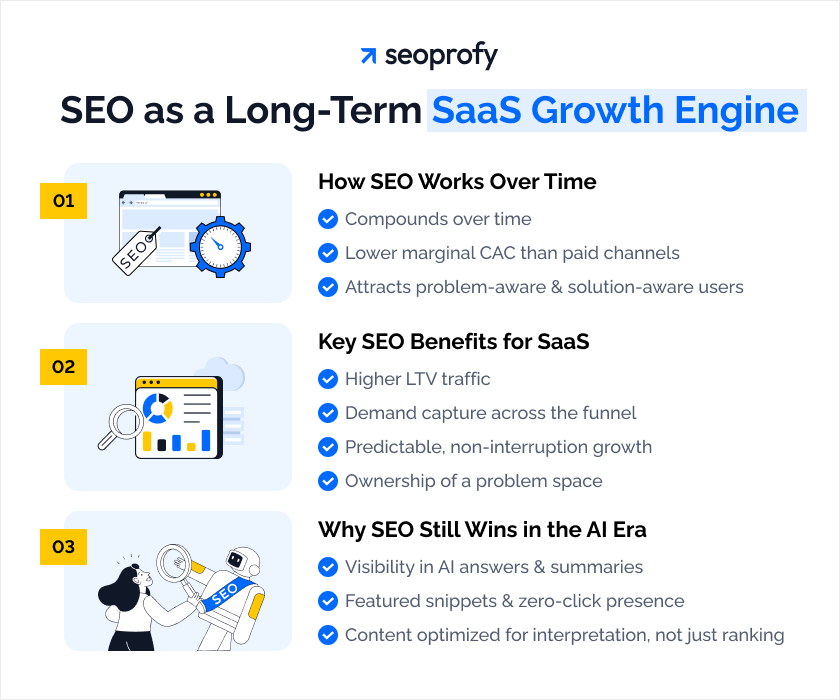
While paid channels can generate short-term demand as a part of SaaS marketing techniques, SEO compounds over time, delivering consistent, high-intent traffic with a lower marginal cost per acquisition. SEO works best when it targets problem-aware and solution-aware users who are actively researching tools, comparisons, and implementation options. These users convert later in the funnel and often have higher LTV than traffic driven by interruption-based ads.
High-performing teams structure their SEO around topic clusters, not standalone keywords. A cluster-based approach uses a main page (like “SaaS onboarding”) that links to related subpages covering topics such as activation metrics, onboarding checklists, UX patterns, and benchmarks.
This structure helps SaaS brands:
- Signal topical authority to search engines and AI systems
- Rank for a broader range of related queries
- Capture users at different stages of the buying journey
Over time, clusters allow SaaS companies to “own” a problem space rather than compete page by page.
Adapt SaaS SEO for AI Results and Zero-Click Searches
Search behavior moves toward AI-generated answers, summaries, and zero-click experiences. To stay visible, SaaS SEO content must be optimized for interpretation, not just ranking.
Effective adaptations include:
- Clear definitions and concise explanations near the top of the pages
- Question-based H2/H3s that directly answer common queries
- Structured lists, tables, and comparisons that AI systems can extract
- Content that explains why and how, not just what
A page targeting “SaaS churn reduction strategies” should include a short definition, a numbered list of proven methods, and brief explanations — making it suitable for featured snippets, AI overviews, and LLM-generated answers. When SEO is treated as a long-term system, combining topical authority, structured content, and AI-aware optimization, it becomes one of the most reliable growth drivers for SaaS companies.
7. Accelerate SaaS Growth with Paid Acquisition
Paid acquisition, SEO, partnerships, email, and social media platforms should not operate as separate experiments. In a mature SaaS marketing plan, each channel plays a defined role based on intent, cost efficiency, and impact on activation and retention.
In SaaS marketing strategies, paid media can help validate critical ICP and messaging assumptions faster than purely organic channels:
Which ICP converts best? Which value proposition resonates? Which use case shortens the sales cycle? The insights gained from paid campaigns then inform SEO, content, product messaging, and sales enablement.
How Different Paid Channels Support SaaS Growth
| Channel | Primary Role | Best-Fit ICP | How SaaS Companies Use It |
| Google Ads (Search) | Capture existing demand | SMB → Enterprise | Targets high-intent queries (solutions, alternatives, comparisons) to convert buyers already in evaluation mode |
| LinkedIn Ads | Precision B2B targeting | Mid-market, Enterprise | Reaches decision-makers by role, industry, and company size with demos, reports, and thought leadership |
| Meta Ads | Demand creation & nurturing | SMB, PLG SaaS | Builds awareness and mid-funnel intent through educational creatives and use-case messaging |
| YouTube / Display | Brand reinforcement | Mid-market SaaS | Supports long sales cycles with product explainers and category education |
| Retargeting (All platforms) | Conversion optimization | All SaaS models | Re-engages users who interacted but didn’t convert |
Using Retargeting Across the SaaS Funnel
Retargeting connects paid acquisition with real product intent:
- Trial users: Feature-led ads accelerate activation and push users toward their first “aha” moment.
- Demo viewers: Customer proof and ROI messaging reduce risk and support sales conversations.
- Abandoned sign-ups: Reminder and objection-handling ads recover lost conversions and shorten decision time.
When customized with ICP segmentation and lifecycle data, paid acquisition becomes a controlled system for learning and scaling — supporting faster results without relying on unsustainable ad spend.
8. Optimize Conversions with CRO and UX
SaaS companies that ignore conversion rate optimization leave a significant share of growth unrealized. As acquisition costs rise and traffic becomes more expensive, improving how existing users convert has a direct impact on revenue efficiency. Even small gains in conversion rates can outperform incremental spending on paid acquisition.
CRO in SaaS focuses on removing uncertainty and guiding users toward action at every touchpoint — landing pages, pricing pages, onboarding flows, and demo requests. This is especially critical for products with longer sales cycles or product-led entry points.
Use A/B Testing to Validate What Converts
A/B testing allows SaaS teams to test headlines, value propositions, CTAs, pricing layouts, and page structure based on real user behavior — not assumptions. For example, testing a feature-led headline against a use-case–driven message often reveals which framing resonates better with a specific ICP.
Improve Message Matching Across the Funnel
Message matching ensures consistency between ads, landing pages, and product experiences. When users see the same promise, language, and use case from click to conversion, trust increases and drop-off decreases.
Reduce Friction Through UX Optimization
Friction often hides in small details: too many form fields, unclear next steps, slow load times, or complex onboarding. Simplifying flows, clarifying CTAs, and shortening time to value significantly improve conversion rates.
Use Heatmaps and Session Recordings to Find Drop-Offs
Heatmaps reveal where users click, scroll, or stop engaging, while session recordings show how real users navigate pages and forms. These insights help identify confusion points, ignored elements, and usability issues that block conversions — making CRO and marketing efforts targeted and measurable.
9. Use Email Marketing to Increase Activation and Retention
In 2026, email marketing remains one of the most effective SaaS channels because it supports the entire customer lifecycle—from first login to long-term retention. Unlike newsletters, lifecycle emails are triggered by user context and product behavior, making them highly relevant and conversion-focused.
Welcome and onboarding emails play a critical role immediately after sign-up. Their purpose is to reduce time to value by guiding users toward a single, meaningful action—such as completing setup, activating a core feature, or importing data. Well-structured onboarding sequences are short, progressive, and closely aligned with in-product steps.
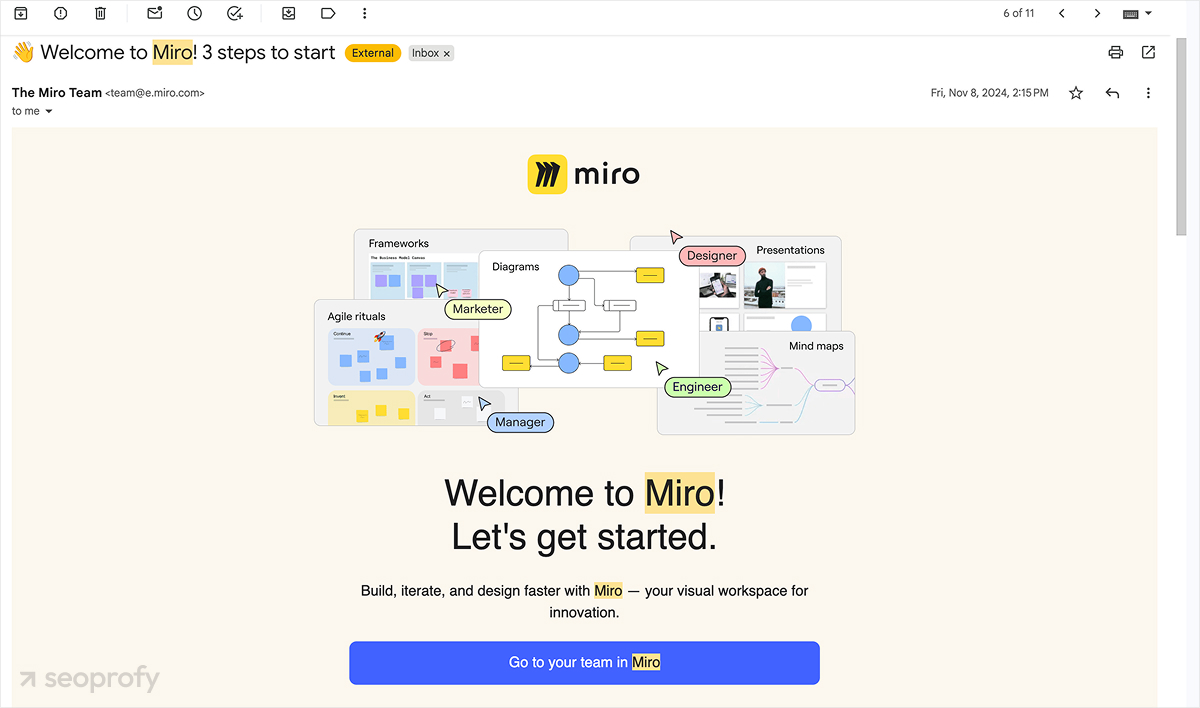
As users engage with the product, behavior-based emails become the main growth driver. These messages respond to real usage signals: inactivity, feature adoption, stalled trials, or upcoming limits. For example, a user who hasn’t completed onboarding may receive a reminder with a short walkthrough, while an active user might get tips on advanced features or integrations.

Personalization is what makes lifecycle email effective at scale. In practice, this means tailoring content based on role, use case, plan type, and recent actions — not just inserting a name. When emails reflect what users are trying to achieve inside the product, they increase activation, reduce churn, and support expansion.
10. Accelerate SaaS Growth Through Partnerships and Integrations
Partnerships are not only a part of SaaS marketing strategies — they’re a scalable growth channel that drives qualified demand, shortens sales cycles, and increases product stickiness. Partnerships are most effective when they closely align with the product, ICP, and go-to-market strategy.
Strategic partnerships allow brands to access pre-qualified audiences through trusted ecosystems rather than competing for attention in saturated paid channels.
Integrations and Marketplaces as Demand Channels
Product integrations are one of the strongest partnership levers in SaaS. When your product integrates with tools your ICP already uses, it becomes easier to adopt, harder to replace, and more visible at the point of intent.
Marketplaces (such as app stores or partner directories) function as acquisition channels by:
- Capturing users actively looking for compatible solutions
- Providing built-in credibility through ecosystem trust
- Supporting upsell and expansion through deeper workflows
Well-positioned integrations often outperform generic content or ads in conversion quality.
Affiliate and Referral Programs for Scalable Reach
Affiliate and referral programs extend distribution through consultants, agencies, and SaaS-focused creators. Unlike broad influencer marketing, these partners are incentivized to drive qualified sign-ups, not just traffic.
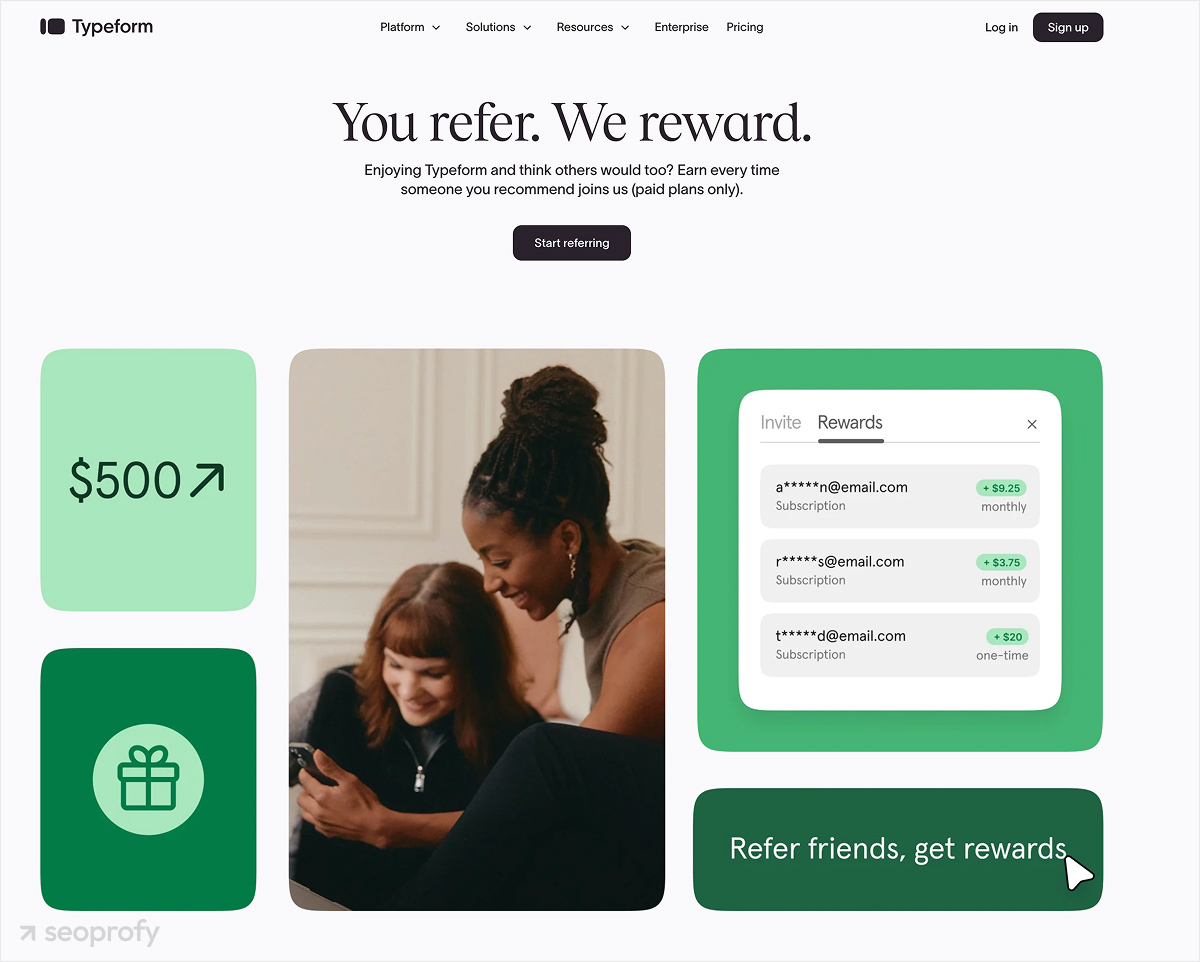
Referral programs, in particular, work well for PLG SaaS by turning active users into advocates — lowering CAC while increasing trust at the first touchpoint.
Co-Marketing to Build Authority Faster
Joint initiatives help SaaS brands borrow authority and expand reach without duplicating effort. Common high-impact formats include:
- Co-hosted webinars addressing shared customer problems
- Joint case studies showing integrated solutions in action
- Collaborative content (guides, reports, templates)
- Coordinated product launches for new integrations
These initiatives are effective because they combine audiences, expertise, and distribution, making them especially effective for mid-funnel and enterprise SaaS growth.
So, the visual shows partnerships as a layered system, where different partner types deliver value at different levels of scale and strategic impact.

At the base, affiliates and referrals help capture demand efficiently, driving high-intent leads with lower acquisition costs. Resellers add commercial leverage by bundling the product with services and selling into established client bases.
Higher up, product partnerships focus on integrations that increase adoption, retention, and marketplace visibility. At the top, strategic alliances align long-term business goals between platforms, creating durable growth and ecosystem authority.
In the context of this section, the pyramid highlights that effective SaaS growth comes from combining short-term distribution channels with long-term ecosystem partnerships, rather than relying on a single partnership model.
11. Create a Unified Revenue Motion Across Marketing and Sales
In B2B SaaS, long sales cycles expose every gap between marketing and sales. Prospects rarely arrive cold—they come with context, opinions, and expectations shaped by content, search, and peer validation. When sales don’t understand this pre-sales journey, conversations reset instead of progressing.
High-performing teams treat marketing and sales as interdependent stages of the same revenue process. Marketing educates, qualifies, and frames the problem. Sales validates fit, deepens understanding, and closes. The handoff works only when both teams rely on the same data and assumptions.
Key elements of effective alignment of this SaaS digital marketing plan strategy include:
- A shared understanding of who is worth pursuing and why
- Access to behavioral and intent signals before outreach
- Consistent positioning across SaaS marketing campaigns, content, and sales conversations
- Qualification focused on readiness and use case, not lead volume
- Continuous feedback loops to refine messaging and targeting
When marketing and sales operate as one system, SaaS companies reduce wasted effort, increase deal velocity, and scale revenue more predictably — even with long and complex buying cycles.
12. Measure SaaS Marketing Performance with the Right Metrics
If you’re just starting in marketing, most advice sounds confusing or contradictory. One article says “grow traffic,” another says “focus on MRR,” dashboards are full of numbers, and it’s unclear what actually matters.
Let’s slow this down and add context — step by step.
SaaS marketing success often looks like this:
- The user visits the site
- The user buys a product
- Revenue happens immediately
SaaS works differently.
A typical SaaS journey looks like:
- Someone finds your site (SEO, ad, referral)
- They read blog posts and compare tools
- They start a trial or book a demo
- They use the product
- They decide later whether to pay
- They may stay subscribed for months or years
Because of this delay, traffic alone cannot show success. You need metrics that reflect progress through the journey.
The biggest beginner mistake: treating traffic as the goal
Traffic is not useless — it’s just incomplete.
Traffic tells you:
- People are discovering you
- Your content is visible
- Your ads are being clicked
Traffic does not tell you:
- If visitors are the right target audience
- If they trust your product
- If they ever become customers
That’s why modern teams treat traffic as the top of the funnel, not the finish line.
How SaaS marketing measurement works (simple mental model)
Think of metrics in three layers:
Layer 1: Visibility (top of funnel)
- Traffic
- Impressions
- Clicks
Useful question: Are people discovering us?
Layer 2: Intent & engagement (middle of funnel)
- Trial starts
- Demo requests
- Pricing page views
- Activation actions
Useful question: Are the right people showing interest?
Layer 3: Revenue & retention (bottom of funnel)
- Paid conversions
- MRR is influenced by marketing
- Retention and churn
- Expansion revenue
Useful question: Is marketing contributing to growth?
Beginners often stop at Layer 1. Professionals connect all three.
Step 1: Clearly define your “money action”
Before tools, dashboards, or reports, you need clarity.
Ask:
“What action usually leads to revenue for us?”
For most companies, it’s one of these:
- Free trial started (product-led SaaS)
- Demo booked (sales-led SaaS)
- Paid sign-up (self-serve SaaS)
This action becomes your primary conversion.
Everything else — traffic, content, ads — exists to support this step.
Step 2: Track meaningful actions in Google Analytics
Beginners often open Google Analytics and feel lost because they’re looking at everything.
You don’t need everything.
What GA4 should show you today
- How many users complete your main conversion
- Which channels help users get there
- Which pages appear before conversion
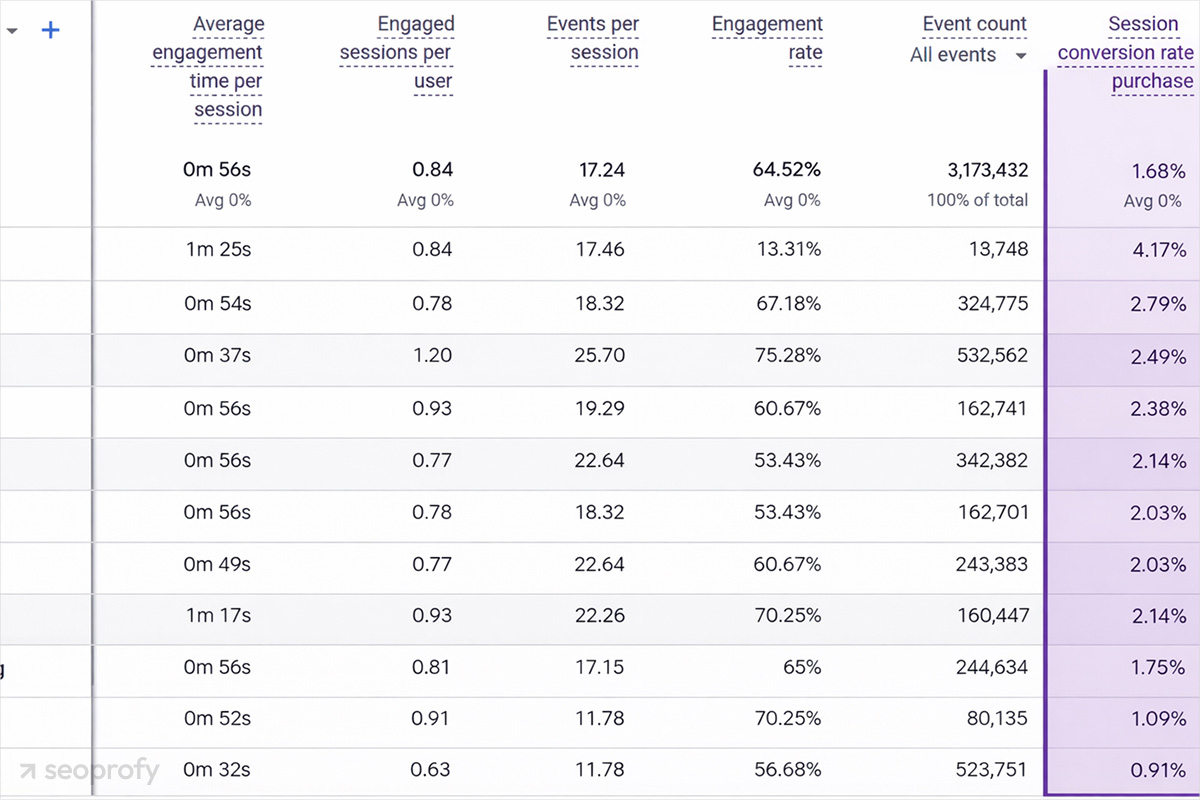
That’s it.
If GA4 cannot answer “what led to a trial or demo?”, it’s not set up correctly.
GA4 is event-based. This means actions matter more than pageviews — which is exactly what SaaS needs.
Step 3: Understand SEO through intent using Google Search Console
Search Console helps beginners see how Google traffic actually behaves.
Instead of asking:
“How many keywords do we rank for?”
Ask:
“Which searches bring people close to buying?”
Examples of high-intent searches:
- “Tool X pricing”
- “Tool X alternatives”
- “Best software for [specific use case]”
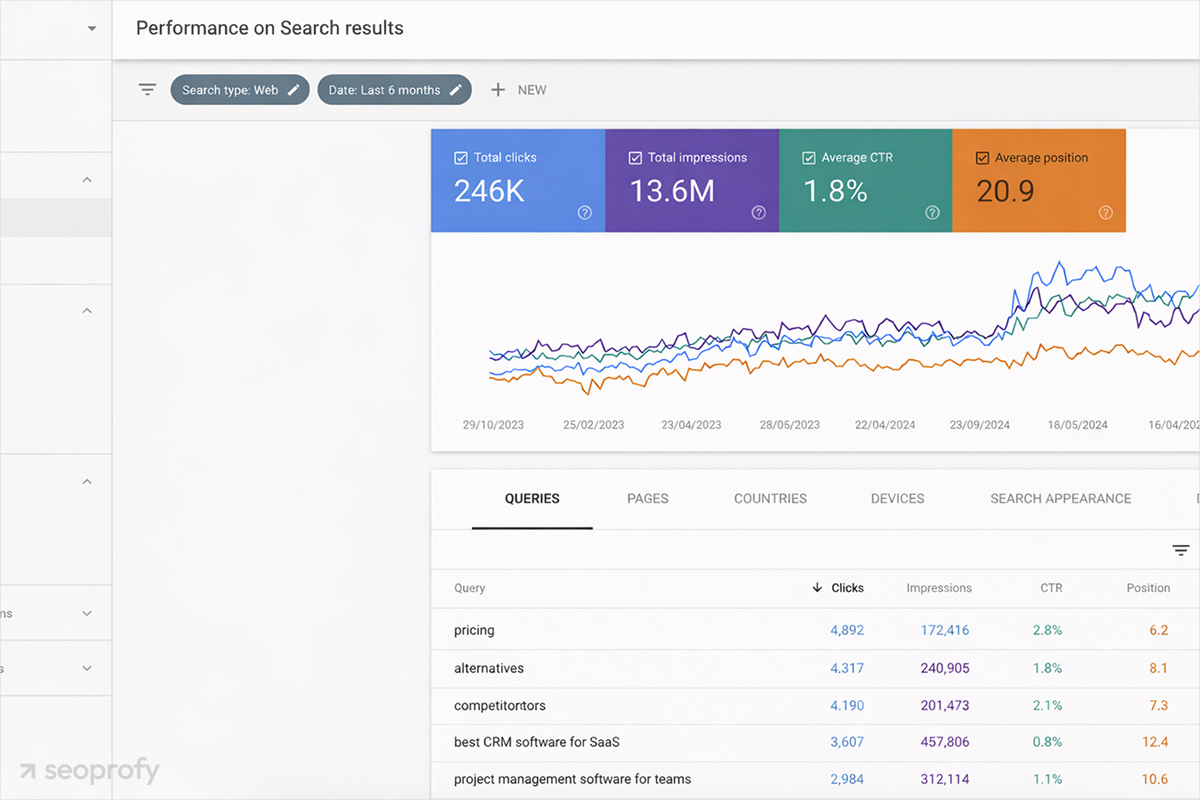
These queries usually generate less traffic but attract users with clearer purchase intent and higher conversion potential. That’s why modern B2B SaaS SEO strategies prioritize search intent and commercial relevance over raw keyword volume — focusing on traffic that drives revenue, not vanity metrics.
Step 4: Add revenue context with HubSpot
At some point, marketing metrics must make sense to:
- Founders
- Sales teams
- Leadership
This is where CRM tools matter.
HubSpot helps answer:
- Where did this lead come from?
- Did sales accept it?
- Did it become revenue?
If sales never close leads from a channel, that channel isn’t performing — no matter how good the traffic looks.
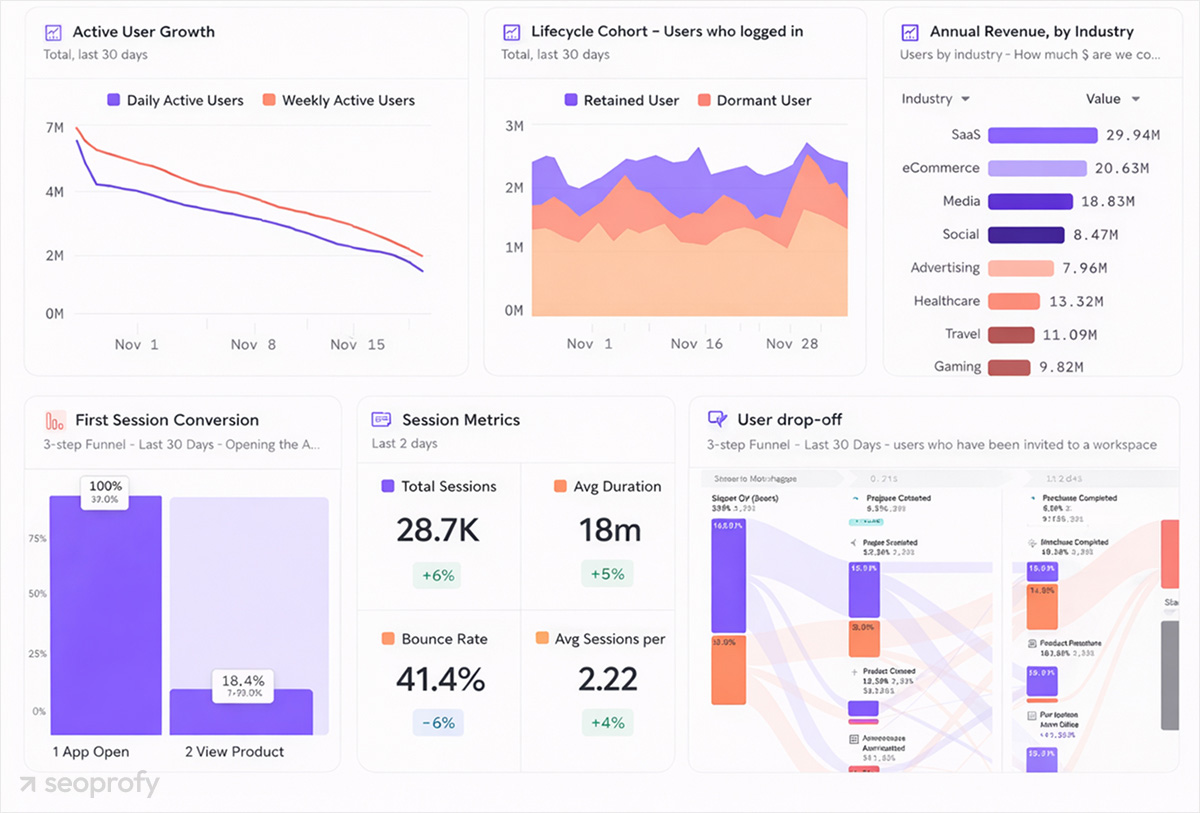
Step 5: Measure the real value of your SaaS digital marketing strategy with Mixpanel
In SaaS, using the product is more important than signing up.
Mixpanel shows:
- What users do after registration
- Where they drop off
- Which actions lead to payment
This is especially important today because:
- Many users sign up “just to test.”
- Fewer users commit immediately
- Activation quality matters more than volume
How analytics helps you grow (not just report)
Analytics is not about creating monthly reports.
It’s about answering practical questions:
- Which content brings users who activate?
- Which channel attracts long-term customers?
- What should we create more of?
- What should we stop doing?
When beginners understand this, analytics stops being scary and starts being useful when evaluating a digital marketing strategy for SaaS.
Simple benchmarks for keeping expectations realistic
While every SaaS is different, many teams see:
- 1–3% visitor → trial conversion
- 15–30% trial → paid conversion
- SEO influences a significant share of pipeline and revenue through assisted conversions and early-stage demand capture.
If you’re below this, analytics shows where to improve — not who to blame.
Build a marketing system that attracts the right audience and turns interest into real demand.
- High-intent traffic
- Qualified leads
- Buyer trust
- Long-term growth

Final Thoughts
There is no single successful marketing strategy for SaaS products that brings growth in isolation from the others. The best results come from building a system where acquisition, activation, retention, and revenue are interconnected. SEO, SaaS content marketing, paid media, partnerships, and lifecycle marketing and analytics are best when utilized in conjunction, rather than in isolation.
The key is for teams to focus. Rather than trying to implement every single strategy, successful teams focus on the ones that align best with their product, ICP, and sales motion. They optimize for the metrics that matter and base their decisions on real user data and not gut feelings.
If you are building or scaling a SaaS product, the best marketing to implement is not the one that does the most, but the one that does the most important things right consistently, turning marketing into a growth engine.
Ready to build a smarter marketing system? Book a SaaS product marketing strategy call with SeoProfy, an SEO company, to identify the channels and metrics that drive revenue — and create a clear plan to scale with confidence.

Julia Lubianytska is a Copywriting Team Lead at SeoProfy with over 7 years of experience in copywriting and editing. She works closely with copywriting teams, helping writers craft clear and thoughtful content for SaaS products, IT services, and businesses in the legal and medical fields. Julia enjoys turning complex topics into easy-to-understand, trustworthy content, focusing on structure, clarity, and consistency to ensure the content is genuinely helpful for real people, not just search engines.