

AI search engines can handle a variety of complex queries and follow-up questions due to deep contextual understanding. Powered by artificial intelligence, they process and understand both structured and unstructured data, enabling them to provide users with clear, personalized answers.


As of early 2026, nearly 4 out of 10 millennials opt for AI-powered search engines. Other user categories also rely on the answers provided by platforms powered by artificial intelligence. However, which of the AI search engines indeed deserve your trust and can provide you with the most accurate information? Check out our comprehensive review of popular platforms to find the one that meets your specific needs.
- Grok-3 Search LLM is the most vulnerable to AI hallucinations (94%).
- Brave Search offers the cheapest paid plan among modern AI search models at only $3/month.
- It’s strongly recommended to use a free version of the AI platform to test how it deals with your specific tasks before you opt for a paid subscription.
- Consensus is the best option for academic research since its algorithms use only academic sources.
- Perplexity and ChatGPT are the most appropriate options for everyday information search due to their friendly UIs, high processing power, and advanced capabilities of free versions.
Why Is AI Search Important?
AI delivers a search experience like never before, thanks to its high accuracy and personalized content, whether you need a quick answer or data-driven recommendations. Although 95% of US users still opt for default search engines like Google, 20% use tools powered by artificial intelligence to find information 10 or more times per month. Usually, people opt for AI search models to:
- Explore and learn about a specific topic (68%)
- Find a fact or statistic they’re interested in (62%)
- Discover a specific website (32%)
At the same time, it’s difficult to choose the best AI search engine, since each platform still has drawbacks that may affect the user experience. For example, many users from the US continue ignoring AI tools and opt for traditional search engines due to the following reasons:
- Privacy and data security issues (45%)
- Accuracy of the provided information (36%)
- A chance of creating harmful content (36%)
It is worth noting that these concerns are justified due to artificial intelligence bias. It refers to biased results arising from human influence on AI training algorithms and data, leading to potentially harmful outputs. Additionally, even the most popular models continue to “hallucinate” despite numerous updates. The top 5 platforms that have proven to provide partially or mostly incorrect answers are:
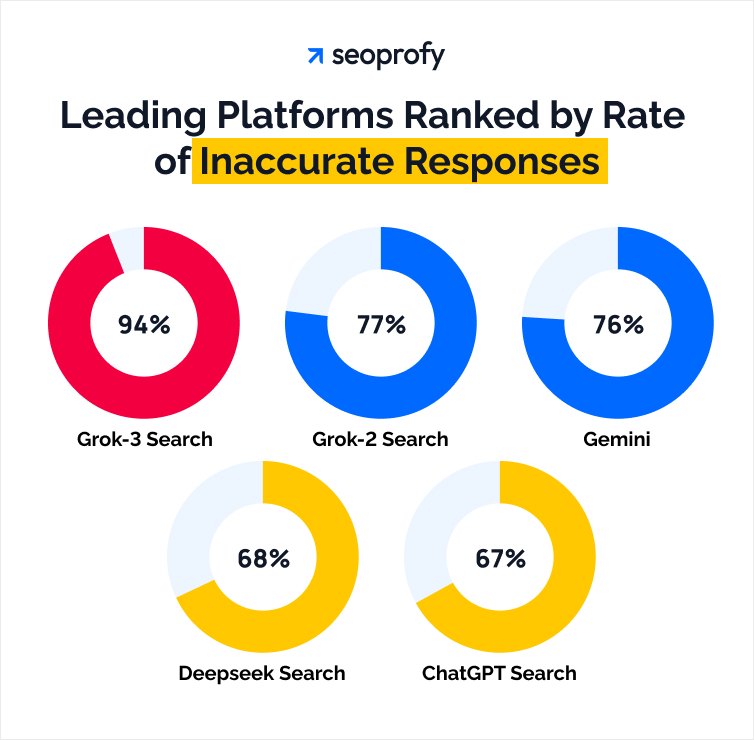
| Model Name | % of hallucinations |
| Grok-3 Search | 94% |
| Grok-2 Search | 77% |
| Gemini | 76% |
| Deepseek Search | 68% |
| ChatGPT Search | 67% |
Even business owners often have concerns about implementing this innovative technology. For instance, according to the latest AI SEO stats, 33% of them think that artificial intelligence can completely change the workforce, leading to job losses. Further, 30% of business owners aren’t sure about the accuracy of the content generated by AI.
On the other hand, progress is unstoppable, so businesses are also actively adopting artificial intelligence. According to Capgemini’s research, modern models are more and more used for:
- Data analysis (62%)
- Personalized customer experience (60%)
- Digital marketing campaigns creation (56%)
- Search engine optimization (56%)
Moreover, many businesses optimize their content to be relevant to both traditional and AI search engines. Thus, they can reach a broader audience genuinely interested in their services or products, resulting in more leads, higher conversions, and a stronger online reputation.
Which AI Search Engine Can Work Best For You?
Are you in a rush and don’t have time to test all the popular platforms powered by artificial intelligence? Check the table below to quickly choose the best AI search engine for your specific needs.
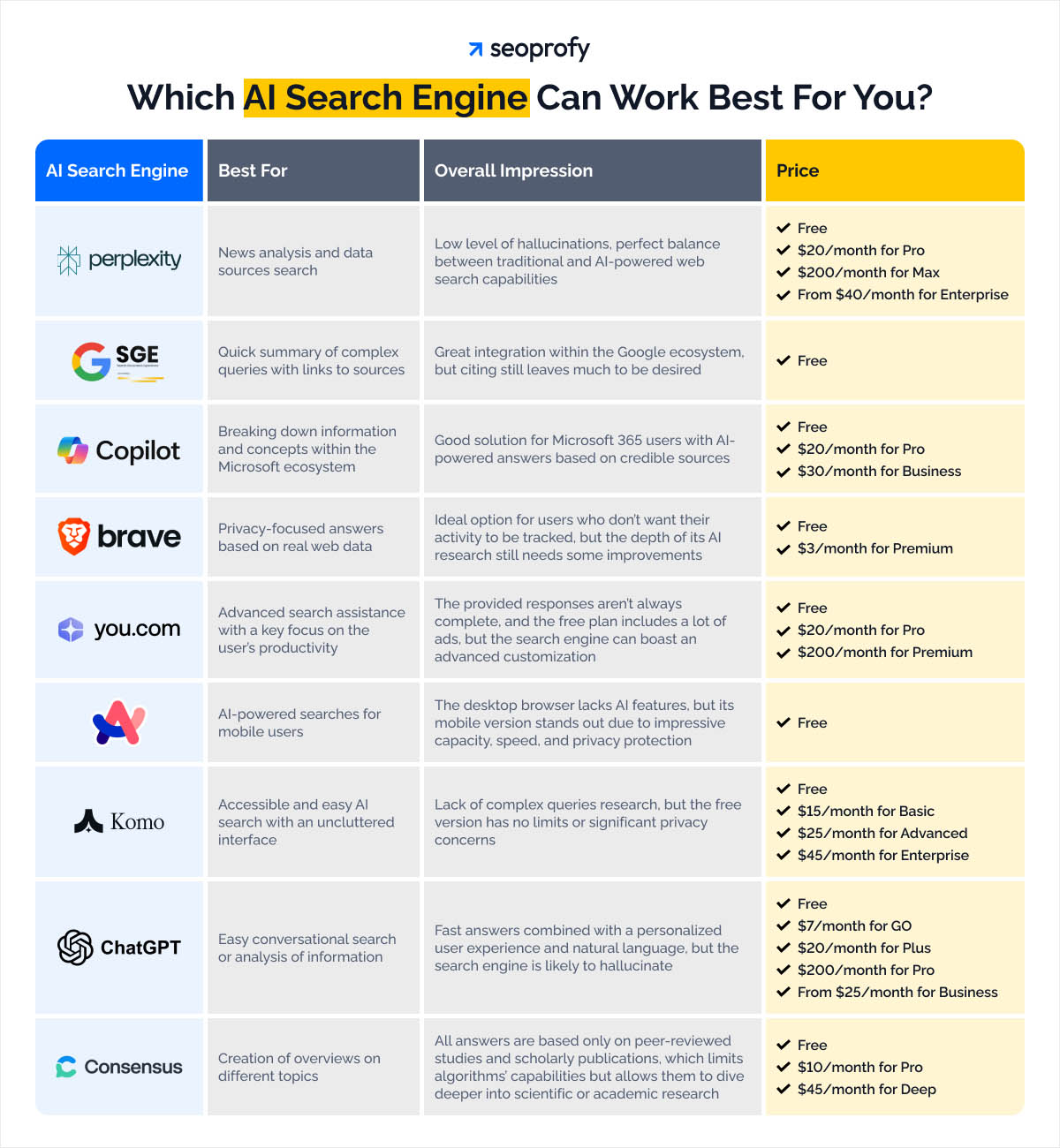
| AI search engine | Best for | Overall Impression | Price |
| Perplexity AI | News analysis and data sources search | Low level of hallucinations, perfect balance between traditional and AI-powered web search capabilities | Free; $20/month for Pro; $200/month for Max; from $40/month for Enterprise |
| Google SGE | Quick summary of complex queries with links to sources | Great integration within the Google ecosystem, but citing still leaves much to be desired | Free |
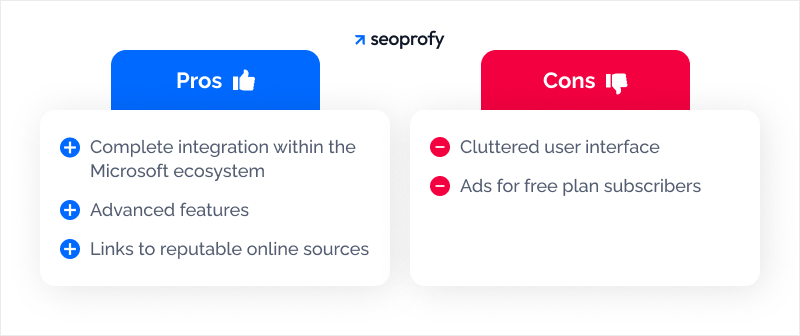
| Microsoft Copilot | Breaking down information and concepts within the Microsoft ecosystem | Good solution for Microsoft 365 users with AI-powered answers based on credible sources | Free; $20/month for Pro; $30/month for Business |
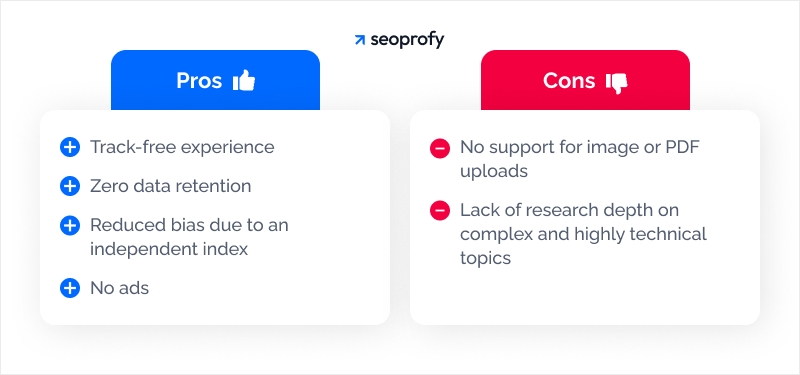
| Brave Search | Privacy-focused answers based on real web data | Ideal option for users who don’t want their activity to be tracked, but the depth of its AI research still needs some improvements | Free; $3/month for Premium |
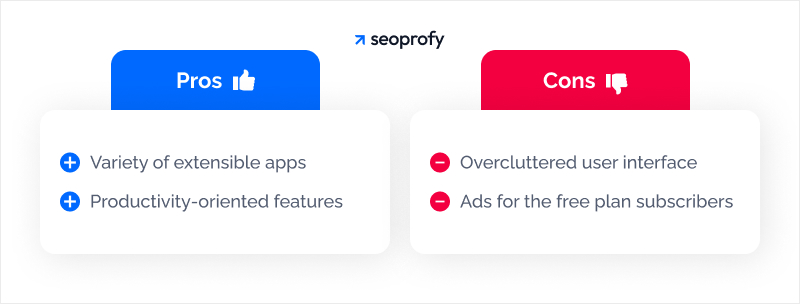
| You.com | Advanced search assistance with a key focus on the user’s productivity | The provided responses aren’t always complete, and the free plan includes a lot of ads, but the search engine can boast an advanced customization | Free; $20/month for Pro; $200/month for Premium |
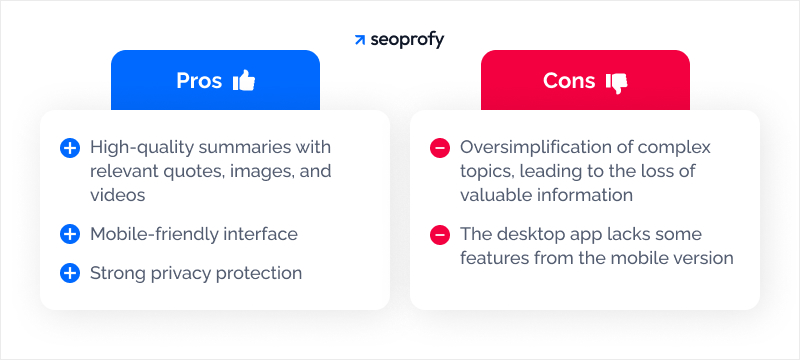
| Arc Search | AI-powered searches for mobile users | The desktop browser lacks AI features, but its mobile version stands out due to impressive capacity, speed, and privacy protection | Free |
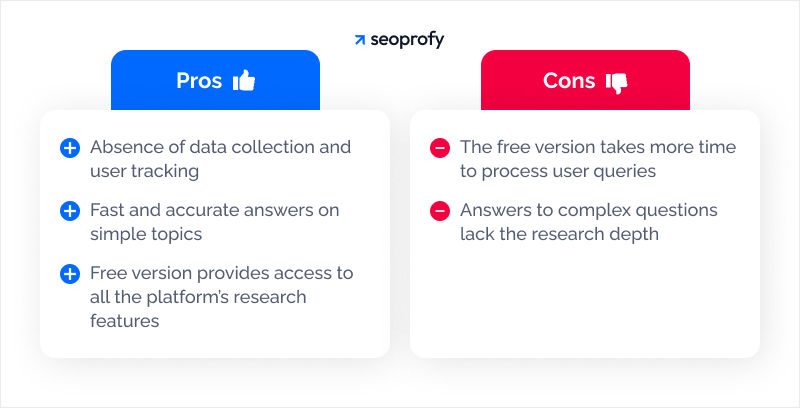
| Komo AI | Accessible and easy AI search with an uncluttered interface | Lack of complex queries research, but the free version has no limits or significant privacy concerns. | Free; $15/month for Basic; $25/month for Advanced; $45/month for Enterprise |
| ChatGPT Search | Easy conversational search or analysis of information | Fast answers combined with a personalized user experience and natural language, but the search engine is likely to hallucinate | Free; $7/month for GO; $20/month for Plus; $200/month for Pro; from $25/month for Business |
| Consensus | Creation of overviews on different topics | All answers are based only on peer-reviewed studies and scholarly publications, which limits algorithms’ capabilities but allows them to dive deeper into scientific or academic research. | Free; $10/month for Pro; $45/month for Deep. |
How We Tested Each AI Search Engine
Considering the variety of LLMs and platforms that use them, choosing the best AI search engine is a tough challenge. So, to provide an accurate and data-based estimation, we’ve used the following metrics:
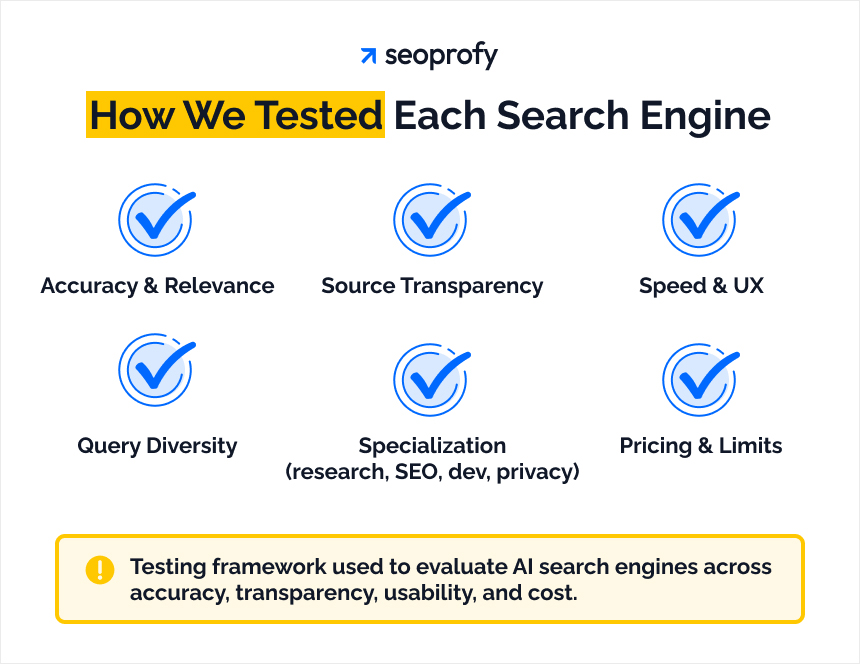
- Query diversity: It shows how an AI model can handle questions and topics of different types and complexity. We used a broad range of different queries, including technical, analytical, and factual.
- Answer accuracy and relevancy: Ideally, an AI model should provide clear answers that directly address the user’s request, while avoiding hallucinations. We compared the received answers against verified sources such as Semrush and Google to ensure there is no misleading information.
- Platform’s usability: An AI search engine must ensure easy access to its features. While testing the platforms, we paid separate attention to their navigation, system clarity, and responsiveness.
- Research speed: A user’s productivity depends on how fast they receive an answer from the AI model. Using both simple and complex queries, we measured the response time it takes to get a satisfactory response.
- AI specialization: Some AI search engines are designed to provide well-researched answers on certain topics, such as programming, law, or medicine. We checked the terminology accuracy and evaluated the depth of specific research, as well as compared them to general-purpose responses.
- Platform’s pricing: Last but not least, a good AI search platform must provide a good balance between its capabilities, delivered value, and accessibility. While reviewing the models from our list, we also compared the differences between the prices of their premium plans.
We used the described metrics and testing method to analyze the capabilities and reliability of all search engine AI platforms from our review. Due to our data-based approach, we could comprehensively review these models and estimate their effectiveness.
Detailed Reviews of the Best AI Search Engines
It’s time to select an AI-driven search engine that fully meets all your needs, such as proficiency in a particular topic, depth of research, or integration with a specific ecosystem. Below, you can discover the descriptions of the most popular models with the key features, advantages, and drawbacks.
Perplexity AI
Among all modern AI search models, Perplexity stands out due to its natural conversational interaction with a user, combined with real-time online research. The platform offers clear, cited answers and a variety of advanced features:
- Structured approach in responding to queries
- Concise summaries with the source links
- Separate “Sources” tab
- Answers with useful comparison tables
- Related search results
Using Perplexity feels like you’ve opted for an improved version of Google that summarizes everything in bullet lists and tables. For instance, if you ask the platform to provide you with the best tools for SEO audit, it can deliver a comprehensive analysis indeed:
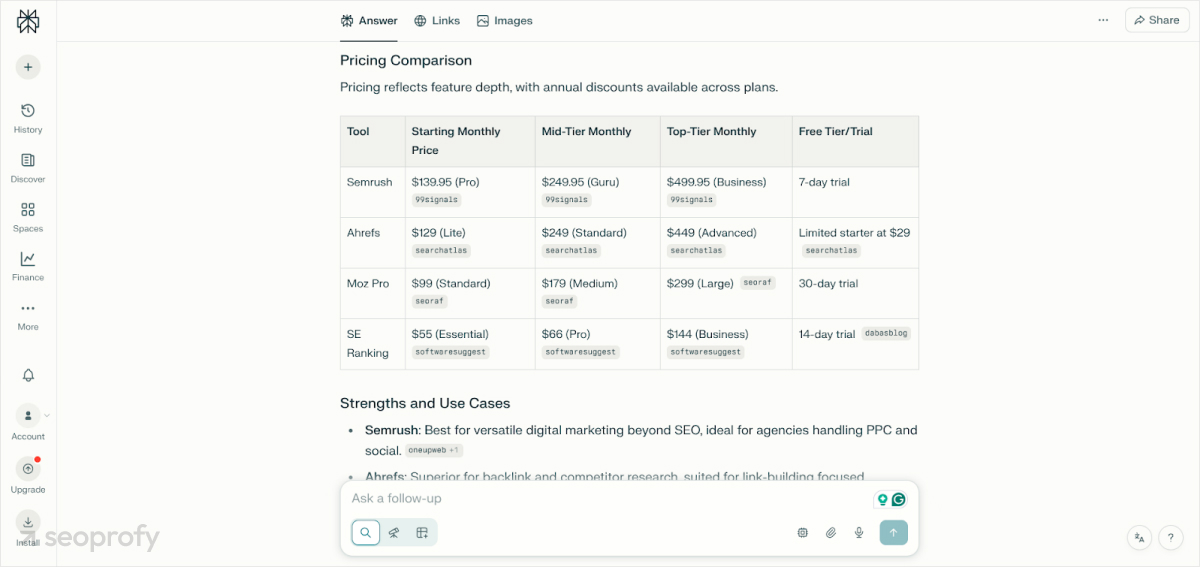
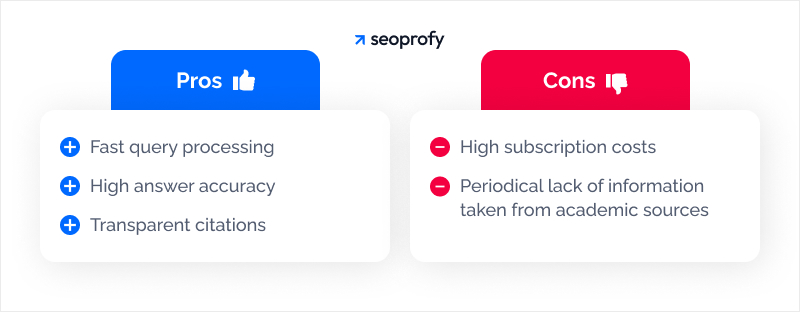
All in all, Perplexity is the best AI search engine for an average user looking for in-depth research based on data from reliable sources. It combines powerful search capabilities with conversational language, ensuring the best experience.
| Pros | Cons |
|
|
Pricing Tiers:
- Free for Basic
- $20/month for Pro
- $200/month for Max
- from $40/month for Enterprise
Google SGE / Gemini
Google Search Generative Experience powered by Gemini is an advanced AI-driven search engine that uses artificial intelligence to deliver quick, contextual, and reliable results. Launched in July 2025, it organizes the answers from relevant online sources into self-contained pages.
Further, unlike Google AI Mode, its Web Guide doesn’t offer conversational interactions. It focuses on a single query and searches for relevant information on the web, allowing you to discover pages you might have missed with traditional web search engines. For example, here you can see how Web Guide provides information on the search for trending topics:
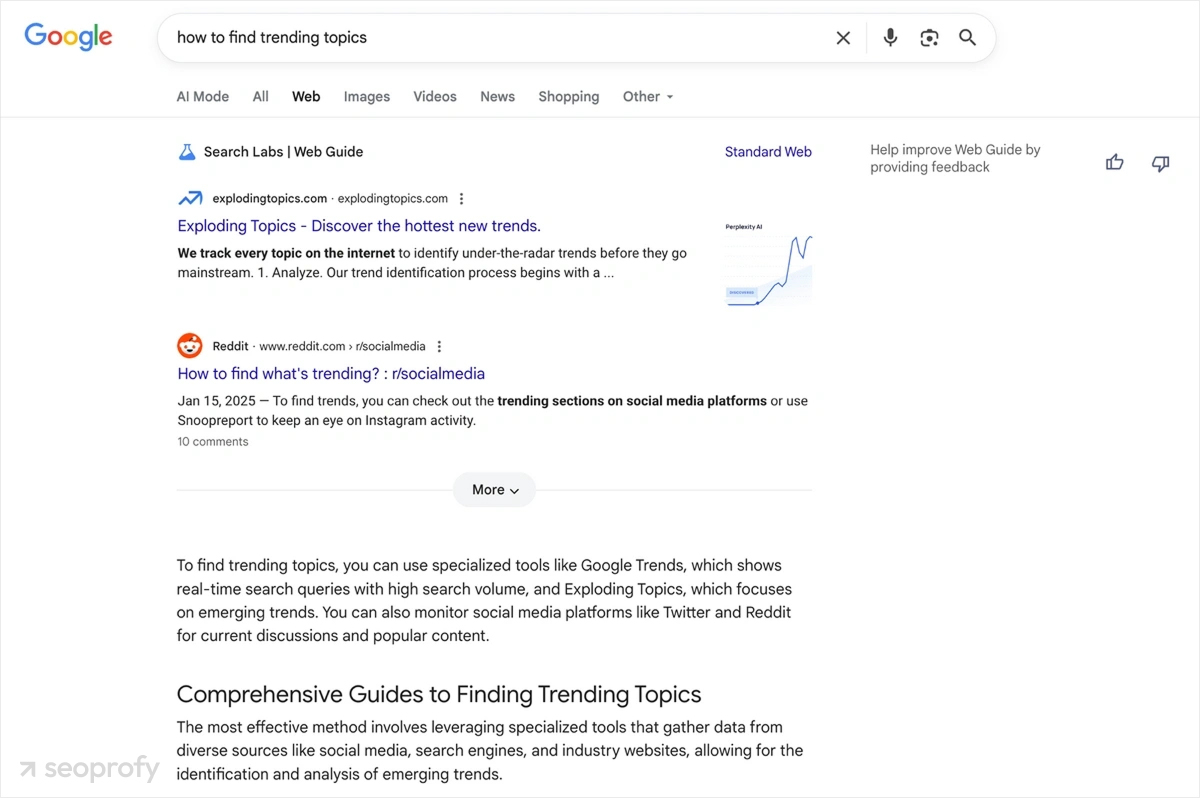
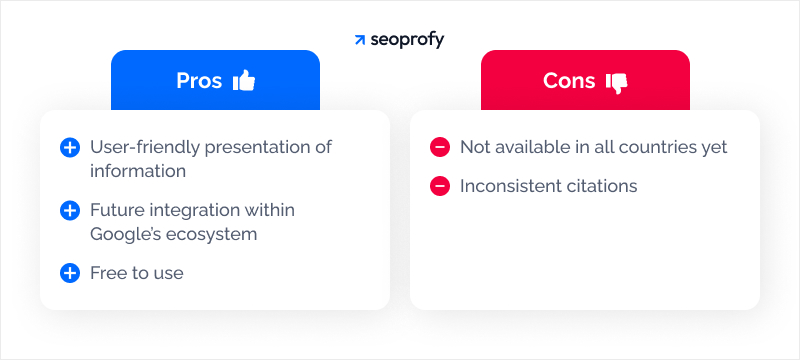
Unfortunately, Google hasn’t fully integrated this tool within its ecosystem for users from all countries yet. However, some users have already tested in the Search Labs.
| Pros | Cons |
|
|
Pricing Tiers:
- Free
Microsoft Copilot (Bing)
In 2023, Microsoft released a new Bing version based on GPT-3.5, and since then, this search engine AI model has continued to improve. Later, Bing was integrated into Copilot, which resulted in the release of a useful assistant for office productivity. Currently, running on OpenAI’s GPT-5, it can deliver accurate search results in natural language. It perfectly structures the information, using comparison tables, just like in our request for the best SEO audit tools:
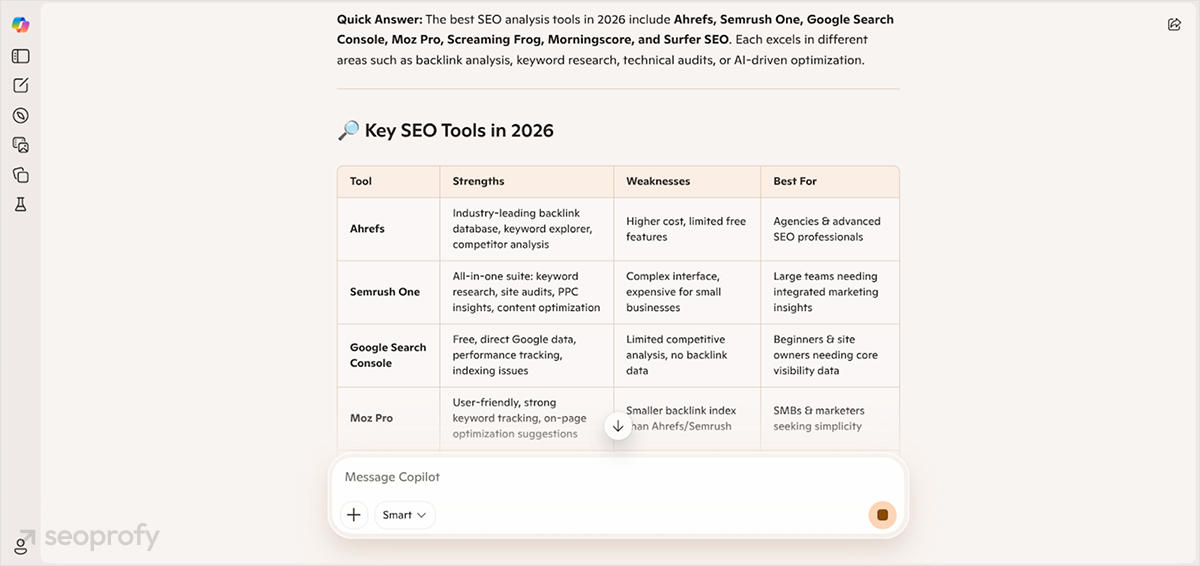
Copilot is the best AI search engine for users who regularly work in the Microsoft 365 ecosystem. In addition, it also offers other impressive features, including advanced image generation.
| Pros | Cons |
|
|
Pricing Tiers:
- Free for Basic
- $20/month for Pro
- $30/month for Business
Brave Search / Brave AI
If you have any concerns about privacy, this AI-driven search engine is just what you need. While avoiding using Google or Bing’s indices, Brave Search provides accurate summaries based on the information from relevant reputable online sources.
Users can activate the AI-powered search feature by clicking the “Answer with AI” button. Brave will then provide you with a well-structured answer to your query, providing the links to sources from which the information was derived:
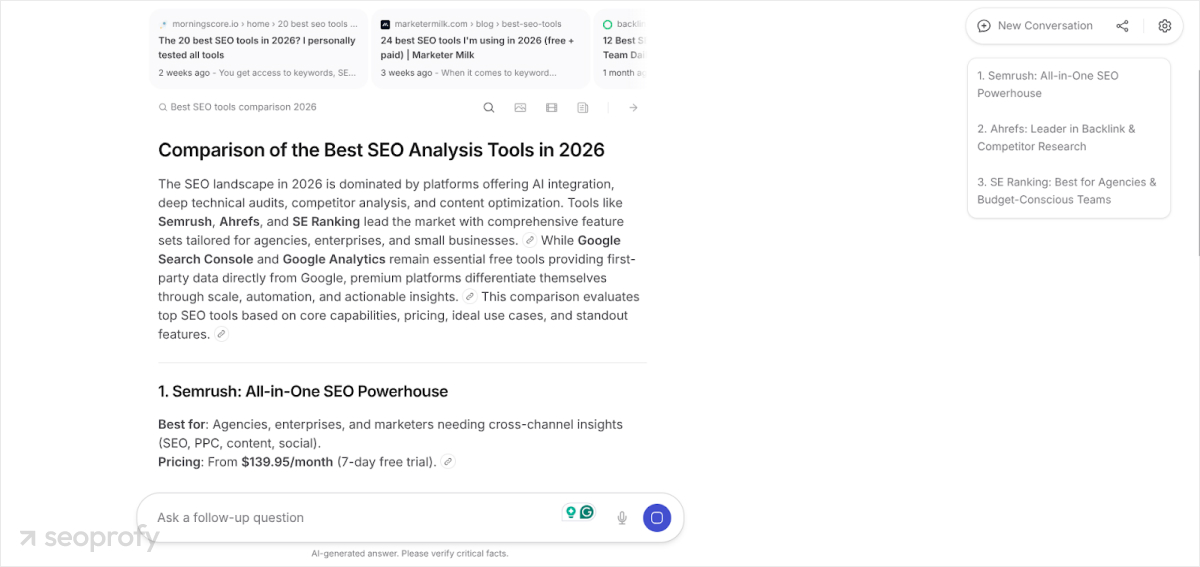
Brave hasn’t officially disclosed which LLM it uses to generate the answers. However, the results it delivers are slightly similar to Google’s AI Overviews, but with a more advanced chatbot interface.
| Pros | Cons |
|
|
Pricing Tiers:
- Free for Basic
- $3/month for Premium
You.com
If you want to boost your productivity, You.com may be the best AI search engine for your goal. Featuring advanced tools for email drafting, code generation, script testing, and article summarization, this platform will surely simplify your daily tasks.
You.com features multiple AI models, including GPT-5 and Claude. Users can adjust the experience through numerous settings. However, even if you choose the default options, you’ll still get solid, well-structured answers to your questions and links to online sources:
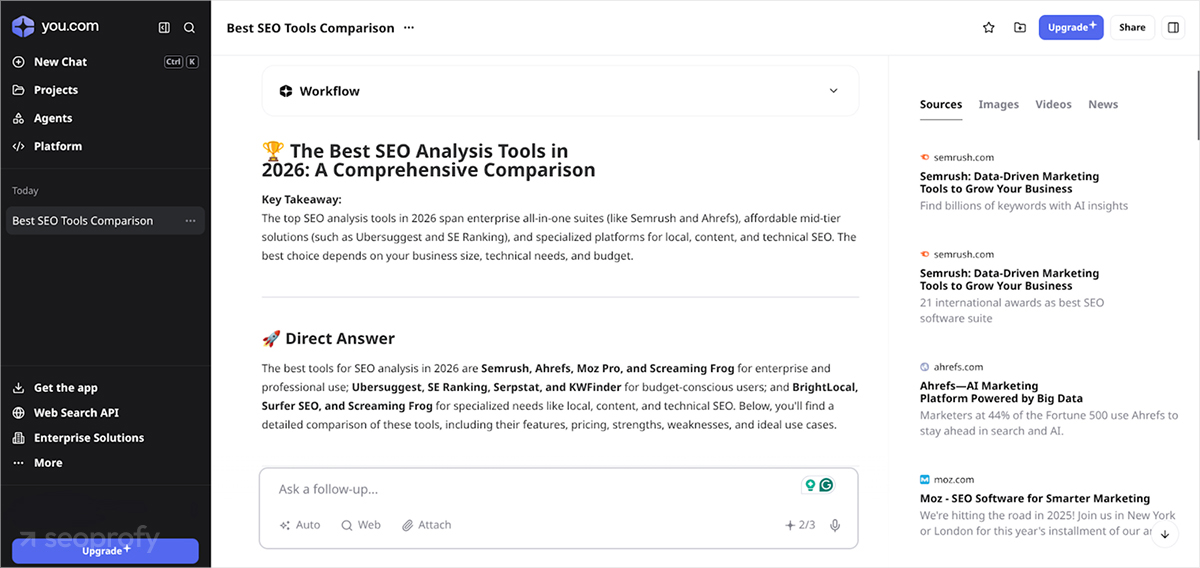
On the other hand, the platform’s interface leaves much to be desired, since it feels slightly overwhelming. However, you can get used to it in a day or two of active usage.
| Pros | Cons |
|
|
Pricing Tiers:
- Free for Basic
- $20/month for Pro
- $200/month for Premium
Arc Search
Arc Search is an AI-driven search engine developed specifically for iOS and Android users. Although there is a Max version for desktop browsers with a bundle of useful extensions, it currently lacks some features that you can find in a mobile app.
Using the “Browse for Me” tool, this AI can search for the necessary information across web sources. Once finished, it creates a custom webpage that summarizes all the collected data and insights:

Arc uses various LLMs, including OpenAI’s products, to efficiently analyze and read web page content. Further, due to its advanced capabilities, it enhances its summaries with relevant images, quotes, and embedded videos.
| Pros | Cons |
|
|
Pricing Tiers:
- Free
Komo AI
Komo’s main goal is to ensure a fast, ad-free experience for users, even without requiring a sign-up. This AI-driven search engine features an intuitive interface and a variety of modes, including Ask, Research, Search, and Explore. Also, users can switch between different LLMs, such as DeepSeek, OpenAI, Claude, Gemini, and LIama.
With such an advantageous technological background, there are many ways to use this AI platform: research, essay writing, or planning. Depending on your objectives, Komo will use the information from data sources like academic research papers, popular websites, news, and its internal data. Thus, it can come up with pretty accurate and well-structured answers:
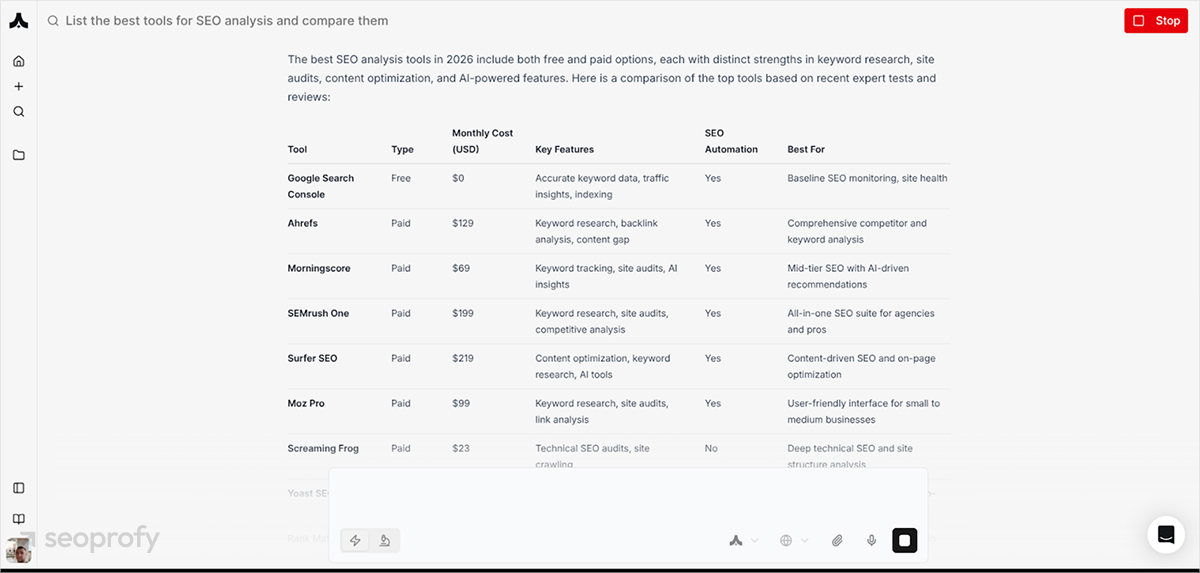
Unfortunately, choosing this AI for complex search queries isn’t the best decision, as it often provides only surface-level information. Plus, the platform’s interface is slightly overcluttered, which may distract some users.
| Pros | Cons |
|
|
Pricing Tiers:
- Free for quick queries
- $15/month for Basic
- $25/month for Advanced
- $45/month for Enterprise
ChatGPT Search / Answer Engine
As one of the most popular search engine AI platforms, ChatGPT is undoubtedly a leader in the booming artificial intelligence market. Powered by OpenAI’s GPT-5, this smart assistant can summarize real-time relevant information in natural language.
This is the best AI search engine for any average user due to its clear interface, strong processing capabilities, and dialogue-driven, accurate responses. Its answers are great for brainstorming, business plan development, and in-depth topic exploration, since they are well-structured and based on reputable sources:
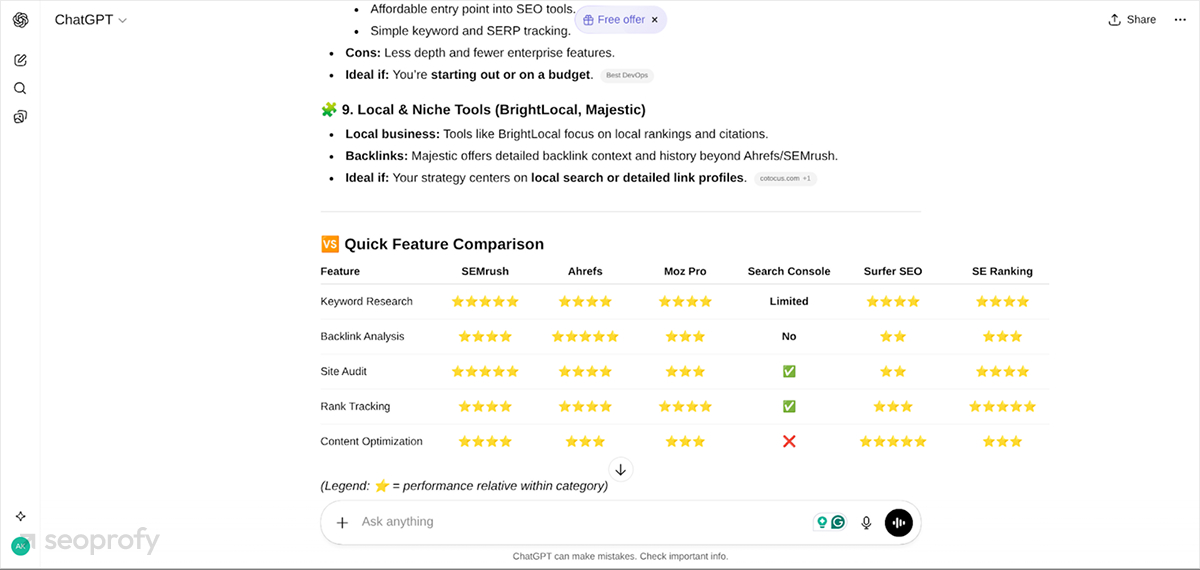
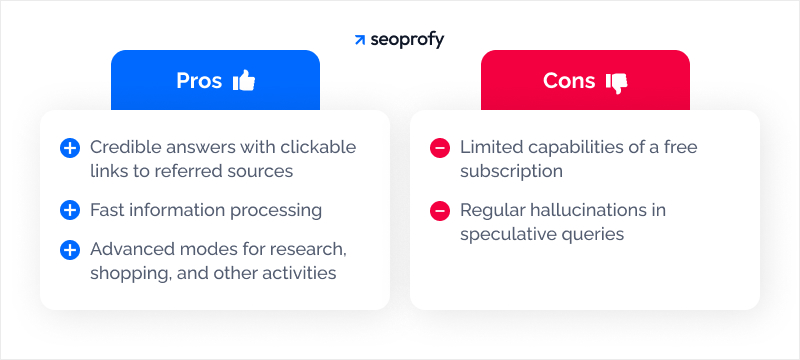
GPT-5 is one of the most advanced modern LLMs, as it understands natural language, conducts comprehensive research, and provides personalized responses. Unfortunately, ChatGPT offers only limited free user access to this model, which sometimes significantly slows down the exploration process.
| Pros | Cons |
|
|
Pricing Tiers:
- Free for Basic
- $7/month for GO
- $20/month for Plus
- $200/month for Pro
- from $25/month for Business
Consensus
Consensus is the best AI search engine for discovering, organizing, and processing peer-reviewed studies. Its algorithms need seconds to research and summarize academic papers.
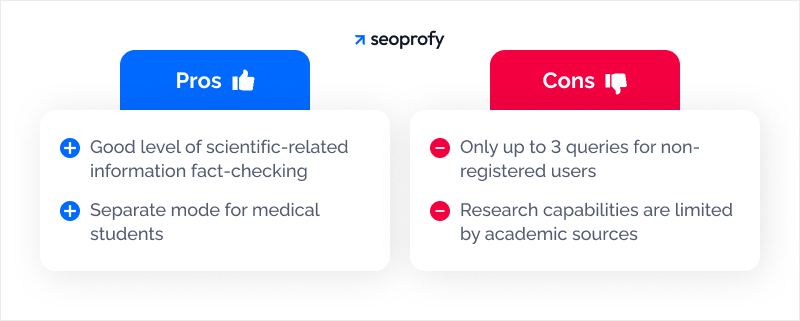
The AI-driven search engine allows its users to switch between two modes: Pro and Deep Research. Further, there is a separate feature for medical students, which enables the algorithms to use only medicine-related sources.
The layout of information needs some improvements as it’s slightly overwhelming. However, as you can see, this search engine AI platform still provides links to sources, uses bullet lists, and tables:
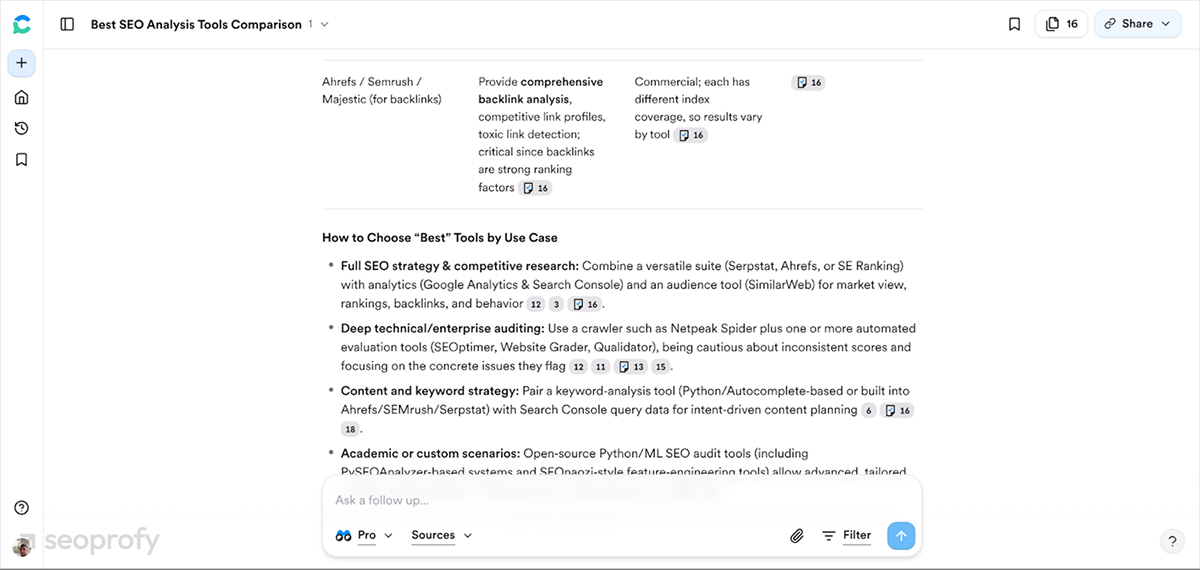
Since Consensus uses only academic sources, its knowledge in some fields may be limited. On the other hand, it provides highly accurate answers in fields like education, healthcare, law, and finance.
| Pros | Cons |
|
|
Pricing Tiers:
- Free for Basic
- $10/month for Pro
- $45/month for Deep
Tips for Optimizing Content for AI Search
AI search engines can not only boost your productivity but also enhance the visibility of your business or personal brand. If your web content gets cited by ChatGPT, Copilot, or other platforms, you’ll reach broader audiences. And with our tips, even the best AI search engine won’t be able to ignore the information provided by your website:
- Perform an AI SEO audit first to identify the strengths and weaknesses of your content.
- Optimize your blog posts for conversational queries, since AI chatbots prefer information from direct answers to questions. Also, ensure that your content sounds natural and features an FAQ section with accurate and useful information for users.
- Adjust your txt. and llms. files to show AI what content on your site is the most useful and worth citing.
- Check whether your pages are well structured and feature clear schema markup.
- Regularly update your content to ensure it includes useful, comprehensive, and up-to-date information.
Consider that many modern AI-driven search engine platforms allow their users to opt for Voice and Image search features. If you want your content to get mentioned in these types of answers, it must meet the following criteria:
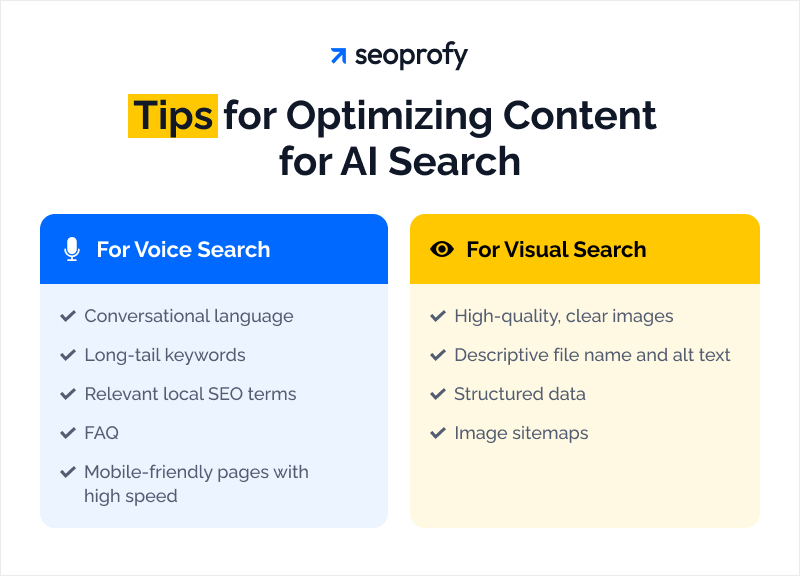
| For Voice Search | For Visual Search |
|
|
Step‑by‑Step Framework to Choose an AI Search Engine
Whether you plan to boost your AI SEO strategy or need research for your medical dissertation, you must know how to choose the best AI search engine for your objectives. Here, we’ve prepared a 5-step simple algorithm for you to select the most appropriate option:
- Clearly identify your goals and expectations for AI search engine use.
- Compare the key features of several platforms and select those that can handle complex problems according to your requirements. Additionally, you can focus on characteristics such as privacy protection, processing speed, and citation quality.
- Prepare identical queries and test them across multiple platforms to estimate the quality of their answers and link relevancy.
- Pay attention to the price and read reviews on platforms like Trustpilot to decide whether the cost is justified by the value.
- Once you finish the analysis, choose the AI search engine that best meets your needs.
Conclusion
We’ve reviewed the best AI search engine platforms for different tasks — from everyday use to specialized academic research. All of them have their pros and cons, and their developers keep improving these products, adding new features from time to time. Luckily, all of them have a free version which you can use to test their capabilities without paying a cent.
Also, if you want to optimize your content to make it visible for AI search algorithms, SeoProfy is at your disposal! You are welcome to explore our case studies to see the practical benefits of our cooperation for your business or personal brand.

Bohdan has been an SEO analyst at SeoProfy for more than two years. He began his career in digital marketing in 2019 and has since gained experience helping scale some of the world’s leading brands in industries such as gambling and SaaS. Bohdan specializes in developing effective strategies tailored to specific regions.