

SaaS lead generation strategy is a complex approach to attracting potential users and converting them into paying customers. It requires a mix of marketing efforts, search engine optimization, and product-driven techniques that help prospects discover your offer, explore its value, and move through a decision journey.


What makes SaaS different is that revenue depends on retention. Winning the lead is step one. Keeping that account active, renewing, and expanding is where profit comes from. Lead generation for SaaS companies is not about quick wins; it is about guiding users from awareness to consideration to decision — and then keeping them.
Successful strategies for SaaS lead generation include content marketing, paid advertising, PR, partnership, and outbound outreach to maintain visibility, brand authority, and trust. SEO supports each of these channels. It ensures that your marketing message and content match specific user intent and remain discoverable in search.
- Consistent SEO lowers CAC and keeps delivering a qualified pipeline long after paid spending stops.
- Search intent mapping helps you get found by the exact buyers who are already looking for a solution.
- Metrics like MQLs, SQLs, and PQLs reflect the true performance of your lead strategy.
- Integrating data, content, and outreach turns SEO into a long-term growth engine.
- The focus shifts from traffic volume to lead quality and retention-driven revenue.
- Lead quality matters more than lead volume. In SaaS, you optimize for LTV: CAC and payback period, not raw signups.
Why Lead Generation in SaaS Is Different
Lead generation for SaaS isn’t about quick wins or one-time transactions — it’s about building long-term relationships that fuel recurring revenue. Unlike traditional B2B industries, SaaS companies operate on a subscription model, where customer retention is just as important as acquisition.
Recurring-Revenue Dynamics
Because revenue comes from monthly or annual subscriptions, you’re not just asking, “Can we close this lead?” You’re asking, “Will this account stay long enough and expand enough to pay back acquisition cost and turn profitable?” That means lead generation strategies must focus on attracting the right users — the ones who will stay, engage, and renew.
Long Buyer Journeys
In SaaS, most buyers don’t convert after one touch. For self-serve products, the path is usually research → trial → activation. For mid-market and enterprise, it’s research → comparison → demo → internal approval → pilot. Each step needs its own content.
Product-Led Growth
Many SaaS companies rely on product-led growth (PLG) — letting the product itself drive adoption. This shifts marketing focus from heavy sales outreach to creating value through hands-on experiences like free plans, trials, or interactive demos.
High CAC (Customer Acquisition Cost)
Paid acquisition in SaaS is brutally expensive, especially in mature categories. If you rely only on paid, your CAC payback period (how long it takes a new customer to cover what you spent to acquire them) can stretch beyond 12 months. That’s not healthy. SEO and content help shorten payback by sending you users who were already looking for a solution.
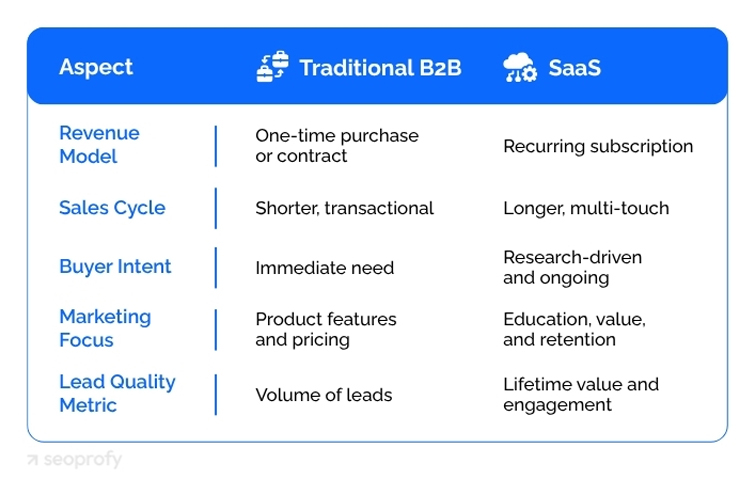
Traditional B2B Lead Gen vs. SaaS Lead Gen
Let us see how SaaS lead generation differs from traditional B2B approaches in structure, goals, and metrics.
|
Aspect |
Traditional B2B |
SaaS |
| Revenue Model | One-time purchase or contract | Recurring subscription |
| Sales Cycle | Shorter, transactional | Longer, multi-touch |
| Buyer Intent | Immediate need | Research-driven and ongoing |
| Marketing Focus | Product features and pricing | Education, value, and retention |
| Lead Quality Metric | Volume of leads | Lifetime value and engagement |
Lead Generation Channels For SaaS Companies (and How SEO Strengthens Each)
When selecting the right channels to show your offer, you need to consider a single rule: be where your customers are.
Content Marketing & SEO Synergy
Your brand’s blog is one of the key channels that generates leads. By creating valuable content relevant and optimized to potential customers’ needs, preferences, and goals, you can address users at different stages of the funnel.
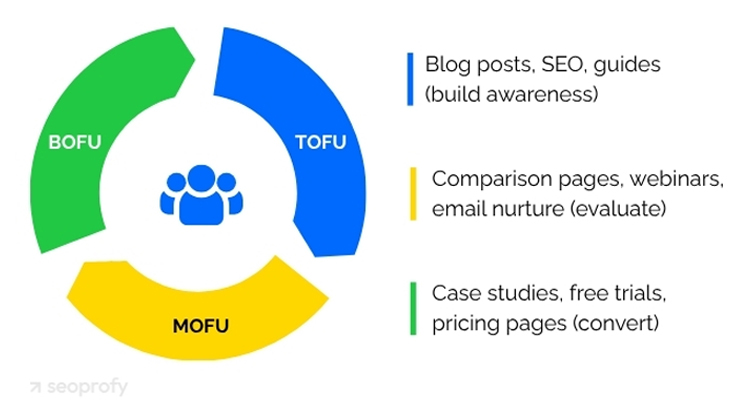
TOFU: Top of the Funnel
At this stage, your goal is awareness. You’re not selling yet — you’re helping your target audience understand the problem and the broader context around it. TOFU content is educational, approachable, and often answers “what” and “why” questions.
Example: Best Tools for Project Management — a post that introduces different options and helps readers recognize their needs.
MOFU: Middle of the Funnel
Once people understand the problem, they start exploring potential solutions. This is where comparison and consideration content comes in. MOFU pieces guide readers through available options, helping them make informed choices.
Example: Asana vs Trello vs ClickUp: Which Tool Fits Your Team Best? — a side-by-side breakdown that helps users evaluate their options.
BOFU: Bottom of the Funnel
Here, your audience is ready to make a decision. BOFU content should clearly show why your solution is the right one. Use real examples, results, and case studies to prove the value of your product or service.
Example: How to Reduce Project Delivery Time by 40% with [Your Tool] — a data-backed story that shows exactly how your product solves the reader’s problem.
After conversion, content continues to play a crucial role in keeping users engaged, satisfied, and paying. Post-signup and onboarding materials — such as walkthroughs, success stories, and feature-deepening tutorials — quickly activate the users, expand usage, and reduce churn. It strengthens retention and supports long-term growth.
The inbound blog-led lead generation strategy guides users through the funnel, turning visitors into qualified leads:
- Raises awareness by introducing problems and solutions.
- Supports consideration by helping users evaluate options.
- Drives decision-making by showcasing value and results.
Each blog post ranks for high-intent queries, brings in new users who really feel the need for your solution, and routes them from top to bottom of the funnel instead of letting them bounce. Internal links navigate users to free trials or demo requests, moving them closer to conversion.
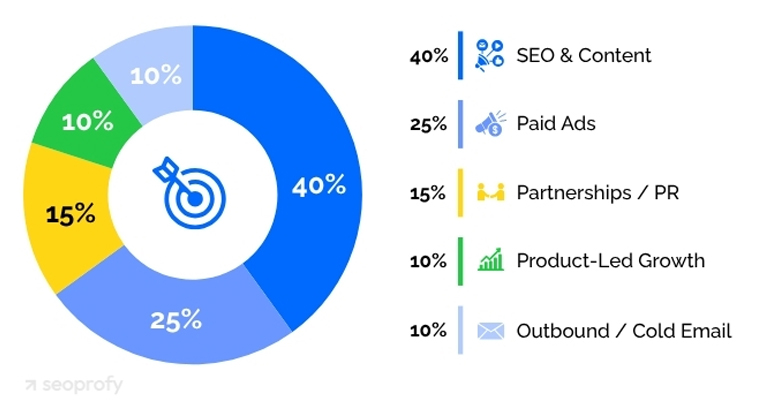
SEO helps to enhance this effective lead generation strategy. It informs keywords for better website structuring and higher content ranking, ensures alignment with SERP intent, and builds topical authority around key buyer pain points. Such an approach signals expertise, experience, and trustworthiness (EEAT) to search engines — core ranking factors determining which content appears at the top of the search results.
Paid Advertising
Paid ads (Google Search, LinkedIn, and Meta) help you showcase your solutions to BOFU users, those with competitor-intent — those who are actively searching for alternative solutions. While generating new leads, the CAC is typically higher (especially in competitive niches), and quality is inconsistent. Each lead should be measured against SQL and PQL benchmarks. It means that not all clicks are valuable. Captured leads should progress to sales-qualified or product-qualified ones.
That is why PPC works best in coordination with SEO efforts. Keyword alignment in PPC and organic search maximizes visibility (at least two positions in SERP are taken) and supports better conversions. Mapping ad keywords to the user’s funnel stage further increases the likelihood of capturing leads who progress to SQL or PQL.
Product-Led Growth & SEO
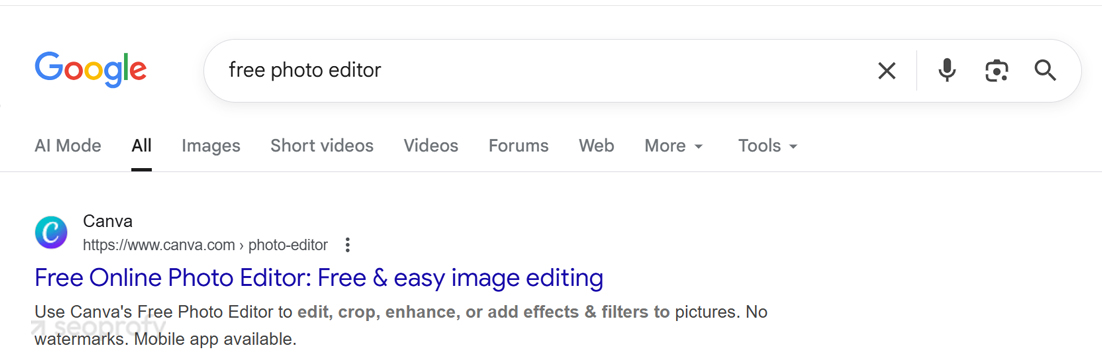
A product-led strategy is based on attracting users to free trials, tools, and services as part of a paid offer. Let us take the Canva visual editor. It offers free editing tools, free templates and elements, and covers some target user needs. In the course of editing, users see the simplicity of the interface and the choice of additional tools, components, templates, and opportunities.
This moves them closer to a purchasing decision by motivating them to request a demo or start a free trial. Users see the value they receive for their money. The trust is built with the possibility to cancel the trial at any time.
To effectively rank free trial tools, the keyword strategy should take into account:
- problem-based intent (“Change photo background”)
- solution framing (“photo editor”)
- commercial modifier (free, premium, all-inclusive, etc.).
The following example shows how Canva positions its image editor:
Partnerships, PR & Backlinks
Buyers don’t just trust what you say about yourself. They Google you. They read comparisons, Reddit threads, case studies, guest features, and niche industry blogs.
Partnerships with other companies generate high-quality leads by putting your product in front of an already relevant audience. This often takes the form of co-marketing (joint webinars, shared landing pages, integration guides) or ecosystem partnerships (“Use [Tool A] + [Tool B] to automate X”). These leads convert better because the user already understands the context and the use case before they ever talk to sales.
PR ensures media coverage and brand mentions and builds trust and authority. Strong backlinks from high-quality, relevant content work on two levels. First, they send qualified referral traffic directly to your most valuable pages — pricing, demos, or free trials. Second, they strengthen those pages’ ability to rank organically, increasing visibility for key SaaS keywords over time. When the referring content continues to rank or get shared, it keeps generating leads long after the initial outreach is done.
Outbound & Cold Outreach
Outbound and cold outreach are proactive strategies that suggest direct contact with potential customers. These can be calls, emails, or through social media platforms. The approach is commonly used for growth acceleration, targeting specific markets and audiences that are difficult to reach with other methods, and gaining more control over the sales process. Cold outreach is crucial for B2B SaaS lead generation, as it suggests a longer sales cycle and requires a personal connection.
SEO offers extensive details about how target users search for solutions, their pain points, intent, and the language they use. These data inform relevant outreach messaging.
SeoProfy ensures you get leads, not traffic.
- SaaS-tailored SEO strategy
- Sales funnel keyword mapping
- Content optimization and scaling
- Authority link building and PR

To boost lead generation and long-term growth, many businesses choose reliable SaaS SEO companies that specialize in optimizing content, keywords, and website structure for B2B audiences.
SEO as the Engine Behind Scalable SaaS Lead Gen
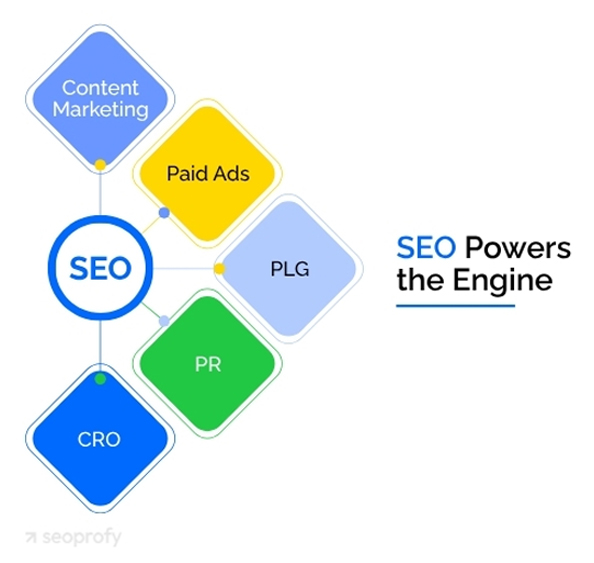
SEO is an essential support in lead generation for SaaS companies, as it ensures visibility in search results, drives long-term growth, and complements other promotional channels. To explore specific optimization tactics and frameworks, check this detailed SaaS SEO guide.
Search Intent Mapping for SaaS
Mapping search intent for B2B SaaS lead generation is crucial because it allows you to attract the right audience genuinely interested in your product. You need to understand three primary types of intent:
- Informational → blog guides, playbooks
- Commercial → comparison pages, “[Competitor] alternatives,” use case pages
- Transactional → pricing, demo, trial, onboarding/signup flows
Understanding intent types is just the first step; here’s how to map them to keywords and content in a clear, practical process:
- Collect keywords using tools like Ahrefs, Semrush, Google Keyword Planner, SurferSEO, or Ubersuggest.
- Classify keywords by intent by analyzing the SERPs for each keyword to see what content ranks.
- Map keywords to content types — assign keywords to blog posts, landing pages, comparison pages, or trial/signup pages depending on their intent.
- Analyze and optimize — track engagement (page views, time on page, bounce rate), conversions (demo requests, purchases), and SERP performance (search position, traffic) to adjust your targeting over time.
Keyword Research for High-Intent Leads
Keywords will be different for each stage of the funnel. While top-of-the-funnel users are targeted with broad, high-volume keywords (for example, task tracking app), high-intent leads are captured with long-tail queries always containing details (task management app with time tracking).
Learn how to choose SaaS keywords correctly. These long-tail queries can be sourced from internal data (customer support requests, internal site search), search engine insights (autocompletes, People Also Ask boxes), and forums and communities. You can also use specific keyword research tools.
Converting Traffic Into Qualified Leads
Getting target traffic to your website does not mean you get a lead. A user can interact with the page and leave it. Your task is to motivate a user to make the next step — try the product. Here are several proven techniques to do this.
Lead Magnets & Interactive Assets
Lead magnets are supplementary assets in B2B SaaS lead generation. They are pieces of valuable content that a user gets in exchange for their contact data. For example, a user fills out the form and gets access to exclusive how-to guides, templates, or video instructions. The company instead gets valid contact data that can be used for further outreach.
Interactive assets are also effective for converting visitors into leads and then into paying customers. These are free tools that a user can try to evaluate whether the product fits their needs. and validate a purchase decision. Use calculators, quizzes, and assessments.
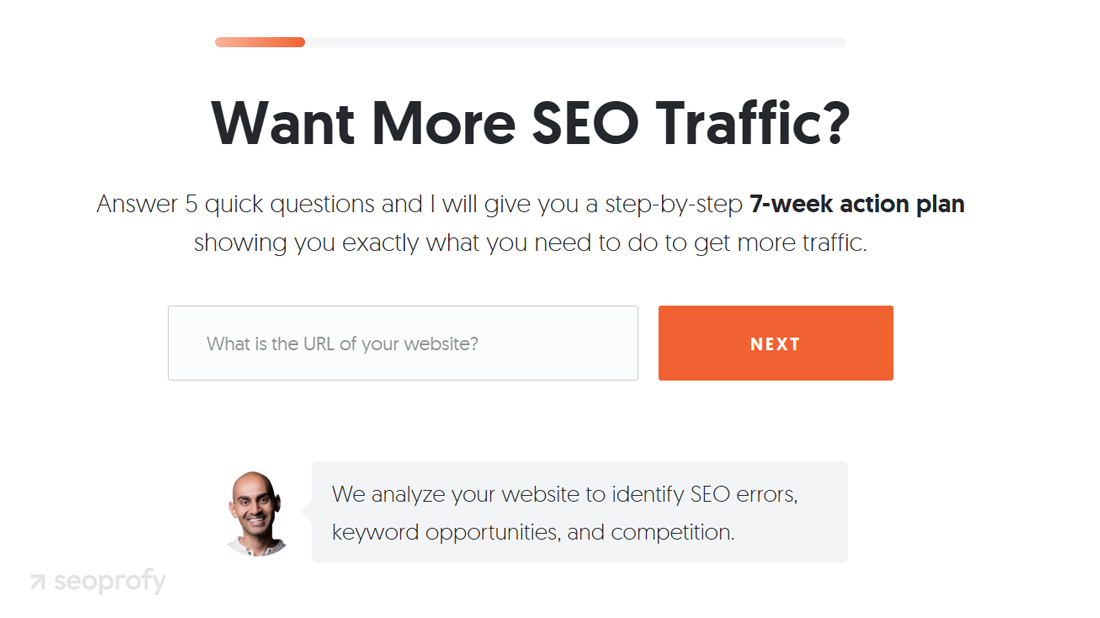
CRO for SaaS
Conversion optimization is essential. If the pages are not optimized for conversion, users will visit them, explore, and leave. The goal of the conversion optimization is to lead the user to the next step in decision-making. Check the following on the pages:
- Clear, specific UVP (not “save time,” but “cut onboarding from 3 days to 3 hours”)
- Social proof (customer testimonials, ratings, logos, case studies)
- Focused CTAs (“Start free trial” and “Book a 15-min demo,” not vague “Learn more”)
- Short forms (only ask for what you actually need to qualify)
- Friction-free next step (does the CTA take me straight to trial/signup, or am I getting dumped on a generic contact page?)
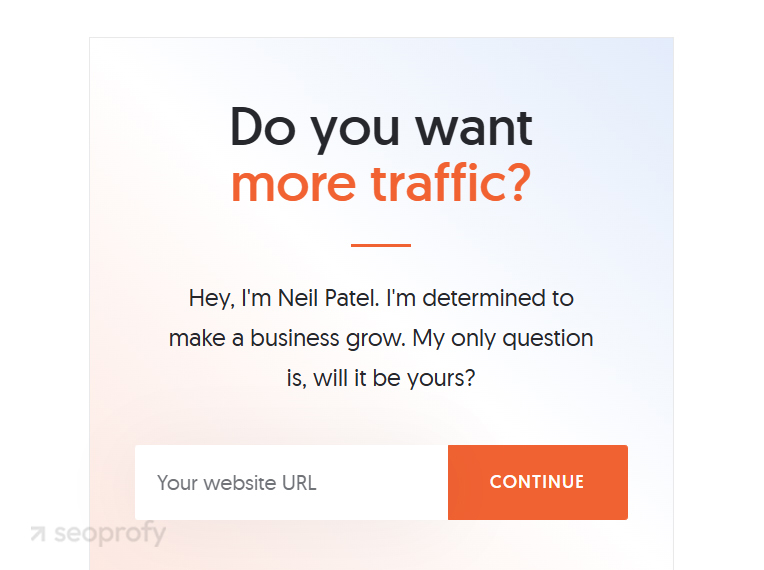
For different website sections, the recommendations will be different. For the pricing page, it will be crucial to highlight prices and the best-choice solution, and ensure easy comparison of the offers. The contact page should clearly show all possible ways to reach out to the company (phone numbers, team and department emails, addresses, etc.)
A/B testing helps you find the highest-converting headline, CTA, and layout. Track behavior in tools like Google Analytics and Hotjar to see where users drop off and fix that friction on pricing, demo request, and signup pages first — those are the money pages.
Nurturing via Email & Retargeting
Email marketing offers extensive opportunities for personalized interaction and communication with a potential customer: informing, getting back to checkout, providing feedback, testing new tools, and considering new offers.
Retargeting, in its turn, works with users who have interacted with your website or product but left without completing a target action. You can reach them via Google Ads, LinkedIn, and Meta Ads.
SEO keyword research will inform you on pain points, goals, needs, and doubts of potential users, so you can effectively work with them in your messages.
Measuring SaaS Lead Generation Performance
Measuring SaaS lead generation performance is an ongoing process to evaluate lead quality and business impact. Key metrics include:
- MQL (Marketing Qualified Lead): A prospect who fits your ICP and has shown interest (webinar signup, ebook download, pricing page visits, etc.).
- SQL (Sales Qualified Lead): A prospect who has signaled buying intent — they requested a demo, asked for pricing, or booked a call.
- PQL (Product Qualified Lead): A user inside the product who has already experienced core value (for example, invited their team, connected data, or hit a usage threshold) and is statistically likely to convert to paid.
For effective lead tracking, brands should integrate their CRM with analytics and attribution tools (GA4, Mixpanel, HubSpot, etc.) to monitor user behavior, conversions, and engagement across the funnel, gaining a complete picture of performance.
To evaluate the cost-effectiveness of SEO for B2B SaaS lead generation, you can compare the typical average cost per lead or mid-market SaaS project:
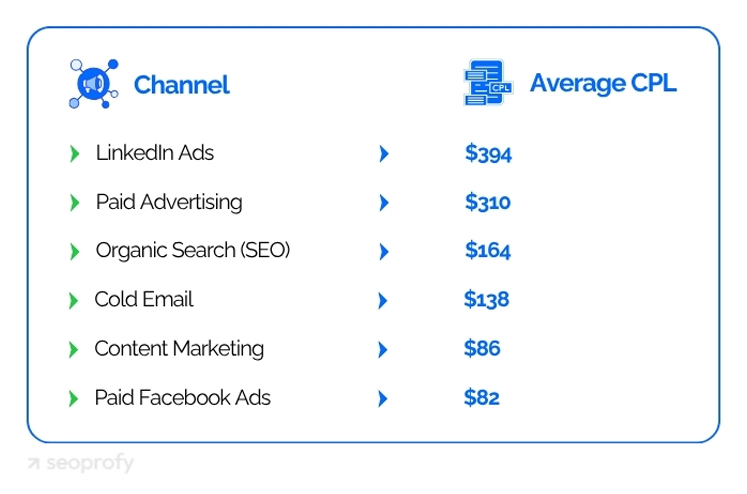
|
Channel |
Average CPL |
| LinkedIn Ads | $394 |
| Paid Advertising | $310 |
| Organic Search (SEO) | $164 |
| Cold Email | $138 |
| Content Marketing | $86 |
| Paid Facebook Ads | $82 |
Finally, estimate the performance of the strategy with ROI frameworks like LTV: CAC — compare customer lifetime value to a customer acquisition cost. A healthy SaaS ratio (average — 3:1 or higher) proves scalable, sustainable growth.
Building a Self-Sustaining SaaS Lead Machine
Lead generation for SaaS is complex. It requires constant research, analysis, and optimization. SEO becomes a powerful source of real user data and insights to inform campaigns, messages, and funnels. In such a way, you build a system that attracts, qualifies, and converts leads organically.
With professional SaaS SEO services, each blog post, ad creative, and message reinforces your authority and product value. When supported by analytics and ROI tracking, SEO turns lead generation into a predictable, scalable growth channel for any SaaS business.

Bohdan has been an SEO analyst at SeoProfy for more than two years. He began his career in digital marketing in 2019 and has since gained experience helping scale some of the world’s leading brands in industries such as gambling and SaaS. Bohdan specializes in developing effective strategies tailored to specific regions.