


SaaS content marketing is a data-driven strategy of creating and distributing valuable, product-focused content that helps Software-as-a-Service companies attract, convert, and retain customers — and today, over 80% of B2B and tech companies rely on it as a primary growth channel. When brands consistently publish high-quality content, they prove product value, build trust with existing customers, and drive long-term subscription revenue.


Unlike traditional marketing, SaaS content marketing supports a subscription model — where acquiring users is only the start. To grow revenue, companies must help customers understand the product fast, adopt key features, and keep seeing value.
A strong SaaS content strategy uses analytics, customer insights, and automation to continually refine performance and scale sustainably. Many teams collaborate with content marketing agencies to accelerate execution and improve efficiency. When executed well, SaaS content becomes one of the most cost-efficient channels for generating predictable revenue and supporting customer retention.
- Focus on revenue and adoption, not traffic alone.
- Support the full lifecycle, from discovery to expansion.
- Prove product value through every content touchpoint.
- Use SEO and automation to increase visibility in search results.
- Maintain a structured content calendar for consistent publishing.
- Constant optimization helps retain existing customers and increase conversions.
- Align content to your target audience and overall marketing strategy.
What Is SaaS Content Marketing?
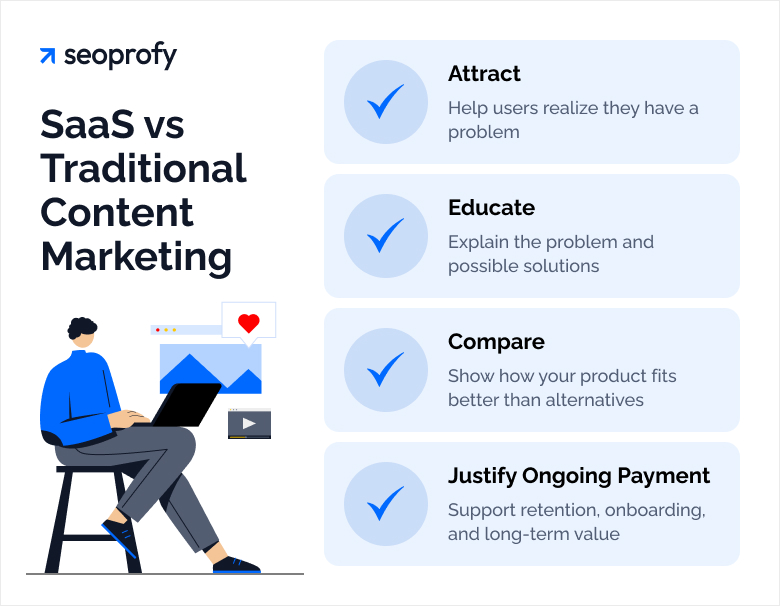
In practical terms, content marketing for SaaS companies is the engine that moves users through the buyer journey – from realizing they have a problem to becoming long-term subscribers. Each piece has a specific role: attract, educate, compare options, and finally justify ongoing payments.
This approach aims at generating high customer lifetime value and predictable monthly recurring revenue. A successful SaaS content strategy establishes the company as a domain authority on the problems that it solves and positions the product as a logical solution.
Sales-Driven Content That Targets Real Customer Pain
One of the crucial mistakes brands make is researching user problems in third-party sources and neglecting the most valuable asset they have: day-to-day sales team communication with potential customers. For maximum effectiveness, a SaaS content marketing strategy must be developed in tight cooperation with the sales team. It ensures your strategic materials address the real-life users’ needs accurately.
The sales team can inform your content marketing efforts in the following aspects:
- Real pain points: The challenges that actually drive customers to seek a solution.
- Objections: The doubts that prevent target customers from taking a desired action.
- Product expectations: What customers hope to get with a product and how they envision the service working.
The user’s questions inform the best website content topics. You will be able to create materials that systematically address user objections and fulfill educational needs. These activities will help to take the workload off the team, making them focus specifically on sales.
The main functions of content marketing are
- User education
- Trust building
- Objections handling
- Competitor differentiation
SaaS Content vs. Traditional Marketing
Unlike retail strategy, which supports emotional one-off purchase decisions, content marketing in the SaaS niche has to sell an intangible product that people can’t touch or test before purchase. The strongest SaaS approach aims to show how your product works for your customers. It works with the target subscribers on a deeper level: it educates, explains, and demonstrates the solution’s applicability for different user challenges.
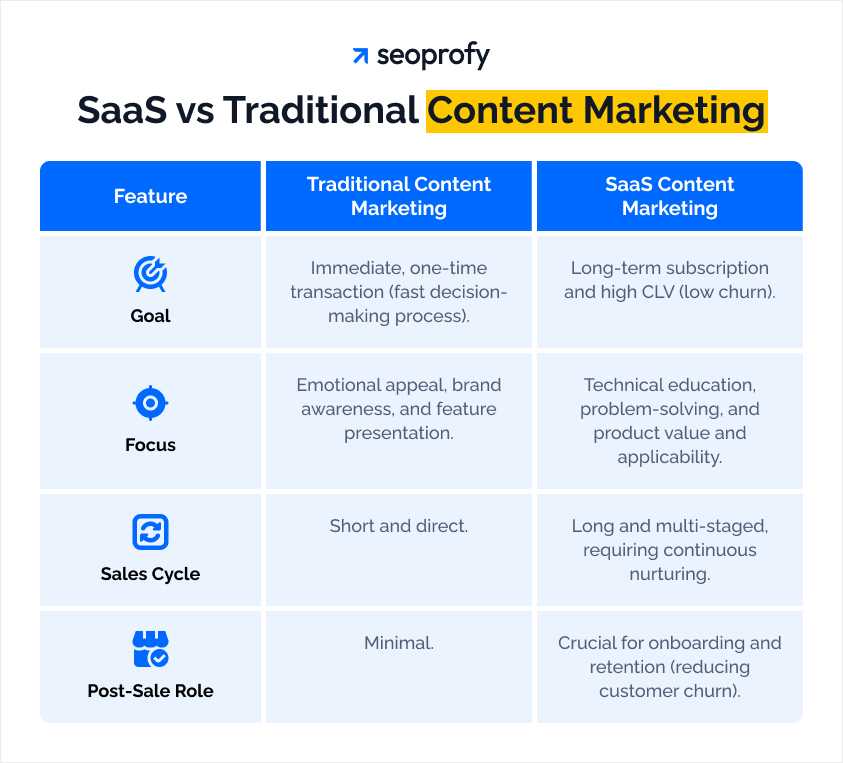
The key point is that SaaS content must justify ongoing payments to target customers. It continuously works with the users before and after the sale through detailed guides, product feature reviews, and advanced feature tutorials.
Why Content is Crucial for SaaS
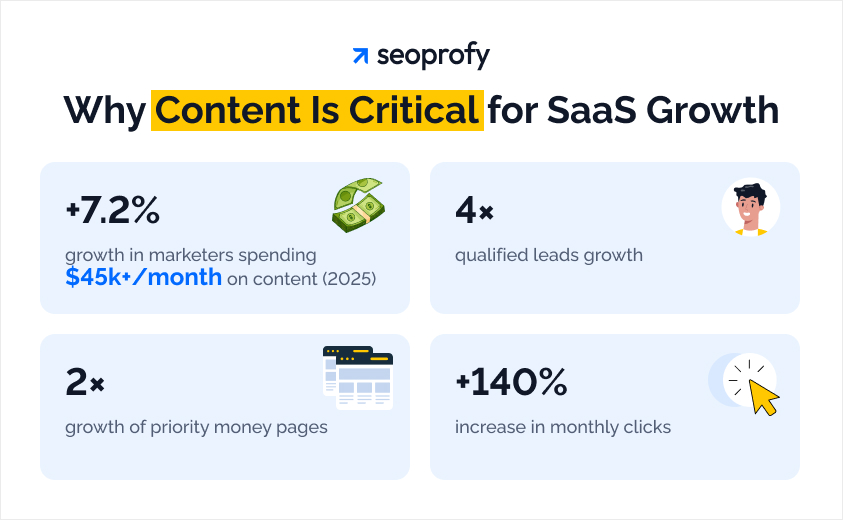
SaaS content marketing is essential because it scales better than paid acquisition. Once published, quality content with proper search engine optimization continues to generate steady organic traffic and qualified leads without requiring ongoing spending. In 2025, the share of marketers spending over $45,000 a month on content creation marketing has increased by 7.2%. The increase is clear proof that teams believe this channel genuinely delivers. And the results can be impressive. One of the SeoProfy cases demonstrates how a strategic approach delivered 4X qualified leads growth, 2X growth in priority money pages, and over 140% in monthly clicks.
Content also builds authority by meeting users at the moment they search for how to solve their problems, not product names or specific brands. It moves users through the buyer journey and helps reduce churn with clear onboarding guides and product education.
10 Steps to Create a Powerful SaaS Content Marketing Strategy
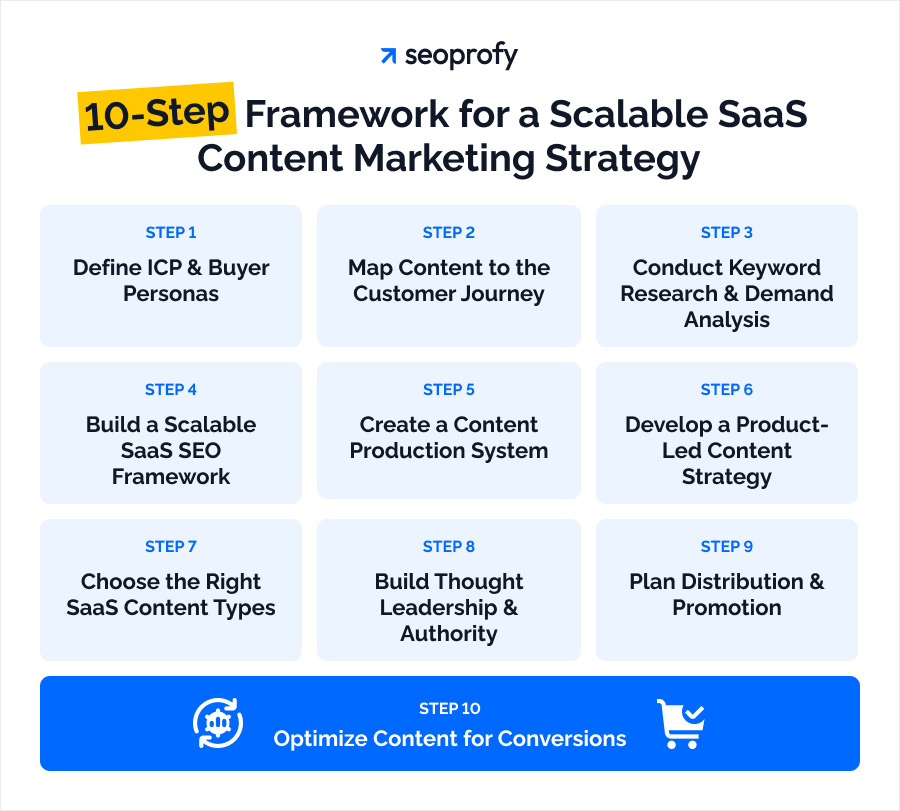
Before you build or scale your SaaS content marketing strategy, you need a roadmap. The ten steps below give you a practical framework for creating a strategy that drives traffic, qualified leads, and earns ongoing payments. This guide will help you craft a predictable system that grows your SaaS month after month.
1. Define Your ICP and SaaS Buyer Personas
Before you create any brand materials or spend any budget, the most critical step is knowing exactly who uses your product and who pays for it. For a SaaS brand, this means clearly defining your Ideal Customer Profile (ICP) and Buyer Personas to address real user problems.
Your Ideal Customer Profile defines the companies that benefit most from your product: the industries, sizes, and business models where your solution delivers ROI. For instance, an ICP might be “B2B e-commerce brands with 50–200 employees and $1M+ annual revenue.”
Your Buyer Personas describe the actual people within those companies who influence the purchase – their roles, driving and constraining factors, and daily pressures.
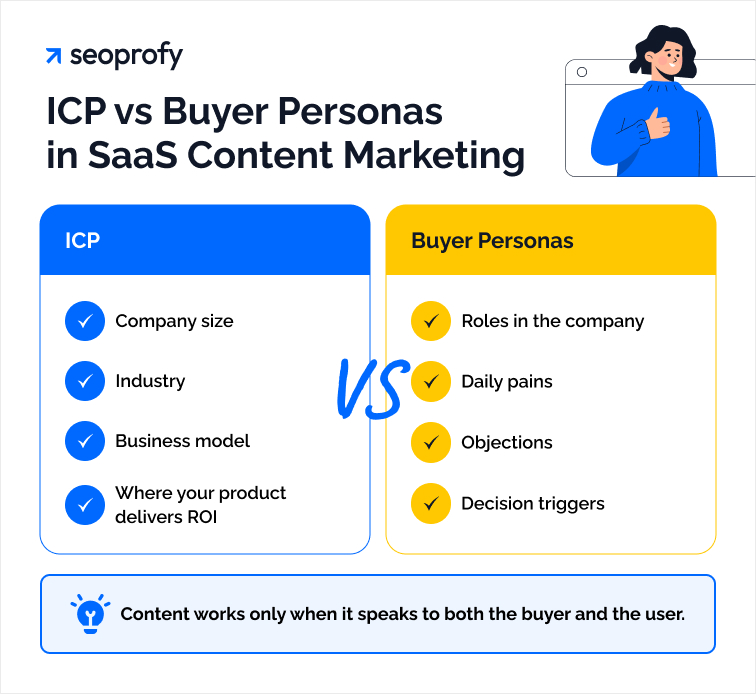
Together, they make sure your content speaks to the right decision-makers, not to an empty audience. They ensure your message matches the people who feel the pain, control the budget, and ultimately choose your software. The outcomes are clear:
- Target the right roles and pain points: Knowing your ICP and buyer persona, you focus on the real tasks they cope with every day. Instead of writing content like “How to use Feature X,” write “How to automate 10 hours of weekly reporting.” Your advice becomes immediately helpful and applicable to the problem they need solved. A detailed persona also clarifies the language used to address the pain points. Such an approach enables you to sound relevant and credible in your content.
- Align content with decision-makers and triggers: In SaaS, multiple people typically participate in the purchase decision. You need to optimize your B2B SaaS content marketing strategy for each of them. Product users need instructions and tutorials, managers expect your product to boost department efficiency, and executives are focused on ROI. By understanding what triggers each role, you can deliver a necessary piece at the moment they are ready to buy.
2. Map Content to the SaaS Customer Journey
Once you know who you are talking to (your personas), the next step is learning what you need to tell them and when to create content that properly aligns with user intent and guides them toward conversion.
We structure the customer journey into four critical stages:
- TOFU (Awareness)
- MOFU (Consideration)
- BOFU (Decision)
- Retention (Post-Sale)
|
Funnel Stage |
Primary Goal |
User Intent/Question |
Focus (The Answer) |
| TOFU (Awareness) | Attract and educate on a problem. | “What is my problem?” / “Why am I struggling?” | Who are you? (Establishing authority and credibility on the problem.) |
| MOFU (Consideration) | Introduce your solution category. | “What are my options?” / “How do I fix this?” | Why you? (Showing your solution is the best type of fix.) |
| BOFU (Decision) | Convert the user into a paying customer. | “Which product is best?” / “Why should I buy now?” | Why now? (Proving your product is the specific best choice.) |
| Retention (Post-Sale) | Ensure adoption and prevent churn. | “How do I use this feature?” / “Is this worth renewing?” | Why continue? (Ensuring the user gets maximum ongoing value.) |
Now, let us see how this works.
Top-of-Funnel (TOFU): Establishing Authority (“Who are you?”)
At this stage, the user faces a pain point or a need but does not know a specific solution for it. The goal of SaaS content marketing here is to show your brand as a helpful, credible resource that understands them.
Here, the SaaS content should focus on problem awareness and broad education. The best content types are blog posts, detailed guides, whitepapers, social media snippets, and checklists.
|
Example |
Why it works |
| “5 Signs Your Team is Wasting Time on Manual Data Entry.” | The user doesn’t know that their working routine can be automated, but they know they have a problem. |
Middle-of-Funnel (MOFU): Guiding the Solution (“Why you?”)
The users have already learned they have a problem and are researching possible ways out. They compare categories of solutions. Your task now is to explain to them the value your software provides.
The SaaS content marketing strategy here focuses on delivery solution comparison and features vs. benefits publications. You can utilize webinars, ebooks, guides on methodologies, and product feature comparison articles (comparing types, but not specific solutions themselves).
|
Example |
Why it works |
| “The Complete Guide to Sales Automation: Benefits vs. Challenges” | Such a topic points the reader toward the type of solution your product offers. |
Bottom-of-Funnel (BOFU): Driving Conversion (“Why now?”)
The user has narrowed down their choice to a few selected options and is now comparing specific SaaS service providers — your solutions vs competitors’ ones. At this stage, they require hard evidence to justify the purchase decision to their manager. The content should work with doubts, objections, and create urgency.
Your primary focus is proof of value, differentiation, and risk reduction. Best-working formats are case studies, direct competitor comparison reviews (“Our Product vs. Competitor X”), free trial sign-up pages, and demo videos.
|
Example |
Why it works |
| “How Acme Software Reduced Support Tickets by 40% (A Customer Case Study).” | It provides real-world examples and proof of value, ROI, and results |
Post-Sale (Retention): Ensuring Success (“Why continue?”)
When the sale is closed, the marketing tasks are not completed. The SaaS business model needs retention to grow. Content is crucial at this stage to maximize product adoption, ensure a successful user experience with the product, and prevent churn from growing. To cope with this task, the SaaS content marketing strategy should focus on helping with onboarding and advanced feature use. Each publication should clearly show why your product is worth choosing. You can use knowledge base articles, video tutorials, and use-case blog posts.
|
Example |
Why it works |
| “7 Tips for Integrating Feature Y to Save an Extra Hour Per Week” | It demonstrates continuous value for an ongoing subscription. |
3. Conduct Keyword Research and Demand Analysis
Keyword research defines real market demand and clarifies how potential customers search at different stages of the buying journey. Instead of focusing only on search volume, effective SaaS keyword analysis prioritizes user intent, competitive feasibility, and logical topic clustering. This approach turns keyword data into a scalable, SEO-driven content roadmap. You can conduct this analysis using tools such as Ahrefs or Semrush.
1. Analyze Search Intent (Connecting Keywords to the Funnel)
Group keywords by what the user tries to complete: learn, compare, or buy. This explains which funnel stage each topic belongs to and what format will work better.
- TOFU: broad “how/what/why” questions
- MOFU: “best/tools/reviews/alternatives.”
- BOFU: “pricing/free trial/your brand vs. competitor.”
2. Identify Competitor Content Gaps (Finding Topic Opportunities)
Competitor analysis reveals where existing pages fail to fully address user intent — whether due to shallow coverage, weak structure, or unclear positioning. These gaps represent opportunities to win rankings by delivering content that is more comprehensive, more focused on user needs, and better aligned with search intent.
3. Build Keyword Clusters (Structuring for Authority)
Instead of targeting one keyword per article, a scalable SaaS SEO strategy uses keyword clustering (groups of keywords) to build topical authority. Creating these clusters the right way requires deep SEO expertise and competitive market analysis; a single content marketing manager can’t do it alone. If you need an effective data-driven strategy, partnering with an SEO agency for SaaS companies is essential.
You can use the pillar-cluster model. It suggests creating a pillar page: a long, comprehensive material that targets a broad, high-volume keyword (for example, “The Complete Guide to Sales Automation”). And then you create cluster pages: specific articles that target long-tail keywords and link back to the pillar page (for example, “Best Sales Automation Tools for Startups”).
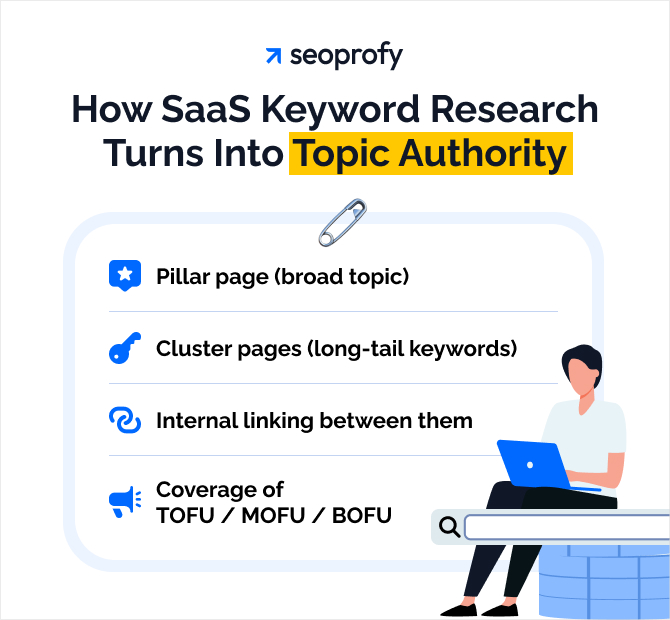
Such an approach to grouping related content and interlinking the pages signals to search engines that your website is a top knowledgeable source for a subject area. This is a proven mechanism to achieve and maintain high search rankings and improve key website metrics, including traffic, sessions, and pageviews.
Such pages create a structured list of content ideas that capture high-value leads across every funnel stage.
4. Build a SaaS SEO Framework That Scales
Scalable B2B SaaS SEO strategies are not only about keywords and blog articles. It uses the product, the brand, and the ecosystem around it to generate ongoing demand.
First, learn what product-led SEO can do for your SaaS service. It suggests creating assets like calculators, templates, free tools, and mini-features to attract high-intent users and demonstrate the value and applicability of your solution. Such pages commonly perform better than theoretical content because they let users try the product, not just describe it.
Next is branded search demand. A good authority and demand signal for a SaaS brand is when users start searching for it by name. Data reports, integrations, and founder-led content work best for it.
SERP features can give you another advantage — high visibility without ranking #1. AI overviews or People Also Ask sections are the right spots to appear:
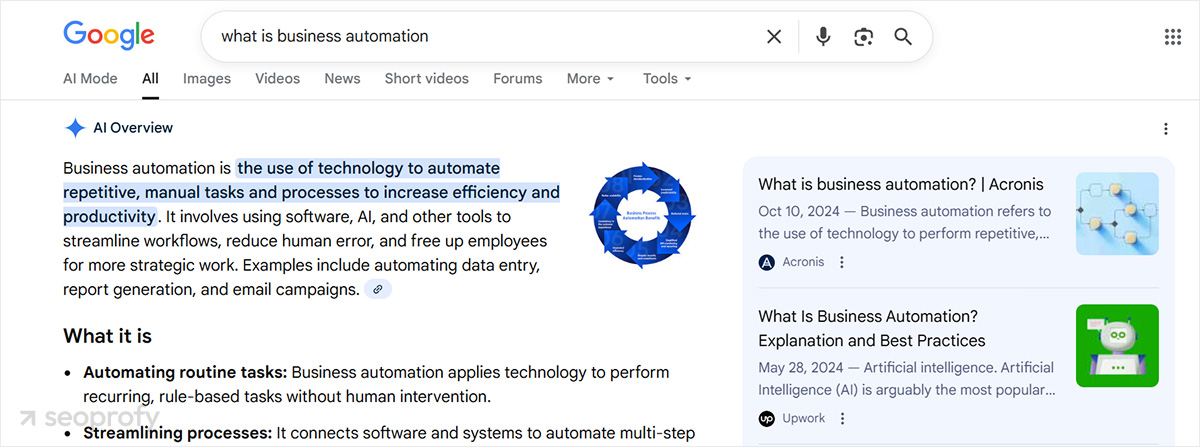
Apart from content and rankings, SaaS SEO requires credibility. Customer reviews, industry mentions, expert authorship, and a consistent PR signal to Google that your brand has expertise and experience in the domain.
High behavior signals (such as page views and time on site) also confirm that the product satisfies real user needs. Together, these signals improve your visibility and reputation. An expert search engine optimization company can assist you in optimizing your content marketing strategy with SEO.
5. Create a Content Production System
To execute your SaaS content marketing strategy effectively, you need a reliable system that will turn development into an organized, repeatable process, resulting in consistent quality, production speed, and impact.
This system should document all the steps of the content lifecycle:
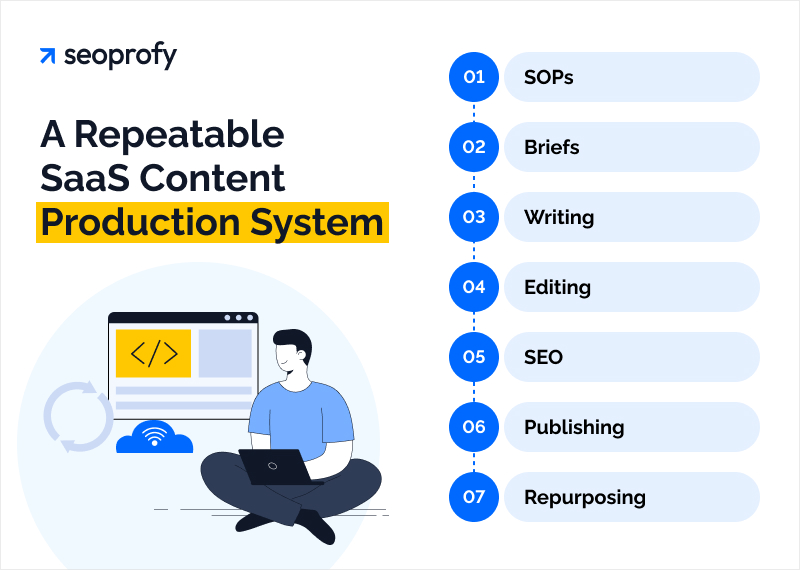
- Standard operating procedures (SOPs): SOPs explain the exact steps for each task (researching, writing content, editing, publishing, and repurposing).
- Editorial guidelines: The documents cover brand voice, format, style, technical requirements, etc. They help keep consistency even in case many copywriters are working on each piece, whether in-house or if you order professional SEO content writing services.
- Briefs: They inform on the target persona, search intent, funnel stage, word count, style, required keywords, and links. Having a brief template simplifies the task for strategists and content writers and ensures consistent results.
- Key Roles: A system works only when each team player knows their roles and areas of responsibility: who plans it, who writes, who reviews accuracy, who optimizes texts, and who publishes content.
- Workflow Management: A visualized workflow (Brief → Draft → Edit → Review → Publish) keeps the process organized.
Such an approach removes chaos from the process and gives everyone a clear understanding of steps, dependencies, timelines, and required resources. It also helps teams meet deadlines and work more efficiently.
6. Create a Product-Led Content Strategy
Product-led content focuses on your solution by showing the product in action and how it solves real user problems, instead of only describing features in theory. The formats can be different: blog posts, tutorials, workflows, use cases, templates, and step-by-step guides. The idea is:
The user should understand how your solution helps them complete the tasks faster and easier than with any other tool.
Such content reduces time-to-value — the period needed for a user to understand the value and advantages of your product. The shorter the period is, the faster they make a purchase decision.
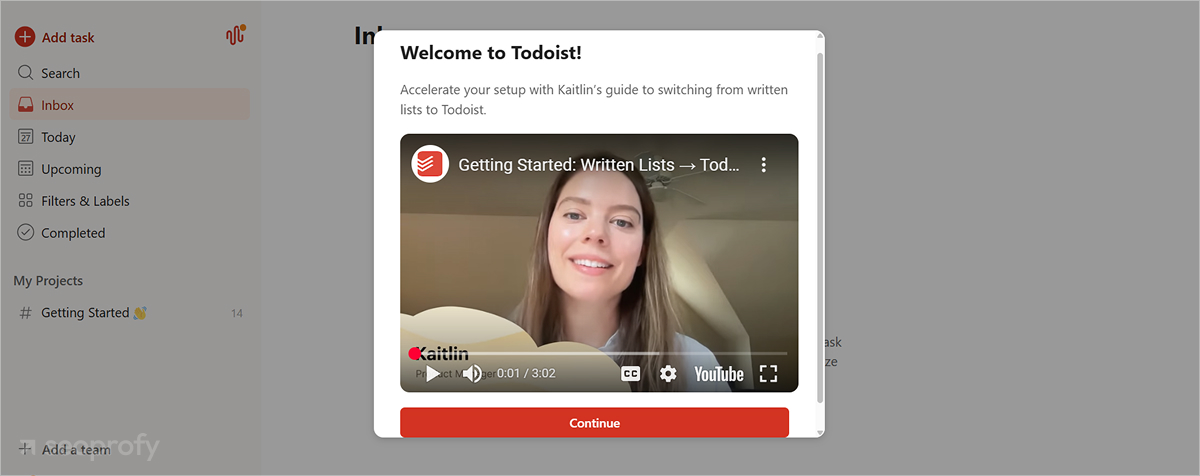
Product-led content also speeds up user activation. It is the moment when the user takes the first meaningful action inside the software: provides personal data, uploads files, or creates a process. Being supported with applicable content (guides, tutorials, pre-built templates, etc.), users reach activation faster, which in turn reduces churn rate and increases adoption. For example, right after registration and entering the account, Todoist shows a short video tutorial on how to use the product for task organization:
7. Develop the Right Types of SaaS Content
Once your SaaS content marketing strategy is mapped and your production system is ready, you need to define the right types and formats for your brand. Each of them moves the user closer to an action: trial, subscription, annual plan, etc.
Among key content types that perform best for SaaS companies are the following:
- Blog posts and articles: With proper search engine optimization, blog posts bring in top-of-funnel traffic by answering common questions and pain points. They build awareness and attract users who just explore a problem.
- Landing pages: They work with users at the consideration stage by offering high-value resources (ebooks, templates, reports) and asking for user contact information in exchange. They turn anonymous traffic into leads.
- Comparison pages: This content works with bottom-of-funnel users who choose a vendor. These pages clarify the difference between your product and competing solutions and remove objections.
- Case studies: They play a crucial role in SaaS marketing, providing proof for users who are close to purchase decisions. Case studies showcase the actual results that product users have achieved in terms of ROI.
- Integration pages: This content addresses user concerns and clarifies how your product integrates with their current tools. These pages support consideration and lower friction after purchase.
- Email sequences: The emails work with users at all stages of the customer journey and guide them through the funnel. It is a vital communication tool and a valuable source of real-life data and user feedback. The emails nurture leads, follow up after demos, share relevant, useful materials, and call users to the next action.
- Videos and tutorials: Visual content formats are important for product demonstration and education to support onboarding and retention. They show how features work, simplify setups, and reduce churn.
8. Build Thought Leadership & Category Authority
For a SaaS company to succeed in the market, you have to become a trusted expert. That means shifting your content away from bold product offerings toward genuine expert guidance. Here is a simple workflow for doing this:
- Offer opinions: Instead of repeating industry news, bring your vision for what you believe is wrong or outdated and support it with data.
- Create your own frameworks: Create simple models that explain how to solve a problem step-by-step.
- Build a narrative: Through simple content, explain why the change is needed and why the old ways fail.
9. Build a Distribution and Promotion Plan
Even the most valuable content will not work if it lacks visibility. It must reach the market consistently through effective SEO services (ranking for high-intent searches), strategic distribution on social media within online communities, collaborations with partners, and outreach. When users find your insights through search, citations, or shared social media posts, they start to trust your expertise and perceive you as a knowledgeable source.
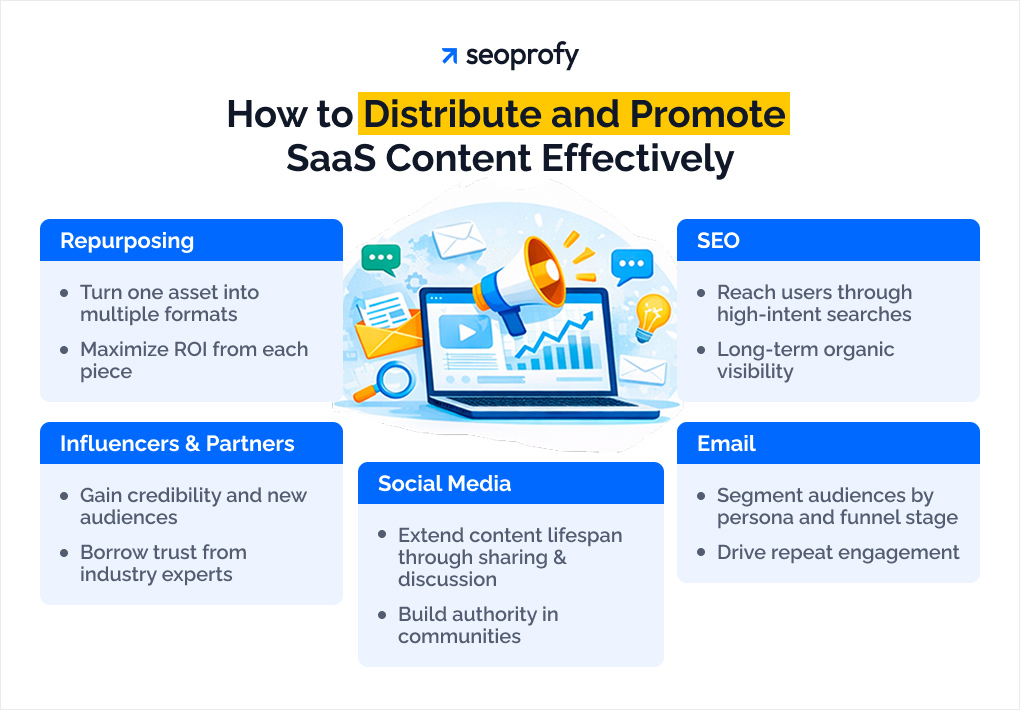
- SEO: Optimize every blog post and article for the keywords your target subscribers actually use when searching for information. SEO ensures that your target users can find the content through organic search.
- Email: Segment subscribers by persona, use case, or funnel stage and send tailored content. Experiment on the email subjects and formats, and track the open rate to learn what your audience expects.
- Social media marketing: Share your brand materials on social media platforms your target audience already uses. Be active in the comments section to keep the discussion going and prolong the content lifecycle after posting.
- Influencers and partners: Partnership with industry experts allows you to gain reach and credibility you can’t build yourself in a short time.
- Repurposing: Effective blog posts can bring you even more if converted into multiple formats (short posts, videos, infographics, email sequences, etc.) and republished on other platforms. Such an approach keeps each piece working after the initial publication.
10. Optimize Content for Conversions
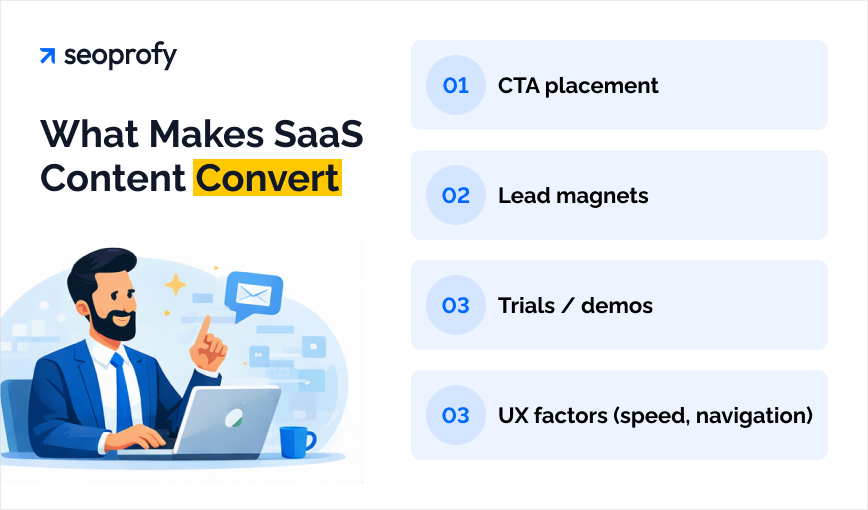
Quality SaaS content must lead a user to take action. Every page should offer simple navigation and clearly show the next step. The CTA text should directly tell what users need to do and what they will get in response.
Utilize lead magnets (free resources offered in exchange for contact data) for top-funnel users and offer free accounts, trials, and demos for purchase-ready visitors. They should be placed naturally on the page within the content to help and not irritate users. Other UX factors that contribute to conversion are fast loading, responsiveness, navigation, and a clear, readable layout, so nothing technically distracts a user’s attention from completing their page task.
SeoProfy turns your content into a measurable growth engine.
- Clear visibility into what drives ROI
- Predictable signups driven by optimized content
- Shorter sales cycles thanks to strategic content that pre-educates users

Common SaaS Content Marketing Mistakes to Avoid
SaaS content writing without a clear, documented strategy is a waste of resources. The strategy must act as a blueprint, mapping every piece to a specific business goal.
In 2025, we are witnessing the content explosion due to accessible AI tools. It may seem that users do not need even more posts, videos, guides, or email messages. But the problem is its quality, expertise, and applicability. AI-generated content is commonly shallow and generic, one-size-fits-all. Though well-written, it provides low to zero value to people.
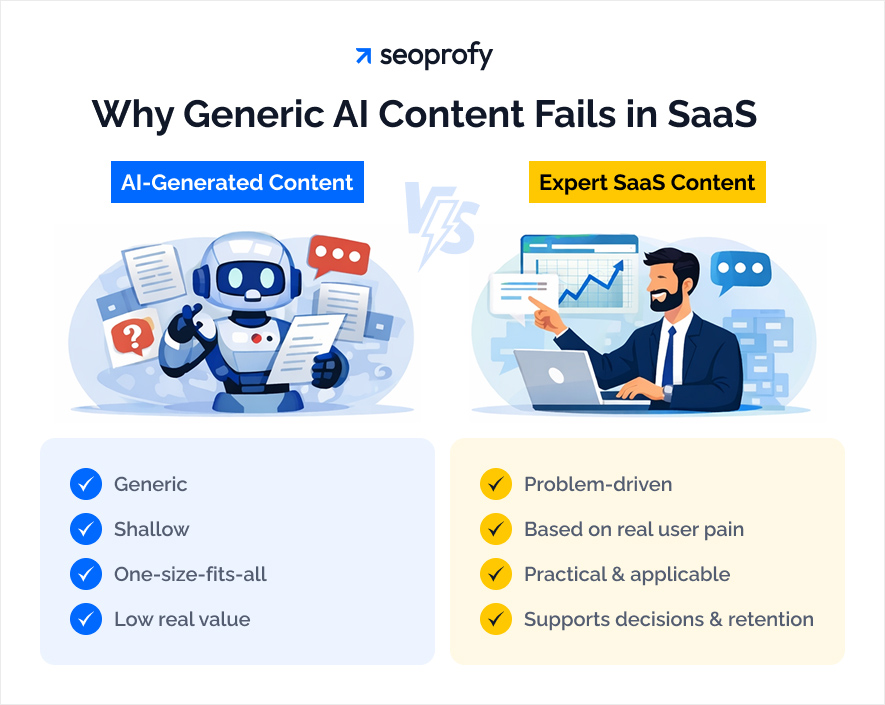
That is why they need high-quality, truly valuable content more than ever. This is where your expert, audience-driven materials should appear and dominate.
The risks of guesswork include:
- Funnel mismatch: You create only general top-of-funnel blog posts and skip content ideas that help users compare solutions or make a final decision. Such an approach brings traffic but almost no sign-ups. For example, choosing “5 ways to edit a photo” instead of a focused topic, “How to remove photo background.”
- Wasted time and budget: Content creation for SaaS without a strategic focus drains resources fast. Finally, you can find that none of the launched pieces drives users to action. For example, you write generic industry updates when users actually need tutorials or problem-solving guides.
- No clear ROI: Without metrics, SaaS companies can’t see which content brings subscriptions or revenue, and which posts only bring empty page views: a page may rank and get 10,000 visitors, but zero product sign-ups.
- Effort inconsistency: No strategy means no process. Publishing becomes irregular, and quality drops, giving competitors room to outrank you.
To avoid these typical mistakes, you need a proven partner from top SaaS SEO companies able to revamp your content marketing and take it to the next level. SeoProfy specializes in research-driven marketing: we analyze an existing framework and create a structured content strategy for SaaS to improve rankings, increase qualified traffic, boost conversion, and retain customers. If you’re ready to replace content creating chaos with a proven process, SeoProfy experts will help you elevate your entire marketing operation.
Measuring Success: SaaS Content Marketing KPIs
When your SaaS content marketing strategy is designed and implemented, you need a system of KPIs to track how it performs. The following metrics show whether your content actually works:
- Organic Sessions (GA4): Shows whether your efforts drive search traffic and ensures baseline visibility.
- Keyword Rankings (Ahrefs/SEMrush): These keyword research tools show how well each piece performs on important search queries.
- Content-to-Lead Conversion Rate (CRM): Tracks how many readers take target actions after dealing with brand materials.
- MQL/SQL Attribution (CRM): Connects content-generated leads to actual pipeline progress.
- Revenue Attribution: CAC & MRR (CRM): Facilitates the analysis of the closed-won deals and recurring revenue generated by the specific content that started the journey.
- Churn & Feature Adoption Impact (Mixpanel/Amplitude): Shows whether your educational materials retain customers and improve product usage.
Final Thoughts: Succeeding in SaaS Content Marketing
SaaS content marketing is different. It focuses on long sales cycles and considered choices. Content marketers should follow a data-driven approach where SEO research informs every step of the strategy in order not to waste effort and budget.
When your strategy is based on personas, data-driven SEO, and measurable KPIs, you move to predictable growth.
If you’re ready to proceed from random publishing to a system that actually drives MRR, SeoProfy can help. Our SaaS content marketing firm handles the full process, from strategy to execution and tracking, so your efforts deliver measurable results.

Andrew Shum is the Head of SEO at SeoProfy with 10+ years of experience in SEO and digital marketing. He has been part of the company for over 6 years and has led the SEO department for the past 3.5 years, managing a team of 15+ specialists. He works with competitive and international multi-language projects across eCommerce, SaaS, and enterprise niches, focusing on practical SEO strategies that deliver measurable results.