


If you want to earn LLM citations, you must know how to hit specific marks considered by popular AI-powered platforms like ChatGPT, Gemini, or Claude. In our guide, we’ll have a closer look at these factors so you can better understand how they work in practice.


We’ll review the common mistakes that stand between you and valuable mentions on popular chatbots. Furthermore, you’ll discover why it’s crucial to get the references from LLMs (Large Language Models) in the era of AI-powered searches.
- LLM citations refer to the sources that provide information for AI-generated answers.
- AI assistants drive less than 1% traffic to sites, but these visitors show strong intent and high conversion rates.
- When choosing sources for answers, AI algorithms consider your brand’s authority, content structure, topical depth, and readability.
- There are a variety of apps for tracking your performance on LLMs’ references, including Writesonic, AtomicAGI, and Profound.
What Are LLM Citations?
LLM citations are references to the sources of information included by large language models in their answers. For example, when you ask ChatGPT about efficient ways to improve your SEO rankings, it’ll also show the websites where its algorithms retrieved or validated the information. All in all, there are two ways to get mentioned by the natural language generation models:
- Citations: AI-platform refers to your content and includes a link to your website. It may provide a reference in the list of sources or when citing a particular piece of information in the answer.
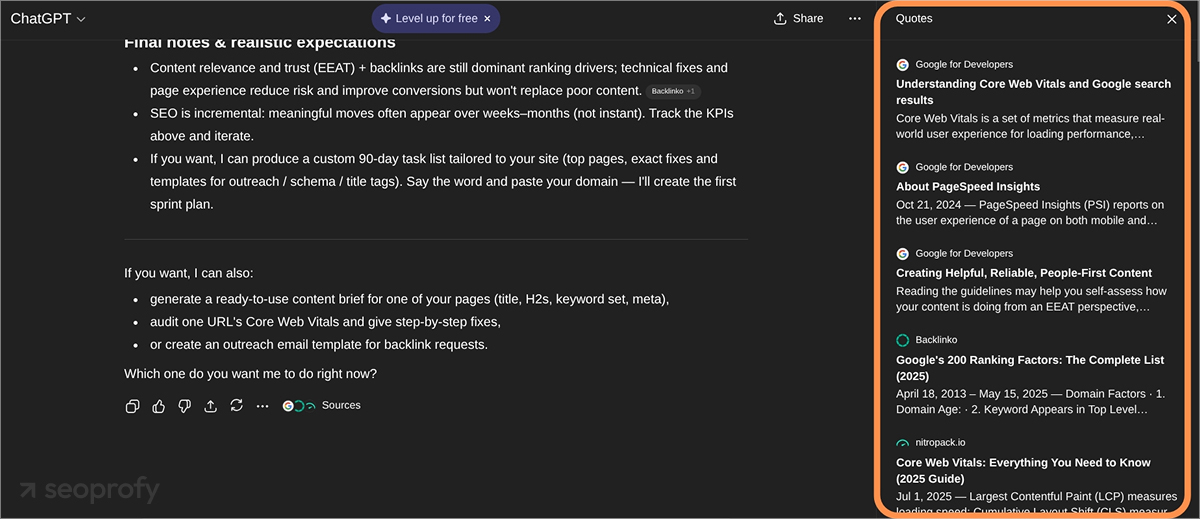
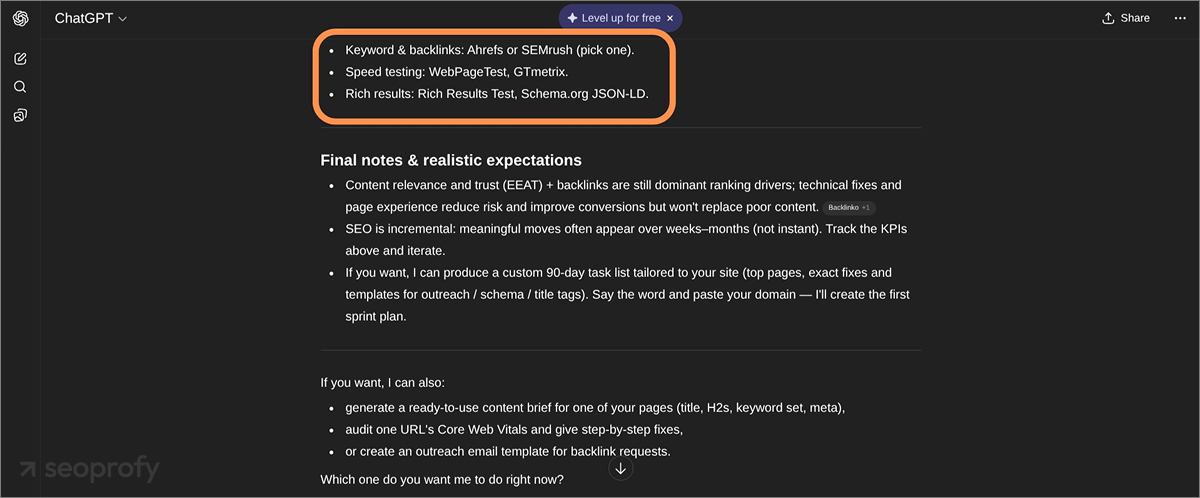
- Mentions: LLMs may also recommend various services or products by simply mentioning the brand names in their answers. Although the AI algorithms may not link to your website in this case, getting these mentions is still vital for building your brand awareness.
Why LLM Citations Matter
Nowadays, getting mentioned in LLM citations is as important as keeping high rankings in traditional search results. These references show that you create relevant and trustworthy content, as well as provide you with other significant benefits:
- AI search visibility: ChatGPT, Google’s AI Overviews, and other platforms powered by artificial intelligence are becoming an integral part of the entire search industry. It’s one of the new channels for promoting your brand and reaching a new target audience.
- Brand authority: AI citations strengthen your brand’s position as a knowledge leader in your industry. Your potential clients are more likely to opt for businesses trusted by AI-powered algorithms.
- Referral traffic: Although, in general, AI-assistants drive less than 1% traffic to websites, these visitors typically have strong intent. They’ve already received general information but want to discover more, which means they are more interested in your content.
- Future-proofing against zero-click search: When you get references from AI platforms, it means their algorithms are unable to summarize all the relevant information you provide, so a user needs to visit your site to discover more.
It’s also important to consider the differences between traditional SEO and LLM visibility. Please, check the table below to get acquainted with the core distinctions:
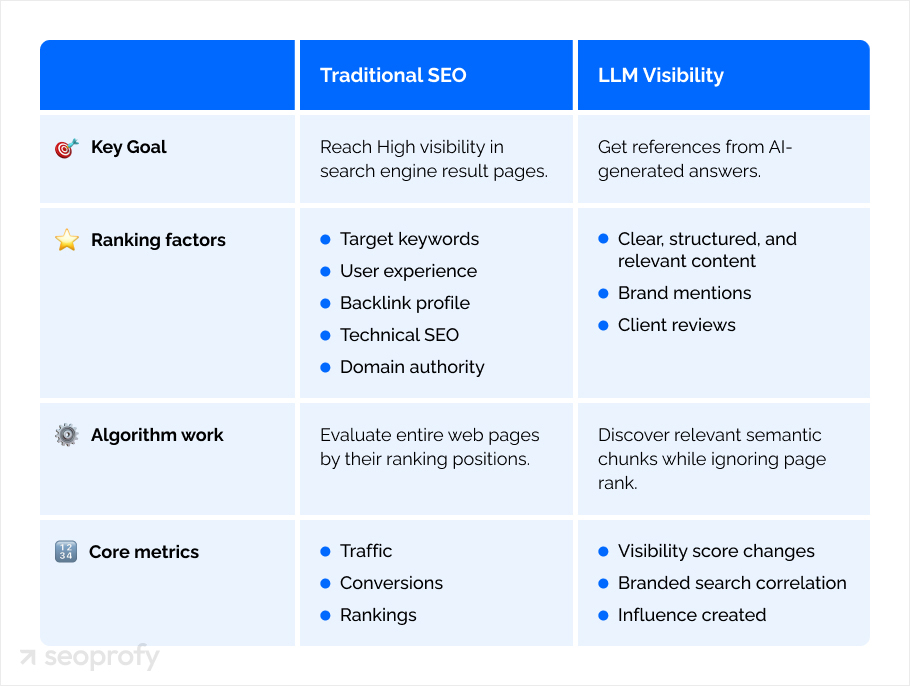
|
Traditional SEO |
LLM Visibility |
|
| Key Goal | Reach High visibility in search engine result pages. | Get references from AI-generated answers. |
| Ranking factors |
|
|
| Algorithm work | Evaluate entire web pages by their ranking positions. | Discover relevant semantic chunks while ignoring page rank. |
| Core metrics |
|
|
How LLMs Choose Sources
The answers you get from chatbots are based on the Retrieval Augmented Generation (RAG) technique, which helps their algorithms use the information from online sources. If you want to get LLM citations, it’s essential to find out how AI tools actually look for your website, analyze its topical authority, and research information about your brand. Once you understand these principles, you’ll be able to adapt your digital marketing strategy accordingly.
Authority Signals
High domain authority is one of the core factors important for LLM seeding. AI-powered platforms will estimate the credibility of your content by analyzing your company credentials, expert bios, certifications, and links to your niche regulatory bodies. Additionally, their algorithms consider your brand’s mentions in user reviews and third-party websites.
The clarity of your content and its topical depth also matter. To overcome your competitors, you must offer unique insights, expert opinions, research, and other valuable information.
Structure & Formatting
Once LLM algorithms visit your website, it’s essential to make it easy for them to parse and cite your web pages. As a rule, they prefer online sources with a skimmable structure, including bulleted lists, clear definitions of the terms, and relevant headings. For instance, a page “Step-by-Step Guide to SEO” with an FAQ is more likely to get referred to than an ordinary generic blog post dedicated to search engine optimization.
Machine Readability
When it comes to LLM seeding, AI models prefer structured data from web pages to generate answers. Schema markup, clear H2 and H3 headings, Q&A sections, updated timestamps, and metadata help algorithms better understand the context of your content.
Content Types LLMs Prefer to Cite
When AI crawlers enter your website, they’ll immediately start scanning its context. The list below includes types of content that are more likely to get mentioned by LLMs, so it’s a wise decision to add them to your web pages:
- Definitions: LLMs prefer short, precise, authoritative explanations of terms and concepts as they are easy to extract.
- Frameworks: Marketing frameworks such as AIDA and SWOT are attractive to AI algorithms because they are structured, distinctive, and easily recognizable.
- Templates: LLMs often draw on this type of content to generate practical, actionable content that can be applied immediately.
- FAQs: Clear FAQ sections or web pages provide direct answers to questions users often search for. Algorithms can easily extract this type of content or pull snippets from it.
- How-to guides: Considering that LLMs prefer structured, actionable content, expert guides are ideal for AI platforms to cite.
- Data studies: The industry research conducted by your in-house specialists adds credibility to your website and provides your audience with unique information that may be interesting to LLMs as well.
- Glossaries: A clear and short definition of the niche terms is perfect to get LLM citations, since AI algorithms can use your glossaries when answering questions like “What does X mean?”
- Checklists: Bullet and numbered lists provide clean, structured content that LLMs can easily reuse to generate answers.
Our team can boast of SEO case studies across various niches that have taken our clients’ websites from low traffic and poor rankings to the top of the SERPs! And now we help them with LLM seeding through an efficient personalized approach:
- Custom strategies
- Regular tracking and reporting
- Proprietary tools and techniques

How to Earn LLM Citations
Now, once you understand how AI-powered platforms work and why it’s reasonable to get references from them, you’re ready to take practical steps to get LLM citations. Follow the tips of our ultimate guide, and soon your web pages will turn into magnets for popular chatbots like Perplexity, ChatGPT, and Gemini.
Step 1 — Analyze Current AI Results
Before you start optimizing and creating content to receive LLM citations, it’s a wise decision to check what’s already working in your specific niche. The following algorithm of actions can help you identify existing citation patterns and competitors across various AI-powered platforms:
- Select models for testing: Create a Google Sheet listing the platforms you are interested in obtaining references from (e.g., ChatGPT, Gemini, and Copilot).
- Prepare several prompts: Use several queries to explore citation behavior, including fractal queries (e.g., “What is the best way to improve SEO?”), product recommendations (e.g., “Top 10 SEO tools”), and niche authority questions (e.g., “What are the best SEO companies in the US?”).
- Stay consistent: Use the same prompt for every AI platform on your list during testing. Extract every citation in your Google Sheet document.
Analyze all the cited sources and try to summarize their general features. Check which format in your niche is most commonly cited, and review competitors’ pages. Once you finish, use this information to find out what your site is missing and adapt your content strategy.
Plus, you may opt for platforms like Ahrefs to conduct thorough research. Using its Brand Radar tool, you can check which pages from your competitors get the most references from various AI-powered platforms:
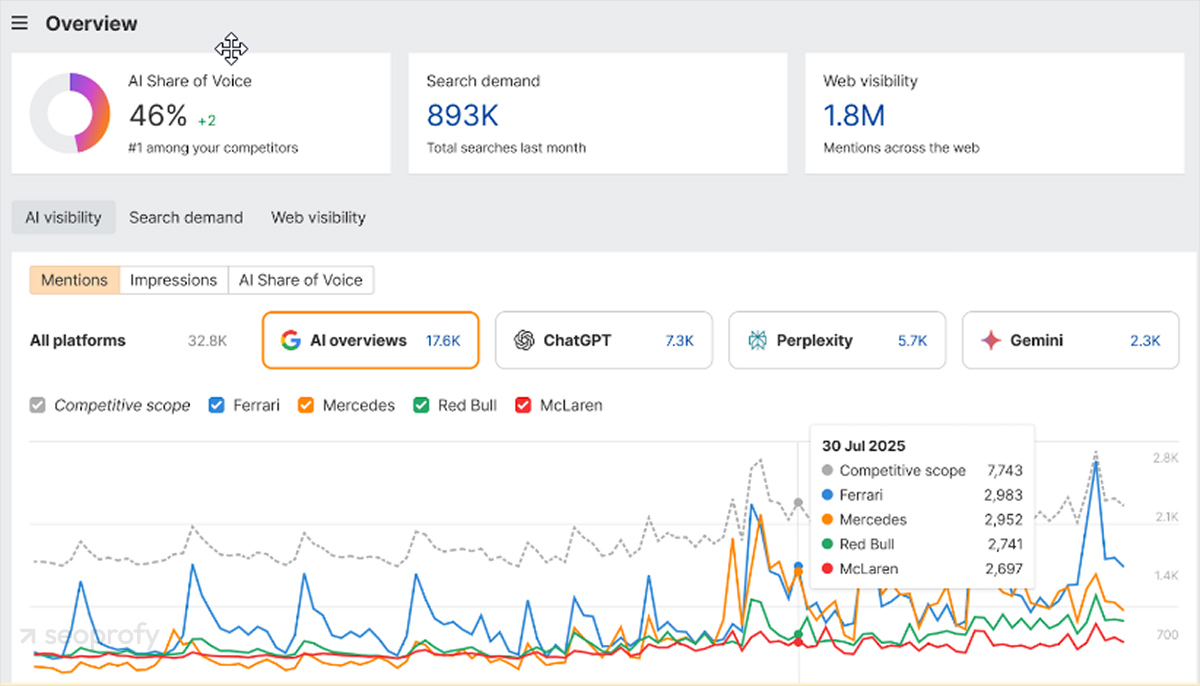
If you want to utilize Brand Radar efficiently, follow these easy steps:
- Open the tool, enter the name of your competitor’s brand, and add their site’s address.
- Check the cited pages report and select the desired LLM.
- In the Filter, set your competitor’s site to limit the domain scope.
Review the received results to identify the exact content type (e.g., research, statistics, guides) and the topics that are of interest to the algorithms.
Step 2 — Create Citation-Ready Content
Use the data you’ve received from your research to update your SEO content strategy and make your existing pages appear in LLM citations. Instead of writing another article on crowded topics, try to find out how you can provide unique and useful information for your target audience. Your task is to become the primary source of the specific content, which must be perfectly polished to capture LLMs’ attention. Thus, it’s crucial to remember core clean formatting recommendations:
- Clear and proper headings: It’s not enough to simply add some H2s and H3s to enhance your content structure. Ensure these elements mimic natural-language questions (e.g., “What is the difference between SEO and SEM?”). It’ll improve the scannability of your web pages, making it easier for algorithms to extract direct answers from your content.
- Concise and direct answers: Start your paragraphs with up to two short sentences that directly answer the key question or provide a clear explanation of a specific term. Thus, you significantly strengthen your chances of winning a featured snippet and getting cited by AI engines for short LMM responses.
- Factual tone: Maintaining consistent terminology and a factual tone identifies your website as a reliable source of training data and reduces the risk of AI misunderstanding your content. This is especially important when discussing complex topics, such as law or medical questions.
- Practical examples: Use cases of your products or services act as supporting materials for your content. As a result, LLMs can better understand their real value, thereby significantly increasing the likelihood of being cited in their references.
Step 3 — Optimize for AI Retrieval
Even if you craft excellent content, it may still be ignored by LLMs and search engines due to inappropriate structure and other issues. We strongly recommend taking the following actions to increase the visibility and crawlability of your web pages:
- Use or adjust schema markup to make it easier for AI crawlers to discover your site’s content.
- Check whether the disallow rules that block AI crawlers are removed from your robots.txt.
- Optimize your web page load time to at least 2 seconds to avoid being skipped in retrieval pipelines.
Additionally, according to Ahrefs, unlike traditional search engines, LLMs opt for fresher content to cite. Thus, it’s essential to regularly update your content, tailoring it to the latest news, industry trends, and SEO techniques.
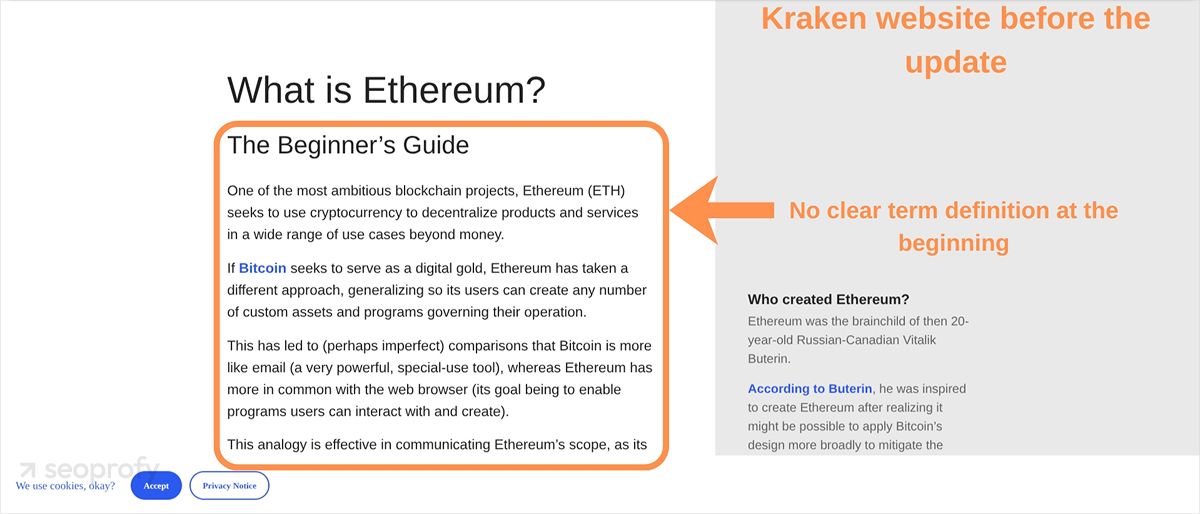
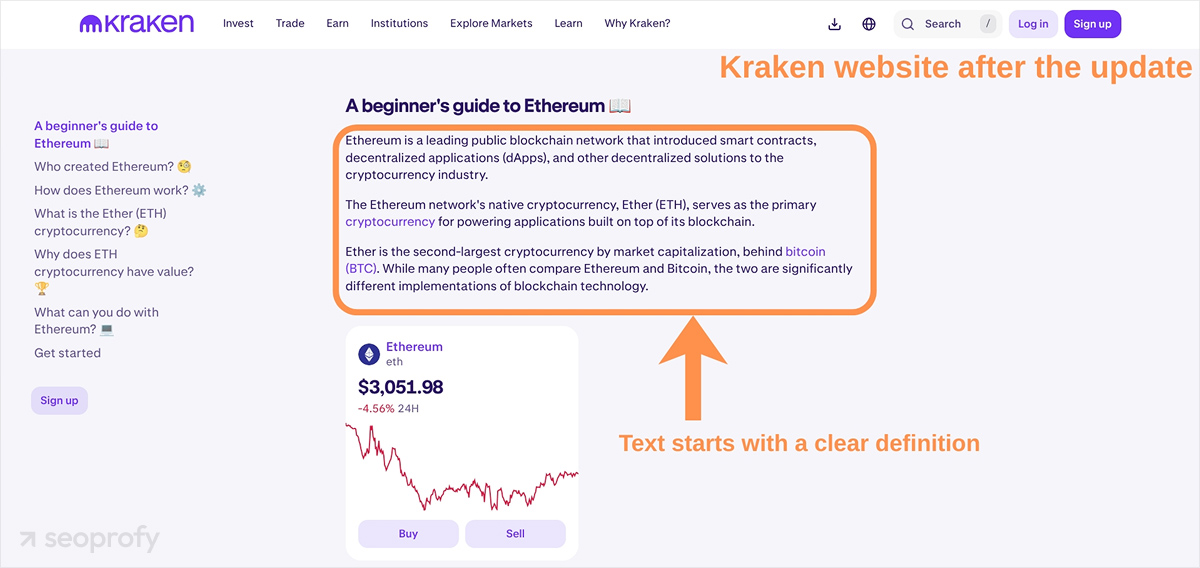
For example, Kraken consistently updates its crypto articles to keep them relevant and attractive for both search and AI-powered algorithms. The screen below demonstrates how its authors changed the Ethereum guide by improving its structure and making it start with a clear definition instead of common sentences:
Step 4 — Strengthen Authority
When trying to enter LLM citations successfully, it’s essential to follow the principles of E-E-A-T. Without taking this important step, your content won’t be visible in search engines, so LLMs simply won’t be able to find it when looking for real-time information.
Consider that Google ranks high only the websites that create content which demonstrates strong Experience, Expertise, Authoritativeness, and Trustworthiness. Thus, to optimize your existing pages for E-E-A-T and make them more attractive for LLMs, always follow the next principles:
- Transparency: Reveal the strategies, techniques, and methods you’ve used to collect or test information in your content.
- Real-life Expertise: Highlight the author’s qualifications and hands-on niche experience in their bio.
- Validation: If you craft content on the Your Money or Your Life topics (YMYL), such as news, law, or finances, you must provide the author’s official certifications.
Also, LMM seeding directly depends on your backlink profiles. Opt for time-tested link building strategies to secure references from trusted, relevant online sources. It’ll make your website and its content more trustworthy in the “eyes” of LLMs. Plus, consider that LLMs monitor your clients’ reviews. Thus, it’s essential to maintain a positive brand reputation on Google Business Profile and third-party platforms such as Clutch and Trustpilot.
Step 5 — Monitor and Update
Monitoring your progress is essential to understanding how LLMs respond to your content. Here are the key metrics to track to estimate your performance:
- Mentions: How many times is your business mentioned in AI answers?
- Citations: How often do LLMs refer to your content?
- Sentiment: Do algorithms mention your brand in a positive, negative, or neutral voice?
To ensure successful LLM seeding and make your pages a relevant source of information, it’s recommended to establish a content refresh cycle. As a rule, it includes the following processes:
- Review and refresh your high-performing evergreen content at least every 12 months.
- Regularly updating time-sensitive statistics or research to keep them accurate and relevant.
- Adding the “Last Updated” timestamps shows AI algorithms that you actively maintain your content.
How to Measure LLM Citations
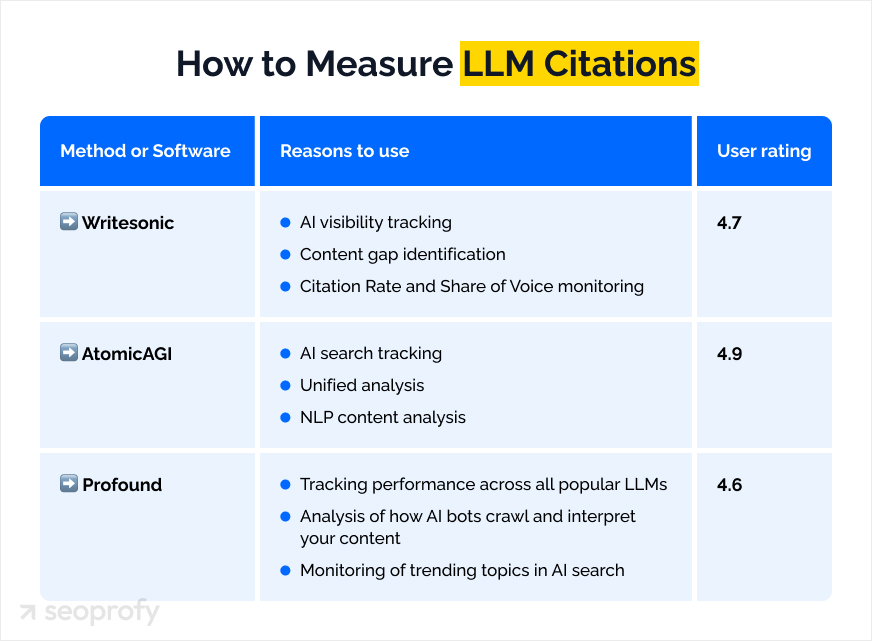
Proper tracking is an efficient way to take control over LLM citations mentioning your brand. Unfortunately, using traditional tools like Google Search Console can’t be applied here. Moreover, the choice of an appropriate tracking method or software directly depends on your research goal:
|
Method or Software |
Reasons to use |
User rating |
| Writesonic |
|
4.7 |
| AtomicAGI |
|
4.9 |
| Profound |
|
4.6 |
Consider that the mentioned software requires extra funds for proper measurements. So, alternatively, you can always opt for manual prompt testing. Simply ask questions related to your niche and content in ChatGPT, Gemini, and other popular chatbots to see whether they refer to your website.
Although it sounds simple, this process is more complicated in practice. We’ve prepared a clear algorithm for you to follow if you want to estimate your performance across LLM citations:
- Prepare up to 20 questions that your content answers.
- Test them monthly across popular AI-powered chatbots.
- Use a Google Sheet or another convenient method to document your results and identify which source the AI algorithms cite.
Using this time-consuming yet efficient method is a great way to discover how users of the platforms like Gemini and ChatGPT see while using these AI assistants. If you notice your site doesn’t appear in the references, you can check your competitors and find out what they do to attract the algorithms’ attention. Carefully analyze their content, identify their strengths and weaknesses, and use the information you gather to enhance your own web pages.
Conclusion
Entering LLM citations is undoubtedly an excellent opportunity to boost your brand’s online visibility and authority. That’s how you can reach people who are indeed interested in the content you post, which means they may be more likely to interact with your business and its products.
Given that not all businesses have yet invested in citation optimization, it’s wise to enter this space before it becomes overcrowded. SeoProfy is ready to help you on this exciting journey, starting with a professional SEO AI audit to identify how we can make your site more attractive to LLMs. Our experts will take care of your content, backlinks, and on-page elements to ensure high positions on both traditional search engines and modern AI systems.

Bohdan has been an SEO analyst at SeoProfy for more than two years. He began his career in digital marketing in 2019 and has since gained experience helping scale some of the world’s leading brands in industries such as gambling and SaaS. Bohdan specializes in developing effective strategies tailored to specific regions.