

Artificial Intelligence (AI) has already become a transformative force across many industries, and it appears it will continue to gain traction in 2026. More and more experts are opting for specialized agents and AI-powered tools. However, have you wondered how many companies are using AI and what results they get?


We’ve prepared key data reports to assess global AI adoption levels across industries and businesses. The insights discovered will help you understand whether your company also needs to dive into the world of artificial intelligence or, maybe, this technology is still nothing more than hype.
- 82% of leading companies use GenAI weekly, but most still experiment without full-scale enterprise adoption.
- The global AI market is projected to grow by $1.3 trillion, reaching $1.7 trillion by 2031.
- The level of trust in AI-powered technologies is the highest among the companies in North America (93%).
- Larger companies are more likely to experiment, implement, and scale AI technologies than smaller ones.
- 43% of modern businesses still lack a budget dedicated to artificial intelligence.
What Percentage of Companies Use AI in 2026?
First of all, let’s find out how many companies use AI in 2026 to better understand the scale of the technology adoption. The data collected below is based on the reports reviewing the condition of artificial intelligence in the global market:
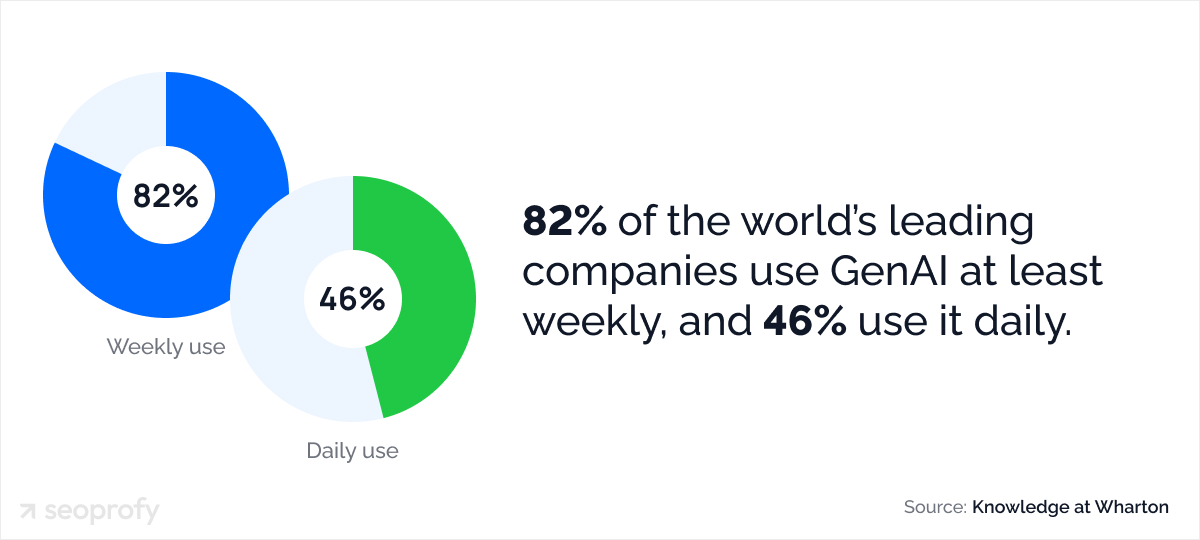
- 82% of the world’s leading companies use GenAI at least weekly, and 46% use it daily. (Knowledge at Wharton)
- 2 out of 3 companies report using AI as an experiment without scaling it across the entire enterprise. (McKinsey)
- The global artificial intelligence market is forecast to grow by 382.65% between 2026 and 2031, reaching a total of 1.3 trillion U.S. dollars. (Statista)
- The AI market size is expected to reach 1.7 trillion U.S. dollars and see a new peak in 2031. (Statista)
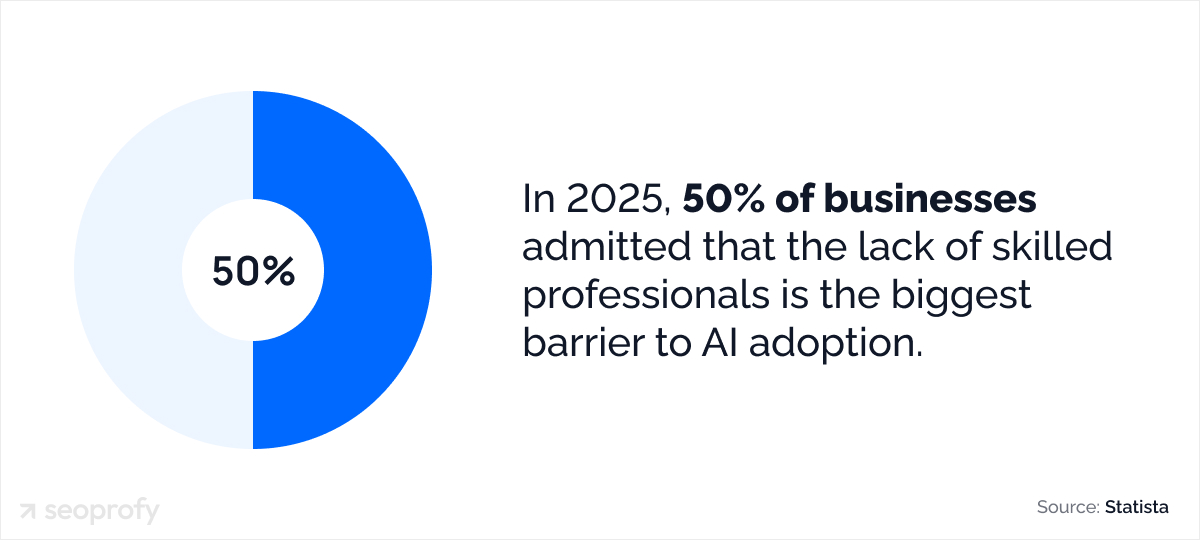
- In 2025, 50% of businesses admitted that the lack of skilled professionals is the biggest barrier to AI adoption. (Statista)
The survey also includes other reasons that were mentioned by the companies, including:
| Lack of vision among the managers and company leaders | 49% |
| High prices on AI tools and services | 29% |
| Lack of AI tools customization options to meet the local needs | 24% |
| Complexity and costs of regulations related to AI usage | 21% |
| Low demand among consumers | 16% |
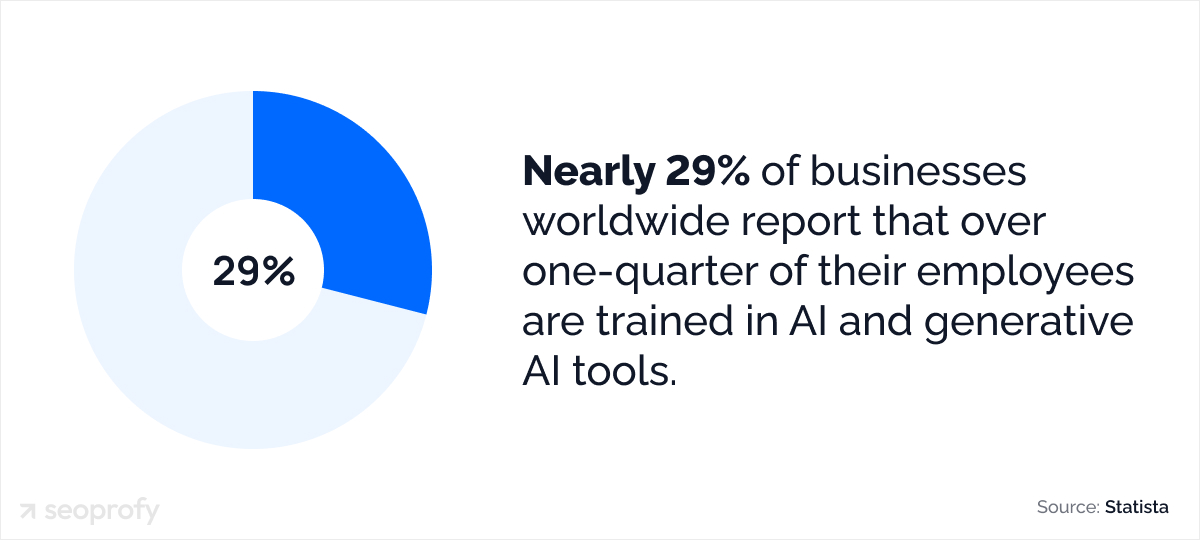
- Nearly 29% of businesses worldwide report that over one-quarter of their employees are trained in AI and generative AI tools. (Statista)
AI Adoption Statistics by Region
Businesses from different regions strive to be cited on AI platforms to attract high-quality traffic from them. At the same time, they often use artificial intelligence to solve issues specific to certain areas or countries. The statistics below show how companies are using AI in different regions, dive into their typical budgets, and highlight the changes in this tendency:
- In 2024, US companies using AI increased their generative artificial intelligence budgets by 102%, resulting in overall spending rising to 10.3 million US dollars. (Statista)
- 96% of North American business employers expect AI to drive transformation in their business. (Statista)
The expansion of artificial intelligence also leads to positive expectations among business owners in other regions. The table below shows how many companies from different corners of the world expect improvements from AI:
| Latin America and the Caribbean | 93% |
| East Asia | 92% |
| Southeast Asia | 90% |
| Europe | 87% |
| Sub-Saharan Africa | 85% |
| Middle East and North Africa | 79% |
| South Asia | 79% |
| Central Asia | 69% |
- The AI market in the US led the North America Market, holding the largest revenue share in 2025. (Grand View Research)
- In 2024, Singapore had the largest share of AI-related job postings worldwide, with nearly 3.3% of all vacancies in the country related to artificial intelligence. (Statista)
- In 2025, India led in AI adoption and trust, with 91% of workers across industries using AI and 81% expressing trust in the technology. (Statista)
- The reports inform that advances in AI tools that make them more accessible are the primary reason why 59% of companies in India opt for this technology. Other factors include the need to reduce costs and automate key processes (48%). (IBM)
- 30% of Indian companies say limited AI skills and expertise are the main barrier to adopting this technology. (IBM)
The table below demonstrates other problems that stand between AI technologies and the percentage of companies that can’t overcome them:
| Lack of tools for AI model development | 28% |
| Integration and scaling difficulties | 27% |
| Ethical concerns | 26% |
| Too much data complexity | 25% |
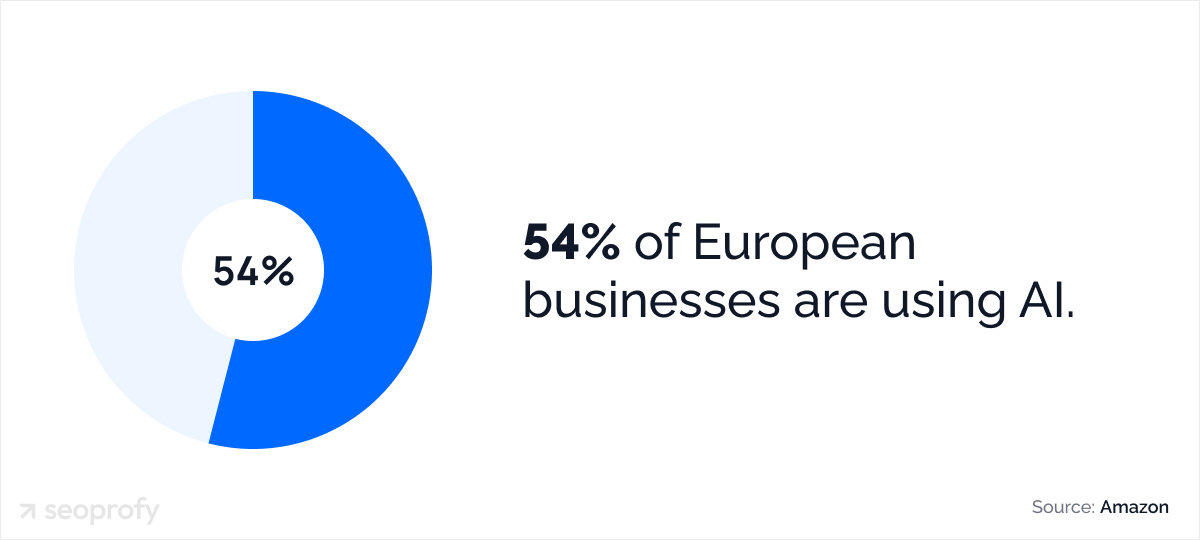
- 54% of European businesses are using AI. (Amazon)
AI Adoption Statistics by Industries
Do you wonder whether companies use AI to improve the processes in your industry? Our experts reviewed the latest studies to prepare key statistics reviewing the implementation of artificial intelligence in different niches:
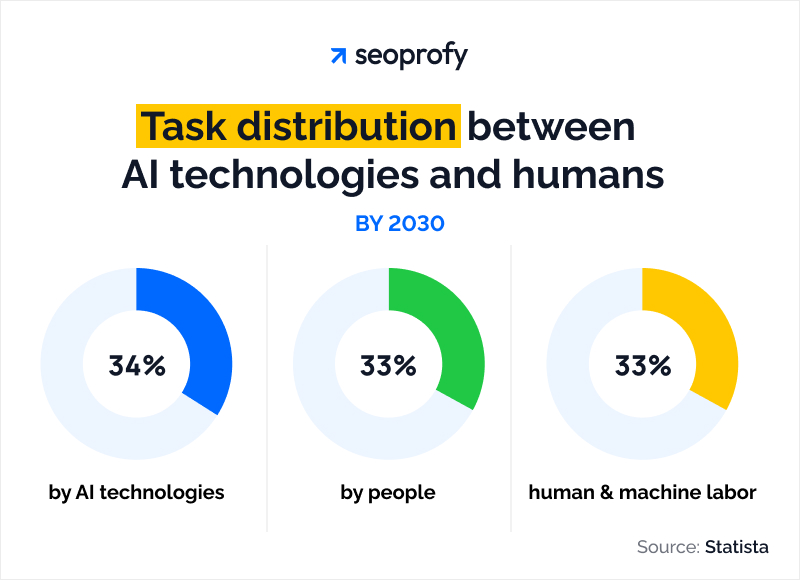
- By 2030, businesses in various industries expect 34% of the tasks to be executed by AI technologies. At the same time, 33% of the tasks will be performed by people and 33% by the combination of human and machine labor. (Statista)
- 100% of industries increase AI usage, including those less exposed to artificial intelligence technologies, such as agriculture and mining. (PwC)
- 22% of the companies are using GenAI in the Technology industry. (McKinsey)
Below, you can see other niches and the percentage of employees using artificial intelligence to handle business tasks:
| Insurance | 15% |
| Healthcare | 13% |
| Media and telecom | 12% |
| Energy and materials | 10% |
| Advanced manufacturing | 9% |
| Pharma and medical products | 8% |
| Consumer goods and retail | 7% |
| Professional services | 6% |
| Travel and logistics | 6% |
| Engineering and construction | 6% |
| Financial institutions | 3% |
AI Adoption Statistics by Company Sizes
Artificial intelligence can significantly improve workflow, especially if you run a big enterprise that involves a variety of routine processes. However, may this technology also be useful for small businesses? The statistics in this part of our article show how companies use AI depending on their size and workflows:
- In 2024, the largest growth in AI budgets in the US was among companies with over 5 billion US dollars in revenue. (Statista)
- 59% of IT employees at large organizations say that they’ve already deployed AI, while 27% are actively exploring the opportunities of using this technology. (IBM)
- Nearly 6 in 10 IT experts at enterprises say that their companies are actively implementing generative AI. (IBM)
- 39% of companies with a revenue of less than $100 million USD only implement AI for an experiment. At the same time, only 5% of such businesses have fully scaled these technologies (McKinsey)
The table below shows how companies are using AI depending on their revenue:
| Revenue | Do Not Use AI | Experiment | Piloting | Scaling | Fully Scaled |
| Less than $100 million | 9% | 39% | 22% | 25% | 5% |
| $100-$499 million | 8% | 33% | 32% | 23% | 4% |
| $500-$999 million | 5% | 31% | 32% | 29% | 3% |
| $1-$4.5 billion | 6% | 22% | 31% | 32% | 9% |
| $5 billion or more | 1% | 17% | 31% | 39% | 10% |
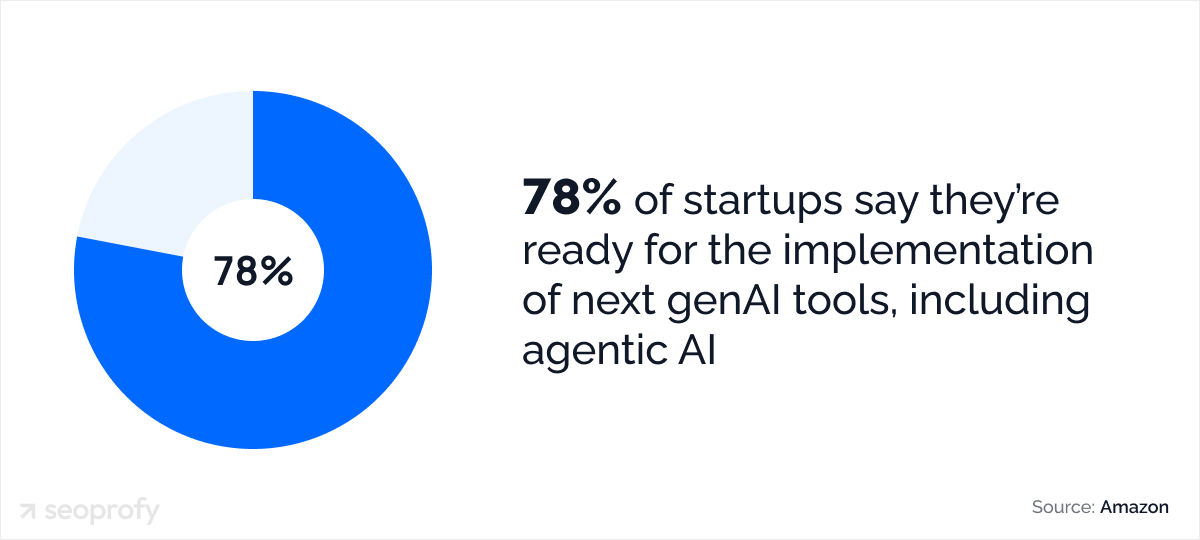
- 78% of startups say they’re ready for the implementation of next genAI tools, including agentic AI. This is a significant difference compared to 19% of the businesses overall. (Amazon)
Level of AI Adoption
Although there are many companies using AI nowadays, many businesses still doubt whether they should use this technology. We’ve decided to collect some useful statistics showing the evolution of AI adoption and review its current condition:
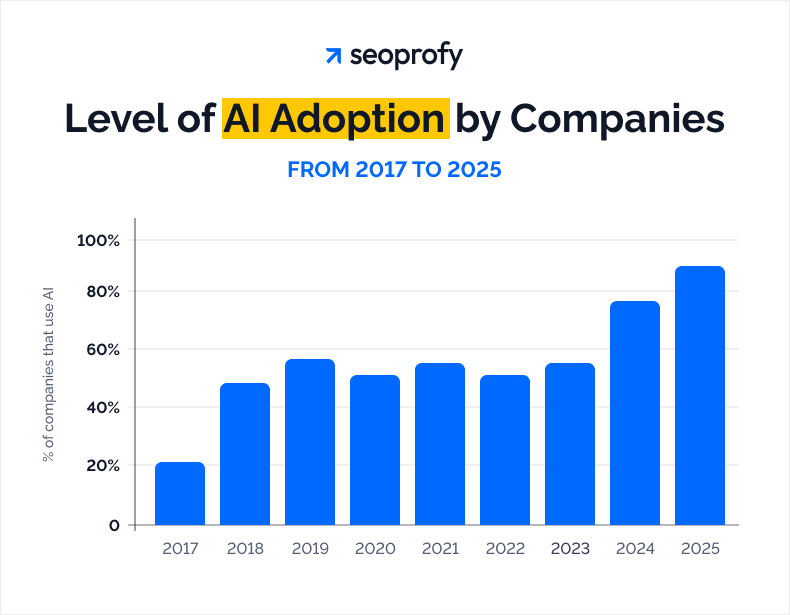
- In 2025, the percentage of companies using AI has reached its peak — 88%. (McKinsey)
Below is a table showing the growth in the adoption of artificial intelligence from 2017 to 2025. You can notice that the turning point happened after 2023, when AI finally got the advanced features necessary for business workflow automation:
What Are Common Ways and Tasks Companies Use AI For?
Our AI SEO stats have already shown how AI adoption can help a business to get the most out of digital marketing campaigns. However, what are the other reasons why companies opt for this technology? The statistics below review the core tasks in which companies use AI:
- 89% of business owners agree that GenAI improves the skills of the company’s employees. (Knowledge at Wharton)
- 3 out of 4 companies see positive returns on their GenAI investments. (Knowledge at Wharton)
- 55% of respondents across 32 markets said they expect AI to increase their efficiency by reducing the time it takes them to get things done. (Statista)
- In 2025, 77% of workers reported using AI to handle work tasks. (Statista)
They also provided information about how often they use artificial intelligence for different business processes:
| Large extent | 21% |
| Moderate extent | 20% |
| Small extent | 30% |
- 42% of employees say they use AI for its 24/7 availability. The other two popular reasons are high machine speed (30%) and quality (30%). (Statista)
- 51% of companies cite improved cybersecurity and data protection capabilities as additional benefits of adopting AI. (PwC)
According to a Gallup poll, company employees most commonly use AI tools for:
| Information/data consolidation | 42% |
| Idea generation | 41% |
| Learning new things | 36% |
| Basic tasks automation | 34% |
| Problem identification | 20% |
| Customer interaction | 13% |
| Collaboration with coworkers | 11% |
| Predictions | 9% |
| Complex equipment/devices set up, operation, and monitoring | 8% |
How Much Businesses Save Using AI
AI adoption helps companies optimize their routines, allowing their employees to focus on the top-priority tasks. Further, we’ve discovered the studies that show other significant benefits, including increased ROI and swift revenue growth:
- Companies operating in industries more exposed to AI experience 3x higher revenue growth per employee. (PwC)
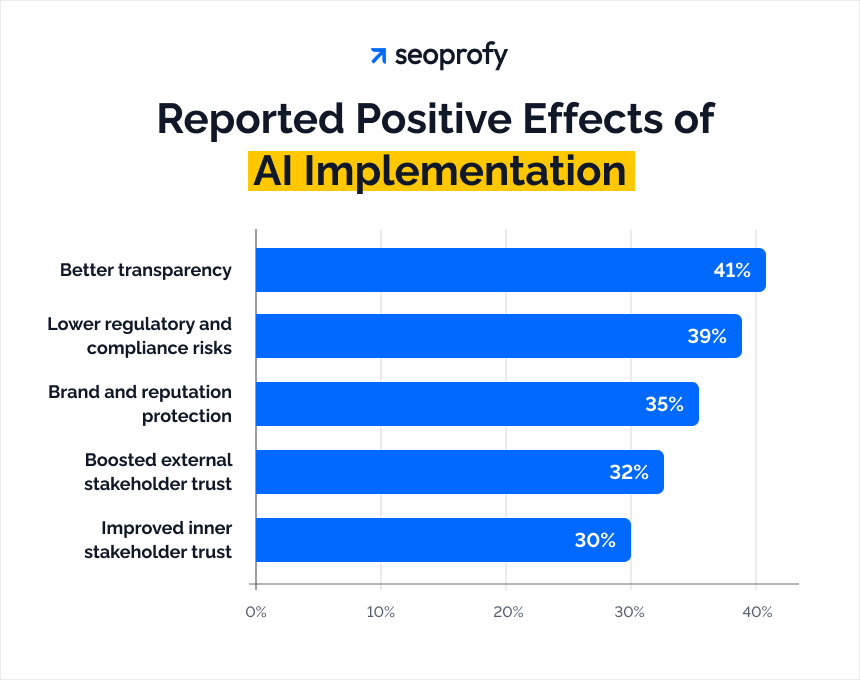
- Nearly 60% of executives say ROI and efficiency increase when companies use AI responsibly. (PwC)
- 55% of companies incorporated AI and reported improvements in customer experience and the development of innovative solutions. (PwC)
The table below includes other positive effects of the proper implementation of AI-powered technologies experienced by a percentage of different companies in various aspects:
- 3 in 5 of the UK tech industry leads whose companies are using AI admit that this technology has a positive impact on overall business function and the company’s growth. (Tech Nation)
- 50% of surveyed companies improved their products and services as a result of AI adoption. (Tech Nation)
- The AI-powered next best experience capability can increase customer retention and satisfaction by 20%, revenue by 8%, and reduce the cost to serve by 30%. (McKinsey)
- The new AI-powered system tested by a global payments processor proved it can reduce merchant attrition by up to 20% per year. (McKinsey)
How Many Companies Invest in AI
Given the significant benefits of artificial intelligence, the number of companies investing in AI continues to grow every day. We’ve prepared the statistics that show the budgets that businesses are ready to spend on the integration of AI-driven tools to solve daily tasks and increase performance:
- In 2024, corporate AI investment reached $252.3 billion, with the private sector reaching 44.5%. (Stanford University)
- The GenAI sector represents more than 20% of all AI-related private investments. (Stanford University)
- In 2024, U.S. private AI investment reached $109.1 billion, which was the highest number across all countries in the world. (Stanford University)
Considering that the level of AI adoption is the highest in the US, it’s natural that there is the biggest number of companies investing in this technology. At the same time, businesses in Europe invested nearly $19.42 billion, and in China, $9.3 billion.
- AI captured nearly 50% of all global funding in 2025. (Crunchbase)
- 43% of companies lack a dedicated AI budget. (Amazon)
What Business AI Usage Trends Show
There are many reasons why companies use AI, ranging from boosting employee efficiency to automating core business operations. At the same time, some experts have concerns about the active AI integration. In this part, we’ll review the key statistics related to the future of AI adoption and possible problems that may occur:
- 43% of experts believe that the growth in AI use may lead to a decline in skill proficiency. (Knowledge at Wharton)
- 88% of enterprise leaders plan to increase GenAI expenses in the next 12 months. (Knowledge at Wharton)
- Over 50% of companies plan to integrate AI technologies into their business processes. (National University)
- 43% of business owners believe that the implementation of AI won’t change the overall workforce size of their organizations, 32% expect decreases, and 13% think it’ll increase. (McKinsey)
- The review of the companies using AI showed that AI adoption creates a significant divide along income lines. High-income employees are far more likely to use anti-trust artificial intelligence compared to their low-income colleagues. (Statista)
- The 2025 survey showed that employees under 35 are more likely to use (72%) and trust (57%) AI. At the same time, the lowest levels of usage (40%) and trust (44%) were among workers over 55. (Statista)
- In the majority of AI-exposed industries, wages are rising 2x faster. (PwC)
- 87% of business owners expect agents to change AI governance principles in 2026. (PwC)
- 81% of companies report that compliance costs have increased over the past three years. (Amazon)
- Google plans to spend $9 billion to expand its data centers and AI tools in Virginia. (JDP)
- Microsoft spent a record $24 billion on the improvement of its AI systems. (JDP)
Start Using AI Opportunities for Your Businesses
Given how many companies use AI, there is no doubt that this technology shapes the future of all industries. Businesses opt for AI-driven agents, tools, and platforms to reduce costs for time-consuming daily processes and optimize employee performance.
At the same time, artificial intelligence opens new ways to promote your products or services. With professional AI SEO services, you can reach the target audience that prefers using platforms like ChatGPT or Grok to search for information online. A combination of these innovative methods with advanced search engine optimization solutions can help you build a strong brand’s online visibility and skyrocket your rankings.

Julia Lubianytska is a Copywriting Team Lead at SeoProfy with over 7 years of experience in copywriting and editing. She works closely with copywriting teams, helping writers craft clear and thoughtful content for SaaS products, IT services, and businesses in the legal and medical fields. Julia enjoys turning complex topics into easy-to-understand, trustworthy content, focusing on structure, clarity, and consistency to ensure the content is genuinely helpful for real people, not just search engines.